CREATING
THE
CONSTITUTION
1. Popular sovereignty – the idea that political authority belongs to the people
2. Legislative branch – the division of the federal government that proposes bills
and passes them into laws
3. Executive branch – the division of the gov’t that includes the president and
administrative departments; it enforces the nation’s laws
4. Judicial branch – the division of the gov’t that is made up of the national
courts; interprets laws, punishes criminals, and settles disputes between
states
5. Checks and balances – a system established by the Constitution that prevents
any branch of government from becoming too powerful
6. Federalism – the system of government in which power is distributed
between a central gov’t and individual states
7. Compromise – an agreement between two or more sides in which each
side gives up some of what it wants
8. Amendment – something added to a document
9. Preside – to be in a position of authority
• The Constitutional Convention was held in May 1789 in Philadelphia
- The convention was called to revise the Articles of Confederation;
however, what came out of the Convention was a new Constitution, and a new
form of government
• Delegates included:
=> Benjamin Franklin – at 81, he was the oldest member of the
Convention
=> James Madison, called the “Father of the Constitution” for his
contributions to the Constitution
=> George Washington, who was elected president of the Convention
by the other delegates
• Delegates at the Convention:
- Were divided over whether to make changes to the Articles of
Confederation, or to rewrite them altogether
- Debated about how strong to make the central national government
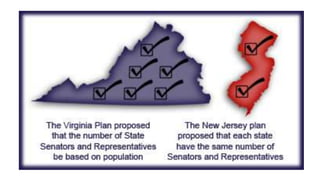
• Two proposed plans were the Virginia
Plan and the New Jersey Plan
• The Virginia Plan would give supreme
power to the central government. Under
this plan, the legislature (law-making
body) would be bicameral, and chosen on
the basis of state population. This meant
that larger states would have more
representatives than the smaller states.
• The New Jersey Plan called for a
unicameral legislature that would give
each state an equal number of
representatives in the national (federal)
government.
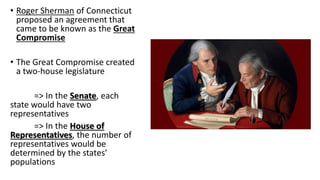
• Roger Sherman of Connecticut
proposed an agreement that
came to be known as the Great
Compromise
• The Great Compromise created
a two-house legislature
=> In the Senate, each
state would have two
representatives
=> In the House of
Representatives, the number of
representatives would be
determined by the states’
populations
FYI:
Pennsylvania has 2 senators and 18
representatives in the House of
Representatives
New Jersey has 2 senators and 12
representatives
Delaware has 2 senators and 1
representative
• The Constitution is called a “bundle of compromises”
=> Southern delegates wanted slaves to be counted as part of their states’
populations, so they could have more representation in Congress; the northern
states disagreed with this.
=> The Three-Fifths Compromise proposed that only three-fifths of a
state’s slave population would be counted in determining representation
=> Another issue was the foreign slave trade. Some delegates wanted
the federal government to ban the slave trade, but many southern states
argued that their economies depended on it. They threatened to leave the
Union if the new gov’t ended the trade right away.
=> The result was the Commerce Compromise, which said that
Congress could regulate trade, and which allowed the importation of slaves
until the end of 1807.
(FYI: The abolition of the African slave trade became effective January 1, 1808.
The widespread trade of slaves within the South was not prohibited, however,
and children of slaves automatically became slave themselves, thus ensuring a
slave population in the South.)
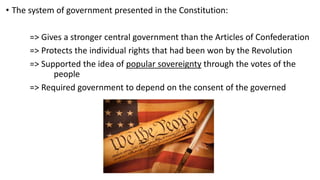
• The system of government presented in the Constitution:
=> Gives a stronger central government than the Articles of Confederation
=> Protects the individual rights that had been won by the Revolution
=> Supported the idea of popular sovereignty through the votes of the
people
=> Required government to depend on the consent of the governed
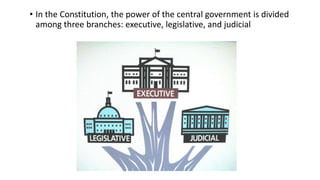
• In the Constitution, the power of the central government is divided
among three branches: executive, legislative, and judicial
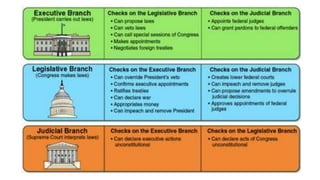
• The Legislative Branch (Congress) proposes and passes laws; made
up of the Senate and the House of Representatives
• The Executive Branch includes the President, who signs and vetoes
laws, and departments that run the government
• The Judicial Branch is made up of national courts; it interprets laws
and punishes criminals
• The framers of the
Constitution created a
system of checks and
balances to keep any one
branch from becoming too
powerful.
• To balance power between
the central government and
the state governments, the
delegates created the
system of federalism.
• The framers wanted the gov’t to be able to adapt as changes were needed, so
they included a way for changing or adding to the Constitution
=> The process for amending the Constitution is difficult and requires the
support of a large majority of voters
=> Over the years, many amendments have been proposed, but only 27
have been approved
RATIFYING THE CONSTITUTION
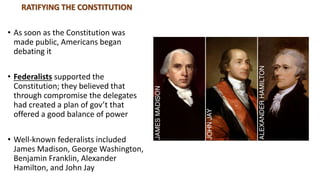
• As soon as the Constitution was
made public, Americans began
debating it
• Federalists supported the
Constitution; they believed that
through compromise the delegates
had created a plan of gov’t that
offered a good balance of power
• Well-known federalists included
James Madison, George Washington,
Benjamin Franklin, Alexander
Hamilton, and John Jay
• Antifederalists opposed the
Constitution, and thought the
delegates should not have
created a new government.
• Notable antifederalists included
James Monroe, George Mason,
Samuel Adams, and Patrick
Henry
• Thomas Jefferson, mostly in
favor of the Constitution, said
that a Bill of Rights was needed.
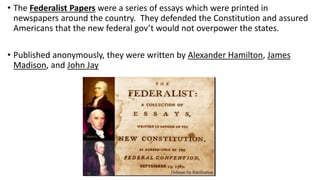
• The Federalist Papers were a series of essays which were printed in
newspapers around the country. They defended the Constitution and assured
Americans that the new federal gov’t would not overpower the states.
• Published anonymously, they were written by Alexander Hamilton, James
Madison, and John Jay
• Delaware was the first state to ratify the Constitution, in December 1787
• Rhode Island was the last state to ratify, in May 1790
==================================================================
*Proposed in 1789, in 1791 the Bill of Rights was added to the Constitution as
amendments
* The Bill of Rights guaranteed basic individual freedoms and set an example of
how changes to the Constitution could be made

Soc studies #16 the constitution

  • 1.
  • 3.
    1. Popular sovereignty– the idea that political authority belongs to the people 2. Legislative branch – the division of the federal government that proposes bills and passes them into laws 3. Executive branch – the division of the gov’t that includes the president and administrative departments; it enforces the nation’s laws 4. Judicial branch – the division of the gov’t that is made up of the national courts; interprets laws, punishes criminals, and settles disputes between states 5. Checks and balances – a system established by the Constitution that prevents any branch of government from becoming too powerful
  • 4.
    6. Federalism –the system of government in which power is distributed between a central gov’t and individual states 7. Compromise – an agreement between two or more sides in which each side gives up some of what it wants 8. Amendment – something added to a document 9. Preside – to be in a position of authority
  • 6.
    • The ConstitutionalConvention was held in May 1789 in Philadelphia - The convention was called to revise the Articles of Confederation; however, what came out of the Convention was a new Constitution, and a new form of government • Delegates included: => Benjamin Franklin – at 81, he was the oldest member of the Convention => James Madison, called the “Father of the Constitution” for his contributions to the Constitution => George Washington, who was elected president of the Convention by the other delegates
  • 7.
    • Delegates atthe Convention: - Were divided over whether to make changes to the Articles of Confederation, or to rewrite them altogether - Debated about how strong to make the central national government
  • 8.
    • Two proposedplans were the Virginia Plan and the New Jersey Plan • The Virginia Plan would give supreme power to the central government. Under this plan, the legislature (law-making body) would be bicameral, and chosen on the basis of state population. This meant that larger states would have more representatives than the smaller states. • The New Jersey Plan called for a unicameral legislature that would give each state an equal number of representatives in the national (federal) government.
  • 10.
    • Roger Shermanof Connecticut proposed an agreement that came to be known as the Great Compromise • The Great Compromise created a two-house legislature => In the Senate, each state would have two representatives => In the House of Representatives, the number of representatives would be determined by the states’ populations
  • 11.
    FYI: Pennsylvania has 2senators and 18 representatives in the House of Representatives New Jersey has 2 senators and 12 representatives Delaware has 2 senators and 1 representative
  • 12.
    • The Constitutionis called a “bundle of compromises” => Southern delegates wanted slaves to be counted as part of their states’ populations, so they could have more representation in Congress; the northern states disagreed with this. => The Three-Fifths Compromise proposed that only three-fifths of a state’s slave population would be counted in determining representation
  • 13.
    => Another issuewas the foreign slave trade. Some delegates wanted the federal government to ban the slave trade, but many southern states argued that their economies depended on it. They threatened to leave the Union if the new gov’t ended the trade right away. => The result was the Commerce Compromise, which said that Congress could regulate trade, and which allowed the importation of slaves until the end of 1807. (FYI: The abolition of the African slave trade became effective January 1, 1808. The widespread trade of slaves within the South was not prohibited, however, and children of slaves automatically became slave themselves, thus ensuring a slave population in the South.)
  • 14.
    • The systemof government presented in the Constitution: => Gives a stronger central government than the Articles of Confederation => Protects the individual rights that had been won by the Revolution => Supported the idea of popular sovereignty through the votes of the people => Required government to depend on the consent of the governed
  • 16.
    • In theConstitution, the power of the central government is divided among three branches: executive, legislative, and judicial
  • 17.
    • The LegislativeBranch (Congress) proposes and passes laws; made up of the Senate and the House of Representatives • The Executive Branch includes the President, who signs and vetoes laws, and departments that run the government • The Judicial Branch is made up of national courts; it interprets laws and punishes criminals
  • 19.
    • The framersof the Constitution created a system of checks and balances to keep any one branch from becoming too powerful. • To balance power between the central government and the state governments, the delegates created the system of federalism.
  • 21.
    • The framerswanted the gov’t to be able to adapt as changes were needed, so they included a way for changing or adding to the Constitution => The process for amending the Constitution is difficult and requires the support of a large majority of voters => Over the years, many amendments have been proposed, but only 27 have been approved
  • 22.
    RATIFYING THE CONSTITUTION •As soon as the Constitution was made public, Americans began debating it • Federalists supported the Constitution; they believed that through compromise the delegates had created a plan of gov’t that offered a good balance of power • Well-known federalists included James Madison, George Washington, Benjamin Franklin, Alexander Hamilton, and John Jay
  • 23.
    • Antifederalists opposedthe Constitution, and thought the delegates should not have created a new government. • Notable antifederalists included James Monroe, George Mason, Samuel Adams, and Patrick Henry • Thomas Jefferson, mostly in favor of the Constitution, said that a Bill of Rights was needed.
  • 25.
    • The FederalistPapers were a series of essays which were printed in newspapers around the country. They defended the Constitution and assured Americans that the new federal gov’t would not overpower the states. • Published anonymously, they were written by Alexander Hamilton, James Madison, and John Jay
  • 26.
    • Delaware wasthe first state to ratify the Constitution, in December 1787 • Rhode Island was the last state to ratify, in May 1790 ================================================================== *Proposed in 1789, in 1791 the Bill of Rights was added to the Constitution as amendments * The Bill of Rights guaranteed basic individual freedoms and set an example of how changes to the Constitution could be made