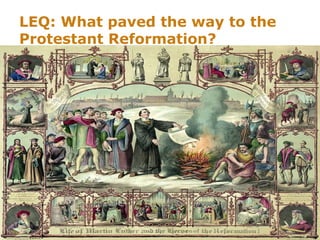
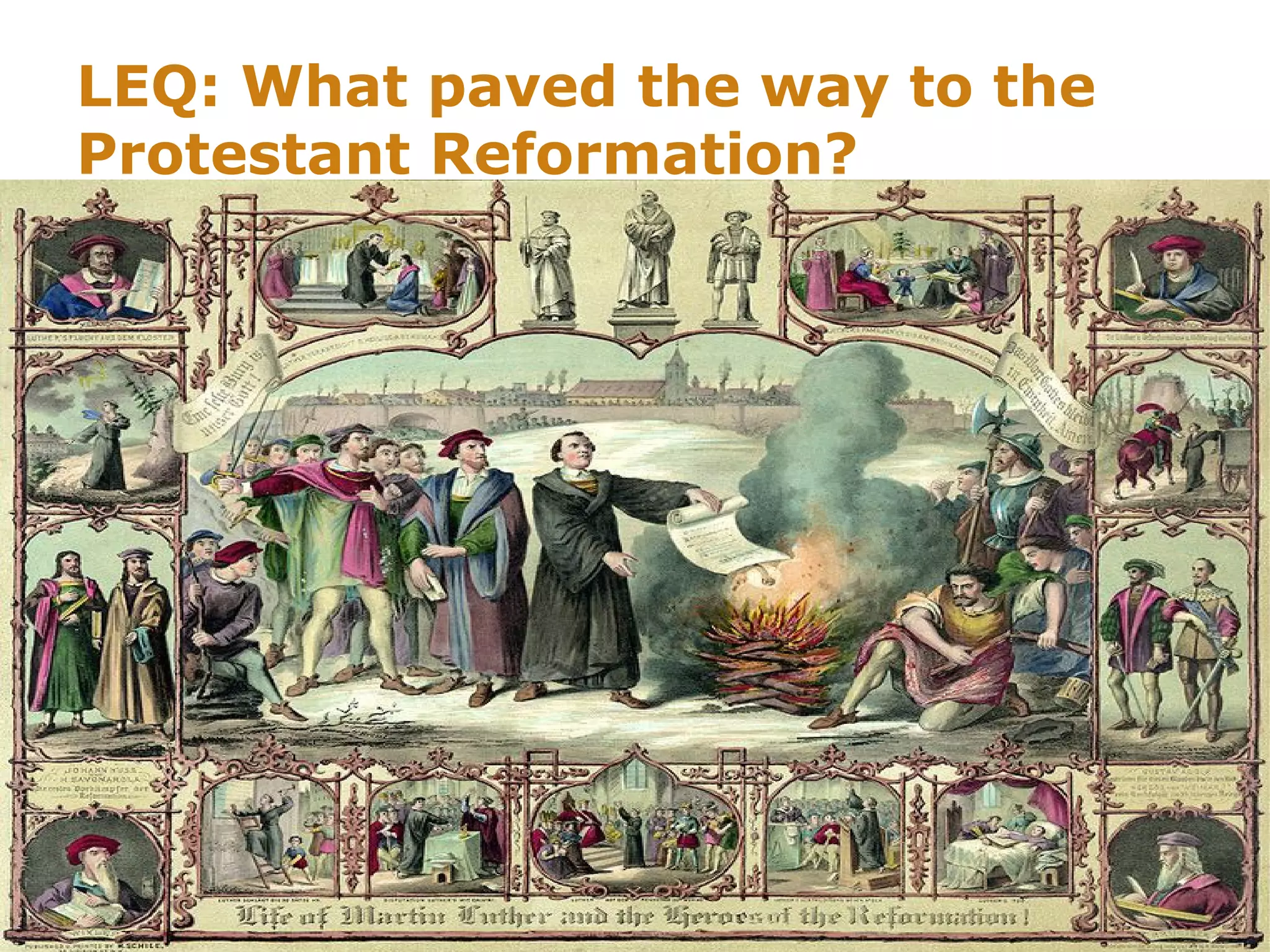
LEQ: What paved the way to the
Protestant Reformation?
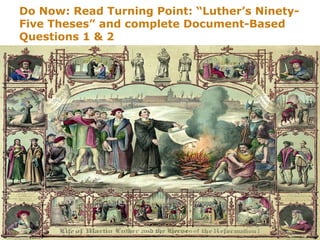
Do Now: Read Turning Point: “Luther’s Ninety-
Five Theses” and complete Document-Based
Questions 1 & 2
Martin Luther
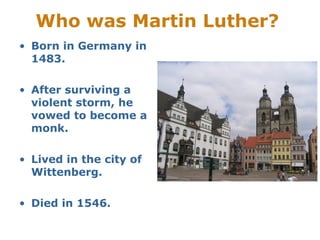
Who was Martin Luther?
• Born in Germany in
  1483.

• After surviving a
  violent storm, he
  vowed to become a
  monk.

• Lived in the city of
  Wittenberg.

• Died in 1546.
Definitions


    Protest           Reform
To express strong   To improve by
     objection      correcting errors
Problems in the Church


  • Corruption


  • Political Conflicts
Corruption

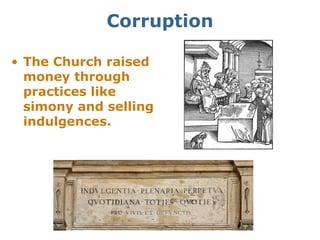
• The Church raised
  money through
  practices like
  simony and selling
  indulgences.
Advantages of Buying
        Indulgences

    Go Directly to Heaven!
• Do not go to Hell!
• Do not go to Purgatory!
• Get through Purgatory faster!
• Do not pass Go!
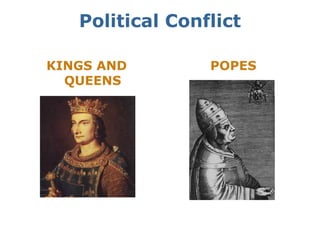
Political Conflict

KINGS AND        POPES
  QUEENS
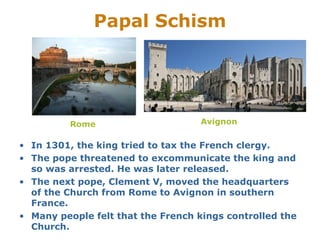
Papal Schism


          Rome                     Avignon


• In 1301, the king tried to tax the French clergy.
• The pope threatened to excommunicate the king and
  so was arrested. He was later released.
• The next pope, Clement V, moved the headquarters
  of the Church from Rome to Avignon in southern
  France.
• Many people felt that the French kings controlled the
  Church.
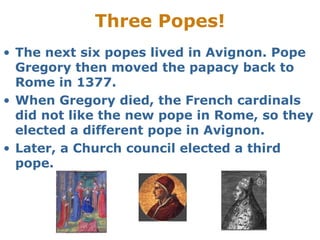
Three Popes!
• The next six popes lived in Avignon. Pope
  Gregory then moved the papacy back to
  Rome in 1377.
• When Gregory died, the French cardinals
  did not like the new pope in Rome, so they
  elected a different pope in Avignon.
• Later, a Church council elected a third
  pope.
Calls for Reform
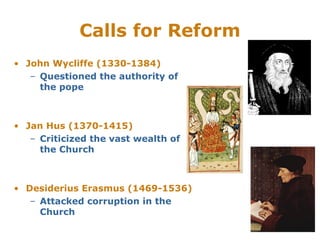
• John Wycliffe (1330-1384)
   – Questioned the authority of
     the pope


• Jan Hus (1370-1415)
   – Criticized the vast wealth of
     the Church


• Desiderius Erasmus (1469-1536)
   – Attacked corruption in the
     Church
Luther Looks for Reforms
• Luther criticized Church
  practices, like selling
  indulgences.

• He wanted to begin a
  discussion within the
  Church about the true
  path to salvation.

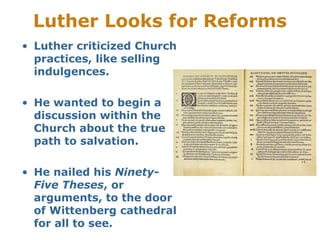
• He nailed his Ninety-
  Five Theses, or
  arguments, to the door
  of Wittenberg cathedral
  for all to see.
Protestant Teaching:
Justification by Faith Alone
                  • The Bible is the
                    only source of
                    truth.

                  • People can read
                    and understand
                    the Bible
                    themselves.

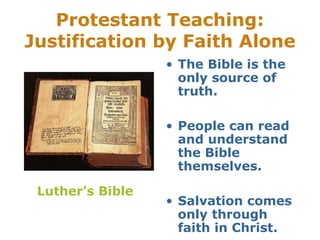
 Luther’s Bible
                  • Salvation comes
                    only through
                    faith in Christ.
Excommunication


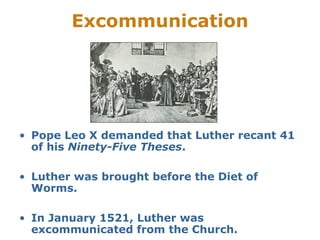
• Pope Leo X demanded that Luther recant 41
  of his Ninety-Five Theses.

• Luther was brought before the Diet of
  Worms.

• In January 1521, Luther was
  excommunicated from the Church.
The Printing Press
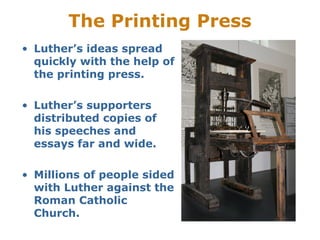
• Luther’s ideas spread
  quickly with the help of
  the printing press.

• Luther’s supporters
  distributed copies of
  his speeches and
  essays far and wide.

• Millions of people sided
  with Luther against the
  Roman Catholic
  Church.
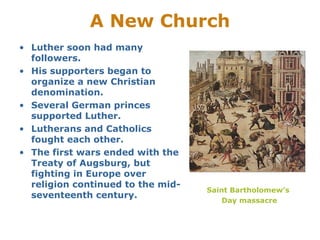
A New Church
• Luther soon had many
  followers.
• His supporters began to
  organize a new Christian
  denomination.
• Several German princes
  supported Luther.
• Lutherans and Catholics
  fought each other.
• The first wars ended with the
  Treaty of Augsburg, but
  fighting in Europe over
  religion continued to the mid-
                                   Saint Bartholomew’s
  seventeenth century.
                                       Day massacre
Lutheranism
• Luther’s followers
  disagreed with many
  of the teachings of
  the Catholic Church.

• They rejected the
  authority of Church
  councils and the
  pope.

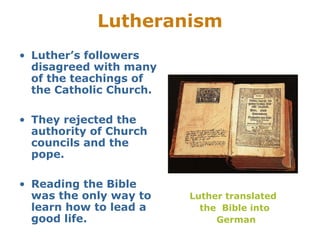
• Reading the Bible
  was the only way to    Luther translated
  learn how to lead a      the Bible into
  good life.                  German
The Reformation spread to
       other countries.
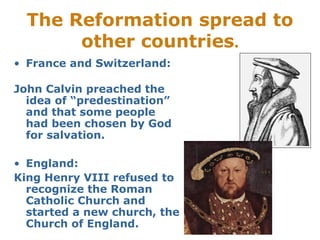
• France and Switzerland:

John Calvin preached the
  idea of “predestination”
  and that some people
  had been chosen by God
  for salvation.

• England:
King Henry VIII refused to
  recognize the Roman
  Catholic Church and
  started a new church, the
  Church of England.
The End


          20

Reformation

  • 1.
    LEQ: What pavedthe way to the Protestant Reformation?
  • 2.
    Do Now: ReadTurning Point: “Luther’s Ninety- Five Theses” and complete Document-Based Questions 1 & 2
  • 3.
  • 4.
    Who was MartinLuther? • Born in Germany in 1483. • After surviving a violent storm, he vowed to become a monk. • Lived in the city of Wittenberg. • Died in 1546.
  • 5.
    Definitions Protest Reform To express strong To improve by objection correcting errors
  • 6.
    Problems in theChurch • Corruption • Political Conflicts
  • 7.
    Corruption • The Churchraised money through practices like simony and selling indulgences.
  • 8.
    Advantages of Buying Indulgences Go Directly to Heaven! • Do not go to Hell! • Do not go to Purgatory! • Get through Purgatory faster! • Do not pass Go!
  • 9.
  • 10.
    Papal Schism Rome Avignon • In 1301, the king tried to tax the French clergy. • The pope threatened to excommunicate the king and so was arrested. He was later released. • The next pope, Clement V, moved the headquarters of the Church from Rome to Avignon in southern France. • Many people felt that the French kings controlled the Church.
  • 11.
    Three Popes! • Thenext six popes lived in Avignon. Pope Gregory then moved the papacy back to Rome in 1377. • When Gregory died, the French cardinals did not like the new pope in Rome, so they elected a different pope in Avignon. • Later, a Church council elected a third pope.
  • 12.
    Calls for Reform •John Wycliffe (1330-1384) – Questioned the authority of the pope • Jan Hus (1370-1415) – Criticized the vast wealth of the Church • Desiderius Erasmus (1469-1536) – Attacked corruption in the Church
  • 13.
    Luther Looks forReforms • Luther criticized Church practices, like selling indulgences. • He wanted to begin a discussion within the Church about the true path to salvation. • He nailed his Ninety- Five Theses, or arguments, to the door of Wittenberg cathedral for all to see.
  • 14.
    Protestant Teaching: Justification byFaith Alone • The Bible is the only source of truth. • People can read and understand the Bible themselves. Luther’s Bible • Salvation comes only through faith in Christ.
  • 15.
    Excommunication • Pope LeoX demanded that Luther recant 41 of his Ninety-Five Theses. • Luther was brought before the Diet of Worms. • In January 1521, Luther was excommunicated from the Church.
  • 16.
    The Printing Press •Luther’s ideas spread quickly with the help of the printing press. • Luther’s supporters distributed copies of his speeches and essays far and wide. • Millions of people sided with Luther against the Roman Catholic Church.
  • 17.
    A New Church •Luther soon had many followers. • His supporters began to organize a new Christian denomination. • Several German princes supported Luther. • Lutherans and Catholics fought each other. • The first wars ended with the Treaty of Augsburg, but fighting in Europe over religion continued to the mid- Saint Bartholomew’s seventeenth century. Day massacre
  • 18.
    Lutheranism • Luther’s followers disagreed with many of the teachings of the Catholic Church. • They rejected the authority of Church councils and the pope. • Reading the Bible was the only way to Luther translated learn how to lead a the Bible into good life. German
  • 19.
    The Reformation spreadto other countries. • France and Switzerland: John Calvin preached the idea of “predestination” and that some people had been chosen by God for salvation. • England: King Henry VIII refused to recognize the Roman Catholic Church and started a new church, the Church of England.
  • 20.

Editor's Notes

  • #4 Martin Luthe,r by Lucas Cranach the Elder; source: http://upload.wikimedia.org/wikipedia/commons/6/61/Luther46c.jpg
  • #5 Market square in modern Wittenberg; source: http://upload.wikimedia.org/wikipedia/commons/b/b0/Wittenberg_Market_square.JPG
  • #8 Woodcut of the pope selling indulgences, from Passionary of the Christ and Antichrist. Source: http://upload.wikimedia.org/wikipedia/commons/6/6a/Antichrist1.jpg. Plenary indulgence; inscription on the left transept of the Basilica of St. John Lateran, Rome. © Marie-Lan Nguyen / Wikimedia Commons. Source: http://en.wikipedia.org/wiki/File:Indulgence_San_Giovanni_in_Laterano_2006-09-07.jpg
  • #10 King Philip IV of France (ruled 1285 – 1314); source: http://en.wikipedia.org/wiki/File:Philippe_IV_Le_Bel.jpg Pope Urban VI (reigned 1378 – 1389); source: http://en.wikipedia.org/wiki/File:Urbanus_VI.jpg
  • #11 Rome and the Tiber river, photo by Dana M. Johnson; source: http://upload.wikimedia.org/wikipedia/commons/c/ca/Castel_D%27Angelo_from_across_the_Tiber.jpg. Avignon; photo by Jean-Marc Rosier; source: http://upload.wikimedia.org/wikipedia/commons/d/db/Avignon%2C_Palais_des_Papes_by_JM_Rosier.jpg
  • #12 Coronation of Benedict XIII (reigned 1394 – 1423); source: http://en.wikipedia.org/wiki/File:Antipope_Benedict_XIII.jpg; Pope Gregory XII (reigned 1406- 1415); source: http://en.wikipedia.org/wiki/File:Gregory_XII.jpg; Pope Alexander V (reigned 1409- 1410); source: http://en.wikipedia.org/wiki/File:Antipope_Alexander_V_%281409-1410%29.JPG
  • #13 John Wycliffe, © John M. Kennedy; source: http://upload.wikimedia.org/wikipedia/commons/3/3e/Jwycliffejmk.jpg. Jan Hus at the stake; source: http://upload.wikimedia.org/wikipedia/commons/b/b0/Jan_Hus_at_the_Stake.jpg. Erasmus by Hans Holbein the Younger; source: http://upload.wikimedia.org/wikipedia/commons/8/89/Hans_Holbein_d._J._047.jpg
  • #14 Luther’s Ninety-Five Theses; source: http://upload.wikimedia.org/wikipedia/commons/8/81/95Thesen.jpg
  • #15 Luther’s Bible; source: http://upload.wikimedia.org/wikipedia/commons/0/03/Lutherbibel.jpg
  • #16 Luther before the Diet of Worms; source: http://upload.wikimedia.org/wikipedia/commons/1/1d/Diet_of_Worms.jpg
  • #17 Printing press; source: http://upload.wikimedia.org/wikipedia/commons/1/17/Handtiegelpresse_von_1811.jpg
  • #18 Saint Bartholomew’s Day massacre, by François Dubois; source: http://upload.wikimedia.org/wikipedia/commons/8/8d/Massacre_saint_barthelemy.jpg
  • #19 Luther’s Bible; source: http://upload.wikimedia.org/wikipedia/commons/0/03/Lutherbibel.jpg
  • #20 John Calvin; engraving by René Boyvin; source: http://upload.wikimedia.org/wikipedia/commons/7/7b/Calvin_1562.jpg. Henry VIII (ruled 1509 – 1547) by Hans Holbein the Younger; source: http://upload.wikimedia.org/wikipedia/commons/8/8a/Hans_Holbein_d._J._074.jpg