
REFLECTION
REFLECTION
It is the bouncing off of light
rays when it hits a surface
like a plane mirror.
MIRROR
It is an object or device that
reflects light. Mirrors are typically
made of glass coated with metal
amalgam (alloy) that reflects a clear
image.
TYPES OF MIRRORS:
PLANE – has flat surface
CURVED/ SPHERICAL- has a
surface that is a section of a
shape of a sphere
ACT. 1: MIRROR, MIRROR ON THE WALL…
OBJECTIVES:
 Determine the height, width, and the distance from
the mirror of the image formed by plane mirrors.
Compare the actual height, width and the distance
from the mirror of the object with that of the image
formed by plane mirror.
Image in a plane mirror
The height of the object is ______________ to the height
of the image.
The distance of the object to the mirror _____________
to the image distance.
The image appears as if it is located behind the mirror
but it is not.
The image is virtual.
is equal
is equal
TYPES OF IMAGES:
REAL
- formed by actual rays of light (when rays actually
converge), it can be projected on a screen. It forms in from of
the mirror
VIRTUAL
- formed by the extension of reflected rays (due to the
rays that only appear to converge, it cannot be projected on a
screen
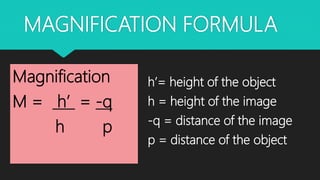
MAGNIFICATION FORMULA
Magnification
M = h’ = -q
h p
h’= height of the object
h = height of the image
-q = distance of the image
p = distance of the object
LAW OF REFLECTION
Incident ray = the ray of light that hits the mirror
Reflected ray = the ray of light that bounces off of the
mirror
Normal line = An imaginary line that can be drawn
perpendicular to the surface of the mirror at point of
incidence where the ray strikes the mirror.
The angle of
incidence if equal to
the angle of
reflection.
The incident ray, the
reflected ray and
normal line lie on the
same plane.
LAW OF REFLECTION
Reflection
Reflection

Reflection

  • 1.
  • 2.
    REFLECTION It is thebouncing off of light rays when it hits a surface like a plane mirror.
  • 3.
    MIRROR It is anobject or device that reflects light. Mirrors are typically made of glass coated with metal amalgam (alloy) that reflects a clear image.
  • 4.
    TYPES OF MIRRORS: PLANE– has flat surface CURVED/ SPHERICAL- has a surface that is a section of a shape of a sphere
  • 5.
    ACT. 1: MIRROR,MIRROR ON THE WALL… OBJECTIVES:  Determine the height, width, and the distance from the mirror of the image formed by plane mirrors. Compare the actual height, width and the distance from the mirror of the object with that of the image formed by plane mirror.
  • 6.
    Image in aplane mirror The height of the object is ______________ to the height of the image. The distance of the object to the mirror _____________ to the image distance. The image appears as if it is located behind the mirror but it is not. The image is virtual. is equal is equal
  • 7.
    TYPES OF IMAGES: REAL -formed by actual rays of light (when rays actually converge), it can be projected on a screen. It forms in from of the mirror VIRTUAL - formed by the extension of reflected rays (due to the rays that only appear to converge, it cannot be projected on a screen
  • 8.
    MAGNIFICATION FORMULA Magnification M =h’ = -q h p h’= height of the object h = height of the image -q = distance of the image p = distance of the object
  • 9.
    LAW OF REFLECTION Incidentray = the ray of light that hits the mirror Reflected ray = the ray of light that bounces off of the mirror Normal line = An imaginary line that can be drawn perpendicular to the surface of the mirror at point of incidence where the ray strikes the mirror.
  • 11.
    The angle of incidenceif equal to the angle of reflection. The incident ray, the reflected ray and normal line lie on the same plane. LAW OF REFLECTION