GOOD MORNING
EVERYONE 
GOOD AFTERNOON EVERYONE 
What can you see when you look at a mirror, or
a polished metal or a still pool of water? You can
see your image. Why? These objects are image
reflecting objects. A mirror is a smooth reflecting
surface, usually made of polished metal or glass
that has been coated with metallic substances.
There are two types of mirrors: a plane mirror
and a curved mirror.
Activity 2: Image in a Plane Mirror
1. Stand in front of a plane mirror. Is your image exactly
the same in size as you are? Where it is apparently
found?
2. Raise your left hand. What hand does your image
raise?
3. Is your image upright or inverted? Is it real or virtual?
(A real image is an inverted image; a virtual image is an
upright image.)
Reflection is the bouncing off of light rays when it
hits a surface like a plane mirror. In the activity, you
used plane mirrors and located the object distance,
p and the image distance, q and found out that p is
equal to q. In plane mirrors, the image appears as if
it is behind the mirror but actually not, so the image
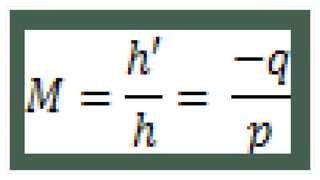
is virtual. The value therefore of image distance, q
is negative. The height of the image, h’ in plane
mirrors is always the same as the height of the
object, thus its magnification, M is 1.
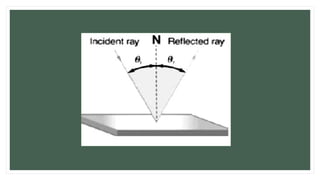
Incident Ray. The ray of light approaching the mirror
represented by an arrow approaching an optical element
like mirrors.
Reflected Ray. The ray of light which leaves the mirror and
is represented by an arrow pointing away from the mirror.
Normal Line. An imaginary line that can be drawn
perpendicular to the surface of the mirror at the point of
incidence where the ray strikes the mirror
Mirror and its characteristics/properties

Mirror and its characteristics/properties

  • 1.
    GOOD MORNING EVERYONE  GOODAFTERNOON EVERYONE 
  • 4.
    What can yousee when you look at a mirror, or a polished metal or a still pool of water? You can see your image. Why? These objects are image reflecting objects. A mirror is a smooth reflecting surface, usually made of polished metal or glass that has been coated with metallic substances. There are two types of mirrors: a plane mirror and a curved mirror.
  • 5.
    Activity 2: Imagein a Plane Mirror 1. Stand in front of a plane mirror. Is your image exactly the same in size as you are? Where it is apparently found? 2. Raise your left hand. What hand does your image raise? 3. Is your image upright or inverted? Is it real or virtual? (A real image is an inverted image; a virtual image is an upright image.)
  • 6.
    Reflection is thebouncing off of light rays when it hits a surface like a plane mirror. In the activity, you used plane mirrors and located the object distance, p and the image distance, q and found out that p is equal to q. In plane mirrors, the image appears as if it is behind the mirror but actually not, so the image is virtual. The value therefore of image distance, q is negative. The height of the image, h’ in plane mirrors is always the same as the height of the object, thus its magnification, M is 1.
  • 8.
    Incident Ray. Theray of light approaching the mirror represented by an arrow approaching an optical element like mirrors. Reflected Ray. The ray of light which leaves the mirror and is represented by an arrow pointing away from the mirror. Normal Line. An imaginary line that can be drawn perpendicular to the surface of the mirror at the point of incidence where the ray strikes the mirror