Unit 2: Processing of Crude Oil
Prepared by:
Ankur Sachdeva
Assistant Professor, ME
Animation of Crude Oil Processing
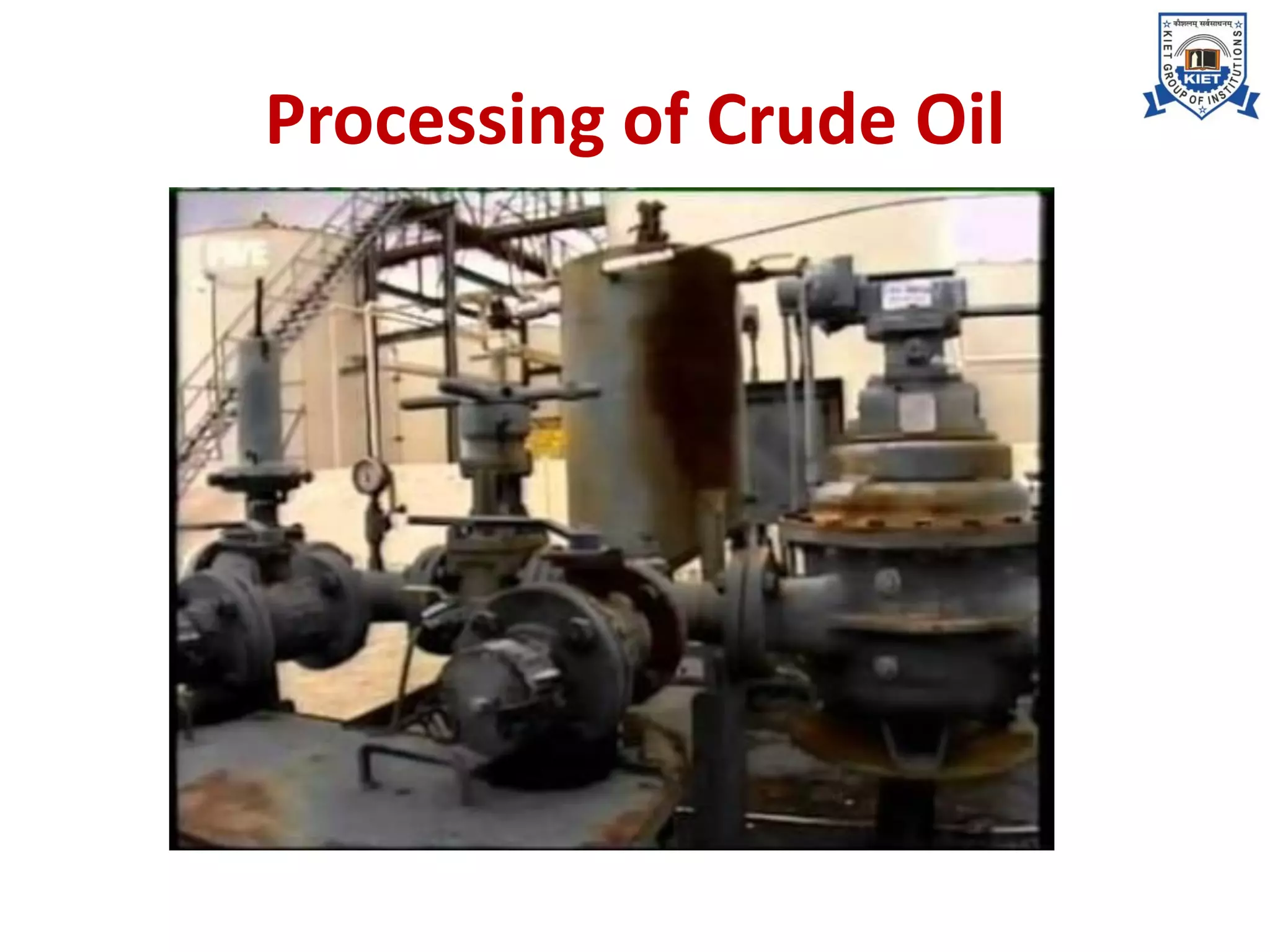
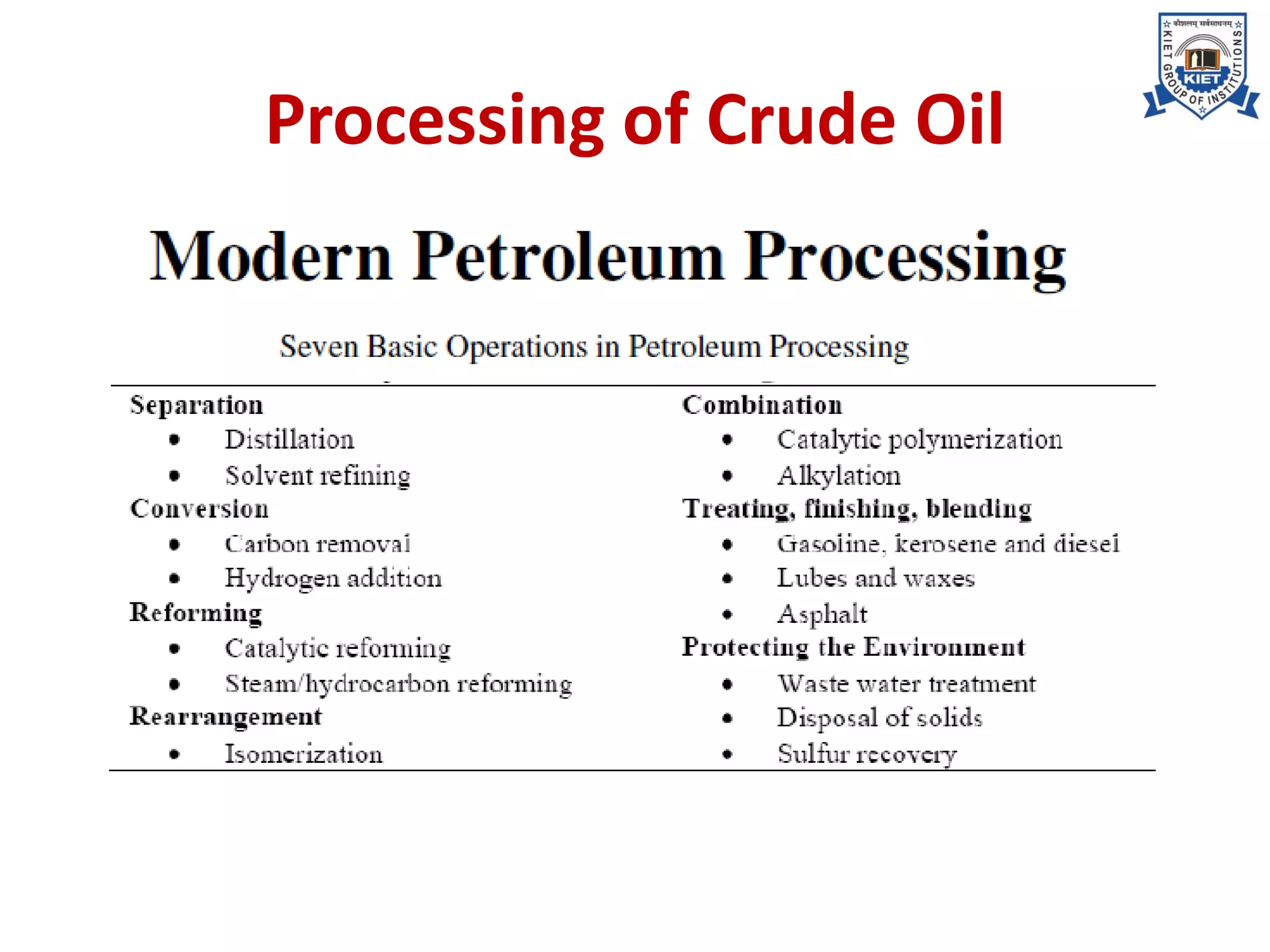
Processing of Crude Oil
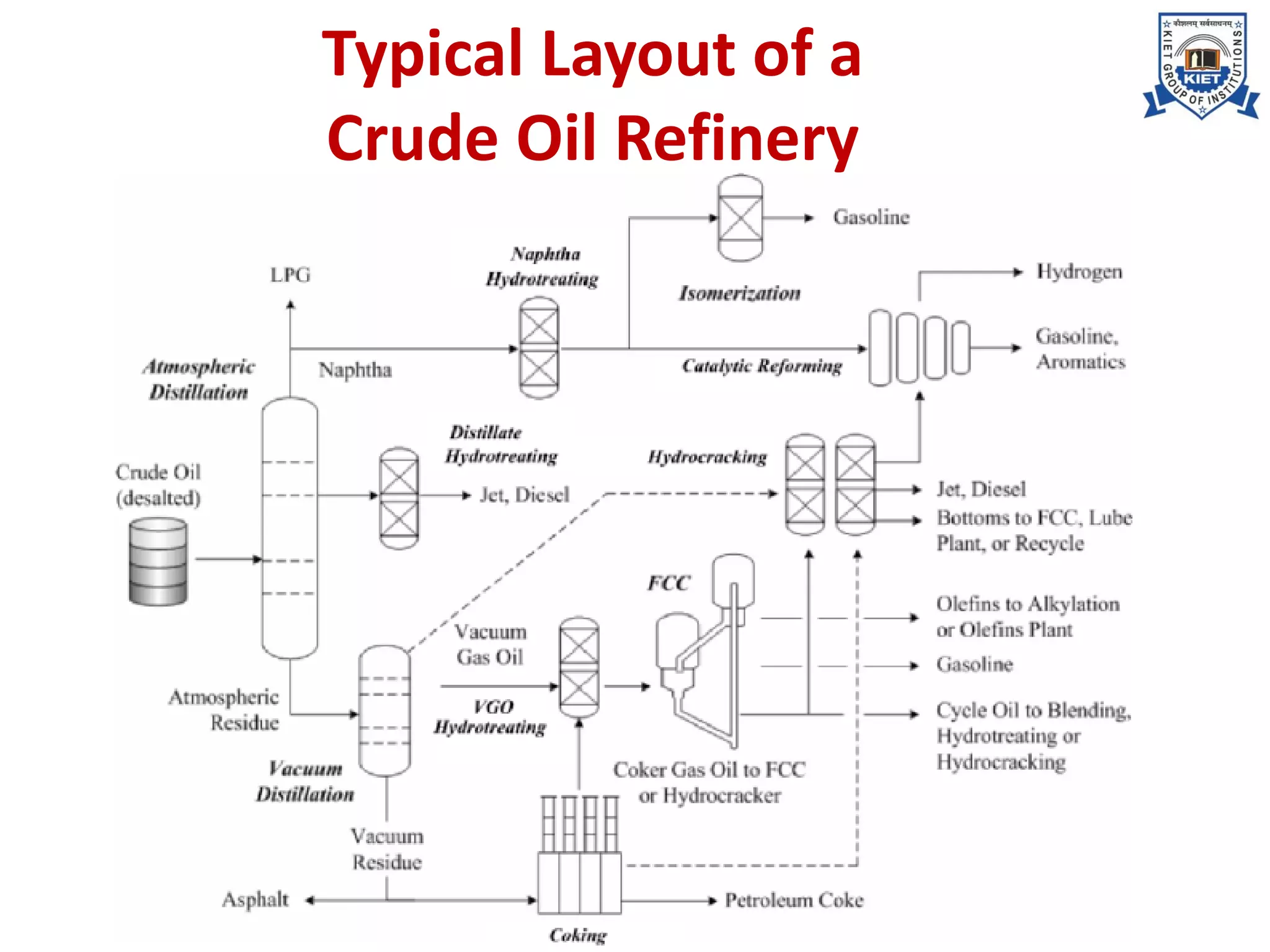
Typical Layout of a
Crude Oil Refinery
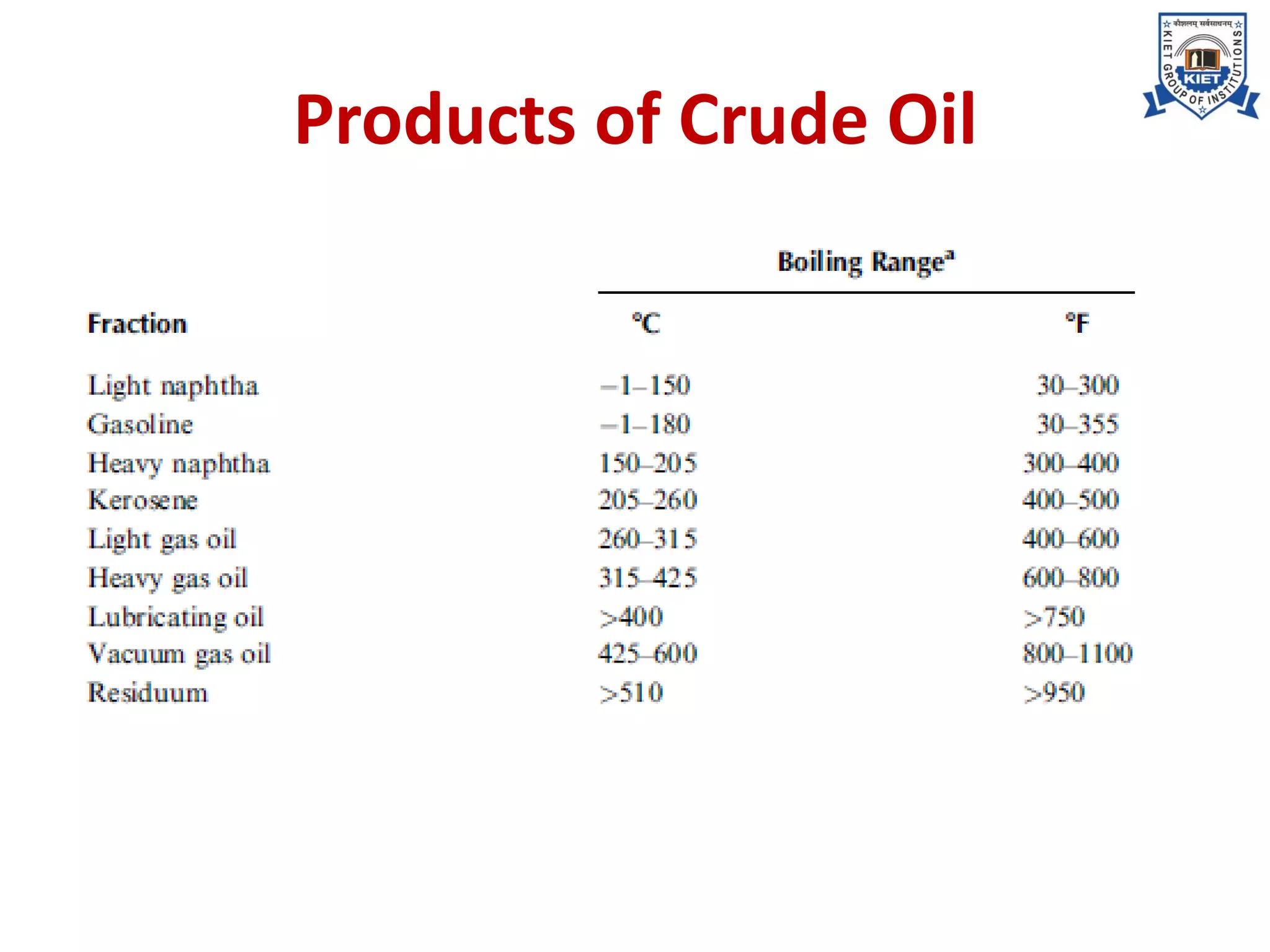
Products of Crude Oil
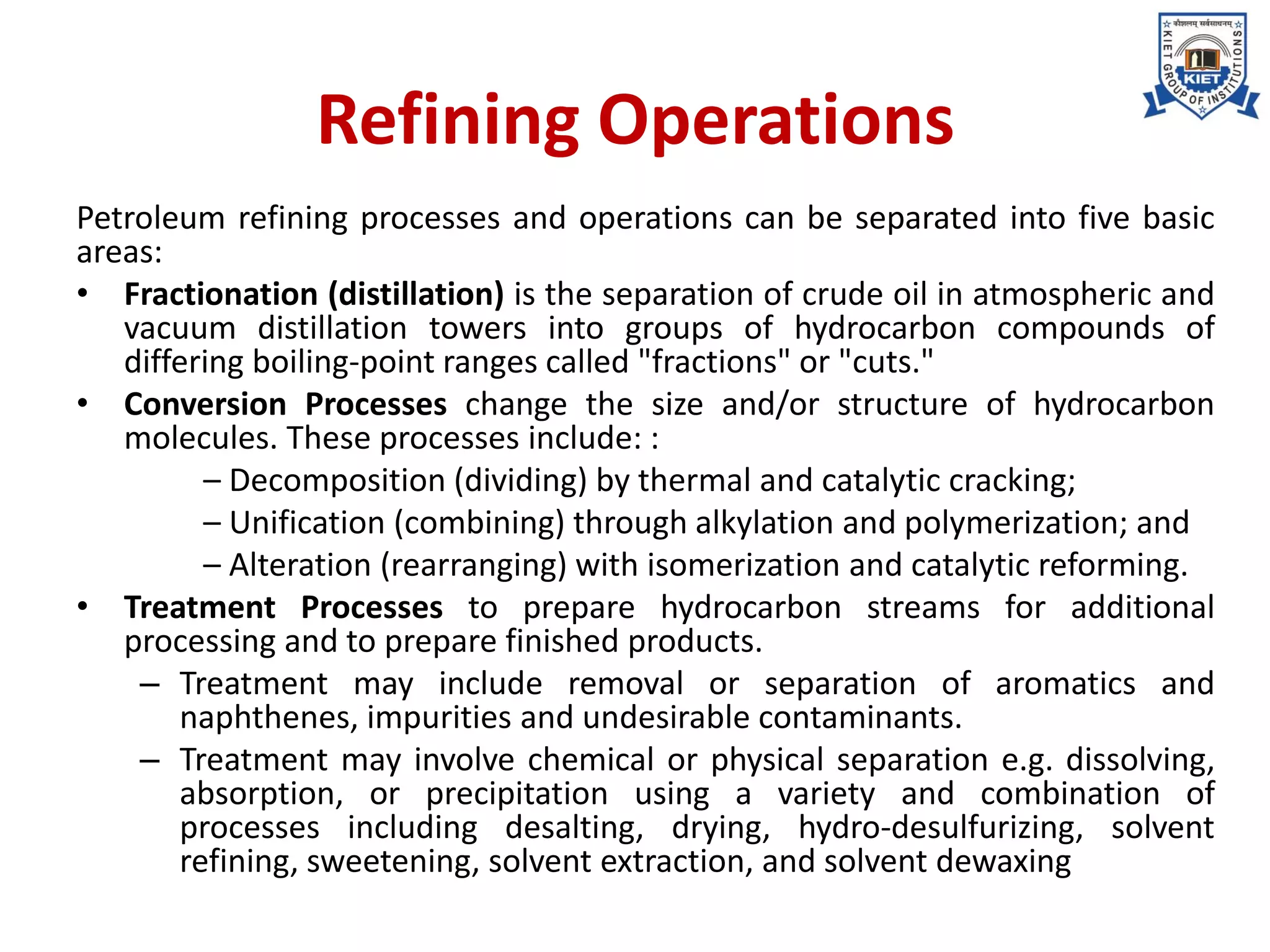
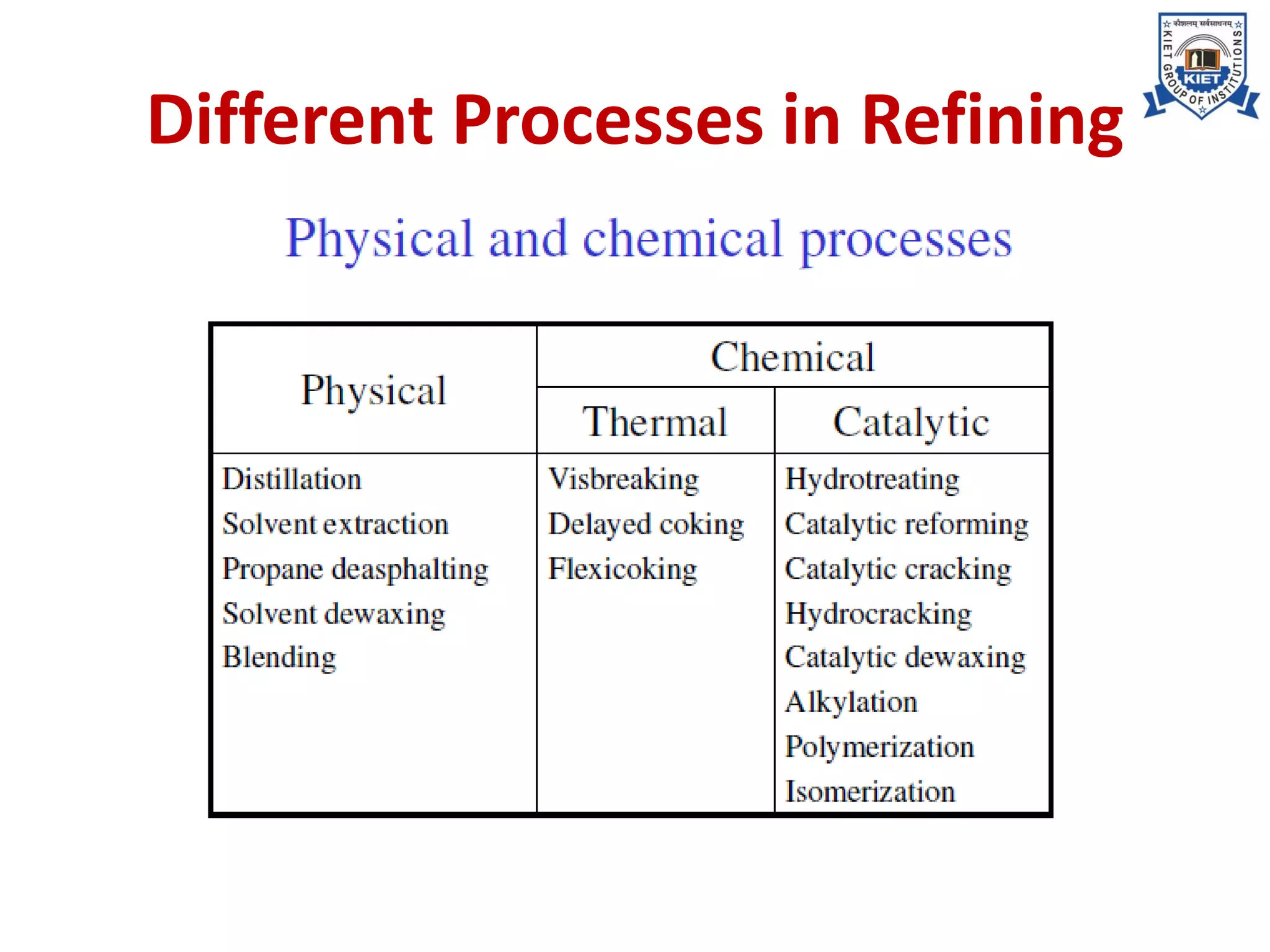
Refining Operations
Petroleum refining processes and operations can be separated into five basic
areas:
• Fractionation (distillation) is the separation of crude oil in atmospheric and
vacuum distillation towers into groups of hydrocarbon compounds of
differing boiling-point ranges called "fractions" or "cuts."
• Conversion Processes change the size and/or structure of hydrocarbon
molecules. These processes include: :
– Decomposition (dividing) by thermal and catalytic cracking;
– Unification (combining) through alkylation and polymerization; and
– Alteration (rearranging) with isomerization and catalytic reforming.
• Treatment Processes to prepare hydrocarbon streams for additional
processing and to prepare finished products.
– Treatment may include removal or separation of aromatics and
naphthenes, impurities and undesirable contaminants.
– Treatment may involve chemical or physical separation e.g. dissolving,
absorption, or precipitation using a variety and combination of
processes including desalting, drying, hydro-desulfurizing, solvent
refining, sweetening, solvent extraction, and solvent dewaxing
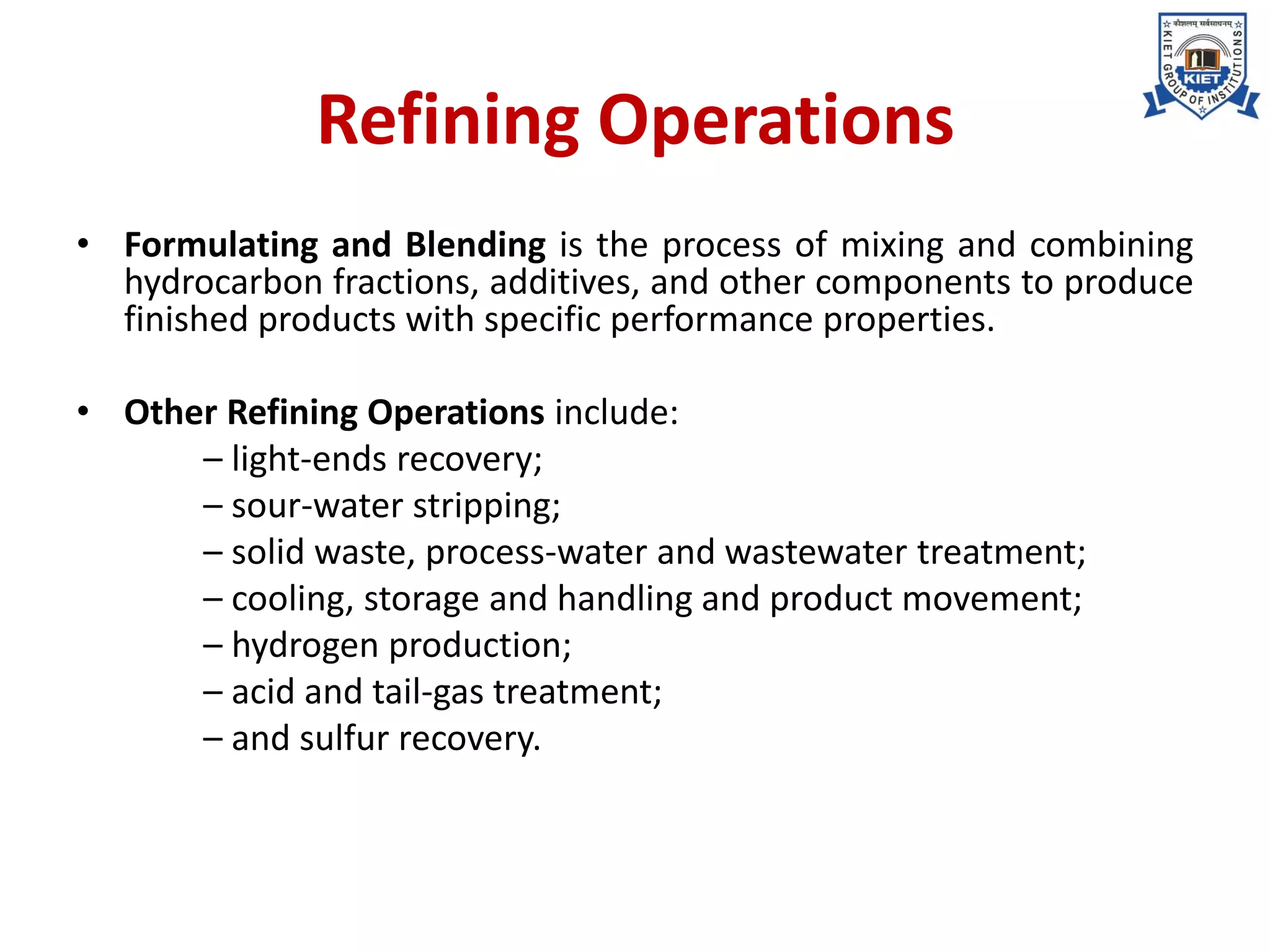
Refining Operations
• Formulating and Blending is the process of mixing and combining
hydrocarbon fractions, additives, and other components to produce
finished products with specific performance properties.
• Other Refining Operations include:
– light-ends recovery;
– sour-water stripping;
– solid waste, process-water and wastewater treatment;
– cooling, storage and handling and product movement;
– hydrogen production;
– acid and tail-gas treatment;
– and sulfur recovery.
Processing of Crude Oil
Different Processes in Refining
Pretreatment of Crude Oil
• Petroleum recovered from reservoir is mixed with
a variety of substances such as gases, water,
chloride salts, and dirt, which contain other
minerals.
• Thus, petroleum processing actually commences
shortly after the production of fluids from
reservoir, where pretreatment operations are
applied to the crude oil prior to transportation.
• Any crude oil to be shipped by pipeline, or by any
other form of transportation, must meet strict
regulations in regard to water and salt content.
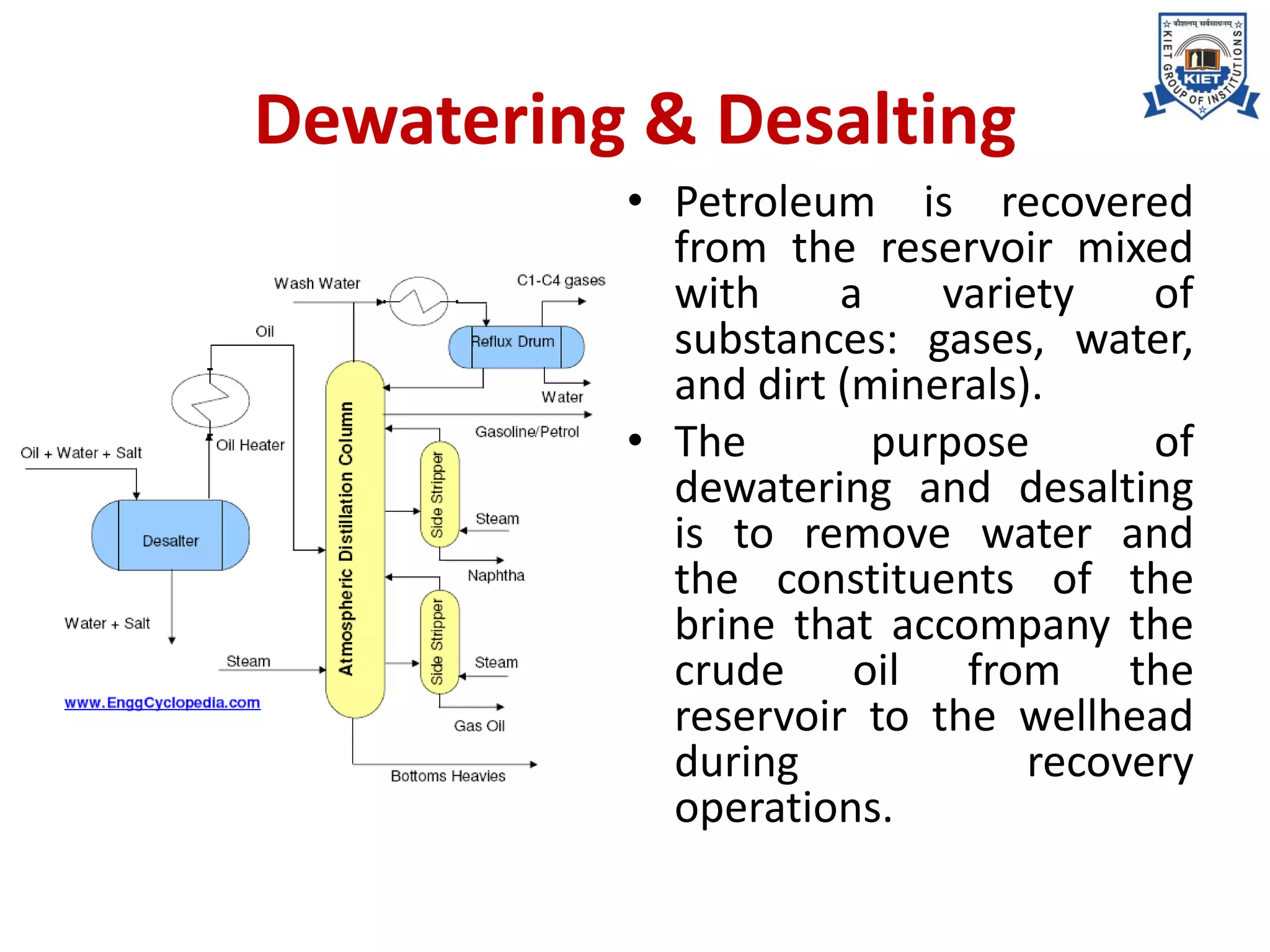
Dewatering & Desalting
• Petroleum is recovered
from the reservoir mixed
with a variety of
substances: gases, water,
and dirt (minerals).
• The purpose of
dewatering and desalting
is to remove water and
the constituents of the
brine that accompany the
crude oil from the
reservoir to the wellhead
during recovery
operations.
Dewatering & Desalting
• Field separation, which occurs at a field site near the recovery
operation, is the first attempt to remove the gases, water, and dirt
that accompany crude oil coming from the ground.
• The separator may be no more than a large vessel that gives a
quieting zone for gravity separation into three phases: gases, crude
oil, and water containing entrained dirt.
• Desalting is a water-washing operation performed at the
production field and at the refinery site for additional crude oil
cleanup.
• If the petroleum from the separators contains water and dirt, water
washing can remove much of the water-soluble minerals and
entrained solids.
• If these crude oil contaminants are not removed, they can cause
operating problems during refinery processing, such as equipment
plugging and corrosion as well as catalyst deactivation.
Dewatering and Desalting Process
• Crude oil distillation is more complicated than product distillation,
in part because crude oils contain water, salts, and suspended
solids.
• Step 1 in the refining process is to remove these contaminants so as
to reduce corrosion, plugging, and fouling of equipment and to
prevent poisoning catalysts in processing units.
• Step 2 most typical methods of crude-oil desalting are chemical and
electrostatic separation, and both use hot water as the extraction
agent.
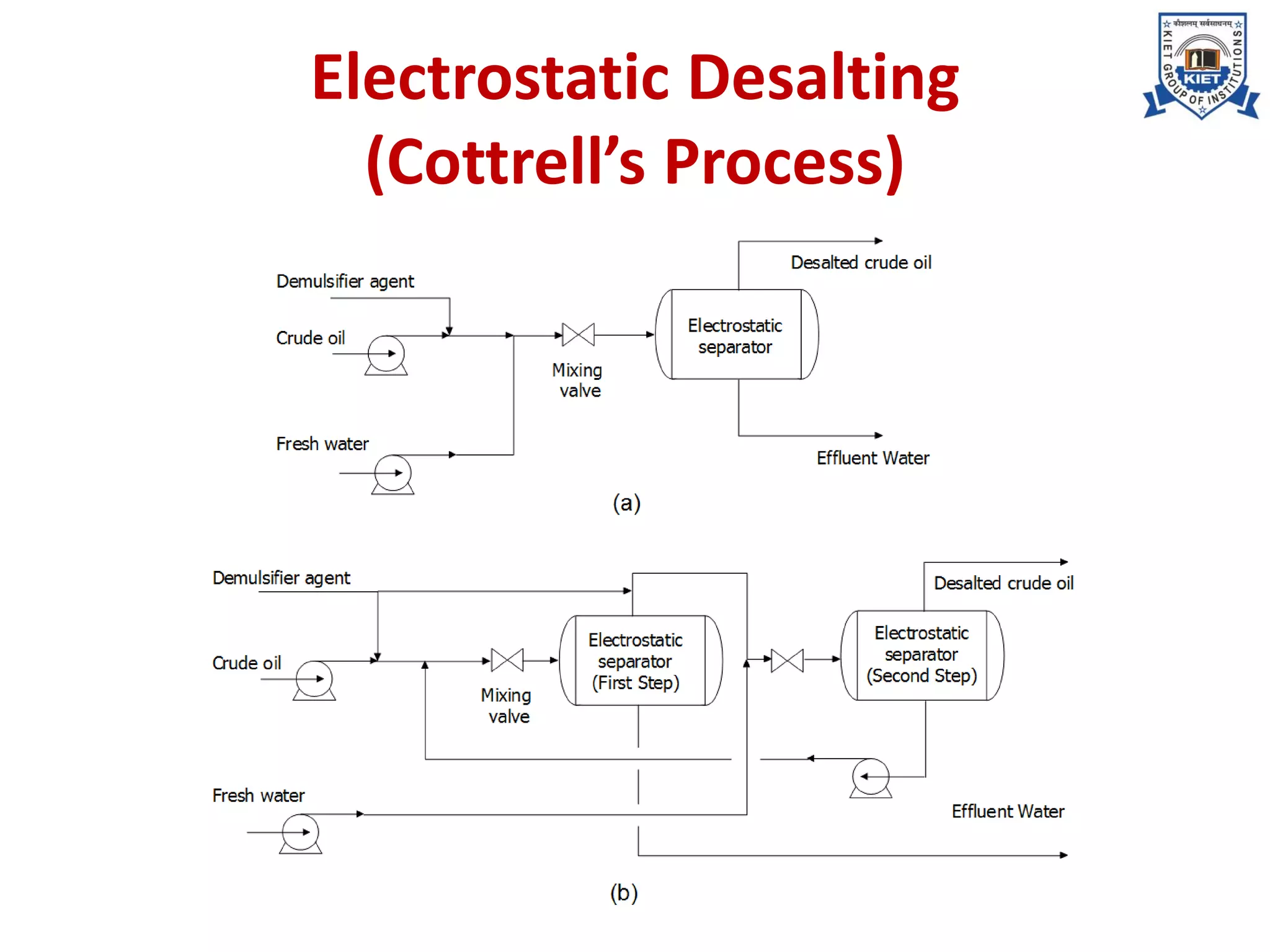
• In chemical desalting, water and chemical surfactant (demulsifiers)
are added to the crude, which is heated so that salts and other
impurities dissolve or attach to the water, then held in a tank to
settle out.
• Electrical desalting is the application of high-voltage electrostatic
charges to concentrate suspended water globules in the bottom of
the settling tank. Surfactants are added only when the crude has a
large amount of suspended solids.
• Step 3(and rare) process filters hot crude using diatomaceous earth
Electrostatic Desalting
(Cottrell’s Process)
Dewatering and Desalting Process
• The crude oil feedstock is heated to 65-180°C to reduce
viscosity and surface tension for easier mixing and
separation of the water.
• The temperature is limited by the vapor pressure of the
crude-oil feedstock.
• In both methods other chemicals may be added.
Ammonia is often used to reduce corrosion. Caustic or
acid may be added to adjust the pH of the water wash.
• Wastewater and contaminants are discharged from the
bottom of the settling tank to the wastewater
treatment facility.

Refining of Petroleum Part-1.pdf

  • 1.
    Unit 2: Processingof Crude Oil Prepared by: Ankur Sachdeva Assistant Professor, ME
  • 2.
    Animation of CrudeOil Processing
  • 3.
  • 4.
    Typical Layout ofa Crude Oil Refinery
  • 5.
  • 6.
    Refining Operations Petroleum refiningprocesses and operations can be separated into five basic areas: • Fractionation (distillation) is the separation of crude oil in atmospheric and vacuum distillation towers into groups of hydrocarbon compounds of differing boiling-point ranges called "fractions" or "cuts." • Conversion Processes change the size and/or structure of hydrocarbon molecules. These processes include: : – Decomposition (dividing) by thermal and catalytic cracking; – Unification (combining) through alkylation and polymerization; and – Alteration (rearranging) with isomerization and catalytic reforming. • Treatment Processes to prepare hydrocarbon streams for additional processing and to prepare finished products. – Treatment may include removal or separation of aromatics and naphthenes, impurities and undesirable contaminants. – Treatment may involve chemical or physical separation e.g. dissolving, absorption, or precipitation using a variety and combination of processes including desalting, drying, hydro-desulfurizing, solvent refining, sweetening, solvent extraction, and solvent dewaxing
  • 7.
    Refining Operations • Formulatingand Blending is the process of mixing and combining hydrocarbon fractions, additives, and other components to produce finished products with specific performance properties. • Other Refining Operations include: – light-ends recovery; – sour-water stripping; – solid waste, process-water and wastewater treatment; – cooling, storage and handling and product movement; – hydrogen production; – acid and tail-gas treatment; – and sulfur recovery.
  • 8.
  • 9.
  • 10.
    Pretreatment of CrudeOil • Petroleum recovered from reservoir is mixed with a variety of substances such as gases, water, chloride salts, and dirt, which contain other minerals. • Thus, petroleum processing actually commences shortly after the production of fluids from reservoir, where pretreatment operations are applied to the crude oil prior to transportation. • Any crude oil to be shipped by pipeline, or by any other form of transportation, must meet strict regulations in regard to water and salt content.
  • 11.
    Dewatering & Desalting •Petroleum is recovered from the reservoir mixed with a variety of substances: gases, water, and dirt (minerals). • The purpose of dewatering and desalting is to remove water and the constituents of the brine that accompany the crude oil from the reservoir to the wellhead during recovery operations.
  • 12.
    Dewatering & Desalting •Field separation, which occurs at a field site near the recovery operation, is the first attempt to remove the gases, water, and dirt that accompany crude oil coming from the ground. • The separator may be no more than a large vessel that gives a quieting zone for gravity separation into three phases: gases, crude oil, and water containing entrained dirt. • Desalting is a water-washing operation performed at the production field and at the refinery site for additional crude oil cleanup. • If the petroleum from the separators contains water and dirt, water washing can remove much of the water-soluble minerals and entrained solids. • If these crude oil contaminants are not removed, they can cause operating problems during refinery processing, such as equipment plugging and corrosion as well as catalyst deactivation.
  • 13.
    Dewatering and DesaltingProcess • Crude oil distillation is more complicated than product distillation, in part because crude oils contain water, salts, and suspended solids. • Step 1 in the refining process is to remove these contaminants so as to reduce corrosion, plugging, and fouling of equipment and to prevent poisoning catalysts in processing units. • Step 2 most typical methods of crude-oil desalting are chemical and electrostatic separation, and both use hot water as the extraction agent. • In chemical desalting, water and chemical surfactant (demulsifiers) are added to the crude, which is heated so that salts and other impurities dissolve or attach to the water, then held in a tank to settle out. • Electrical desalting is the application of high-voltage electrostatic charges to concentrate suspended water globules in the bottom of the settling tank. Surfactants are added only when the crude has a large amount of suspended solids. • Step 3(and rare) process filters hot crude using diatomaceous earth
  • 14.
  • 15.
    Dewatering and DesaltingProcess • The crude oil feedstock is heated to 65-180°C to reduce viscosity and surface tension for easier mixing and separation of the water. • The temperature is limited by the vapor pressure of the crude-oil feedstock. • In both methods other chemicals may be added. Ammonia is often used to reduce corrosion. Caustic or acid may be added to adjust the pH of the water wash. • Wastewater and contaminants are discharged from the bottom of the settling tank to the wastewater treatment facility.