Redundancy Masterclass
21 September 2017
Tom Draper, Partner
Kelly Gibson, Chartered Legal Executive
Emma Patchett, Legal Assistant
“ the material for this seminar has been prepared solely for the benefit of delegates on this seminar. It should not be relied upon
for giving advice and Taylor&Emmet LLP accept no responsibility for loss or consequential losses incurred as a result of
reliance on this material”.
Overview
Definition of redundancy
Redundancy and unfair dismissal
Redundancy and discrimination
Case study
Collective consultation
Redundancy pay
Tricky redundancy issues
Questions
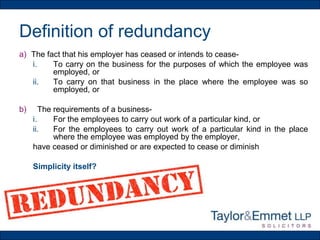
Definition of redundancy
a) The fact that his employer has ceased or intends to cease-
i. To carry on the business for the purposes of which the employee was
employed, or
ii. To carry on that business in the place where the employee was so
employed, or
b) The requirements of a business-
i. For the employees to carry out work of a particular kind, or
ii. For the employees to carry out work of a particular kind in the place
where the employee was employed by the employer,
have ceased or diminished or are expected to cease or diminish
Simplicity itself?
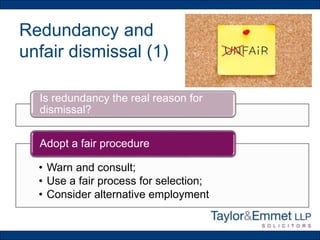
Redundancy and
unfair dismissal (1)
Is redundancy the real reason for
dismissal?
• Warn and consult;
• Use a fair process for selection;
• Consider alternative employment
Adopt a fair procedure
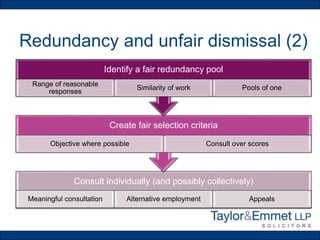
Redundancy and unfair dismissal (2)
Consult individually (and possibly collectively)
Meaningful consultation Alternative employment Appeals
Create fair selection criteria
Objective where possible Consult over scores
Identify a fair redundancy pool
Range of reasonable
responses
Similarity of work Pools of one
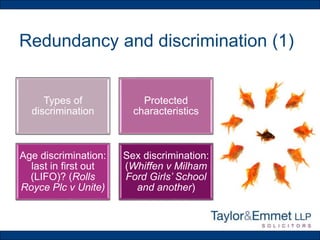
Redundancy and discrimination (1)
Types of
discrimination
Protected
characteristics
Age discrimination:
last in first out
(LIFO)? (Rolls
Royce Plc v Unite)
Sex discrimination:
(Whiffen v Milham
Ford Girls’ School
and another)
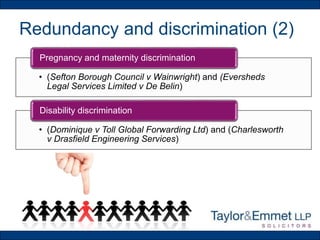
Redundancy and discrimination (2)
• (Sefton Borough Council v Wainwright) and (Eversheds
Legal Services Limited v De Belin)
Pregnancy and maternity discrimination
• (Dominique v Toll Global Forwarding Ltd) and (Charlesworth
v Drasfield Engineering Services)
Disability discrimination
Case study
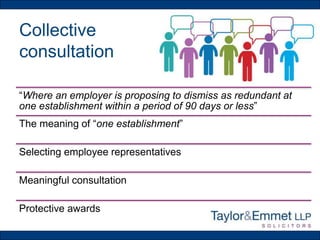
Collective
consultation
“Where an employer is proposing to dismiss as redundant at
one establishment within a period of 90 days or less”
The meaning of “one establishment”
Selecting employee representatives
Meaningful consultation
Protective awards
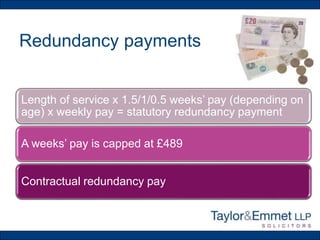
Redundancy payments
Length of service x 1.5/1/0.5 weeks’ pay (depending on
age) x weekly pay = statutory redundancy payment
A weeks’ pay is capped at £489
Contractual redundancy pay
Tricky redundancy issues:
alternative employment
and trial periods
Renewal or re-engagement
Suitable alternative employment
Four week trial period
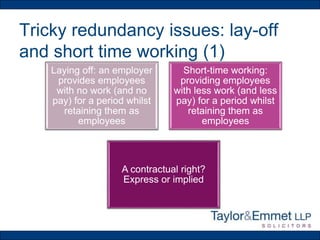
Tricky redundancy issues: lay-off
and short time working (1)
Laying off: an employer
provides employees
with no work (and no
pay) for a period whilst
retaining them as
employees
Short-time working:
providing employees
with less work (and less
pay) for a period whilst
retaining them as
employees
A contractual right?
Express or implied
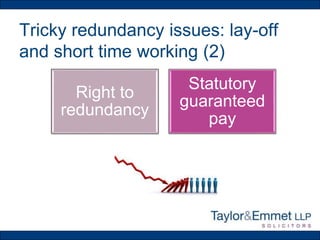
Tricky redundancy issues: lay-off
and short time working (2)
Right to
redundancy
Statutory
guaranteed
pay
Tricky redundancy issues: bumping
Process of moving a potentially redundant employee
into another role, and dismissing the employee
currently performing that role
No obligation to consider bumping but may be
unreasonable not to
Tricky redundancy issues: mobility
clauses
Not the sole determinant
Does the employee have
more than one place of work?
Redundancy Masterclass
• Employment Law Advice
• HR Training
• T&E Complete – all inclusive HR support
• Corporate Finance
• Commercial Law advice
• Commercial Litigation
• Commercial Property
• Property Litigation
• Debt Recovery
• Social Housing

Redundancy Masterclass by Tom Draper

  • 1.
    Redundancy Masterclass 21 September2017 Tom Draper, Partner Kelly Gibson, Chartered Legal Executive Emma Patchett, Legal Assistant “ the material for this seminar has been prepared solely for the benefit of delegates on this seminar. It should not be relied upon for giving advice and Taylor&Emmet LLP accept no responsibility for loss or consequential losses incurred as a result of reliance on this material”.
  • 2.
    Overview Definition of redundancy Redundancyand unfair dismissal Redundancy and discrimination Case study Collective consultation Redundancy pay Tricky redundancy issues Questions
  • 3.
    Definition of redundancy a)The fact that his employer has ceased or intends to cease- i. To carry on the business for the purposes of which the employee was employed, or ii. To carry on that business in the place where the employee was so employed, or b) The requirements of a business- i. For the employees to carry out work of a particular kind, or ii. For the employees to carry out work of a particular kind in the place where the employee was employed by the employer, have ceased or diminished or are expected to cease or diminish Simplicity itself?
  • 4.
    Redundancy and unfair dismissal(1) Is redundancy the real reason for dismissal? • Warn and consult; • Use a fair process for selection; • Consider alternative employment Adopt a fair procedure
  • 5.
    Redundancy and unfairdismissal (2) Consult individually (and possibly collectively) Meaningful consultation Alternative employment Appeals Create fair selection criteria Objective where possible Consult over scores Identify a fair redundancy pool Range of reasonable responses Similarity of work Pools of one
  • 6.
    Redundancy and discrimination(1) Types of discrimination Protected characteristics Age discrimination: last in first out (LIFO)? (Rolls Royce Plc v Unite) Sex discrimination: (Whiffen v Milham Ford Girls’ School and another)
  • 7.
    Redundancy and discrimination(2) • (Sefton Borough Council v Wainwright) and (Eversheds Legal Services Limited v De Belin) Pregnancy and maternity discrimination • (Dominique v Toll Global Forwarding Ltd) and (Charlesworth v Drasfield Engineering Services) Disability discrimination
  • 8.
  • 9.
    Collective consultation “Where an employeris proposing to dismiss as redundant at one establishment within a period of 90 days or less” The meaning of “one establishment” Selecting employee representatives Meaningful consultation Protective awards
  • 10.
    Redundancy payments Length ofservice x 1.5/1/0.5 weeks’ pay (depending on age) x weekly pay = statutory redundancy payment A weeks’ pay is capped at £489 Contractual redundancy pay
  • 11.
    Tricky redundancy issues: alternativeemployment and trial periods Renewal or re-engagement Suitable alternative employment Four week trial period
  • 12.
    Tricky redundancy issues:lay-off and short time working (1) Laying off: an employer provides employees with no work (and no pay) for a period whilst retaining them as employees Short-time working: providing employees with less work (and less pay) for a period whilst retaining them as employees A contractual right? Express or implied
  • 13.
    Tricky redundancy issues:lay-off and short time working (2) Right to redundancy Statutory guaranteed pay
  • 14.
    Tricky redundancy issues:bumping Process of moving a potentially redundant employee into another role, and dismissing the employee currently performing that role No obligation to consider bumping but may be unreasonable not to
  • 15.
    Tricky redundancy issues:mobility clauses Not the sole determinant Does the employee have more than one place of work?
  • 17.
    Redundancy Masterclass • EmploymentLaw Advice • HR Training • T&E Complete – all inclusive HR support • Corporate Finance • Commercial Law advice • Commercial Litigation • Commercial Property • Property Litigation • Debt Recovery • Social Housing

Editor's Notes

  • #3 TD 8.30am
  • #4 TD: 8.35am Generally the definition can be surmised as: Closure of the business as a whole; Closure of the particular workplace where the employee was employed; or Reduction in the size of the workforce Determining whether there is a redundancy situation will depend on the circumstances. It is important to recognise a redundancy situation as there may be redundancy payments that are payable or a duty to inform and consult on the employer which could lead to complex employment tribunal litigation. The definition was described as “simplicity itself” by the House of Lords in Murray v Foyle Meats but it is difficult to apply in practice sometimes. Examples of potential redundancy situations: Office move; Reduced headcount; Reduction in hours; and Outsourcing work previously done by the employer’s own employees.
  • #5 TD There is no statutory redundancy procedure and therefore an employer should check whether there are internal redundancy policies or procedures that could be implied into the employees’ contract of employment. To bring a unfair dismissal claim, those claiming will need to be an employee and have 2 years continuous service. Unless dismissal or selection for redundancy is based on certain grounds (including redundancy selection connected to pregnancy or childbirth, whistleblowing). Discrimination is covered later. An unfair redundancy dismissal may arise if: There was no genuine redundancy situation; The employer failed to consult with employees; The employee was unfairly selected for redundancy; The employer failed to offer suitable alternative employment; or The employer failed to allow an appeal Potential remedies: Compensation made of the following: Basic award- will be cancelled out by amount paid under statutory redundancy payment Compensatory award- to compensate for financial loss arising from the unfair loss of their job (potential to be reduced by monies received in excess of the employee’s statutory redundancy payment e.g. enhanced redundancy pay) Reinstatement- same job Reengagement- like for like job How to dismiss fairly? Generally: Establish that redundancy was the real reason for dismissal; Show that you acted reasonably (in all the circumstances) in treating redundancy as the reason for dismissal ‘Range of reasonable responses’ When an ET is considering this they will not consider what they would have done in the circumstances. Polkey v A E Dayton Services Limited [1987] IRLR 503 Employer will normally not act reasonably unless it: Warns and consults- employees, or their representatives about the proposed redundancy; Adopts a fair basis on which to select for redundancy (redundancy pool and criteria) Considers suitable alternative employment ACAS code of practice on disciplinary does not apply to redundancy dismissals. Additional complications where there is union recognition which we do not go into detail with here.
  • #6 TD Adopting a fair basis for selection for redundancy involves the fair application of objective selection criteria to a pool of employees. Redundancy pool Identify the pool (group of employees from which it will select those to be made redundant); No fixed rules, an employer has a wide measure of flexibility but some principles: Choice of pool within the range of reasonable responses? How the pool is defined is a matter for the employer. As long as the employer genuinely applies its mind to the choice of a pool, it will be difficult for an employee to challenge; A pool can include one person. Tips for considering choice of pool: What type of work ceasing/diminishing ; Extent to which employees are doing similar work; Extent to which employees’ jobs are interchangeable (low skilled work can make it more likely it is interchangeable); Different sites may need to be considered; Whether the employer ‘genuinely applied’ its mind to the composition of the pool; Whether the selection pool was agreed with the union/employee representatives; Document this process Selection criteria Selection criteria should be reasonable, objective and capable of independent verification (not based on personal opinion). Some examples; performance and ability, attendance records, length of service and disciplinary records. Whether it is reasonable, will depend on the circumstances. ETs will not rescore employees. Employers should consult individuals on their scores, giving them the chance to challenge their individual markings. Individual consultation This should be meaningful i.e. the employer should not have already made their mind up. Tips for ‘meaningful consultation’: Consult when proposals still at a formative stage (i.e. not already decided); Provide adequate information on which to respond; Provide adequate time in which to respond; and Conscientious consideration of the response to the consultation. The purpose of individual consultation are the principles derived from Polkey and the subject matter will depend on the specific circumstances but should generally include: An opportunity for the employee to comment on the basis for selection, both regarding the pool and the selection criteria; An opportunity for the employee to challenge their redundancy selection assessment and to explain any factors that might have led to their selection and of which their employer might not have been aware; An opportunity for the employee to put forward any suggestions for ways to avoid their redundancy; Consideration of any alternative employment positions that may exist; An opportunity for the employee to address any other matter. No statutory right to be accompanied to a redundancy consultation meeting but it is good practice to allow this. Appeals: As the ACAS Code on disciplinary and grievances does not apply to redundancy dismissals this will not automatically render a dismissal unfair when failing to allow an appeal, it will depend on the circumstances. Alternatives to compulsory redundancy? Voluntary redundancy, recruitment freeze, withdrawing new job offers; Temporary stoppages; Reducing hours; Reducing payroll costs.
  • #7 KG: 8.50am Reminder on direct or indirect discrimination: Direct: A person (A) discriminates against (B) if because of a protected characteristic (PC), A treats B less favourably than A treats/would treat others Indirect: An employer (A) has a provision, criterion or practice (PCP) which applies to all but, in practice, it has the effect of putting a group of people with a protected characteristic at a particular disadvantage. The claimant must also suffer a disadvantage. But this is potentially capable of justification if a) a legitimate aim and b) PCP is a proportionate means of achieving that aim. Selection for redundancy has the potential to be discriminatory: LIFO potentially indirect discrimination on the grounds of age and sex Attendance records- absence for pregnancy-related illness, maternity or other family-friendly leave should be discounted? Absence connected to a disability? Could amount to disability discrimination on the basis the employer should make a reasonable adjustment Employers should also be aware that employees should not be selected purely on their fixed-term employee status as fixed-term employees have the right not to be treated by his employer less favourably than the employer treats a comparable permanent employee. Rolls-Royce Plc v Unite the Union [2009] IRLR 576 – use of length of service in a redundancy matrix was indirectly discriminatory against younger workers but it was justified. Legitimate aims: rewarding loyalty and maintaining a stable workforce Proportionate: criterion was used as part of a balanced set of criteria Whiffen v Milham Ford Girls’ School and Oxfordshire County Council [2001] IRLR 468- policy which had the effect selecting those not on permanent contracts first for redundancy was discriminatory against women and was not justified. This case pre-dates legislation protecting part-time/fixed-term employees from less-favourable treatment, therefore a current case similar to this would have more legal implications.
  • #8 KG Any employees at risk of redundancy who are on maternity leave have special protection, in that they have an automatic right to be offered any suitable alternative vacancies ahead of other potentially redundant employees. Failure to do this renders a dismissal automatically unfair. Sefton Borough Council v Wainwright UKEAT/0168/14: An employee on maternity leave was not automatically given a suitable alternative role. The role was given to the employee’s male colleague. The employer argued the right for employees on maternity leave to be automatically offered suitable alternative employment only arose once the restructure had been completed and the employee had been placed on a redeployment list. The EAT rejected this argument as it would undermine the purpose of this automatic right if the employer was free to wait until after a restructure had been completed. There is no obligation to offer an employee on maternity leave every suitable vacancy but they should offer at least one and therefore if the employer had offered this employee another suitable vacancy (even if it was not the new role that her role had been amalgamated into), they may have complied with their duty. Wainwright therefore confirmed this right is absolute meaning the employee should be offered a suitable vacancy even if she was not the best candidate for the job and employees on maternity leave should not be required to engage in any form of selection process. However, unfairly favouring a pregnant employee/employee on maternity leave will not make the practice ‘safe’: Eversheds Legal Services Limited v De Belin [2011] IRLR 448 – The employer had discriminated against a male employee on the grounds of sex when, in a redundancy scoring exercise, it inflated the score of his female colleague to take account of the fact she was on maternity leave when the employer could’ve assessed a period in which she was not on maternity leave rather than inflating her score. Disability discrimination If the employer is intending to use attendance records as part of the selection criteria, it should check the accuracy of the information and consider the reasons behind the absence. Particular consideration should be made as to whether periods of absence should be discounted. For example: Absence for pregnancy-related illness, maternity or other family leave (discussed later); or Absence connected with a disability. Dominique v Toll Global Forwarding Ltd - EAT held that an employer failed in its duty to make reasonable adjustments when it did not adjust certain redundancy criteria that placed a disabled employee at a substantial disadvantage. This was despite the fact that making adjustments would have made no difference to the eventual decision to dismiss the employee. The receipt of lower scores was itself a substantial disadvantage, which the reasonable adjustments should have addressed. Therefore in the event an employer is intending to use attendance records as a selection criteria, sickness absence due to a disability may need to be discounted if it is reasonable in the circumstances. Absence can also cause difficulties in terms of consultation with employees and therefore an employer may need to consider making an adjustment to their method of consultation. For example whether it may be appropriate to complete this via telephone or a home visit. This will depend on the circumstances. Charlesworth v Drasfield Engineering Services UKEAT/0197/16 – The employee was absent on sick leave due to a disability whilst the employer was going through a redundancy exercise. Due to the absence of the employee and the fact no-one had done this employees work in their absence, the employer made the employee redundant. This was not disability discrimination as the consideration of the employee’s absence was not the same as saying the employee was dismissed because of their absence.
  • #9 EP: 9.10-9.25am
  • #10 EP: 9.25am Failure to collectively consult could result in a protective award of up to 90 days’ gross actual pay for each affected employee. In GMB and AEEU v Campbells UK Ltd ET/26787/96 a protective award of over £400,000 was made against Campbells when it decided to close one of its factories before any collective consultation began. Collective consultation applies to large scale redundancies- 20 or more employees to be made redundant within a period of 90 days or less at one establishment. The employer must consult on its proposal with representatives of the affected employees and also notify BEIS If the employer is proposing to dismiss 100 or more employees at one establishment within 90 day period, consultation must begin 45 days prior to the first dismissal; If the employer is proposing to dismiss between 20 and 99 employees in a 90 day period, consultation must begin at least 30 days before the first dismissal Consultation does not need to last for the above length of time, simply that the dismissals should not take place until this period of time has elapsed. “One establishment” – Woolworths case The duty to collectively consult with employees will only arise where 20 or more dismissals are proposed at one establishment. The meaning of one establishment has caused some confusion, for example in large chain companies that have numerous establishments in the country. Previously this had been interpreted as collective consultation applying even where the employees concerned are at different establishments, meaning the number of proposed dismissals must be aggregated across the workforce. USDAW and another v WW Realisation 1 Ltd, Ethel Austin Ltd and another [2015]IRLR 577 (Woolworths case) has provided clarity. The Woolworths case arose following the insolvency of national high street retailers which meant large scale redundancies. Employment Tribunal awards were made for protective award, but only for the employees who worked at stores with 20 or more employees. The Tribunal held that each store was a separate “establishment” and therefore stores that had less than 20 employees were not entitled to a protective award. The EAT upheld the Tribunals decision and so the Secretary of State (being responsible for the protective award monies due to the companies being insolvent) appealed to the ECJ. The ECJ held the term “establishment” is the entitled or unit to which the workers made redundant are assigned to carry out their duties that constitutes the establishment for the purposes of the Directive. Therefore each branch of Woolworths and Ethel Austin was a separate establishment for the purposes of collective consultation. Commentary however did include that numerous stores in the same shopping centre could amount to a ‘local employment unit.’ Selecting employee representative: The obligations on the employer is to consult with “appropriate representatives” of the “affected employees.” Appropriate representatives is an umbrella term covering three separate potential categories: Representatives of a recognised trade union; Directly elected representatives, the is, elected by employees affected by a specific redundancy proposal for the purpose of consultation on that proposal; A standing body of elected or appointed representatives not specifically elected for the purpose of redundancy consultation. Trade union reps: The issue is not whether the affected employees are trade union members, but whether the affected employees fall into the bargaining unit as defined by the collective agreement. Only if there is no recognised trade union in respect of the affected employees does the employer have the choice of whom to consult. It may chose to consult either: Representatives directly elected for the purpose by the affected employees; Employee representatives "appointed or elected by the affected employees otherwise than for the purposes of consultation who have authority from those employees to receive information and to be consulted about the proposed dismissals on their behalf. The employees have no right to insist on a particular choice, the decision is the employers. In practice most employers will choose to consult with representatives directly elected by the affected employees rather than a standing body of representatives. An alternative approach might be for employers to arrange for employees to elect a standing body of employee representatives specifically for the purposes of collective consultation over redundancies, whenever they may occur. The main advantage of doing so is to allow consultation to begin quickly, avoiding the delay which is inevitable when employee representatives have to be specifically elected. The disadvantage is that the nature of a specific redundancy proposal may be such that a standing body is not sufficiently representative of the affected employees and indeed may not be capable of meeting the essential legal requirement of having been appointed or elected "by the affected employees".  New regulations allow employees in organisations with at least 50 employees to request that the employer sets up information and consultation machinery. This may include a "national works council", staff forums or other similar representative bodies that enable employers to consult their workforce. There are statutory rules for the election of employee representatives, including ensuring that the election is fair and the number of representatives should be sufficient to represent the interests of all affect employees having regard to the number and classes of those employees. What does “meaningful consultation” involve? Provision of written information to the representatives; Consultation on the proposed redundancies “with a view to reaching agreement” about certain matters Information to be provided to the representatives in writing: Reasons for the proposed redundancies; Numbers and descriptions of employees whom it is proposed to dismiss as redundant; Total number of employees of any such description employed by the employer at the establishment in question; Proposed method of selection; Proposed method of carrying out the dismissals; Proposed methods of calculating the amount of any redundancy payments to be made to employees who may be dismissed; “Suitable information” about its use of agency workers. However there is only a requirement to ‘consult’ on the following: Avoiding the dismissals; Reducing the number of employees to be dismissed; and Mitigating the consequences of dismissals There may be problems if employers are making staged dismissals or at different places of work. Thomas v BNP Paribas Real Estate UKEAT/0134/16 – A ‘perfunctory and insensitive’ redundancy consultation made the redundancy dismissal unfair. The Claimant had over 40 years' service, ending up as a Director of the Respondent's property management division. After a strategic review, the Claimant was put at risk of redundancy and immediately put on 'garden leave' and told not to contact clients or colleagues. The Respondent then made a number of procedural errors, including getting the Claimant's first name wrong in a letter. However, the employment tribunal found that the dismissal was fair. The EAT overturned the decision and criticised the decision to put the Claimant on garden leave and to prohibit contact with colleagues during the consultation period. The EAT found it 'particularly troubling' that the employment tribunal had found the manner of consultation perfunctory and insensitive, yet considered that it was reasonable, without saying why. Such a process would not necessarily be unreasonable, and hence unfair, but there was a lack of reasoning to explain why the consultation was unreasonable.
  • #11 EP Payable to employees with 2 years service that have been dismissed by way of redundancy or are eligible to claim a payment following a period of layoff. Length of service is capped at 20 years’ service If the employee is under 22 for any part of the year 0.5 of a weeks’ pay, between 22 an 40 at the beginning of the year 1 weeks’ pay, or 41 or over at the beginning of the year 1.5 of a weeks’ pay A weeks’ pay is capped at £489. An employee will have 6 months to bring a claim. Contractual redundancy pay? Some employers will offer an enhancement to statutory redundancy pay e.g. no cap on the length of service or week’s pay This will need to be within the employment contract or it can be implied where the employer has a ‘custom and practice’ of providing enhancements. This must however be ‘reasonable, notorious and certain.’ An employee will have a shorter time limit of 3 months to bring a claim for a contractual redundancy payment.
  • #12 KG: 9.35am Employees will not be entitled to a redundancy payment if they unreasonably refuse an offer of suitable alternative employment. The offer of suitable alternative employment should be given after the employee has been notified that their employment will terminate. It is good practice to repeat the offer within a dismissal letter if an employer is hoping to rely on the fact that the employee has forfeited their redundancy payment. Whether an employee has unreasonably refused a suitable alternative offer of employment is fact sensitive. In practice ‘suitability’ and ‘reasonableness’ overlap, some examples: The employees skills, aptitudes, experience and whether they meet the requirements of the job on offer; The terms of the alternative job (e.g. status, place of work, tasks to be performed, pay, hours and responsibility) and how they compare with the terms of the employee’s previous employment. Trial: This is automatic, but is good practice to notify employees. It is irrelevant if the new terms and conditions are more favourable. The rules relating to rejecting a trial period and still being entitled to a redundancy payment (provided the employee has not been unreasonable and the alternative employment is suitable) will mean that the employee should reject the new role within the four week trial period otherwise the statutory process on being entitled to a redundancy payment will not apply. But this does not prevent the individual from bringing an unfair dismissal or constructive unfair dismissal claim.
  • #13 KG Laying off/short-time working is usually a temporary solution to the problem of no or less work. More common in some sectors such as manufacturing. Employees’ rights will differ depending on whether the employer has the contractual right to lay them off or put them on short-time working. Subject to meeting certain relevant statutory conditions, an employee who is laid off or put on short-time working will be entitled to apply for a statutory redundancy payment in certain circumstances. Alternatively the employee may be entitled to statutory guarantee payments by their employer. Usually, there is no implied right in the employment contract for the employee to be provided with work but there is an implied right to be provided with pay. Therefore, laying off employees or putting them on short-time working could be a breach of contract. There may however be an implied right to do this where there has been a custom and practice of laying staff off or putting them on short-time working. Absence of a contractual right to lay off or put on short-time working has the potential for the employee to bring a claim against their employer for different reasons, such as breach of contract, unlawful deduction from wages or a statutory redundancy payment. If an employer exercises a contractual right to lay off/short-time working, the employee will be entitled to a redundancy payment where they: Have two years continuous service; Have been laid off/kept on short-time working for 4 consecutive weeks or more or for a period of 6 weeks (where no more than 3 weeks were consecutive) over a period of 13 weeks; and Follow the statutory scheme for claiming this. Where an employee serves a notice of intention to claim redundancy (as required by the statutory scheme) an employer can serve a counter-notice. Statutory guaranteed pay An employee may be entitled to a statutory guarantee payment (SGP) on up to 5 “workless days” in a three-month period, or pro rata for part-time employees. A “workless day” is a day which the employee would normally be required to work in accordance with their contract of employment, when the employee is not provided with work by their employer because of a reduction in the requirements of the employer’s business for work of the kind which the employee is employed to do. SGP is £27 per day or £135 per week and is paid by the employer.
  • #14 KG
  • #15 TD: 9.45am Must be the transfer of the “bumping” that causes the “bumped” employee to lose their job (e.g. not because B is no longer capable in that role and A is offer it as a suitable alternative role) There is no general obligation to consider bumping but may be unreasonable not to consider it. Lionel Leventhal Ltd v North UKEAT/0265/04 – senior employee dismissed on the basis of being too expensive and his dismissal was considered unfair. His employer should’ve considered making a more junior employee redundancy and offering their job to the senior employee. Fulcrum Pharma (Europe) Ltd v Bonassera and another UKEAT/0198/10 supported Lionel but said the onus was on the employer to raise with a potentially redundant employees the possibility of bumping them into a more junior role. Byrne v Arvin Meritor LVS (UK) Ltd UKEAT/239/02 dismissal was not unfair when the employer failed to consider dismissing a long-serving junior employee in order to retain a more highly experienced senior employee
  • #16 TD The existence of a mobility clause in the employee’s employment contract can be taken into account. In cases where the employee’s place of work is arguably two or more places, only one of which is closing, it may be easier in practice to establish a redundancy situation by reference to a diminishing requirement for employees. This may avoid disputes about whether the mobility clause should be invoked. Some difficulties may arise if the employer attempts to argue that there is no redundancy situation due to the existence of a mobility clause. This can be problematic, as the workplace for the purposes of redundancy is the location the employee actually works, not where they can be required to work. Therefore if an employee has a mobility clause in their contract but this has never been exercised the definition of redundancy is likely to have been met (subject to the other requirements). Employers may also attempt to rely on a mobility clause to relocate employees in order to avoid making them redundant. Following this, if the employee’s fail to comply with the instruction, commence disciplinary proceedings for misconduct. To do this lawfully will depend on the circumstances. Kellogg Brown & Root (UK) Ltd v (1) Fitton The use of the mobility clause may enable an employer to avoid dismissing employees for redundancy, but the manner in which the employer operates the clause may be subject to scrutiny. Involved two employees whose place of work had shut down, the employer had exercised a mobility clause in their contract, deemed this as suitable due to a compensation scheme for 6 months and reducing core hours to allow for M25 traffic. Both employees failed to turn up for their role at the new location and were dismissed for gross misconduct. The EAT found the dismissals had been for the reason of conduct and not redundancy as this is what Kellogg had genuinely had in mind. Regardless of this reason, the dismissals were held to be unfair. The mobility clauses, based on the circumstances was not a valid contractual requirement. The instruction was not reasonable.
  • #17 TD: 10am