
Reduction of Plant Diseases
Using Nutrients
“Fertilizer Labels-A Foreign Language”
Manzoor nabi
Plant Pathologist/Agronomist
Winfield Solutions, LLC
Mewar university Rajasthan
Essential Plant Nutrients
Plant Nutrient Uptake
1.Dissolve in water (form ions)
Soil Solution, Foliage
2. Gasses
Carbon (CO2), Nitrogen fixation (N2)
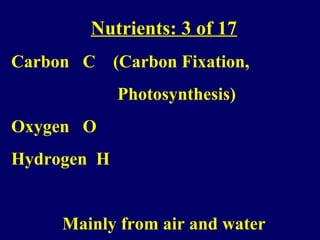
Nutrients: 3 of 17
Carbon C (Carbon Fixation,
Photosynthesis)
Oxygen O
Hydrogen H
Mainly from air and water
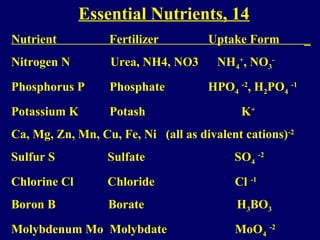
Essential Nutrients, 14
Nutrient Fertilizer Uptake Form _
Nitrogen N Urea, NH4, NO3 NH4
+
, NO3
-
Phosphorus P Phosphate HPO4
-2
, H2PO4
-1
Potassium K Potash K+
Ca, Mg, Zn, Mn, Cu, Fe, Ni (all as divalent cations)-2
Sulfur S Sulfate SO4
-2
Chlorine Cl Chloride Cl -1
Boron B Borate H3BO3
Molybdenum Mo Molybdate MoO4
-2
Beneficial Nutrients
Not shown to be essential.
Many! Maybe 12 or more!
Another seminar!
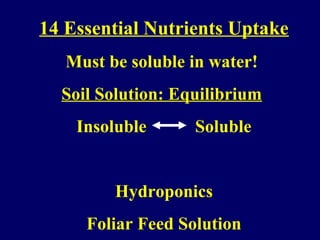
14 Essential Nutrients Uptake
Must be soluble in water!
Soil Solution: Equilibrium
Insoluble Soluble
Hydroponics
Foliar Feed Solution
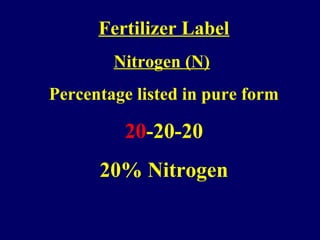
Fertilizer Label
Nitrogen (N)
Percentage listed in pure form
20-20-20
20% Nitrogen
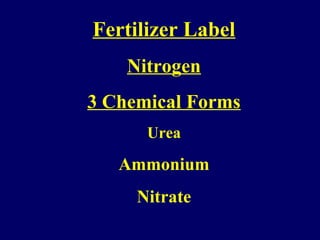
Fertilizer Label
Nitrogen
3 Chemical Forms
Urea
Ammonium
Nitrate
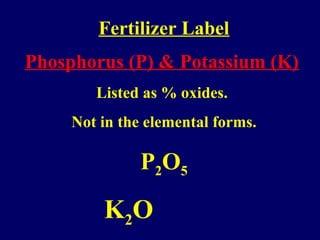
Fertilizer Label
Phosphorus (P) & Potassium (K)
Listed as % oxides.
Not in the elemental forms.
P2O5
K2O
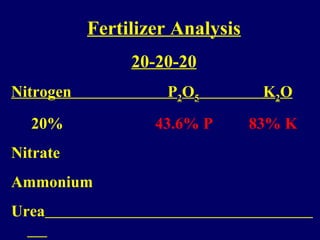
Fertilizer Analysis
20-20-20
Nitrogen P2O5 K2O
20% 43.6% P 83% K
Nitrate
Ammonium
Urea
Soil & Foliar Tests
Nutrients are listed in elemental
forms.
N, P, K etc.
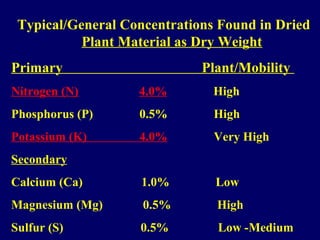
Typical/General Concentrations Found in Dried
Plant Material as Dry Weight
Primary Plant/Mobility
Nitrogen (N) 4.0% High
Phosphorus (P) 0.5% High
Potassium (K) 4.0% Very High
Secondary
Calcium (Ca) 1.0% Low
Magnesium (Mg) 0.5% High
Sulfur (S) 0.5% Low -Medium
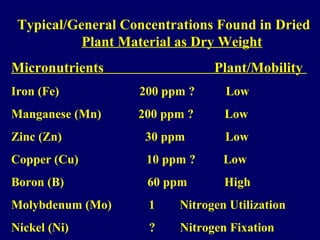
Typical/General Concentrations Found in Dried
Plant Material as Dry Weight
Micronutrients Plant/Mobility
Iron (Fe) 200 ppm ? Low
Manganese (Mn) 200 ppm ? Low
Zinc (Zn) 30 ppm Low
Copper (Cu) 10 ppm ? Low
Boron (B) 60 ppm High
Molybdenum (Mo) 1 Nitrogen Utilization
Nickel (Ni) ? Nitrogen Fixation
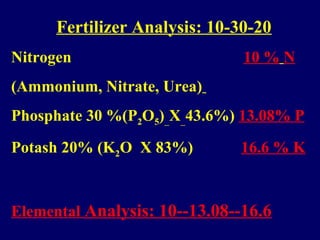
Fertilizer Analysis: 10-30-20
Nitrogen 10 % N
(Ammonium, Nitrate, Urea)
Phosphate 30 %(P2O5) X 43.6%) 13.08% P
Potash 20% (K2O X 83%) 16.6 % K
Elemental Analysis: 10--13.08--16.6
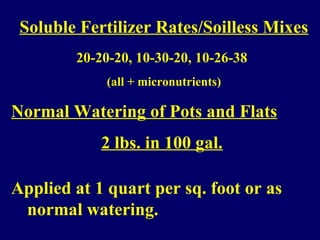
Soluble Fertilizer Rates/Soilless Mixes
20-20-20, 10-30-20, 10-26-38
(all + micronutrients)
Normal Watering of Pots and Flats
2 lbs. in 100 gal.
Applied at 1 quart per sq. foot or as
normal watering.
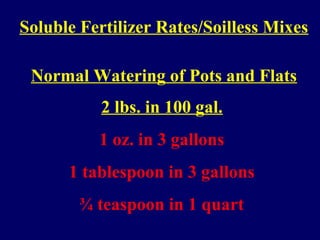
Soluble Fertilizer Rates/Soilless Mixes
Normal Watering of Pots and Flats
2 lbs. in 100 gal.
1 oz. in 3 gallons
1 tablespoon in 3 gallons
¾ teaspoon in 1 quart
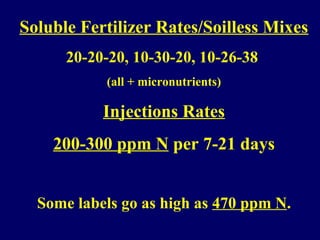
Soluble Fertilizer Rates/Soilless Mixes
20-20-20, 10-30-20, 10-26-38
(all + micronutrients)
Injections Rates
200-300 ppm N per 7-21 days
Some labels go as high as 470 ppm N.
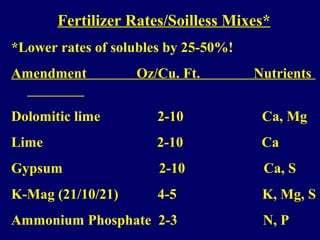
Fertilizer Rates/Soilless Mixes*
*Lower rates of solubles by 25-50%!
Amendment Oz/Cu. Ft. Nutrients
Dolomitic lime 2-10 Ca, Mg
Lime 2-10 Ca
Gypsum 2-10 Ca, S
K-Mag (21/10/21) 4-5 K, Mg, S
Ammonium Phosphate 2-3 N, P
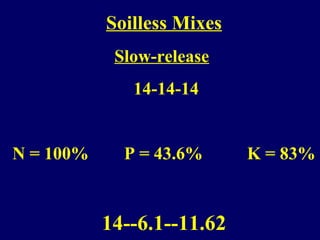
Soilless Mixes
Slow-release
14-14-14
N = 100% P = 43.6% K = 83%
14--6.1--11.62
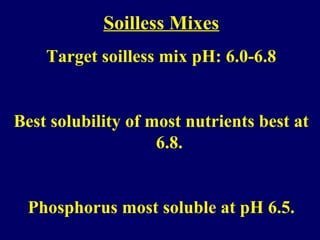
Soilless Mixes
Target soilless mix pH: 6.0-6.8
Best solubility of most nutrients best at
6.8.
Phosphorus most soluble at pH 6.5.
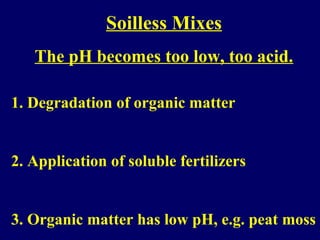
Soilless Mixes
The pH becomes too low, too acid.
1. Degradation of organic matter
2. Application of soluble fertilizers
3. Organic matter has low pH, e.g. peat moss
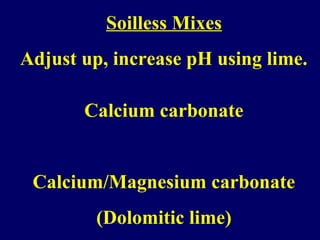
Soilless Mixes
Adjust up, increase pH using lime.
Calcium carbonate
Calcium/Magnesium carbonate
(Dolomitic lime)
Soilless Mixes
“Special Case”
Fusarium oxysporum-Crown Rot
This fungus kills ferrocacti if soil pH is acid.
Adjust soil pH to greater than 7.0.
Lime!
Cacti, Succulents and Native Plants
Respond to Higher Nutrient Levels
1.Optimum Yield/Growth
2. Disease & Insect Resistance
Most Important Nutrients for
Disease Resistance
K, Ca, Cu, B, Mn, S,
Si*
* Not essential, but beneficial
Most Important Nutrients for
Disease Resistance
“Context”
Sufficient Quantities of all Essential
Nutrients Must be Delivered to the
Plant
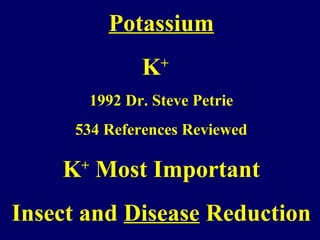
Potassium
K+
1992 Dr. Steve Petrie
534 References Reviewed
K+
Most Important
Insect and Disease Reduction
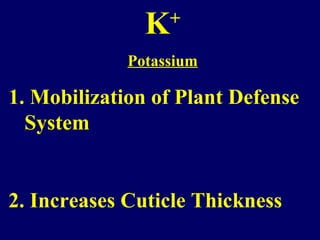
K+
Potassium
1. Mobilization of Plant Defense
System
2. Increases Cuticle Thickness
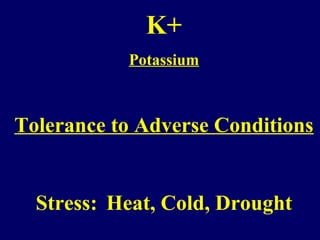
K+
Potassium
Tolerance to Adverse Conditions
Stress: Heat, Cold, Drought
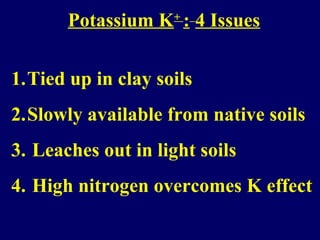
Potassium K+
: 4 Issues
1.Tied up in clay soils
2.Slowly available from native soils
3. Leaches out in light soils
4. High nitrogen overcomes K effect
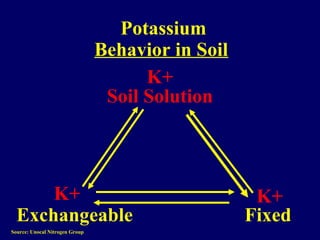
K+ K+
Exchangeable
Potassium
Fixed
Behavior in Soil
K+
Soil Solution
Source: Unocal Nitrogen Group
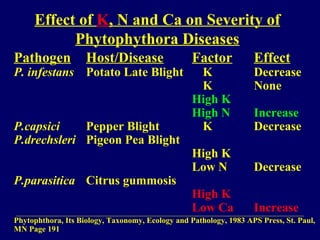
Effect of K, N and Ca on Severity of
Phytophythora Diseases
Pathogen Host/Disease Factor Effect
P. infestans Potato Late Blight K Decrease
K None
High K
High N Increase
P.capsici Pepper Blight K Decrease
P.drechsleri Pigeon Pea Blight
High K
Low N Decrease
P.parasitica Citrus gummosis
High K
Low Ca Increase
Phytophthora, Its Biology, Taxonomy, Ecology and Pathology, 1983 APS Press, St. Paul,
MN Page 191
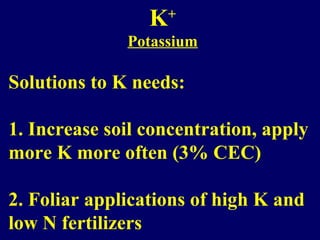
K+
Potassium
Solutions to K needs:
1. Increase soil concentration, apply
more K more often (3% CEC)
2. Foliar applications of high K and
low N fertilizers
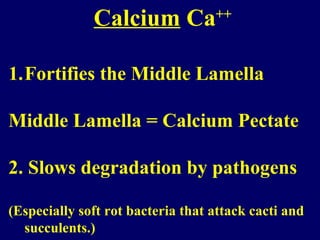
Calcium Ca++
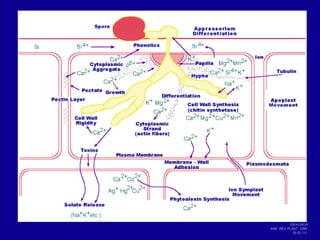
1.Fortifies the Middle Lamella
Middle Lamella = Calcium Pectate
2. Slows degradation by pathogens
(Especially soft rot bacteria that attack cacti and
succulents.)
Ca++
More Calcium in Middle Lamella
Reduces Pathogen Enzyme Activity
Pectolytic Enzyme Activity:
Polygalacturonase
Ca++
Stops Motile Spores=Zoospores
Encyst or Stop Swimming
Phytophthora and Pythium
Pathogens of Cacti and Succulents
Phytophthora species
Hosts
Boogum-trees
Pathogens of Cacti and Succulents
Pythium species
Hosts
Agaves, Cacti & Euphorbiaceae
seedlings
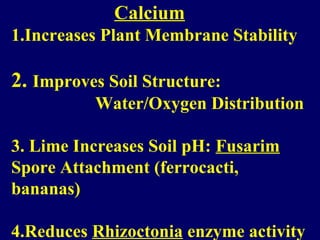
Calcium
1.Increases Plant Membrane Stability
2. Improves Soil Structure:
Water/Oxygen Distribution
3. Lime Increases Soil pH: Fusarim
Spore Attachment (ferrocacti,
bananas)
4.Reduces Rhizoctonia enzyme activity
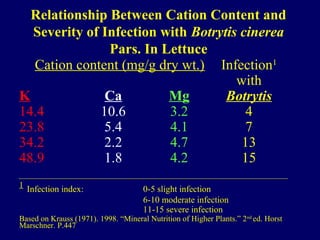
Relationship Between Cation Content and
Severity of Infection with Botrytis cinerea
Pars. In Lettuce
Cation content (mg/g dry wt.) Infection1
with
K Ca Mg Botrytis
14.4 10.6 3.2 4
23.8 5.4 4.1 7
34.2 2.2 4.7 13
48.9 1.8 4.2 15
1
Infection index: 0-5 slight infection
6-10 moderate infection
11-15 severe infection
Based on Krauss (1971). 1998. “Mineral Nutrition of Higher Plants.” 2nd
ed. Horst
Marschner. P.447
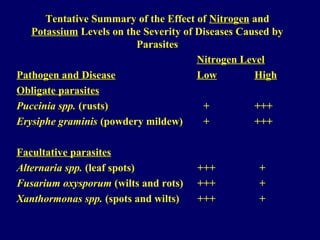
Tentative Summary of the Effect of Nitrogen and
Potassium Levels on the Severity of Diseases Caused by
Parasites
Nitrogen Level
Pathogen and Disease Low High
Obligate parasites
Puccinia spp. (rusts) + +++
Erysiphe graminis (powdery mildew) + +++
Facultative parasites
Alternaria spp. (leaf spots) +++ +
Fusarium oxysporum (wilts and rots) +++ +
Xanthormonas spp. (spots and wilts) +++ +
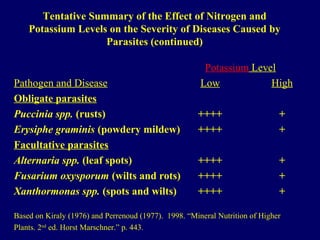
Tentative Summary of the Effect of Nitrogen and
Potassium Levels on the Severity of Diseases Caused by
Parasites (continued)
Potassium Level
Pathogen and Disease Low High
Obligate parasites
Puccinia spp. (rusts) ++++ +
Erysiphe graminis (powdery mildew) ++++ +
Facultative parasites
Alternaria spp. (leaf spots) ++++ +
Fusarium oxysporum (wilts and rots) ++++ +
Xanthormonas spp. (spots and wilts) ++++ +
Based on Kiraly (1976) and Perrenoud (1977). 1998. “Mineral Nutrition of Higher
Plants. 2nd
ed. Horst Marschner.” p. 443.
Cu++
- Copper
• Increases cuticle thickness
•Cuticle: a barrier to infections
•Careful!
Cu++
- Copper
• Necessary for polyphenoloxidase
activity.
• Polyphenoloxidase system produces
some phytoalexins and other anti-
pathogenic molecules.
Cu++
- Copper
Phytoalexins-antimicrobial compounds
produced by plants in response to a host-
parasite interaction.
Some phytoalexins are phenolics.
Others such as sulfur are not organic
molecules.
Boron
B
1. Increases the uptake of cations (Blevins,
Schon, U. of Missouri)
2. K, Ca and Cu are cations that are vital
for plant resistance to disease.
3. Involved in the metabolism of phenolics.
Boron
B
Phenolics include phytoalexins and other
molecules that are toxic to plant pathogens.
Phytoalexins are phenolics that are toxic to
plant pathogens.
Qinones from phenolics may form: also toxic to plant pathogens.
Manganese Mn++
1988 Study by Huber and Wilhelm
82 scientific papers were review
Papers addressed disease and Mn content.
All but 4 papers indicated that added
Mn decreased disease.
Two of the 4 papers showed Mn in the toxic
range.
Manganese Mn++
• Involved in the production of lignin.
•Lignin is the principal component of
wood and very difficult to degrade.
Manganese Mn++
•Wheat with higher uptake of
manganese has a higher content of
lignin and is more resistant to take-all
disease.
Manganese Mn++
• Mn+2
inhibits the enzyme pectin
methyl-esterase.
•Pectin methylesterase is a fungal
pathogen exoenzyme for degrading
host cell walls.
Diseases Reduced or Controlled by
the Addition of Manganese
• Take-all and powdery mildew of wheat
•Common scab of potato
•Blast and leaf spot of rice
•Root rot of avocado
•Powdery mildew of canola, sorghum
•Nematodes attacking barley
Zinc Zn++
•Not directly involved in disease resistance
•Most important micronutrient in plants
•A cofactor for more than 100 plant
enzymes
•Applications to foliar almost always
produce a response in plans.
Thank you!
Questions!
Major Turf Disease Problems
• Turfgrass patch diseases
• Pythium blight
• Dollar spot
• Fusarium blight
Patch Diseases
•More prevalent during the past 3 year.
•More positive IDs during last year.
• Several fungal pathogens involved.
•Identification/taxonomy is unclear.
•All ascomycetes: Indicates the active fungicides.
Pathogenic Patch Fungi
Genera
•Leptosphaeria MagnaportheMagnaporthe
Gaeumannomyces
•Sexual stages: Ascomycetes (powdery mildews)
•All form black or olivaceous ectotrophic hyphae
•Ectotrophic hyphae: mycelium over root
Turfgrass Patch Diseases
• Take-all Bentgrass
Gaeumannomyces graminis var. avenae
• Bermudagrass Decline Bermudagrass
G. graminis var. graminis
Turfgrass Patch Diseases
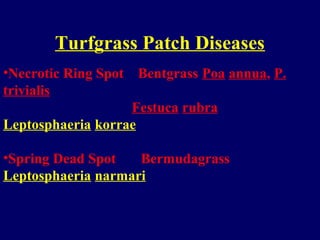
•Necrotic Ring Spot Bentgrass Poa annua, P.
trivialis
Festuca rubra
Leptosphaeria korrae
•Spring Dead Spot Bermudagrass
Leptosphaeria narmari
Turfgrass Patch Diseases
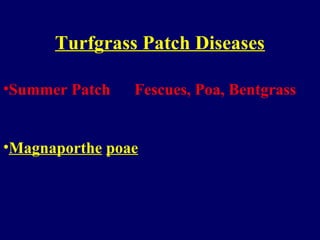
•Summer Patch Fescues, Poa, Bentgrass
•Magnaporthe poae
Reducing Take-All and Other
Patch Diseases
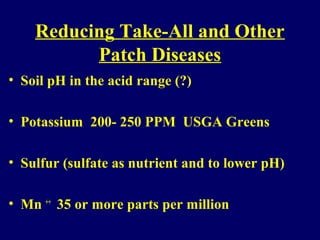
• Soil pH in the acid range (?)
• Potassium 200- 250 PPM USGA Greens
• Sulfur (sulfate as nutrient and to lower pH)
• Mn ++
35 or more parts per million
Reducing Take-All and Other
Patch Diseases
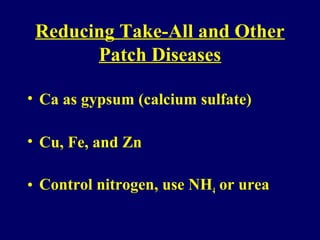
• Ca as gypsum (calcium sulfate)
• Cu, Fe, and Zn
• Control nitrogen, use NH4 or urea
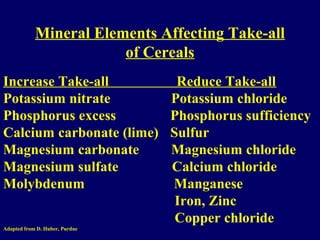
Mineral Elements Affecting Take-all
of Cereals
Increase Take-all Reduce Take-all
Potassium nitrate Potassium chloride
Phosphorus excess Phosphorus sufficiency
Calcium carbonate (lime) Sulfur
Magnesium carbonate Magnesium chloride
Magnesium sulfate Calcium chloride
Molybdenum Manganese
Iron, Zinc
Copper chloride
Adapted from D. Huber, Purdue
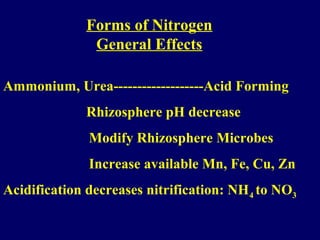
Forms of Nitrogen
General Effects
Ammonium, Urea-------------------Acid Forming
Rhizosphere pH decrease
Modify Rhizosphere Microbes
Increase available Mn, Fe, Cu, Zn
Acidification decreases nitrification: NH4 to NO3
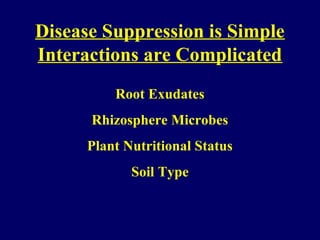
Disease Suppression is Simple
Interactions are Complicated
Root Exudates
Rhizosphere Microbes
Plant Nutritional Status
Soil Type
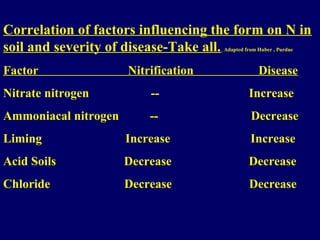
Correlation of factors influencing the form on N in
soil and severity of disease-Take all. Adapted from Huber , Purdue
Factor Nitrification Disease
Nitrate nitrogen -- Increase
Ammoniacal nitrogen -- Decrease
Liming Increase Increase
Acid Soils Decrease Decrease
Chloride Decrease Decrease
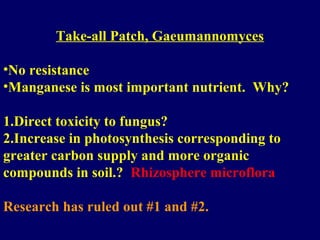
Take-all Patch, Gaeumannomyces
•No resistance
•Manganese is most important nutrient. Why?
1.Direct toxicity to fungus?
2.Increase in photosynthesis corresponding to
greater carbon supply and more organic
compounds in soil.? Rhizosphere microflora
Research has ruled out #1 and #2.
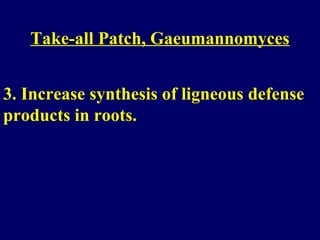
Take-all Patch, Gaeumannomyces
3. Increase synthesis of ligneous defense
products in roots.
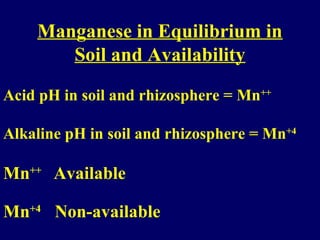
Manganese in Equilibrium in
Soil and Availability
Acid pH in soil and rhizosphere = Mn++
Alkaline pH in soil and rhizosphere = Mn+4
Mn++
Available
Mn+4
Non-available
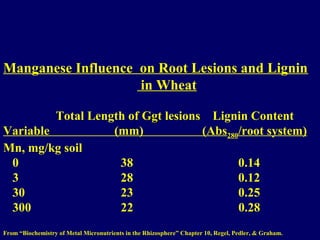
Manganese Influence on Root Lesions and Lignin
in Wheat
Total Length of GgtGgt lesions Lignin Content
Variable (mm) (Abs280/root system)
Mn, mg/kg soil
0 38 0.14
3 28 0.12
30 23 0.25
300 22 0.28
From “Biochemistry of Metal Micronutrients in the Rhizosphere” Chapter 10, Regel, Pedler, & Graham.
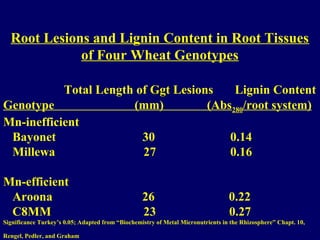
Root Lesions and Lignin Content in Root Tissues
of Four Wheat Genotypes
Total Length of GgtGgt Lesions Lignin Content
Genotype (mm) (Abs280/root system)
Mn-inefficient
Bayonet 30 0.14
Millewa 27 0.16
Mn-efficient
Aroona 26 0.22
C8MM 23 0.27
Significance Turkey’s 0.05; Adapted from “Biochemistry of Metal Micronutrients in the Rhizosphere” Chapt. 10,
Rengel, Pedler, and Graham
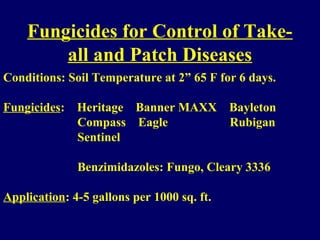
Fungicides for Control of Take-
all and Patch Diseases
Conditions: Soil Temperature at 2” 65 F for 6 days.
Fungicides: Heritage Banner MAXX Bayleton
Compass Eagle Rubigan
Sentinel
Benzimidazoles: Fungo, Cleary 3336
Application: 4-5 gallons per 1000 sq. ft.
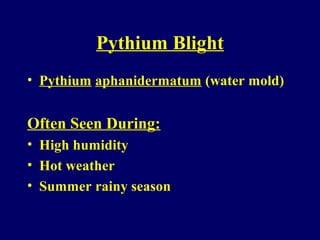
Pythium Blight
• Pythium aphanidermatum (water mold)
Often Seen During:
• High humidity
• Hot weather
• Summer rainy season
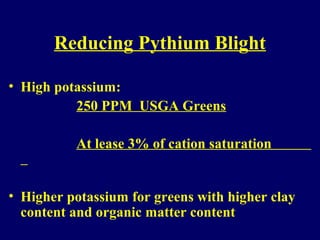
Reducing Pythium Blight
• High potassium:
250 PPM USGA Greens
At lease 3% of cation saturation
• Higher potassium for greens with higher clay
content and organic matter content
Reducing Pythium Blight
• Calcium-drainage and nutrition
• Copper 1-3 PPM in soil
• Control nitrogen
Dollar Spot
• Sclerotinia homoeocarpa (fungus)
Reducing Dollar Spot
• Maintain sufficient nitrogen
• Balance nitrogen with high potassium
• Collect clippings and reduce thatch
• Maintain calcium
• Gypsum and sulfur-water penetration,
stress
Fusarium Blight
• Fusarium species (fungus)
Reducing Fusarium Blight
• Reduce stress (potassium, calcium)
• Maintain soil pH close to neutral (lime)
• Control nitrogen
Reducing Pythium and Phytophthora
• High potassium
• High calcium
• Good drainage-gypsum, sulfur
• Acivator 90 20 PPM kills zoospores
Free Calcium
Increases Plant Membrane Stability
Improves Soil Structure:
Water/Oxygen Distribution
Lime Increases Soil pH:
Stops or Reduces Spore Pathogen
Attachment
Reduction of Plant Diseases  Using Nutrients

Reduction of Plant Diseases Using Nutrients

  • 1.
    Reduction of PlantDiseases Using Nutrients “Fertilizer Labels-A Foreign Language” Manzoor nabi Plant Pathologist/Agronomist Winfield Solutions, LLC Mewar university Rajasthan
  • 2.
  • 3.
    Plant Nutrient Uptake 1.Dissolvein water (form ions) Soil Solution, Foliage 2. Gasses Carbon (CO2), Nitrogen fixation (N2)
  • 4.
    Nutrients: 3 of17 Carbon C (Carbon Fixation, Photosynthesis) Oxygen O Hydrogen H Mainly from air and water
  • 5.
    Essential Nutrients, 14 NutrientFertilizer Uptake Form _ Nitrogen N Urea, NH4, NO3 NH4 + , NO3 - Phosphorus P Phosphate HPO4 -2 , H2PO4 -1 Potassium K Potash K+ Ca, Mg, Zn, Mn, Cu, Fe, Ni (all as divalent cations)-2 Sulfur S Sulfate SO4 -2 Chlorine Cl Chloride Cl -1 Boron B Borate H3BO3 Molybdenum Mo Molybdate MoO4 -2
  • 6.
    Beneficial Nutrients Not shownto be essential. Many! Maybe 12 or more! Another seminar!
  • 7.
    14 Essential NutrientsUptake Must be soluble in water! Soil Solution: Equilibrium Insoluble Soluble Hydroponics Foliar Feed Solution
  • 8.
    Fertilizer Label Nitrogen (N) Percentagelisted in pure form 20-20-20 20% Nitrogen
  • 9.
    Fertilizer Label Nitrogen 3 ChemicalForms Urea Ammonium Nitrate
  • 10.
    Fertilizer Label Phosphorus (P)& Potassium (K) Listed as % oxides. Not in the elemental forms. P2O5 K2O
  • 11.
    Fertilizer Analysis 20-20-20 Nitrogen P2O5K2O 20% 43.6% P 83% K Nitrate Ammonium Urea
  • 12.
    Soil & FoliarTests Nutrients are listed in elemental forms. N, P, K etc.
  • 13.
    Typical/General Concentrations Foundin Dried Plant Material as Dry Weight Primary Plant/Mobility Nitrogen (N) 4.0% High Phosphorus (P) 0.5% High Potassium (K) 4.0% Very High Secondary Calcium (Ca) 1.0% Low Magnesium (Mg) 0.5% High Sulfur (S) 0.5% Low -Medium
  • 14.
    Typical/General Concentrations Foundin Dried Plant Material as Dry Weight Micronutrients Plant/Mobility Iron (Fe) 200 ppm ? Low Manganese (Mn) 200 ppm ? Low Zinc (Zn) 30 ppm Low Copper (Cu) 10 ppm ? Low Boron (B) 60 ppm High Molybdenum (Mo) 1 Nitrogen Utilization Nickel (Ni) ? Nitrogen Fixation
  • 15.
    Fertilizer Analysis: 10-30-20 Nitrogen10 % N (Ammonium, Nitrate, Urea) Phosphate 30 %(P2O5) X 43.6%) 13.08% P Potash 20% (K2O X 83%) 16.6 % K Elemental Analysis: 10--13.08--16.6
  • 16.
    Soluble Fertilizer Rates/SoillessMixes 20-20-20, 10-30-20, 10-26-38 (all + micronutrients) Normal Watering of Pots and Flats 2 lbs. in 100 gal. Applied at 1 quart per sq. foot or as normal watering.
  • 17.
    Soluble Fertilizer Rates/SoillessMixes Normal Watering of Pots and Flats 2 lbs. in 100 gal. 1 oz. in 3 gallons 1 tablespoon in 3 gallons ¾ teaspoon in 1 quart
  • 18.
    Soluble Fertilizer Rates/SoillessMixes 20-20-20, 10-30-20, 10-26-38 (all + micronutrients) Injections Rates 200-300 ppm N per 7-21 days Some labels go as high as 470 ppm N.
  • 19.
    Fertilizer Rates/Soilless Mixes* *Lowerrates of solubles by 25-50%! Amendment Oz/Cu. Ft. Nutrients Dolomitic lime 2-10 Ca, Mg Lime 2-10 Ca Gypsum 2-10 Ca, S K-Mag (21/10/21) 4-5 K, Mg, S Ammonium Phosphate 2-3 N, P
  • 20.
    Soilless Mixes Slow-release 14-14-14 N =100% P = 43.6% K = 83% 14--6.1--11.62
  • 21.
    Soilless Mixes Target soillessmix pH: 6.0-6.8 Best solubility of most nutrients best at 6.8. Phosphorus most soluble at pH 6.5.
  • 22.
    Soilless Mixes The pHbecomes too low, too acid. 1. Degradation of organic matter 2. Application of soluble fertilizers 3. Organic matter has low pH, e.g. peat moss
  • 23.
    Soilless Mixes Adjust up,increase pH using lime. Calcium carbonate Calcium/Magnesium carbonate (Dolomitic lime)
  • 24.
    Soilless Mixes “Special Case” Fusariumoxysporum-Crown Rot This fungus kills ferrocacti if soil pH is acid. Adjust soil pH to greater than 7.0. Lime!
  • 25.
    Cacti, Succulents andNative Plants Respond to Higher Nutrient Levels 1.Optimum Yield/Growth 2. Disease & Insect Resistance
  • 26.
    Most Important Nutrientsfor Disease Resistance K, Ca, Cu, B, Mn, S, Si* * Not essential, but beneficial
  • 27.
    Most Important Nutrientsfor Disease Resistance “Context” Sufficient Quantities of all Essential Nutrients Must be Delivered to the Plant
  • 28.
    Potassium K+ 1992 Dr. StevePetrie 534 References Reviewed K+ Most Important Insect and Disease Reduction
  • 29.
    K+ Potassium 1. Mobilization ofPlant Defense System 2. Increases Cuticle Thickness
  • 30.
    K+ Potassium Tolerance to AdverseConditions Stress: Heat, Cold, Drought
  • 31.
    Potassium K+ : 4Issues 1.Tied up in clay soils 2.Slowly available from native soils 3. Leaches out in light soils 4. High nitrogen overcomes K effect
  • 32.
    K+ K+ Exchangeable Potassium Fixed Behavior inSoil K+ Soil Solution Source: Unocal Nitrogen Group
  • 33.
    Effect of K,N and Ca on Severity of Phytophythora Diseases Pathogen Host/Disease Factor Effect P. infestans Potato Late Blight K Decrease K None High K High N Increase P.capsici Pepper Blight K Decrease P.drechsleri Pigeon Pea Blight High K Low N Decrease P.parasitica Citrus gummosis High K Low Ca Increase Phytophthora, Its Biology, Taxonomy, Ecology and Pathology, 1983 APS Press, St. Paul, MN Page 191
  • 34.
    K+ Potassium Solutions to Kneeds: 1. Increase soil concentration, apply more K more often (3% CEC) 2. Foliar applications of high K and low N fertilizers
  • 35.
    Calcium Ca++ 1.Fortifies theMiddle Lamella Middle Lamella = Calcium Pectate 2. Slows degradation by pathogens (Especially soft rot bacteria that attack cacti and succulents.)
  • 36.
    Ca++ More Calcium inMiddle Lamella Reduces Pathogen Enzyme Activity Pectolytic Enzyme Activity: Polygalacturonase
  • 37.
    Ca++ Stops Motile Spores=Zoospores Encystor Stop Swimming Phytophthora and Pythium
  • 38.
    Pathogens of Cactiand Succulents Phytophthora species Hosts Boogum-trees
  • 39.
    Pathogens of Cactiand Succulents Pythium species Hosts Agaves, Cacti & Euphorbiaceae seedlings
  • 40.
    Calcium 1.Increases Plant MembraneStability 2. Improves Soil Structure: Water/Oxygen Distribution 3. Lime Increases Soil pH: Fusarim Spore Attachment (ferrocacti, bananas) 4.Reduces Rhizoctonia enzyme activity
  • 41.
    Relationship Between CationContent and Severity of Infection with Botrytis cinerea Pars. In Lettuce Cation content (mg/g dry wt.) Infection1 with K Ca Mg Botrytis 14.4 10.6 3.2 4 23.8 5.4 4.1 7 34.2 2.2 4.7 13 48.9 1.8 4.2 15 1 Infection index: 0-5 slight infection 6-10 moderate infection 11-15 severe infection Based on Krauss (1971). 1998. “Mineral Nutrition of Higher Plants.” 2nd ed. Horst Marschner. P.447
  • 42.
    Tentative Summary ofthe Effect of Nitrogen and Potassium Levels on the Severity of Diseases Caused by Parasites Nitrogen Level Pathogen and Disease Low High Obligate parasites Puccinia spp. (rusts) + +++ Erysiphe graminis (powdery mildew) + +++ Facultative parasites Alternaria spp. (leaf spots) +++ + Fusarium oxysporum (wilts and rots) +++ + Xanthormonas spp. (spots and wilts) +++ +
  • 43.
    Tentative Summary ofthe Effect of Nitrogen and Potassium Levels on the Severity of Diseases Caused by Parasites (continued) Potassium Level Pathogen and Disease Low High Obligate parasites Puccinia spp. (rusts) ++++ + Erysiphe graminis (powdery mildew) ++++ + Facultative parasites Alternaria spp. (leaf spots) ++++ + Fusarium oxysporum (wilts and rots) ++++ + Xanthormonas spp. (spots and wilts) ++++ + Based on Kiraly (1976) and Perrenoud (1977). 1998. “Mineral Nutrition of Higher Plants. 2nd ed. Horst Marschner.” p. 443.
  • 44.
    Cu++ - Copper • Increasescuticle thickness •Cuticle: a barrier to infections •Careful!
  • 45.
    Cu++ - Copper • Necessaryfor polyphenoloxidase activity. • Polyphenoloxidase system produces some phytoalexins and other anti- pathogenic molecules.
  • 46.
    Cu++ - Copper Phytoalexins-antimicrobial compounds producedby plants in response to a host- parasite interaction. Some phytoalexins are phenolics. Others such as sulfur are not organic molecules.
  • 47.
    Boron B 1. Increases theuptake of cations (Blevins, Schon, U. of Missouri) 2. K, Ca and Cu are cations that are vital for plant resistance to disease. 3. Involved in the metabolism of phenolics.
  • 48.
    Boron B Phenolics include phytoalexinsand other molecules that are toxic to plant pathogens. Phytoalexins are phenolics that are toxic to plant pathogens. Qinones from phenolics may form: also toxic to plant pathogens.
  • 49.
    Manganese Mn++ 1988 Studyby Huber and Wilhelm 82 scientific papers were review Papers addressed disease and Mn content. All but 4 papers indicated that added Mn decreased disease. Two of the 4 papers showed Mn in the toxic range.
  • 50.
    Manganese Mn++ • Involvedin the production of lignin. •Lignin is the principal component of wood and very difficult to degrade.
  • 51.
    Manganese Mn++ •Wheat withhigher uptake of manganese has a higher content of lignin and is more resistant to take-all disease.
  • 52.
    Manganese Mn++ • Mn+2 inhibitsthe enzyme pectin methyl-esterase. •Pectin methylesterase is a fungal pathogen exoenzyme for degrading host cell walls.
  • 53.
    Diseases Reduced orControlled by the Addition of Manganese • Take-all and powdery mildew of wheat •Common scab of potato •Blast and leaf spot of rice •Root rot of avocado •Powdery mildew of canola, sorghum •Nematodes attacking barley
  • 54.
    Zinc Zn++ •Not directlyinvolved in disease resistance •Most important micronutrient in plants •A cofactor for more than 100 plant enzymes •Applications to foliar almost always produce a response in plans.
  • 55.
  • 57.
    Major Turf DiseaseProblems • Turfgrass patch diseases • Pythium blight • Dollar spot • Fusarium blight
  • 58.
    Patch Diseases •More prevalentduring the past 3 year. •More positive IDs during last year. • Several fungal pathogens involved. •Identification/taxonomy is unclear. •All ascomycetes: Indicates the active fungicides.
  • 59.
    Pathogenic Patch Fungi Genera •LeptosphaeriaMagnaportheMagnaporthe Gaeumannomyces •Sexual stages: Ascomycetes (powdery mildews) •All form black or olivaceous ectotrophic hyphae •Ectotrophic hyphae: mycelium over root
  • 60.
    Turfgrass Patch Diseases •Take-all Bentgrass Gaeumannomyces graminis var. avenae • Bermudagrass Decline Bermudagrass G. graminis var. graminis
  • 61.
    Turfgrass Patch Diseases •NecroticRing Spot Bentgrass Poa annua, P. trivialis Festuca rubra Leptosphaeria korrae •Spring Dead Spot Bermudagrass Leptosphaeria narmari
  • 62.
    Turfgrass Patch Diseases •SummerPatch Fescues, Poa, Bentgrass •Magnaporthe poae
  • 63.
    Reducing Take-All andOther Patch Diseases • Soil pH in the acid range (?) • Potassium 200- 250 PPM USGA Greens • Sulfur (sulfate as nutrient and to lower pH) • Mn ++ 35 or more parts per million
  • 64.
    Reducing Take-All andOther Patch Diseases • Ca as gypsum (calcium sulfate) • Cu, Fe, and Zn • Control nitrogen, use NH4 or urea
  • 65.
    Mineral Elements AffectingTake-all of Cereals Increase Take-all Reduce Take-all Potassium nitrate Potassium chloride Phosphorus excess Phosphorus sufficiency Calcium carbonate (lime) Sulfur Magnesium carbonate Magnesium chloride Magnesium sulfate Calcium chloride Molybdenum Manganese Iron, Zinc Copper chloride Adapted from D. Huber, Purdue
  • 66.
    Forms of Nitrogen GeneralEffects Ammonium, Urea-------------------Acid Forming Rhizosphere pH decrease Modify Rhizosphere Microbes Increase available Mn, Fe, Cu, Zn Acidification decreases nitrification: NH4 to NO3
  • 67.
    Disease Suppression isSimple Interactions are Complicated Root Exudates Rhizosphere Microbes Plant Nutritional Status Soil Type
  • 68.
    Correlation of factorsinfluencing the form on N in soil and severity of disease-Take all. Adapted from Huber , Purdue Factor Nitrification Disease Nitrate nitrogen -- Increase Ammoniacal nitrogen -- Decrease Liming Increase Increase Acid Soils Decrease Decrease Chloride Decrease Decrease
  • 69.
    Take-all Patch, Gaeumannomyces •Noresistance •Manganese is most important nutrient. Why? 1.Direct toxicity to fungus? 2.Increase in photosynthesis corresponding to greater carbon supply and more organic compounds in soil.? Rhizosphere microflora Research has ruled out #1 and #2.
  • 70.
    Take-all Patch, Gaeumannomyces 3.Increase synthesis of ligneous defense products in roots.
  • 71.
    Manganese in Equilibriumin Soil and Availability Acid pH in soil and rhizosphere = Mn++ Alkaline pH in soil and rhizosphere = Mn+4 Mn++ Available Mn+4 Non-available
  • 72.
    Manganese Influence onRoot Lesions and Lignin in Wheat Total Length of GgtGgt lesions Lignin Content Variable (mm) (Abs280/root system) Mn, mg/kg soil 0 38 0.14 3 28 0.12 30 23 0.25 300 22 0.28 From “Biochemistry of Metal Micronutrients in the Rhizosphere” Chapter 10, Regel, Pedler, & Graham.
  • 73.
    Root Lesions andLignin Content in Root Tissues of Four Wheat Genotypes Total Length of GgtGgt Lesions Lignin Content Genotype (mm) (Abs280/root system) Mn-inefficient Bayonet 30 0.14 Millewa 27 0.16 Mn-efficient Aroona 26 0.22 C8MM 23 0.27 Significance Turkey’s 0.05; Adapted from “Biochemistry of Metal Micronutrients in the Rhizosphere” Chapt. 10, Rengel, Pedler, and Graham
  • 74.
    Fungicides for Controlof Take- all and Patch Diseases Conditions: Soil Temperature at 2” 65 F for 6 days. Fungicides: Heritage Banner MAXX Bayleton Compass Eagle Rubigan Sentinel Benzimidazoles: Fungo, Cleary 3336 Application: 4-5 gallons per 1000 sq. ft.
  • 75.
    Pythium Blight • Pythiumaphanidermatum (water mold) Often Seen During: • High humidity • Hot weather • Summer rainy season
  • 76.
    Reducing Pythium Blight •High potassium: 250 PPM USGA Greens At lease 3% of cation saturation • Higher potassium for greens with higher clay content and organic matter content
  • 77.
    Reducing Pythium Blight •Calcium-drainage and nutrition • Copper 1-3 PPM in soil • Control nitrogen
  • 78.
    Dollar Spot • Sclerotiniahomoeocarpa (fungus) Reducing Dollar Spot • Maintain sufficient nitrogen • Balance nitrogen with high potassium • Collect clippings and reduce thatch • Maintain calcium • Gypsum and sulfur-water penetration, stress
  • 79.
    Fusarium Blight • Fusariumspecies (fungus) Reducing Fusarium Blight • Reduce stress (potassium, calcium) • Maintain soil pH close to neutral (lime) • Control nitrogen
  • 80.
    Reducing Pythium andPhytophthora • High potassium • High calcium • Good drainage-gypsum, sulfur • Acivator 90 20 PPM kills zoospores
  • 81.
    Free Calcium Increases PlantMembrane Stability Improves Soil Structure: Water/Oxygen Distribution Lime Increases Soil pH: Stops or Reduces Spore Pathogen Attachment