TAMIL NADU AGRICULTURAL UNIVERSITY
REDOX POTENTIAL MEASUREMENT AND
ITS APPLICATION IN SOIL FERTILITY
B.KARTHIKEYAN
2019520103
SOIL SCIENCE& AGRL.CHEMISTRY
AC&RI MADURAI
SAC 511- ANALYTICAL TECHNIQUES AND INSTRUMENTAL
METHODS IN SOIL AND PLANT ANALYSIS
NUT SHELL
 REDOX REACTIONS
 REDOX POTENTIAL MEASUREMENTS
 Pe CONCEPT
 KINETICS OF pH
 KINETICS OF EC
 NUTRIENT DYNAMICS UNDER SUBMERGENCE
 REFERENCE
OXIDATION
1)Gain of oxygen (or)
2)Loss of hydrogen (or)
3)Loss of electrons during a reaction by a molecule, atom or ion.
REDUCTION
1)Loss of oxygen (or)
2)Gain of hydrogen (or)
3)Gain of electrons during a reaction by a molecule, atom or ion.
(Reduction)
Eg : Fe3+ + e- Fe2+
(Oxidation)
In soil oxidation and reduction reaction occur simultaneously. Normally in well drained
in soil surface layer is in oxidized condition, sub soil is reduced condition
REDOX REACTION
Redox potential is a measure of the tendency of a chemical species to acquire
electrons from or lose electrons to an electrode and thereby be reduced or oxidised
respectively. Redox potential is measured in volts (V), or millivolts (mV)
REDOX POTENTIAL :
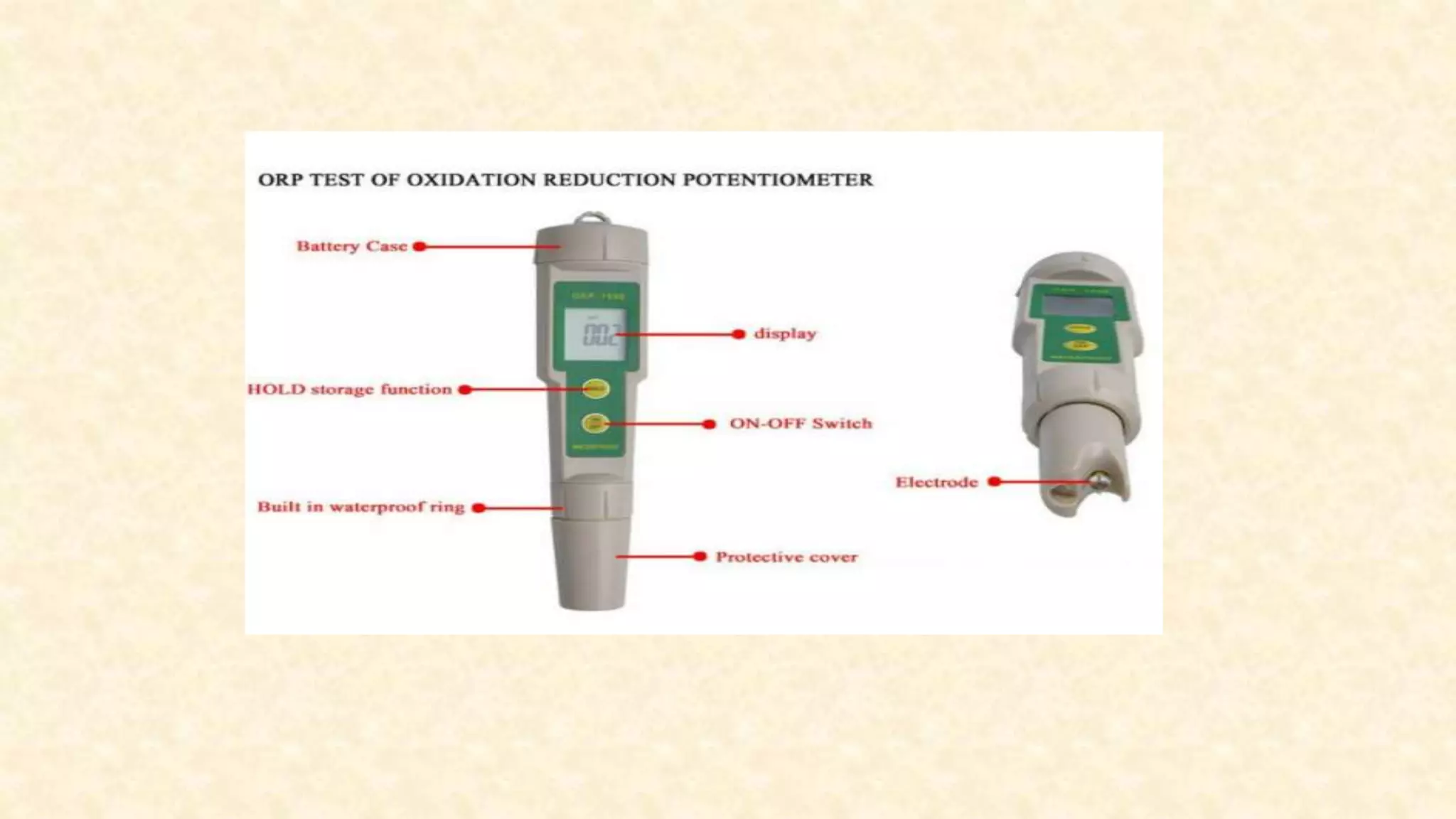
REDOX POTENTIAL MEASUREMENT :
 Assume Cu electrode dipped in cupric solution ( CuSO4) as a test electrode
 At interface copper dissolves from metal and increase the concentration of Cu2+ ion in
solution
 This creates concentration difference of Cu2+ ions between interface and bulk solution
 Therefore potential difference developed between metal and solution (Electrode
potential)
 Electrode potential is calculated through Nernst equation
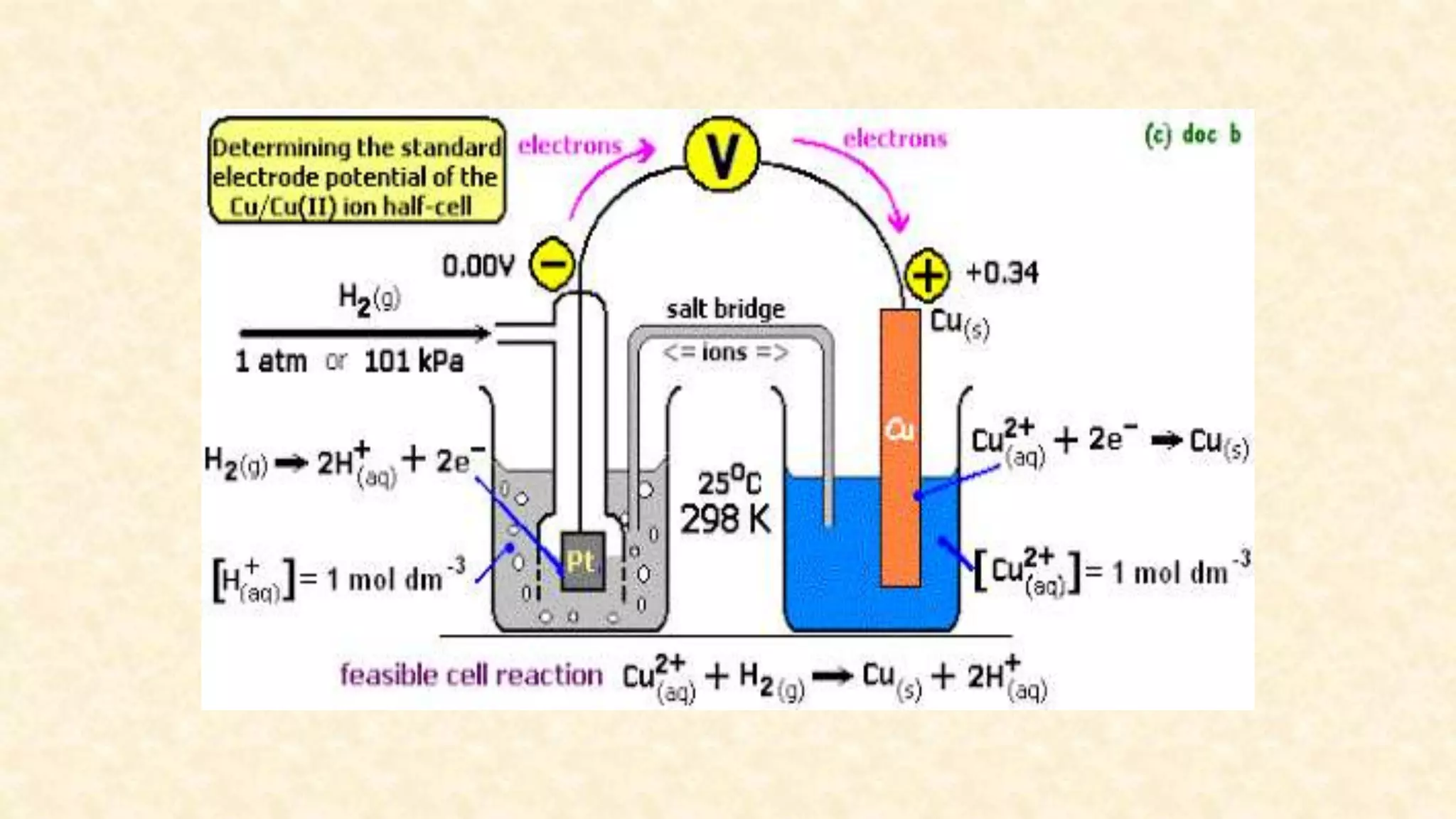
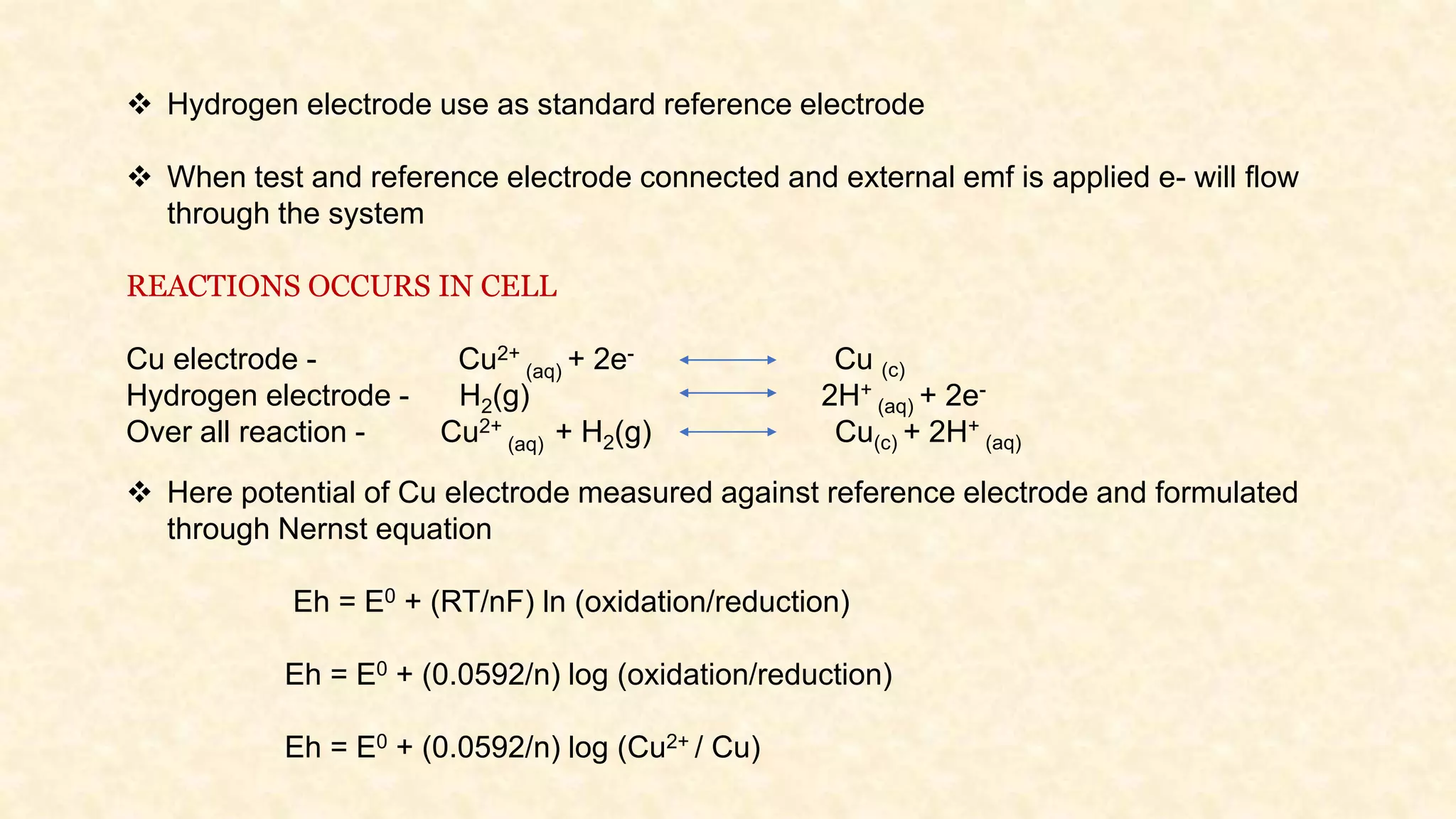
 Hydrogen electrode use as standard reference electrode
 When test and reference electrode connected and external emf is applied e- will flow
through the system
REACTIONS OCCURS IN CELL
Cu electrode - Cu2+
(aq) + 2e- Cu (c)
Hydrogen electrode - H2(g) 2H+
(aq) + 2e-
Over all reaction - Cu2+
(aq) + H2(g) Cu(c) + 2H+
(aq)
 Here potential of Cu electrode measured against reference electrode and formulated
through Nernst equation
Eh = E0 + (RT/nF) ln (oxidation/reduction)
Eh = E0 + (0.0592/n) log (oxidation/reduction)
Eh = E0 + (0.0592/n) log (Cu2+ / Cu)
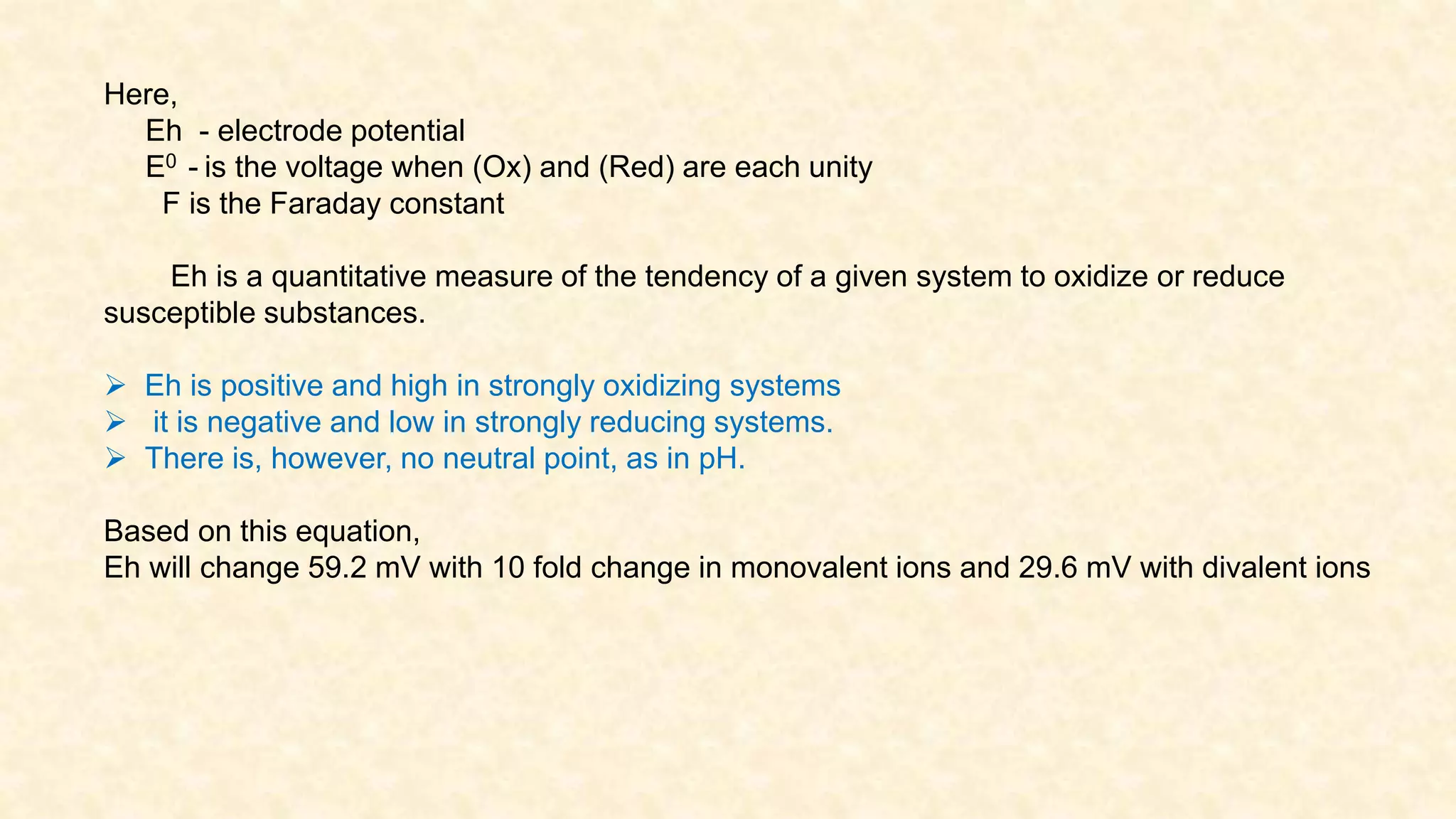
Here,
Eh - electrode potential
E0 - is the voltage when (Ox) and (Red) are each unity
F is the Faraday constant
Eh is a quantitative measure of the tendency of a given system to oxidize or reduce
susceptible substances.
 Eh is positive and high in strongly oxidizing systems
 it is negative and low in strongly reducing systems.
 There is, however, no neutral point, as in pH.
Based on this equation,
Eh will change 59.2 mV with 10 fold change in monovalent ions and 29.6 mV with divalent ions
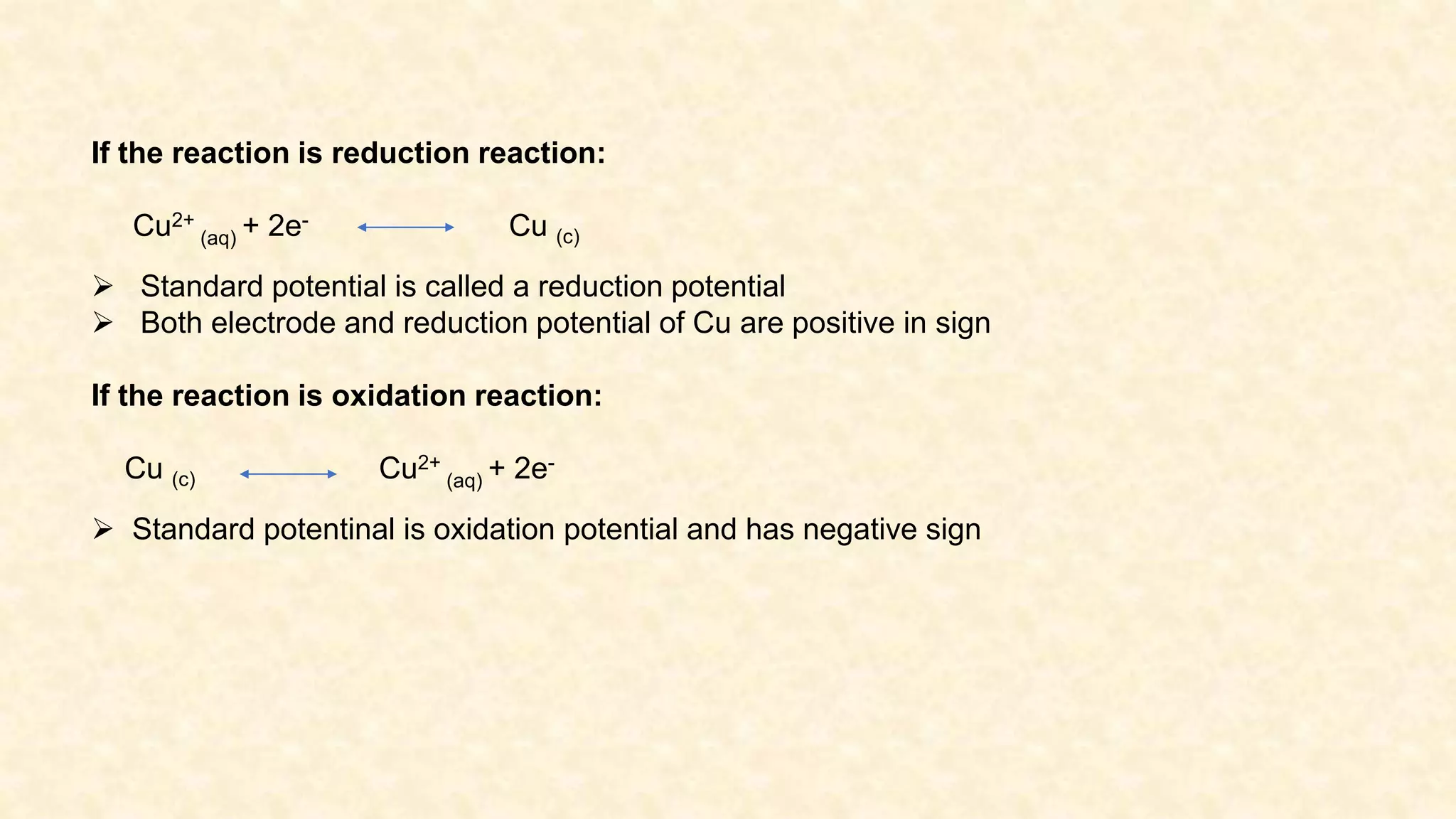
If the reaction is reduction reaction:
Cu2+
(aq) + 2e- Cu (c)
 Standard potential is called a reduction potential
 Both electrode and reduction potential of Cu are positive in sign
If the reaction is oxidation reaction:
Cu (c) Cu2+
(aq) + 2e-
 Standard potentinal is oxidation potential and has negative sign
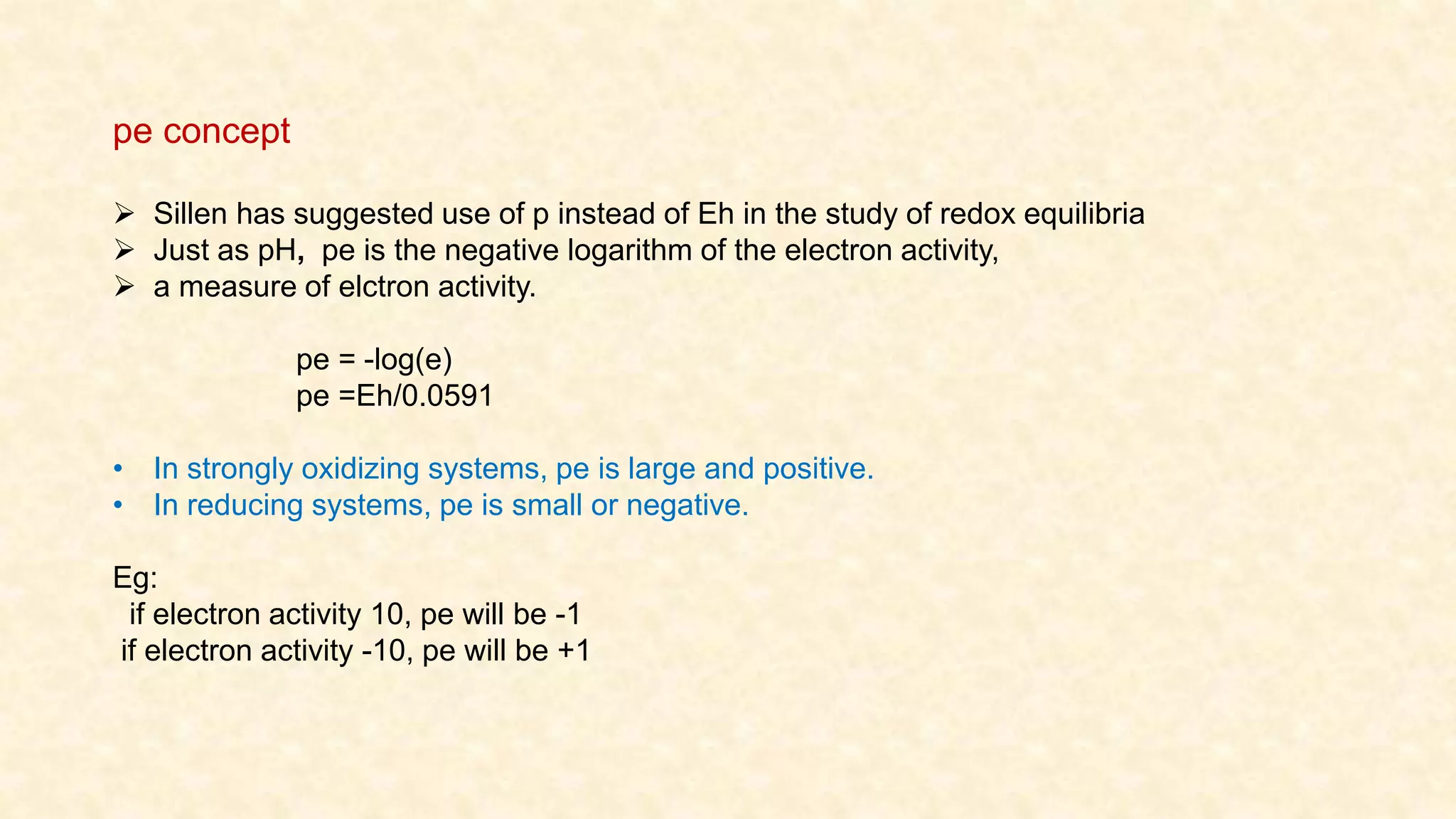
 Sillen has suggested use of p instead of Eh in the study of redox equilibria
 Just as pH, pe is the negative logarithm of the electron activity,
 a measure of elctron activity.
pe = -log(e)
pe =Eh/0.0591
• In strongly oxidizing systems, pe is large and positive.
• In reducing systems, pe is small or negative.
Eg:
if electron activity 10, pe will be -1
if electron activity -10, pe will be +1
pe concept
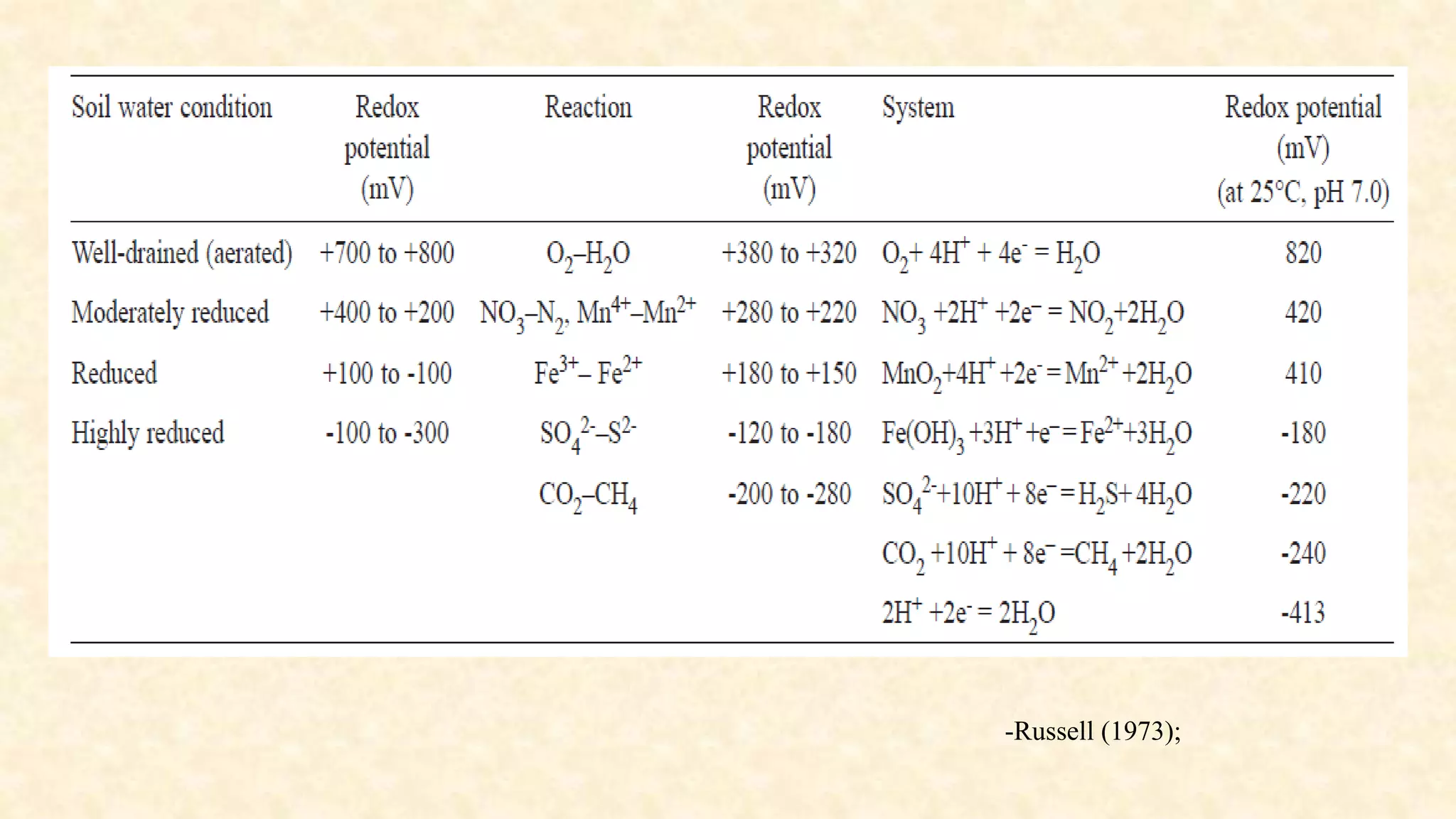
-Russell (1973);
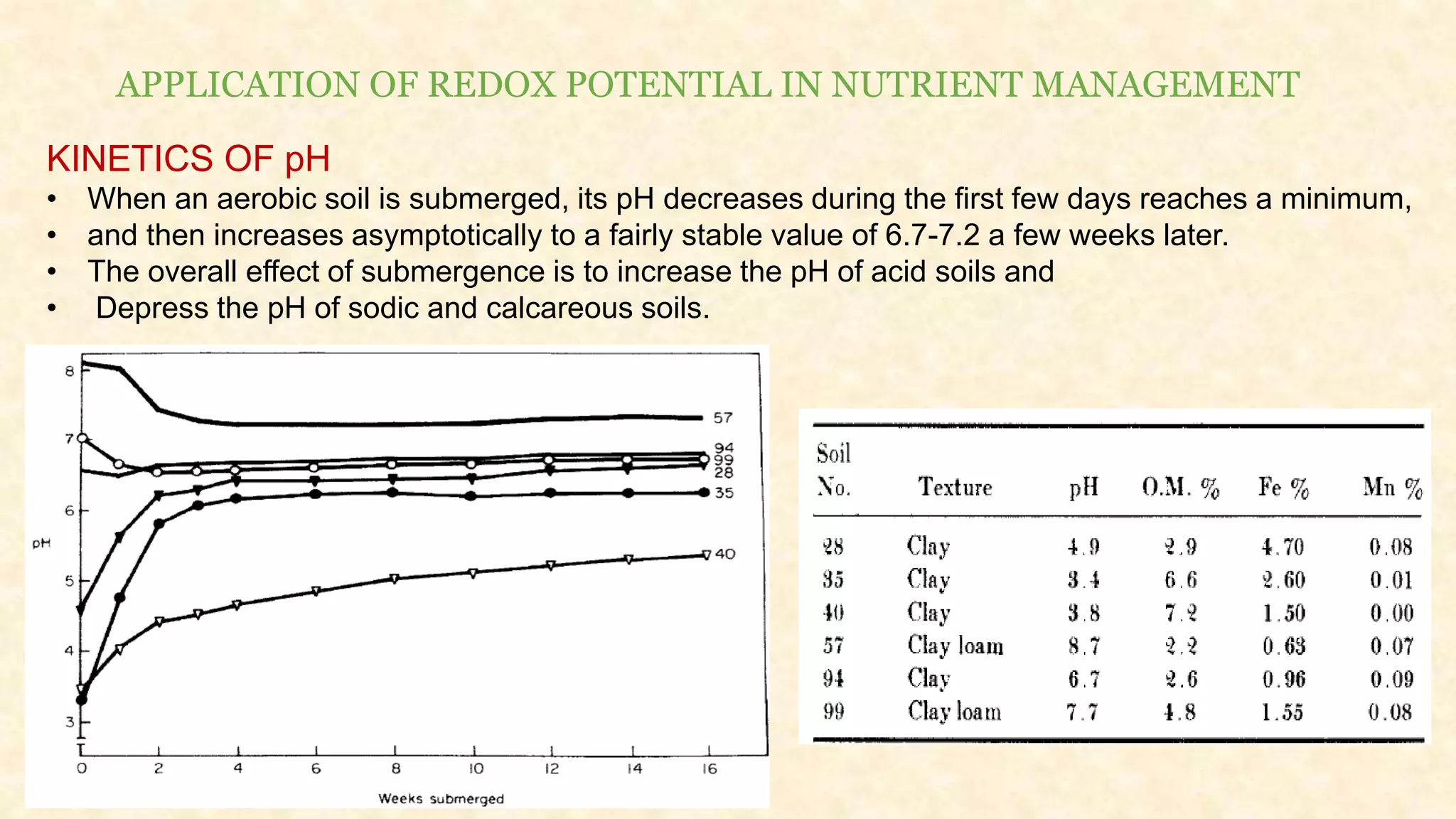
KINETICS OF pH
• When an aerobic soil is submerged, its pH decreases during the first few days reaches a minimum,
• and then increases asymptotically to a fairly stable value of 6.7-7.2 a few weeks later.
• The overall effect of submergence is to increase the pH of acid soils and
• Depress the pH of sodic and calcareous soils.
APPLICATION OF REDOX POTENTIAL IN NUTRIENT MANAGEMENT
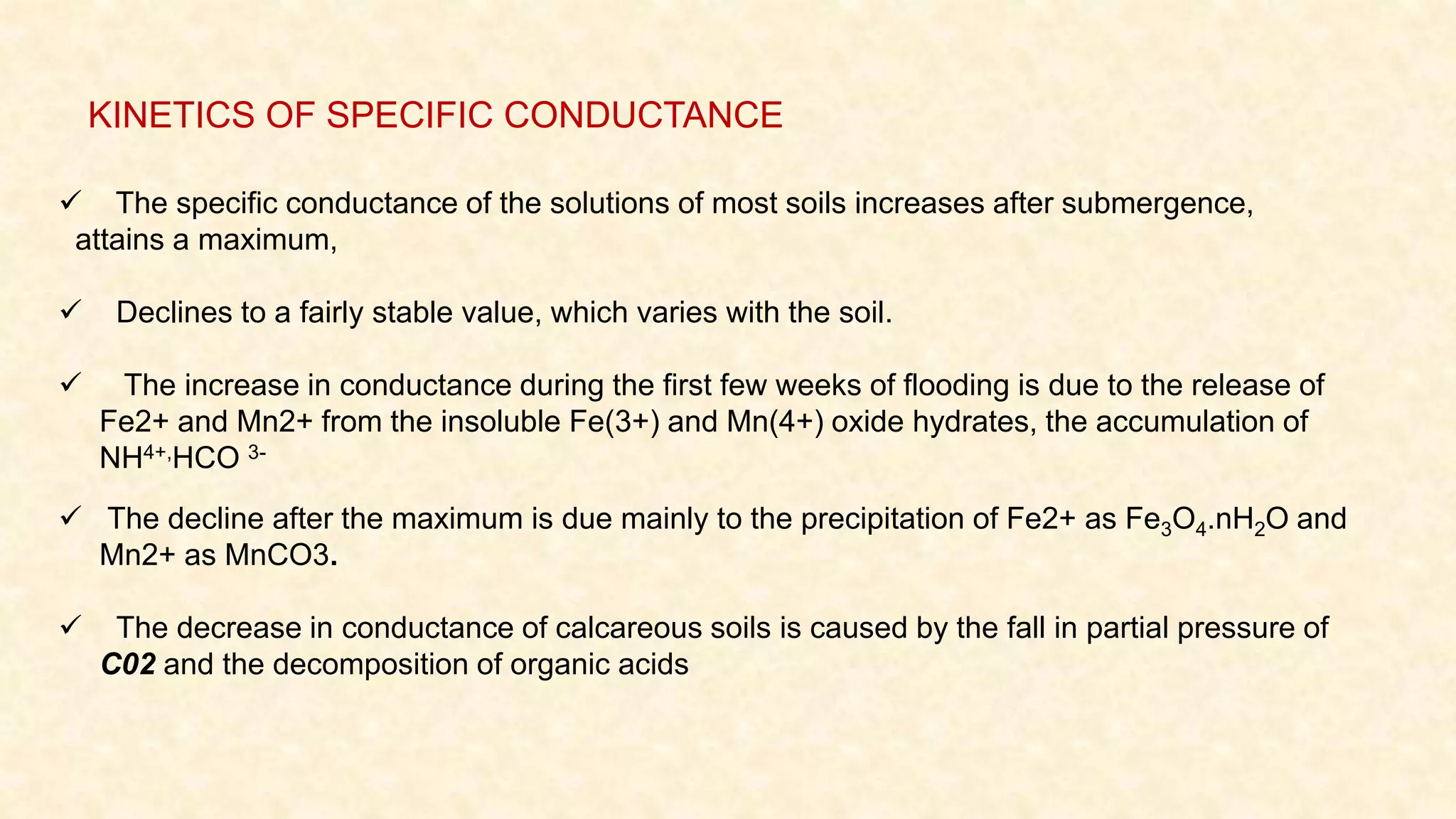
 The specific conductance of the solutions of most soils increases after submergence,
attains a maximum,
 Declines to a fairly stable value, which varies with the soil.
 The increase in conductance during the first few weeks of flooding is due to the release of
Fe2+ and Mn2+ from the insoluble Fe(3+) and Mn(4+) oxide hydrates, the accumulation of
NH4+,HCO 3-
 The decline after the maximum is due mainly to the precipitation of Fe2+ as Fe3O4.nH2O and
Mn2+ as MnCO3.
 The decrease in conductance of calcareous soils is caused by the fall in partial pressure of
C02 and the decomposition of organic acids
KINETICS OF SPECIFIC CONDUCTANCE
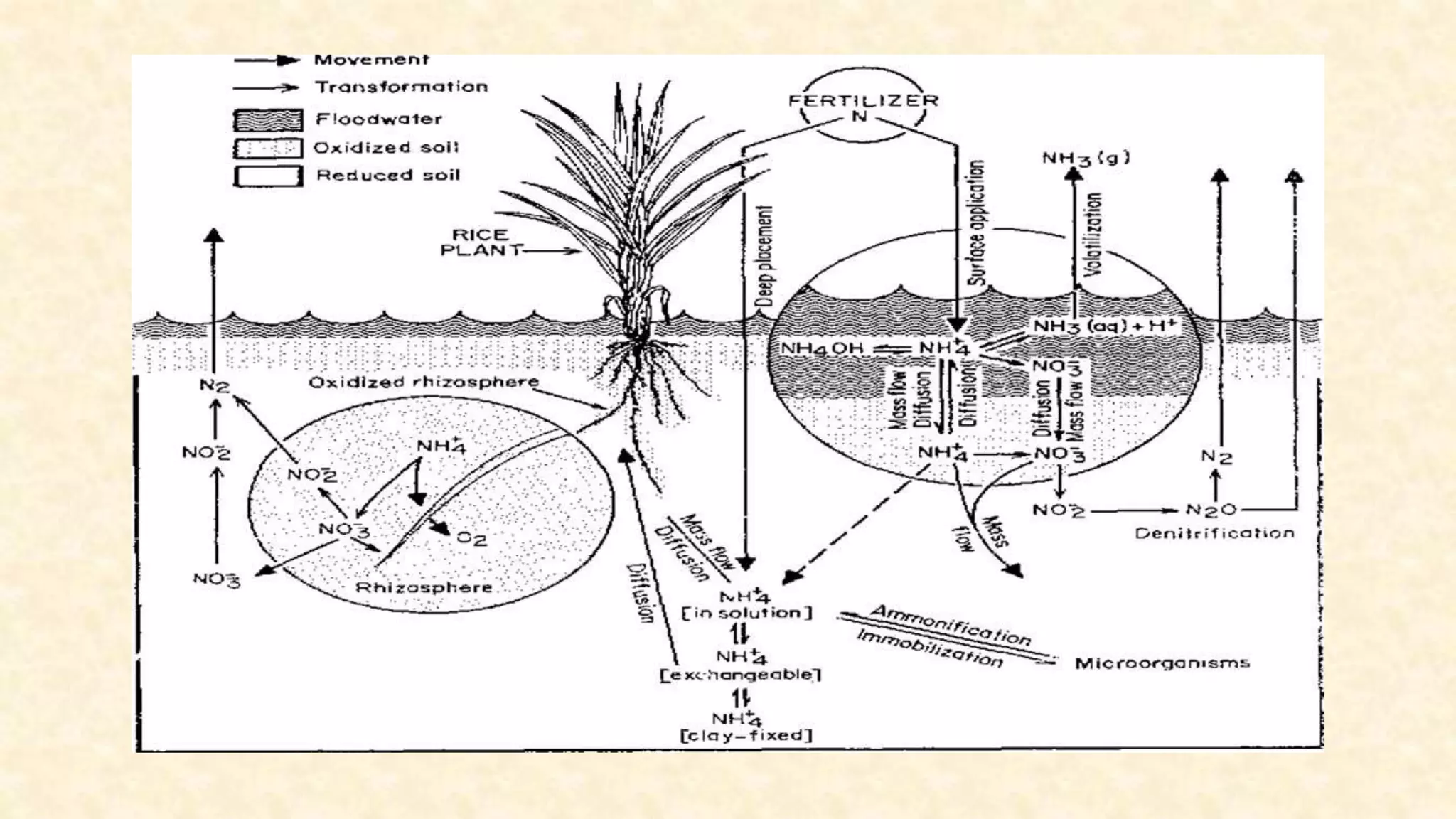
Redox potential affect H,C,N,O,S,Fe,Mn,Cu,Zn
NITROGEN
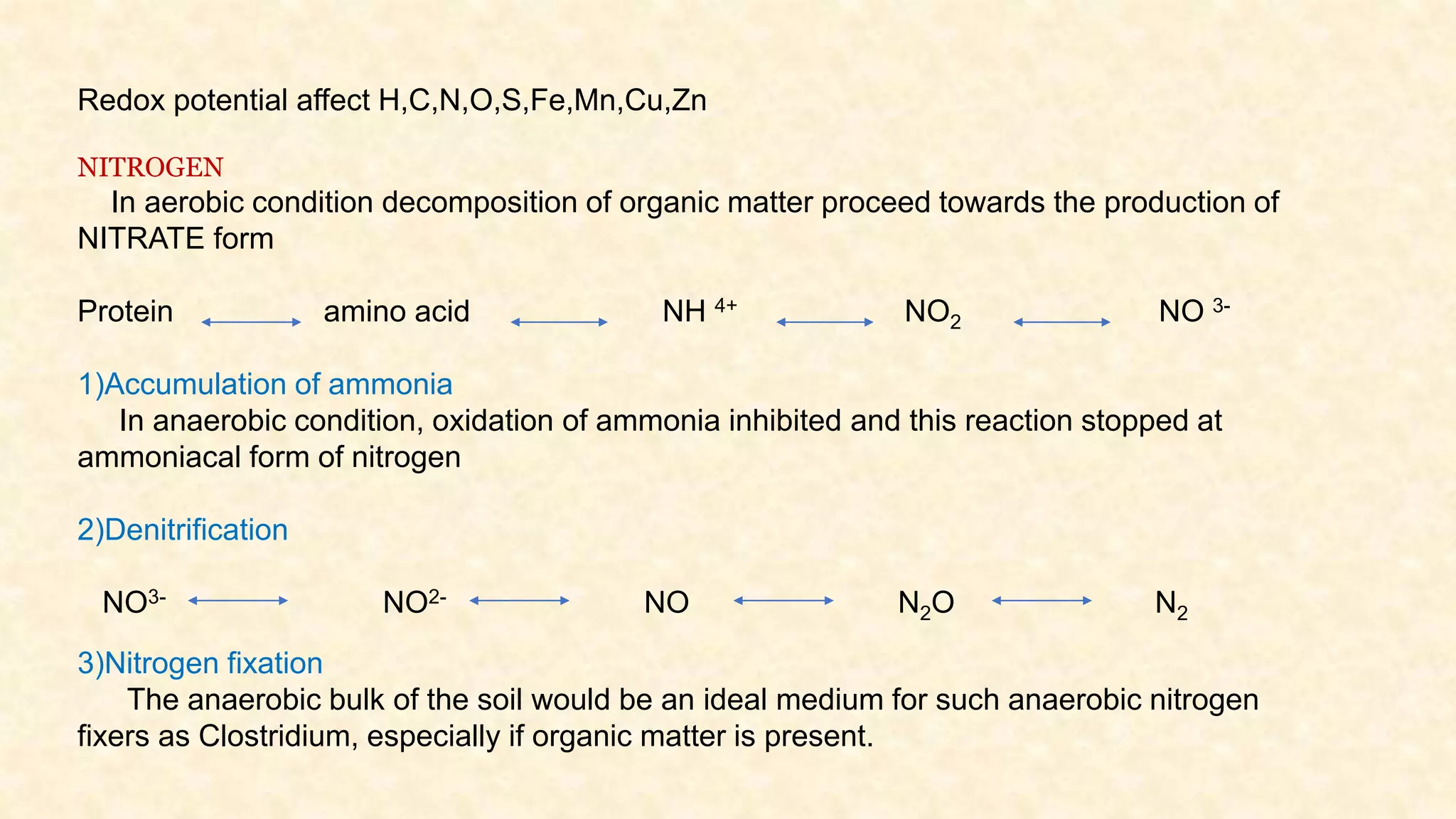
In aerobic condition decomposition of organic matter proceed towards the production of
NITRATE form
Protein amino acid NH 4+ NO2 NO 3-
1)Accumulation of ammonia
In anaerobic condition, oxidation of ammonia inhibited and this reaction stopped at
ammoniacal form of nitrogen
2)Denitrification
NO3- NO2- NO N2O N2
3)Nitrogen fixation
The anaerobic bulk of the soil would be an ideal medium for such anaerobic nitrogen
fixers as Clostridium, especially if organic matter is present.
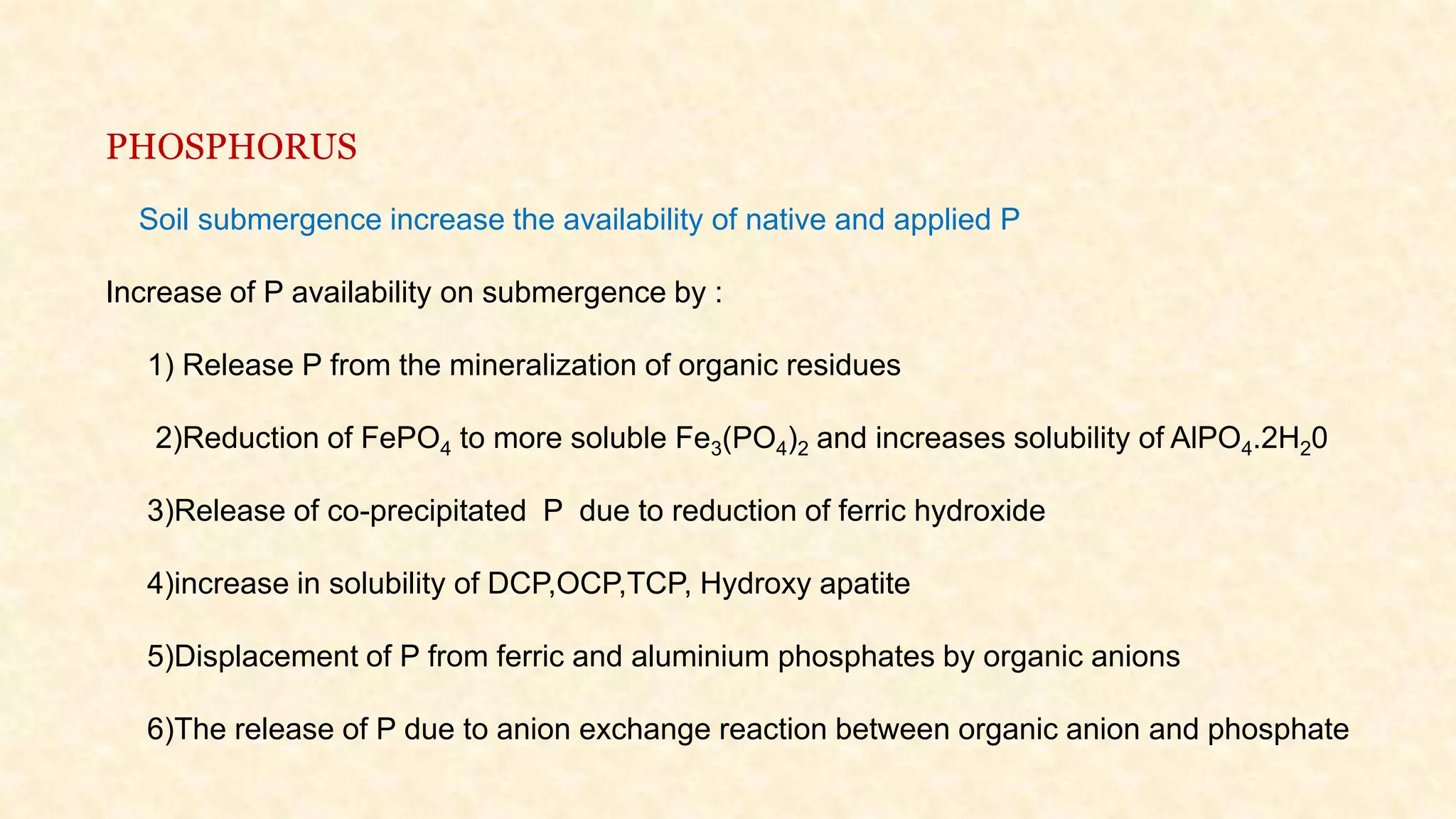
PHOSPHORUS
Soil submergence increase the availability of native and applied P
Increase of P availability on submergence by :
1) Release P from the mineralization of organic residues
2)Reduction of FePO4 to more soluble Fe3(PO4)2 and increases solubility of AlPO4.2H20
3)Release of co-precipitated P due to reduction of ferric hydroxide
4)increase in solubility of DCP,OCP,TCP, Hydroxy apatite
5)Displacement of P from ferric and aluminium phosphates by organic anions
6)The release of P due to anion exchange reaction between organic anion and phosphate
POTASIUM
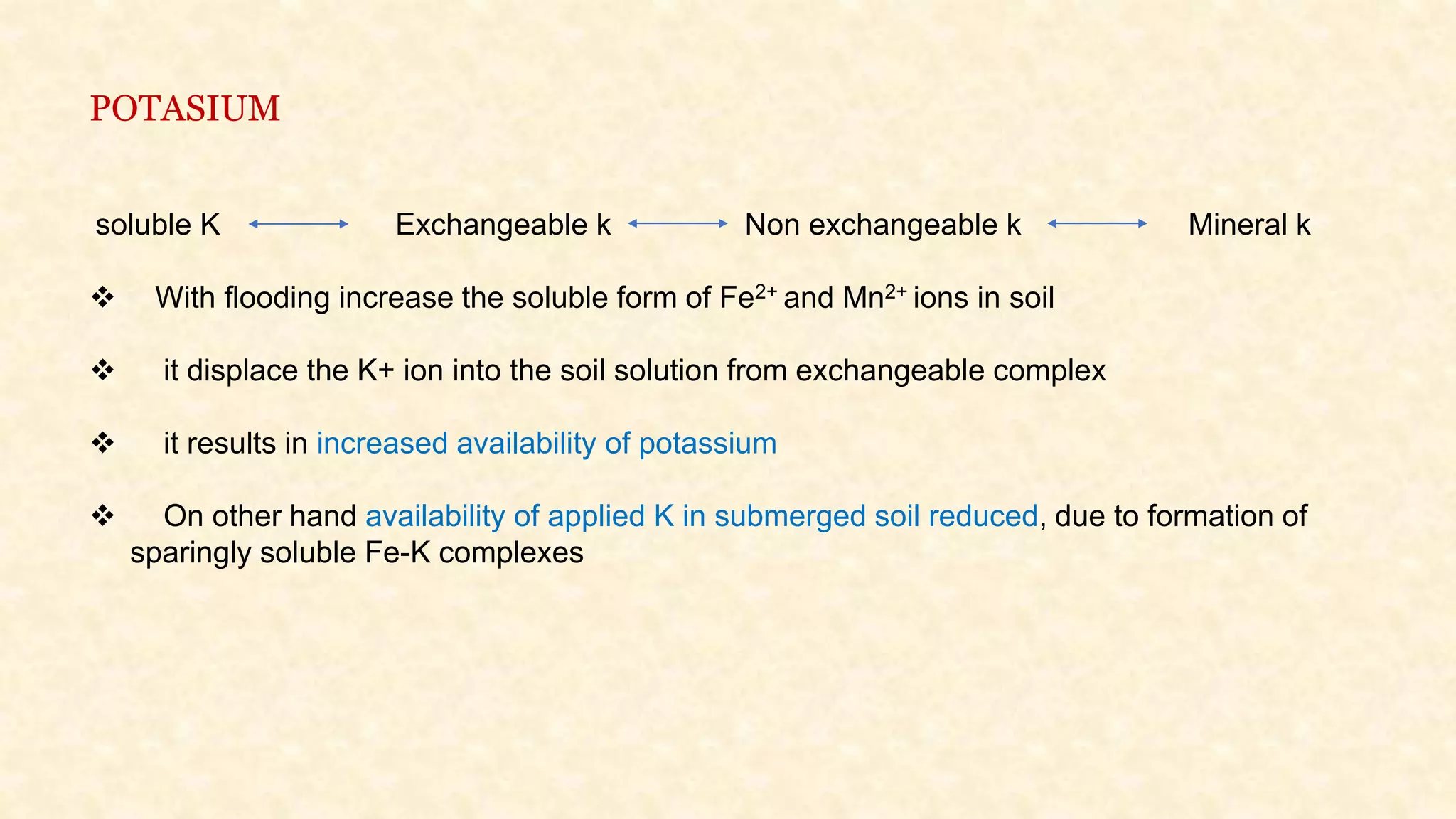
soluble K Exchangeable k Non exchangeable k Mineral k
 With flooding increase the soluble form of Fe2+ and Mn2+ ions in soil
 it displace the K+ ion into the soil solution from exchangeable complex
 it results in increased availability of potassium
 On other hand availability of applied K in submerged soil reduced, due to formation of
sparingly soluble Fe-K complexes
SULPHUR
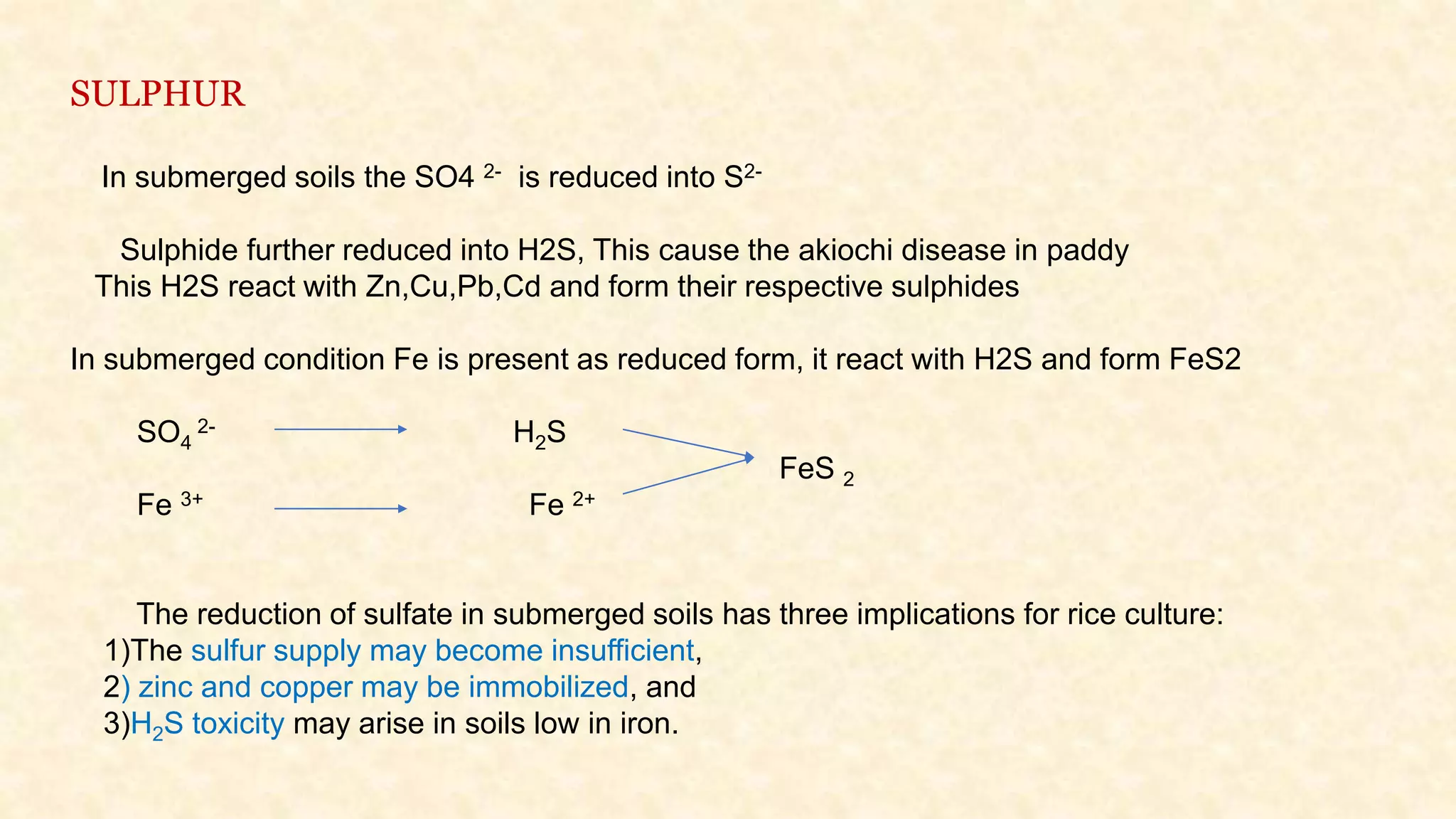
In submerged soils the SO4 2- is reduced into S2-
Sulphide further reduced into H2S, This cause the akiochi disease in paddy
This H2S react with Zn,Cu,Pb,Cd and form their respective sulphides
In submerged condition Fe is present as reduced form, it react with H2S and form FeS2
SO4
2- H2S
FeS 2
Fe 3+ Fe 2+
The reduction of sulfate in submerged soils has three implications for rice culture:
1)The sulfur supply may become insufficient,
2) zinc and copper may be immobilized, and
3)H2S toxicity may arise in soils low in iron.
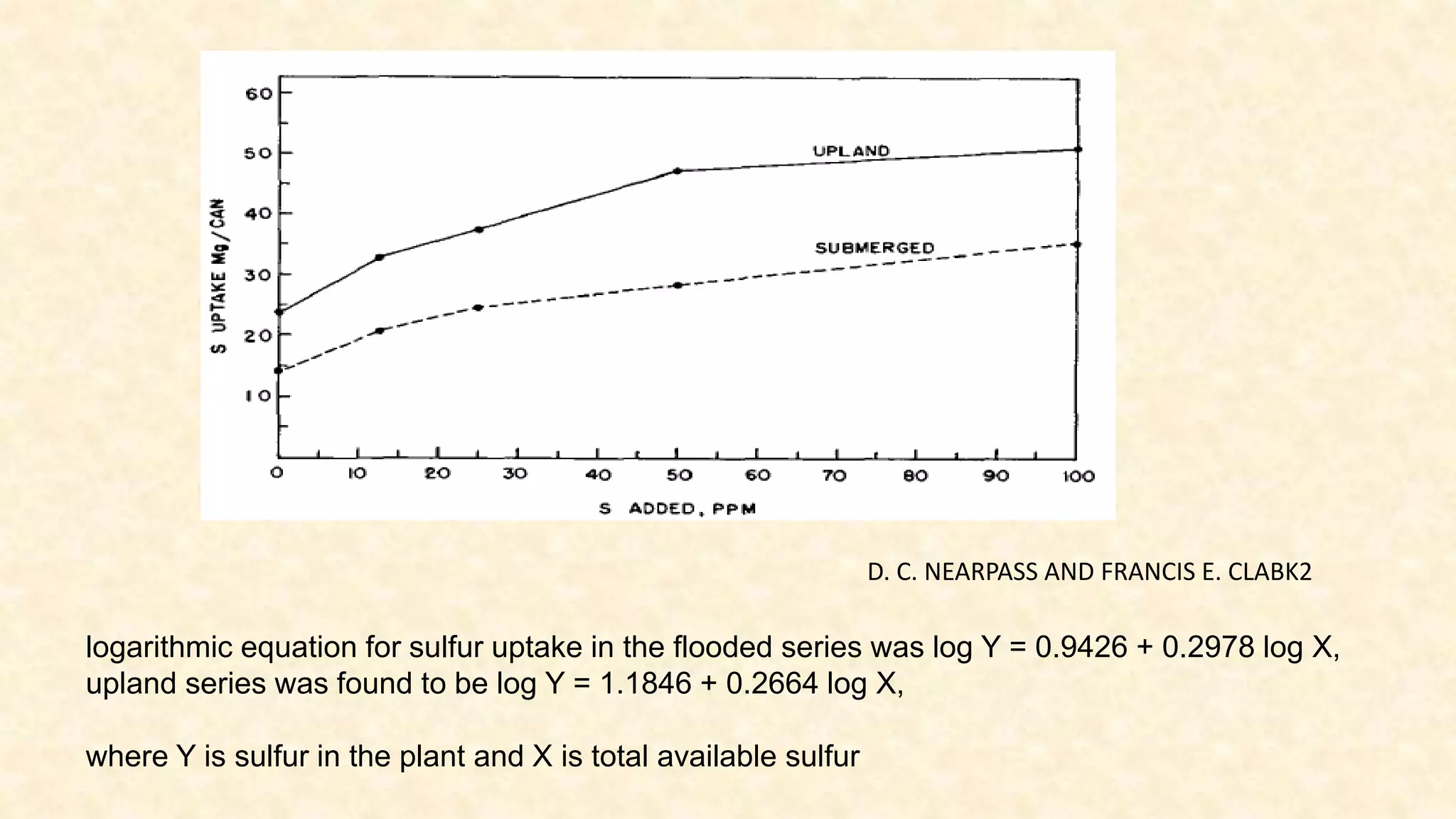
D. C. NEARPASS AND FRANCIS E. CLABK2
logarithmic equation for sulfur uptake in the flooded series was log Y = 0.9426 + 0.2978 log X,
upland series was found to be log Y = 1.1846 + 0.2664 log X,
where Y is sulfur in the plant and X is total available sulfur
IRON
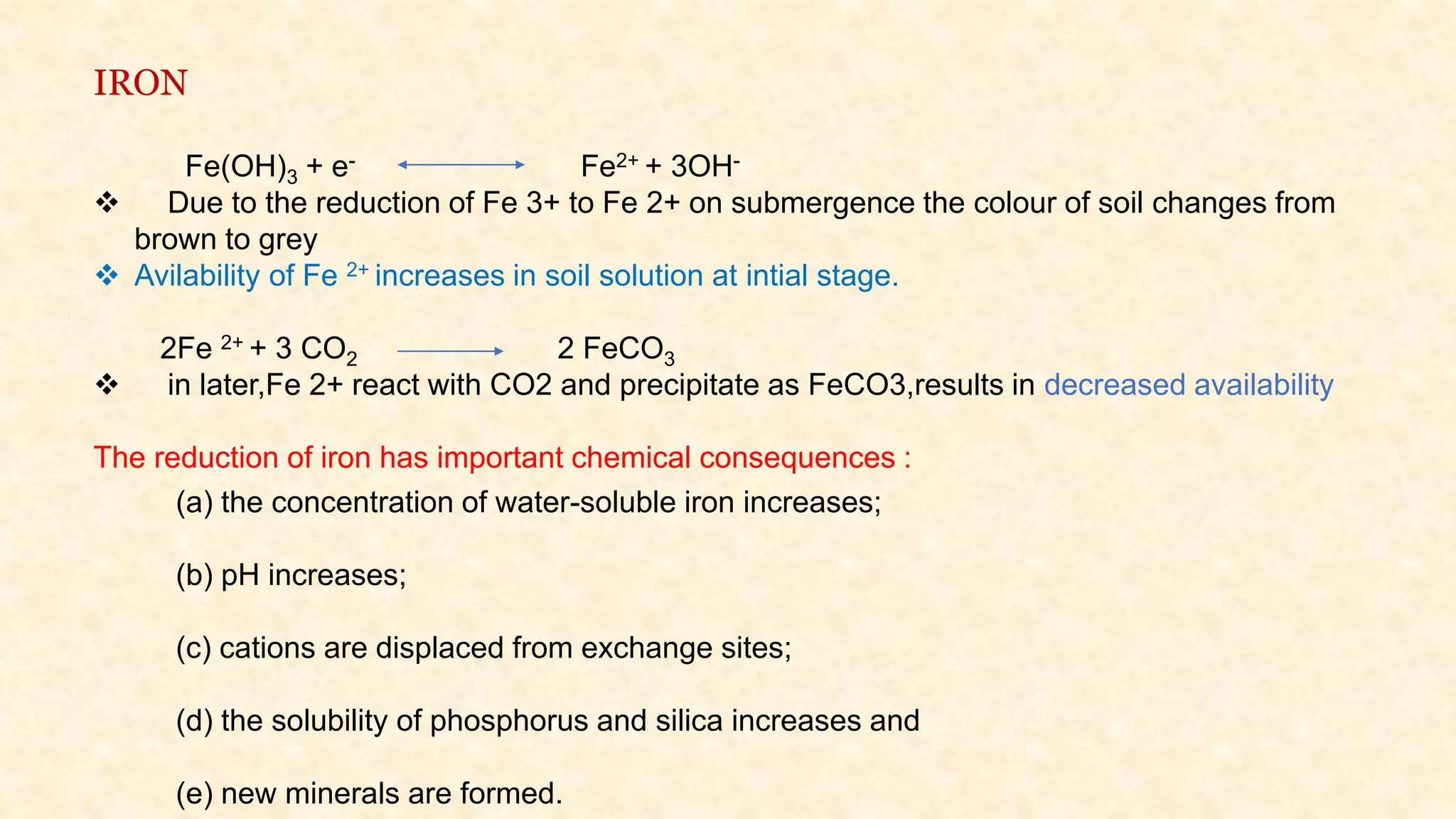
Fe(OH)3 + e- Fe2+ + 3OH-
 Due to the reduction of Fe 3+ to Fe 2+ on submergence the colour of soil changes from
brown to grey
 Avilability of Fe 2+ increases in soil solution at intial stage.
2Fe 2+ + 3 CO2 2 FeCO3
 in later,Fe 2+ react with CO2 and precipitate as FeCO3,results in decreased availability
The reduction of iron has important chemical consequences :
(a) the concentration of water-soluble iron increases;
(b) pH increases;
(c) cations are displaced from exchange sites;
(d) the solubility of phosphorus and silica increases and
(e) new minerals are formed.
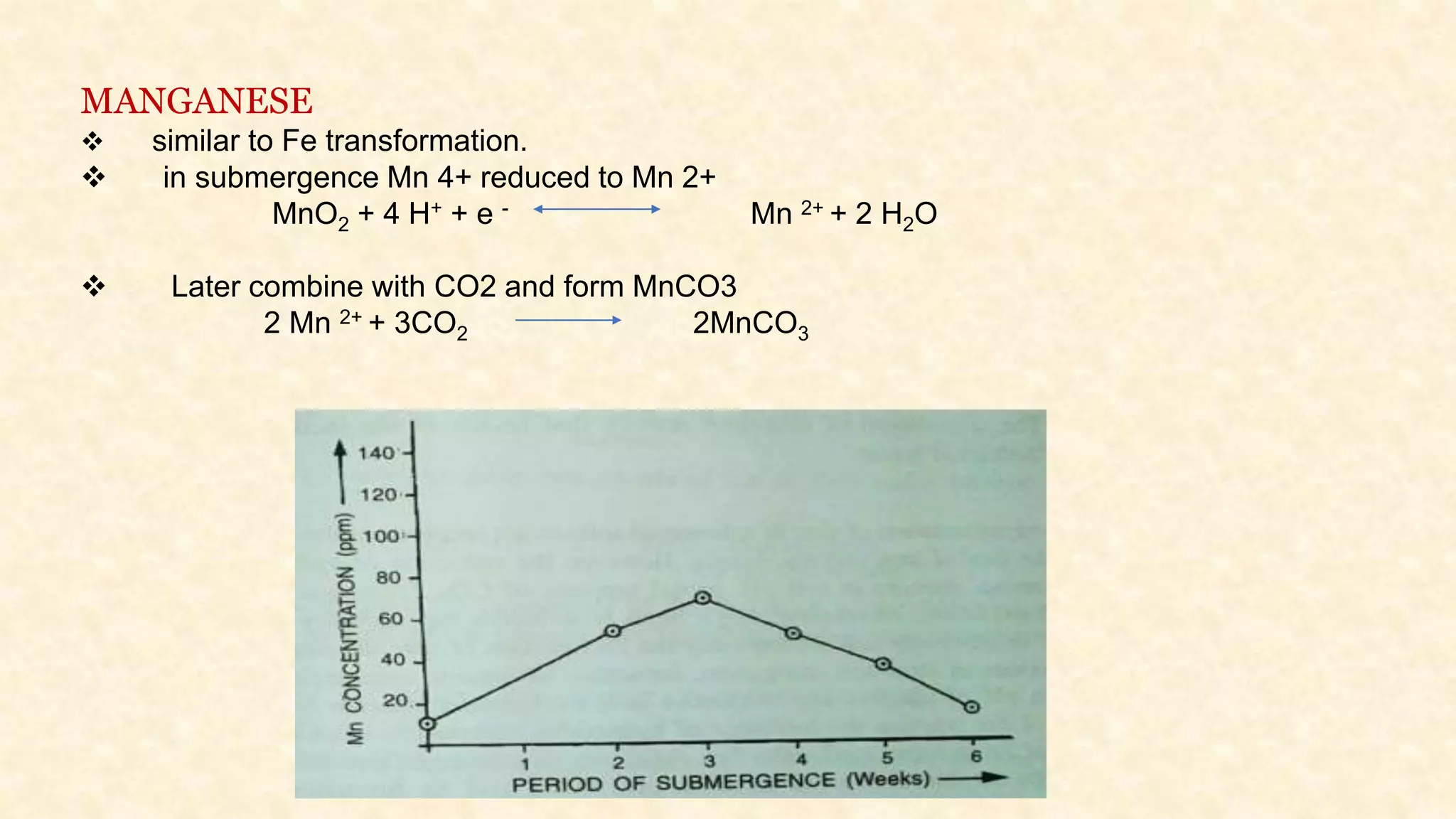
MANGANESE
 similar to Fe transformation.
 in submergence Mn 4+ reduced to Mn 2+
MnO2 + 4 H+ + e - Mn 2+ + 2 H2O
 Later combine with CO2 and form MnCO3
2 Mn 2+ + 3CO2 2MnCO3
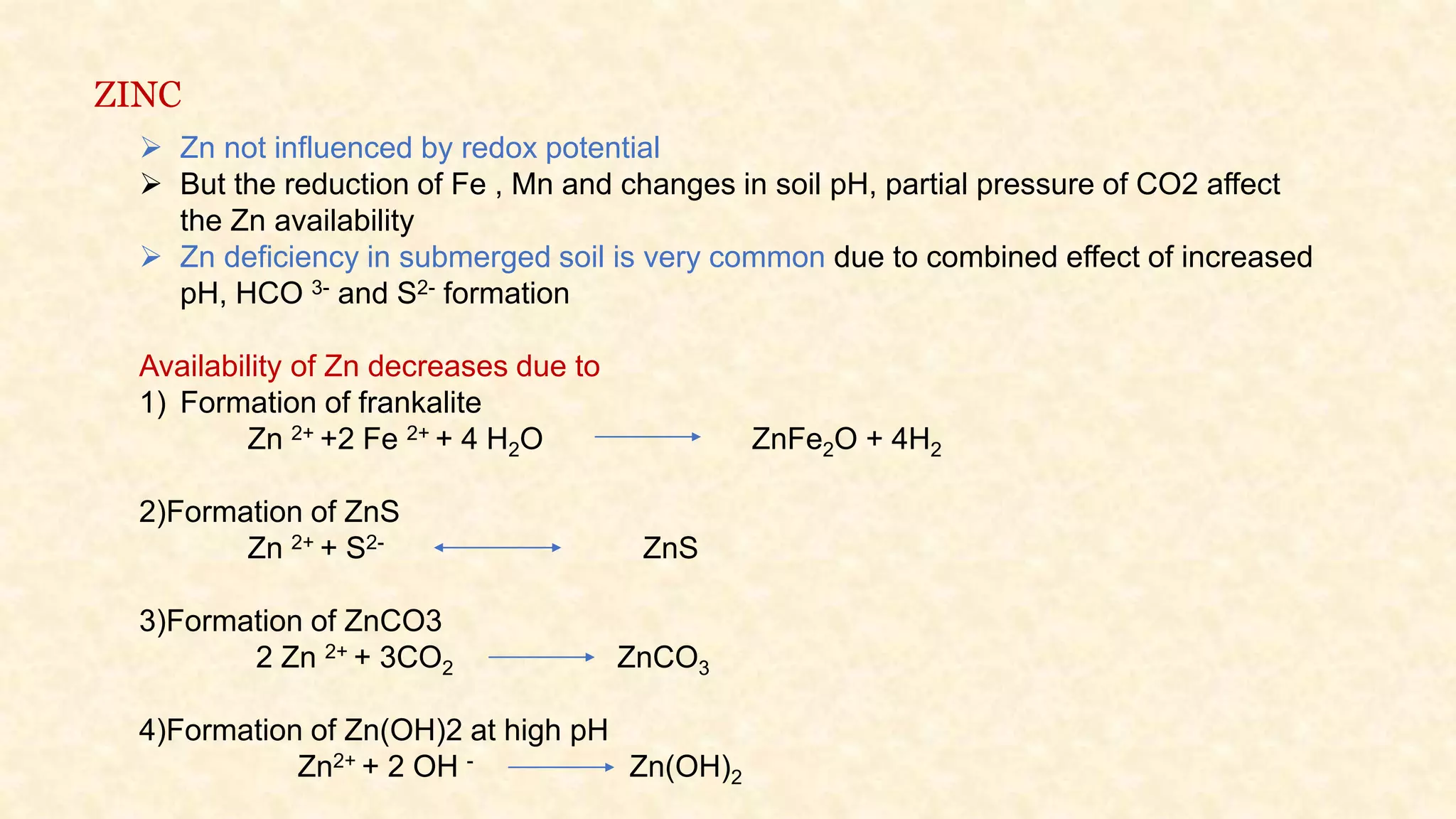
 Zn not influenced by redox potential
 But the reduction of Fe , Mn and changes in soil pH, partial pressure of CO2 affect
the Zn availability
 Zn deficiency in submerged soil is very common due to combined effect of increased
pH, HCO 3- and S2- formation
Availability of Zn decreases due to
1) Formation of frankalite
Zn 2+ +2 Fe 2+ + 4 H2O ZnFe2O + 4H2
2)Formation of ZnS
Zn 2+ + S2- ZnS
3)Formation of ZnCO3
2 Zn 2+ + 3CO2 ZnCO3
4)Formation of Zn(OH)2 at high pH
Zn2+ + 2 OH - Zn(OH)2
ZINC
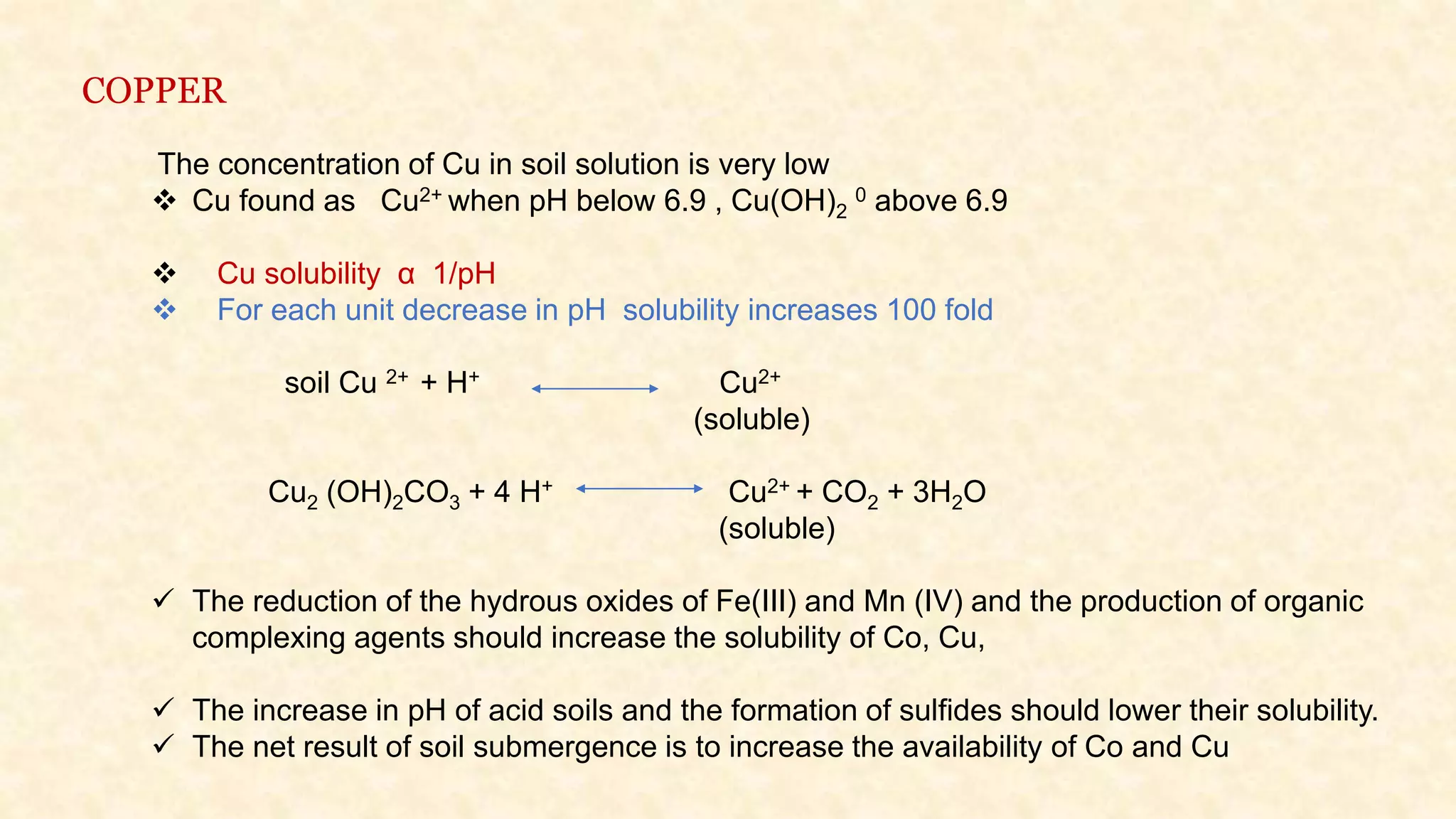
The concentration of Cu in soil solution is very low
 Cu found as Cu2+ when pH below 6.9 , Cu(OH)2
0 above 6.9
 Cu solubility α 1/pH
 For each unit decrease in pH solubility increases 100 fold
soil Cu 2+ + H+ Cu2+
(soluble)
Cu2 (OH)2CO3 + 4 H+ Cu2+ + CO2 + 3H2O
(soluble)
 The reduction of the hydrous oxides of Fe(III) and Mn (IV) and the production of organic
complexing agents should increase the solubility of Co, Cu,
 The increase in pH of acid soils and the formation of sulfides should lower their solubility.
 The net result of soil submergence is to increase the availability of Co and Cu
COPPER
REFERENCE
 REDOX POTENTIAL –R D DELAUNE ,K R REDDY
 THE CHEMISTRY OF SUBMERGED SOILS - F . N . PONNAMPERUMA
 INTERLINKED CHEMICAL-BIOLOGICAL PROCESSES IN ANOXIC WATERLOGGED SOIL – A
REVIEW - DEBARATI BHADURI, ASIT MANDAL, KOUSHIK CHAKRABORTY
 CHEMISTRY OF LOWLAND RICE SOILS AND NUTRIENT AVAILABILITY
N. K. FAGERIA , G. D. CARVALHO , A. B. SANTOS
 REDOX POTENTIAL MEASUREMENTS - M.J. VEPRASKAS
 AVAILABILITY OF SULFUR TO RICE PLANTS IN SUBMERGED AND UPLAND SOIL
D. C. NEARPASS AND FRANCIS E. CLABK
 PRINCIPLES OF SOIL CHEMISTRY – KIM H. TAN
 INTRODUCTOTY SOIL SCIENCE – D K DAS
REDOX POTENTIAL MEASUREMENT AND  ITS APPLICATION IN SOIL FERTILITY

REDOX POTENTIAL MEASUREMENT AND ITS APPLICATION IN SOIL FERTILITY

  • 1.
    TAMIL NADU AGRICULTURALUNIVERSITY REDOX POTENTIAL MEASUREMENT AND ITS APPLICATION IN SOIL FERTILITY B.KARTHIKEYAN 2019520103 SOIL SCIENCE& AGRL.CHEMISTRY AC&RI MADURAI SAC 511- ANALYTICAL TECHNIQUES AND INSTRUMENTAL METHODS IN SOIL AND PLANT ANALYSIS
  • 2.
    NUT SHELL  REDOXREACTIONS  REDOX POTENTIAL MEASUREMENTS  Pe CONCEPT  KINETICS OF pH  KINETICS OF EC  NUTRIENT DYNAMICS UNDER SUBMERGENCE  REFERENCE
  • 3.
    OXIDATION 1)Gain of oxygen(or) 2)Loss of hydrogen (or) 3)Loss of electrons during a reaction by a molecule, atom or ion. REDUCTION 1)Loss of oxygen (or) 2)Gain of hydrogen (or) 3)Gain of electrons during a reaction by a molecule, atom or ion. (Reduction) Eg : Fe3+ + e- Fe2+ (Oxidation) In soil oxidation and reduction reaction occur simultaneously. Normally in well drained in soil surface layer is in oxidized condition, sub soil is reduced condition REDOX REACTION
  • 4.
    Redox potential isa measure of the tendency of a chemical species to acquire electrons from or lose electrons to an electrode and thereby be reduced or oxidised respectively. Redox potential is measured in volts (V), or millivolts (mV) REDOX POTENTIAL : REDOX POTENTIAL MEASUREMENT :  Assume Cu electrode dipped in cupric solution ( CuSO4) as a test electrode  At interface copper dissolves from metal and increase the concentration of Cu2+ ion in solution  This creates concentration difference of Cu2+ ions between interface and bulk solution  Therefore potential difference developed between metal and solution (Electrode potential)  Electrode potential is calculated through Nernst equation
  • 7.
     Hydrogen electrodeuse as standard reference electrode  When test and reference electrode connected and external emf is applied e- will flow through the system REACTIONS OCCURS IN CELL Cu electrode - Cu2+ (aq) + 2e- Cu (c) Hydrogen electrode - H2(g) 2H+ (aq) + 2e- Over all reaction - Cu2+ (aq) + H2(g) Cu(c) + 2H+ (aq)  Here potential of Cu electrode measured against reference electrode and formulated through Nernst equation Eh = E0 + (RT/nF) ln (oxidation/reduction) Eh = E0 + (0.0592/n) log (oxidation/reduction) Eh = E0 + (0.0592/n) log (Cu2+ / Cu)
  • 8.
    Here, Eh - electrodepotential E0 - is the voltage when (Ox) and (Red) are each unity F is the Faraday constant Eh is a quantitative measure of the tendency of a given system to oxidize or reduce susceptible substances.  Eh is positive and high in strongly oxidizing systems  it is negative and low in strongly reducing systems.  There is, however, no neutral point, as in pH. Based on this equation, Eh will change 59.2 mV with 10 fold change in monovalent ions and 29.6 mV with divalent ions
  • 9.
    If the reactionis reduction reaction: Cu2+ (aq) + 2e- Cu (c)  Standard potential is called a reduction potential  Both electrode and reduction potential of Cu are positive in sign If the reaction is oxidation reaction: Cu (c) Cu2+ (aq) + 2e-  Standard potentinal is oxidation potential and has negative sign
  • 10.
     Sillen hassuggested use of p instead of Eh in the study of redox equilibria  Just as pH, pe is the negative logarithm of the electron activity,  a measure of elctron activity. pe = -log(e) pe =Eh/0.0591 • In strongly oxidizing systems, pe is large and positive. • In reducing systems, pe is small or negative. Eg: if electron activity 10, pe will be -1 if electron activity -10, pe will be +1 pe concept
  • 11.
  • 12.
    KINETICS OF pH •When an aerobic soil is submerged, its pH decreases during the first few days reaches a minimum, • and then increases asymptotically to a fairly stable value of 6.7-7.2 a few weeks later. • The overall effect of submergence is to increase the pH of acid soils and • Depress the pH of sodic and calcareous soils. APPLICATION OF REDOX POTENTIAL IN NUTRIENT MANAGEMENT
  • 13.
     The specificconductance of the solutions of most soils increases after submergence, attains a maximum,  Declines to a fairly stable value, which varies with the soil.  The increase in conductance during the first few weeks of flooding is due to the release of Fe2+ and Mn2+ from the insoluble Fe(3+) and Mn(4+) oxide hydrates, the accumulation of NH4+,HCO 3-  The decline after the maximum is due mainly to the precipitation of Fe2+ as Fe3O4.nH2O and Mn2+ as MnCO3.  The decrease in conductance of calcareous soils is caused by the fall in partial pressure of C02 and the decomposition of organic acids KINETICS OF SPECIFIC CONDUCTANCE
  • 14.
    Redox potential affectH,C,N,O,S,Fe,Mn,Cu,Zn NITROGEN In aerobic condition decomposition of organic matter proceed towards the production of NITRATE form Protein amino acid NH 4+ NO2 NO 3- 1)Accumulation of ammonia In anaerobic condition, oxidation of ammonia inhibited and this reaction stopped at ammoniacal form of nitrogen 2)Denitrification NO3- NO2- NO N2O N2 3)Nitrogen fixation The anaerobic bulk of the soil would be an ideal medium for such anaerobic nitrogen fixers as Clostridium, especially if organic matter is present.
  • 16.
    PHOSPHORUS Soil submergence increasethe availability of native and applied P Increase of P availability on submergence by : 1) Release P from the mineralization of organic residues 2)Reduction of FePO4 to more soluble Fe3(PO4)2 and increases solubility of AlPO4.2H20 3)Release of co-precipitated P due to reduction of ferric hydroxide 4)increase in solubility of DCP,OCP,TCP, Hydroxy apatite 5)Displacement of P from ferric and aluminium phosphates by organic anions 6)The release of P due to anion exchange reaction between organic anion and phosphate
  • 17.
    POTASIUM soluble K Exchangeablek Non exchangeable k Mineral k  With flooding increase the soluble form of Fe2+ and Mn2+ ions in soil  it displace the K+ ion into the soil solution from exchangeable complex  it results in increased availability of potassium  On other hand availability of applied K in submerged soil reduced, due to formation of sparingly soluble Fe-K complexes
  • 18.
    SULPHUR In submerged soilsthe SO4 2- is reduced into S2- Sulphide further reduced into H2S, This cause the akiochi disease in paddy This H2S react with Zn,Cu,Pb,Cd and form their respective sulphides In submerged condition Fe is present as reduced form, it react with H2S and form FeS2 SO4 2- H2S FeS 2 Fe 3+ Fe 2+ The reduction of sulfate in submerged soils has three implications for rice culture: 1)The sulfur supply may become insufficient, 2) zinc and copper may be immobilized, and 3)H2S toxicity may arise in soils low in iron.
  • 19.
    D. C. NEARPASSAND FRANCIS E. CLABK2 logarithmic equation for sulfur uptake in the flooded series was log Y = 0.9426 + 0.2978 log X, upland series was found to be log Y = 1.1846 + 0.2664 log X, where Y is sulfur in the plant and X is total available sulfur
  • 20.
    IRON Fe(OH)3 + e-Fe2+ + 3OH-  Due to the reduction of Fe 3+ to Fe 2+ on submergence the colour of soil changes from brown to grey  Avilability of Fe 2+ increases in soil solution at intial stage. 2Fe 2+ + 3 CO2 2 FeCO3  in later,Fe 2+ react with CO2 and precipitate as FeCO3,results in decreased availability The reduction of iron has important chemical consequences : (a) the concentration of water-soluble iron increases; (b) pH increases; (c) cations are displaced from exchange sites; (d) the solubility of phosphorus and silica increases and (e) new minerals are formed.
  • 21.
    MANGANESE  similar toFe transformation.  in submergence Mn 4+ reduced to Mn 2+ MnO2 + 4 H+ + e - Mn 2+ + 2 H2O  Later combine with CO2 and form MnCO3 2 Mn 2+ + 3CO2 2MnCO3
  • 22.
     Zn notinfluenced by redox potential  But the reduction of Fe , Mn and changes in soil pH, partial pressure of CO2 affect the Zn availability  Zn deficiency in submerged soil is very common due to combined effect of increased pH, HCO 3- and S2- formation Availability of Zn decreases due to 1) Formation of frankalite Zn 2+ +2 Fe 2+ + 4 H2O ZnFe2O + 4H2 2)Formation of ZnS Zn 2+ + S2- ZnS 3)Formation of ZnCO3 2 Zn 2+ + 3CO2 ZnCO3 4)Formation of Zn(OH)2 at high pH Zn2+ + 2 OH - Zn(OH)2 ZINC
  • 23.
    The concentration ofCu in soil solution is very low  Cu found as Cu2+ when pH below 6.9 , Cu(OH)2 0 above 6.9  Cu solubility α 1/pH  For each unit decrease in pH solubility increases 100 fold soil Cu 2+ + H+ Cu2+ (soluble) Cu2 (OH)2CO3 + 4 H+ Cu2+ + CO2 + 3H2O (soluble)  The reduction of the hydrous oxides of Fe(III) and Mn (IV) and the production of organic complexing agents should increase the solubility of Co, Cu,  The increase in pH of acid soils and the formation of sulfides should lower their solubility.  The net result of soil submergence is to increase the availability of Co and Cu COPPER
  • 25.
    REFERENCE  REDOX POTENTIAL–R D DELAUNE ,K R REDDY  THE CHEMISTRY OF SUBMERGED SOILS - F . N . PONNAMPERUMA  INTERLINKED CHEMICAL-BIOLOGICAL PROCESSES IN ANOXIC WATERLOGGED SOIL – A REVIEW - DEBARATI BHADURI, ASIT MANDAL, KOUSHIK CHAKRABORTY  CHEMISTRY OF LOWLAND RICE SOILS AND NUTRIENT AVAILABILITY N. K. FAGERIA , G. D. CARVALHO , A. B. SANTOS  REDOX POTENTIAL MEASUREMENTS - M.J. VEPRASKAS  AVAILABILITY OF SULFUR TO RICE PLANTS IN SUBMERGED AND UPLAND SOIL D. C. NEARPASS AND FRANCIS E. CLABK  PRINCIPLES OF SOIL CHEMISTRY – KIM H. TAN  INTRODUCTOTY SOIL SCIENCE – D K DAS