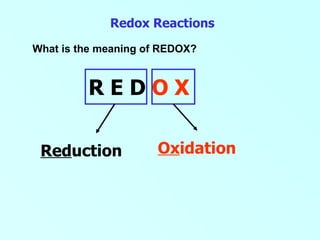
Redox Reactions What is the meaning of REDOX? R E D  O X Ox idation Red uction
Examples of Redox Reactions which occur in daily life Combustion Corrosion/Rusting Photosynthesis Respiration
 
Defn 1 (In terms of oxygen) Oxidation = addition/gain of oxygen A substance that gains oxygen is said to be oxidised. Reduction = removal/loss of oxygen. A substance that loses oxygen is said to be reduced.
Example based on Defn 1 (In terms of oxygen) Zn  +  PbO  -> ZnO  + Pb Zinc (Zn)  is oxidised because  it gains oxygen to form zinc oxide . Lead (II) oxide (PbO)  is reduced because it  loses oxygen to form lead .   When one substance is oxidised, another substance must be reduced.  Oxidation and reduction take place at the same time. Such reactions are called  REDOX  reactions.
Example based on Defn 1 (In terms of oxygen) 2. Fe 2 O 3   +  3CO  -> 2Fe  + 3CO 2 Carbon monoxide (CO) is oxidised. Iron (III) oxide (Fe 2 O 3 ) is reduced.
Defn 2 (In terms of hydrogen) Oxidation = removal/loss of hydrogen A substance that  loses hydrogen  is said to be oxidised. Reduction = addition/gain of hydrogen. A substance that  gains hydrogen  is said to be reduced.
H 2 S + Cl 2   -> 2HCl  + S The substance oxidised is  h ydrogen sulfide (H 2 S)  because  it loses hydrogen to form sulfur . The substance reduced is  c hlorine (Cl 2 )  because it  gains hydrogen to form hydrogen chloride . 2. CH 4  + Cl 2   -> CH 3 Cl  +  HCl Substance oxidised is methane (CH 4 ). Substance reduced is chlorine (Cl 2 ).   Example based on Defn 2 (In terms of hydrogen)

Redox o h

  • 1.
    Redox Reactions Whatis the meaning of REDOX? R E D O X Ox idation Red uction
  • 2.
    Examples of RedoxReactions which occur in daily life Combustion Corrosion/Rusting Photosynthesis Respiration
  • 3.
  • 4.
    Defn 1 (Interms of oxygen) Oxidation = addition/gain of oxygen A substance that gains oxygen is said to be oxidised. Reduction = removal/loss of oxygen. A substance that loses oxygen is said to be reduced.
  • 5.
    Example based onDefn 1 (In terms of oxygen) Zn + PbO -> ZnO + Pb Zinc (Zn) is oxidised because it gains oxygen to form zinc oxide . Lead (II) oxide (PbO) is reduced because it loses oxygen to form lead . When one substance is oxidised, another substance must be reduced. Oxidation and reduction take place at the same time. Such reactions are called REDOX reactions.
  • 6.
    Example based onDefn 1 (In terms of oxygen) 2. Fe 2 O 3 + 3CO -> 2Fe + 3CO 2 Carbon monoxide (CO) is oxidised. Iron (III) oxide (Fe 2 O 3 ) is reduced.
  • 7.
    Defn 2 (Interms of hydrogen) Oxidation = removal/loss of hydrogen A substance that loses hydrogen is said to be oxidised. Reduction = addition/gain of hydrogen. A substance that gains hydrogen is said to be reduced.
  • 8.
    H 2 S+ Cl 2 -> 2HCl + S The substance oxidised is h ydrogen sulfide (H 2 S) because it loses hydrogen to form sulfur . The substance reduced is c hlorine (Cl 2 ) because it gains hydrogen to form hydrogen chloride . 2. CH 4 + Cl 2 -> CH 3 Cl + HCl Substance oxidised is methane (CH 4 ). Substance reduced is chlorine (Cl 2 ). Example based on Defn 2 (In terms of hydrogen)