Red Hat's updates on the cloud & infrastructure strategy
Orgad Kimchi
Senior Cloud Architect
Red Hat
•  Market Trends
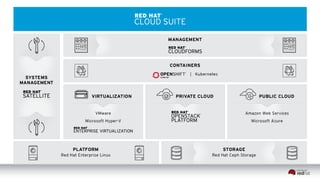
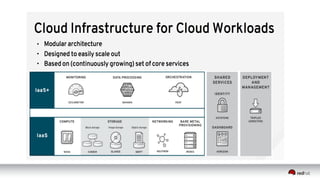
•  Red Hat Cloud Suite
•  OpenStack – Software Platform for Cloud Computing
•  OpenShift – DevOps and Containers Platform
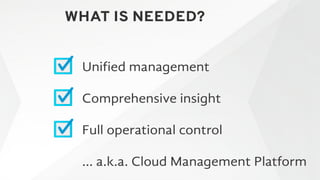
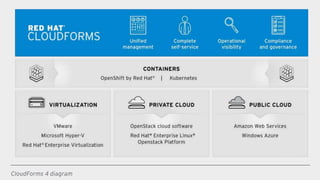
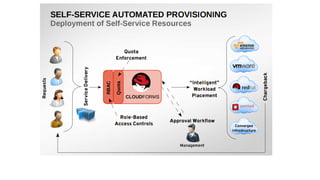
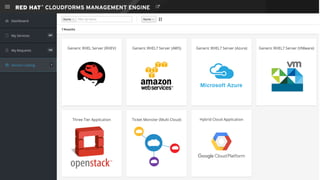
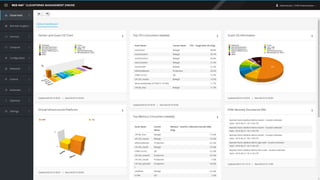
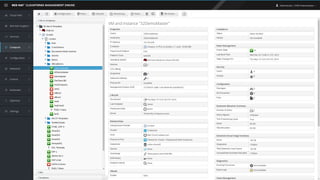
•  CloudForms – Cloud Management Platform
Agenda
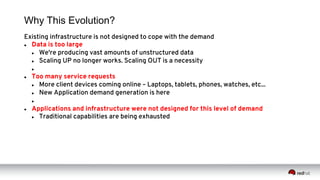
Existing infrastructure is not designed to cope with the demand
l  Data is too large
l  We're producing vast amounts of unstructured data
l  Scaling UP no longer works. Scaling OUT is a necessity
l 
l  Too many service requests
l  More client devices coming online – Laptops, tablets, phones, watches, etc...
l  New Application demand generation is here
l 
l  Applications and infrastructure were not designed for this level of demand
l  Traditional capabilities are being exhausted
Why This Evolution?
●  Cloud sets up self provisioning infrastructure
●  Hybrid Cloud allows unlimited elasticity (no constraints)
●  Hybrid data model (sensitive aware) ensures privacy
●  Programmable automation simplifies management
Market trends
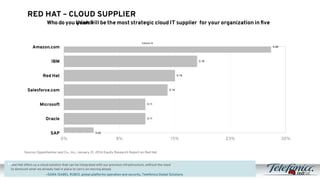
RED HAT – CLOUD SUPPLIER
Red Hat offers us a cloud solution that can be integrated with our previous infrastructure, without the need
to demount what we already had in place to carry on moving ahead.
—SARA ISABEL RUBIO, global platforms operation and security, Telefónica Global Solutions
0.28
0.18
0.15
0.14
0.11
0.11
0.04
0% 8% 15% 23% 30%
Amazon.com
IBM
Red Hat
Salesforce.com
Microsoft
Oracle
SAP
Column	
  B	
  
Source: Oppenheimer and Co., Inc.; January 21, 2014 Equity Research Report on Red Hat
Whodoyou think will be the most strategic cloud IT supplier for your organization in fiveyears?
Software Platform for Cloud Computing
7
OpenStack
What is OpenStack?
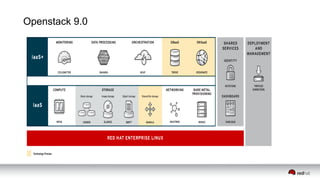
Openstack 9.0
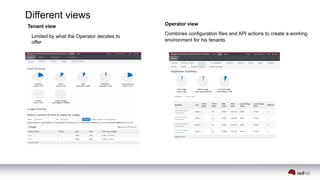
Different views
Tenant view Operator view
Limited by what the Operator decides to
offer
Combines configuration files and API actions to create a working
environment for his tenants.
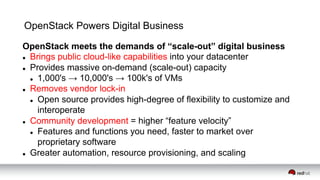
OpenStack meets the demands of “scale-out” digital business
l  Brings public cloud-like capabilities into your datacenter
l  Provides massive on-demand (scale-out) capacity
l  1,000's → 10,000's → 100k's of VMs
l  Removes vendor lock-in
l  Open source provides high-degree of flexibility to customize and
interoperate
l  Community development = higher “feature velocity”
l  Features and functions you need, faster to market over
proprietary software
l  Greater automation, resource provisioning, and scaling
OpenStack Powers Digital Business
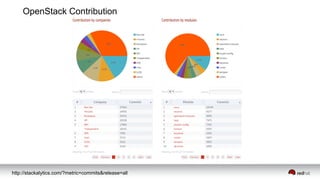
OpenStack Contribution
http://stackalytics.com/?metric=commits&release=all
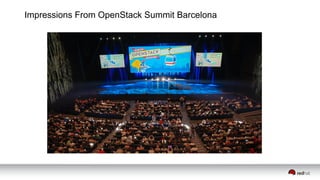
Impressions From OpenStack Summit Barcelona
Speed, Agility, Availability, Management …....
16
DevOps + Platform = Openshift
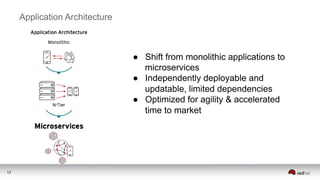
●  Shift from monolithic applications to
microservices
●  Independently deployable and
updatable, limited dependencies
●  Optimized for agility & accelerated
time to market
17
Application Architecture
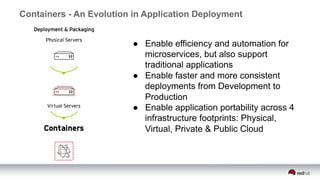
●  Enable efficiency and automation for
microservices, but also support
traditional applications
●  Enable faster and more consistent
deployments from Development to
Production
●  Enable application portability across 4
infrastructure footprints: Physical,
Virtual, Private & Public Cloud
Containers - An Evolution in Application Deployment
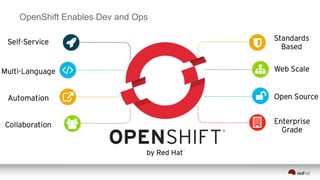
OpenShift Enables Dev and Ops
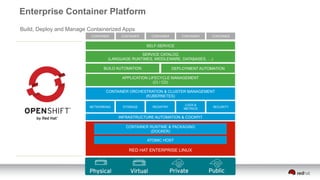
SERVICE CATALOG
(LANGUAGE RUNTIMES, MIDDLEWARE, DATABASES, …)
SELF-SERVICE
APPLICATION LIFECYCLE MANAGEMENT
(CI / CD)
BUILD AUTOMATION DEPLOYMENT AUTOMATION
CONTAINER CONTAINERCONTAINER CONTAINER CONTAINER
NETWORKING SECURITYSTORAGE REGISTRY
LOGS &
METRICS
CONTAINER ORCHESTRATION & CLUSTER MANAGEMENT
(KUBERNETES)
RED HAT ENTERPRISE LINUX
CONTAINER RUNTIME & PACKAGING
(DOCKER)
ATOMIC HOST
INFRASTRUCTURE AUTOMATION & COCKPIT
Enterprise Container Platform
Build, Deploy and Manage Containerized Apps
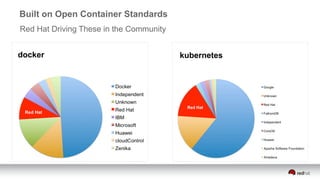
Built on Open Container Standards
Red Hat Driving These in the Community
docker kubernetes
CHALLENGE
“I need a secure and reliable platform
if I am ever going to run this from
Development to Production”
22
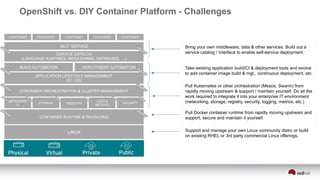
OpenShift vs. DIY Container Platform - Challenges
Support and manage your own Linux community distro or build
on existing RHEL or 3rd party commercial Linux offerings.
Pull Docker container runtime from rapidly moving upstream and
support, secure and maintain it yourself.
Pull Kubernetes or other orchestration (Mesos, Swarm) from
rapidly moving upstream & support / maintain yourself. Do all the
work required to integrate it into your enterprise IT environment
(networking, storage, registry, security, logging, metrics, etc.)
Take existing application build/CI & deployment tools and evolve
to add container image build & mgt., continuous deployment, etc.
SERVICE CATALOG
(LANGUAGE RUNTIMES, MIDDLEWARE, DATABASES, …)
SELF-SERVICE
APPLICATION LIFECYCLE MANAGEMENT
(CI / CD)
BUILD AUTOMATION DEPLOYMENT AUTOMATION
CONTAINER CONTAINERCONTAINER CONTAINER CONTAINER
NETWORKIN
G
SECURITYSTORAGE REGISTRY
LOGS &
METRICS
CONTAINER ORCHESTRATION & CLUSTER MANAGEMENT
LINUX
CONTAINER RUNTIME & PACKAGING
Bring your own middleware, data & other services. Build out a
service catalog / interface to enable self-service deployment.
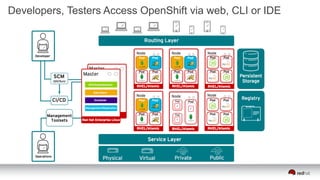
Developers, Testers Access OpenShift via web, CLI or IDE
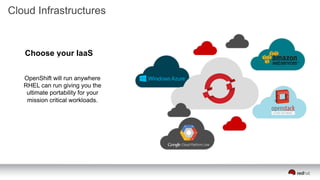
Choose your IaaS
OpenShift will run anywhere
RHEL can run giving you the
ultimate portability for your
mission critical workloads.
Cloud Infrastructures
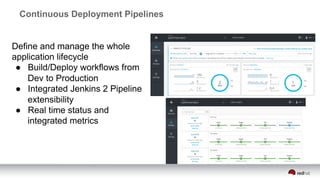
Continuous Deployment Pipelines
Define and manage the whole
application lifecycle
●  Build/Deploy workflows from
Dev to Production
●  Integrated Jenkins 2 Pipeline
extensibility
●  Real time status and
integrated metrics
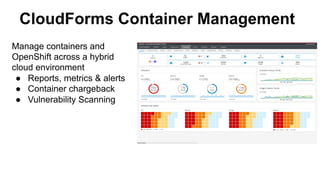
CloudForms Container Management
Manage containers and
OpenShift across a hybrid
cloud environment
●  Reports, metrics & alerts
●  Container chargeback
●  Vulnerability Scanning
Manage the Entire cloud Services
28
Management - CloudForms
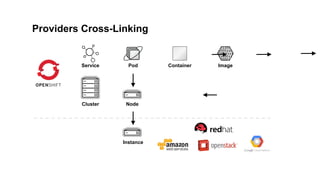
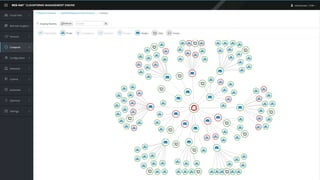
Providers Cross-Linking
Service ContainerPod Image
NodeCluster
Instance
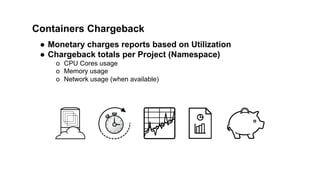
Containers Chargeback
●  Monetary charges reports based on Utilization
●  Chargeback totals per Project (Namespace)
o  CPU Cores usage
o  Memory usage
o  Network usage (when available)
Red hat's updates on the cloud & infrastructure strategy

Red hat's updates on the cloud & infrastructure strategy

  • 1.
    Red Hat's updateson the cloud & infrastructure strategy Orgad Kimchi Senior Cloud Architect Red Hat
  • 2.
    •  Market Trends • Red Hat Cloud Suite •  OpenStack – Software Platform for Cloud Computing •  OpenShift – DevOps and Containers Platform •  CloudForms – Cloud Management Platform Agenda
  • 3.
    Existing infrastructure isnot designed to cope with the demand l  Data is too large l  We're producing vast amounts of unstructured data l  Scaling UP no longer works. Scaling OUT is a necessity l  l  Too many service requests l  More client devices coming online – Laptops, tablets, phones, watches, etc... l  New Application demand generation is here l  l  Applications and infrastructure were not designed for this level of demand l  Traditional capabilities are being exhausted Why This Evolution?
  • 4.
    ●  Cloud setsup self provisioning infrastructure ●  Hybrid Cloud allows unlimited elasticity (no constraints) ●  Hybrid data model (sensitive aware) ensures privacy ●  Programmable automation simplifies management Market trends
  • 5.
    RED HAT –CLOUD SUPPLIER Red Hat offers us a cloud solution that can be integrated with our previous infrastructure, without the need to demount what we already had in place to carry on moving ahead. —SARA ISABEL RUBIO, global platforms operation and security, Telefónica Global Solutions 0.28 0.18 0.15 0.14 0.11 0.11 0.04 0% 8% 15% 23% 30% Amazon.com IBM Red Hat Salesforce.com Microsoft Oracle SAP Column  B   Source: Oppenheimer and Co., Inc.; January 21, 2014 Equity Research Report on Red Hat Whodoyou think will be the most strategic cloud IT supplier for your organization in fiveyears?
  • 7.
    Software Platform forCloud Computing 7 OpenStack
  • 8.
  • 10.
  • 11.
    Different views Tenant viewOperator view Limited by what the Operator decides to offer Combines configuration files and API actions to create a working environment for his tenants.
  • 12.
    OpenStack meets thedemands of “scale-out” digital business l  Brings public cloud-like capabilities into your datacenter l  Provides massive on-demand (scale-out) capacity l  1,000's → 10,000's → 100k's of VMs l  Removes vendor lock-in l  Open source provides high-degree of flexibility to customize and interoperate l  Community development = higher “feature velocity” l  Features and functions you need, faster to market over proprietary software l  Greater automation, resource provisioning, and scaling OpenStack Powers Digital Business
  • 13.
  • 14.
  • 16.
    Speed, Agility, Availability,Management ….... 16 DevOps + Platform = Openshift
  • 17.
    ●  Shift frommonolithic applications to microservices ●  Independently deployable and updatable, limited dependencies ●  Optimized for agility & accelerated time to market 17 Application Architecture
  • 18.
    ●  Enable efficiencyand automation for microservices, but also support traditional applications ●  Enable faster and more consistent deployments from Development to Production ●  Enable application portability across 4 infrastructure footprints: Physical, Virtual, Private & Public Cloud Containers - An Evolution in Application Deployment
  • 19.
  • 20.
    SERVICE CATALOG (LANGUAGE RUNTIMES,MIDDLEWARE, DATABASES, …) SELF-SERVICE APPLICATION LIFECYCLE MANAGEMENT (CI / CD) BUILD AUTOMATION DEPLOYMENT AUTOMATION CONTAINER CONTAINERCONTAINER CONTAINER CONTAINER NETWORKING SECURITYSTORAGE REGISTRY LOGS & METRICS CONTAINER ORCHESTRATION & CLUSTER MANAGEMENT (KUBERNETES) RED HAT ENTERPRISE LINUX CONTAINER RUNTIME & PACKAGING (DOCKER) ATOMIC HOST INFRASTRUCTURE AUTOMATION & COCKPIT Enterprise Container Platform Build, Deploy and Manage Containerized Apps
  • 21.
    Built on OpenContainer Standards Red Hat Driving These in the Community docker kubernetes
  • 22.
    CHALLENGE “I need asecure and reliable platform if I am ever going to run this from Development to Production” 22
  • 23.
    OpenShift vs. DIYContainer Platform - Challenges Support and manage your own Linux community distro or build on existing RHEL or 3rd party commercial Linux offerings. Pull Docker container runtime from rapidly moving upstream and support, secure and maintain it yourself. Pull Kubernetes or other orchestration (Mesos, Swarm) from rapidly moving upstream & support / maintain yourself. Do all the work required to integrate it into your enterprise IT environment (networking, storage, registry, security, logging, metrics, etc.) Take existing application build/CI & deployment tools and evolve to add container image build & mgt., continuous deployment, etc. SERVICE CATALOG (LANGUAGE RUNTIMES, MIDDLEWARE, DATABASES, …) SELF-SERVICE APPLICATION LIFECYCLE MANAGEMENT (CI / CD) BUILD AUTOMATION DEPLOYMENT AUTOMATION CONTAINER CONTAINERCONTAINER CONTAINER CONTAINER NETWORKIN G SECURITYSTORAGE REGISTRY LOGS & METRICS CONTAINER ORCHESTRATION & CLUSTER MANAGEMENT LINUX CONTAINER RUNTIME & PACKAGING Bring your own middleware, data & other services. Build out a service catalog / interface to enable self-service deployment.
  • 24.
    Developers, Testers AccessOpenShift via web, CLI or IDE
  • 25.
    Choose your IaaS OpenShiftwill run anywhere RHEL can run giving you the ultimate portability for your mission critical workloads. Cloud Infrastructures
  • 26.
    Continuous Deployment Pipelines Defineand manage the whole application lifecycle ●  Build/Deploy workflows from Dev to Production ●  Integrated Jenkins 2 Pipeline extensibility ●  Real time status and integrated metrics
  • 27.
    CloudForms Container Management Managecontainers and OpenShift across a hybrid cloud environment ●  Reports, metrics & alerts ●  Container chargeback ●  Vulnerability Scanning
  • 28.
    Manage the Entirecloud Services 28 Management - CloudForms
  • 31.
  • 37.
    Containers Chargeback ●  Monetarycharges reports based on Utilization ●  Chargeback totals per Project (Namespace) o  CPU Cores usage o  Memory usage o  Network usage (when available)