Red Hat OpenShift Enterprise
Giovanni Galloro
Cloud Solution Architect – Red Hat
ggalloro@redhat.com
Transforming Application Delivery
with PaaS and Linux Containers
PaaS and Linux Containers
Agenda
● Platform as a Service Capabilities
● OpenShift Enterprise Architecture
– Linux Containers
– Docker
– Kubernetes
– RHEL Atomic Host
● OpenShift Application Deployment Flow
● OpenShift Adoption
● Containers Adoption Challenges and Red Hat Strategy
Platform as a Service
Capabilities
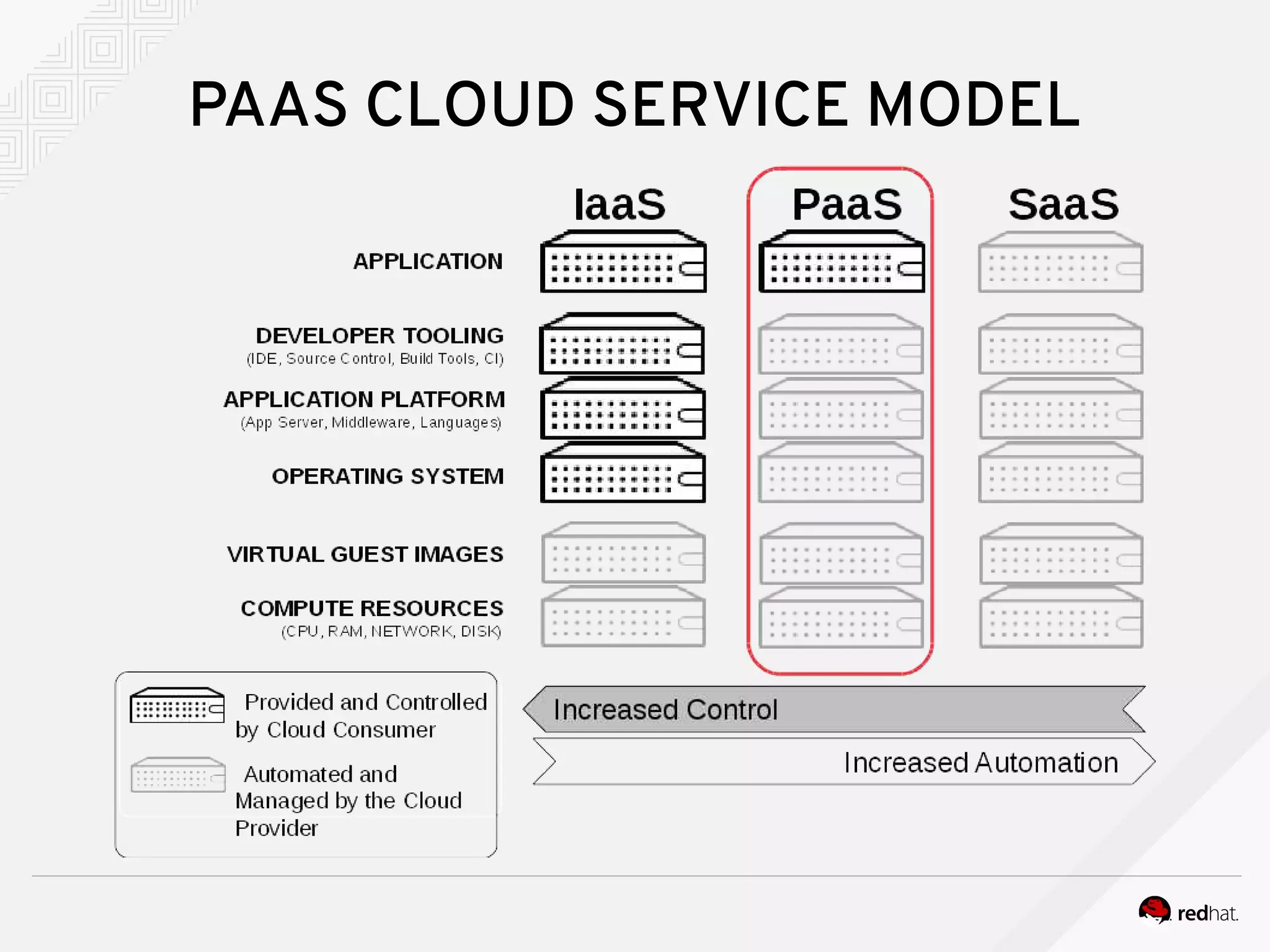
PAAS CLOUD SERVICE MODEL
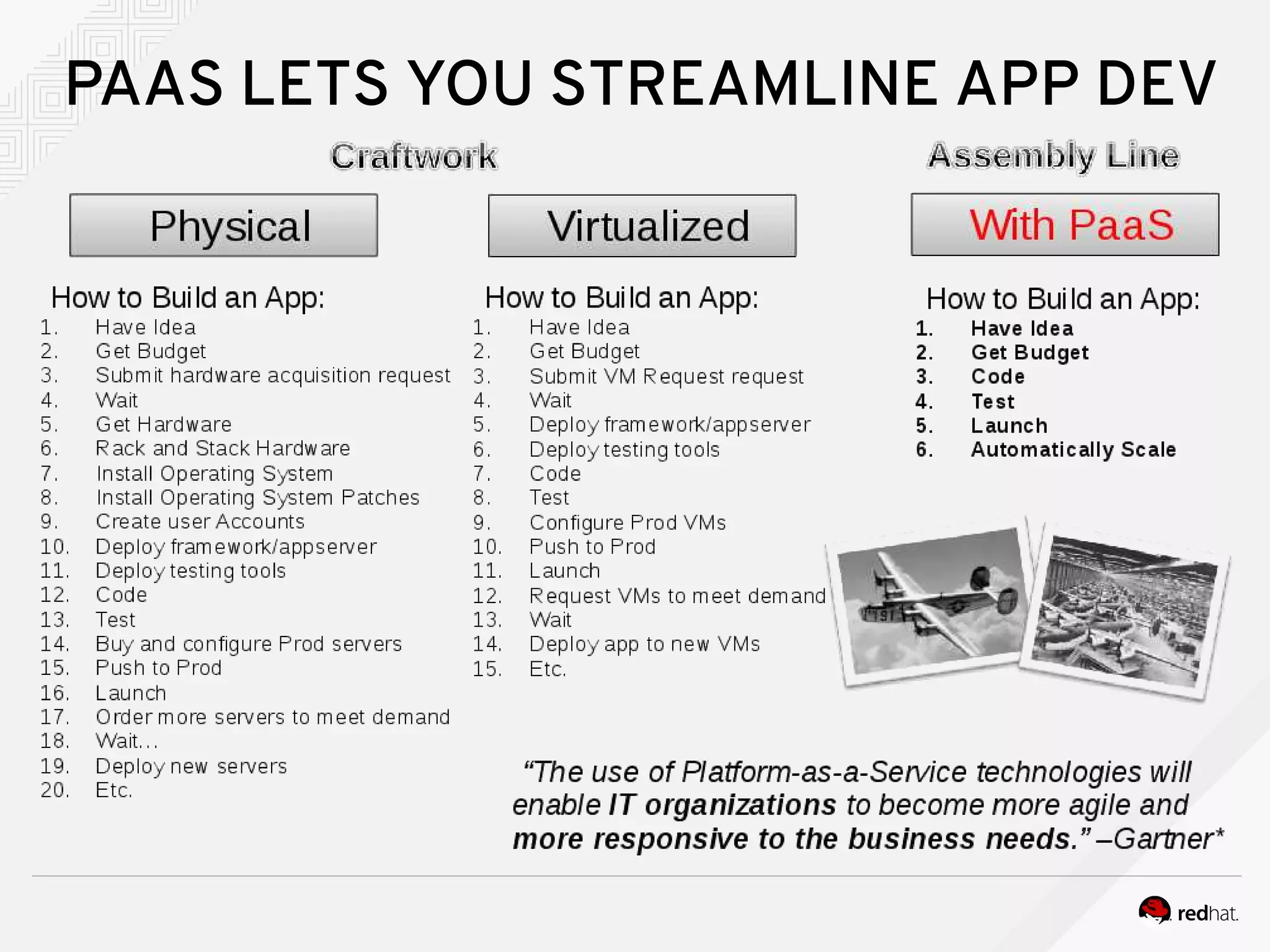
PAAS LETS YOU STREAMLINE APP DEV
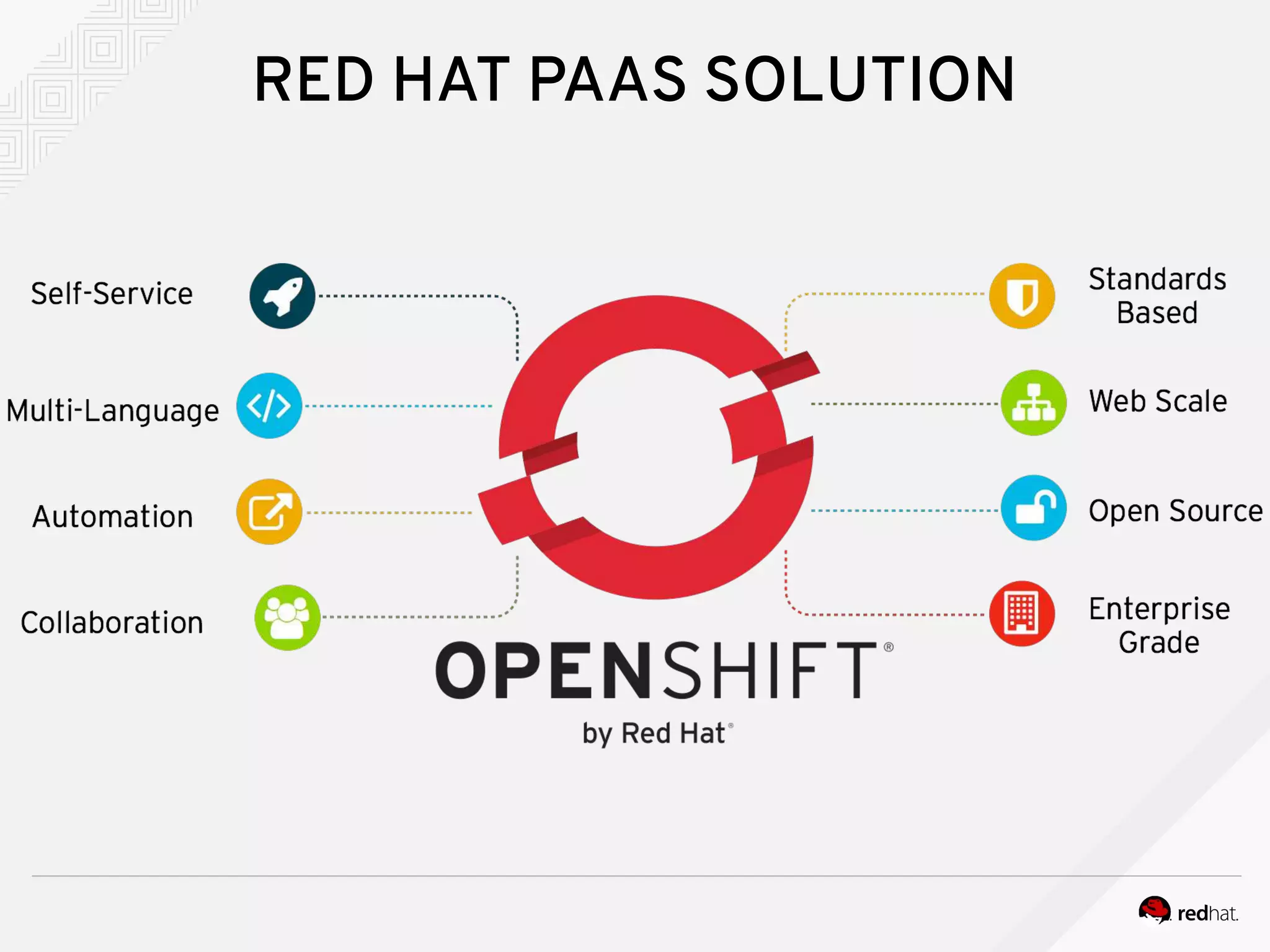
RED HAT PAAS SOLUTION
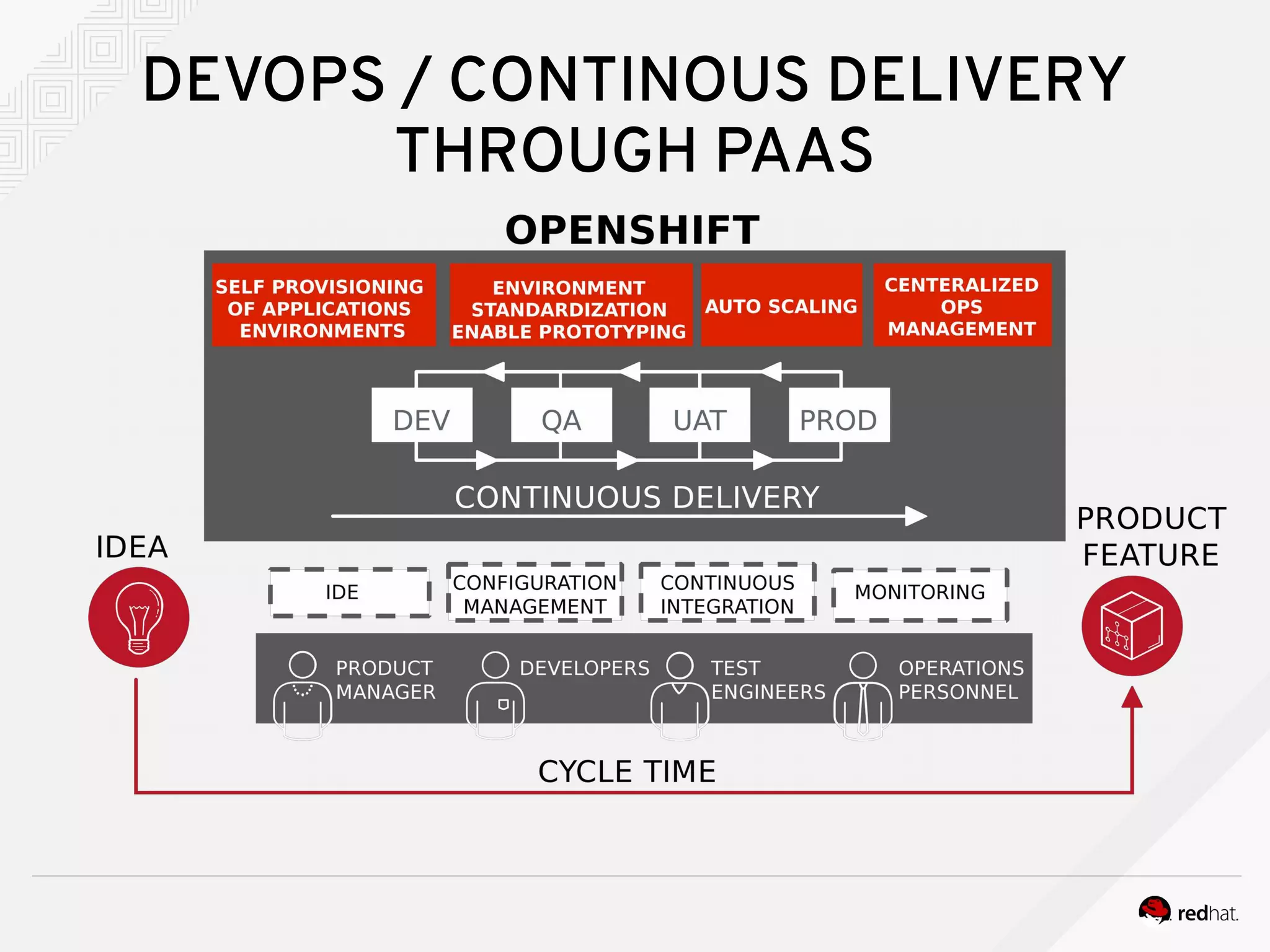
DEVOPS / CONTINOUS DELIVERY
THROUGH PAAS
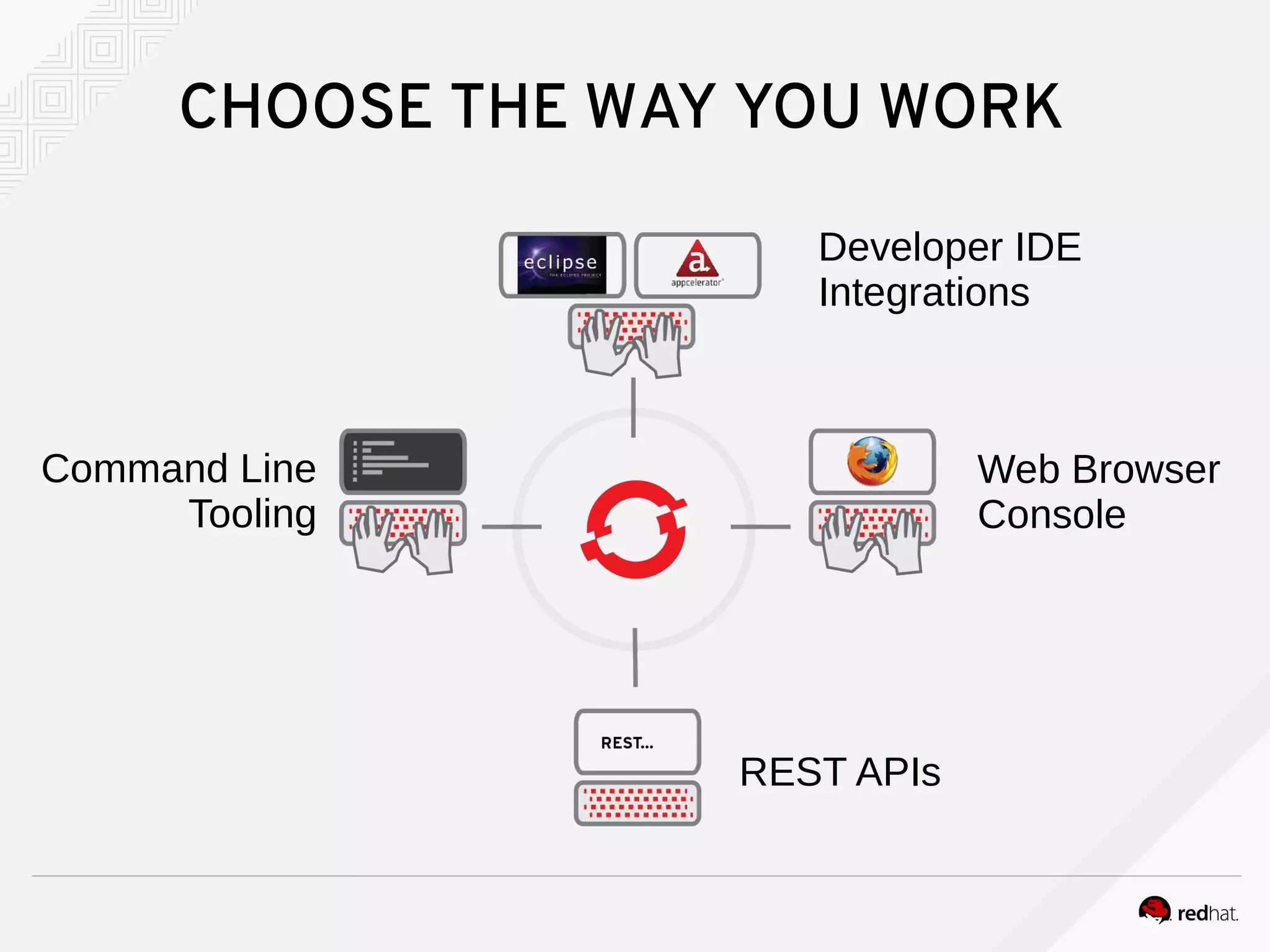
CHOOSE THE WAY YOU WORK
Developer IDE
Integrations
Web Browser
Console
Command Line
Tooling
REST APIs
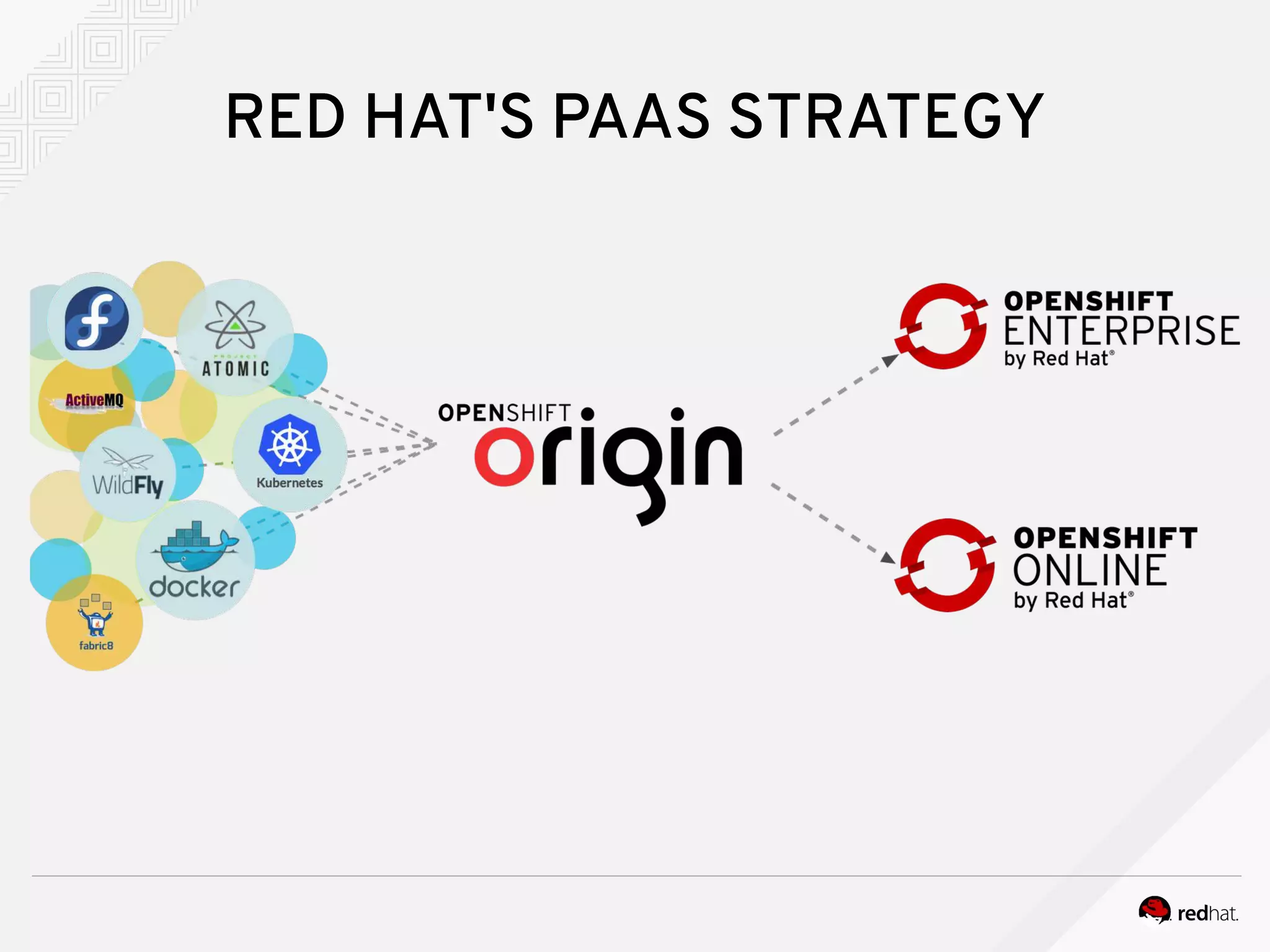
RED HAT'S PAAS STRATEGY
OpenShift Enterprise
Architecture
RED HAT CONFIDENTIAL | NDA ONLY11
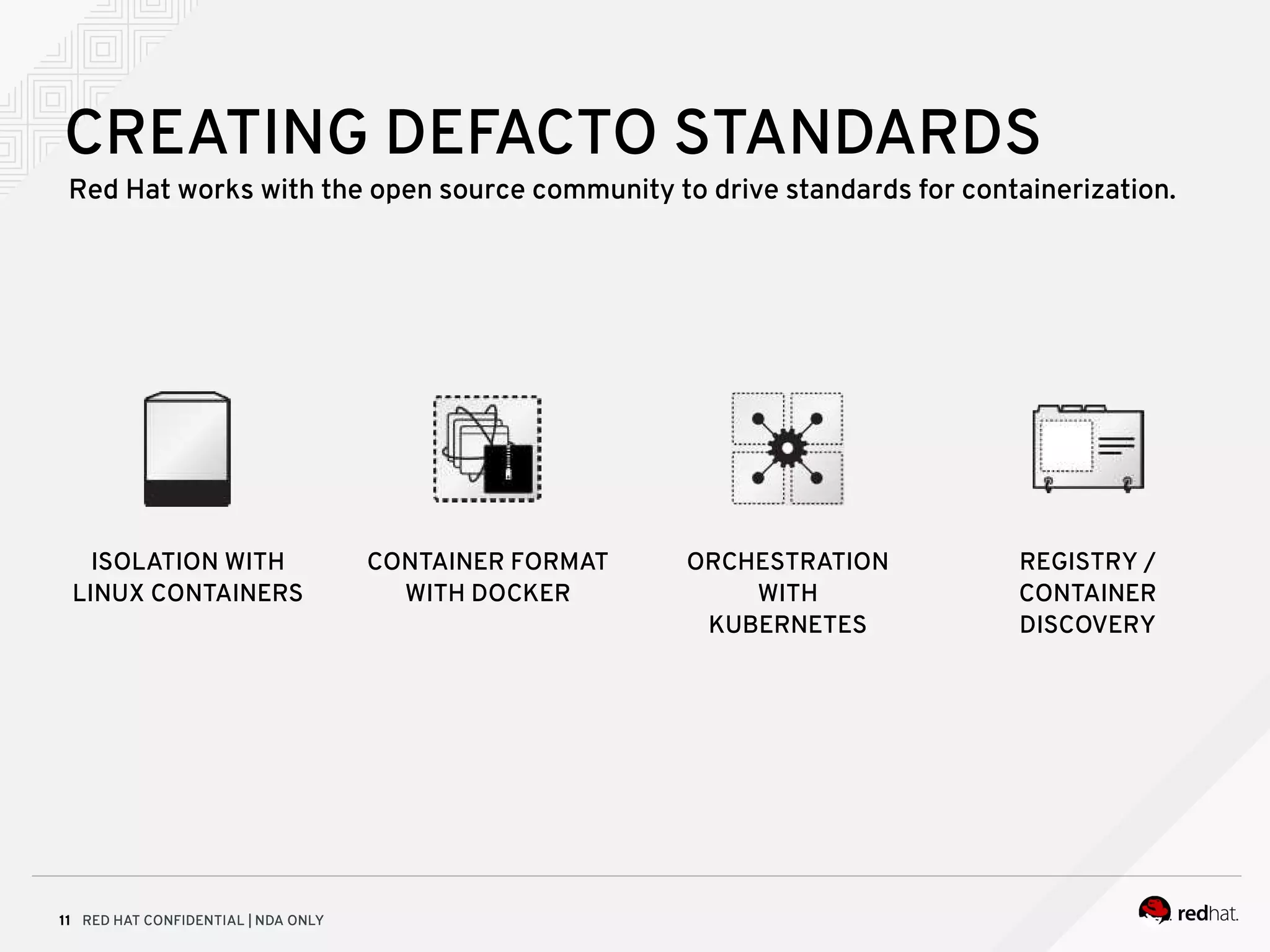
CREATING DEFACTO STANDARDS
REGISTRY /
CONTAINER
DISCOVERY
CONTAINER FORMAT
WITH DOCKER
ISOLATION WITH
LINUX CONTAINERS
ORCHESTRATION
WITH
KUBERNETES
Red Hat works with the open source community to drive standards for containerization.
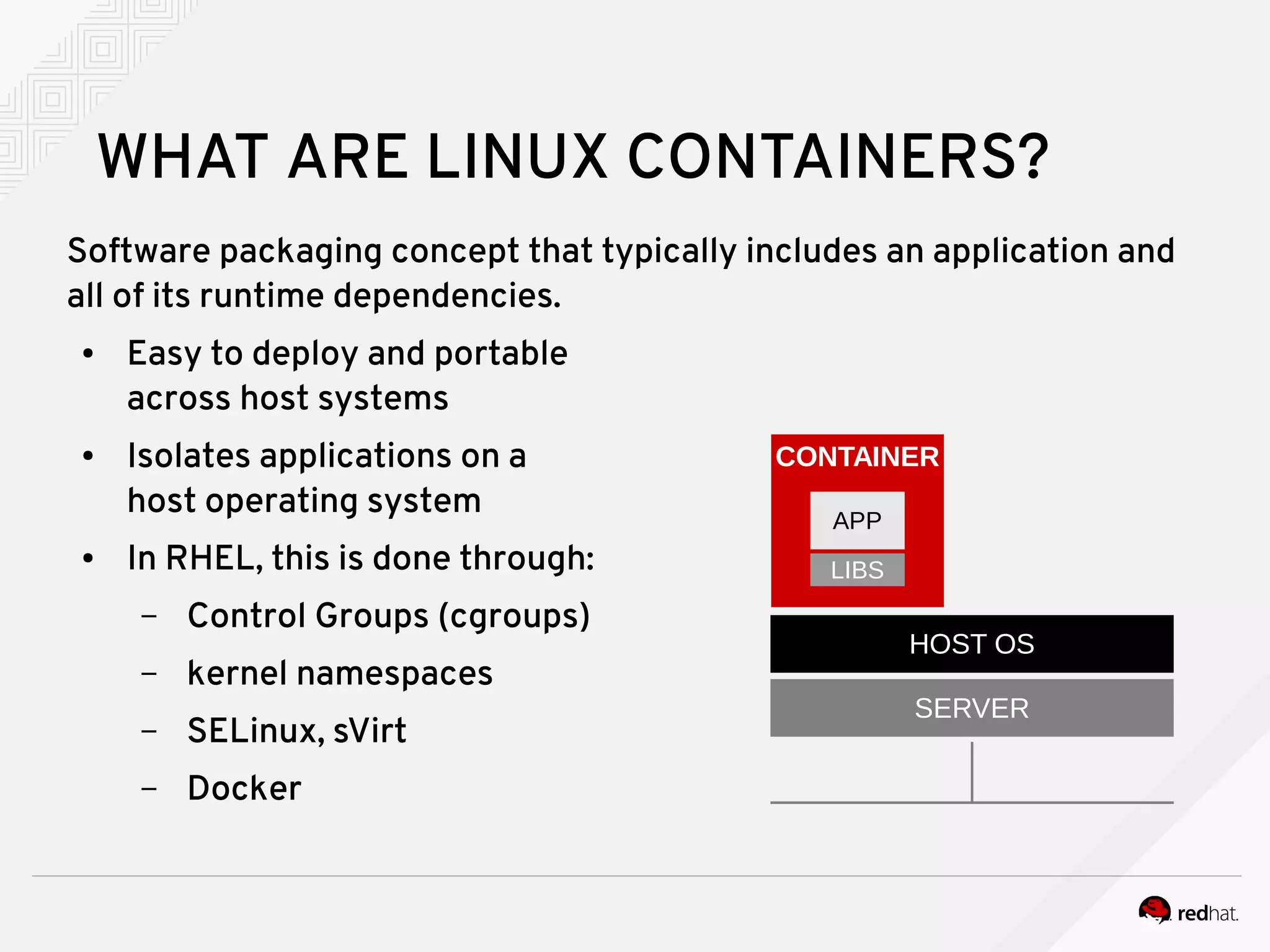
WHAT ARE LINUX CONTAINERS?
Software packaging concept that typically includes an application and
all of its runtime dependencies.
● Easy to deploy and portable
across host systems
● Isolates applications on a
host operating system
● In RHEL, this is done through:
– Control Groups (cgroups)
– kernel namespaces
– SELinux, sVirt
– Docker
HOST OS
SERVER
CONTAINER
LIBS
APP
13
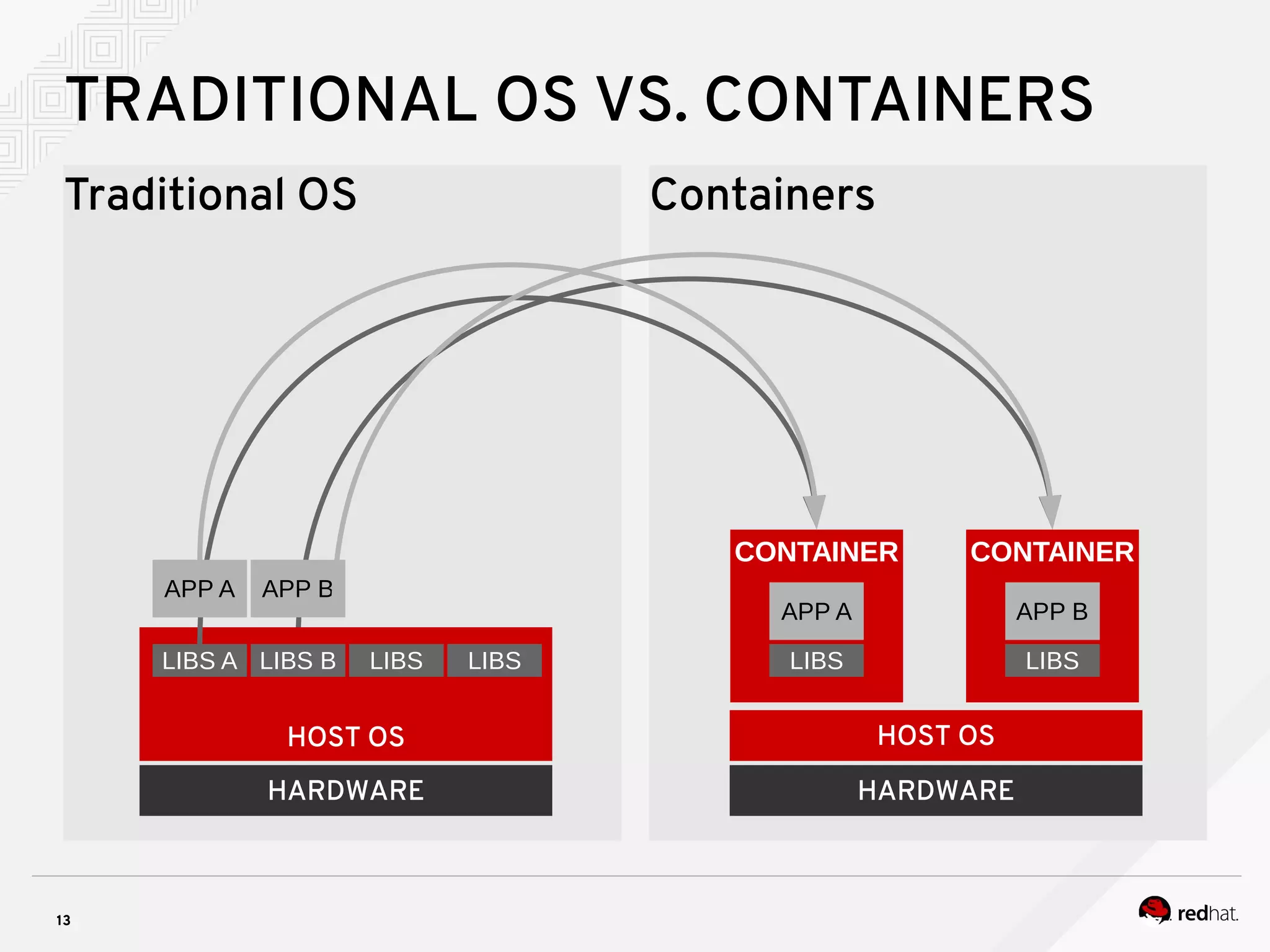
Traditional OS Containers
TRADITIONAL OS VS. CONTAINERS
HARDWARE
HOST OS
HARDWARE
HOST OS
CONTAINER
LIBS
APP A
LIBS A LIBS B LIBS LIBS
APP A APP B
CONTAINER
LIBS
APP B
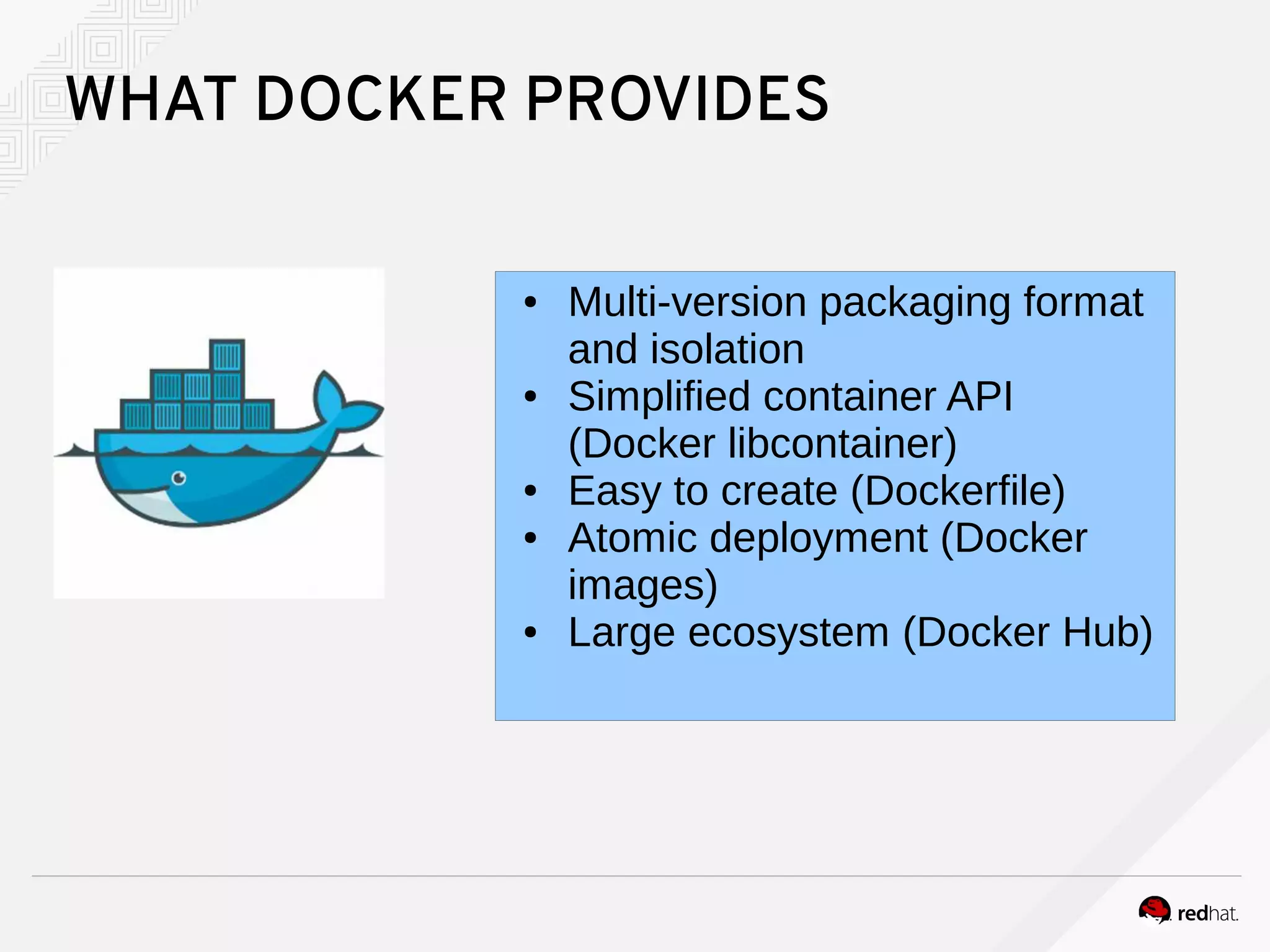
WHAT DOCKER PROVIDES
● Multi-version packaging format
and isolation
● Simplified container API
(Docker libcontainer)
● Easy to create (Dockerfile)
● Atomic deployment (Docker
images)
● Large ecosystem (Docker Hub)
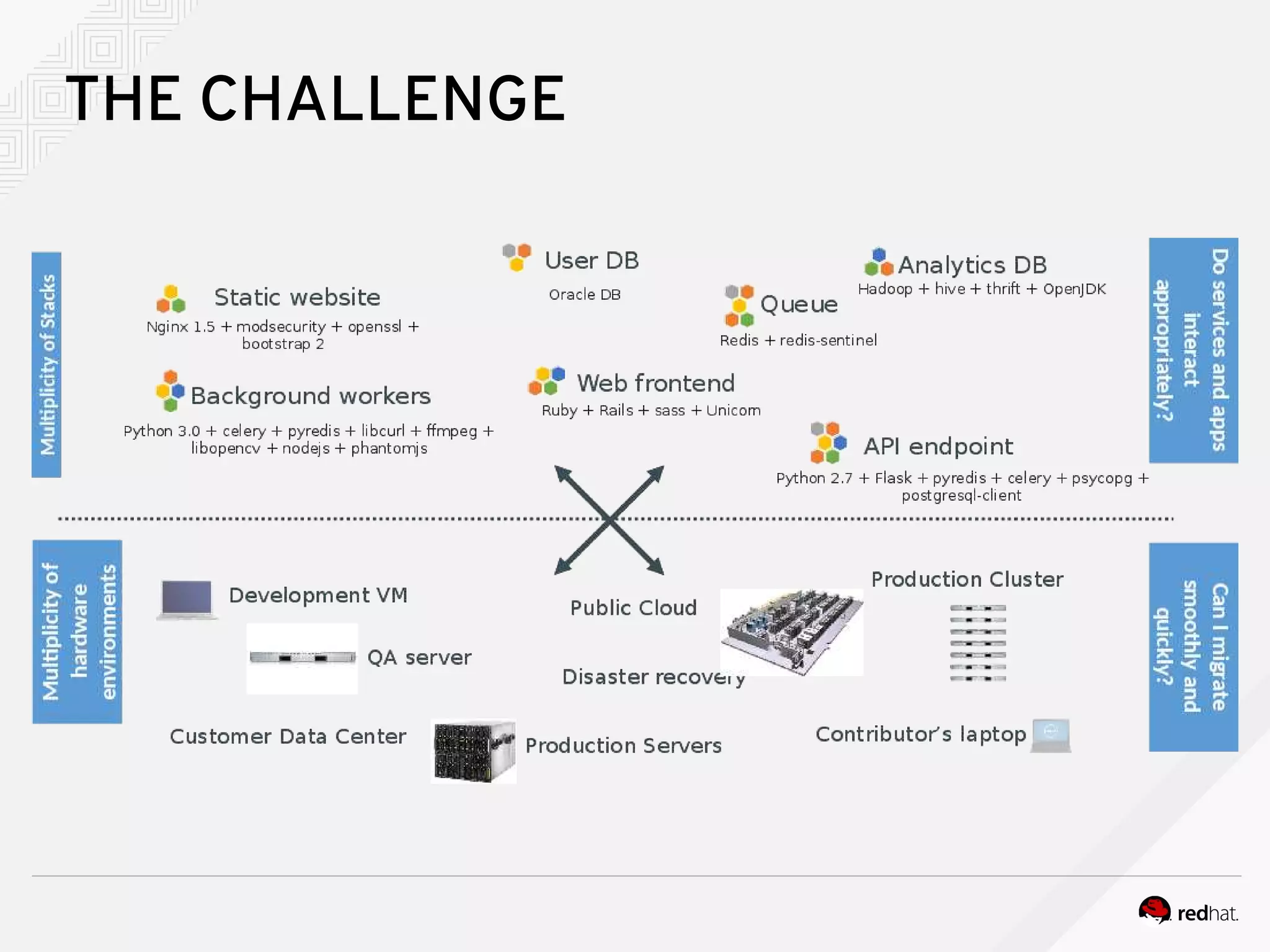
THE CHALLENGE
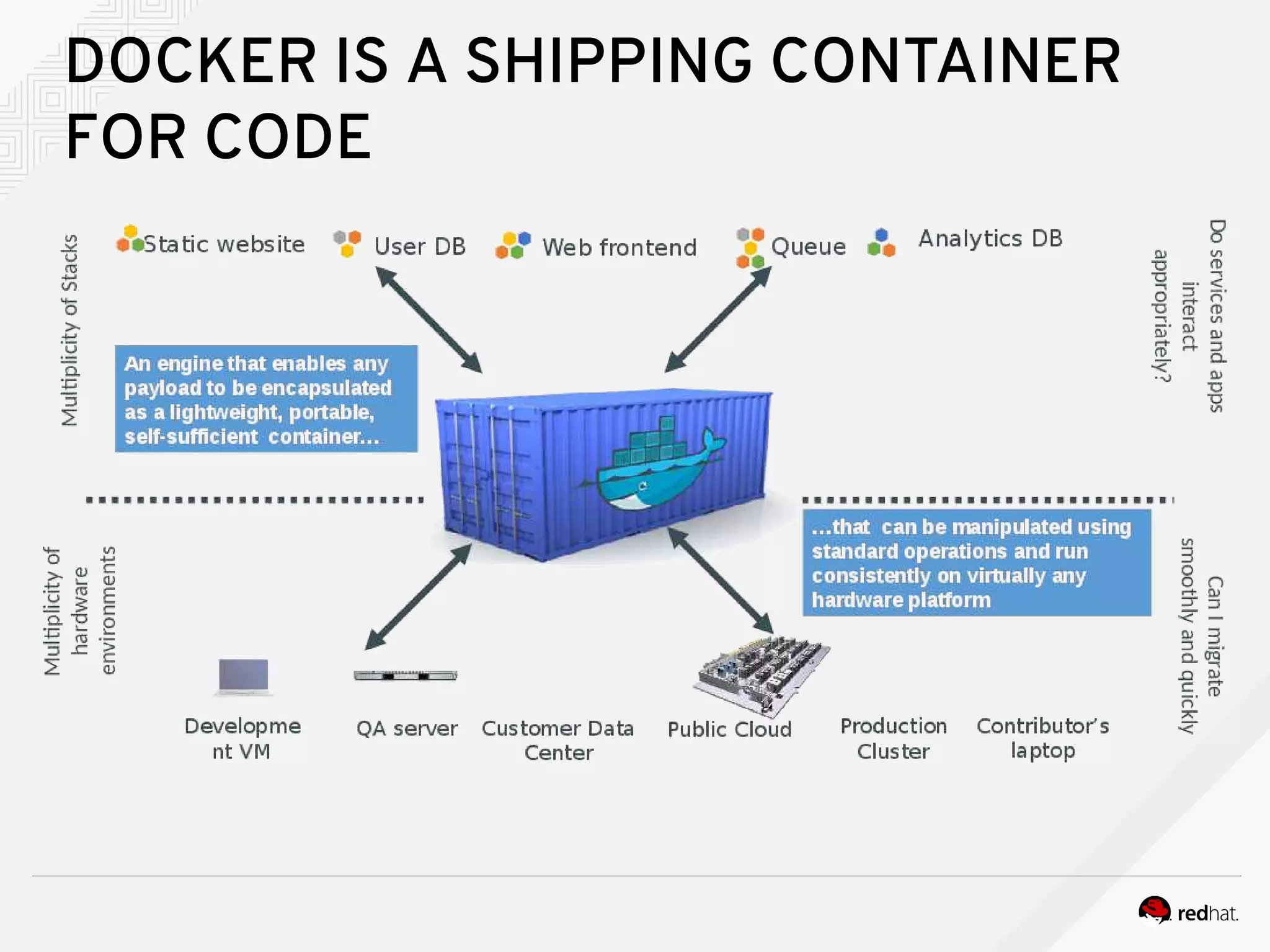
DOCKER IS A SHIPPING CONTAINER
FOR CODE
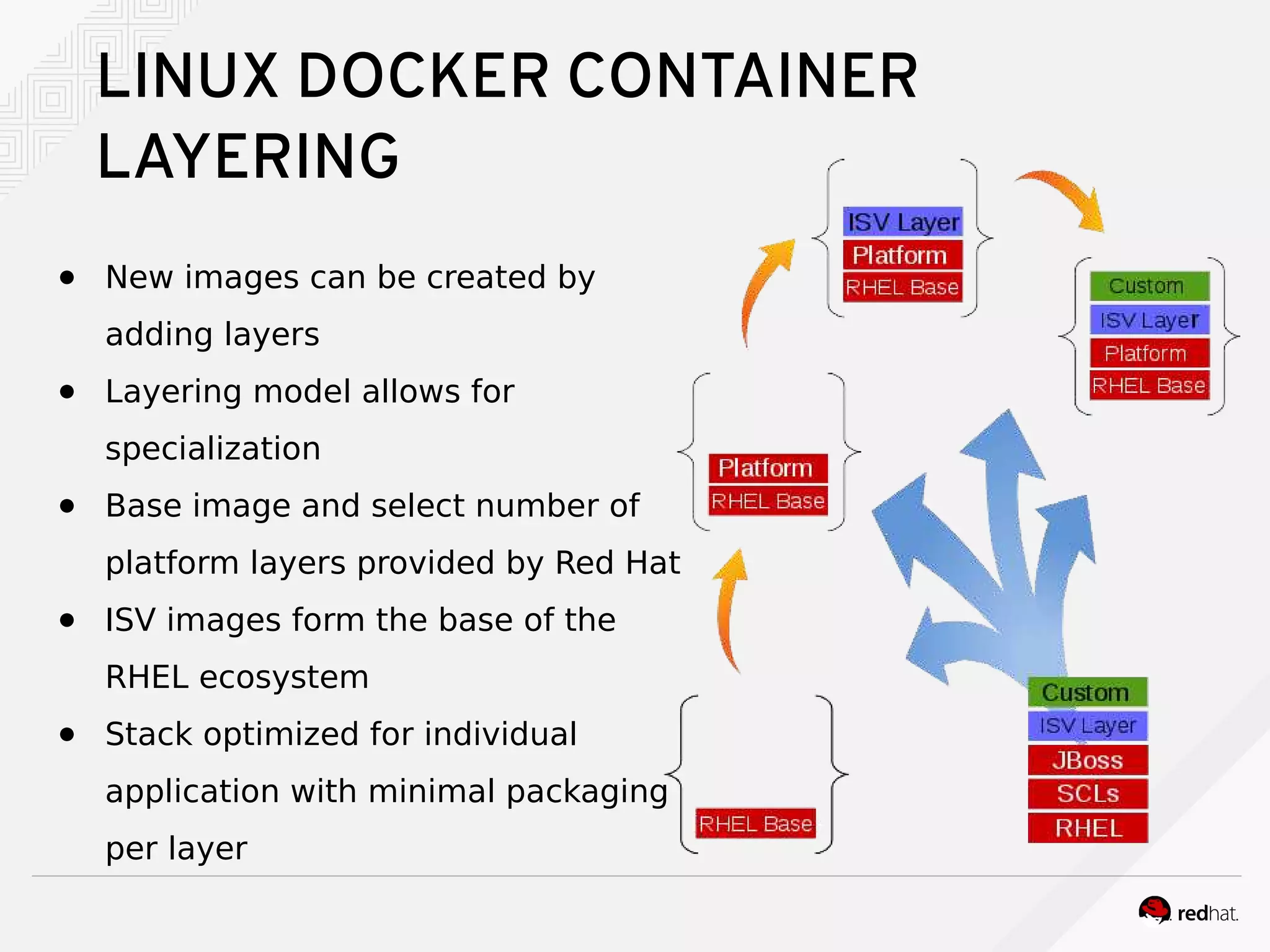
LINUX DOCKER CONTAINER
LAYERING
● New images can be created by
adding layers
● Layering model allows for
specialization
● Base image and select number of
platform layers provided by Red Hat
● ISV images form the base of the
RHEL ecosystem
● Stack optimized for individual
application with minimal packaging
per layer
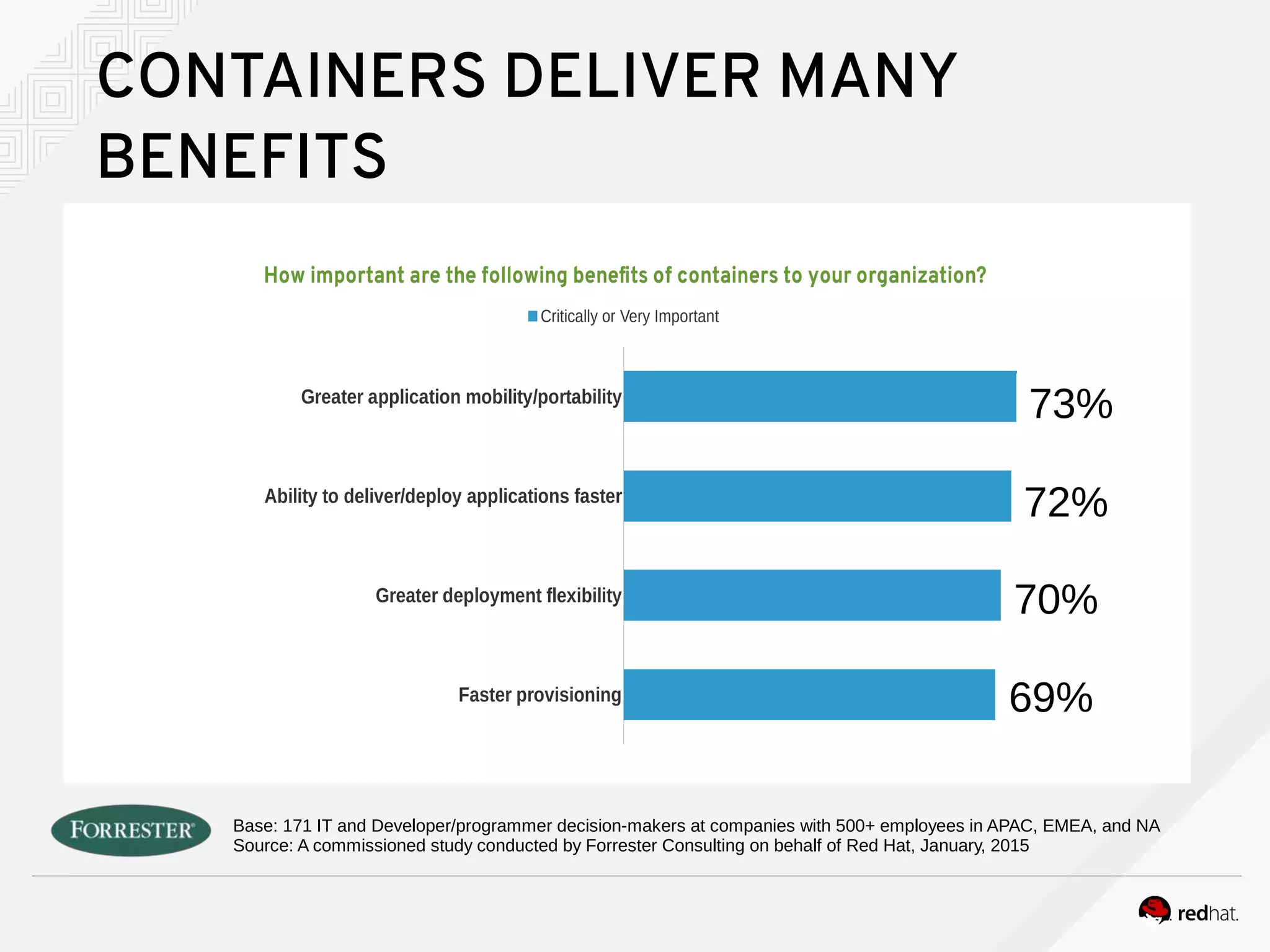
CONTAINERS DELIVER MANY
BENEFITS
Base: 171 IT and Developer/programmer decision-makers at companies with 500+ employees in APAC, EMEA, and NA
Source: A commissioned study conducted by Forrester Consulting on behalf of Red Hat, January, 2015
Faster provisioning
Greater deployment flexibility
Ability to deliver/deploy applications faster
Greater application mobility/portability
69%
70%
72%
73%
How important are the following benefits of containers to your organization?
Critically or Very Important
73%
72%
70%
69%
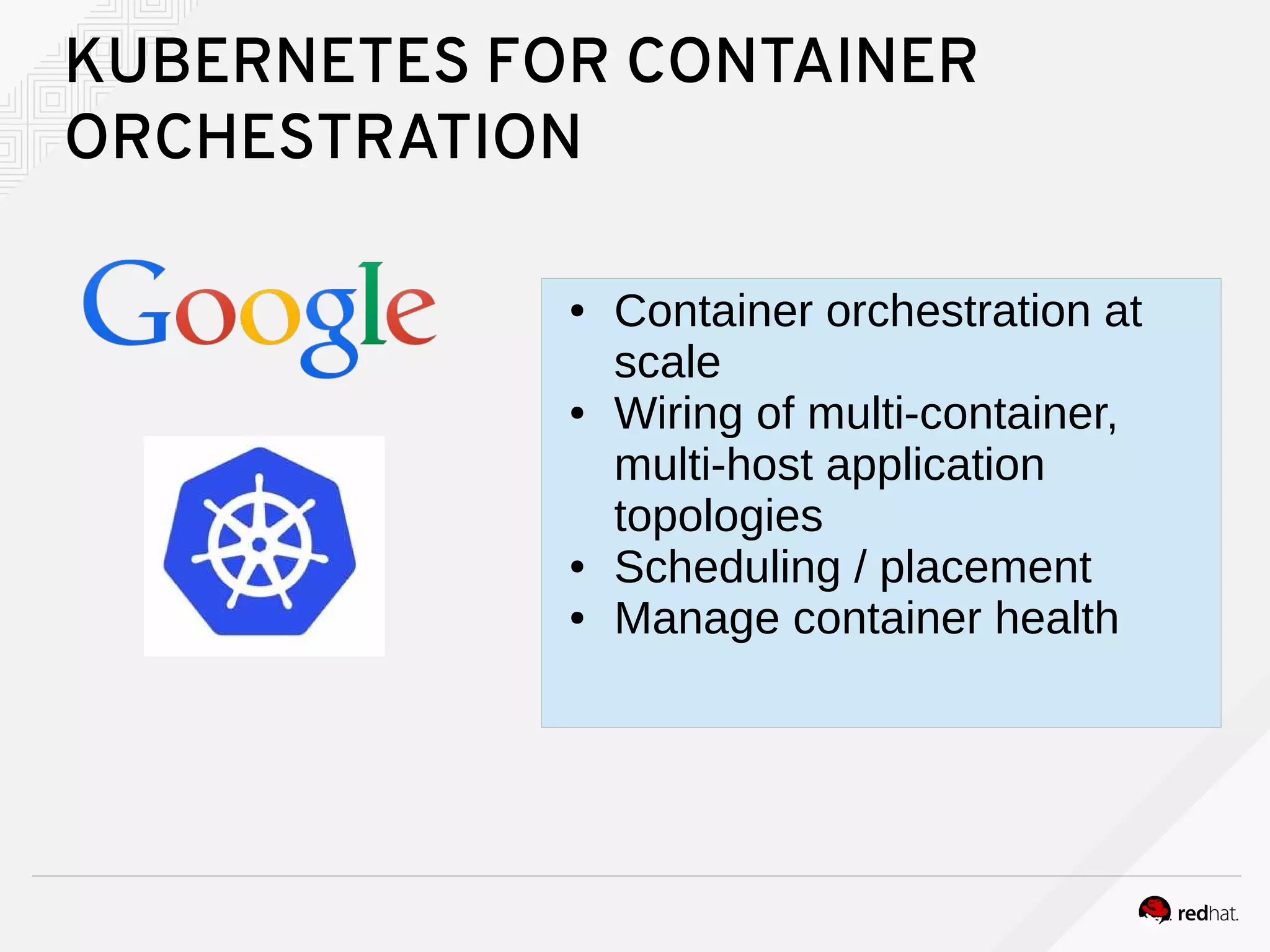
KUBERNETES FOR CONTAINER
ORCHESTRATION
● Container orchestration at
scale
● Wiring of multi-container,
multi-host application
topologies
● Scheduling / placement
● Manage container health
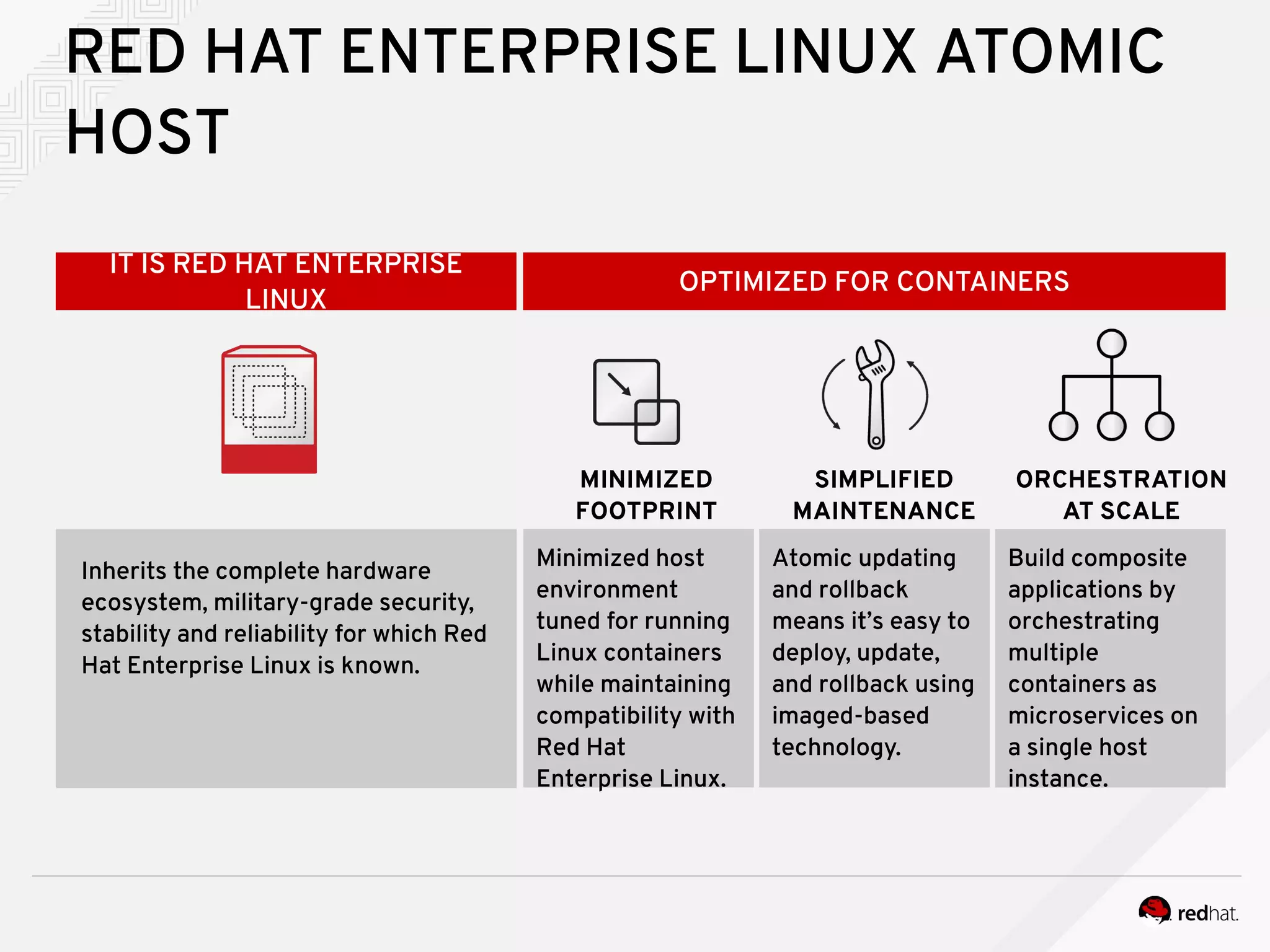
RED HAT ENTERPRISE LINUX ATOMIC
HOST
IT IS RED HAT ENTERPRISE
LINUX
OPTIMIZED FOR CONTAINERS
Minimized host
environment
tuned for running
Linux containers
while maintaining
compatibility with
Red Hat
Enterprise Linux.
Inherits the complete hardware
ecosystem, military-grade security,
stability and reliability for which Red
Hat Enterprise Linux is known.
MINIMIZED
FOOTPRINT
SIMPLIFIED
MAINTENANCE
ORCHESTRATION
AT SCALE
Atomic updating
and rollback
means it’s easy to
deploy, update,
and rollback using
imaged-based
technology.
Build composite
applications by
orchestrating
multiple
containers as
microservices on
a single host
instance.
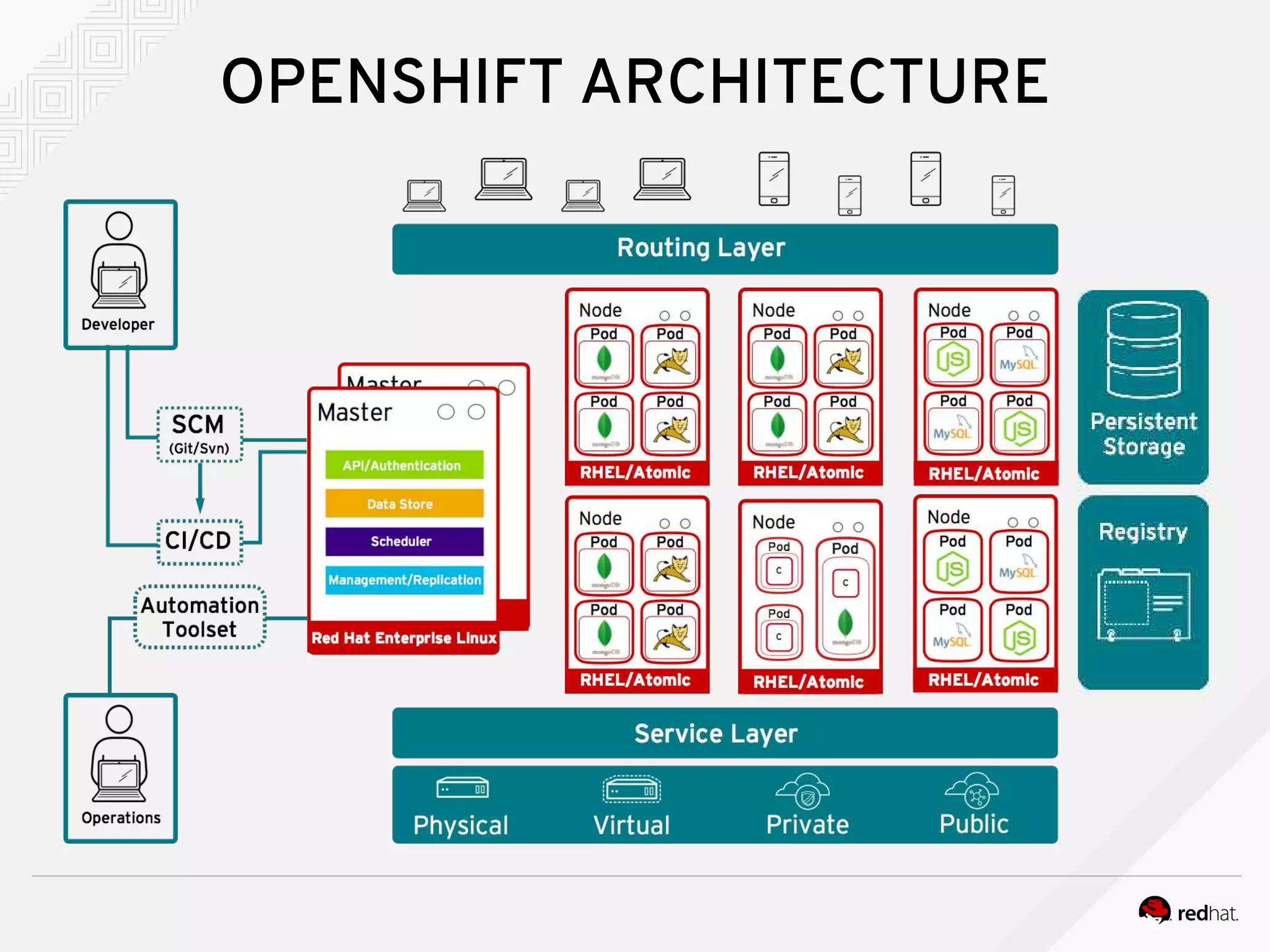
OPENSHIFT ARCHITECTURE
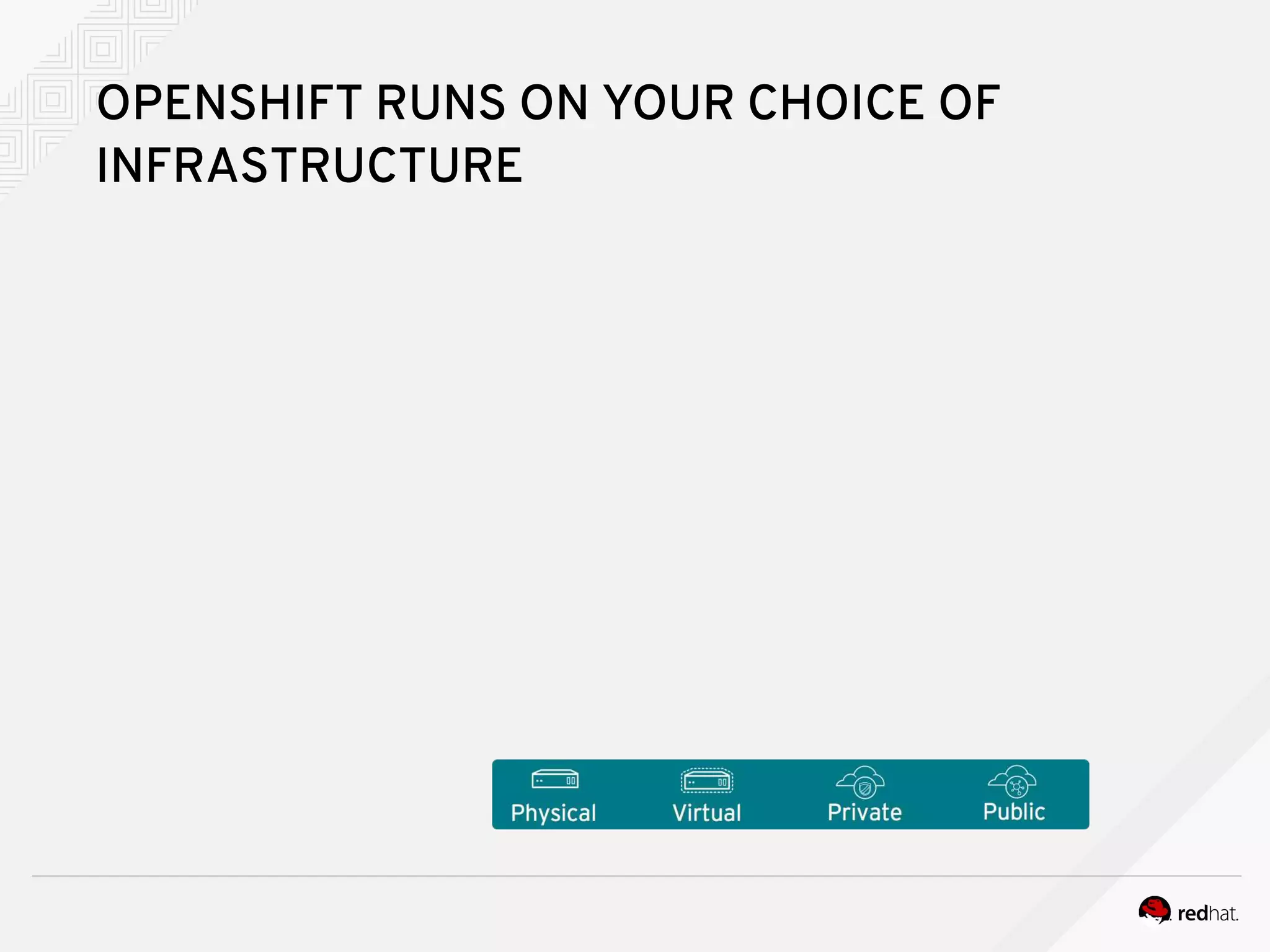
OPENSHIFT RUNS ON YOUR CHOICE OF
INFRASTRUCTURE
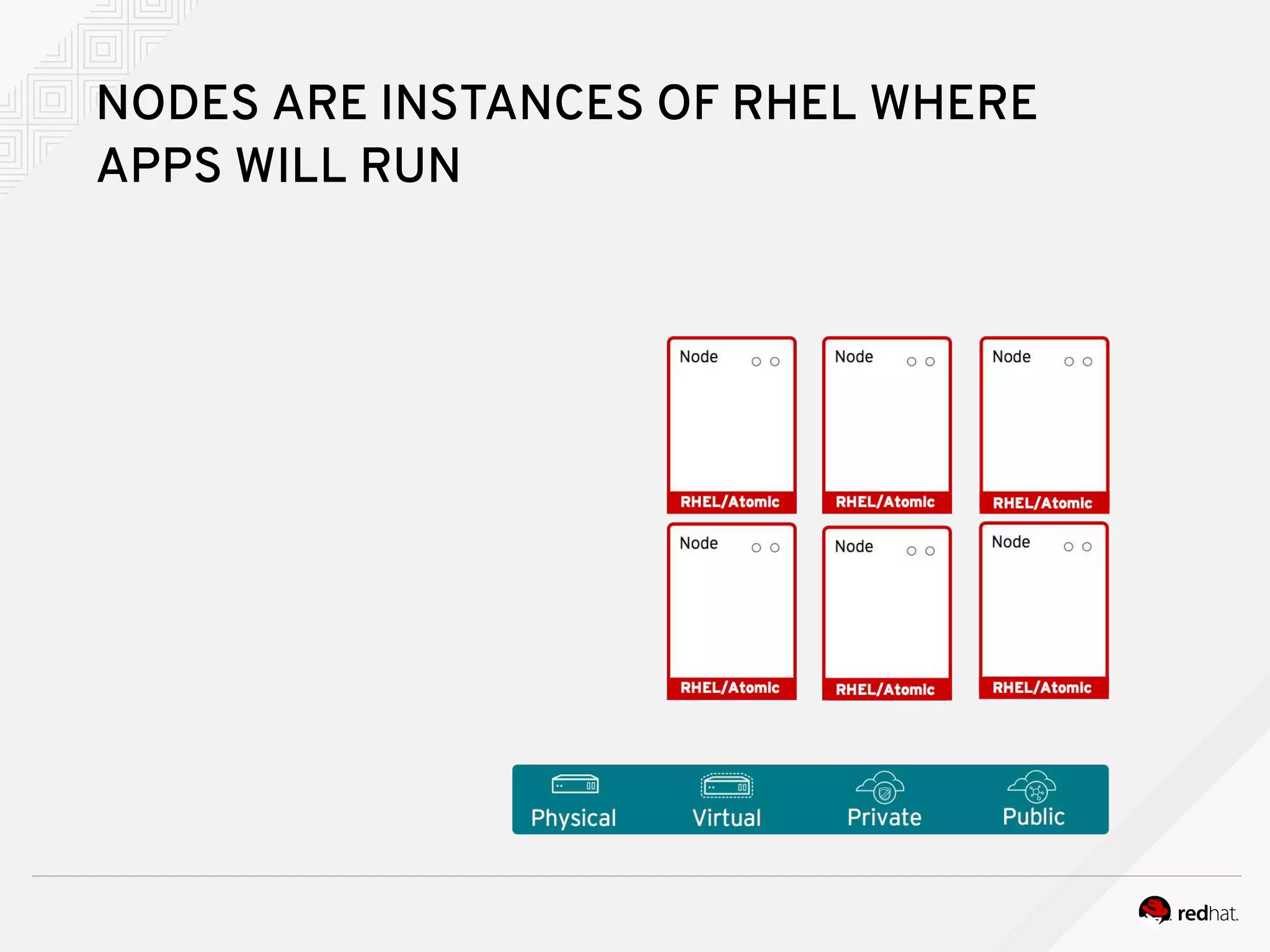
NODES ARE INSTANCES OF RHEL WHERE
APPS WILL RUN
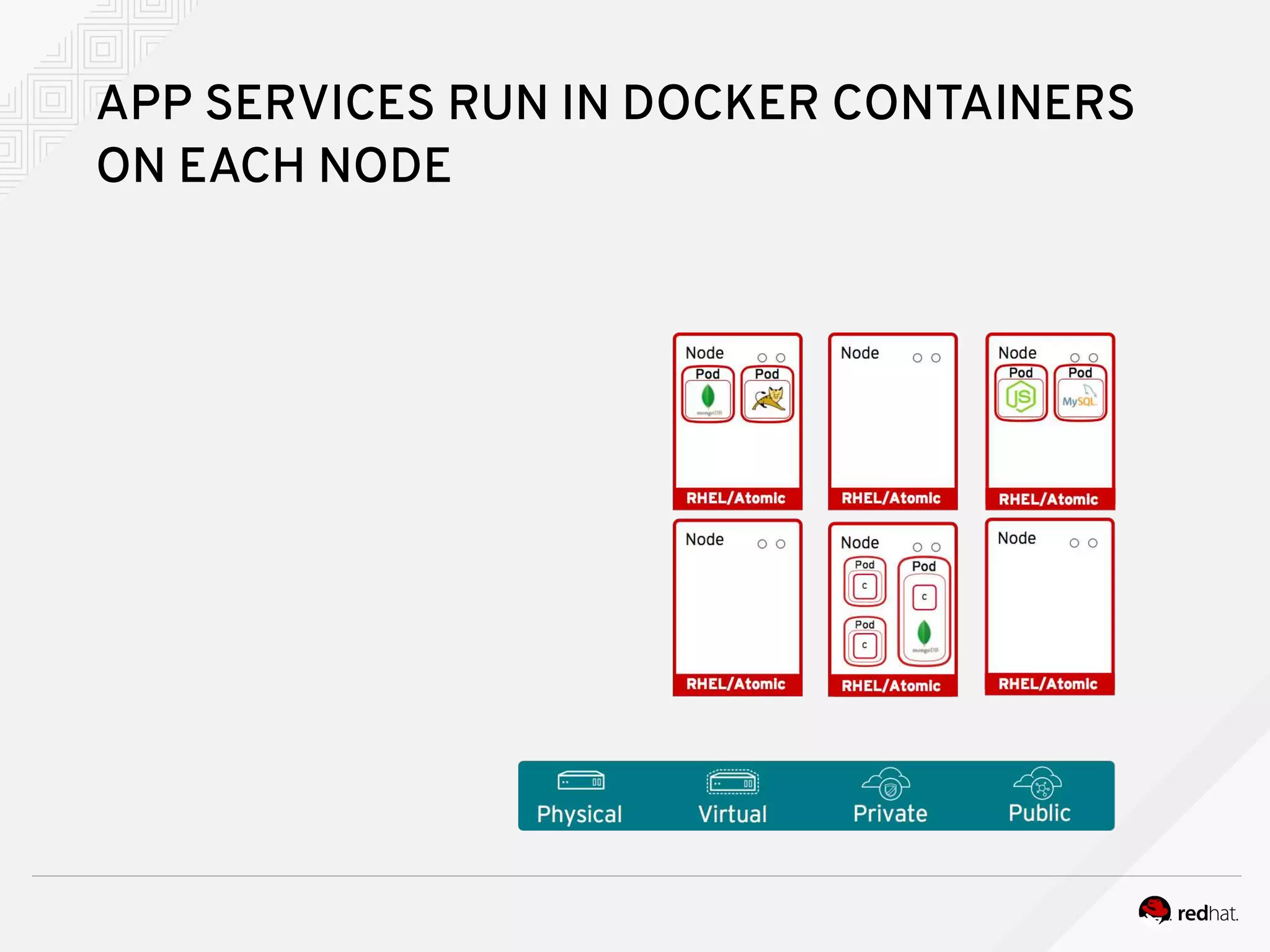
APP SERVICES RUN IN DOCKER CONTAINERS
ON EACH NODE
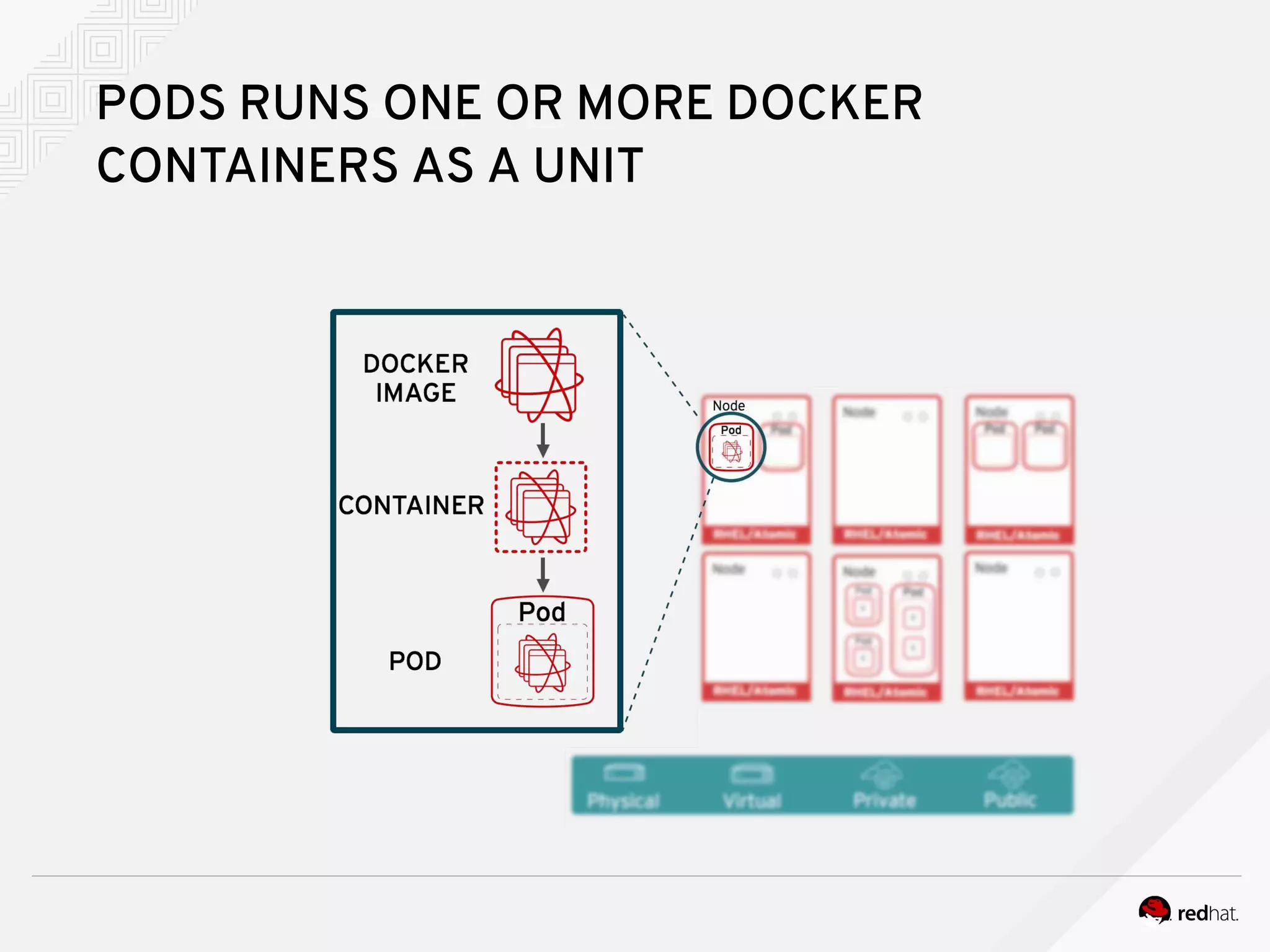
PODS RUNS ONE OR MORE DOCKER
CONTAINERS AS A UNIT
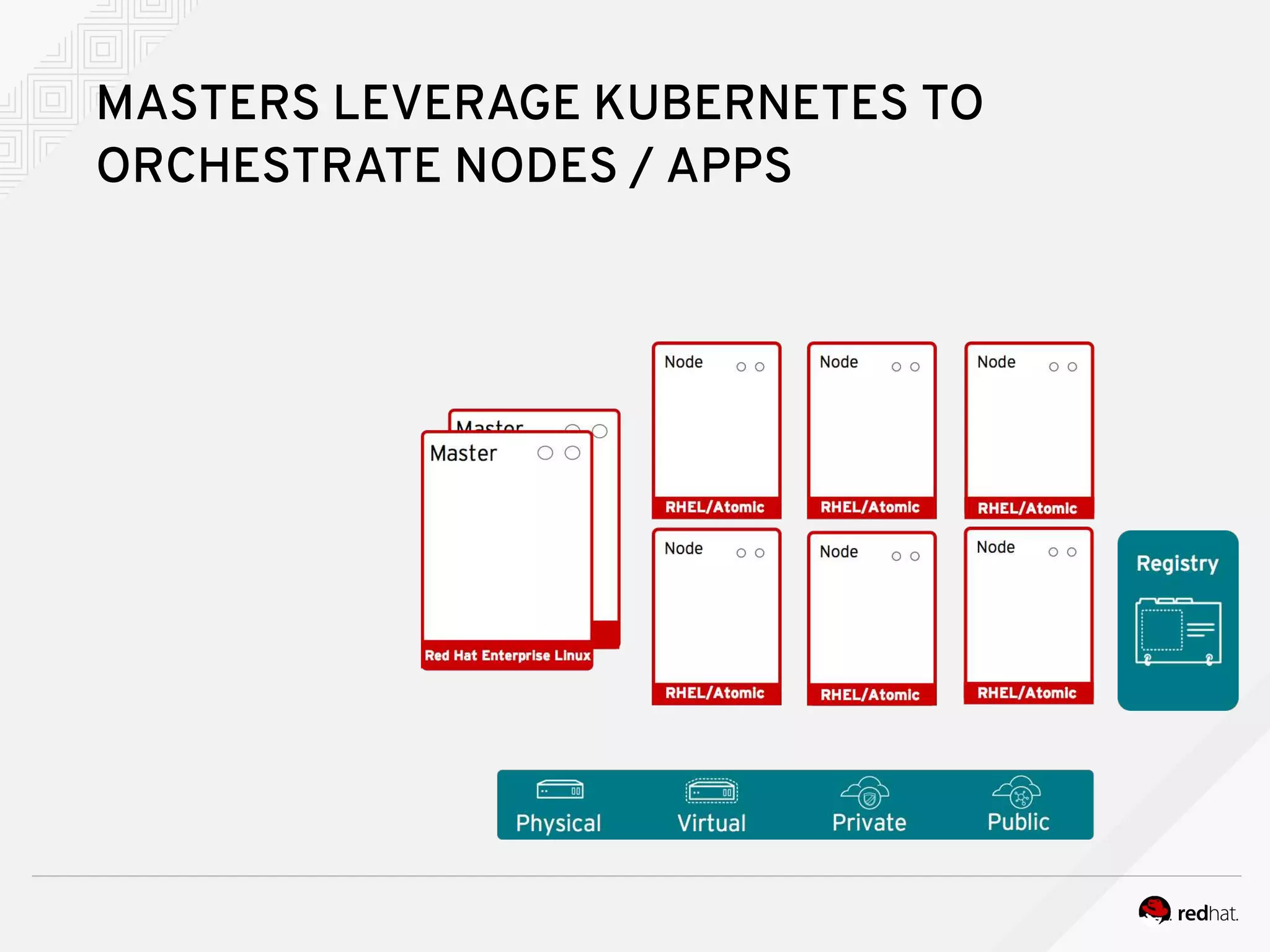
MASTERS LEVERAGE KUBERNETES TO
ORCHESTRATE NODES / APPS
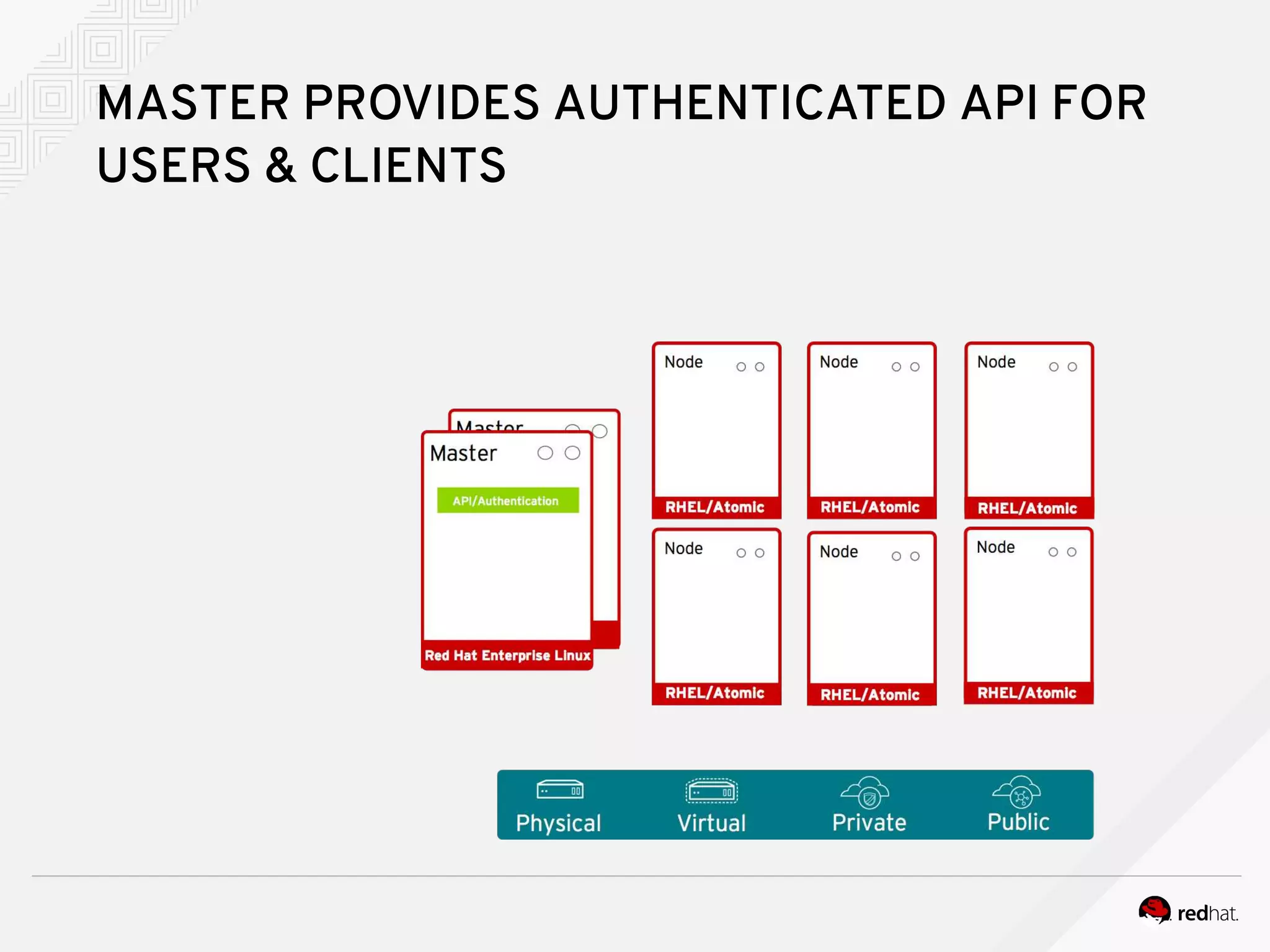
MASTER PROVIDES AUTHENTICATED API FOR
USERS & CLIENTS
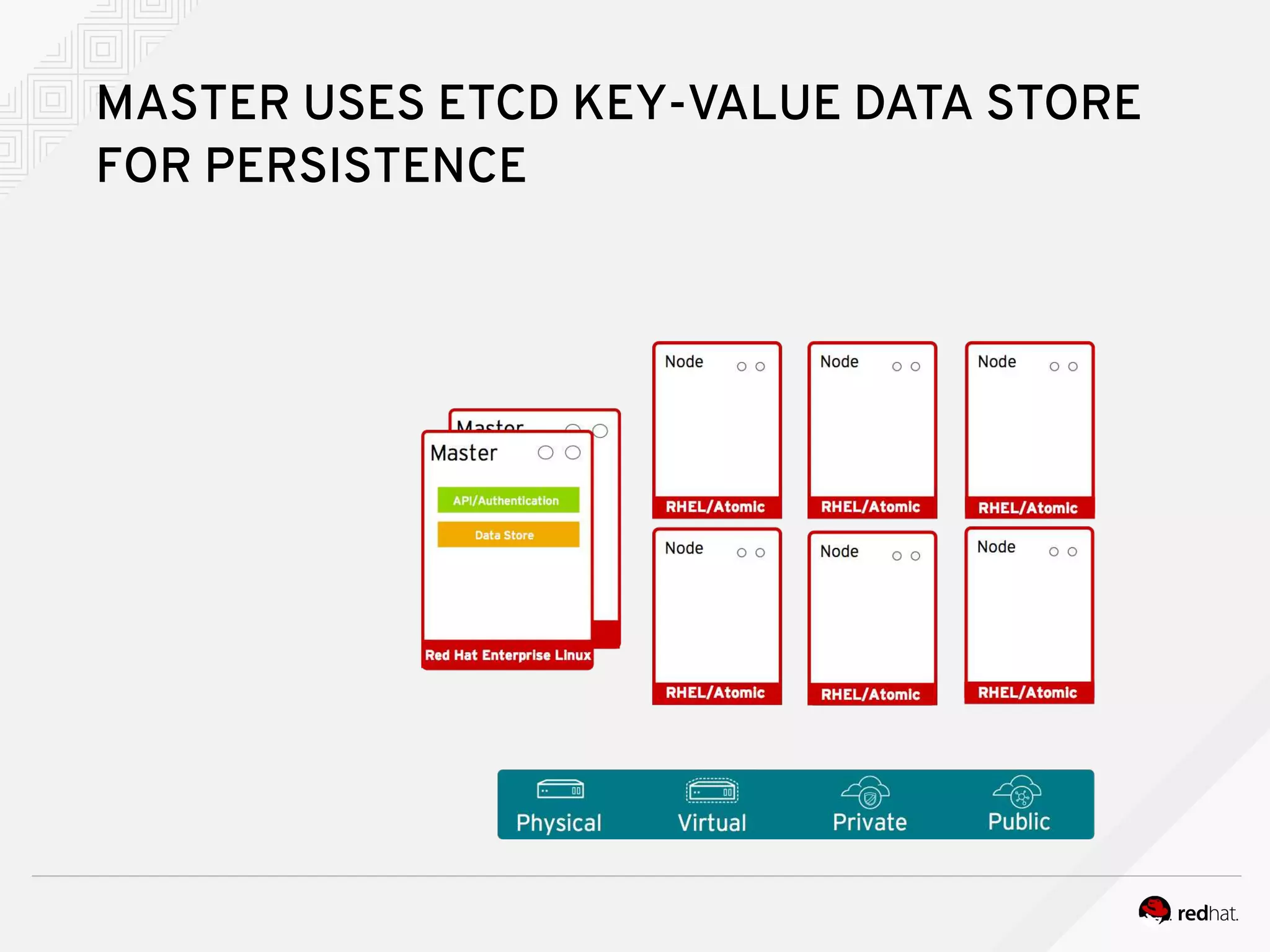
MASTER USES ETCD KEY-VALUE DATA STORE
FOR PERSISTENCE
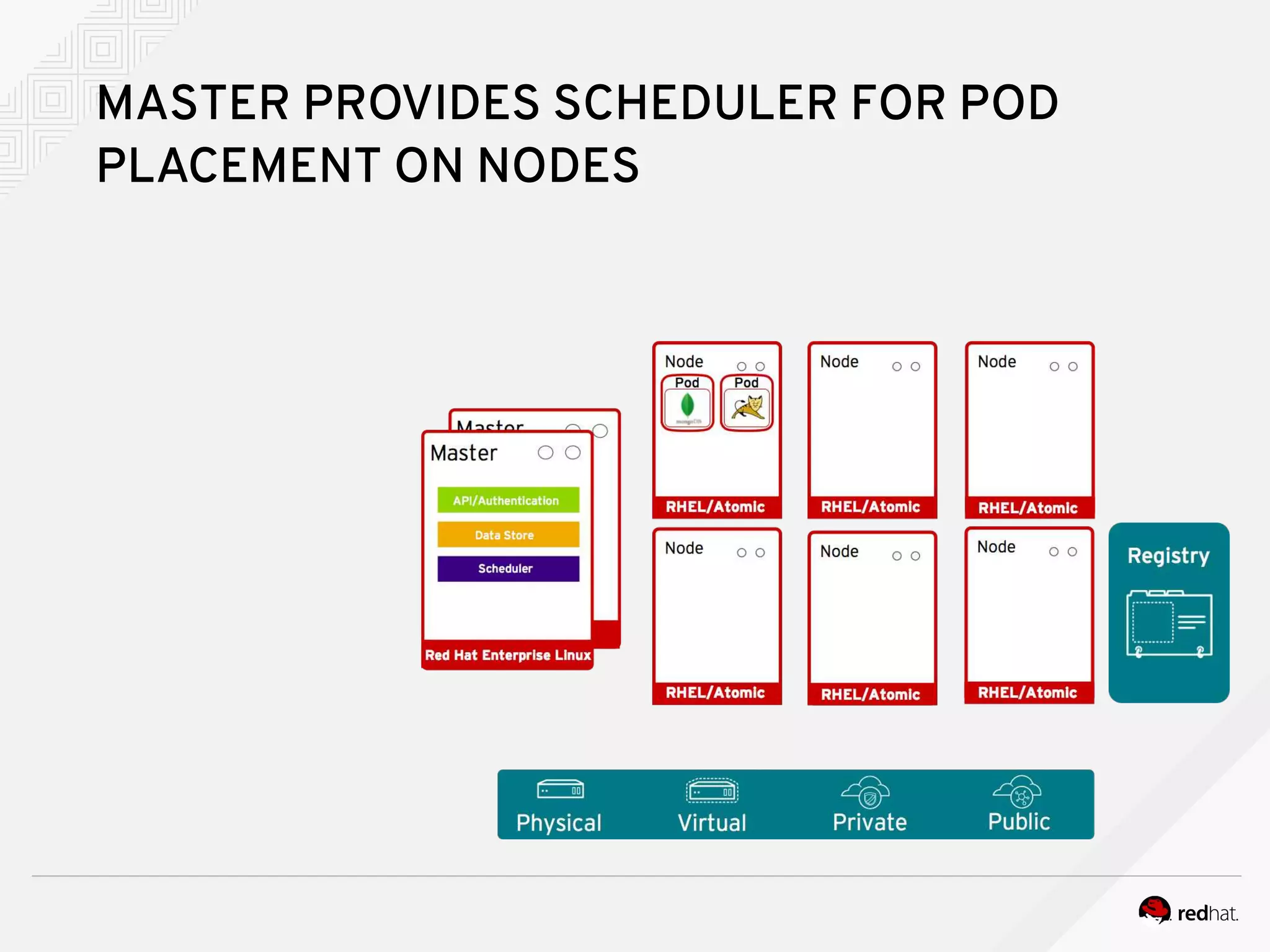
MASTER PROVIDES SCHEDULER FOR POD
PLACEMENT ON NODES
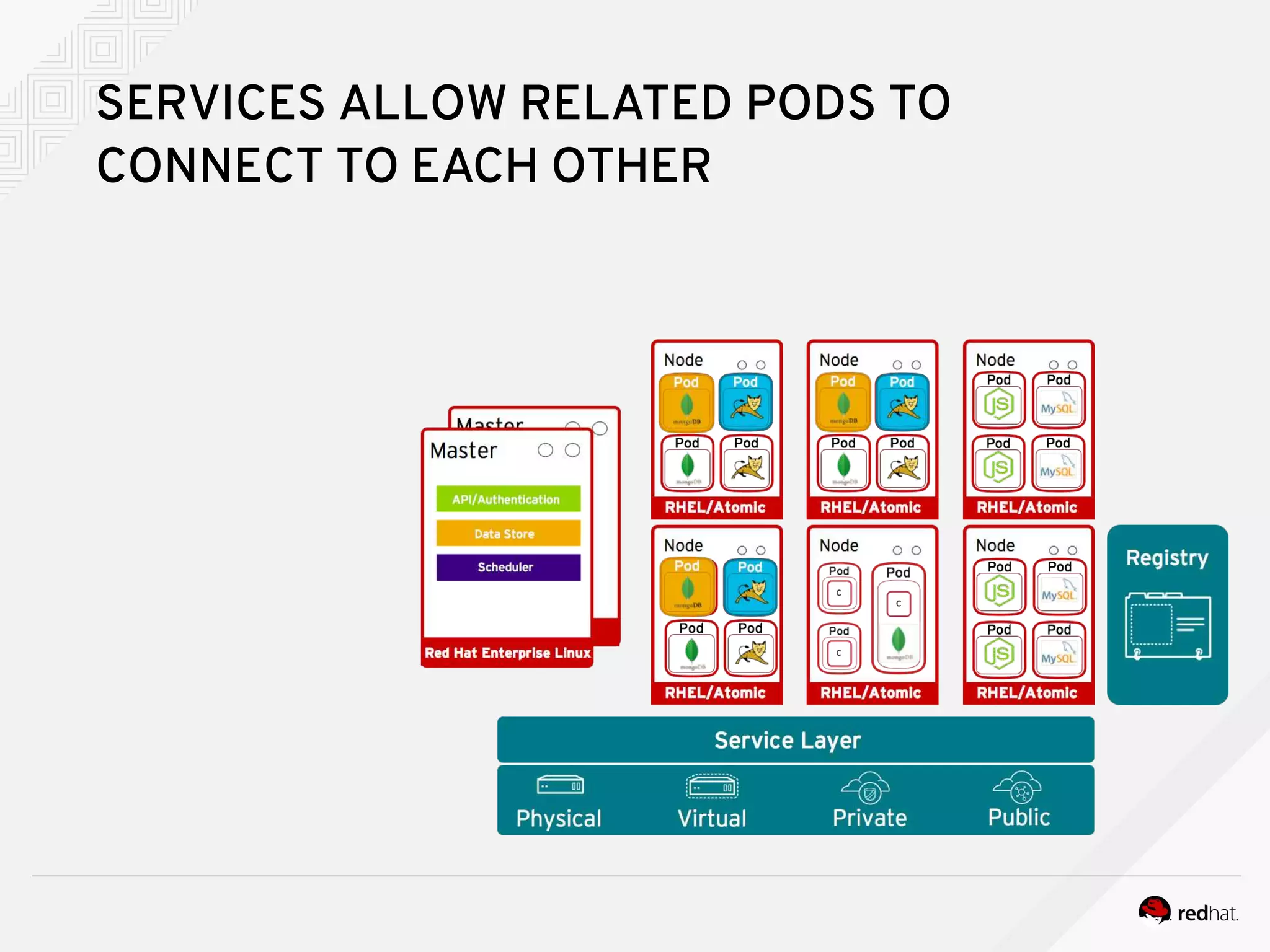
SERVICES ALLOW RELATED PODS TO
CONNECT TO EACH OTHER
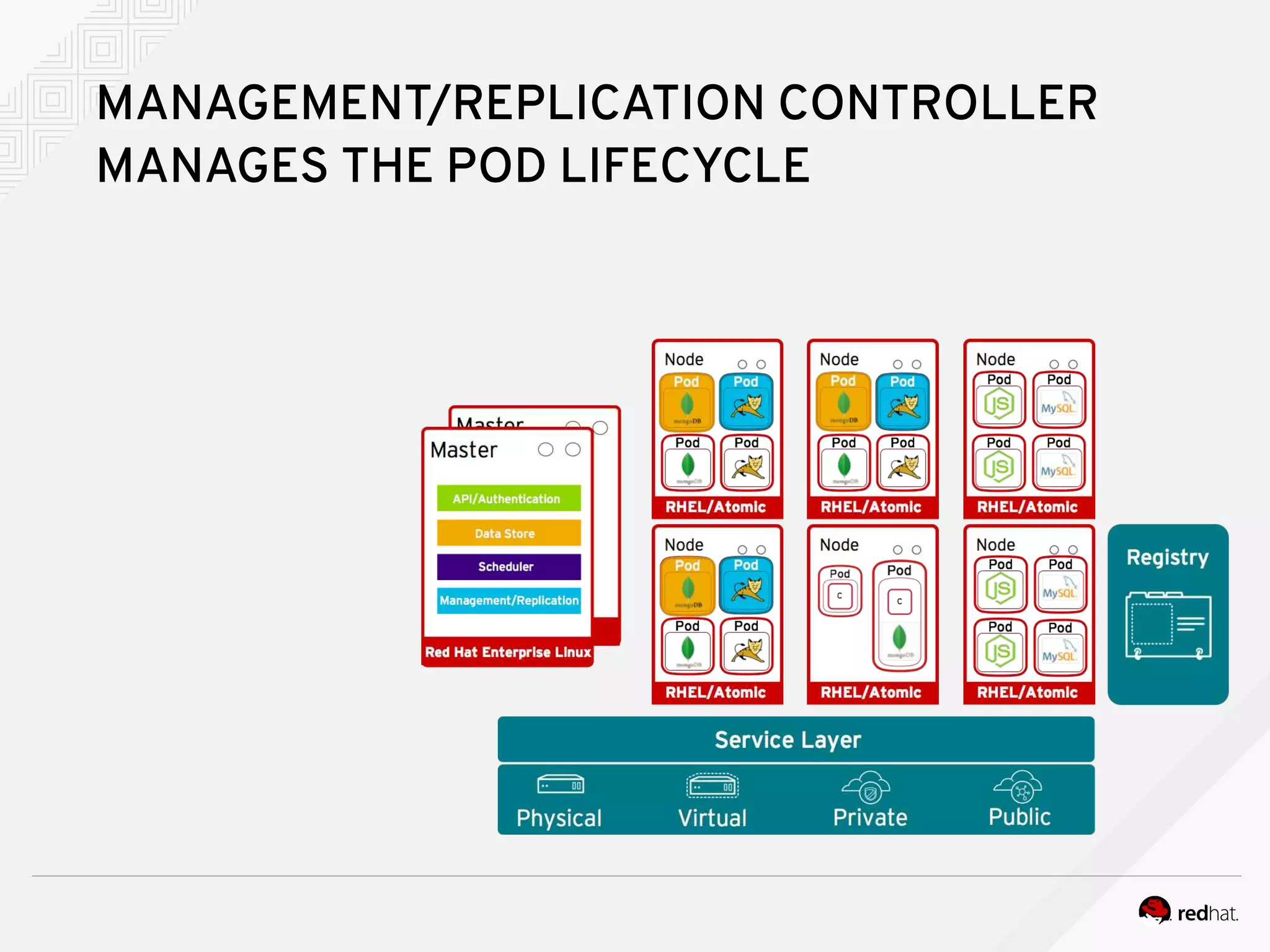
MANAGEMENT/REPLICATION CONTROLLER
MANAGES THE POD LIFECYCLE
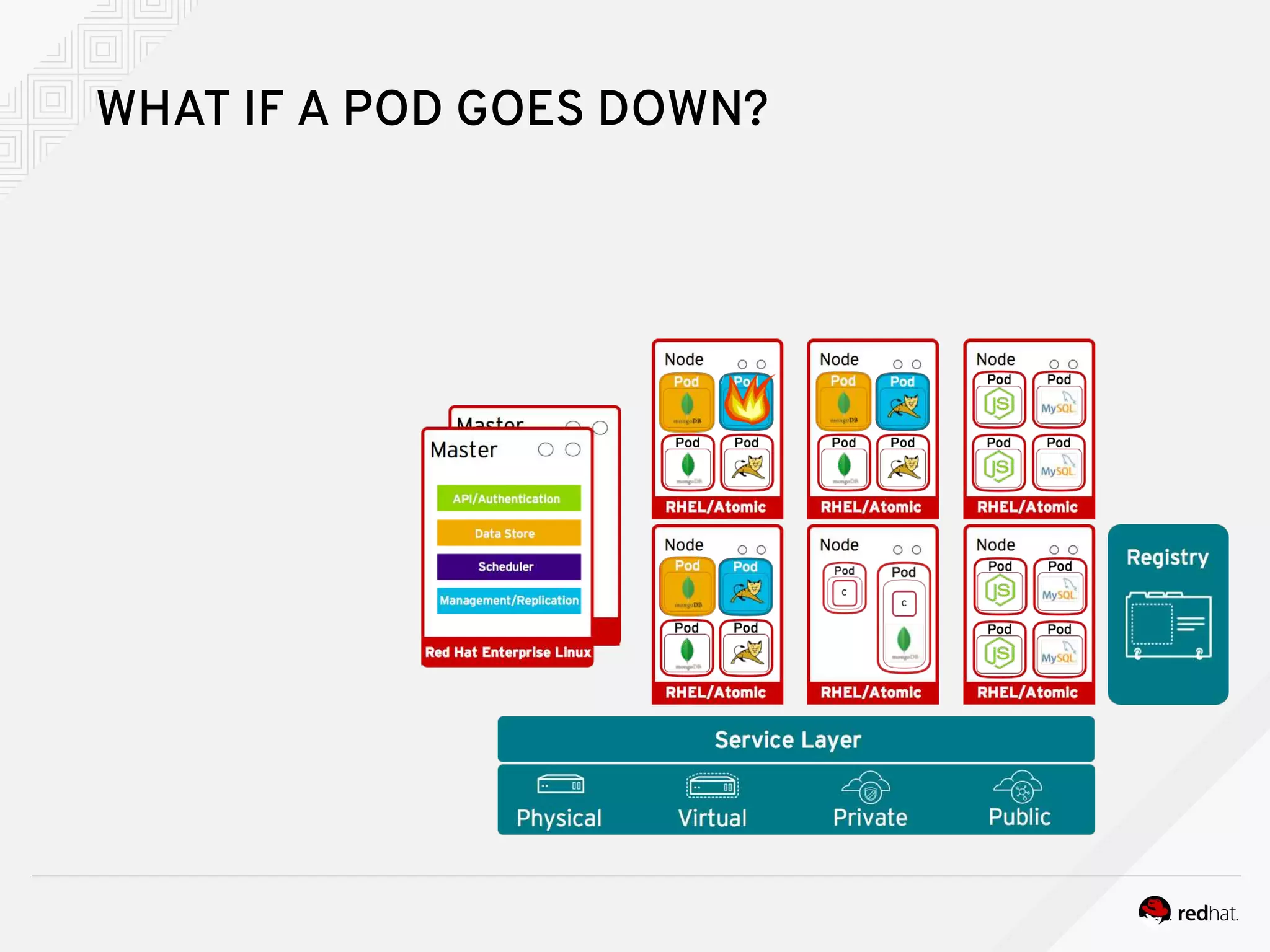
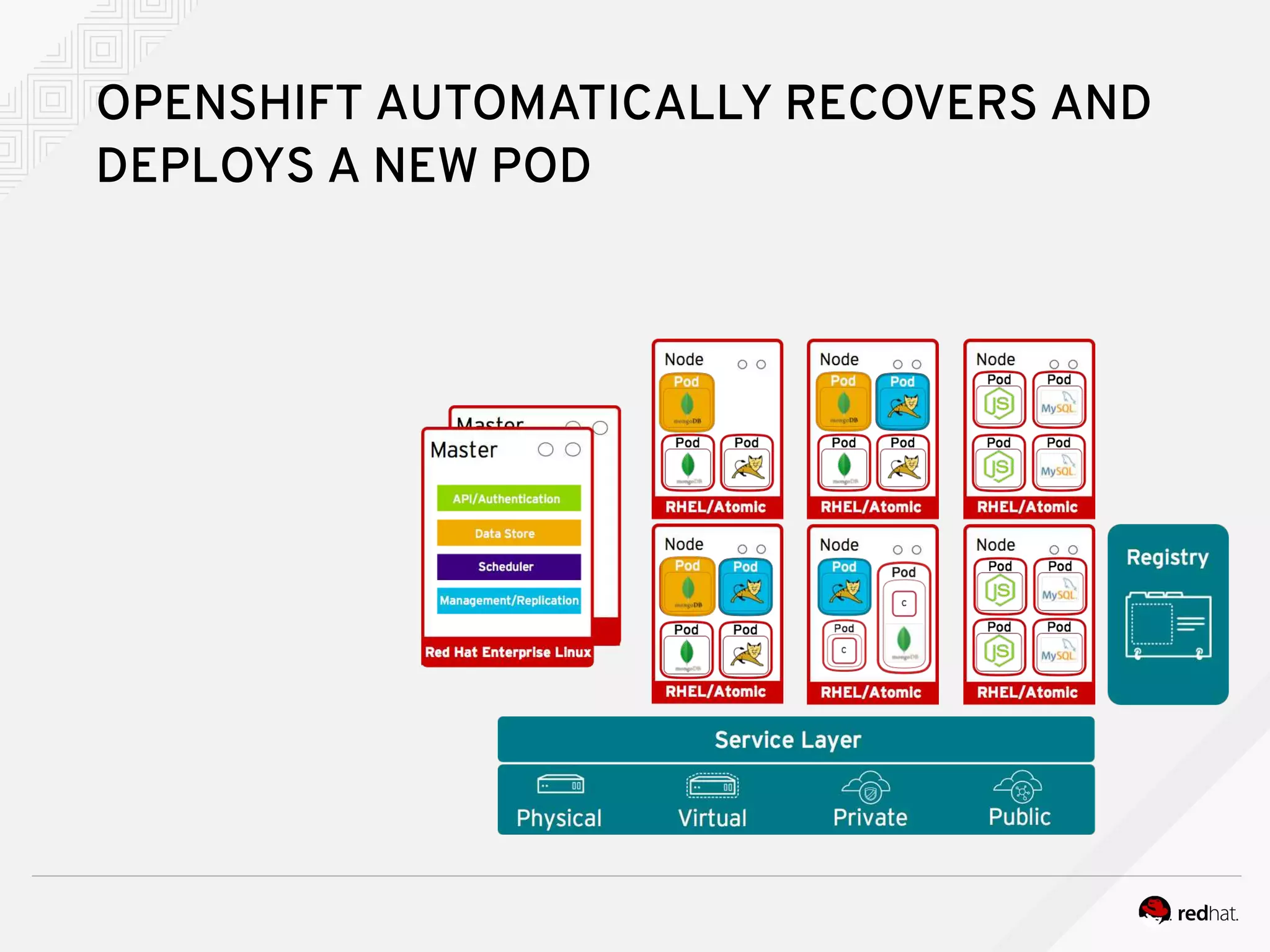
WHAT IF A POD GOES DOWN?
OPENSHIFT AUTOMATICALLY RECOVERS AND
DEPLOYS A NEW POD
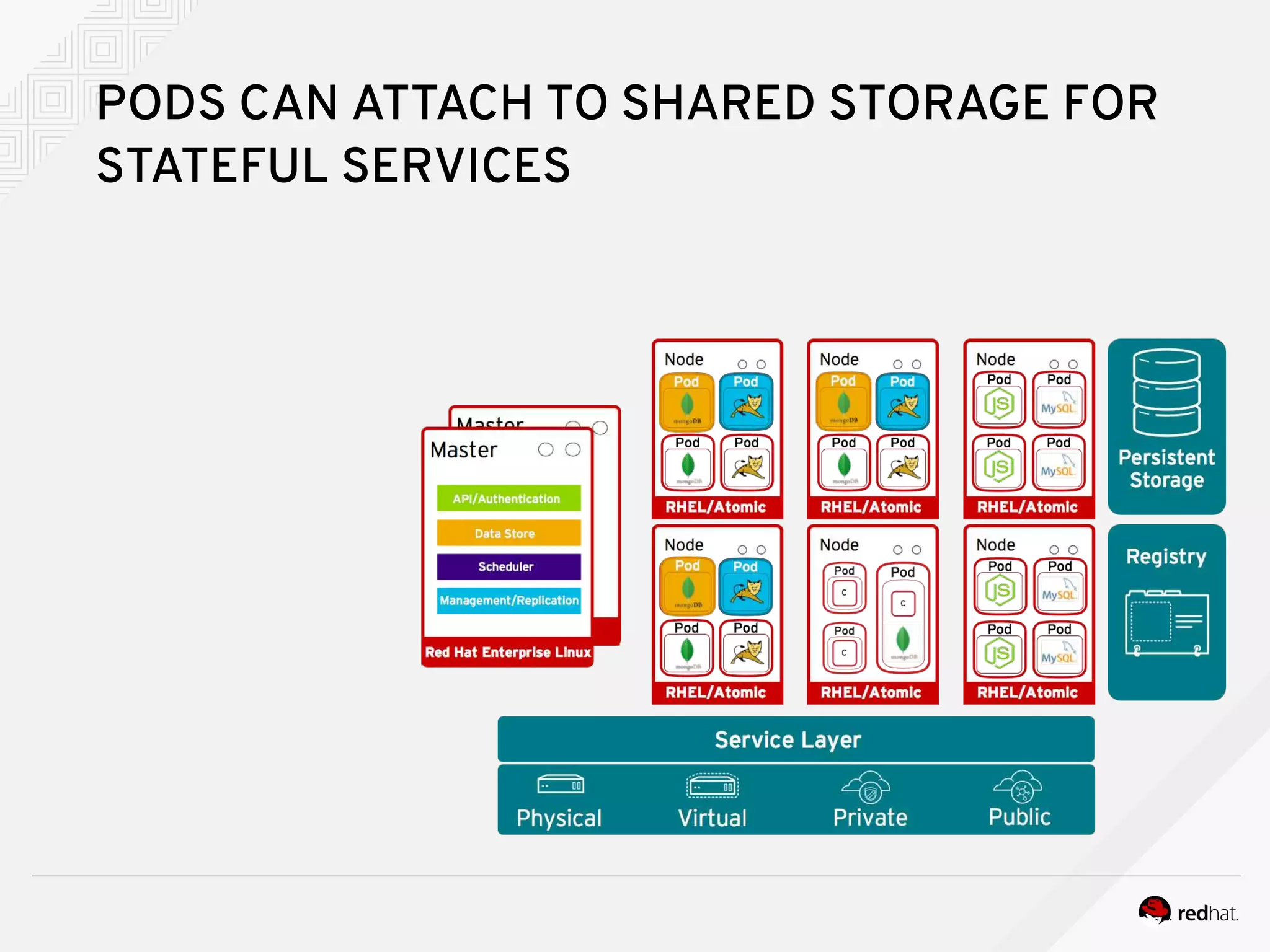
PODS CAN ATTACH TO SHARED STORAGE FOR
STATEFUL SERVICES
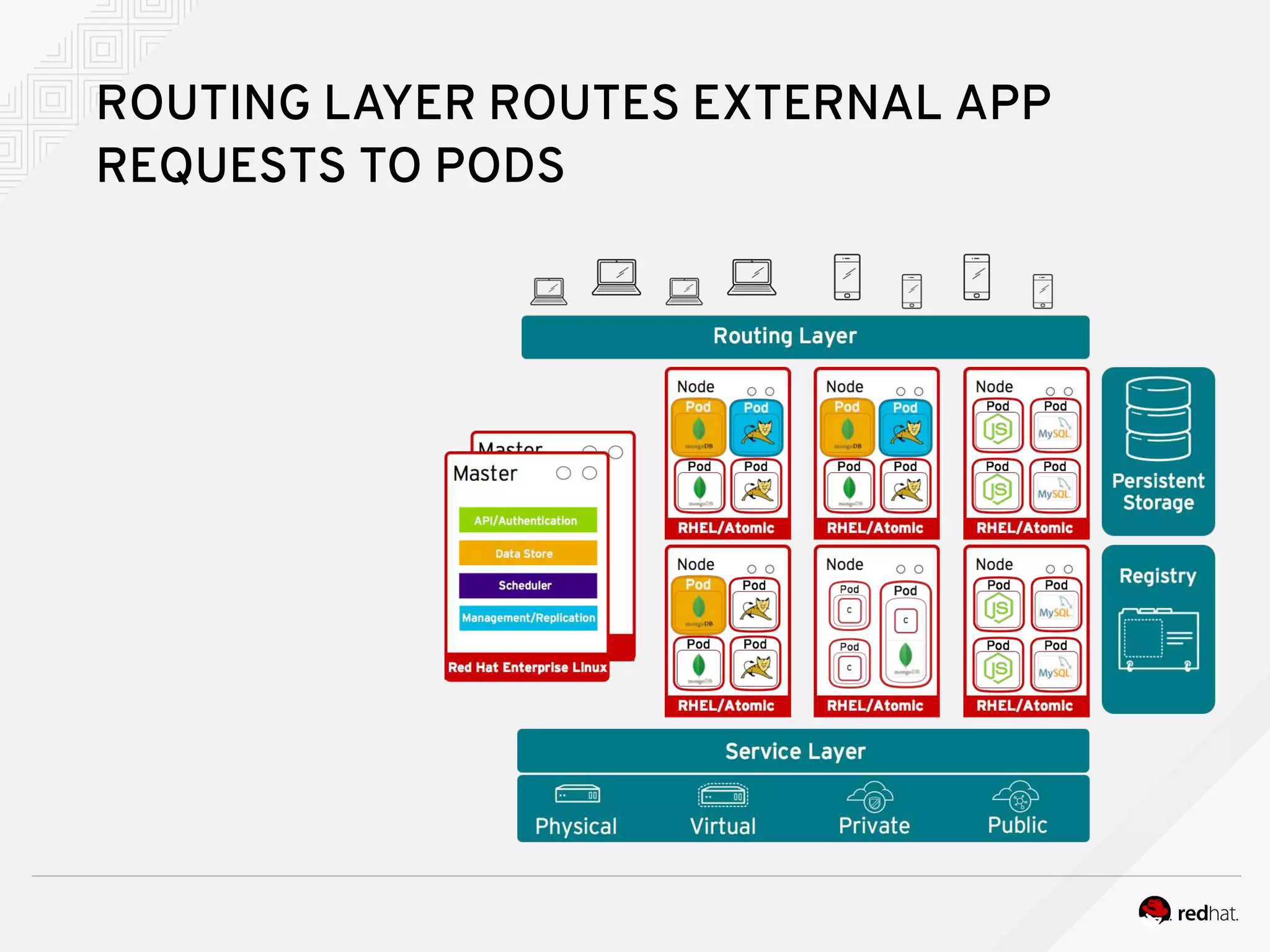
ROUTING LAYER ROUTES EXTERNAL APP
REQUESTS TO PODS
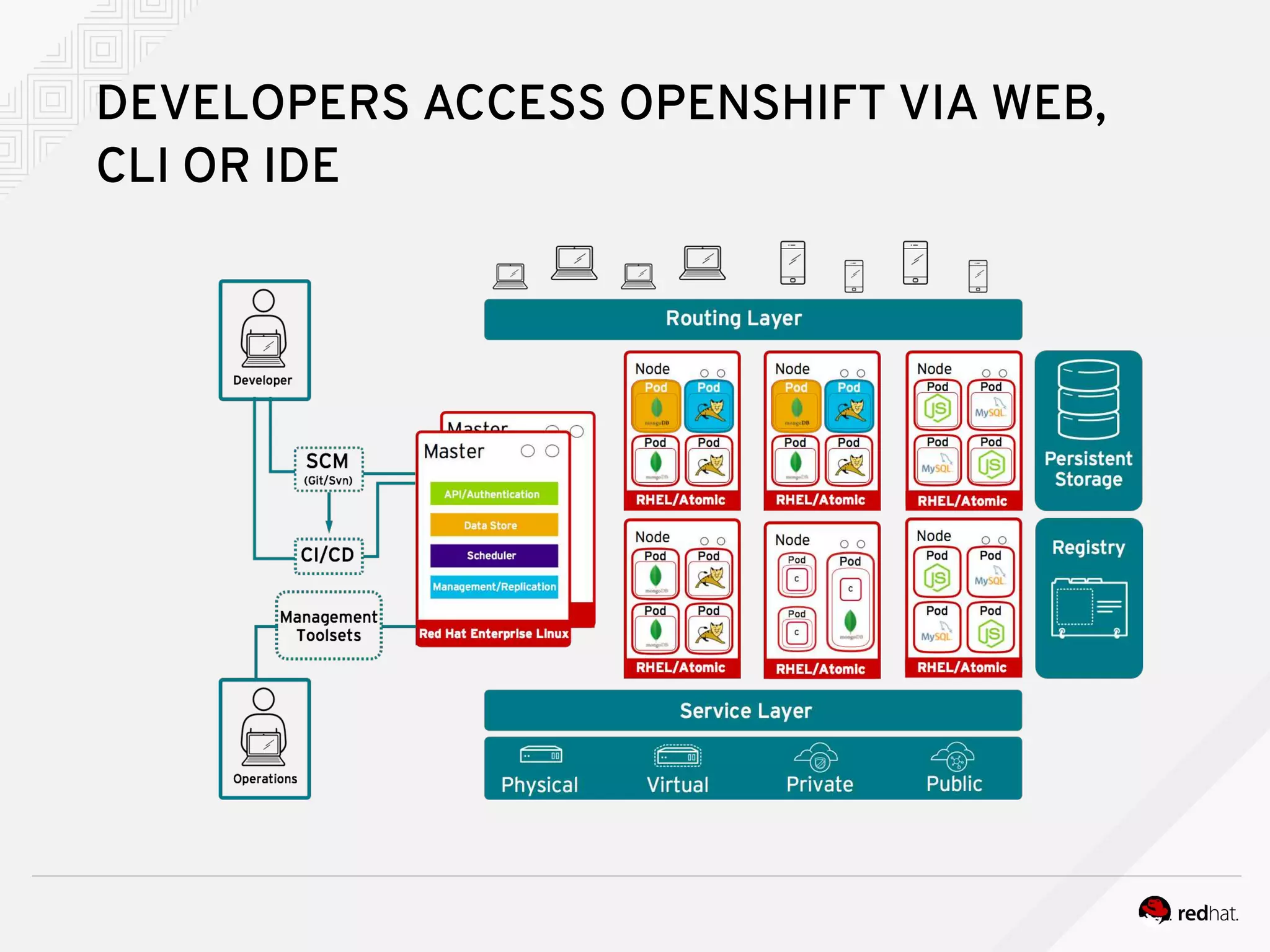
DEVELOPERS ACCESS OPENSHIFT VIA WEB,
CLI OR IDE
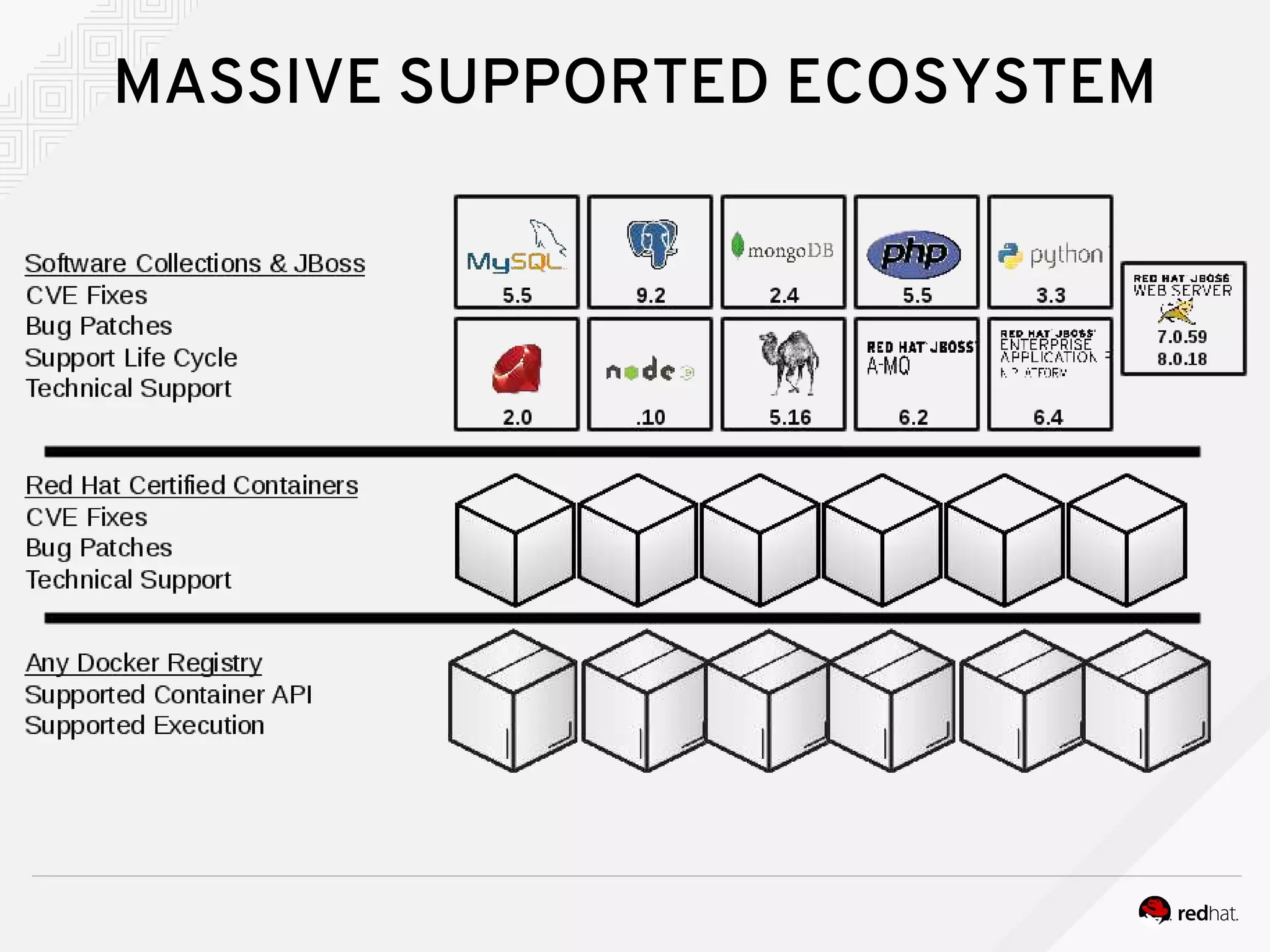
MASSIVE SUPPORTED ECOSYSTEM
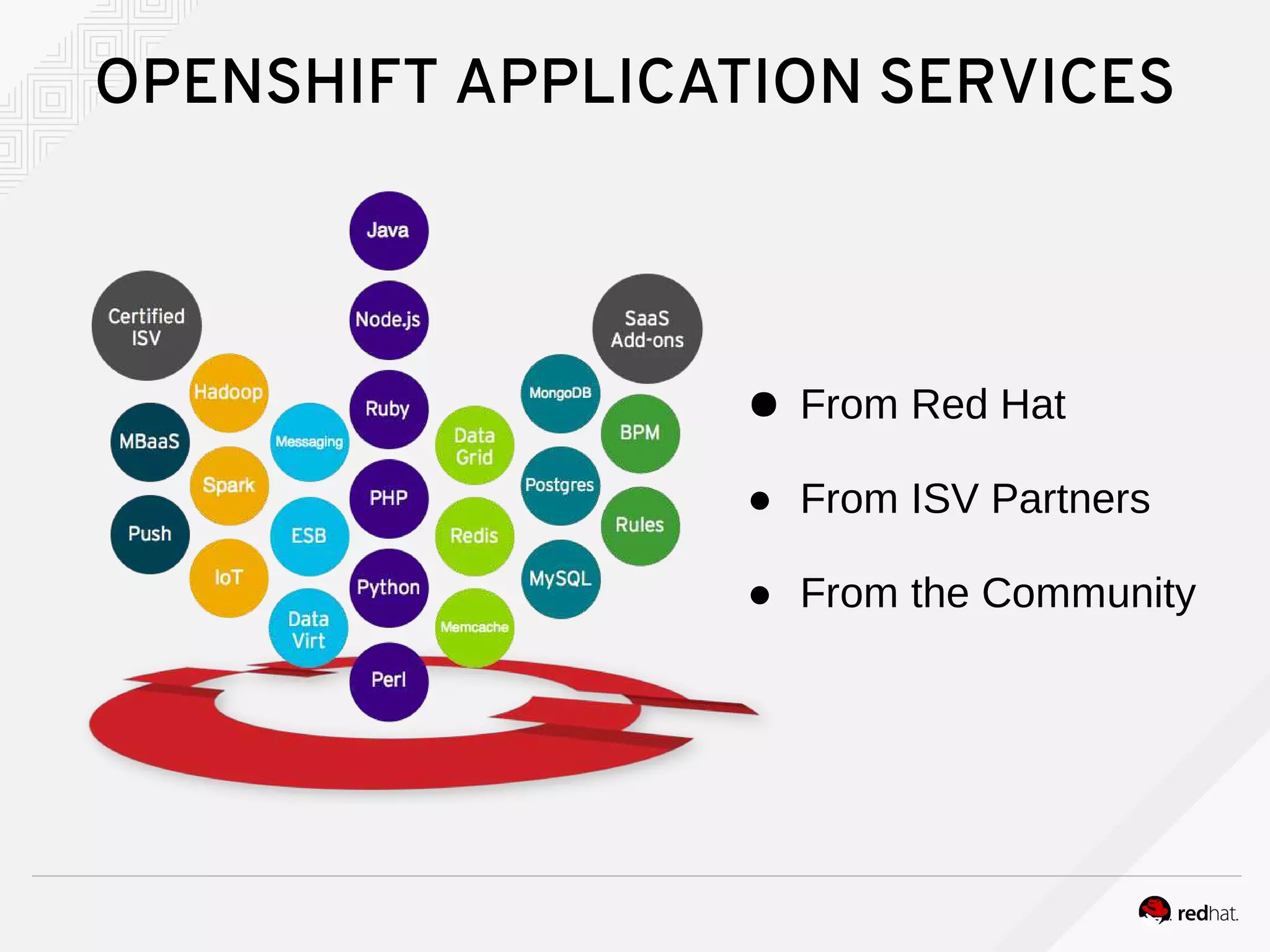
OPENSHIFT APPLICATION SERVICES
● From Red Hat
● From ISV Partners
● From the Community
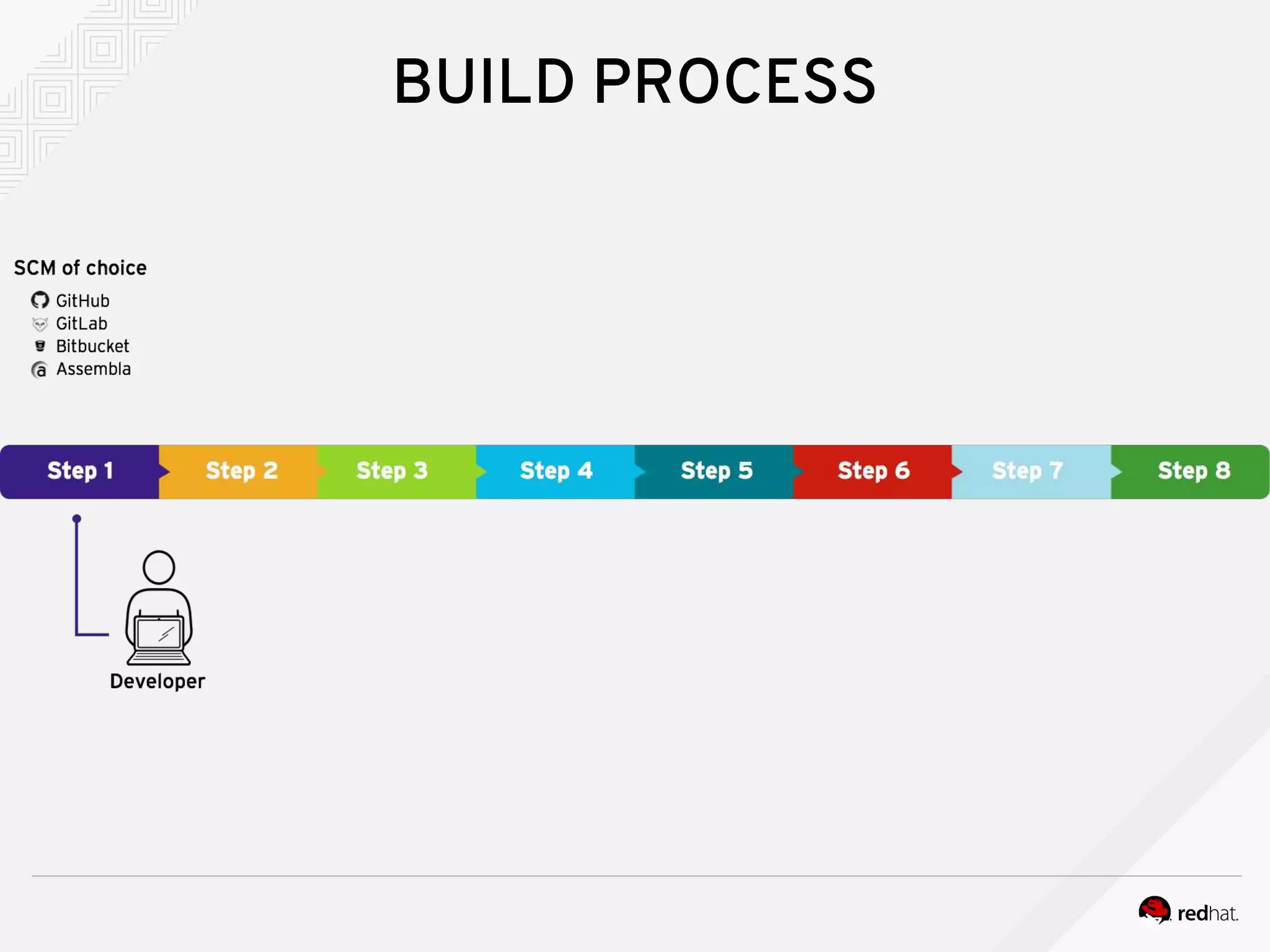
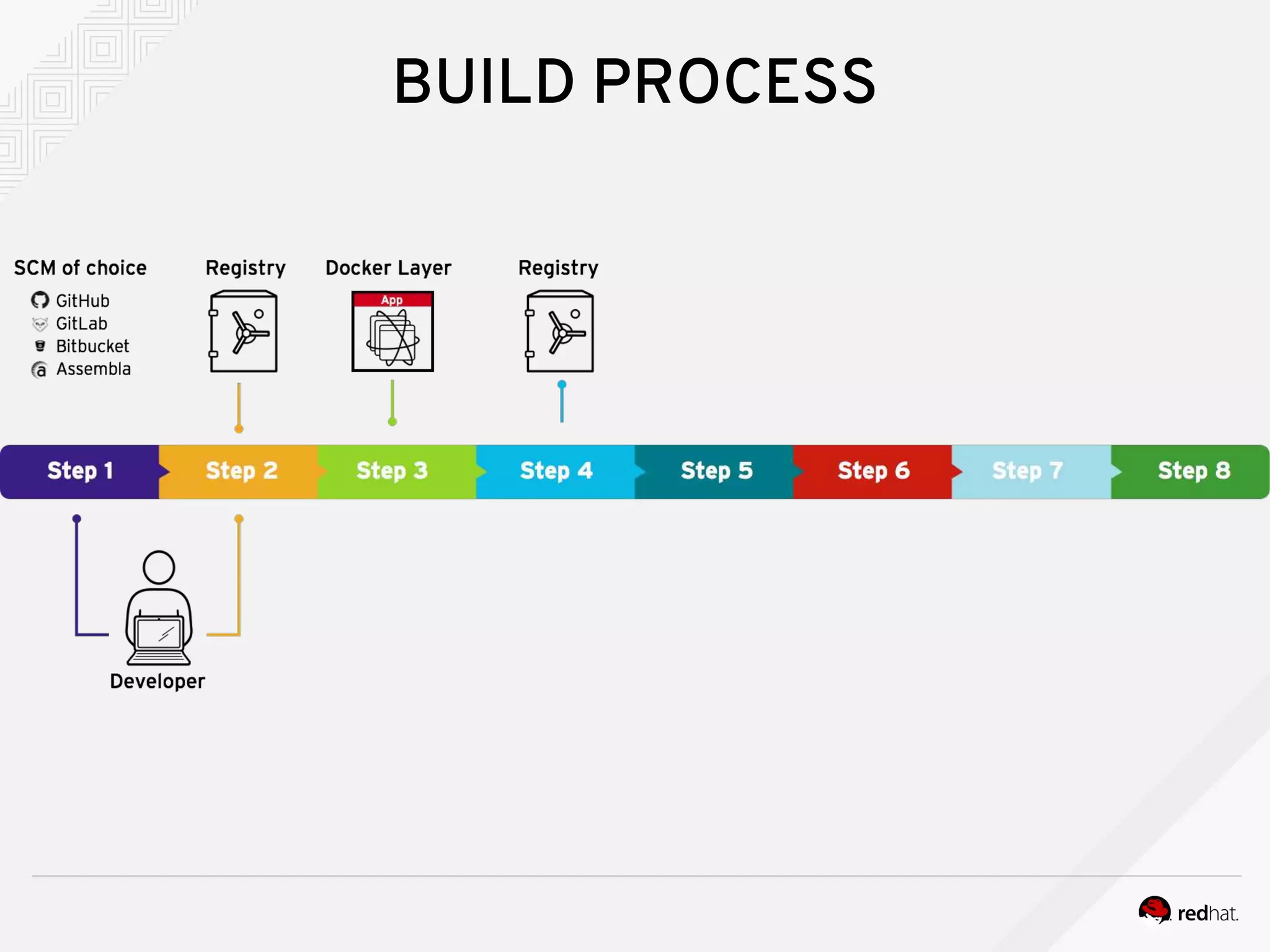
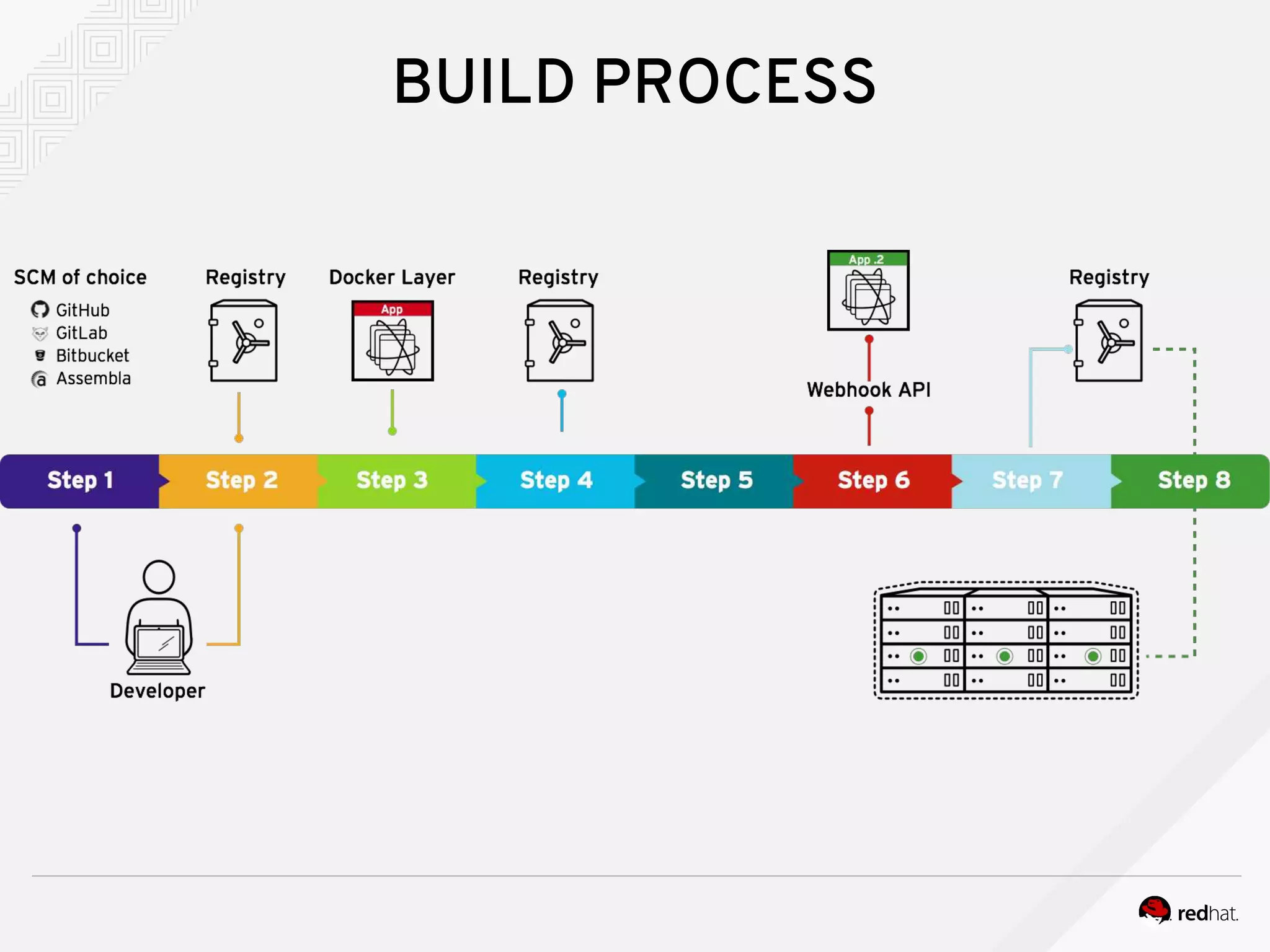
BUILD PROCESS
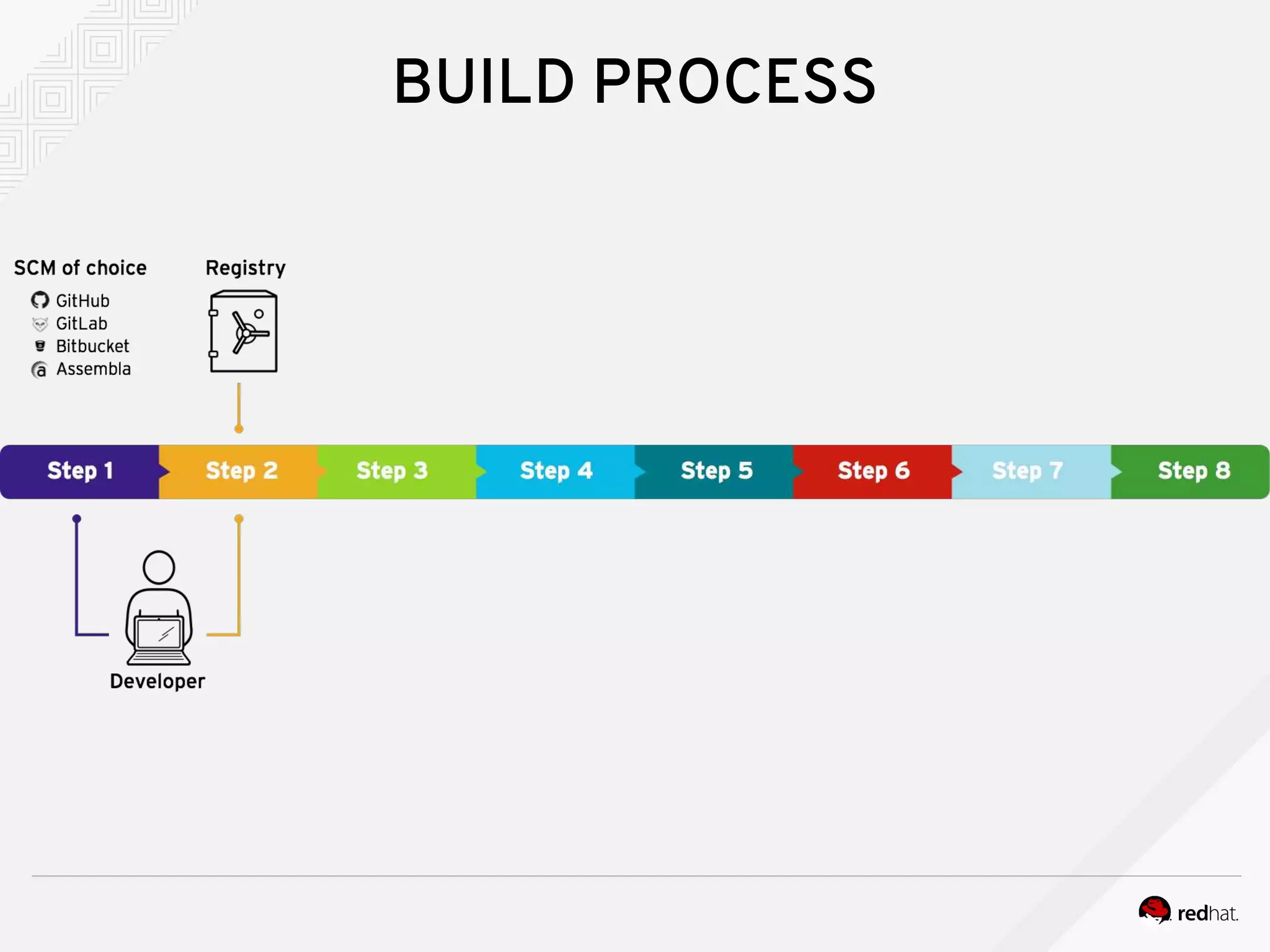
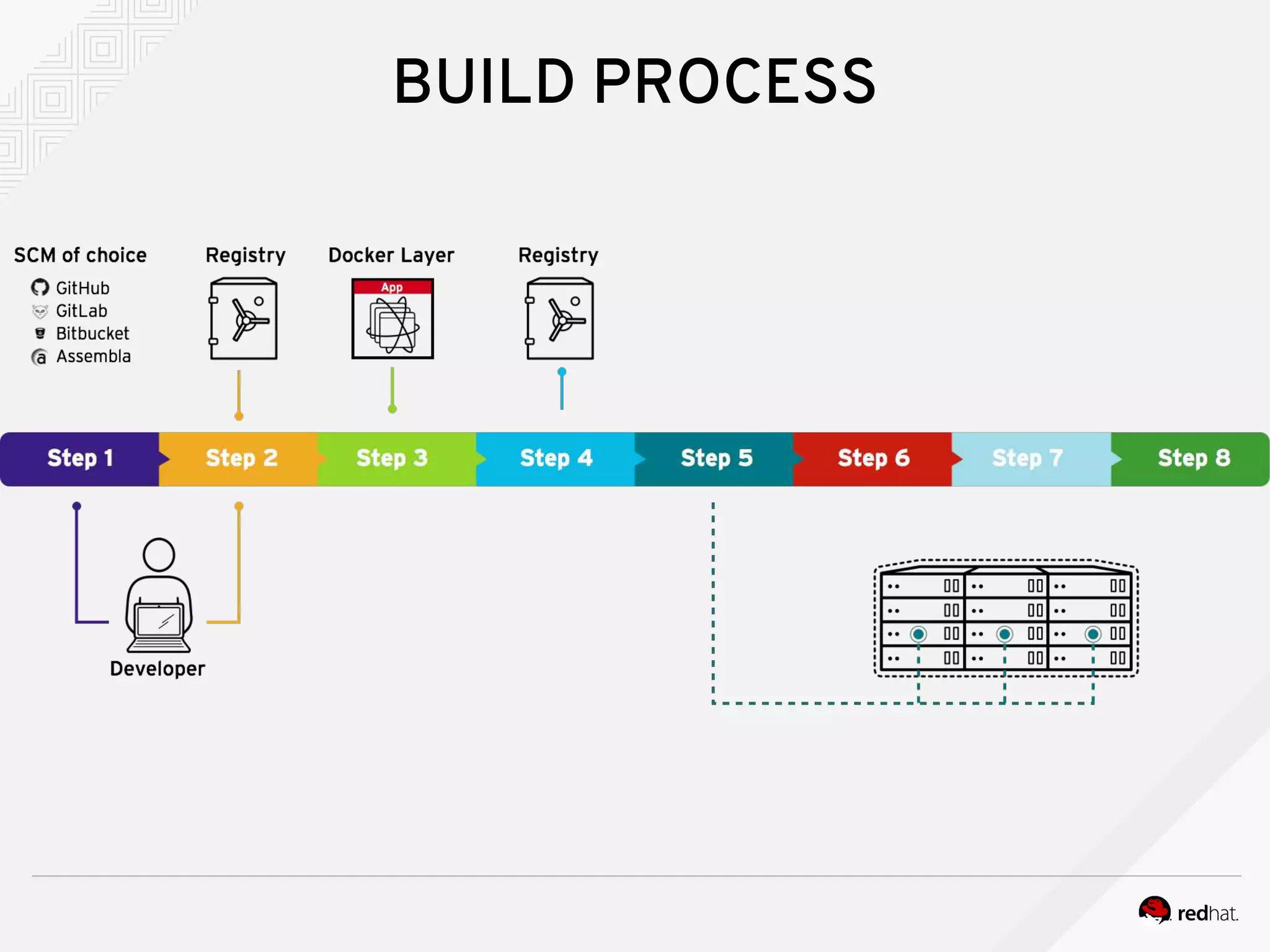
BUILD PROCESS
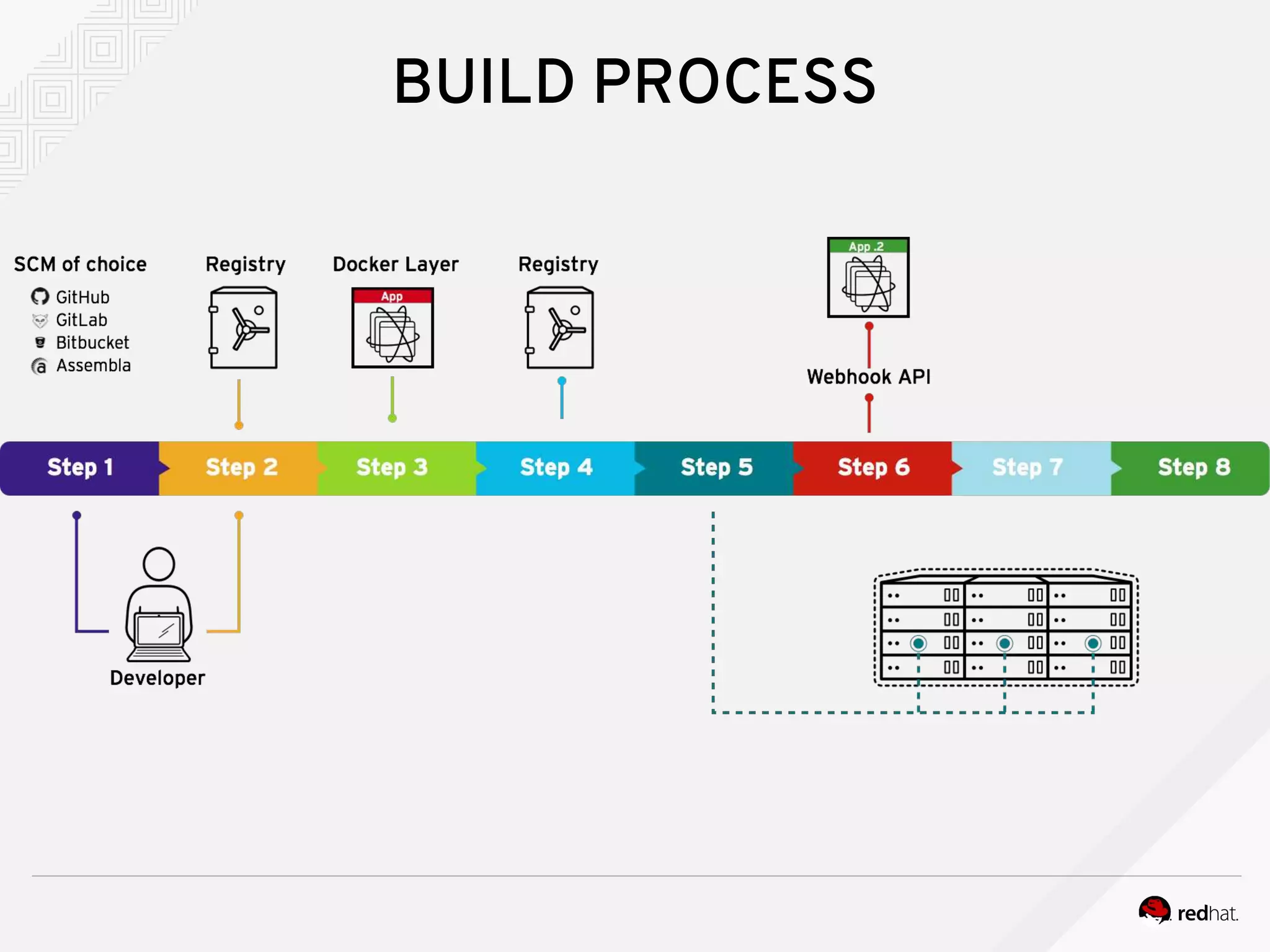
BUILD PROCESS
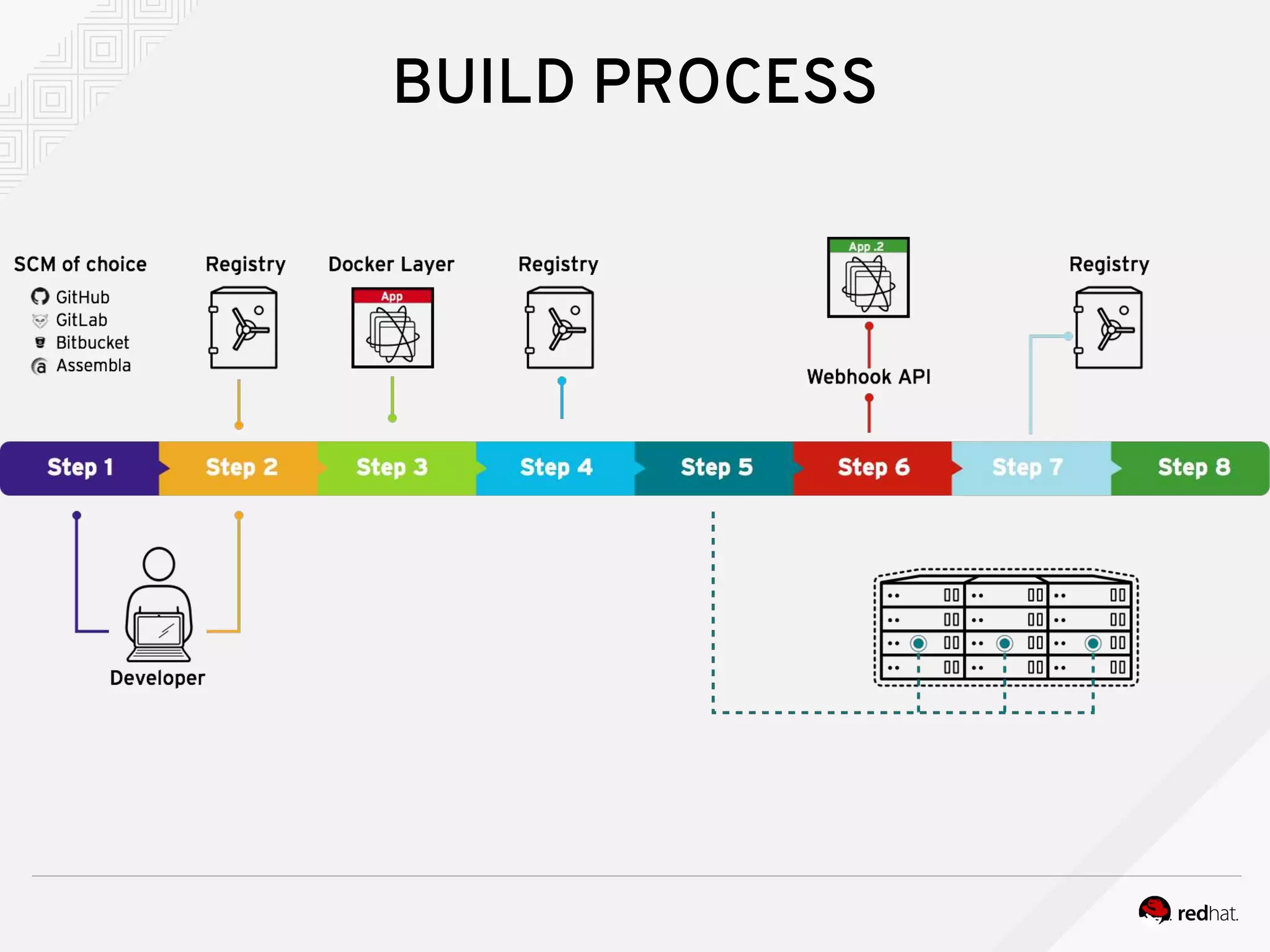
BUILD PROCESS
BUILD PROCESS
BUILD PROCESS
BUILD PROCESS
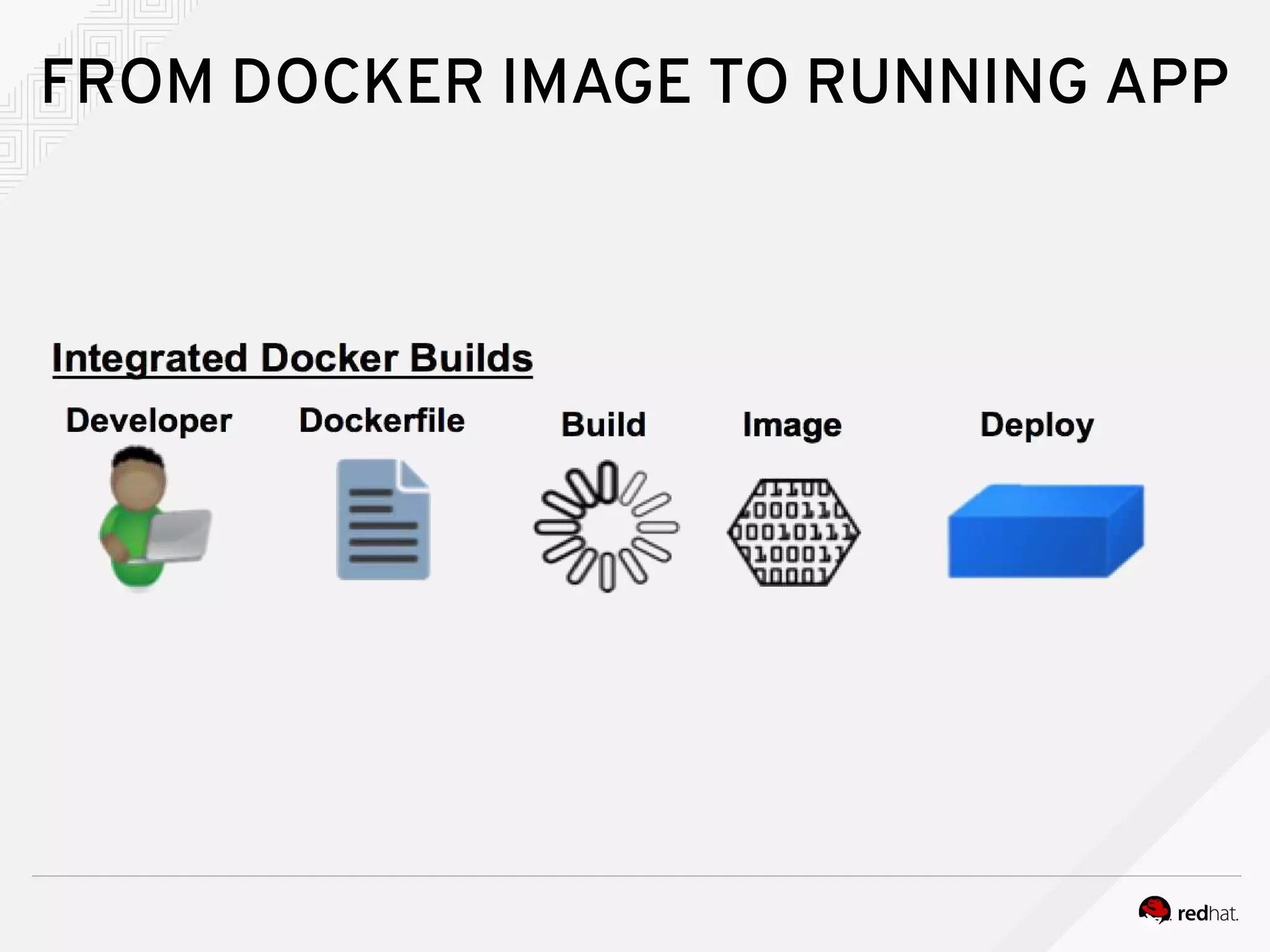
FROM DOCKER IMAGE TO RUNNING APP
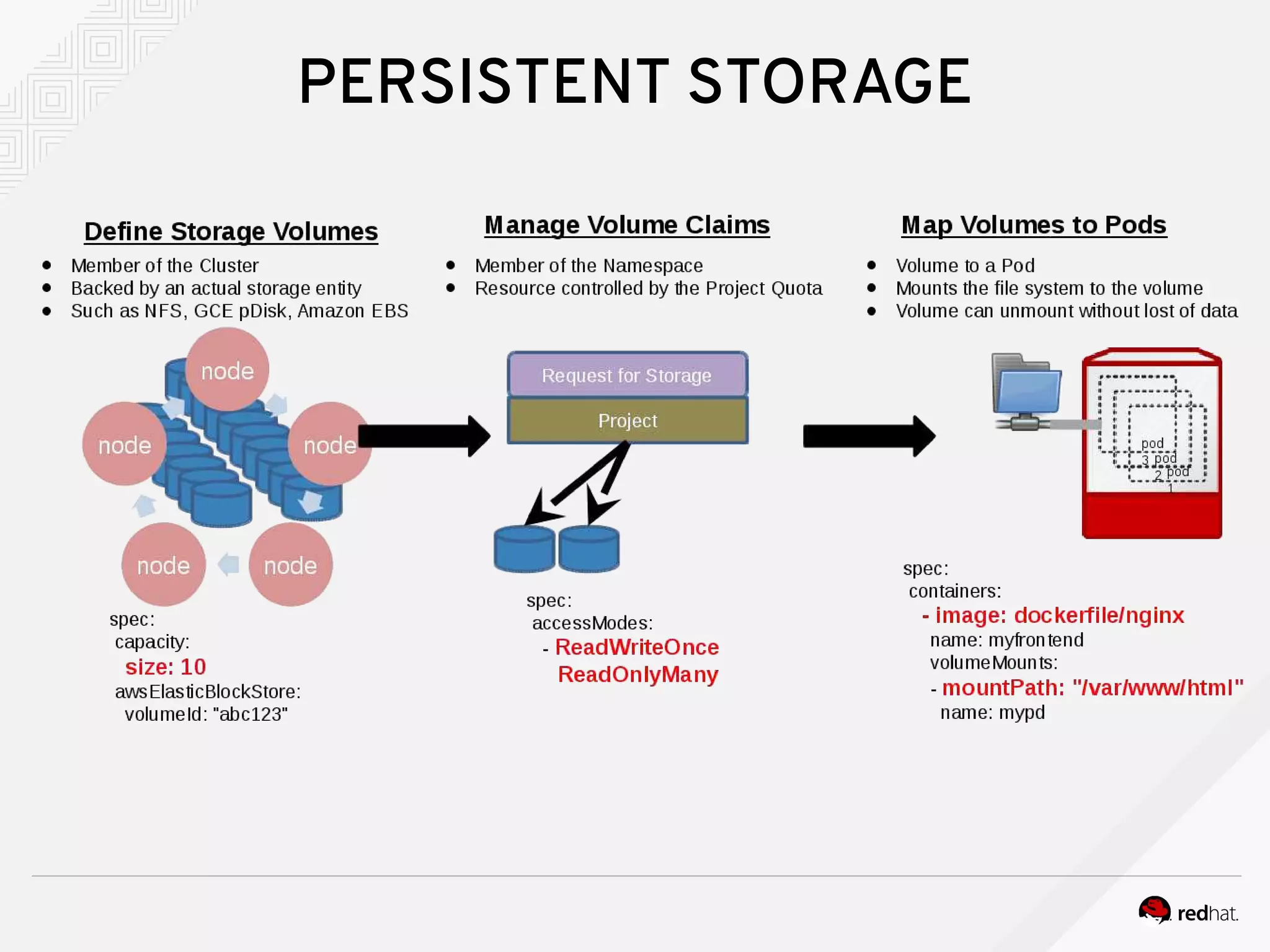
PERSISTENT STORAGE
OpenShift Adoption
OPENSHIFT ENTERPRISE ADOPTION
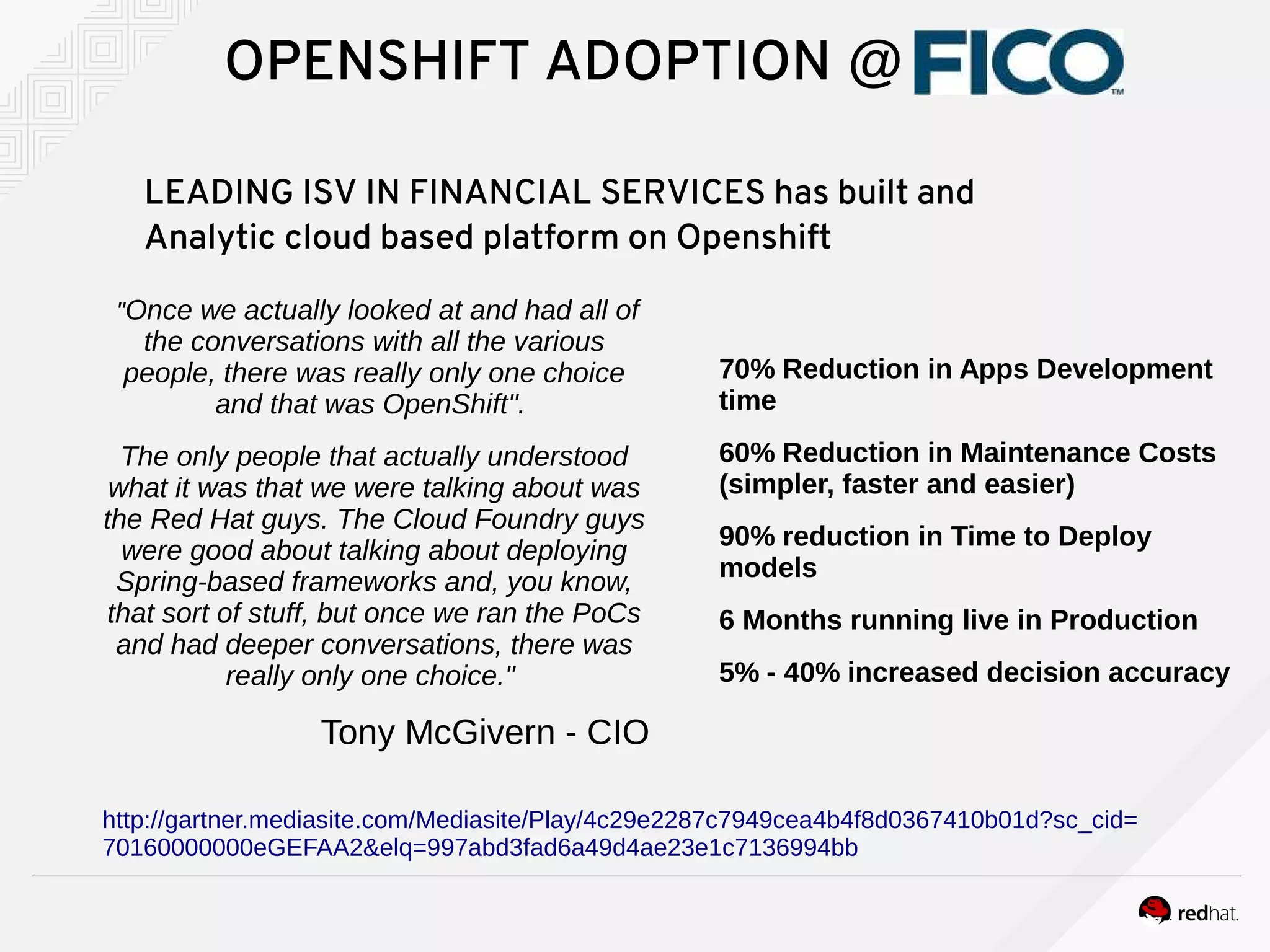
"Once we actually looked at and had all of
the conversations with all the various
people, there was really only one choice
and that was OpenShift".
The only people that actually understood
what it was that we were talking about was
the Red Hat guys. The Cloud Foundry guys
were good about talking about deploying
Spring-based frameworks and, you know,
that sort of stuff, but once we ran the PoCs
and had deeper conversations, there was
really only one choice."
Tony McGivern - CIO
OPENSHIFT ADOPTION @
LEADING ISV IN FINANCIAL SERVICES has built and
Analytic cloud based platform on Openshift
70% Reduction in Apps Development
time
60% Reduction in Maintenance Costs
(simpler, faster and easier)
90% reduction in Time to Deploy
models
6 Months running live in Production
5% - 40% increased decision accuracy
http://gartner.mediasite.com/Mediasite/Play/4c29e2287c7949cea4b4f8d0367410b01d?sc_cid=
70160000000eGEFAA2&elq=997abd3fad6a49d4ae23e1c7136994bb
Containers Adoption
Challenges
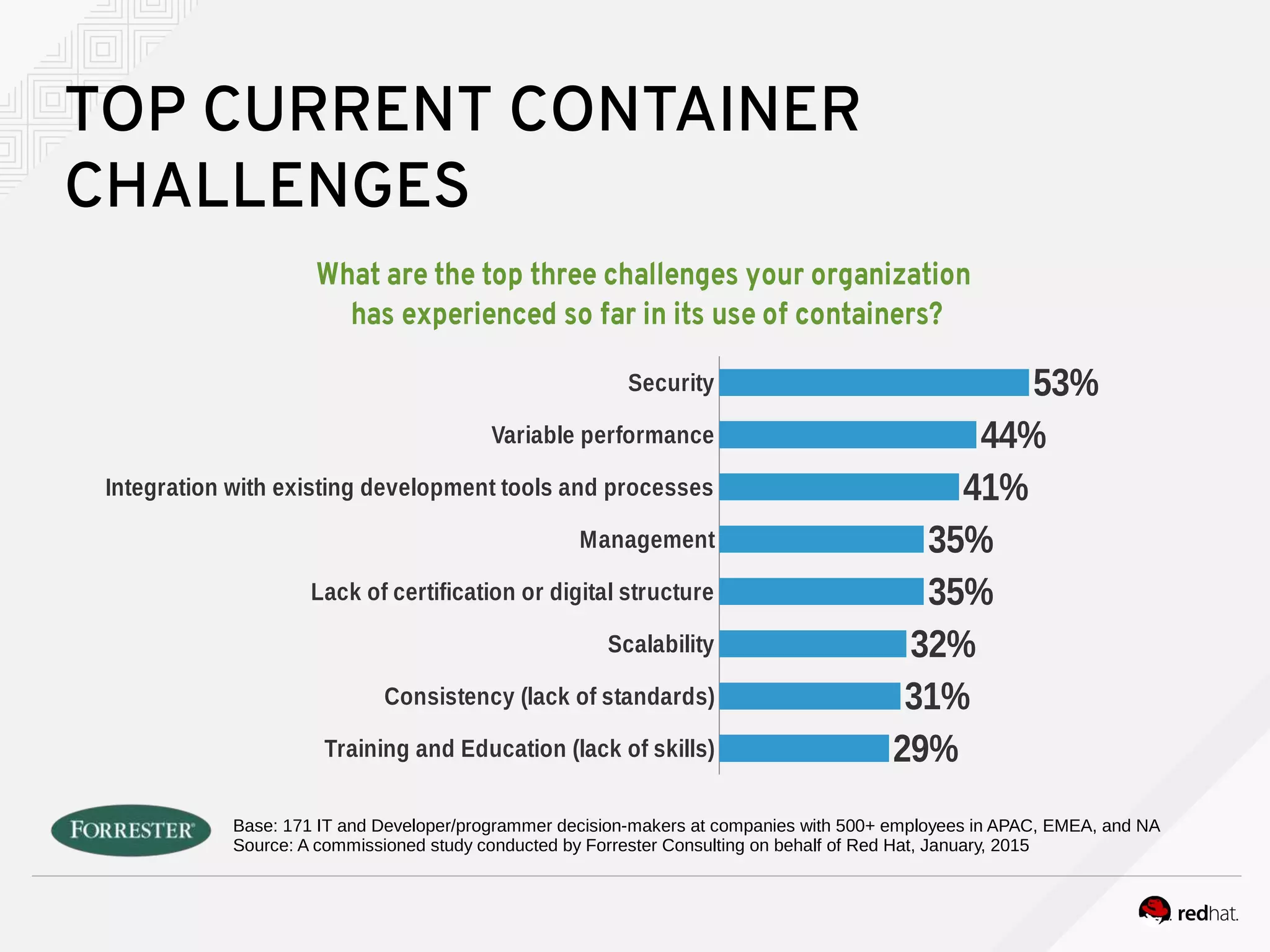
TOP CURRENT CONTAINER
CHALLENGES
Training and Education (lack of skills)
Consistency (lack of standards)
Scalability
Lack of certification or digital structure
Management
Integration with existing development tools and processes
Variable performance
Security
29%
31%
32%
35%
35%
41%
44%
53%
What are the top three challenges your organization
has experienced so far in its use of containers?
Base: 171 IT and Developer/programmer decision-makers at companies with 500+ employees in APAC, EMEA, and NA
Source: A commissioned study conducted by Forrester Consulting on behalf of Red Hat, January, 2015
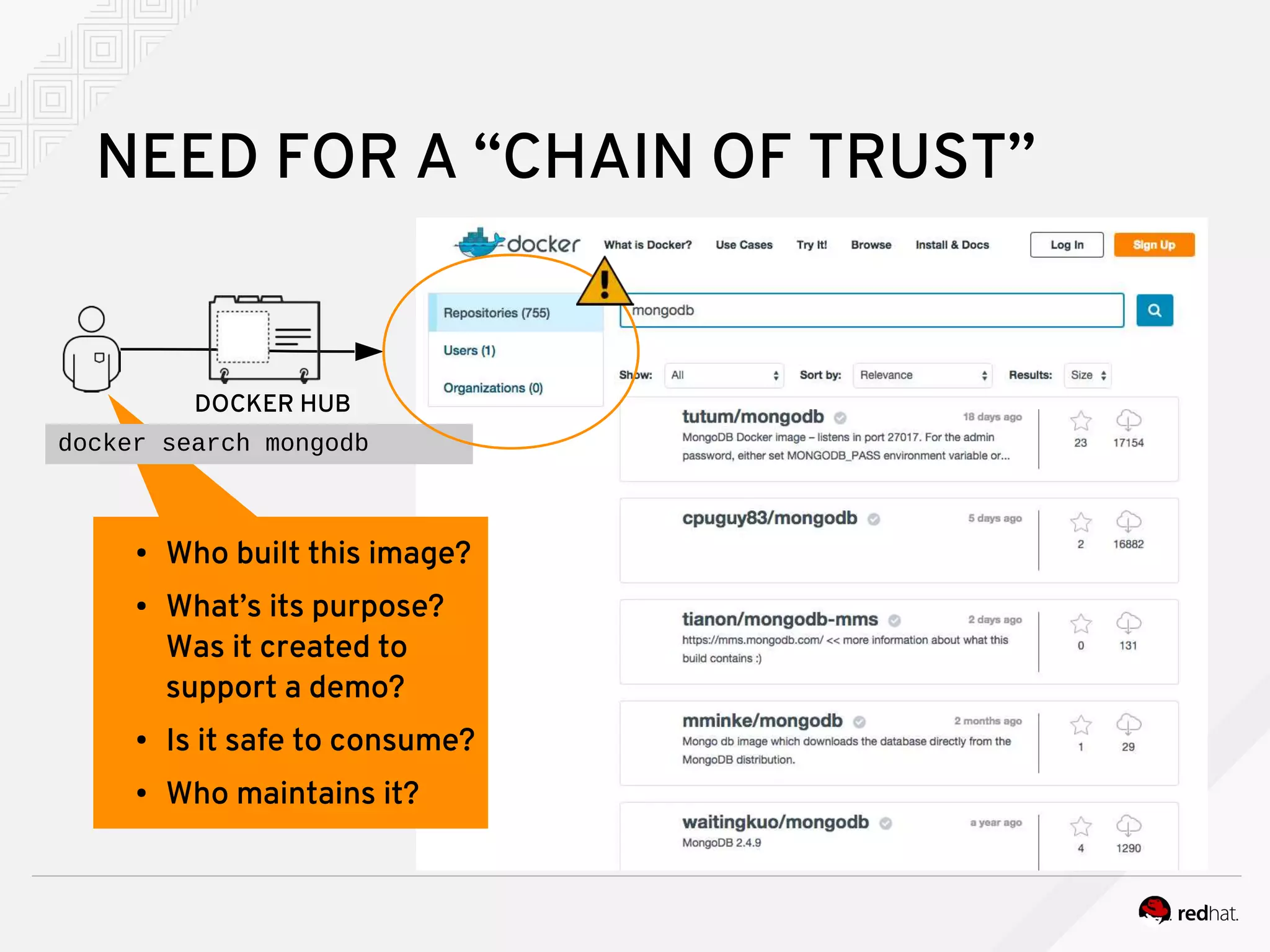
● Who built this image?
● What’s its purpose?
Was it created to
support a demo?
● Is it safe to consume?
● Who maintains it?
NEED FOR A “CHAIN OF TRUST”
DOCKER HUB
docker search mongodb
RED HAT CONFIDENTIAL | NDA ONLY57
WHAT'S INSIDE THE CONTAINER
MATTERS
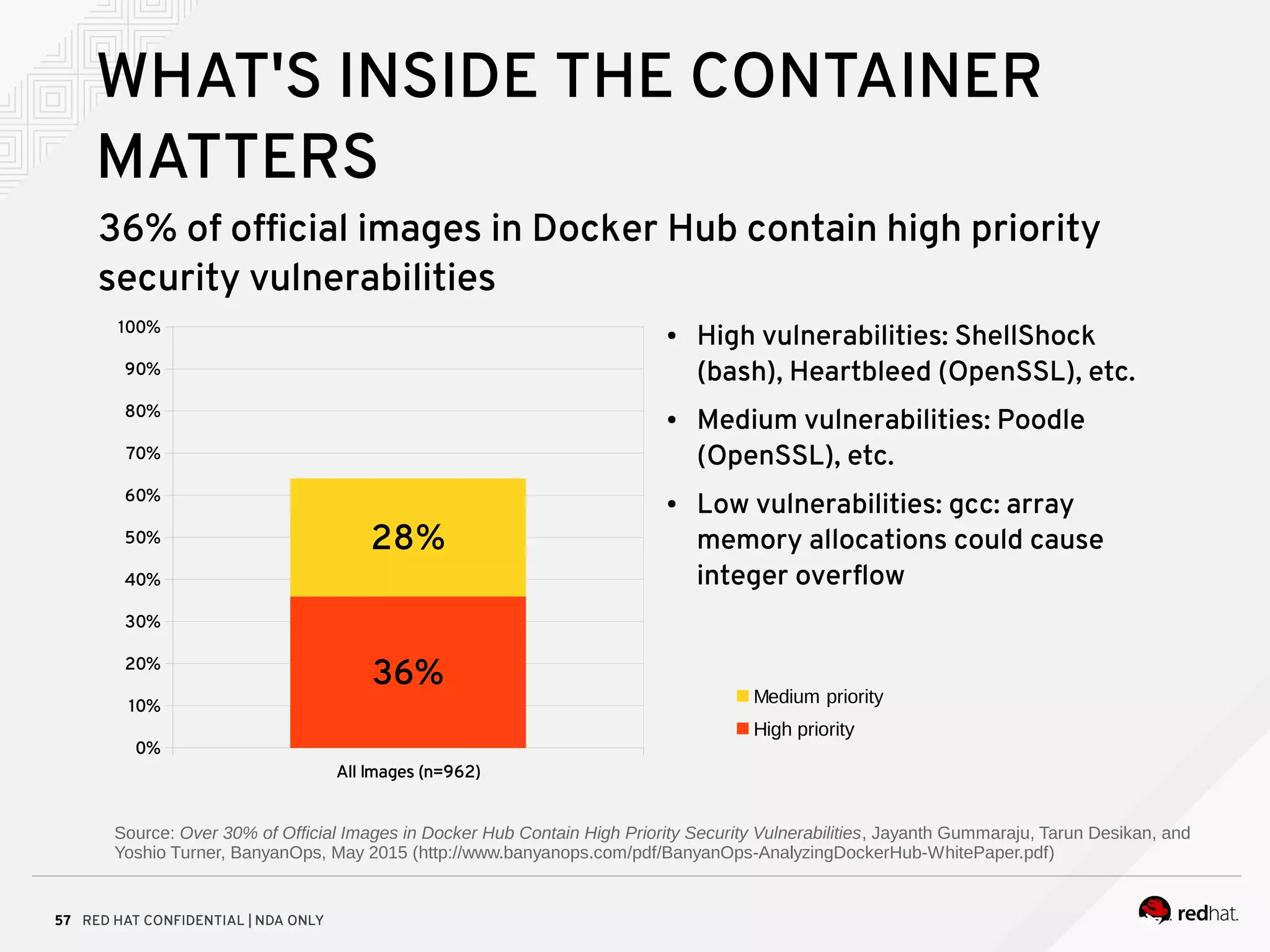
36% of official images in Docker Hub contain high priority
security vulnerabilities
● High vulnerabilities: ShellShock
(bash), Heartbleed (OpenSSL), etc.
● Medium vulnerabilities: Poodle
(OpenSSL), etc.
● Low vulnerabilities: gcc: array
memory allocations could cause
integer overflow
All Images (n=962)
0%
10%
20%
30%
40%
50%
60%
70%
80%
90%
100%
36%
28%
Medium priority
High priority
Source: Over 30% of Official Images in Docker Hub Contain High Priority Security Vulnerabilities, Jayanth Gummaraju, Tarun Desikan, and
Yoshio Turner, BanyanOps, May 2015 (http://www.banyanops.com/pdf/BanyanOps-AnalyzingDockerHub-WhitePaper.pdf)
Red Hat Strategy for
Containers Adoption
RED HAT CONFIDENTIAL | NDA ONLY59
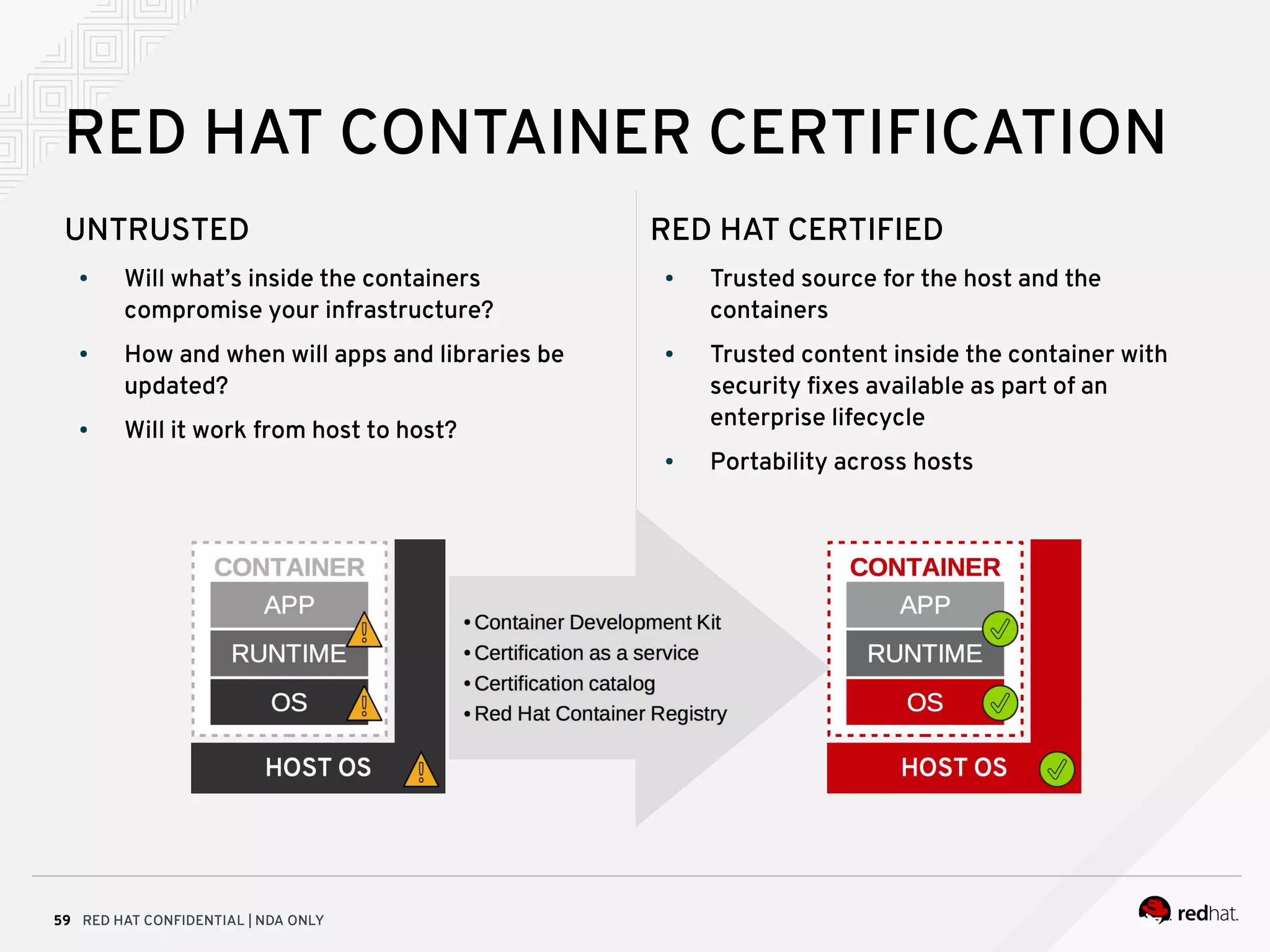
RED HAT CONTAINER CERTIFICATION
UNTRUSTED
● Will what’s inside the containers
compromise your infrastructure?
● How and when will apps and libraries be
updated?
● Will it work from host to host?
RED HAT CERTIFIED
● Trusted source for the host and the
containers
● Trusted content inside the container with
security fixes available as part of an
enterprise lifecycle
● Portability across hosts
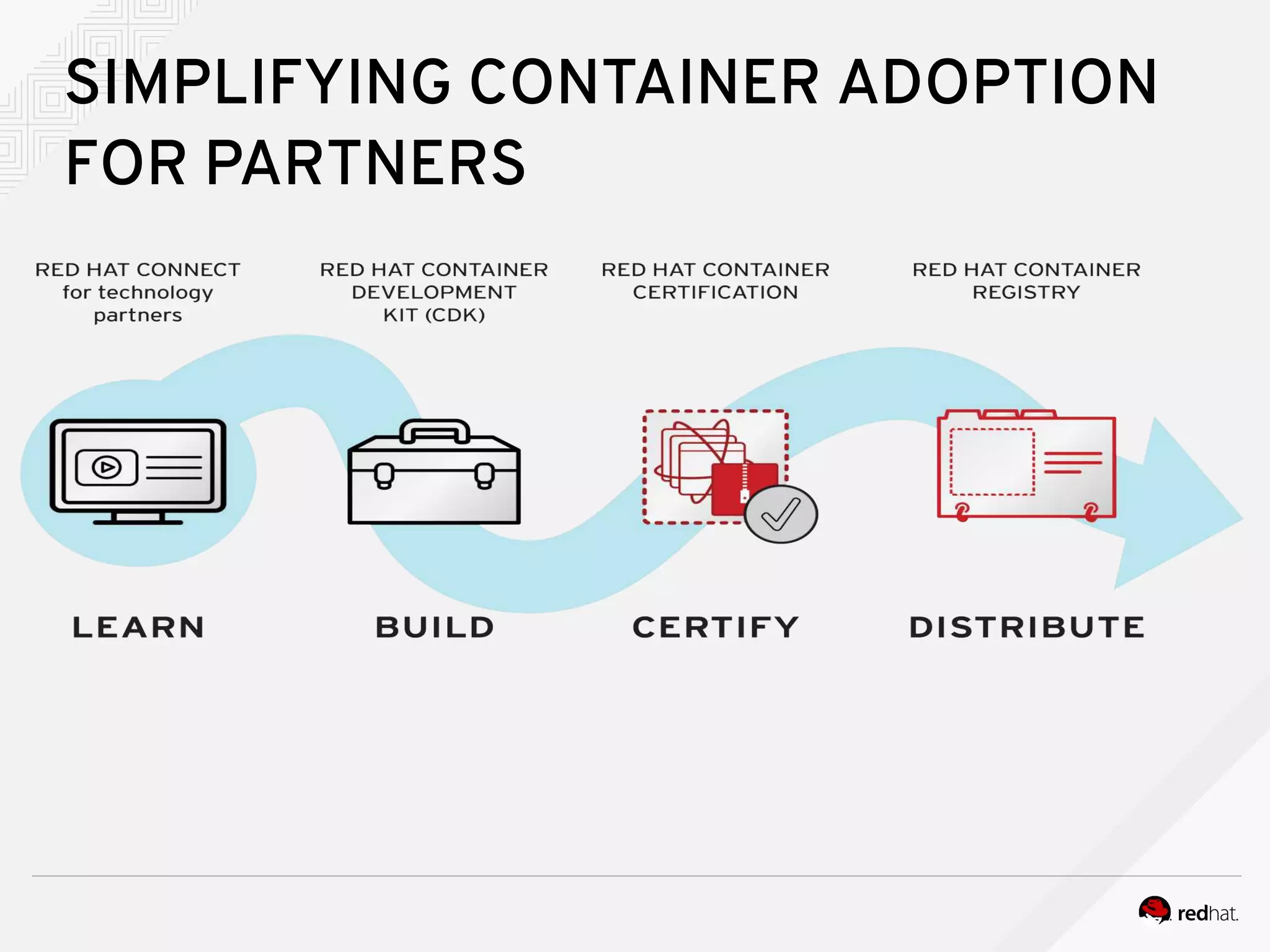
SIMPLIFYING CONTAINER ADOPTION
FOR PARTNERS
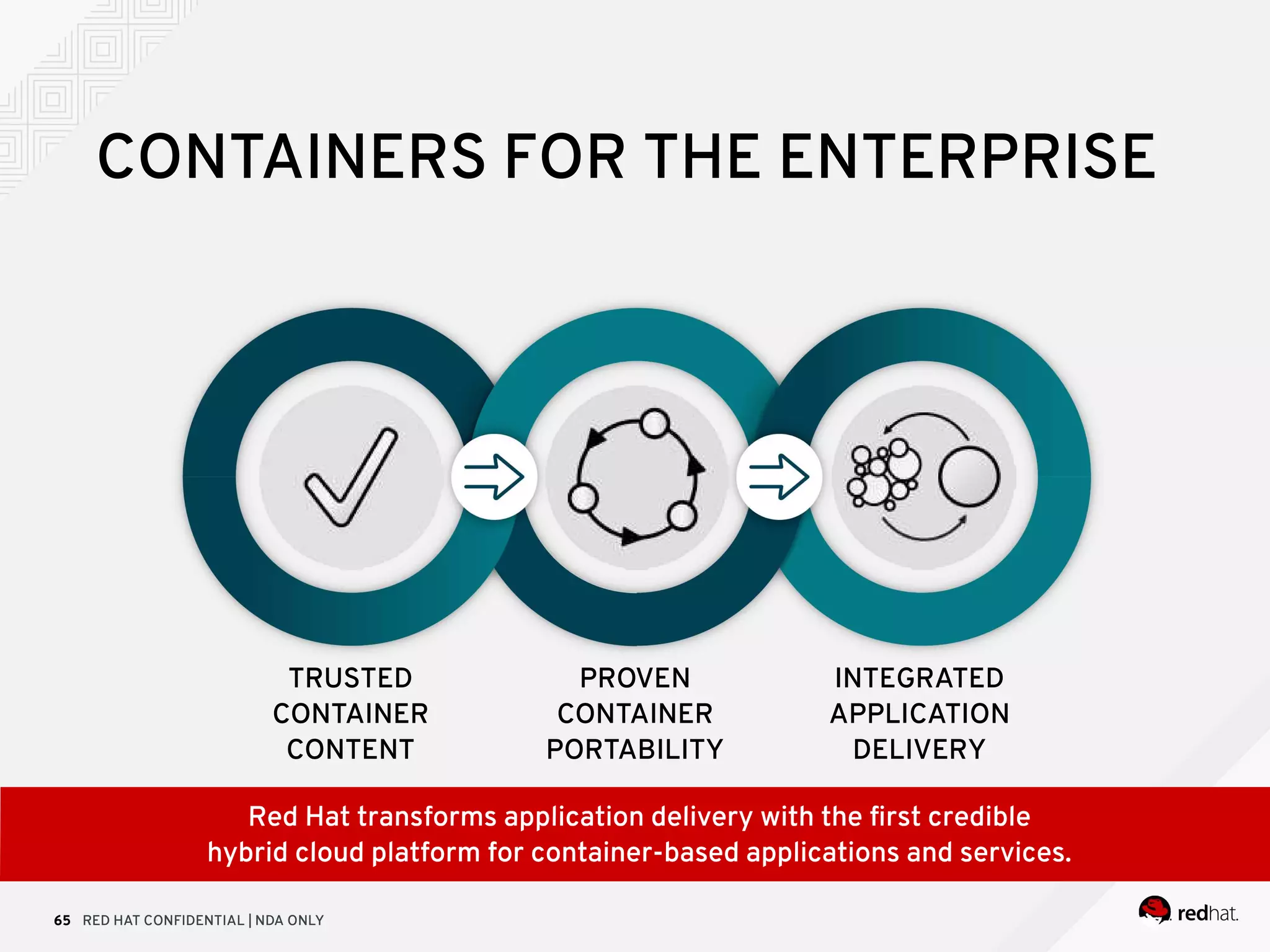
RED HAT CONFIDENTIAL | NDA ONLY65
TRUSTED
CONTAINER
CONTENT
PROVEN
CONTAINER
PORTABILITY
INTEGRATED
APPLICATION
DELIVERY
CONTAINERS FOR THE ENTERPRISE
INSERT DESIGNATOR, IF NEEDED 66
THANK YOU

Transforming Application Delivery with PaaS and Linux Containers

  • 1.
    Red Hat OpenShiftEnterprise Giovanni Galloro Cloud Solution Architect – Red Hat ggalloro@redhat.com Transforming Application Delivery with PaaS and Linux Containers
  • 2.
    PaaS and LinuxContainers Agenda ● Platform as a Service Capabilities ● OpenShift Enterprise Architecture – Linux Containers – Docker – Kubernetes – RHEL Atomic Host ● OpenShift Application Deployment Flow ● OpenShift Adoption ● Containers Adoption Challenges and Red Hat Strategy
  • 3.
    Platform as aService Capabilities
  • 4.
  • 5.
    PAAS LETS YOUSTREAMLINE APP DEV
  • 6.
    RED HAT PAASSOLUTION
  • 7.
    DEVOPS / CONTINOUSDELIVERY THROUGH PAAS
  • 8.
    CHOOSE THE WAYYOU WORK Developer IDE Integrations Web Browser Console Command Line Tooling REST APIs
  • 9.
  • 10.
  • 11.
    RED HAT CONFIDENTIAL| NDA ONLY11 CREATING DEFACTO STANDARDS REGISTRY / CONTAINER DISCOVERY CONTAINER FORMAT WITH DOCKER ISOLATION WITH LINUX CONTAINERS ORCHESTRATION WITH KUBERNETES Red Hat works with the open source community to drive standards for containerization.
  • 12.
    WHAT ARE LINUXCONTAINERS? Software packaging concept that typically includes an application and all of its runtime dependencies. ● Easy to deploy and portable across host systems ● Isolates applications on a host operating system ● In RHEL, this is done through: – Control Groups (cgroups) – kernel namespaces – SELinux, sVirt – Docker HOST OS SERVER CONTAINER LIBS APP
  • 13.
    13 Traditional OS Containers TRADITIONALOS VS. CONTAINERS HARDWARE HOST OS HARDWARE HOST OS CONTAINER LIBS APP A LIBS A LIBS B LIBS LIBS APP A APP B CONTAINER LIBS APP B
  • 14.
    WHAT DOCKER PROVIDES ●Multi-version packaging format and isolation ● Simplified container API (Docker libcontainer) ● Easy to create (Dockerfile) ● Atomic deployment (Docker images) ● Large ecosystem (Docker Hub)
  • 15.
  • 16.
    DOCKER IS ASHIPPING CONTAINER FOR CODE
  • 17.
    LINUX DOCKER CONTAINER LAYERING ●New images can be created by adding layers ● Layering model allows for specialization ● Base image and select number of platform layers provided by Red Hat ● ISV images form the base of the RHEL ecosystem ● Stack optimized for individual application with minimal packaging per layer
  • 18.
    CONTAINERS DELIVER MANY BENEFITS Base:171 IT and Developer/programmer decision-makers at companies with 500+ employees in APAC, EMEA, and NA Source: A commissioned study conducted by Forrester Consulting on behalf of Red Hat, January, 2015 Faster provisioning Greater deployment flexibility Ability to deliver/deploy applications faster Greater application mobility/portability 69% 70% 72% 73% How important are the following benefits of containers to your organization? Critically or Very Important 73% 72% 70% 69%
  • 19.
    KUBERNETES FOR CONTAINER ORCHESTRATION ●Container orchestration at scale ● Wiring of multi-container, multi-host application topologies ● Scheduling / placement ● Manage container health
  • 20.
    RED HAT ENTERPRISELINUX ATOMIC HOST IT IS RED HAT ENTERPRISE LINUX OPTIMIZED FOR CONTAINERS Minimized host environment tuned for running Linux containers while maintaining compatibility with Red Hat Enterprise Linux. Inherits the complete hardware ecosystem, military-grade security, stability and reliability for which Red Hat Enterprise Linux is known. MINIMIZED FOOTPRINT SIMPLIFIED MAINTENANCE ORCHESTRATION AT SCALE Atomic updating and rollback means it’s easy to deploy, update, and rollback using imaged-based technology. Build composite applications by orchestrating multiple containers as microservices on a single host instance.
  • 21.
  • 22.
    OPENSHIFT RUNS ONYOUR CHOICE OF INFRASTRUCTURE
  • 23.
    NODES ARE INSTANCESOF RHEL WHERE APPS WILL RUN
  • 24.
    APP SERVICES RUNIN DOCKER CONTAINERS ON EACH NODE
  • 25.
    PODS RUNS ONEOR MORE DOCKER CONTAINERS AS A UNIT
  • 26.
    MASTERS LEVERAGE KUBERNETESTO ORCHESTRATE NODES / APPS
  • 27.
    MASTER PROVIDES AUTHENTICATEDAPI FOR USERS & CLIENTS
  • 28.
    MASTER USES ETCDKEY-VALUE DATA STORE FOR PERSISTENCE
  • 29.
    MASTER PROVIDES SCHEDULERFOR POD PLACEMENT ON NODES
  • 30.
    SERVICES ALLOW RELATEDPODS TO CONNECT TO EACH OTHER
  • 31.
  • 32.
    WHAT IF APOD GOES DOWN?
  • 33.
    OPENSHIFT AUTOMATICALLY RECOVERSAND DEPLOYS A NEW POD
  • 34.
    PODS CAN ATTACHTO SHARED STORAGE FOR STATEFUL SERVICES
  • 35.
    ROUTING LAYER ROUTESEXTERNAL APP REQUESTS TO PODS
  • 36.
    DEVELOPERS ACCESS OPENSHIFTVIA WEB, CLI OR IDE
  • 37.
  • 38.
    OPENSHIFT APPLICATION SERVICES ●From Red Hat ● From ISV Partners ● From the Community
  • 39.
  • 40.
  • 41.
  • 42.
  • 43.
  • 44.
  • 45.
  • 46.
    FROM DOCKER IMAGETO RUNNING APP
  • 47.
  • 48.
  • 49.
  • 50.
    "Once we actuallylooked at and had all of the conversations with all the various people, there was really only one choice and that was OpenShift". The only people that actually understood what it was that we were talking about was the Red Hat guys. The Cloud Foundry guys were good about talking about deploying Spring-based frameworks and, you know, that sort of stuff, but once we ran the PoCs and had deeper conversations, there was really only one choice." Tony McGivern - CIO OPENSHIFT ADOPTION @ LEADING ISV IN FINANCIAL SERVICES has built and Analytic cloud based platform on Openshift 70% Reduction in Apps Development time 60% Reduction in Maintenance Costs (simpler, faster and easier) 90% reduction in Time to Deploy models 6 Months running live in Production 5% - 40% increased decision accuracy http://gartner.mediasite.com/Mediasite/Play/4c29e2287c7949cea4b4f8d0367410b01d?sc_cid= 70160000000eGEFAA2&elq=997abd3fad6a49d4ae23e1c7136994bb
  • 51.
  • 52.
    TOP CURRENT CONTAINER CHALLENGES Trainingand Education (lack of skills) Consistency (lack of standards) Scalability Lack of certification or digital structure Management Integration with existing development tools and processes Variable performance Security 29% 31% 32% 35% 35% 41% 44% 53% What are the top three challenges your organization has experienced so far in its use of containers? Base: 171 IT and Developer/programmer decision-makers at companies with 500+ employees in APAC, EMEA, and NA Source: A commissioned study conducted by Forrester Consulting on behalf of Red Hat, January, 2015
  • 53.
    ● Who builtthis image? ● What’s its purpose? Was it created to support a demo? ● Is it safe to consume? ● Who maintains it? NEED FOR A “CHAIN OF TRUST” DOCKER HUB docker search mongodb
  • 54.
    RED HAT CONFIDENTIAL| NDA ONLY57 WHAT'S INSIDE THE CONTAINER MATTERS 36% of official images in Docker Hub contain high priority security vulnerabilities ● High vulnerabilities: ShellShock (bash), Heartbleed (OpenSSL), etc. ● Medium vulnerabilities: Poodle (OpenSSL), etc. ● Low vulnerabilities: gcc: array memory allocations could cause integer overflow All Images (n=962) 0% 10% 20% 30% 40% 50% 60% 70% 80% 90% 100% 36% 28% Medium priority High priority Source: Over 30% of Official Images in Docker Hub Contain High Priority Security Vulnerabilities, Jayanth Gummaraju, Tarun Desikan, and Yoshio Turner, BanyanOps, May 2015 (http://www.banyanops.com/pdf/BanyanOps-AnalyzingDockerHub-WhitePaper.pdf)
  • 55.
    Red Hat Strategyfor Containers Adoption
  • 56.
    RED HAT CONFIDENTIAL| NDA ONLY59 RED HAT CONTAINER CERTIFICATION UNTRUSTED ● Will what’s inside the containers compromise your infrastructure? ● How and when will apps and libraries be updated? ● Will it work from host to host? RED HAT CERTIFIED ● Trusted source for the host and the containers ● Trusted content inside the container with security fixes available as part of an enterprise lifecycle ● Portability across hosts
  • 57.
  • 58.
    RED HAT CONFIDENTIAL| NDA ONLY65 TRUSTED CONTAINER CONTENT PROVEN CONTAINER PORTABILITY INTEGRATED APPLICATION DELIVERY CONTAINERS FOR THE ENTERPRISE
  • 59.
    INSERT DESIGNATOR, IFNEEDED 66 THANK YOU