Overview
James Falkner
Technical Evangelist
Red Hat
@schtool
Retail Finance Media
Transportation
?
?
Software Disrupts Business
of US CEOs say they
entered or considered
entering a different
industry at some point
over the past three years
Think it’s likely
competitors will compete
in industries other than
their own over the next
three years
Half of US CEOs believe a significant
competitor is emerging or could
emerge from technology sector
versus 32% of CEOs globally.
PWC - 2015 US CEO Survey
http://www.pwc.com/us/en/ceo-survey/
index.html
Impact of Technology
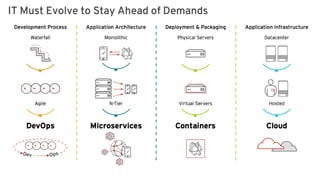
IT Must Evolve to Stay Ahead of Demands
“If you don't like change,
you're going to like
irrelevance even less.”
- Gen. Eric Shinseki, Chief of Staff, US Army, Ret.
Red Hat Addresses Container Adoption Concerns
Comprehensive offerings and
capabilities enable enterprise-
wide container adoption.
SECURITY
SCALABILITY
INTEGRATION
MANAGEMENT
CERTIFICATION
docker kubernetes
Built on Open Container Standards
Red Hat Driving These in the Community
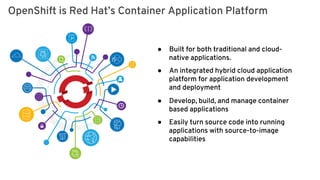
OpenShift is Red Hat’s Container Application Platform
●  Built for both traditional and cloud-
native applications.
●  An integrated hybrid cloud application
platform for application development
and deployment
●  Develop, build, and manage container
based applications
●  Easily turn source code into running
applications with source-to-image
capabilities
Value of OpenShift
Community Powered Innovation
SERVICE CATALOG
(LANGUAGE RUNTIMES, MIDDLEWARE, DATABASES, …)
SELF-SERVICE
APPLICATION LIFECYCLE MANAGEMENT
(CI / CD)
BUILD AUTOMATION DEPLOYMENT AUTOMATION
CONTAINER CONTAINERCONTAINER CONTAINER CONTAINER
NETWORKING SECURITYSTORAGE REGISTRY
LOGS &
METRICS
CONTAINER ORCHESTRATION & CLUSTER MANAGEMENT
(KUBERNETES)
RED HAT ENTERPRISE LINUX
CONTAINER RUNTIME & PACKAGING
(DOCKER)
ATOMIC HOST
Enterprise Container Platform
ENTERPRISE-GRADE CONTAINER OS
Business
Automation
CONTAINER CONTAINERCONTAINER CONTAINER CONTAINER
Integration Data
Web &
Mobile
3rd party
frameworks
CONTAINER INFRASTRUCTURE
(Orchestration & Scheduling, Storage, Registry, Security, Networking)
LIFECYCLE AUTOMATION
(Self-service, CI/CD, Img Streams)
CONTAINER MANAGEMENT
(Monitoring, Capacity, Policies)
Red Hat Enterprise
Linux & Atomic Host
Red Hat Application
Services (JBoss)
Traditional, Stateful & Microservices-based Apps
Red Hat
Registry
CloudForms
Ansible
Satellite
Developer
Studio
CDK
Storage
PaaS
CaaS
IaaS
Red Hat Container Stack & Tools
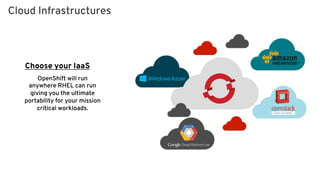
Choose your IaaS
OpenShift will run
anywhere RHEL can run
giving you the ultimate
portability for your mission
critical workloads.
Cloud Infrastructures
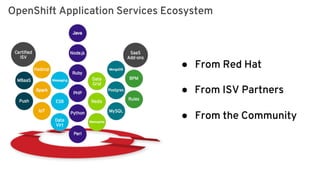
●  From Red Hat
●  From ISV Partners
●  From the Community
OpenShift Application Services Ecosystem
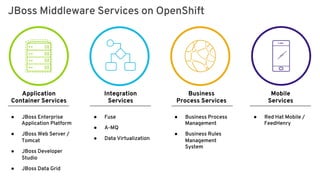
●  JBoss Enterprise
Application Platform
●  JBoss Web Server /
Tomcat
●  JBoss Developer
Studio
●  JBoss Data Grid
●  Fuse
●  A-MQ
●  Data Virtualization
●  Business Process
Management
●  Business Rules
Management
System
●  Red Hat Mobile /
FeedHenry
Application
Container Services
Integration
Services
Business
Process Services
Mobile
Services
JBoss Middleware Services on OpenShift
OpenShift and native .NET
●  OpenShift provides a .NET
runtime distributed and
supported by Red Hat and
Microsoft
●  Will start with version 5 of the
core framework
●  Version parity goal of 60 days
●  More info: red.ht/29hdqC3
10,000ft View
●  Access a broad selection of
application components
●  Deploy application environments on-
demand
●  Leverage your choice of interface &
integrate with existing tools
●  Automate application deployments,
builds and source-to-image
●  Enable collaboration across users,
teams & projects
Benefits for Developers
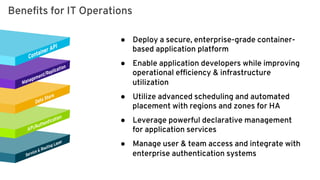
●  Deploy a secure, enterprise-grade container-
based application platform
●  Enable application developers while improving
operational efficiency & infrastructure
utilization
●  Utilize advanced scheduling and automated
placement with regions and zones for HA
●  Leverage powerful declarative management
for application services
●  Manage user & team access and integrate with
enterprise authentication systems
Benefits for IT Operations
A True Open Hybrid Cloud
●  Deploy OpenShift on OpenStack via Heat
●  Integrate Apps with OpenStack services
●  Manage it all with CloudForms
●  Get it all at once with Red Hat Cloud Suite
●  github.com/redhat-openstack/openshift-
on-openstack
OpenShift On OpenStack
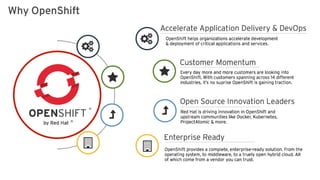
Why OpenShift
OpenShift
Product Deep Dive
10,000 ft. View (Again)
OpenShift runs on your choice of infrastructure
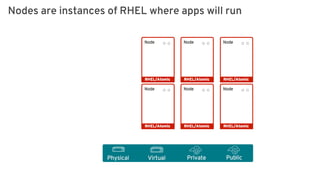
Nodes are instances of RHEL where apps will run
App services run in docker containers on each node
Registry
Pods run one or more docker containers as a unit
Masters leverage kubernetes to orchestrate nodes / apps
Master provides authenticated API for users & clients
Master uses etcd key-value data store for persistence
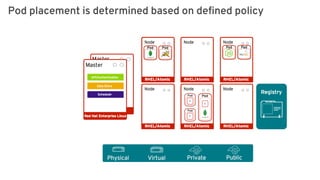
Master provides scheduler for pod placement on nodes
Pod placement is determined based on defined policy
Services allow related pods to connect to each other
Management/Replication controller manages the pod lifecycle
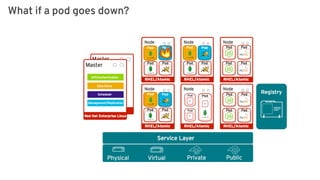
What if a pod goes down?
OpenShift automatically recovers and deploys a new Pod
Pods can attach to shared storage for stateful services
Routing layer routes external app requests to pods
Developers access openShift via web, CLI or IDE
OpenShift
Source-2-Image
Code
Deploy
Build
Can configure different
deployment strategies
like A/B, Rolling upgrade,
Automated base updates,
and more.
Can configure triggers for
automated deployments,
builds, and more.
Source 2 Image Walk Through
Developers can leverage existing
development tools and then access
the OpenShift Web, CLI or IDE
interfaces to create new application
services and push source code via
GIT. OpenShift can also accept
binary deployments or be fully
integrated with a customer’s existing
CI/CD environment.
Code
Source 2 Image Walk Through Can configure triggers for
automated deployments,
builds, and more.
OpenShift automates the Docker
image build process with Source-to-
Image (S2I). S2I combines source
code with a corresponding Builder
image from the integrated Docker
registry. Builds can also be triggered
manually or automatically by setting
a Git webhook.
Build
Source 2 Image Walk Through Can configure triggers for
automated deployments,
builds, and more.
Deploy
OpenShift automates the deployment
of application containers across
multiple Node hosts via the
Kubernetes scheduler. Users can
automatically trigger deployments on
application changes and do rollbacks,
configure A/B deployments & other
custom deployment types.
Source 2 Image Walk Through
Can configure
different
deployment
strategies like A/B,
Rolling upgrade,
Automated base
updates, and more.
Can configure triggers
for automated
deployments, builds,
and more.
OpenShift 3.3
What’s new
blog.openshift.com/whats-new-openshift-3-3-developer-experience
●  Cloud Forms functionality now
included with OpenShift Container
Platform to improve control over apps
and infrastructure
●  Monitor and manage resource
consumption of containers running in
OpenShift Container Platform
●  Docker and Kubernetes aware
(containers, pods, services...)
Infrastructure Management with CloudForms & OpenShift
OpenShift Pipelines
•  True first class pipeline
execution capability
•  Based on the Jenkins
Pipeline plugin
•  Defined as a new build
strategy within OpenShift
•  Launch Jenkins slaves on
OpenShift cluster
oc cluster up (or down)
Try it: github.com/openshift/origin/releases
Other Notables
•  Serialized Build Execution
•  Enhanced rsync
•  A/B Routing
•  Improved Web Console UX
•  Build Trigger Causes
•  Web Hook Payloads
•  Self-Tuning Images
•  Docker Image Details
•  Built-In Metrics
•  Container Debugging
•  Router Sharding
•  Kerberos support in CLI
•  Pod Idling
OpenShift 3.3
Demo. Brace Yourselves.
53
54
55
Firewall
56
DevQAProd
UI
Services
UI
Services
UI
Services
Promote
Promote
Promote
Promote
Prod
Services
UI
QA Dev
UIServices
CI/CD
UIServices UIServices
Routing
Load
Balancing
K8s
Clusters
Docker
Registry
Web
Dev
Tools
SCM
Demo Architecture
DevDev
Q&A
THANK YOU
plus.google.com/+RedHat
linkedin.com/company/red-hat
youtube.com/user/RedHatVideos
facebook.com/redhatinc
facebook.com/jboss
twitter.com/RedHatNews
twitter.com/JBoss

Red Hat OpenShift Container Platform Overview

  • 1.
  • 2.
  • 3.
    of US CEOssay they entered or considered entering a different industry at some point over the past three years Think it’s likely competitors will compete in industries other than their own over the next three years Half of US CEOs believe a significant competitor is emerging or could emerge from technology sector versus 32% of CEOs globally. PWC - 2015 US CEO Survey http://www.pwc.com/us/en/ceo-survey/ index.html Impact of Technology
  • 4.
    IT Must Evolveto Stay Ahead of Demands
  • 5.
    “If you don'tlike change, you're going to like irrelevance even less.” - Gen. Eric Shinseki, Chief of Staff, US Army, Ret.
  • 7.
    Red Hat AddressesContainer Adoption Concerns Comprehensive offerings and capabilities enable enterprise- wide container adoption. SECURITY SCALABILITY INTEGRATION MANAGEMENT CERTIFICATION
  • 8.
    docker kubernetes Built onOpen Container Standards Red Hat Driving These in the Community
  • 9.
    OpenShift is RedHat’s Container Application Platform ●  Built for both traditional and cloud- native applications. ●  An integrated hybrid cloud application platform for application development and deployment ●  Develop, build, and manage container based applications ●  Easily turn source code into running applications with source-to-image capabilities
  • 10.
  • 11.
  • 12.
    SERVICE CATALOG (LANGUAGE RUNTIMES,MIDDLEWARE, DATABASES, …) SELF-SERVICE APPLICATION LIFECYCLE MANAGEMENT (CI / CD) BUILD AUTOMATION DEPLOYMENT AUTOMATION CONTAINER CONTAINERCONTAINER CONTAINER CONTAINER NETWORKING SECURITYSTORAGE REGISTRY LOGS & METRICS CONTAINER ORCHESTRATION & CLUSTER MANAGEMENT (KUBERNETES) RED HAT ENTERPRISE LINUX CONTAINER RUNTIME & PACKAGING (DOCKER) ATOMIC HOST Enterprise Container Platform
  • 13.
    ENTERPRISE-GRADE CONTAINER OS Business Automation CONTAINERCONTAINERCONTAINER CONTAINER CONTAINER Integration Data Web & Mobile 3rd party frameworks CONTAINER INFRASTRUCTURE (Orchestration & Scheduling, Storage, Registry, Security, Networking) LIFECYCLE AUTOMATION (Self-service, CI/CD, Img Streams) CONTAINER MANAGEMENT (Monitoring, Capacity, Policies) Red Hat Enterprise Linux & Atomic Host Red Hat Application Services (JBoss) Traditional, Stateful & Microservices-based Apps Red Hat Registry CloudForms Ansible Satellite Developer Studio CDK Storage PaaS CaaS IaaS Red Hat Container Stack & Tools
  • 14.
    Choose your IaaS OpenShiftwill run anywhere RHEL can run giving you the ultimate portability for your mission critical workloads. Cloud Infrastructures
  • 15.
    ●  From RedHat ●  From ISV Partners ●  From the Community OpenShift Application Services Ecosystem
  • 16.
    ●  JBoss Enterprise ApplicationPlatform ●  JBoss Web Server / Tomcat ●  JBoss Developer Studio ●  JBoss Data Grid ●  Fuse ●  A-MQ ●  Data Virtualization ●  Business Process Management ●  Business Rules Management System ●  Red Hat Mobile / FeedHenry Application Container Services Integration Services Business Process Services Mobile Services JBoss Middleware Services on OpenShift
  • 17.
    OpenShift and native.NET ●  OpenShift provides a .NET runtime distributed and supported by Red Hat and Microsoft ●  Will start with version 5 of the core framework ●  Version parity goal of 60 days ●  More info: red.ht/29hdqC3
  • 18.
  • 19.
    ●  Access abroad selection of application components ●  Deploy application environments on- demand ●  Leverage your choice of interface & integrate with existing tools ●  Automate application deployments, builds and source-to-image ●  Enable collaboration across users, teams & projects Benefits for Developers
  • 20.
    ●  Deploy asecure, enterprise-grade container- based application platform ●  Enable application developers while improving operational efficiency & infrastructure utilization ●  Utilize advanced scheduling and automated placement with regions and zones for HA ●  Leverage powerful declarative management for application services ●  Manage user & team access and integrate with enterprise authentication systems Benefits for IT Operations
  • 21.
    A True OpenHybrid Cloud ●  Deploy OpenShift on OpenStack via Heat ●  Integrate Apps with OpenStack services ●  Manage it all with CloudForms ●  Get it all at once with Red Hat Cloud Suite ●  github.com/redhat-openstack/openshift- on-openstack OpenShift On OpenStack
  • 23.
  • 24.
  • 25.
  • 26.
    OpenShift runs onyour choice of infrastructure
  • 27.
    Nodes are instancesof RHEL where apps will run
  • 28.
    App services runin docker containers on each node
  • 29.
    Registry Pods run oneor more docker containers as a unit
  • 30.
    Masters leverage kubernetesto orchestrate nodes / apps
  • 31.
    Master provides authenticatedAPI for users & clients
  • 32.
    Master uses etcdkey-value data store for persistence
  • 33.
    Master provides schedulerfor pod placement on nodes
  • 34.
    Pod placement isdetermined based on defined policy
  • 35.
    Services allow relatedpods to connect to each other
  • 36.
  • 37.
    What if apod goes down?
  • 38.
    OpenShift automatically recoversand deploys a new Pod
  • 39.
    Pods can attachto shared storage for stateful services
  • 40.
    Routing layer routesexternal app requests to pods
  • 41.
    Developers access openShiftvia web, CLI or IDE
  • 42.
  • 43.
    Code Deploy Build Can configure different deploymentstrategies like A/B, Rolling upgrade, Automated base updates, and more. Can configure triggers for automated deployments, builds, and more. Source 2 Image Walk Through
  • 44.
    Developers can leverageexisting development tools and then access the OpenShift Web, CLI or IDE interfaces to create new application services and push source code via GIT. OpenShift can also accept binary deployments or be fully integrated with a customer’s existing CI/CD environment. Code Source 2 Image Walk Through Can configure triggers for automated deployments, builds, and more.
  • 45.
    OpenShift automates theDocker image build process with Source-to- Image (S2I). S2I combines source code with a corresponding Builder image from the integrated Docker registry. Builds can also be triggered manually or automatically by setting a Git webhook. Build Source 2 Image Walk Through Can configure triggers for automated deployments, builds, and more.
  • 46.
    Deploy OpenShift automates thedeployment of application containers across multiple Node hosts via the Kubernetes scheduler. Users can automatically trigger deployments on application changes and do rollbacks, configure A/B deployments & other custom deployment types. Source 2 Image Walk Through Can configure different deployment strategies like A/B, Rolling upgrade, Automated base updates, and more. Can configure triggers for automated deployments, builds, and more.
  • 47.
  • 48.
    ●  Cloud Formsfunctionality now included with OpenShift Container Platform to improve control over apps and infrastructure ●  Monitor and manage resource consumption of containers running in OpenShift Container Platform ●  Docker and Kubernetes aware (containers, pods, services...) Infrastructure Management with CloudForms & OpenShift
  • 49.
    OpenShift Pipelines •  Truefirst class pipeline execution capability •  Based on the Jenkins Pipeline plugin •  Defined as a new build strategy within OpenShift •  Launch Jenkins slaves on OpenShift cluster
  • 50.
    oc cluster up(or down) Try it: github.com/openshift/origin/releases
  • 51.
    Other Notables •  SerializedBuild Execution •  Enhanced rsync •  A/B Routing •  Improved Web Console UX •  Build Trigger Causes •  Web Hook Payloads •  Self-Tuning Images •  Docker Image Details •  Built-In Metrics •  Container Debugging •  Router Sharding •  Kerberos support in CLI •  Pod Idling
  • 52.
  • 53.
  • 54.
  • 55.
  • 56.
  • 57.
  • 58.