Cloud Technologies
Dr.K.Umamaheswari
Assistant Professor, Dept. of Computer Science, Bharathi Women’s College, Chennai –108.
Agenda
1. Innovations in Cloud Computing
2. Cloud Computing
3. Future in the Cloud
4. Trending Cloud Technologies
5. Project clues in Cloud
6. Cloud Forensics
7. Cloud statistics
8. Some interesting facts in Cloud
Dr.K.Umamaheswari, Assistant Professor, Dept. of Computer Science, Bharathi Women’s College, Chennai –108.
1. Innovations in Cloud
Computing
• Is it Cloud Computing a boring old norm?
• Emerging technologies would not be
possible without cloud
• Loads of data
• super-fast processing times
• as-needed basis
Innovations in Cloud Computing
• Artificial Intelligence
Innovations in Cloud Computing
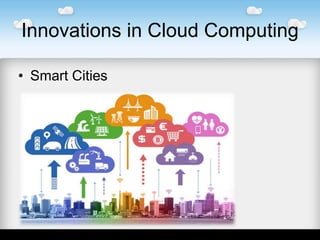
• Smart Cities
Innovations in Cloud Computing
• Driverless Cars
Innovations in Cloud Computing
• The Internet of Things
Innovations in Cloud Computing
• Edge Computing
2. Cloud Computing
According to NIST,
• Cloud computing is a model for enabling
ubiquitous, convenient, on-demand
network access to a shared pool of
configurable computing resources that can
be rapidly provisioned and released with
minimal management effort or service
provider interaction.
Cloud Computing
• Characteristics
– On-demand self-service
– Broad network access
– Resource pooling
– Rapid elasticity
– Measured service
Cloud service models
Infrastructure as a Service
– Amazon Web Services (AWS)
– Microsoft Azure
– Google Compute Engine (GCE), the IaaS
component of Google Cloud Platform (GCP)
Google Data center street view
Google Data Center
Cloud service models
Platform as a Service
– Google App Engine (GAE)
– Red Hat OpenShift
– Microsoft Azure
– AWS Elastic Beanstalk
Cloud service models
Software as a Service
– Dropbox
– Salesforce CRM
– Zoom
– Office 365
– Google Apps
Cloud deployment models
• Public cloud
Cloud deployment models
• Private cloud
Cloud deployment models
• Hybrid cloud
Advantages
• Cost-efficiency
• Speed
• Elastic scaling
• Increased productivity
• Security
• Business continuity
Disadvantages
• High Cost
• Migration can also be expensive
• Trust issues
3. Is your future in the cloud?
• The shortage of qualified professionals in this
domain presents a golden opportunity.
• it is important to stand out with your cloud
experience.
• A way in which to do so would be to gain a
Cloud Engineer or Cloud Architect
accreditation from Microsoft, Amazon or
Google.
Cloud Architect
• An IT specialist who has a combined
knowledge of cloud computing and its
roles and utilization in the market.
• According to the Bureau of Labor
Statistics, the demand for cloud architects
is rising exponentially and expected to
open more than twelve thousand positions
each year through 2024.
Job Description of
Cloud Architect
• Planning and designing a cloud environment
• Guidance for project development or deployment
• Maintain ownership of the systems
• Delivery of expertise in complete infrastructure
• Acknowledging the relevant systems
• Understanding the functionalities needed by a business
and its competitive advantages
• Selection of right vendors for the business
• Adoption of APIs and standards
• Integration of the components acquired from various
suppliers
Key Skills to become
Cloud Architect
• Knowledge of programming languages such as Python,
Ruby and Elixir
• Background in IT engineering
• Strong people skills
• Excellent leadership skills
• Excellent written and verbal communication
• Ability to design and implement cloud infrastructure
How to become a cloud
architect?
1. Get your degree
2. Get on-the-job experience
3. Get certified
4. Trending Cloud Technologies
• Edge
• Serverless
• SASE (Secure Access Service Edge)
• Cloud Migration and Data Privacy
• Automated Cloud Orchestration
• Multicloud
5. Project clues in Cloud
1. Smart Traffic Management (STM)
2. Chatbots
3. Bug Tracker
4. Detecting Data Leaks Using SQL
5. Android Offloading
6. Text CAT. (Categorization)
7. Encrypted Cloud Storage
6. Cloud Forensics
• A cross-discipline between cloud
computing and digital forensics.
• Digital forensics is the application of
science to the identification, collection,
examination, and analysis of data while
preserving the integrity of the information
and maintaining a strict chain of custody
for the data. (Kent et al.,2006)
Cloud Forensics
Dimensions
1. Technical
2. Organizational
3. Legal
Cloud Forensics
Challenges
1. forensic data collection
2. elastic, static and live forensics
3. evidence segregation
4. virtualized environments
5. Multi-Jurisdiction and multi-tenancy
7. Cloud statistics
Global cloud storage market in Billions USD, 2017-2028
Cloud statistics
The most used cloud storage services
Cloud statistics
Cloud Security Concerns
Cloud statistics
Employee work preferences: Remote vs In office
8. Some interesting facts in
Cloud
• By 2025, there will be over 100 zettabytes
of data stored in the cloud
• Cloud data centers will process 94 percent
of all workloads in 2021.
• AWS currently holds 31 percent of the
market, followed by Microsoft Azure at 20
percent and Google Cloud at seven
percent.
Some interesting facts in Cloud
• The appropriately named Citadel is the
largest data center ever constructed, and
is located in Tahoe Reno, Nevada.
• With an overwhelming 94.44
percent, Google Drive is by far the most
used cloud storage service in the world.
• The Video Streaming and Cloud Gaming
Market Continues to Grow
Thank you!

Cloud technologies

  • 1.
    Cloud Technologies Dr.K.Umamaheswari Assistant Professor,Dept. of Computer Science, Bharathi Women’s College, Chennai –108.
  • 2.
    Agenda 1. Innovations inCloud Computing 2. Cloud Computing 3. Future in the Cloud 4. Trending Cloud Technologies 5. Project clues in Cloud 6. Cloud Forensics 7. Cloud statistics 8. Some interesting facts in Cloud Dr.K.Umamaheswari, Assistant Professor, Dept. of Computer Science, Bharathi Women’s College, Chennai –108.
  • 3.
    1. Innovations inCloud Computing • Is it Cloud Computing a boring old norm? • Emerging technologies would not be possible without cloud • Loads of data • super-fast processing times • as-needed basis
  • 4.
    Innovations in CloudComputing • Artificial Intelligence
  • 5.
    Innovations in CloudComputing • Smart Cities
  • 6.
    Innovations in CloudComputing • Driverless Cars
  • 7.
    Innovations in CloudComputing • The Internet of Things
  • 8.
    Innovations in CloudComputing • Edge Computing
  • 9.
    2. Cloud Computing Accordingto NIST, • Cloud computing is a model for enabling ubiquitous, convenient, on-demand network access to a shared pool of configurable computing resources that can be rapidly provisioned and released with minimal management effort or service provider interaction.
  • 10.
    Cloud Computing • Characteristics –On-demand self-service – Broad network access – Resource pooling – Rapid elasticity – Measured service
  • 11.
    Cloud service models Infrastructureas a Service – Amazon Web Services (AWS) – Microsoft Azure – Google Compute Engine (GCE), the IaaS component of Google Cloud Platform (GCP) Google Data center street view Google Data Center
  • 12.
    Cloud service models Platformas a Service – Google App Engine (GAE) – Red Hat OpenShift – Microsoft Azure – AWS Elastic Beanstalk
  • 13.
    Cloud service models Softwareas a Service – Dropbox – Salesforce CRM – Zoom – Office 365 – Google Apps
  • 14.
  • 15.
  • 16.
  • 17.
    Advantages • Cost-efficiency • Speed •Elastic scaling • Increased productivity • Security • Business continuity
  • 18.
    Disadvantages • High Cost •Migration can also be expensive • Trust issues
  • 19.
    3. Is yourfuture in the cloud? • The shortage of qualified professionals in this domain presents a golden opportunity. • it is important to stand out with your cloud experience. • A way in which to do so would be to gain a Cloud Engineer or Cloud Architect accreditation from Microsoft, Amazon or Google.
  • 20.
    Cloud Architect • AnIT specialist who has a combined knowledge of cloud computing and its roles and utilization in the market. • According to the Bureau of Labor Statistics, the demand for cloud architects is rising exponentially and expected to open more than twelve thousand positions each year through 2024.
  • 21.
    Job Description of CloudArchitect • Planning and designing a cloud environment • Guidance for project development or deployment • Maintain ownership of the systems • Delivery of expertise in complete infrastructure • Acknowledging the relevant systems • Understanding the functionalities needed by a business and its competitive advantages • Selection of right vendors for the business • Adoption of APIs and standards • Integration of the components acquired from various suppliers
  • 22.
    Key Skills tobecome Cloud Architect • Knowledge of programming languages such as Python, Ruby and Elixir • Background in IT engineering • Strong people skills • Excellent leadership skills • Excellent written and verbal communication • Ability to design and implement cloud infrastructure
  • 23.
    How to becomea cloud architect? 1. Get your degree 2. Get on-the-job experience 3. Get certified
  • 24.
    4. Trending CloudTechnologies • Edge • Serverless • SASE (Secure Access Service Edge) • Cloud Migration and Data Privacy • Automated Cloud Orchestration • Multicloud
  • 25.
    5. Project cluesin Cloud 1. Smart Traffic Management (STM) 2. Chatbots 3. Bug Tracker 4. Detecting Data Leaks Using SQL 5. Android Offloading 6. Text CAT. (Categorization) 7. Encrypted Cloud Storage
  • 26.
    6. Cloud Forensics •A cross-discipline between cloud computing and digital forensics. • Digital forensics is the application of science to the identification, collection, examination, and analysis of data while preserving the integrity of the information and maintaining a strict chain of custody for the data. (Kent et al.,2006)
  • 27.
  • 28.
    Cloud Forensics Challenges 1. forensicdata collection 2. elastic, static and live forensics 3. evidence segregation 4. virtualized environments 5. Multi-Jurisdiction and multi-tenancy
  • 29.
    7. Cloud statistics Globalcloud storage market in Billions USD, 2017-2028
  • 30.
    Cloud statistics The mostused cloud storage services
  • 31.
  • 32.
    Cloud statistics Employee workpreferences: Remote vs In office
  • 33.
    8. Some interestingfacts in Cloud • By 2025, there will be over 100 zettabytes of data stored in the cloud • Cloud data centers will process 94 percent of all workloads in 2021. • AWS currently holds 31 percent of the market, followed by Microsoft Azure at 20 percent and Google Cloud at seven percent.
  • 34.
    Some interesting factsin Cloud • The appropriately named Citadel is the largest data center ever constructed, and is located in Tahoe Reno, Nevada. • With an overwhelming 94.44 percent, Google Drive is by far the most used cloud storage service in the world. • The Video Streaming and Cloud Gaming Market Continues to Grow
  • 35.