Developer 2 Developer
Building microservices webcast series
Ravi Tella - Microsoft
John Archer - Red Hat
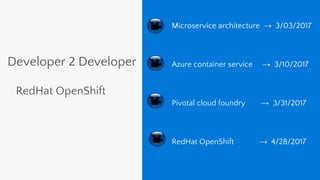
Microservice architecture → 3/03/2017
Azure container service → 3/10/2017
Pivotal cloud foundry → 3/31/2017
RedHat OpenShift → 4/28/2017
Developer 2 Developer
RedHat OpenShift
Content:
http://aka.ms/houaz
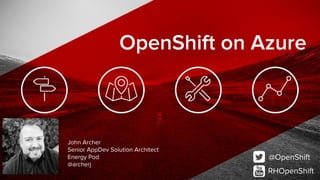
@OpenShift
RHOpenShift
OpenShift on Azure
John Archer
Senior AppDev Solution Architect
Energy Pod
@archerj
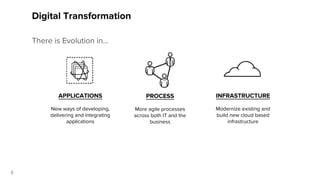
APPLICATIONS
New ways of developing,
delivering and integrating
applications
INFRASTRUCTURE
Modernize existing and
build new cloud based
infrastructure
PROCESS
More agile processes
across both IT and the
business
5
Digital Transformation
There is Evolution in...
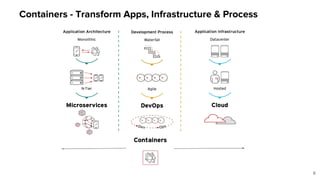
Containers - Transform Apps, Infrastructure & Process
6
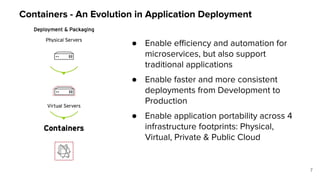
● Enable efficiency and automation for
microservices, but also support
traditional applications
● Enable faster and more consistent
deployments from Development to
Production
● Enable application portability across 4
infrastructure footprints: Physical,
Virtual, Private & Public Cloud
Containers - An Evolution in Application Deployment
7
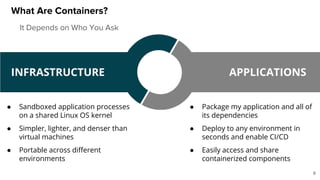
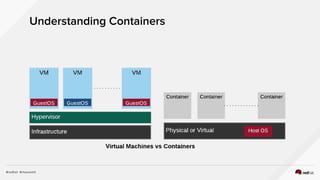
What Are Containers?
● Sandboxed application processes
on a shared Linux OS kernel
● Simpler, lighter, and denser than
virtual machines
● Portable across different
environments
● Package my application and all of
its dependencies
● Deploy to any environment in
seconds and enable CI/CD
● Easily access and share
containerized components
INFRASTRUCTURE APPLICATIONS
It Depends on Who You Ask
8
Understanding Containers
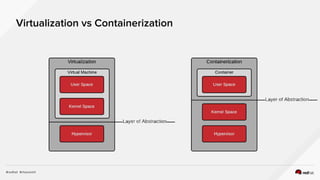
Virtualization vs Containerization
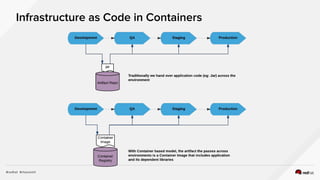
Infrastructure as Code in Containers
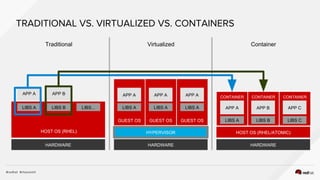
GUEST OS
HARDWARE
HOST OS (RHEL/ATOMIC)HOST OS (RHEL)
LIBS A LIBS B LIBS...
APP A APP B
Traditional ContainerVirtualized
TRADITIONAL VS. VIRTUALIZED VS. CONTAINERS
HARDWAREHARDWARE
LIBS A
APP A
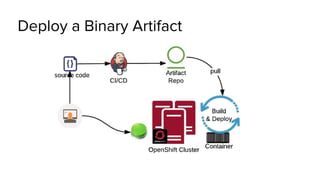
HYPERVISOR
CONTAINER CONTAINER
LIBS A LIBS B
APP A APP B
CONTAINER
LIBS C
APP C
GUEST OS
LIBS A
APP A
GUEST OS
LIBS A
APP A
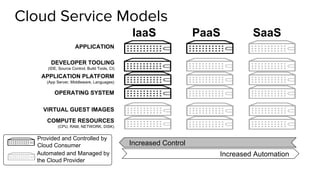
Cloud Service Models
COMPUTE RESOURCES
(CPU, RAM, NETWORK, DISK)
VIRTUAL GUEST IMAGES
OPERATING SYSTEM
APPLICATION PLATFORM
(App Server, Middleware, Languages)
APPLICATION
Automated and Managed by
the Cloud Provider
Provided and Controlled by
Cloud Consumer
IaaS PaaS SaaS
Increased Control
Increased Automation
DEVELOPER TOOLING
(IDE, Source Control, Build Tools, CI)
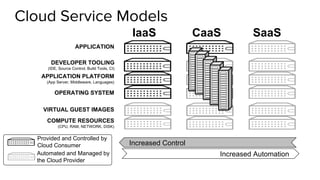
Cloud Service Models
COMPUTE RESOURCES
(CPU, RAM, NETWORK, DISK)
VIRTUAL GUEST IMAGES
OPERATING SYSTEM
APPLICATION PLATFORM
(App Server, Middleware, Languages)
APPLICATION
Automated and Managed by
the Cloud Provider
Provided and Controlled by
Cloud Consumer
IaaS CaaS SaaS
Increased Control
Increased Automation
DEVELOPER TOOLING
(IDE, Source Control, Build Tools, CI)
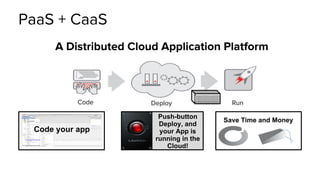
PaaS + CaaS
A Distributed Cloud Application Platform
Code Deploy Run
Save Time and Money
Code your app
Push-button
Deploy, and
your App is
running in the
Cloud!
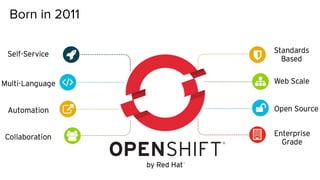
Born in 2011
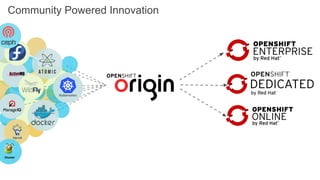
Community Powered Innovation
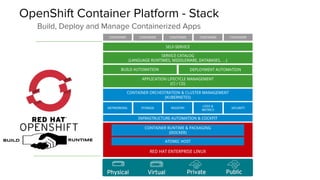
SERVICE CATALOG
(LANGUAGE RUNTIMES, MIDDLEWARE, DATABASES, …)
SELF-SERVICE
APPLICATION LIFECYCLE MANAGEMENT
(CI / CD)
BUILD AUTOMATION DEPLOYMENT AUTOMATION
CONTAINER CONTAINERCONTAINER CONTAINER CONTAINER
NETWORKING SECURITYSTORAGE REGISTRY
LOGS &
METRICS
CONTAINER ORCHESTRATION & CLUSTER MANAGEMENT
(KUBERNETES)
RED HAT ENTERPRISE LINUX
CONTAINER RUNTIME & PACKAGING
(DOCKER)
ATOMIC HOST
INFRASTRUCTURE AUTOMATION & COCKPIT
OpenShift Container Platform - Stack
Build, Deploy and Manage Containerized Apps
Build RUNTIME
RED HAT CONFIDENTIAL
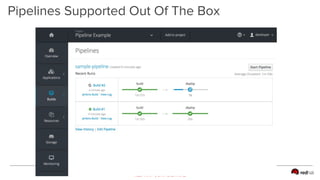
Pipelines Supported Out Of The Box
RED HAT CONFIDENTIAL
OpenShift provides multiple Deployment Models.
.. we don’t force a certain way. Enterprises can
adopt the change at their own pace.
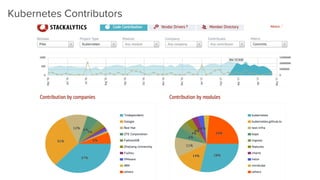
Kubernetes Contributors
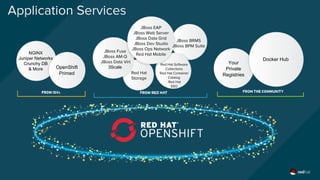
Application Services
JBoss EAP
JBoss Web Server
JBoss Data Grid
JBoss Dev Studio
JBoss Ops Network
Red Hat MobileNGINX
Juniper Networks
Crunchy DB
& More
JBoss Fuse
JBoss AM-Q
JBoss Data Virt
3Scale
JBoss BRMS
JBoss BPM Suite
Red Hat Software
Collections
Red Hat Container
Catalog
Red Hat
SSO
Red Hat
Storage
Docker Hub
OpenShift
Primed
Your
Private
Registries
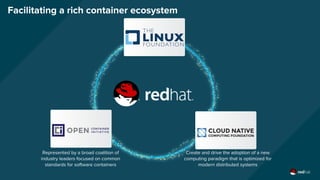
Facilitating a rich container ecosystem
Represented by a broad coalition of
industry leaders focused on common
standards for software containers
Create and drive the adoption of a new
computing paradigm that is optimized for
modern distributed systems
RED HAT CONFIDENTIAL
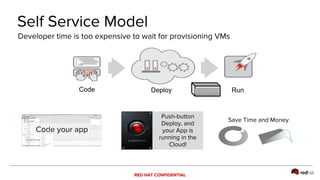
Self Service Model
Developer time is too expensive to wait for provisioning VMs
Code Deploy Run
Save Time and Money
Code your app
Push-button
Deploy, and
your App is
running in the
Cloud!
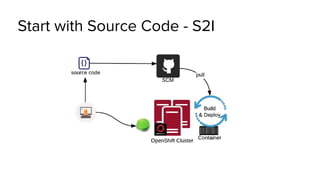
Start with Source Code - S2I
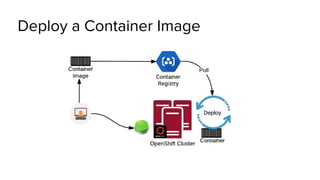
Deploy a Container Image
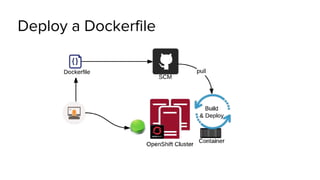
Deploy a Dockerfile
Deploy a Binary Artifact
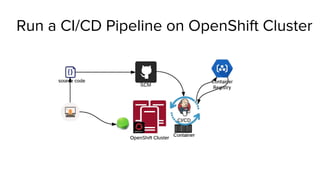
Run a CI/CD Pipeline on OpenShift Cluster
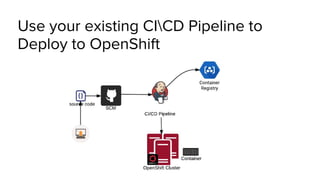
Use your existing CICD Pipeline to
Deploy to OpenShift
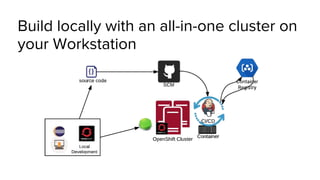
Build locally with an all-in-one cluster on
your Workstation
RED HAT CONFIDENTIAL
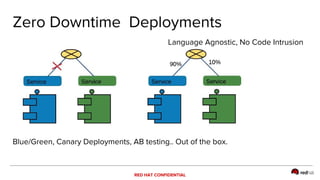
Zero Downtime Deployments
Blue/Green, Canary Deployments, AB testing.. Out of the box.
Language Agnostic, No Code Intrusion
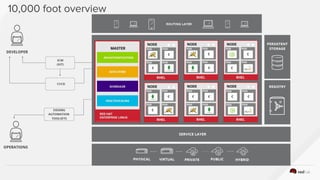
10,000 foot overview
RED HAT CONFIDENTIAL
NEXT-GEN ECOSYSTEMS
RED HAT CONFIDENTIAL
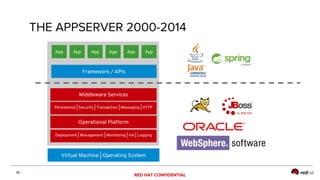
THE APPSERVER 2000-2014
36
Framework / APIs
Middleware Services
Operational Platform
App App
Persistence | Security | Transaction | Messaging | HTTP
Deployment | Management | Monitoring | HA | Logging
Virtual Machine | Operating System
App AppApp App
RED HAT CONFIDENTIAL
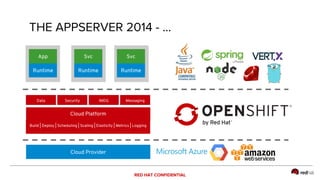
Runtime
App
Cloud Platform
Data
Build | Deploy | Scheduling | Scaling | Elasticity | Metrics | Logging
Security IMDG Messaging
Runtime
Svc
Runtime
Svc
Cloud Provider
THE APPSERVER 2014 - ...
RED HAT CONFIDENTIAL
38
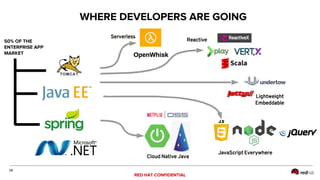
50% OF THE
ENTERPRISE APP
MARKET
WHERE DEVELOPERS ARE GOING
RED HAT CONFIDENTIAL
39
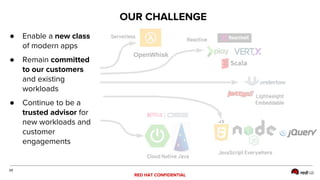
● Enable a new class
of modern apps
● Remain committed
to our customers
and existing
workloads
● Continue to be a
trusted advisor for
new workloads and
customer
engagements
OUR CHALLENGE
RED HAT CONFIDENTIAL40
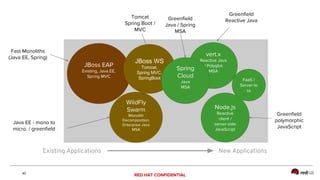
JBoss EAP
Existing, Java EE,
Spring MVC
WildFly
Swarm
Monolith
Decomposition,
Enterprise Java
MSA
Fast Monoliths
(Java EE, Spring)
Tomcat
Spring Boot /
MVC
JBoss WS
Tomcat,
Spring MVC,
SpringBoot
Greenfield
Reactive Java
Java EE - mono to
micro. / greenfield
vert.x
Reactive Java
/ Polyglot
MSA
Node.js
Reactive
client /
server-side
JavaScript
Greenfield
polymorphic
JavaScript
FaaS /
Server-le
ss
Existing Applications New Applications
Spring
Cloud
Java
MSA
Greenfield
Java / Spring
MSA
RED HAT CONFIDENTIAL
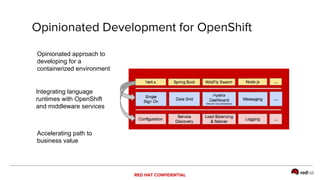
Opinionated Development for OpenShift
Integrating language
runtimes with OpenShift
and middleware services
Opinionated approach to
developing for a
containerized environment
Accelerating path to
business value
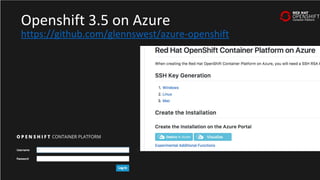
Openshift 3.5 on Azure
https://github.com/glennswest/azure-openshift
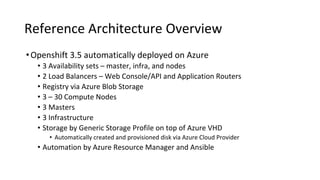
Reference Architecture Overview
•Openshift 3.5 automatically deployed on Azure
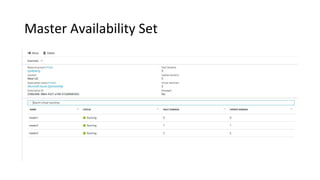
• 3 Availability sets – master, infra, and nodes
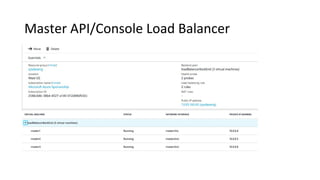
• 2 Load Balancers – Web Console/API and Application Routers
• Registry via Azure Blob Storage
• 3 – 30 Compute Nodes
• 3 Masters
• 3 Infrastructure
• Storage by Generic Storage Profile on top of Azure VHD
• Automatically created and provisioned disk via Azure Cloud Provider
• Automation by Azure Resource Manager and Ansible
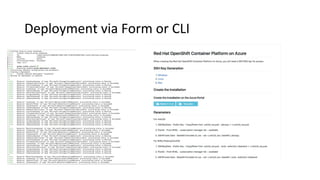
Deployment via Form or CLI
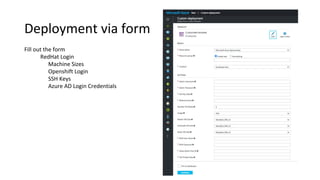
Deployment via form
Fill out the form
RedHat Login
Machine Sizes
Openshift Login
SSH Keys
Azure AD Login Credentials
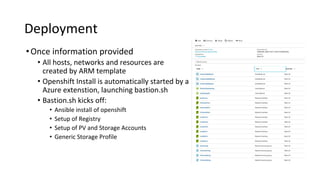
Deployment
•Once information provided
• All hosts, networks and resources are
created by ARM template
• Openshift Install is automatically started by a
Azure extenstion, launching bastion.sh
• Bastion.sh kicks off:
• Ansible install of openshift
• Setup of Registry
• Setup of PV and Storage Accounts
• Generic Storage Profile
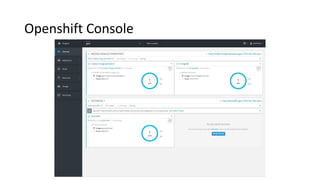
Openshift Console
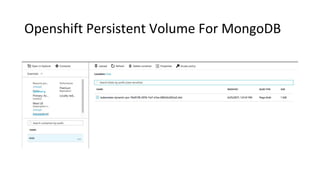
Openshift Persistent Volume For MongoDB
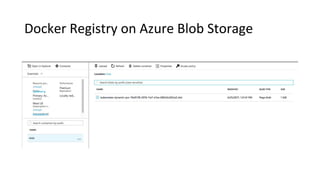
Docker Registry on Azure Blob Storage
Master Availability Set
Master API/Console Load Balancer
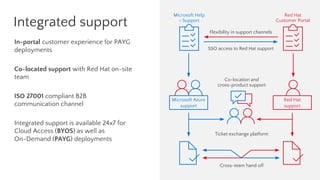
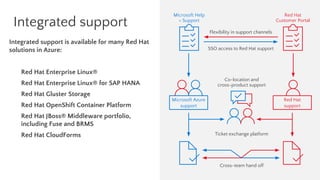
Integrated support
In-portal customer experience for PAYG
deployments
Co-located support with Red Hat on-site
team
ISO 27001 compliant B2B
communication channel
Integrated support is available 24x7 for
Cloud Access (BYOS) as well as
On-Demand (PAYG) deployments
Microsoft Help
+ Support
Red Hat
Customer Portal
Flexibility in support channels
SSO access to Red Hat support
Co-location and
cross-product support
Microsoft Azure
support
Red Hat
support
Ticket exchange platform
Cross-team hand off
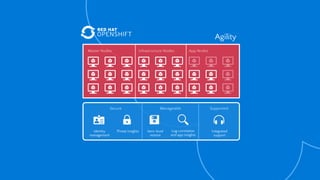
Agility
Secure Manageable Supported
Integrated
support
Log correlation
and app insights
Item-level
restore
Identity
management
Threat insights
Master Nodes Infrastructure Nodes App Nodes
Integrated support
Integrated support is available for many Red Hat
solutions in Azure:
Red Hat Enterprise Linux®
Red Hat Enterprise Linux® for SAP HANA
Red Hat Gluster Storage
Red Hat OpenShift Container Platform
Red Hat JBoss® Middleware portfolio,
including Fuse and BRMS
Red Hat CloudForms
Microsoft Help
+ Support
Red Hat
Customer Portal
Flexibility in support channels
SSO access to Red Hat support
Co-location and
cross-product support
Microsoft Azure
support
Red Hat
support
Ticket exchange platform
Cross-team hand off
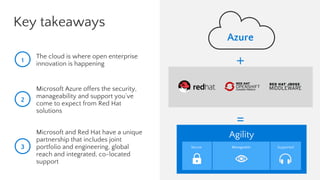
Key takeaways
The cloud is where open enterprise
innovation is happening
Microsoft Azure offers the security,
manageability and support you’ve
come to expect from Red Hat
solutions
Microsoft and Red Hat have a unique
partnership that includes joint
portfolio and engineering, global
reach and integrated, co-located
support
2
3
1 +
Azure
=
Agility
Secure Manageable Supported
OpenShift
Architecture Overview
OpenShift runs on your choice of infrastructure
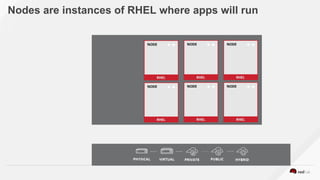
Nodes are instances of RHEL where apps will run
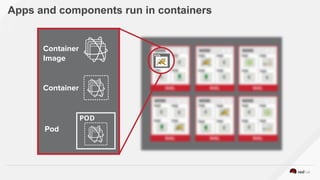
Apps and components run in containers
Container
Image
Container
Pod
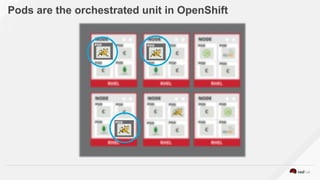
Pods are the orchestrated unit in OpenShift
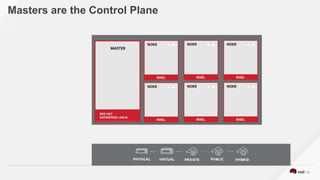
Masters are the Control Plane
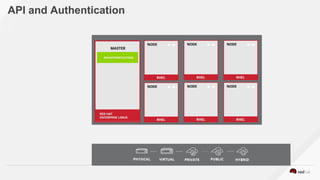
API and Authentication
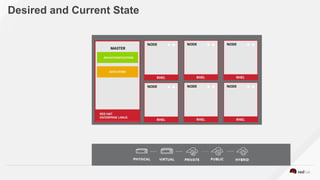
Desired and Current State
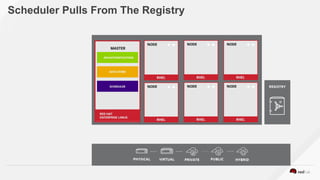
Scheduler Pulls From The Registry
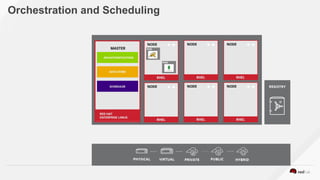
Orchestration and Scheduling
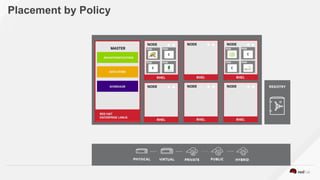
Placement by Policy
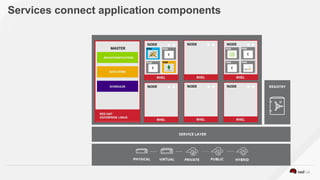
Services connect application components
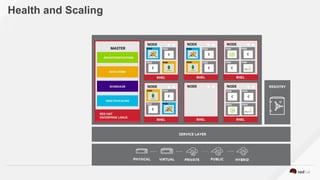
Health and Scaling
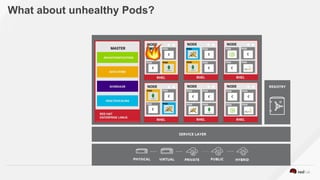
What about unhealthy Pods?
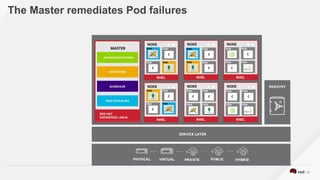
The Master remediates Pod failures
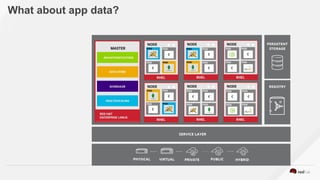
What about app data?
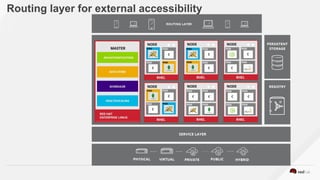
Routing layer for external accessibility
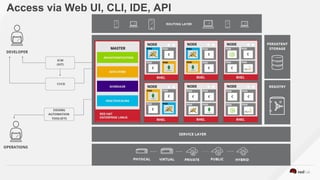
Access via Web UI, CLI, IDE, API
OpenShift
Source-to-Image
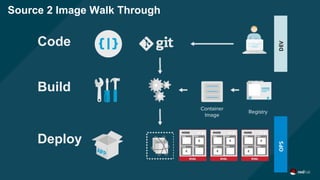
Source 2 Image Walk Through
Code
Build
Deploy
Container
Image
Registry
Source 2 Image Walk Through
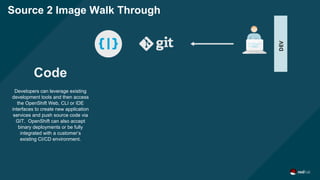
Code
Developers can leverage existing
development tools and then access
the OpenShift Web, CLI or IDE
interfaces to create new application
services and push source code via
GIT. OpenShift can also accept
binary deployments or be fully
integrated with a customer’s
existing CI/CD environment.
Source 2 Image Walk Through
Container
Image
Registry
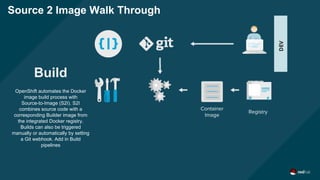
Build
OpenShift automates the Docker
image build process with
Source-to-Image (S2I). S2I
combines source code with a
corresponding Builder image from
the integrated Docker registry.
Builds can also be triggered
manually or automatically by setting
a Git webhook. Add in Build
pipelines
Source 2 Image Walk Through
Container
Image
Registry
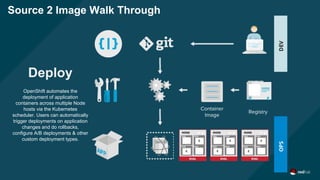
Deploy
OpenShift automates the
deployment of application
containers across multiple Node
hosts via the Kubernetes
scheduler. Users can automatically
trigger deployments on application
changes and do rollbacks,
configure A/B deployments & other
custom deployment types.
Backup
K8S concepts
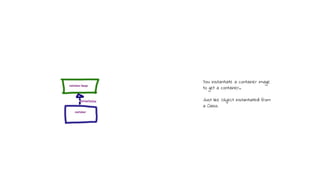
You instantiate a container image
to get a container..
Just like Object instantiated from
a Class
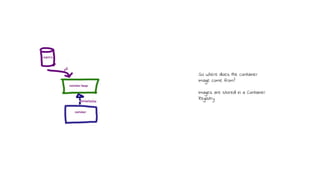
So where does the container
image come from?
Images are stored in a Container
Registry
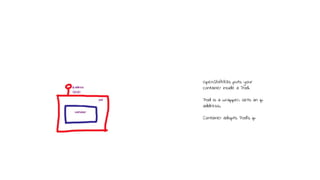
OpenShift/K8s puts your
container inside a Pod.
Pod is a wrapper. Gets an ip
address.
Container adopts Pod’s ip
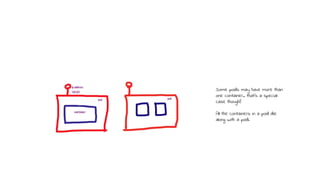
Some pods may have more than
one container.. that’s a special
case though!!
All the containers in a pod die
along with a pod.
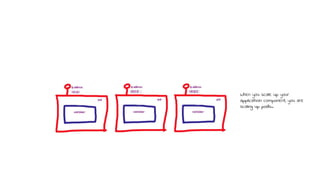
When you scale up your
applicatioin component, you are
scaling up pods..
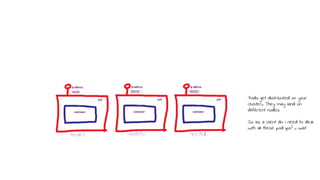
Pods get distributed on your
cluster.. They may land on
different nodes
So as a client do I need to deal
with all these pod ips? .. wait
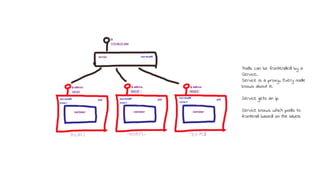
Pods can be frontended by a
Service.
Service is a proxy.. Every node
knows about it.
Service gets an ip
Service knows which pods to
frontend based on the labels
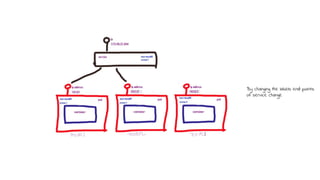
By changing the labels end points
of service change
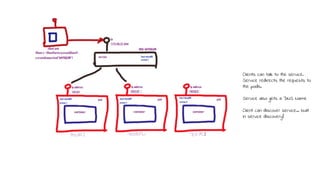
Clients can talk to the service.
Service redirects the requests to
the pods.
Service also gets a DNS Name
Client can discover service… built
in service discovery!!
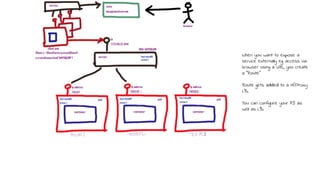
When you want to expose a
service externally eg: access via
browser using a URL, you create
a “Route”
Route gets added to a HAProxy
LB.
You can configure your F5 as
well as LB.

Red Hat Openshift on Microsoft Azure

  • 1.
    Developer 2 Developer Buildingmicroservices webcast series Ravi Tella - Microsoft John Archer - Red Hat
  • 2.
    Microservice architecture →3/03/2017 Azure container service → 3/10/2017 Pivotal cloud foundry → 3/31/2017 RedHat OpenShift → 4/28/2017 Developer 2 Developer RedHat OpenShift
  • 3.
  • 4.
    @OpenShift RHOpenShift OpenShift on Azure JohnArcher Senior AppDev Solution Architect Energy Pod @archerj
  • 5.
    APPLICATIONS New ways ofdeveloping, delivering and integrating applications INFRASTRUCTURE Modernize existing and build new cloud based infrastructure PROCESS More agile processes across both IT and the business 5 Digital Transformation There is Evolution in...
  • 6.
    Containers - TransformApps, Infrastructure & Process 6
  • 7.
    ● Enable efficiencyand automation for microservices, but also support traditional applications ● Enable faster and more consistent deployments from Development to Production ● Enable application portability across 4 infrastructure footprints: Physical, Virtual, Private & Public Cloud Containers - An Evolution in Application Deployment 7
  • 8.
    What Are Containers? ●Sandboxed application processes on a shared Linux OS kernel ● Simpler, lighter, and denser than virtual machines ● Portable across different environments ● Package my application and all of its dependencies ● Deploy to any environment in seconds and enable CI/CD ● Easily access and share containerized components INFRASTRUCTURE APPLICATIONS It Depends on Who You Ask 8
  • 9.
  • 10.
  • 11.
  • 12.
    GUEST OS HARDWARE HOST OS(RHEL/ATOMIC)HOST OS (RHEL) LIBS A LIBS B LIBS... APP A APP B Traditional ContainerVirtualized TRADITIONAL VS. VIRTUALIZED VS. CONTAINERS HARDWAREHARDWARE LIBS A APP A HYPERVISOR CONTAINER CONTAINER LIBS A LIBS B APP A APP B CONTAINER LIBS C APP C GUEST OS LIBS A APP A GUEST OS LIBS A APP A
  • 13.
    Cloud Service Models COMPUTERESOURCES (CPU, RAM, NETWORK, DISK) VIRTUAL GUEST IMAGES OPERATING SYSTEM APPLICATION PLATFORM (App Server, Middleware, Languages) APPLICATION Automated and Managed by the Cloud Provider Provided and Controlled by Cloud Consumer IaaS PaaS SaaS Increased Control Increased Automation DEVELOPER TOOLING (IDE, Source Control, Build Tools, CI)
  • 14.
    Cloud Service Models COMPUTERESOURCES (CPU, RAM, NETWORK, DISK) VIRTUAL GUEST IMAGES OPERATING SYSTEM APPLICATION PLATFORM (App Server, Middleware, Languages) APPLICATION Automated and Managed by the Cloud Provider Provided and Controlled by Cloud Consumer IaaS CaaS SaaS Increased Control Increased Automation DEVELOPER TOOLING (IDE, Source Control, Build Tools, CI)
  • 15.
    PaaS + CaaS ADistributed Cloud Application Platform Code Deploy Run Save Time and Money Code your app Push-button Deploy, and your App is running in the Cloud!
  • 16.
  • 17.
  • 18.
    SERVICE CATALOG (LANGUAGE RUNTIMES,MIDDLEWARE, DATABASES, …) SELF-SERVICE APPLICATION LIFECYCLE MANAGEMENT (CI / CD) BUILD AUTOMATION DEPLOYMENT AUTOMATION CONTAINER CONTAINERCONTAINER CONTAINER CONTAINER NETWORKING SECURITYSTORAGE REGISTRY LOGS & METRICS CONTAINER ORCHESTRATION & CLUSTER MANAGEMENT (KUBERNETES) RED HAT ENTERPRISE LINUX CONTAINER RUNTIME & PACKAGING (DOCKER) ATOMIC HOST INFRASTRUCTURE AUTOMATION & COCKPIT OpenShift Container Platform - Stack Build, Deploy and Manage Containerized Apps Build RUNTIME
  • 19.
    RED HAT CONFIDENTIAL PipelinesSupported Out Of The Box
  • 20.
    RED HAT CONFIDENTIAL OpenShiftprovides multiple Deployment Models. .. we don’t force a certain way. Enterprises can adopt the change at their own pace.
  • 21.
  • 22.
    Application Services JBoss EAP JBossWeb Server JBoss Data Grid JBoss Dev Studio JBoss Ops Network Red Hat MobileNGINX Juniper Networks Crunchy DB & More JBoss Fuse JBoss AM-Q JBoss Data Virt 3Scale JBoss BRMS JBoss BPM Suite Red Hat Software Collections Red Hat Container Catalog Red Hat SSO Red Hat Storage Docker Hub OpenShift Primed Your Private Registries
  • 23.
    Facilitating a richcontainer ecosystem Represented by a broad coalition of industry leaders focused on common standards for software containers Create and drive the adoption of a new computing paradigm that is optimized for modern distributed systems
  • 25.
    RED HAT CONFIDENTIAL SelfService Model Developer time is too expensive to wait for provisioning VMs Code Deploy Run Save Time and Money Code your app Push-button Deploy, and your App is running in the Cloud!
  • 26.
  • 27.
  • 28.
  • 29.
  • 30.
    Run a CI/CDPipeline on OpenShift Cluster
  • 31.
    Use your existingCICD Pipeline to Deploy to OpenShift
  • 32.
    Build locally withan all-in-one cluster on your Workstation
  • 33.
    RED HAT CONFIDENTIAL ZeroDowntime Deployments Blue/Green, Canary Deployments, AB testing.. Out of the box. Language Agnostic, No Code Intrusion
  • 34.
  • 35.
  • 36.
    RED HAT CONFIDENTIAL THEAPPSERVER 2000-2014 36 Framework / APIs Middleware Services Operational Platform App App Persistence | Security | Transaction | Messaging | HTTP Deployment | Management | Monitoring | HA | Logging Virtual Machine | Operating System App AppApp App
  • 37.
    RED HAT CONFIDENTIAL Runtime App CloudPlatform Data Build | Deploy | Scheduling | Scaling | Elasticity | Metrics | Logging Security IMDG Messaging Runtime Svc Runtime Svc Cloud Provider THE APPSERVER 2014 - ...
  • 38.
    RED HAT CONFIDENTIAL 38 50%OF THE ENTERPRISE APP MARKET WHERE DEVELOPERS ARE GOING
  • 39.
    RED HAT CONFIDENTIAL 39 ●Enable a new class of modern apps ● Remain committed to our customers and existing workloads ● Continue to be a trusted advisor for new workloads and customer engagements OUR CHALLENGE
  • 40.
    RED HAT CONFIDENTIAL40 JBossEAP Existing, Java EE, Spring MVC WildFly Swarm Monolith Decomposition, Enterprise Java MSA Fast Monoliths (Java EE, Spring) Tomcat Spring Boot / MVC JBoss WS Tomcat, Spring MVC, SpringBoot Greenfield Reactive Java Java EE - mono to micro. / greenfield vert.x Reactive Java / Polyglot MSA Node.js Reactive client / server-side JavaScript Greenfield polymorphic JavaScript FaaS / Server-le ss Existing Applications New Applications Spring Cloud Java MSA Greenfield Java / Spring MSA
  • 41.
    RED HAT CONFIDENTIAL OpinionatedDevelopment for OpenShift Integrating language runtimes with OpenShift and middleware services Opinionated approach to developing for a containerized environment Accelerating path to business value
  • 42.
    Openshift 3.5 onAzure https://github.com/glennswest/azure-openshift
  • 43.
    Reference Architecture Overview •Openshift3.5 automatically deployed on Azure • 3 Availability sets – master, infra, and nodes • 2 Load Balancers – Web Console/API and Application Routers • Registry via Azure Blob Storage • 3 – 30 Compute Nodes • 3 Masters • 3 Infrastructure • Storage by Generic Storage Profile on top of Azure VHD • Automatically created and provisioned disk via Azure Cloud Provider • Automation by Azure Resource Manager and Ansible
  • 44.
  • 45.
    Deployment via form Fillout the form RedHat Login Machine Sizes Openshift Login SSH Keys Azure AD Login Credentials
  • 46.
    Deployment •Once information provided •All hosts, networks and resources are created by ARM template • Openshift Install is automatically started by a Azure extenstion, launching bastion.sh • Bastion.sh kicks off: • Ansible install of openshift • Setup of Registry • Setup of PV and Storage Accounts • Generic Storage Profile
  • 47.
  • 48.
  • 49.
    Docker Registry onAzure Blob Storage
  • 50.
  • 51.
  • 52.
    Integrated support In-portal customerexperience for PAYG deployments Co-located support with Red Hat on-site team ISO 27001 compliant B2B communication channel Integrated support is available 24x7 for Cloud Access (BYOS) as well as On-Demand (PAYG) deployments Microsoft Help + Support Red Hat Customer Portal Flexibility in support channels SSO access to Red Hat support Co-location and cross-product support Microsoft Azure support Red Hat support Ticket exchange platform Cross-team hand off
  • 53.
    Agility Secure Manageable Supported Integrated support Logcorrelation and app insights Item-level restore Identity management Threat insights Master Nodes Infrastructure Nodes App Nodes
  • 54.
    Integrated support Integrated supportis available for many Red Hat solutions in Azure: Red Hat Enterprise Linux® Red Hat Enterprise Linux® for SAP HANA Red Hat Gluster Storage Red Hat OpenShift Container Platform Red Hat JBoss® Middleware portfolio, including Fuse and BRMS Red Hat CloudForms Microsoft Help + Support Red Hat Customer Portal Flexibility in support channels SSO access to Red Hat support Co-location and cross-product support Microsoft Azure support Red Hat support Ticket exchange platform Cross-team hand off
  • 55.
    Key takeaways The cloudis where open enterprise innovation is happening Microsoft Azure offers the security, manageability and support you’ve come to expect from Red Hat solutions Microsoft and Red Hat have a unique partnership that includes joint portfolio and engineering, global reach and integrated, co-located support 2 3 1 + Azure = Agility Secure Manageable Supported
  • 56.
  • 57.
    OpenShift runs onyour choice of infrastructure
  • 58.
    Nodes are instancesof RHEL where apps will run
  • 59.
    Apps and componentsrun in containers Container Image Container Pod
  • 60.
    Pods are theorchestrated unit in OpenShift
  • 61.
    Masters are theControl Plane
  • 62.
  • 63.
  • 64.
  • 65.
  • 66.
  • 67.
  • 68.
  • 69.
  • 70.
  • 71.
  • 72.
    Routing layer forexternal accessibility
  • 73.
    Access via WebUI, CLI, IDE, API
  • 74.
  • 75.
    Source 2 ImageWalk Through Code Build Deploy Container Image Registry
  • 76.
    Source 2 ImageWalk Through Code Developers can leverage existing development tools and then access the OpenShift Web, CLI or IDE interfaces to create new application services and push source code via GIT. OpenShift can also accept binary deployments or be fully integrated with a customer’s existing CI/CD environment.
  • 77.
    Source 2 ImageWalk Through Container Image Registry Build OpenShift automates the Docker image build process with Source-to-Image (S2I). S2I combines source code with a corresponding Builder image from the integrated Docker registry. Builds can also be triggered manually or automatically by setting a Git webhook. Add in Build pipelines
  • 78.
    Source 2 ImageWalk Through Container Image Registry Deploy OpenShift automates the deployment of application containers across multiple Node hosts via the Kubernetes scheduler. Users can automatically trigger deployments on application changes and do rollbacks, configure A/B deployments & other custom deployment types.
  • 79.
  • 80.
    You instantiate acontainer image to get a container.. Just like Object instantiated from a Class
  • 81.
    So where doesthe container image come from? Images are stored in a Container Registry
  • 82.
    OpenShift/K8s puts your containerinside a Pod. Pod is a wrapper. Gets an ip address. Container adopts Pod’s ip
  • 83.
    Some pods mayhave more than one container.. that’s a special case though!! All the containers in a pod die along with a pod.
  • 84.
    When you scaleup your applicatioin component, you are scaling up pods..
  • 85.
    Pods get distributedon your cluster.. They may land on different nodes So as a client do I need to deal with all these pod ips? .. wait
  • 86.
    Pods can befrontended by a Service. Service is a proxy.. Every node knows about it. Service gets an ip Service knows which pods to frontend based on the labels
  • 87.
    By changing thelabels end points of service change
  • 88.
    Clients can talkto the service. Service redirects the requests to the pods. Service also gets a DNS Name Client can discover service… built in service discovery!!
  • 89.
    When you wantto expose a service externally eg: access via browser using a URL, you create a “Route” Route gets added to a HAProxy LB. You can configure your F5 as well as LB.