Enterprise Cloud
management platform
Nagaraj Shenoy
About
● Nagaraj Shenoy
● MS - Illinois institute of Technology(IIT), Chicago
● Tech Generalist, FOSS lover
https://in.linkedin.com/in/mnshenoy
www.webinav.com
Licensed under a Creative Commons Attribution-NonCommercial-ShareAlike 4.0 International License.
Agenda
● An insight into Openstack Ecosystem
● Why a cloud management platform ?
● Basic Ingredients of an enterprise cloud services platform
● Openstack based CMP Architecture
● Nova, Neutron, Glance
● HEAT
● Ceilometer
About Openstack
Why ?
● Fastest growing open source project
● Distributed cloud operating system
● Promotes Vendor neutrality
● Wide Ecosystem, backed by Industry juggernauts
Why not ?
● Comprises of many projects, many of them still not ready for enterprise
● Learning curve !! New release every six months. Icehouse as we speak !!
● Still cant call it a CMP
● Containers !! Docker and Kubernetes gaining attention
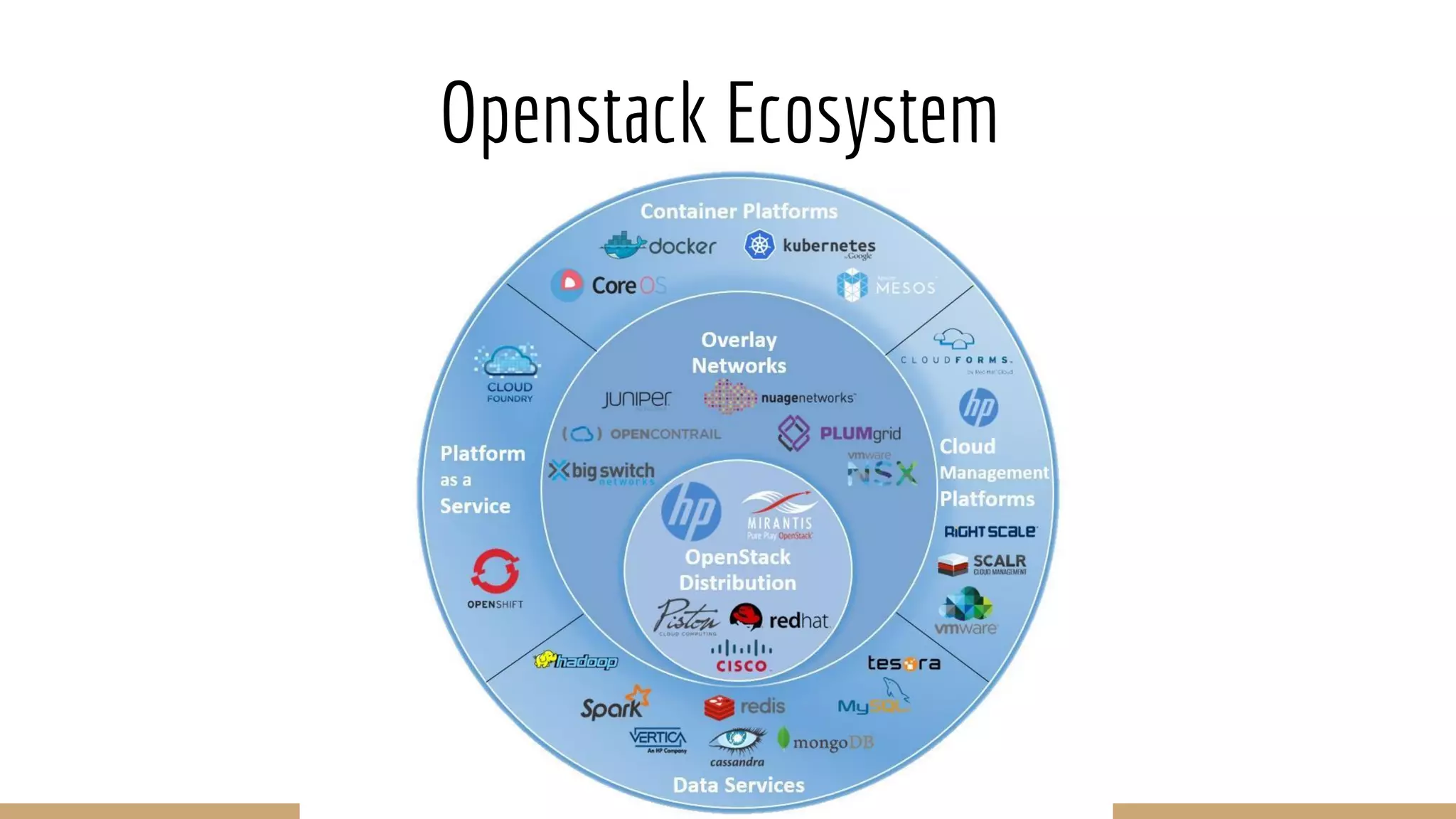
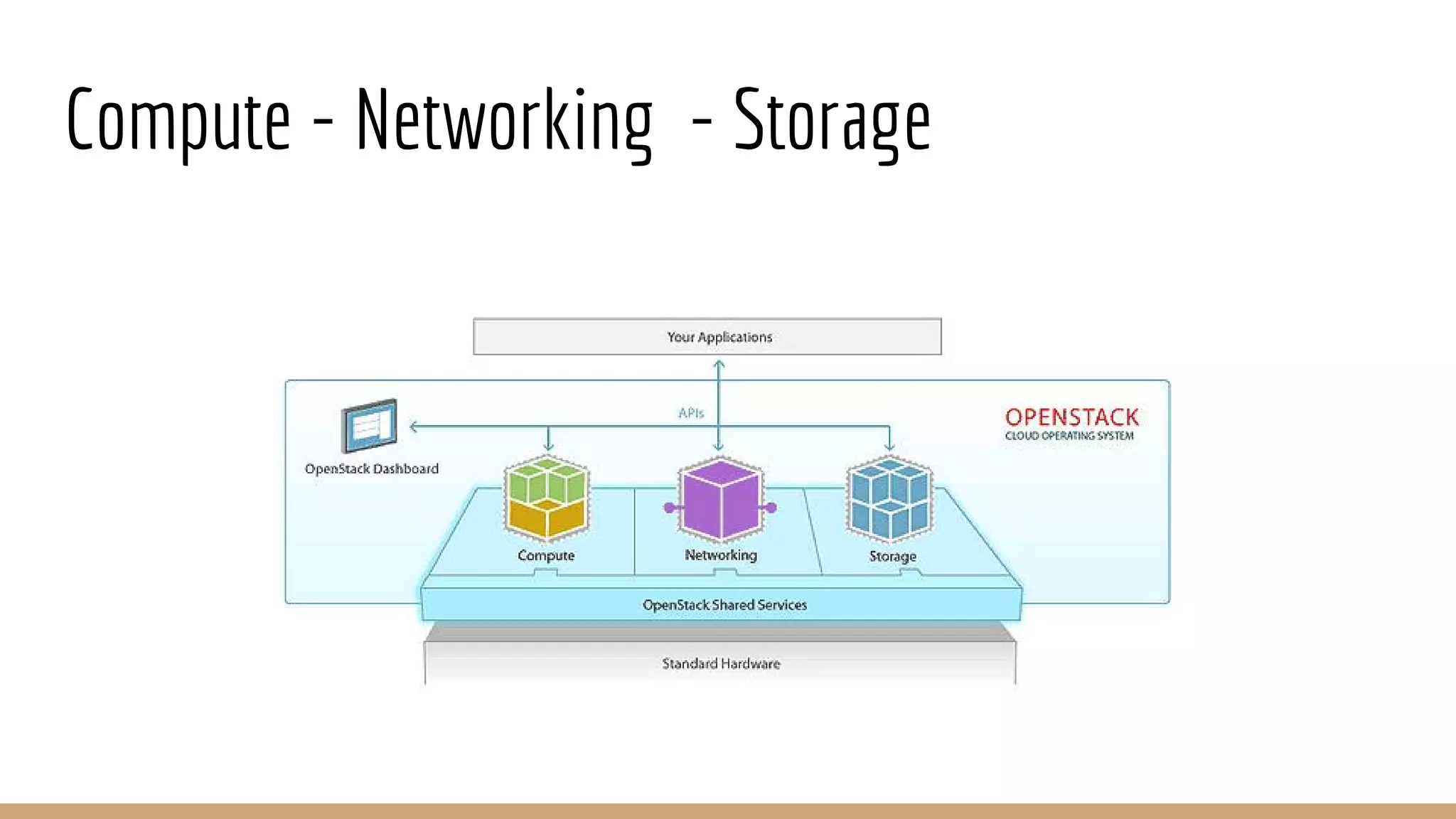
Openstack Ecosystem
Compute - Networking - Storage
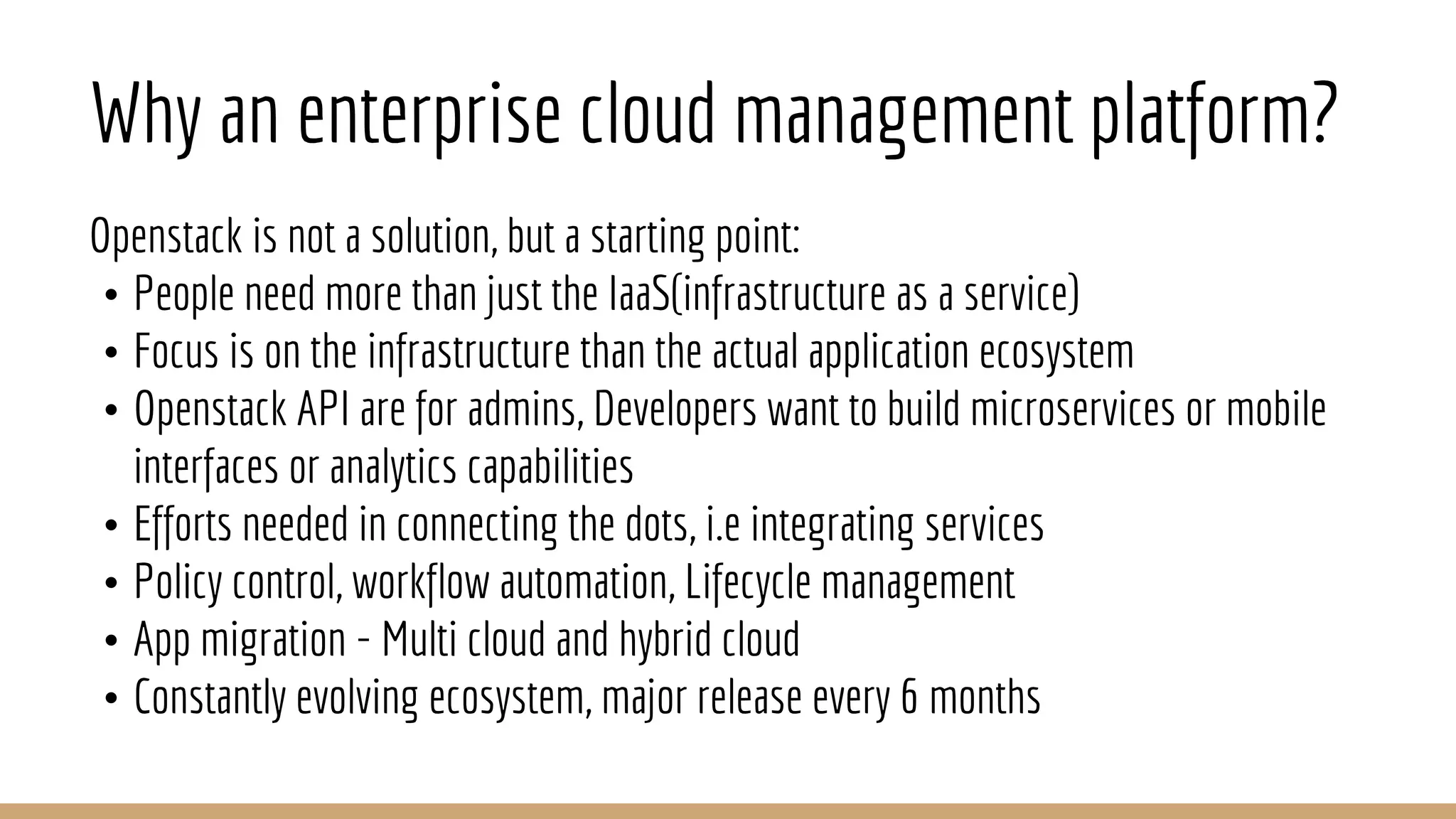
Why an enterprise cloud management platform?
Openstack is not a solution, but a starting point:
• People need more than just the IaaS(infrastructure as a service)
• Focus is on the infrastructure than the actual application ecosystem
• Openstack API are for admins, Developers want to build microservices or mobile
interfaces or analytics capabilities
• Efforts needed in connecting the dots, i.e integrating services
• Policy control, workflow automation, Lifecycle management
• App migration - Multi cloud and hybrid cloud
• Constantly evolving ecosystem, major release every 6 months
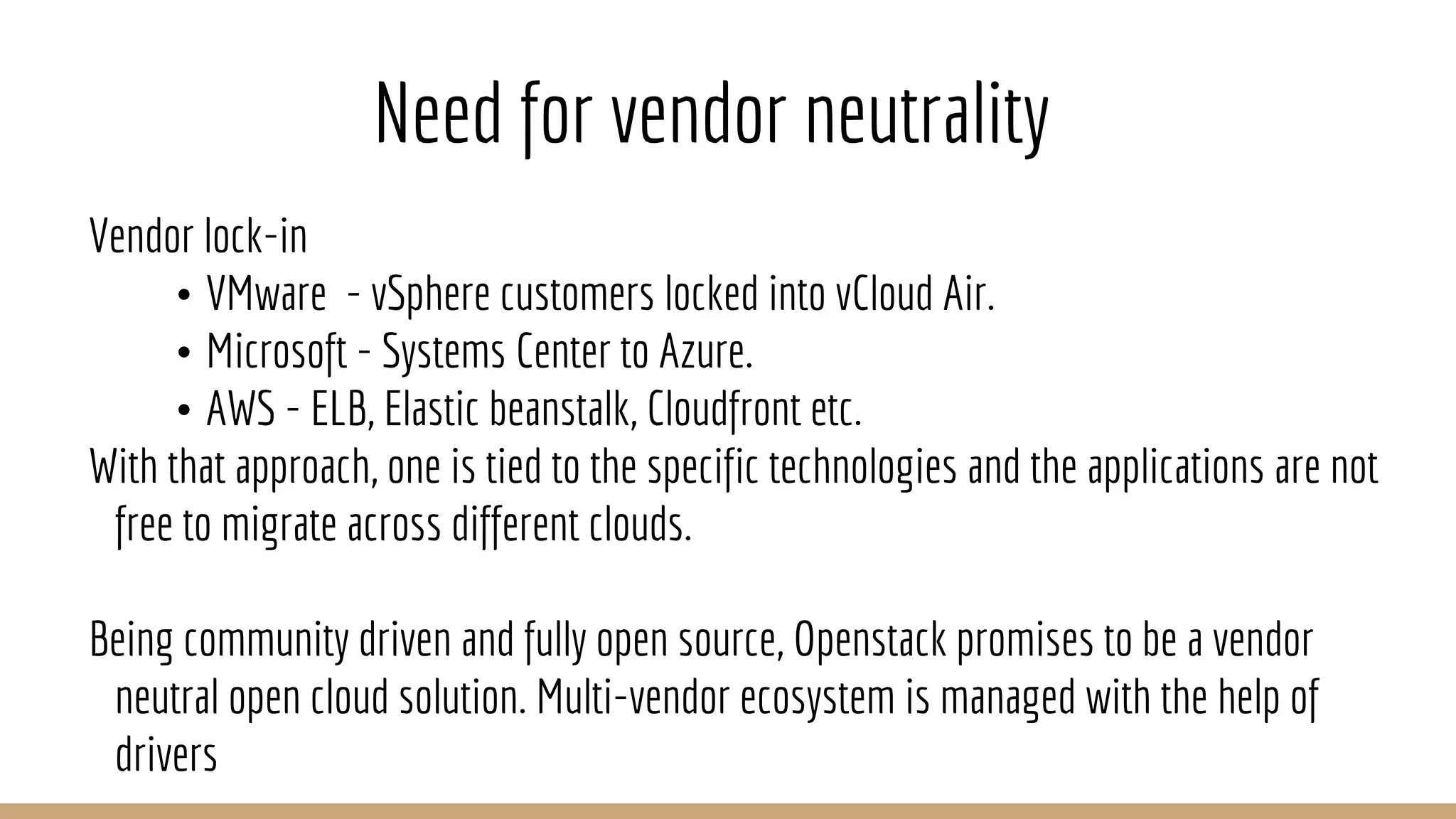
Need for vendor neutrality
Vendor lock-in
• VMware - vSphere customers locked into vCloud Air.
• Microsoft - Systems Center to Azure.
• AWS - ELB, Elastic beanstalk, Cloudfront etc.
With that approach, one is tied to the specific technologies and the applications are not
free to migrate across different clouds.
Being community driven and fully open source, Openstack promises to be a vendor
neutral open cloud solution. Multi-vendor ecosystem is managed with the help of
drivers
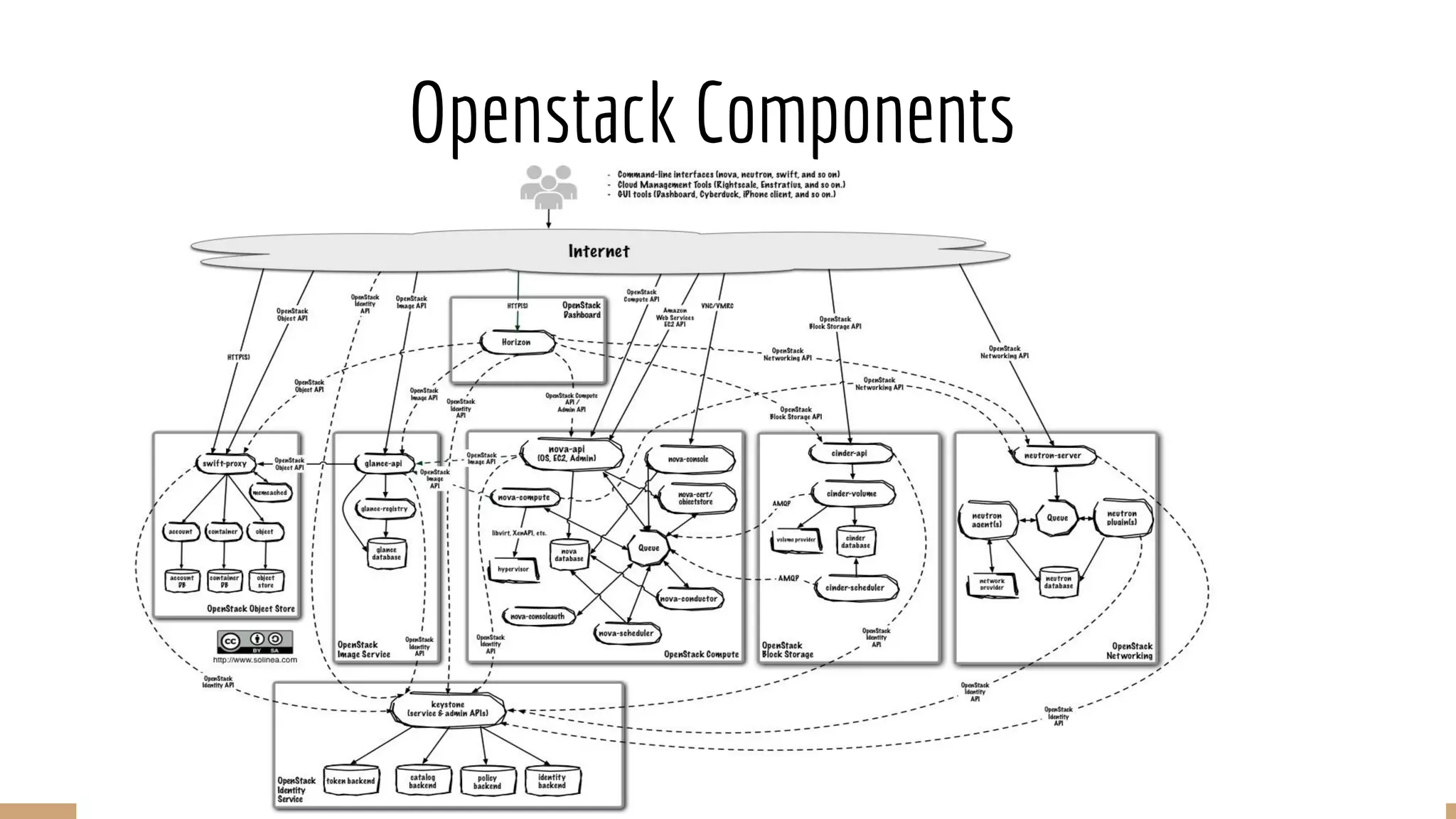
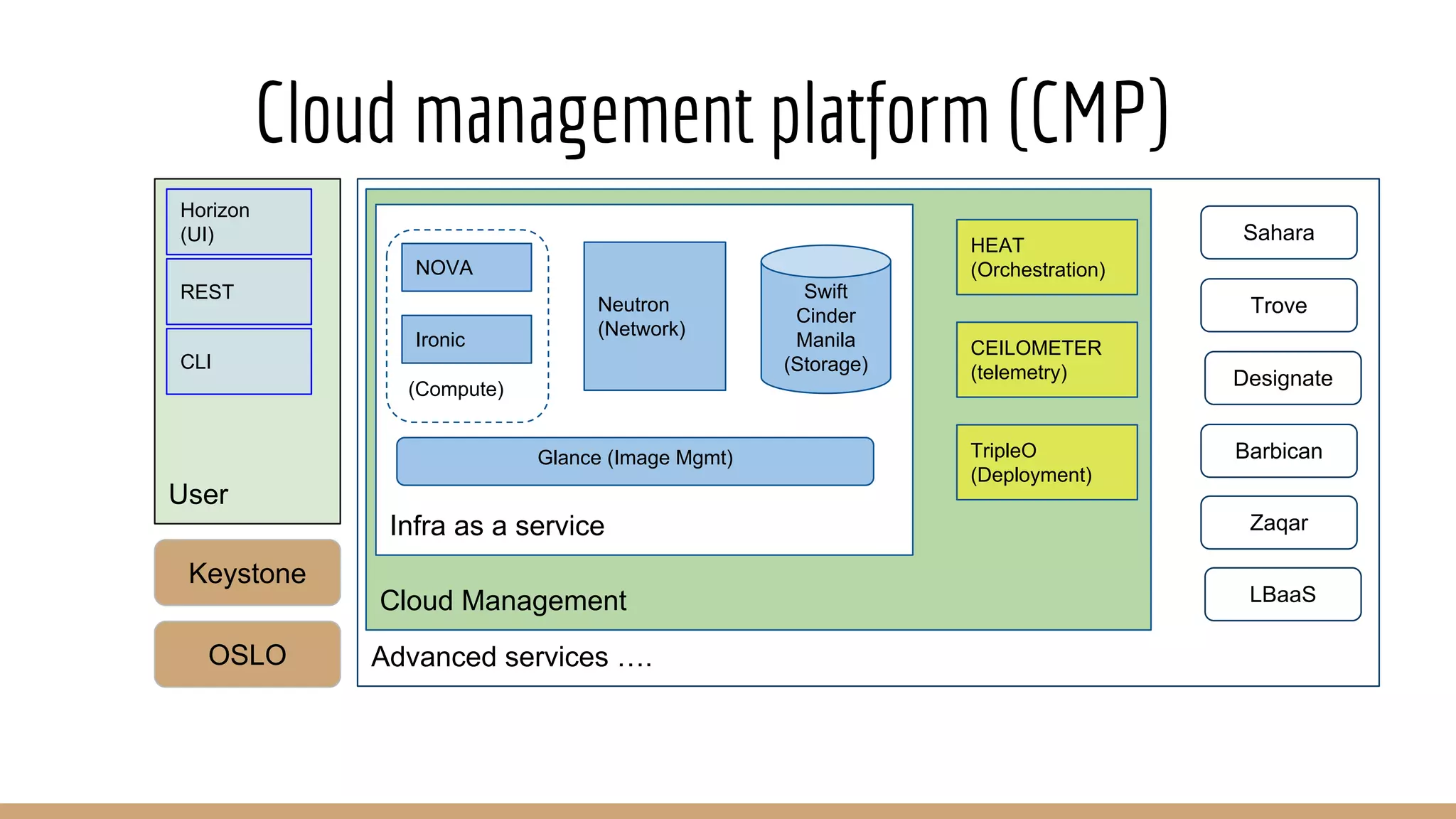
Openstack Components
Advanced services ….
User
Cloud management platform (CMP)
Cloud Management
Infra as a service
NOVA
Ironic
Neutron
(Network)
Swift
Cinder
Manila
(Storage)
(Compute)
Glance (Image Mgmt)
HEAT
(Orchestration)
CEILOMETER
(telemetry)
TripleO
(Deployment)
Horizon
(UI)
REST
CLI
Sahara
Trove
Designate
Barbican
Zaqar
Keystone
OSLO
LBaaS
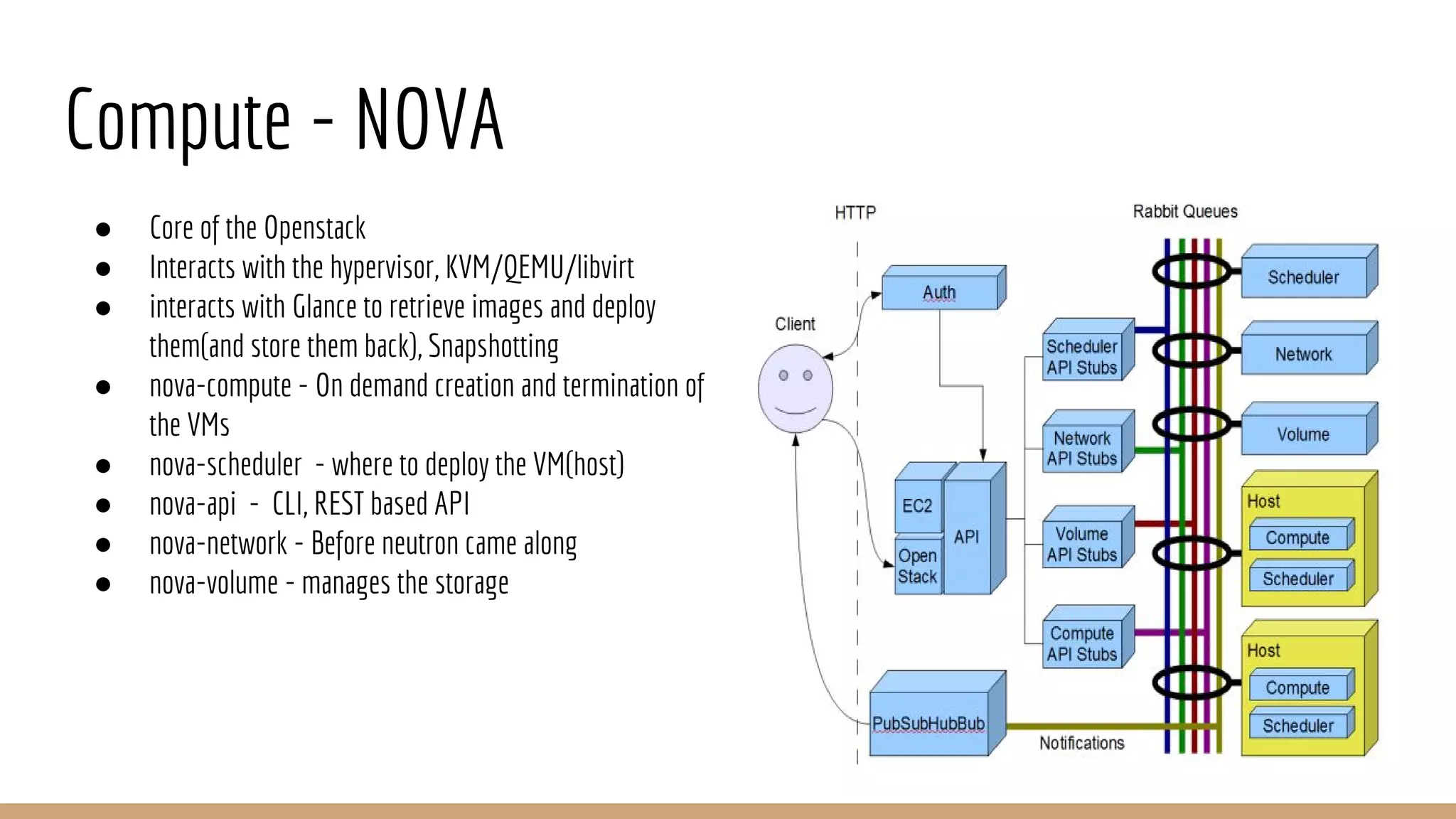
Compute - NOVA
● Core of the Openstack
● Interacts with the hypervisor, KVM/QEMU/libvirt
● interacts with Glance to retrieve images and deploy
them(and store them back), Snapshotting
● nova-compute - On demand creation and termination of
the VMs
● nova-scheduler - where to deploy the VM(host)
● nova-api - CLI, REST based API
● nova-network - Before neutron came along
● nova-volume - manages the storage
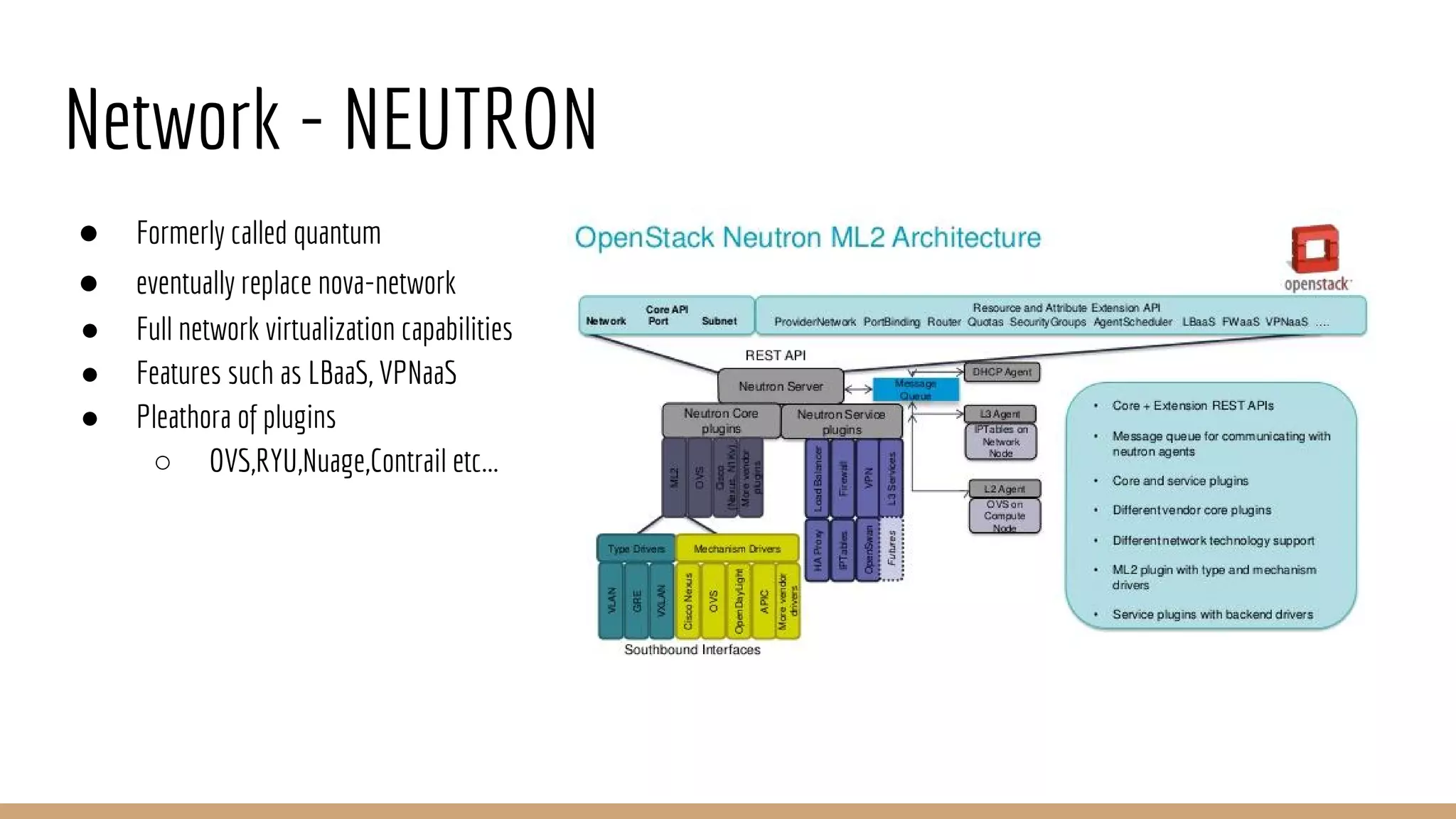
Network - NEUTRON
● Formerly called quantum
● eventually replace nova-network
● Full network virtualization capabilities
● Features such as LBaaS, VPNaaS
● Pleathora of plugins
○ OVS,RYU,Nuage,Contrail etc...
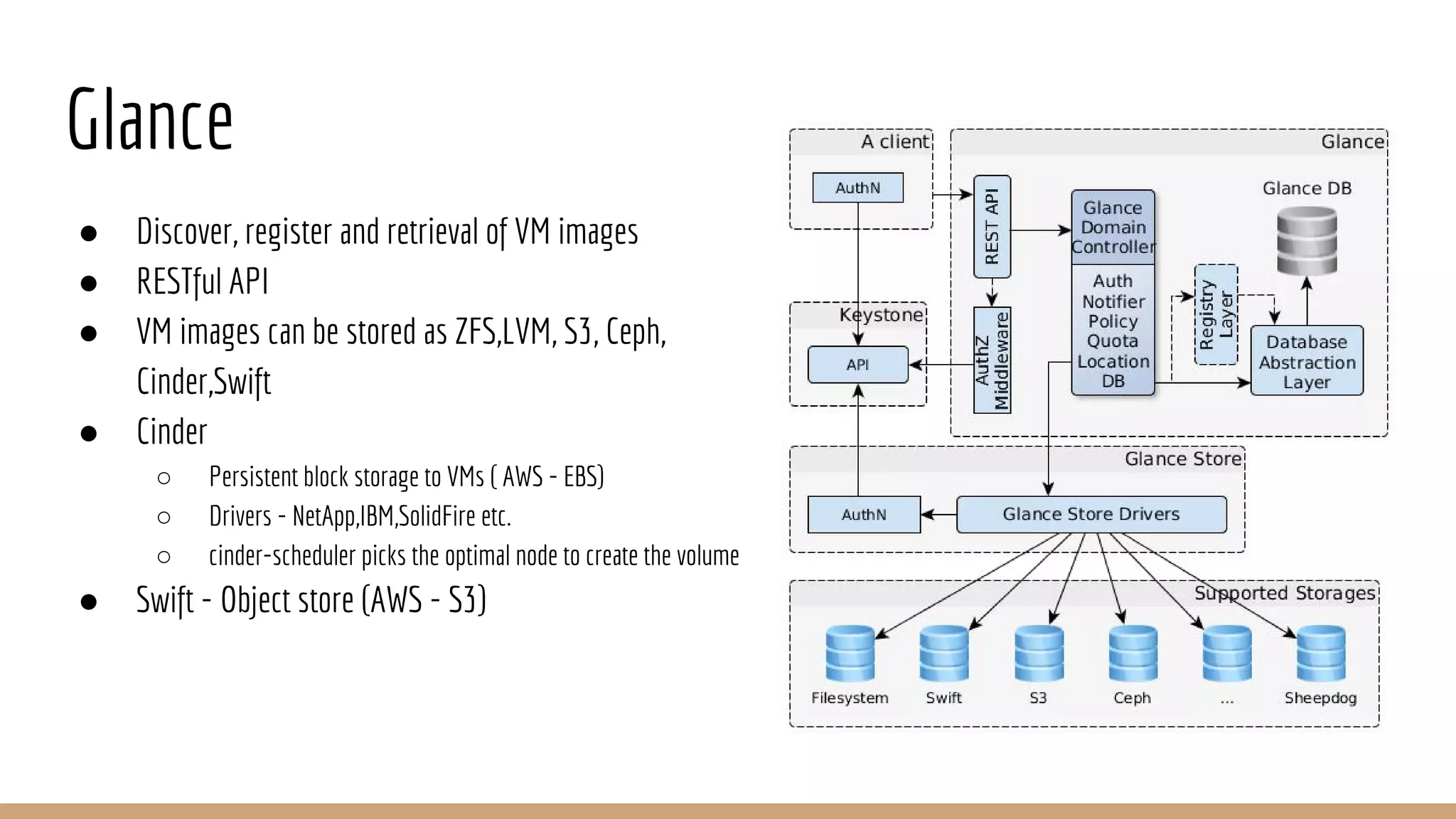
Glance
● Discover, register and retrieval of VM images
● RESTful API
● VM images can be stored as ZFS,LVM, S3, Ceph,
Cinder,Swift
● Cinder
○ Persistent block storage to VMs ( AWS - EBS)
○ Drivers - NetApp,IBM,SolidFire etc.
○ cinder-scheduler picks the optimal node to create the volume
● Swift - Object store (AWS - S3)
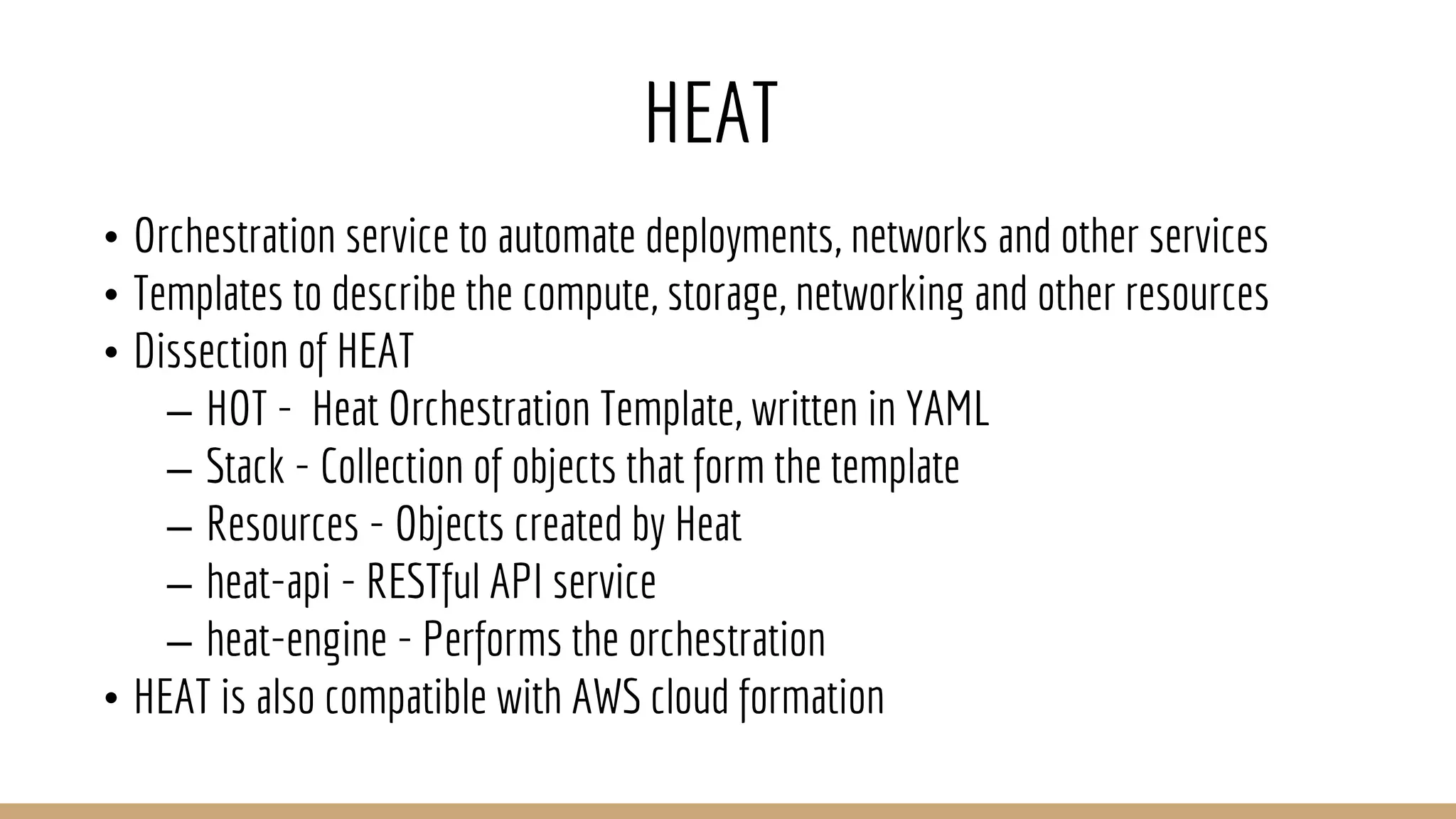
HEAT
• Orchestration service to automate deployments, networks and other services
• Templates to describe the compute, storage, networking and other resources
• Dissection of HEAT
– HOT - Heat Orchestration Template, written in YAML
– Stack - Collection of objects that form the template
– Resources - Objects created by Heat
– heat-api - RESTful API service
– heat-engine - Performs the orchestration
• HEAT is also compatible with AWS cloud formation
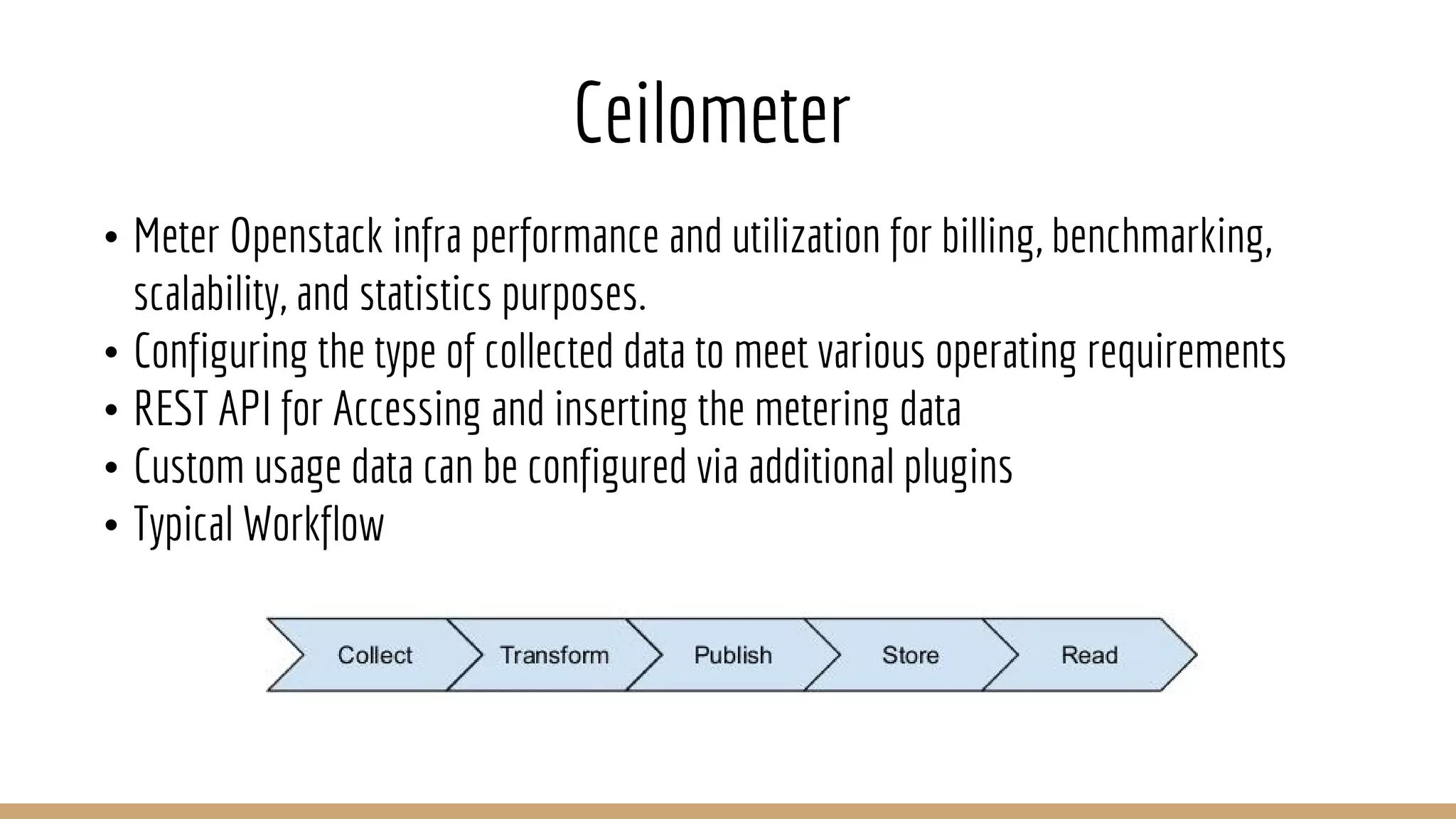
Ceilometer
• Meter Openstack infra performance and utilization for billing, benchmarking,
scalability, and statistics purposes.
• Configuring the type of collected data to meet various operating requirements
• REST API for Accessing and inserting the metering data
• Custom usage data can be configured via additional plugins
• Typical Workflow
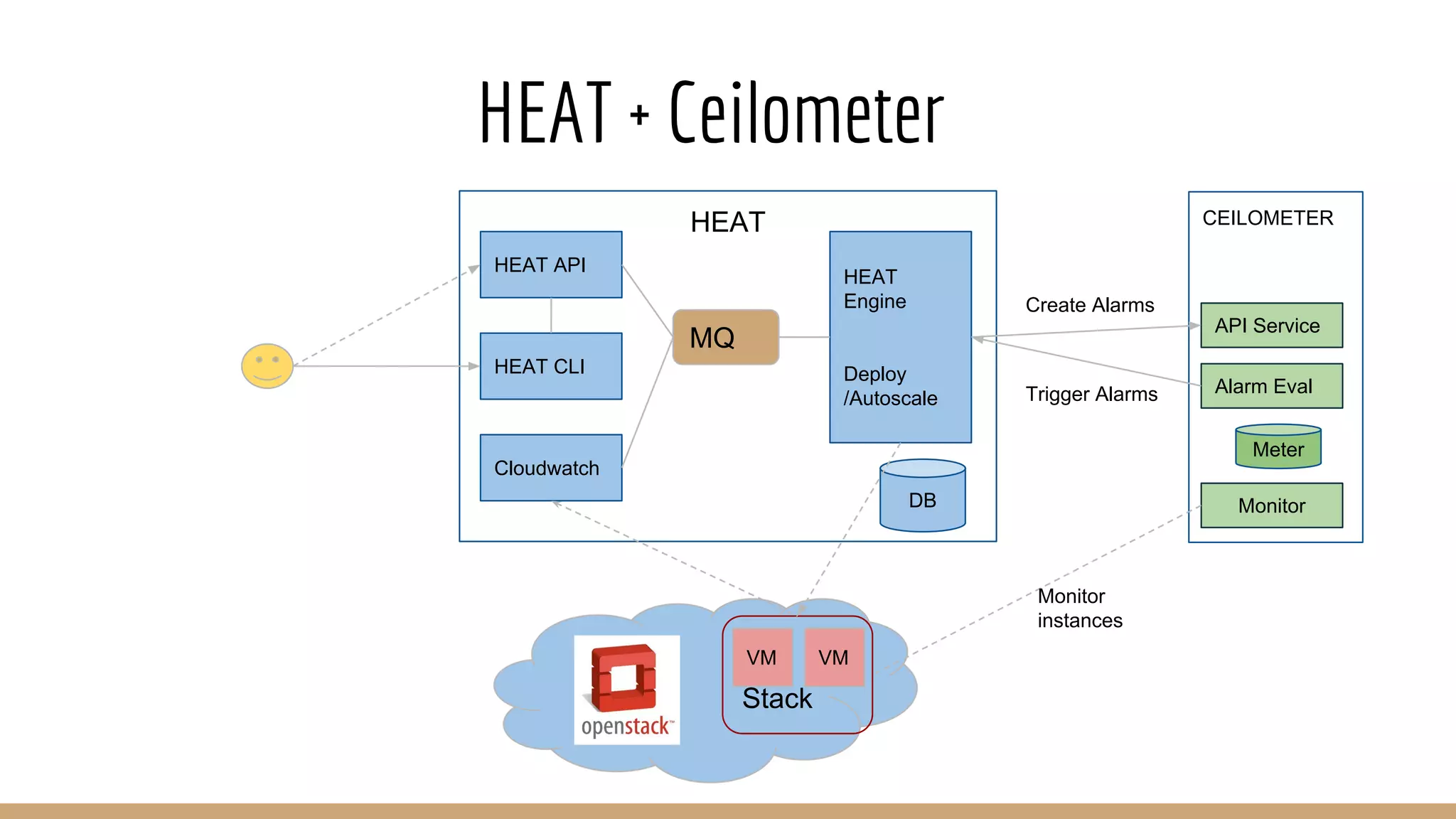
HEAT + Ceilometer
HEAT
HEAT API
DB
HEAT
Engine
Deploy
/Autoscale
MQ
HEAT CLI
Cloudwatch
VM VM
Stack
CEILOMETER
API Service
Alarm Eval
Monitor
Create Alarms
Monitor
instances
Trigger Alarms
Meter
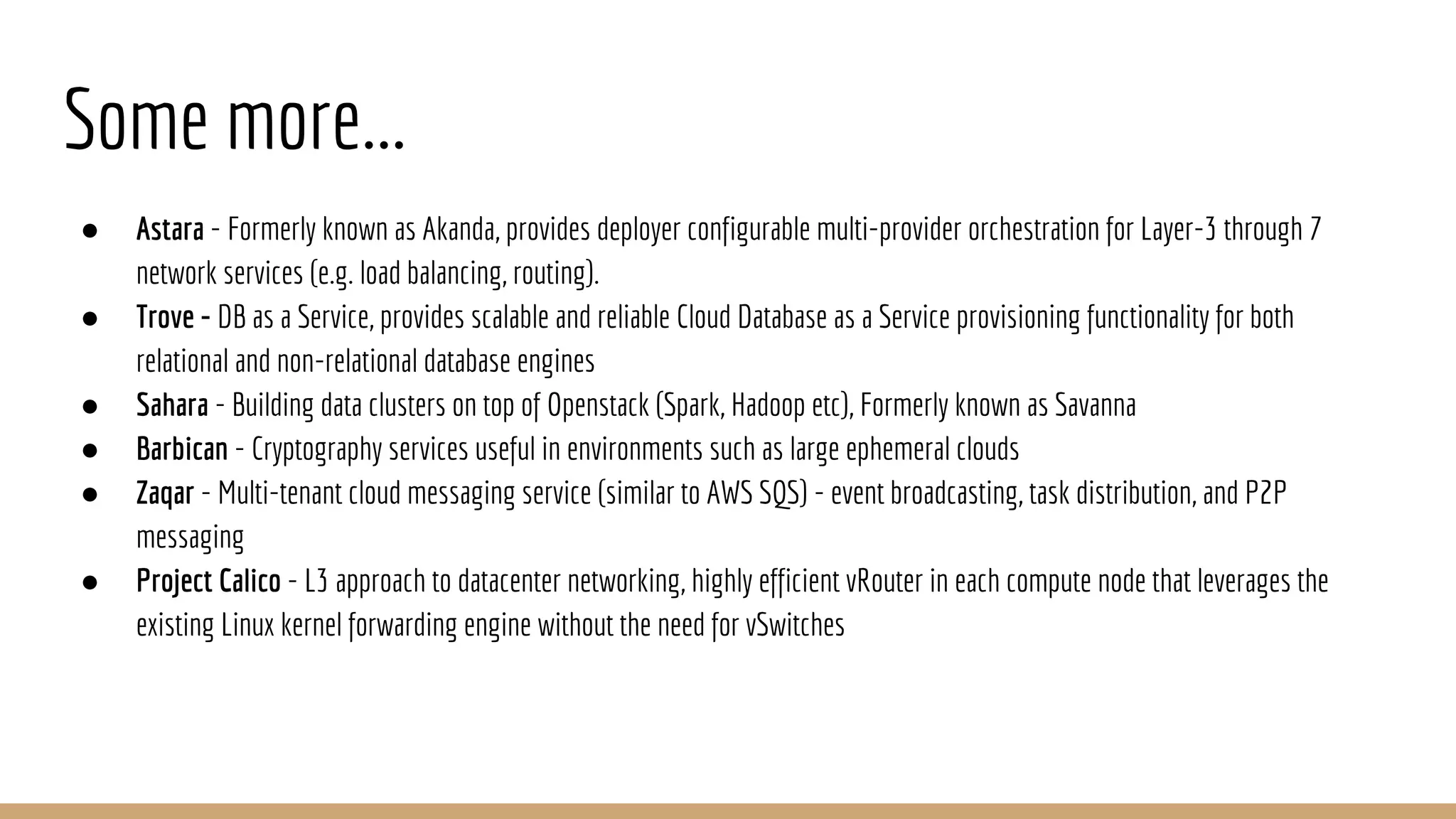
Some more...
● Astara - Formerly known as Akanda, provides deployer configurable multi-provider orchestration for Layer-3 through 7
network services (e.g. load balancing, routing).
● Trove - DB as a Service, provides scalable and reliable Cloud Database as a Service provisioning functionality for both
relational and non-relational database engines
● Sahara - Building data clusters on top of Openstack (Spark, Hadoop etc), Formerly known as Savanna
● Barbican - Cryptography services useful in environments such as large ephemeral clouds
● Zaqar - Multi-tenant cloud messaging service (similar to AWS SQS) - event broadcasting, task distribution, and P2P
messaging
● Project Calico - L3 approach to datacenter networking, highly efficient vRouter in each compute node that leverages the
existing Linux kernel forwarding engine without the need for vSwitches
Summary
There is no doubt that Openstack represents one of the massive industry alignment towards the Open source cloud, Some even
touting it to be the linux of cloud computing. But is it “THE” perfect solution ?
● Vanilla Openstack is a “Myth”
● The choice of Openstack as part of your cloud strategy purely depends on the kind of workload and the add-on features.
● Openstack can be a serious contender especially for fresh deployments and applications that are being architected for cloud.
But as the environment gets diverse(legacy integrations) Openstack can be tricky to integrate and maintain
● One might require a vendor based Cloud management platform especially when the cloud strategy involves public clouds(AWS,
Azure, GCE) and migration of application services across
● No doubt it is fully open source, but it comes with learning curve, release cycles, Vendor specific driver integrations etc.
● Interesting developments with respect to containers, docker, Kubernetes, Mesosphere etc will challenge Openstack
● Openstack will no doubt will grow mature over next couple of years, until then, the hunt for the CMP continues...
Topics of interest
Can I use openstack
● to build a true hyper converged cloud ?
● as an enterprise cloud management platform ?
● public cloud ? (as a CSP)
● Telco carrier grade cloud ?
● VNF, MANO and SDN integrations
● Federation of Clouds( Cloud of Clouds)
Questions ?
rajshenoy@gmail.com

Openstack - Enterprise cloud management platform

  • 1.
  • 2.
    About ● Nagaraj Shenoy ●MS - Illinois institute of Technology(IIT), Chicago ● Tech Generalist, FOSS lover https://in.linkedin.com/in/mnshenoy www.webinav.com Licensed under a Creative Commons Attribution-NonCommercial-ShareAlike 4.0 International License.
  • 3.
    Agenda ● An insightinto Openstack Ecosystem ● Why a cloud management platform ? ● Basic Ingredients of an enterprise cloud services platform ● Openstack based CMP Architecture ● Nova, Neutron, Glance ● HEAT ● Ceilometer
  • 4.
    About Openstack Why ? ●Fastest growing open source project ● Distributed cloud operating system ● Promotes Vendor neutrality ● Wide Ecosystem, backed by Industry juggernauts Why not ? ● Comprises of many projects, many of them still not ready for enterprise ● Learning curve !! New release every six months. Icehouse as we speak !! ● Still cant call it a CMP ● Containers !! Docker and Kubernetes gaining attention
  • 5.
  • 6.
  • 7.
    Why an enterprisecloud management platform? Openstack is not a solution, but a starting point: • People need more than just the IaaS(infrastructure as a service) • Focus is on the infrastructure than the actual application ecosystem • Openstack API are for admins, Developers want to build microservices or mobile interfaces or analytics capabilities • Efforts needed in connecting the dots, i.e integrating services • Policy control, workflow automation, Lifecycle management • App migration - Multi cloud and hybrid cloud • Constantly evolving ecosystem, major release every 6 months
  • 8.
    Need for vendorneutrality Vendor lock-in • VMware - vSphere customers locked into vCloud Air. • Microsoft - Systems Center to Azure. • AWS - ELB, Elastic beanstalk, Cloudfront etc. With that approach, one is tied to the specific technologies and the applications are not free to migrate across different clouds. Being community driven and fully open source, Openstack promises to be a vendor neutral open cloud solution. Multi-vendor ecosystem is managed with the help of drivers
  • 9.
  • 10.
    Advanced services …. User Cloudmanagement platform (CMP) Cloud Management Infra as a service NOVA Ironic Neutron (Network) Swift Cinder Manila (Storage) (Compute) Glance (Image Mgmt) HEAT (Orchestration) CEILOMETER (telemetry) TripleO (Deployment) Horizon (UI) REST CLI Sahara Trove Designate Barbican Zaqar Keystone OSLO LBaaS
  • 11.
    Compute - NOVA ●Core of the Openstack ● Interacts with the hypervisor, KVM/QEMU/libvirt ● interacts with Glance to retrieve images and deploy them(and store them back), Snapshotting ● nova-compute - On demand creation and termination of the VMs ● nova-scheduler - where to deploy the VM(host) ● nova-api - CLI, REST based API ● nova-network - Before neutron came along ● nova-volume - manages the storage
  • 12.
    Network - NEUTRON ●Formerly called quantum ● eventually replace nova-network ● Full network virtualization capabilities ● Features such as LBaaS, VPNaaS ● Pleathora of plugins ○ OVS,RYU,Nuage,Contrail etc...
  • 13.
    Glance ● Discover, registerand retrieval of VM images ● RESTful API ● VM images can be stored as ZFS,LVM, S3, Ceph, Cinder,Swift ● Cinder ○ Persistent block storage to VMs ( AWS - EBS) ○ Drivers - NetApp,IBM,SolidFire etc. ○ cinder-scheduler picks the optimal node to create the volume ● Swift - Object store (AWS - S3)
  • 14.
    HEAT • Orchestration serviceto automate deployments, networks and other services • Templates to describe the compute, storage, networking and other resources • Dissection of HEAT – HOT - Heat Orchestration Template, written in YAML – Stack - Collection of objects that form the template – Resources - Objects created by Heat – heat-api - RESTful API service – heat-engine - Performs the orchestration • HEAT is also compatible with AWS cloud formation
  • 15.
    Ceilometer • Meter Openstackinfra performance and utilization for billing, benchmarking, scalability, and statistics purposes. • Configuring the type of collected data to meet various operating requirements • REST API for Accessing and inserting the metering data • Custom usage data can be configured via additional plugins • Typical Workflow
  • 16.
    HEAT + Ceilometer HEAT HEATAPI DB HEAT Engine Deploy /Autoscale MQ HEAT CLI Cloudwatch VM VM Stack CEILOMETER API Service Alarm Eval Monitor Create Alarms Monitor instances Trigger Alarms Meter
  • 17.
    Some more... ● Astara- Formerly known as Akanda, provides deployer configurable multi-provider orchestration for Layer-3 through 7 network services (e.g. load balancing, routing). ● Trove - DB as a Service, provides scalable and reliable Cloud Database as a Service provisioning functionality for both relational and non-relational database engines ● Sahara - Building data clusters on top of Openstack (Spark, Hadoop etc), Formerly known as Savanna ● Barbican - Cryptography services useful in environments such as large ephemeral clouds ● Zaqar - Multi-tenant cloud messaging service (similar to AWS SQS) - event broadcasting, task distribution, and P2P messaging ● Project Calico - L3 approach to datacenter networking, highly efficient vRouter in each compute node that leverages the existing Linux kernel forwarding engine without the need for vSwitches
  • 18.
    Summary There is nodoubt that Openstack represents one of the massive industry alignment towards the Open source cloud, Some even touting it to be the linux of cloud computing. But is it “THE” perfect solution ? ● Vanilla Openstack is a “Myth” ● The choice of Openstack as part of your cloud strategy purely depends on the kind of workload and the add-on features. ● Openstack can be a serious contender especially for fresh deployments and applications that are being architected for cloud. But as the environment gets diverse(legacy integrations) Openstack can be tricky to integrate and maintain ● One might require a vendor based Cloud management platform especially when the cloud strategy involves public clouds(AWS, Azure, GCE) and migration of application services across ● No doubt it is fully open source, but it comes with learning curve, release cycles, Vendor specific driver integrations etc. ● Interesting developments with respect to containers, docker, Kubernetes, Mesosphere etc will challenge Openstack ● Openstack will no doubt will grow mature over next couple of years, until then, the hunt for the CMP continues...
  • 19.
    Topics of interest CanI use openstack ● to build a true hyper converged cloud ? ● as an enterprise cloud management platform ? ● public cloud ? (as a CSP) ● Telco carrier grade cloud ? ● VNF, MANO and SDN integrations ● Federation of Clouds( Cloud of Clouds)
  • 20.