Parul Institute of Engineering & Technology
Subject Code : 150703
Name Of Subject : DESIGN & ANALYSIS OF ALGORITHM
Name of Unit : ANALYSIS OF ALGORITHM
Topic : Introduction,Analysis,Efficeincy of algorithm
Name of Student: Agrawal Swapnil
CONTENTS
INTRODUCTION TO ALGORITHMS
ANALYSIS OF ALGORITHM
EFFIECIENCY OF ALGORITHM
BEST CASE
WORST CASE
AVERAGE CASE
EXAMPLES
Sub: DESIGN & ANALYSIS OF ALGORITHM
Topic: Introduction,Analysis,Effieciency Of Algorithm
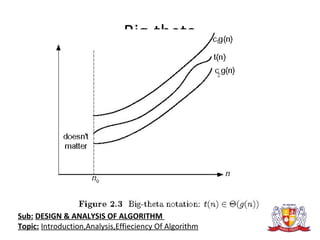
Introduction of algorithms
• An Algorithm is a Step by Step solution of a specific
mathematical or computer related problem
• There are different types of Algorithms
– Greedy
– Dynamic
– Divide & Conquer ,etc
• They can be expressed in different ways.
– Pseudocode
– By using simple English statements(Steps)
Sub: DESIGN & ANALYSIS OF ALGORITHM
Topic: Introduction,Analysis,Effieciency Of Algorithm
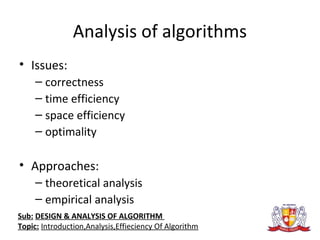
Analysis of algorithms
• Issues:
– correctness
– time efficiency
– space efficiency
– optimality
• Approaches:
– theoretical analysis
– empirical analysis
Sub: DESIGN & ANALYSIS OF ALGORITHM
Topic: Introduction,Analysis,Effieciency Of Algorithm
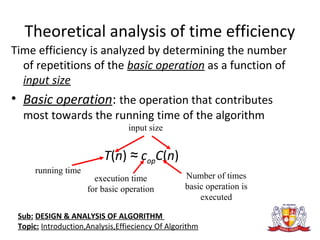
Theoretical analysis of time efficiency
Time efficiency is analyzed by determining the number
of repetitions of the basic operation as a function of
input size
• Basic operation: the operation that contributes
most towards the running time of the algorithm
T(n) ≈ copC(n)
running time
execution time
for basic operation
Number of times
basic operation is
executed
input size
Sub: DESIGN & ANALYSIS OF ALGORITHM
Topic: Introduction,Analysis,Effieciency Of Algorithm
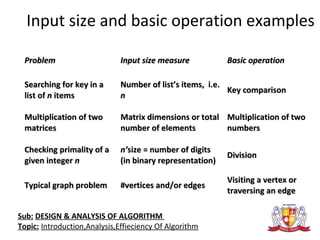
Input size and basic operation examples
ProblemProblem Input size measureInput size measure Basic operationBasic operation
Searching for key in aSearching for key in a
list oflist of nn itemsitems
Number of list’s items, i.e.Number of list’s items, i.e.
nn
Key comparisonKey comparison
Multiplication of twoMultiplication of two
matricesmatrices
Matrix dimensions or totalMatrix dimensions or total
number of elementsnumber of elements
Multiplication of twoMultiplication of two
numbersnumbers
Checking primality of aChecking primality of a
given integergiven integer nn
n’n’size = number of digitssize = number of digits
(in binary representation)(in binary representation)
DivisionDivision
Typical graph problemTypical graph problem #vertices and/or edges#vertices and/or edges
Visiting a vertex orVisiting a vertex or
traversing an edgetraversing an edge
Sub: DESIGN & ANALYSIS OF ALGORITHM
Topic: Introduction,Analysis,Effieciency Of Algorithm
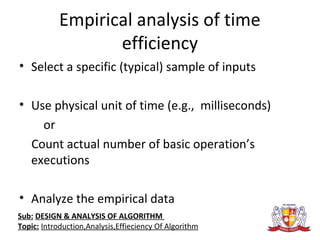
Empirical analysis of time
efficiency
• Select a specific (typical) sample of inputs
• Use physical unit of time (e.g., milliseconds)
or
Count actual number of basic operation’s
executions
• Analyze the empirical data
Sub: DESIGN & ANALYSIS OF ALGORITHM
Topic: Introduction,Analysis,Effieciency Of Algorithm
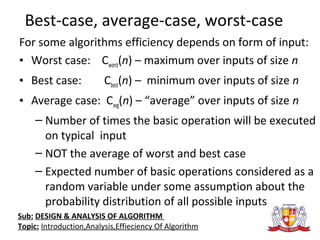
Best-case, average-case, worst-case
For some algorithms efficiency depends on form of input:
• Worst case: Cworst(n) – maximum over inputs of size n
• Best case: Cbest(n) – minimum over inputs of size n
• Average case: Cavg(n) – “average” over inputs of size n
– Number of times the basic operation will be executed
on typical input
– NOT the average of worst and best case
– Expected number of basic operations considered as a
random variable under some assumption about the
probability distribution of all possible inputs
Sub: DESIGN & ANALYSIS OF ALGORITHM
Topic: Introduction,Analysis,Effieciency Of Algorithm
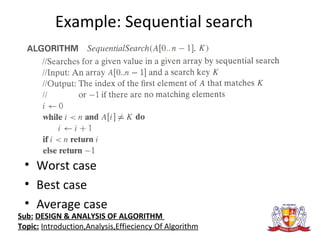
Example: Sequential search
• Worst case
• Best case
• Average case
Sub: DESIGN & ANALYSIS OF ALGORITHM
Topic: Introduction,Analysis,Effieciency Of Algorithm
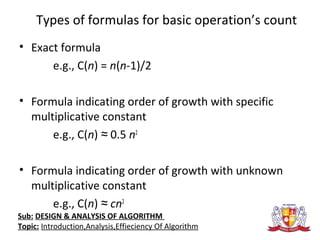
Types of formulas for basic operation’s count
• Exact formula
e.g., C(n) = n(n-1)/2
• Formula indicating order of growth with specific
multiplicative constant
e.g., C(n) ≈ 0.5 n2
• Formula indicating order of growth with unknown
multiplicative constant
e.g., C(n) ≈ cn2
Sub: DESIGN & ANALYSIS OF ALGORITHM
Topic: Introduction,Analysis,Effieciency Of Algorithm
Order of growth
• Most important: Order of growth within a constant
multiple as n→∞
• Example:
– How much faster will algorithm run on computer
that is twice as fast?
– How much longer does it take to solve problem of
double input size?
Sub: DESIGN & ANALYSIS OF ALGORITHM
Topic: Introduction,Analysis,Effieciency Of Algorithm
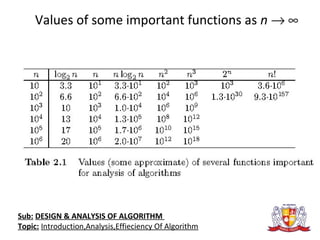
Values of some important functions as n → ∞
Sub: DESIGN & ANALYSIS OF ALGORITHM
Topic: Introduction,Analysis,Effieciency Of Algorithm
Asymptotic order of growth
A way of comparing functions that ignores constant factors
and small input sizes
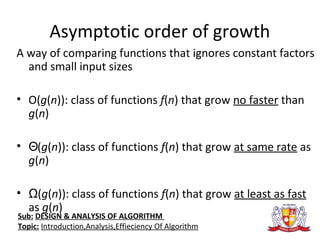
• O(g(n)): class of functions f(n) that grow no faster than
g(n)
• Θ(g(n)): class of functions f(n) that grow at same rate as
g(n)
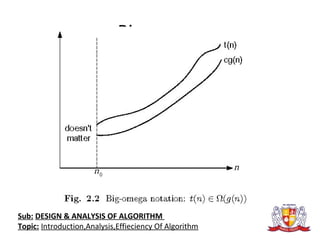
• Ω(g(n)): class of functions f(n) that grow at least as fast
as g(n)
Sub: DESIGN & ANALYSIS OF ALGORITHM
Topic: Introduction,Analysis,Effieciency Of Algorithm
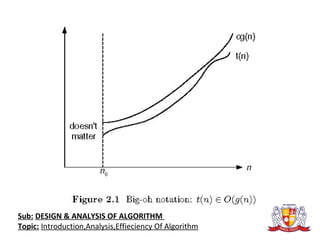
Big-oh
Sub: DESIGN & ANALYSIS OF ALGORITHM
Topic: Introduction,Analysis,Effieciency Of Algorithm
Big-omega
Sub: DESIGN & ANALYSIS OF ALGORITHM
Topic: Introduction,Analysis,Effieciency Of Algorithm
Big-theta
Sub: DESIGN & ANALYSIS OF ALGORITHM
Topic: Introduction,Analysis,Effieciency Of Algorithm
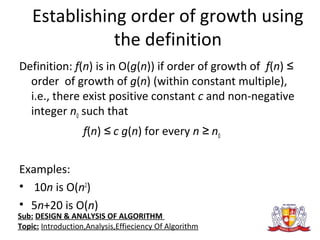
Establishing order of growth using
the definition
Definition: f(n) is in O(g(n)) if order of growth of f(n) ≤
order of growth of g(n) (within constant multiple),
i.e., there exist positive constant c and non-negative
integer n0 such that
f(n) ≤ c g(n) for every n ≥ n0
Examples:
• 10n is O(n2
)
• 5n+20 is O(n)
Sub: DESIGN & ANALYSIS OF ALGORITHM
Topic: Introduction,Analysis,Effieciency Of Algorithm
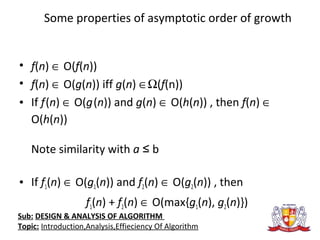
Some properties of asymptotic order of growth
• f(n) ∈ O(f(n))
• f(n) ∈ O(g(n)) iff g(n) ∈Ω(f(n))
• If f(n) ∈ O(g(n)) and g(n) ∈ O(h(n)) , then f(n) ∈
O(h(n))
Note similarity with a ≤ b
• If f1(n) ∈ O(g1(n)) and f2(n) ∈ O(g2(n)) , then
f1(n) + f2(n) ∈ O(max{g1(n), g2(n)})
Sub: DESIGN & ANALYSIS OF ALGORITHM
Topic: Introduction,Analysis,Effieciency Of Algorithm
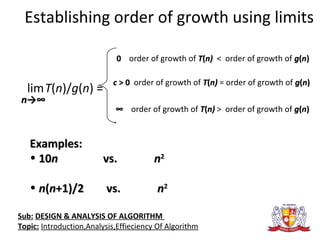
Establishing order of growth using limits
limT(n)/g(n) =
00 order of growth of TT((n)n) < order of growth of gg((nn))
cc > 0> 0 order of growth of TT((n)n) = order of growth of gg((nn))
∞∞ order of growth of TT((n)n) > order of growth of gg((nn))
Examples:Examples:
• 1010nn vs.vs. nn22
• nn((nn+1)/2 vs.+1)/2 vs. nn22
nn→∞→∞
Sub: DESIGN & ANALYSIS OF ALGORITHM
Topic: Introduction,Analysis,Effieciency Of Algorithm
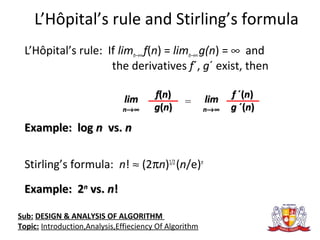
L’Hôpital’s rule and Stirling’s formula
L’Hôpital’s rule: If limn→∞f(n) = limn→∞g(n) = ∞ and
the derivatives f´, g´ exist, then
Stirling’s formula: n! ≈ (2πn)1/2
(n/e)n
ff((nn))
gg((nn))
limlim
nn→∞→∞
=
ff ´(´(nn))
gg ´(´(nn))
limlim
nn→∞→∞
Example: logExample: log nn vs.vs. nn
Example: 2Example: 2nn
vs.vs. nn!!
Sub: DESIGN & ANALYSIS OF ALGORITHM
Topic: Introduction,Analysis,Effieciency Of Algorithm
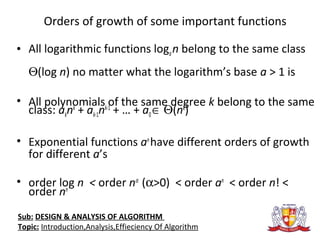
Orders of growth of some important functions
• All logarithmic functions logan belong to the same class
Θ(log n) no matter what the logarithm’s base a > 1 is
• All polynomials of the same degree k belong to the same
class: aknk
+ ak-1nk-1
+ … + a0∈ Θ(nk
)
• Exponential functions an
have different orders of growth
for different a’s
• order log n < order nα
(α>0) < order an
< order n! <
order nn
Sub: DESIGN & ANALYSIS OF ALGORITHM
Topic: Introduction,Analysis,Effieciency Of Algorithm
Basic asymptotic efficiency classes
11 constantconstant
loglog nn logarithmiclogarithmic
nn linearlinear
nn loglog nn n-n-loglog-n-n
nn22
quadraticquadratic
nn33
cubiccubic
22nn
exponentialexponential
nn!! factorialfactorial
Sub: DESIGN & ANALYSIS OF ALGORITHM
Topic: Introduction,Analysis,Effieciency Of Algorithm
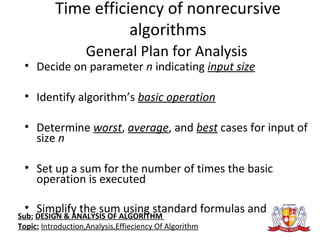
Time efficiency of nonrecursive
algorithms
General Plan for Analysis
• Decide on parameter n indicating input size
• Identify algorithm’s basic operation
• Determine worst, average, and best cases for input of
size n
• Set up a sum for the number of times the basic
operation is executed
• Simplify the sum using standard formulas and rules
Sub: DESIGN & ANALYSIS OF ALGORITHM
Topic: Introduction,Analysis,Effieciency Of Algorithm
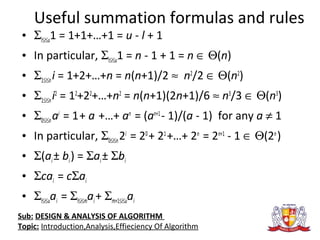
Useful summation formulas and rules
• Σl≤i≤u1 = 1+1+…+1 = u - l + 1
• In particular, Σl≤i≤u1 = n - 1 + 1 = n ∈ Θ(n)
• Σ1≤i≤ni = 1+2+…+n = n(n+1)/2 ≈ n2
/2 ∈ Θ(n2
)
• Σ1≤i≤ni2
= 12
+22
+…+n2
= n(n+1)(2n+1)/6 ≈ n3
/3 ∈ Θ(n3
)
• Σ0≤i≤nai
= 1+ a +…+ an
= (an+1
- 1)/(a - 1) for any a ≠ 1
• In particular, Σ0≤i≤n2i
= 20
+ 21
+…+ 2n
= 2n+1
- 1 ∈ Θ(2n
)
• Σ(ai± bi) = Σai± Σbi
• Σcai = cΣai
• Σl≤i≤uai = Σl≤i≤mai+ Σm+1≤i≤uai
Sub: DESIGN & ANALYSIS OF ALGORITHM
Topic: Introduction,Analysis,Effieciency Of Algorithm
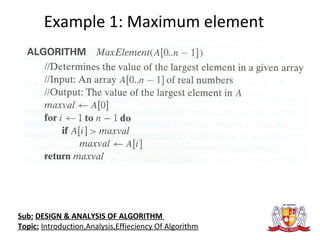
Example 1: Maximum element
Sub: DESIGN & ANALYSIS OF ALGORITHM
Topic: Introduction,Analysis,Effieciency Of Algorithm
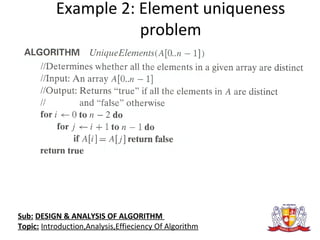
Example 2: Element uniqueness
problem
Sub: DESIGN & ANALYSIS OF ALGORITHM
Topic: Introduction,Analysis,Effieciency Of Algorithm
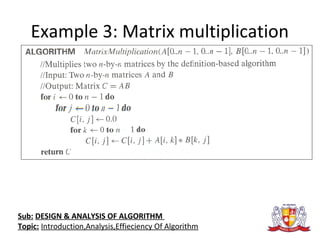
Example 3: Matrix multiplication
Sub: DESIGN & ANALYSIS OF ALGORITHM
Topic: Introduction,Analysis,Effieciency Of Algorithm
Example 4: Gaussian elimination
Algorithm GaussianElimination(A[0..n-1,0..n])
//Implements Gaussian elimination of an n-by-(n+1)
matrix A
for i ← 0 to n - 2 do
for j ← i + 1 to n - 1 do
for k ← i to n do
A[j,k] ← A[j,k] - A[i,k] ∗ A[j,i] / A[i,i]
Find the efficiency class and a constant factor
improvement.
Sub: DESIGN & ANALYSIS OF ALGORITHM
Topic: Introduction,Analysis,Effieciency Of Algorithm
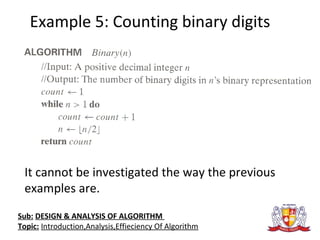
Example 5: Counting binary digits
It cannot be investigated the way the previous
examples are.
Sub: DESIGN & ANALYSIS OF ALGORITHM
Topic: Introduction,Analysis,Effieciency Of Algorithm
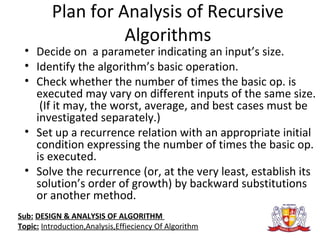
Plan for Analysis of Recursive
Algorithms
• Decide on a parameter indicating an input’s size.
• Identify the algorithm’s basic operation.
• Check whether the number of times the basic op. is
executed may vary on different inputs of the same size.
(If it may, the worst, average, and best cases must be
investigated separately.)
• Set up a recurrence relation with an appropriate initial
condition expressing the number of times the basic op.
is executed.
• Solve the recurrence (or, at the very least, establish its
solution’s order of growth) by backward substitutions
or another method.
Sub: DESIGN & ANALYSIS OF ALGORITHM
Topic: Introduction,Analysis,Effieciency Of Algorithm
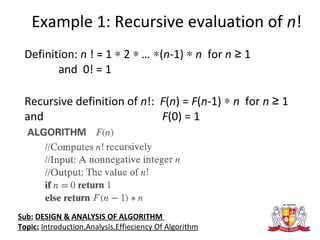
Example 1: Recursive evaluation of n!
Definition: n ! = 1 ∗ 2 ∗ … ∗(n-1) ∗ n for n ≥ 1
and 0! = 1
Recursive definition of n!: F(n) = F(n-1) ∗ n for n ≥ 1
and F(0) = 1
Sub: DESIGN & ANALYSIS OF ALGORITHM
Topic: Introduction,Analysis,Effieciency Of Algorithm
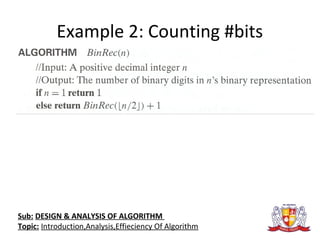
Example 2: Counting #bits
Sub: DESIGN & ANALYSIS OF ALGORITHM
Topic: Introduction,Analysis,Effieciency Of Algorithm
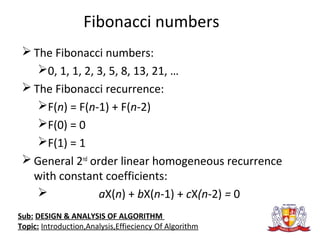
Fibonacci numbers
 The Fibonacci numbers:
0, 1, 1, 2, 3, 5, 8, 13, 21, …
 The Fibonacci recurrence:
F(n) = F(n-1) + F(n-2)
F(0) = 0
F(1) = 1
 General 2nd
order linear homogeneous recurrence
with constant coefficients:
 aX(n) + bX(n-1) + cX(n-2) = 0
Sub: DESIGN & ANALYSIS OF ALGORITHM
Topic: Introduction,Analysis,Effieciency Of Algorithm
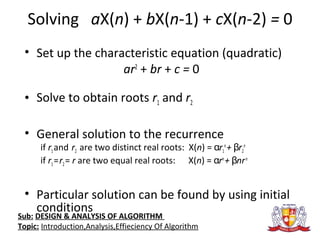
Solving aX(n) + bX(n-1) + cX(n-2) = 0
• Set up the characteristic equation (quadratic)
ar2
+ br + c = 0
• Solve to obtain roots r1 and r2
• General solution to the recurrence
if r1and r2 are two distinct real roots: X(n) = αr1
n
+ βr2
n
if r1=r2= r are two equal real roots: X(n) = αrn
+ βnrn
• Particular solution can be found by using initial
conditions
Sub: DESIGN & ANALYSIS OF ALGORITHM
Topic: Introduction,Analysis,Effieciency Of Algorithm
Application to the Fibonacci
numbers
F(n) = F(n-1) + F(n-2) or F(n) - F(n-1) - F(n-2) = 0
Characteristic equation:
Roots of the characteristic equation:
General solution to the recurrence:
Particular solution for F(0) =0, F(1)=1:
Sub: DESIGN & ANALYSIS OF ALGORITHM
Topic: Introduction,Analysis,Effieciency Of Algorithm
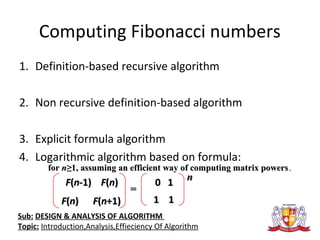
Computing Fibonacci numbers
1. Definition-based recursive algorithm
2. Non recursive definition-based algorithm
3. Explicit formula algorithm
4. Logarithmic algorithm based on formula:
FF((nn-1)-1) FF((nn))
FF((nn)) FF((nn+1)+1)
0 10 1
1 11 1
==
nn
forfor nn≥≥1,1, assuming an efficient way of computing matrix powersassuming an efficient way of computing matrix powers..
Sub: DESIGN & ANALYSIS OF ALGORITHM
Topic: Introduction,Analysis,Effieciency Of Algorithm
REFERENCES
Books:-
1. Introduction to design & analysis of algorithm
By Anany levitin, Pearson Publication
2. Design & Analysis of Algorithm
By A.A.Puntambekar , Technical Publication
3. Introduction to Algorithms
By Thomas Cormen , MIT Press
Web Resources:-
1.Google
2.Wikipedia

Design and Analysis of Algorithms

  • 1.
    Parul Institute ofEngineering & Technology Subject Code : 150703 Name Of Subject : DESIGN & ANALYSIS OF ALGORITHM Name of Unit : ANALYSIS OF ALGORITHM Topic : Introduction,Analysis,Efficeincy of algorithm Name of Student: Agrawal Swapnil
  • 2.
    CONTENTS INTRODUCTION TO ALGORITHMS ANALYSISOF ALGORITHM EFFIECIENCY OF ALGORITHM BEST CASE WORST CASE AVERAGE CASE EXAMPLES Sub: DESIGN & ANALYSIS OF ALGORITHM Topic: Introduction,Analysis,Effieciency Of Algorithm
  • 3.
    Introduction of algorithms •An Algorithm is a Step by Step solution of a specific mathematical or computer related problem • There are different types of Algorithms – Greedy – Dynamic – Divide & Conquer ,etc • They can be expressed in different ways. – Pseudocode – By using simple English statements(Steps) Sub: DESIGN & ANALYSIS OF ALGORITHM Topic: Introduction,Analysis,Effieciency Of Algorithm
  • 4.
    Analysis of algorithms •Issues: – correctness – time efficiency – space efficiency – optimality • Approaches: – theoretical analysis – empirical analysis Sub: DESIGN & ANALYSIS OF ALGORITHM Topic: Introduction,Analysis,Effieciency Of Algorithm
  • 5.
    Theoretical analysis oftime efficiency Time efficiency is analyzed by determining the number of repetitions of the basic operation as a function of input size • Basic operation: the operation that contributes most towards the running time of the algorithm T(n) ≈ copC(n) running time execution time for basic operation Number of times basic operation is executed input size Sub: DESIGN & ANALYSIS OF ALGORITHM Topic: Introduction,Analysis,Effieciency Of Algorithm
  • 6.
    Input size andbasic operation examples ProblemProblem Input size measureInput size measure Basic operationBasic operation Searching for key in aSearching for key in a list oflist of nn itemsitems Number of list’s items, i.e.Number of list’s items, i.e. nn Key comparisonKey comparison Multiplication of twoMultiplication of two matricesmatrices Matrix dimensions or totalMatrix dimensions or total number of elementsnumber of elements Multiplication of twoMultiplication of two numbersnumbers Checking primality of aChecking primality of a given integergiven integer nn n’n’size = number of digitssize = number of digits (in binary representation)(in binary representation) DivisionDivision Typical graph problemTypical graph problem #vertices and/or edges#vertices and/or edges Visiting a vertex orVisiting a vertex or traversing an edgetraversing an edge Sub: DESIGN & ANALYSIS OF ALGORITHM Topic: Introduction,Analysis,Effieciency Of Algorithm
  • 7.
    Empirical analysis oftime efficiency • Select a specific (typical) sample of inputs • Use physical unit of time (e.g., milliseconds) or Count actual number of basic operation’s executions • Analyze the empirical data Sub: DESIGN & ANALYSIS OF ALGORITHM Topic: Introduction,Analysis,Effieciency Of Algorithm
  • 8.
    Best-case, average-case, worst-case Forsome algorithms efficiency depends on form of input: • Worst case: Cworst(n) – maximum over inputs of size n • Best case: Cbest(n) – minimum over inputs of size n • Average case: Cavg(n) – “average” over inputs of size n – Number of times the basic operation will be executed on typical input – NOT the average of worst and best case – Expected number of basic operations considered as a random variable under some assumption about the probability distribution of all possible inputs Sub: DESIGN & ANALYSIS OF ALGORITHM Topic: Introduction,Analysis,Effieciency Of Algorithm
  • 9.
    Example: Sequential search •Worst case • Best case • Average case Sub: DESIGN & ANALYSIS OF ALGORITHM Topic: Introduction,Analysis,Effieciency Of Algorithm
  • 10.
    Types of formulasfor basic operation’s count • Exact formula e.g., C(n) = n(n-1)/2 • Formula indicating order of growth with specific multiplicative constant e.g., C(n) ≈ 0.5 n2 • Formula indicating order of growth with unknown multiplicative constant e.g., C(n) ≈ cn2 Sub: DESIGN & ANALYSIS OF ALGORITHM Topic: Introduction,Analysis,Effieciency Of Algorithm
  • 11.
    Order of growth •Most important: Order of growth within a constant multiple as n→∞ • Example: – How much faster will algorithm run on computer that is twice as fast? – How much longer does it take to solve problem of double input size? Sub: DESIGN & ANALYSIS OF ALGORITHM Topic: Introduction,Analysis,Effieciency Of Algorithm
  • 12.
    Values of someimportant functions as n → ∞ Sub: DESIGN & ANALYSIS OF ALGORITHM Topic: Introduction,Analysis,Effieciency Of Algorithm
  • 13.
    Asymptotic order ofgrowth A way of comparing functions that ignores constant factors and small input sizes • O(g(n)): class of functions f(n) that grow no faster than g(n) • Θ(g(n)): class of functions f(n) that grow at same rate as g(n) • Ω(g(n)): class of functions f(n) that grow at least as fast as g(n) Sub: DESIGN & ANALYSIS OF ALGORITHM Topic: Introduction,Analysis,Effieciency Of Algorithm
  • 14.
    Big-oh Sub: DESIGN &ANALYSIS OF ALGORITHM Topic: Introduction,Analysis,Effieciency Of Algorithm
  • 15.
    Big-omega Sub: DESIGN &ANALYSIS OF ALGORITHM Topic: Introduction,Analysis,Effieciency Of Algorithm
  • 16.
    Big-theta Sub: DESIGN &ANALYSIS OF ALGORITHM Topic: Introduction,Analysis,Effieciency Of Algorithm
  • 17.
    Establishing order ofgrowth using the definition Definition: f(n) is in O(g(n)) if order of growth of f(n) ≤ order of growth of g(n) (within constant multiple), i.e., there exist positive constant c and non-negative integer n0 such that f(n) ≤ c g(n) for every n ≥ n0 Examples: • 10n is O(n2 ) • 5n+20 is O(n) Sub: DESIGN & ANALYSIS OF ALGORITHM Topic: Introduction,Analysis,Effieciency Of Algorithm
  • 18.
    Some properties ofasymptotic order of growth • f(n) ∈ O(f(n)) • f(n) ∈ O(g(n)) iff g(n) ∈Ω(f(n)) • If f(n) ∈ O(g(n)) and g(n) ∈ O(h(n)) , then f(n) ∈ O(h(n)) Note similarity with a ≤ b • If f1(n) ∈ O(g1(n)) and f2(n) ∈ O(g2(n)) , then f1(n) + f2(n) ∈ O(max{g1(n), g2(n)}) Sub: DESIGN & ANALYSIS OF ALGORITHM Topic: Introduction,Analysis,Effieciency Of Algorithm
  • 19.
    Establishing order ofgrowth using limits limT(n)/g(n) = 00 order of growth of TT((n)n) < order of growth of gg((nn)) cc > 0> 0 order of growth of TT((n)n) = order of growth of gg((nn)) ∞∞ order of growth of TT((n)n) > order of growth of gg((nn)) Examples:Examples: • 1010nn vs.vs. nn22 • nn((nn+1)/2 vs.+1)/2 vs. nn22 nn→∞→∞ Sub: DESIGN & ANALYSIS OF ALGORITHM Topic: Introduction,Analysis,Effieciency Of Algorithm
  • 20.
    L’Hôpital’s rule andStirling’s formula L’Hôpital’s rule: If limn→∞f(n) = limn→∞g(n) = ∞ and the derivatives f´, g´ exist, then Stirling’s formula: n! ≈ (2πn)1/2 (n/e)n ff((nn)) gg((nn)) limlim nn→∞→∞ = ff ´(´(nn)) gg ´(´(nn)) limlim nn→∞→∞ Example: logExample: log nn vs.vs. nn Example: 2Example: 2nn vs.vs. nn!! Sub: DESIGN & ANALYSIS OF ALGORITHM Topic: Introduction,Analysis,Effieciency Of Algorithm
  • 21.
    Orders of growthof some important functions • All logarithmic functions logan belong to the same class Θ(log n) no matter what the logarithm’s base a > 1 is • All polynomials of the same degree k belong to the same class: aknk + ak-1nk-1 + … + a0∈ Θ(nk ) • Exponential functions an have different orders of growth for different a’s • order log n < order nα (α>0) < order an < order n! < order nn Sub: DESIGN & ANALYSIS OF ALGORITHM Topic: Introduction,Analysis,Effieciency Of Algorithm
  • 22.
    Basic asymptotic efficiencyclasses 11 constantconstant loglog nn logarithmiclogarithmic nn linearlinear nn loglog nn n-n-loglog-n-n nn22 quadraticquadratic nn33 cubiccubic 22nn exponentialexponential nn!! factorialfactorial Sub: DESIGN & ANALYSIS OF ALGORITHM Topic: Introduction,Analysis,Effieciency Of Algorithm
  • 23.
    Time efficiency ofnonrecursive algorithms General Plan for Analysis • Decide on parameter n indicating input size • Identify algorithm’s basic operation • Determine worst, average, and best cases for input of size n • Set up a sum for the number of times the basic operation is executed • Simplify the sum using standard formulas and rules Sub: DESIGN & ANALYSIS OF ALGORITHM Topic: Introduction,Analysis,Effieciency Of Algorithm
  • 24.
    Useful summation formulasand rules • Σl≤i≤u1 = 1+1+…+1 = u - l + 1 • In particular, Σl≤i≤u1 = n - 1 + 1 = n ∈ Θ(n) • Σ1≤i≤ni = 1+2+…+n = n(n+1)/2 ≈ n2 /2 ∈ Θ(n2 ) • Σ1≤i≤ni2 = 12 +22 +…+n2 = n(n+1)(2n+1)/6 ≈ n3 /3 ∈ Θ(n3 ) • Σ0≤i≤nai = 1+ a +…+ an = (an+1 - 1)/(a - 1) for any a ≠ 1 • In particular, Σ0≤i≤n2i = 20 + 21 +…+ 2n = 2n+1 - 1 ∈ Θ(2n ) • Σ(ai± bi) = Σai± Σbi • Σcai = cΣai • Σl≤i≤uai = Σl≤i≤mai+ Σm+1≤i≤uai Sub: DESIGN & ANALYSIS OF ALGORITHM Topic: Introduction,Analysis,Effieciency Of Algorithm
  • 25.
    Example 1: Maximumelement Sub: DESIGN & ANALYSIS OF ALGORITHM Topic: Introduction,Analysis,Effieciency Of Algorithm
  • 26.
    Example 2: Elementuniqueness problem Sub: DESIGN & ANALYSIS OF ALGORITHM Topic: Introduction,Analysis,Effieciency Of Algorithm
  • 27.
    Example 3: Matrixmultiplication Sub: DESIGN & ANALYSIS OF ALGORITHM Topic: Introduction,Analysis,Effieciency Of Algorithm
  • 28.
    Example 4: Gaussianelimination Algorithm GaussianElimination(A[0..n-1,0..n]) //Implements Gaussian elimination of an n-by-(n+1) matrix A for i ← 0 to n - 2 do for j ← i + 1 to n - 1 do for k ← i to n do A[j,k] ← A[j,k] - A[i,k] ∗ A[j,i] / A[i,i] Find the efficiency class and a constant factor improvement. Sub: DESIGN & ANALYSIS OF ALGORITHM Topic: Introduction,Analysis,Effieciency Of Algorithm
  • 29.
    Example 5: Countingbinary digits It cannot be investigated the way the previous examples are. Sub: DESIGN & ANALYSIS OF ALGORITHM Topic: Introduction,Analysis,Effieciency Of Algorithm
  • 30.
    Plan for Analysisof Recursive Algorithms • Decide on a parameter indicating an input’s size. • Identify the algorithm’s basic operation. • Check whether the number of times the basic op. is executed may vary on different inputs of the same size. (If it may, the worst, average, and best cases must be investigated separately.) • Set up a recurrence relation with an appropriate initial condition expressing the number of times the basic op. is executed. • Solve the recurrence (or, at the very least, establish its solution’s order of growth) by backward substitutions or another method. Sub: DESIGN & ANALYSIS OF ALGORITHM Topic: Introduction,Analysis,Effieciency Of Algorithm
  • 31.
    Example 1: Recursiveevaluation of n! Definition: n ! = 1 ∗ 2 ∗ … ∗(n-1) ∗ n for n ≥ 1 and 0! = 1 Recursive definition of n!: F(n) = F(n-1) ∗ n for n ≥ 1 and F(0) = 1 Sub: DESIGN & ANALYSIS OF ALGORITHM Topic: Introduction,Analysis,Effieciency Of Algorithm
  • 32.
    Example 2: Counting#bits Sub: DESIGN & ANALYSIS OF ALGORITHM Topic: Introduction,Analysis,Effieciency Of Algorithm
  • 33.
    Fibonacci numbers  TheFibonacci numbers: 0, 1, 1, 2, 3, 5, 8, 13, 21, …  The Fibonacci recurrence: F(n) = F(n-1) + F(n-2) F(0) = 0 F(1) = 1  General 2nd order linear homogeneous recurrence with constant coefficients:  aX(n) + bX(n-1) + cX(n-2) = 0 Sub: DESIGN & ANALYSIS OF ALGORITHM Topic: Introduction,Analysis,Effieciency Of Algorithm
  • 34.
    Solving aX(n) +bX(n-1) + cX(n-2) = 0 • Set up the characteristic equation (quadratic) ar2 + br + c = 0 • Solve to obtain roots r1 and r2 • General solution to the recurrence if r1and r2 are two distinct real roots: X(n) = αr1 n + βr2 n if r1=r2= r are two equal real roots: X(n) = αrn + βnrn • Particular solution can be found by using initial conditions Sub: DESIGN & ANALYSIS OF ALGORITHM Topic: Introduction,Analysis,Effieciency Of Algorithm
  • 35.
    Application to theFibonacci numbers F(n) = F(n-1) + F(n-2) or F(n) - F(n-1) - F(n-2) = 0 Characteristic equation: Roots of the characteristic equation: General solution to the recurrence: Particular solution for F(0) =0, F(1)=1: Sub: DESIGN & ANALYSIS OF ALGORITHM Topic: Introduction,Analysis,Effieciency Of Algorithm
  • 36.
    Computing Fibonacci numbers 1.Definition-based recursive algorithm 2. Non recursive definition-based algorithm 3. Explicit formula algorithm 4. Logarithmic algorithm based on formula: FF((nn-1)-1) FF((nn)) FF((nn)) FF((nn+1)+1) 0 10 1 1 11 1 == nn forfor nn≥≥1,1, assuming an efficient way of computing matrix powersassuming an efficient way of computing matrix powers.. Sub: DESIGN & ANALYSIS OF ALGORITHM Topic: Introduction,Analysis,Effieciency Of Algorithm
  • 37.
    REFERENCES Books:- 1. Introduction todesign & analysis of algorithm By Anany levitin, Pearson Publication 2. Design & Analysis of Algorithm By A.A.Puntambekar , Technical Publication 3. Introduction to Algorithms By Thomas Cormen , MIT Press Web Resources:- 1.Google 2.Wikipedia

Editor's Notes

  • #12 Example: cn2 how much faster on twice as fast computer? (2) how much longer for 2n? (4)