
Recursive and non-recursive
models
2
Recursivity
• All models considered so far are ‘recursive’
• A recursive model is one where all causal
effects are uni-directional and disturbances
are uncorrelated
• A non-recursive model contains one or more
‘feedback loops’ or ‘reciprocal’ effects
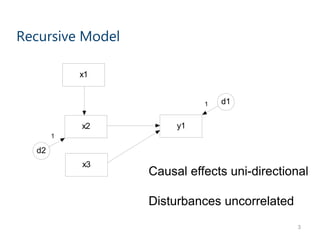
Recursive Model
3
x2 y1
x3
x1
d11
d2
1
Causal effects uni-directional
Disturbances uncorrelated
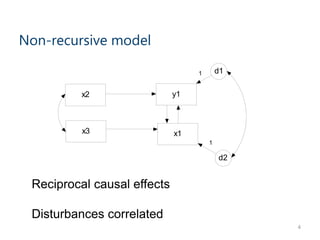
Non-recursive model
4
x2 y1
x3 x1
d11
d2
1
Reciprocal causal effects
Disturbances correlated
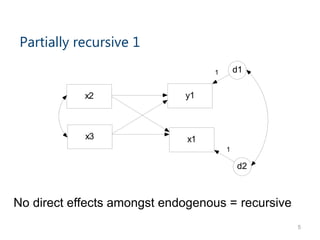
Partially recursive 1
5
No direct effects amongst endogenous = recursive
x2 y1
x3 x1
d11
d2
1
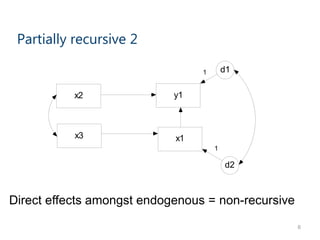
Partially recursive 2
6
x2 y1
x3 x1
d11
d2
1
Direct effects amongst endogenous = non-recursive
Recursivity
• Recursive models always identified, simple to
estimate
• Non-recursive models more flexible
• But can pose problems for identification
• Require additional variables for identification
7
Non-recursive models
• Just because a model is identified does not
mean the parameter estimates are correct
• Consistent estimation of reciprocal paths
requires some strict (and often implausible)
assumptions to be met
• E.g. the exogenous variable used to identify of
synchronous parameters must meet be an
‘instrumental variable’
8
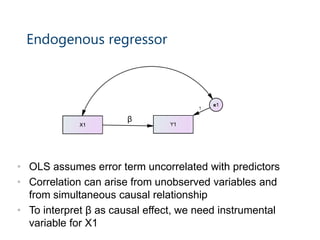
Endogenous regressor
• OLS assumes error term uncorrelated with predictors
• Correlation can arise from unobserved variables and
from simultaneous causal relationship
• To interpret β as causal effect, we need instrumental
variable for X1
β
Instrumental Variables (IV)
• An IV is a variable which introduces exogenous
variability into an endogenous regressor
• The IV, Z, must directly cause the endogenous
regressor but not the outcome
– Cov(Z,u)=0, Cov(xK,Z)≠0
• Random assignment to treatment & control
conditions in RCT is a good instrumental variable
10
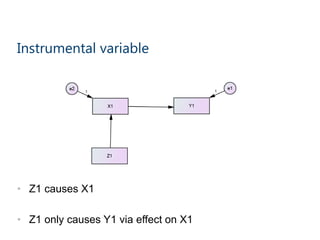
Instrumental variable
• Z1 causes X1
• Z1 only causes Y1 via effect on X1
Instrumental Variables - examples
• Vietnam lottery draft for effect of Vietnam war on later
outcomes (Angrist and Krueger 1991)
• Proximity of nearest college for education on earnings
(Card 1995)
• Variation in amount of compulsory schooling for effects of
education on earnings (Hammon & Walker 1995)
12
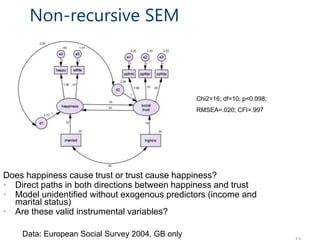
Non-recursive SEM
Does happiness cause trust or trust cause happiness?
• Direct paths in both directions between happiness and trust
• Model unidentified without exogenous predictors (income and
marital status)
• Are these valid instrumental variables?
Chi2=16; df=10; p<0.098;
RMSEA=.020; CFI=.997
Data: European Social Survey 2004, GB only
Non-recursive SEM
Does happiness cause trust or trust cause happiness?
• Direct paths in both directions between happiness and trust
• Model unidentified without exogenous predictors (income and
marital status)
• Are these valid instrumental variables?
Chi2=16; df=10; p<0.098;
RMSEA=.020; CFI=.997
Data: European Social Survey 2004, GB only

Recursive and non-recursive models

  • 1.
  • 2.
    2 Recursivity • All modelsconsidered so far are ‘recursive’ • A recursive model is one where all causal effects are uni-directional and disturbances are uncorrelated • A non-recursive model contains one or more ‘feedback loops’ or ‘reciprocal’ effects
  • 3.
    Recursive Model 3 x2 y1 x3 x1 d11 d2 1 Causaleffects uni-directional Disturbances uncorrelated
  • 4.
    Non-recursive model 4 x2 y1 x3x1 d11 d2 1 Reciprocal causal effects Disturbances correlated
  • 5.
    Partially recursive 1 5 Nodirect effects amongst endogenous = recursive x2 y1 x3 x1 d11 d2 1
  • 6.
    Partially recursive 2 6 x2y1 x3 x1 d11 d2 1 Direct effects amongst endogenous = non-recursive
  • 7.
    Recursivity • Recursive modelsalways identified, simple to estimate • Non-recursive models more flexible • But can pose problems for identification • Require additional variables for identification 7
  • 8.
    Non-recursive models • Justbecause a model is identified does not mean the parameter estimates are correct • Consistent estimation of reciprocal paths requires some strict (and often implausible) assumptions to be met • E.g. the exogenous variable used to identify of synchronous parameters must meet be an ‘instrumental variable’ 8
  • 9.
    Endogenous regressor • OLSassumes error term uncorrelated with predictors • Correlation can arise from unobserved variables and from simultaneous causal relationship • To interpret β as causal effect, we need instrumental variable for X1 β
  • 10.
    Instrumental Variables (IV) •An IV is a variable which introduces exogenous variability into an endogenous regressor • The IV, Z, must directly cause the endogenous regressor but not the outcome – Cov(Z,u)=0, Cov(xK,Z)≠0 • Random assignment to treatment & control conditions in RCT is a good instrumental variable 10
  • 11.
    Instrumental variable • Z1causes X1 • Z1 only causes Y1 via effect on X1
  • 12.
    Instrumental Variables -examples • Vietnam lottery draft for effect of Vietnam war on later outcomes (Angrist and Krueger 1991) • Proximity of nearest college for education on earnings (Card 1995) • Variation in amount of compulsory schooling for effects of education on earnings (Hammon & Walker 1995) 12
  • 13.
    Non-recursive SEM Does happinesscause trust or trust cause happiness? • Direct paths in both directions between happiness and trust • Model unidentified without exogenous predictors (income and marital status) • Are these valid instrumental variables? Chi2=16; df=10; p<0.098; RMSEA=.020; CFI=.997 Data: European Social Survey 2004, GB only
  • 14.
    Non-recursive SEM Does happinesscause trust or trust cause happiness? • Direct paths in both directions between happiness and trust • Model unidentified without exogenous predictors (income and marital status) • Are these valid instrumental variables? Chi2=16; df=10; p<0.098; RMSEA=.020; CFI=.997 Data: European Social Survey 2004, GB only