An introduction to
Spatial Interaction Modelling
Dr Andy Newing
School of Geography, University of Leeds
• Demand
• Accessibility
• Attractiveness
• Competition (intervening opportunities)
Spatial Interaction
• Important concept in Geography
• Flows:
– Of people (migration, commuting etc.)
– Of money (expenditure, goods etc.)
• Interaction between origin and destination
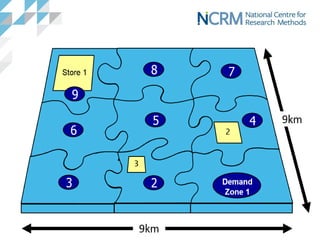
Origins and destinations
• Origins are generally zonal (e.g. countries, regions, local authorities,
neighbourhoods).
– We’ll typically have multiple origins within a SIM:
i1 i2 i3 etc.
• Destinations could be zonal (e.g. countries, regions, local
authorities, neighbourhoods) or points (e.g. the location of specific
services or facilities such as retail stores, schools, hospitals).
– We’ll typically have multiple destinations within a SIM:
j1 j2 j3 etc.
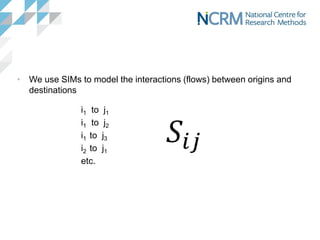
• We use SIMs to model the interactions (flows) between origins and
destinations
i1 to j1
i1 to j2
i1 to j3
i2 to j1
etc.
j1 j2 j3
i1 i1 j1 i1 j2
I2
I3
I4
I5
I6
I7
I8
i9
The flow between i1 and j1 is proportional to
• The demand available in origin zone i1
• The attractiveness of destination j1
• The accessibility of destination j1 to [consumers] in origin zone i1
• Intervening opportunities – the relative accessibility and
attractiveness of destination j1 to [consumers] in origin zone i1
versus all other destinations (j2, j3, etc.) [Competition]
Flow between origin i and
destination j
Competition
Demand
Attractiveness
Accessibility
• SIMs are statistical models that we can use to represent
origin-destination flows
• Capture the mathematical relationship which accounts for
the observed interactions (flows)
• Use that relationship to:
– estimate missing data
– model and forecast flows under various scenarios (e.g. for
planning purposes)
In more complex terms …
Early SIMs (Gravity Models)
• Captured flows or interactions based on Newtonian
analogies
• Lacked robust theoretical justification in a human context
• Reilly’s (1929) ‘law of retail gravitation’ – applied the
gravity concept to trade area analysis and competition
between cities. Probability of a consumer shopping at a
particular ‘centre’ – bigger centres will attract consumers
from a farther distance and have a larger trade area.
https://royalsociety.org/people/alan-wilson-12528/
Entropy Maximising Models
• Early 1970s, Sir Alan Wilson demonstrated a more robust
way to derive and justify gravity models using entropy
maximisation (statistical mechanics).
• First applied to transport planning models.
• Provided a better theoretical justification.
• Introduced term ‘Spatial Interaction Model’
• Realised potential role as a location model.
• Wide ranging applications in geography, planning,
transportation, social science and the commercial sector
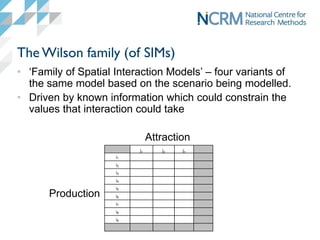
The Wilson family (of SIMs)
• ‘Family of Spatial Interaction Models’ – four variants of
the same model based on the scenario being modelled.
• Driven by known information which could constrain the
values that interaction could take
Attraction
Production
j1 j2 j3
i1
i2
i3
i4
i5
i6
i7
i8
i9
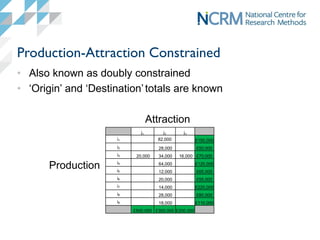
Production-Attraction Constrained
• Also known as doubly constrained
• ‘Origin’ and ‘Destination’totals are known
Attraction
Production
j1 j2 j3
i1 82,000 £150,000
i2 28,000 £50,000
i3 20,000 34,000 16,000 £70,000
i4 64,000 £120,000
i5 12,000 £65,000
i6 20,000 £55,000
i7 14,000 £220,000
i8 28,000 £80,000
i9 18,000 £110,000
£500,000 £300,000 £200,000
Unconstrained
• Neither ‘Origin’ and ‘Destination’ totals are known
Attraction
Production
j1 j2 j3
i1
i2
i3
i4
i5
i6
i7
i8
i9
Attraction Constrained
• Destination totals are known
Attraction
Production
j1 j2 j3
i1 82,000
i2 28,000
i3 34,000
i4 64,000
i5 12,000
i6 20,000
i7 14,000
i8 28,000
i9 18,000
£500,000 £300,000 £200,000
Production Constrained
• Origin totals are known
Attraction
Production
j1 j2 j3
i1 £150,000
i2 £50,000
i3 20,000 34,000 16,000 £70,000
i4 £120,000
i5 £65,000
i6 £55,000
i7 £220,000
i8 £80,000
i9 £110,000
SIMs
• Can appear complicated at first!
• Straightforward once the basics make sense.
• For a easy to digest overview, try:
• Birkin M. and Clarke G.P. 1991. Spatial
interaction in geography. Geography Review,
4(5), pp.16-21.
• The SIM is one of Geography/Social Science’s
most successful applications in the commercial
world - and not just in retail.
Further Reading
• Birkin, M., Clarke, G. P. and Clarke, M. 2010. Refining and
operationalising entropy-maximising models for business
applications Geographical Analysis, 42(4), pp.422-445.
• Newing, A., Clarke, G. P. and Clarke, M. 2014. Developing and
applying a disaggregated retail location model with extended retail
demand estimations. Geographical Analysis, 47(3), pp.219-239
• Roy, J. R. and Thill, J.-C. 2004. Spatial interaction modelling. Papers
in Regional Science, 83(1), pp.339-361.
• Wilson, A. G. 1971. A family of spatial interaction models, and
associated developments. Environment and Planning 3, pp.1-32.
• Wilson, A. G. 2010. Entropy in urban and regional modelling:
retrospect and prospect. Geographical Analysis, 42(4), pp.364-394.
An introduction to
Spatial Interaction Modelling
Dr Andy Newing
School of Geography, University of Leeds

Introduction to spatial interaction modelling

  • 1.
    An introduction to SpatialInteraction Modelling Dr Andy Newing School of Geography, University of Leeds
  • 3.
    • Demand • Accessibility •Attractiveness • Competition (intervening opportunities)
  • 4.
    Spatial Interaction • Importantconcept in Geography • Flows: – Of people (migration, commuting etc.) – Of money (expenditure, goods etc.) • Interaction between origin and destination
  • 5.
    Origins and destinations •Origins are generally zonal (e.g. countries, regions, local authorities, neighbourhoods). – We’ll typically have multiple origins within a SIM: i1 i2 i3 etc. • Destinations could be zonal (e.g. countries, regions, local authorities, neighbourhoods) or points (e.g. the location of specific services or facilities such as retail stores, schools, hospitals). – We’ll typically have multiple destinations within a SIM: j1 j2 j3 etc.
  • 6.
    • We useSIMs to model the interactions (flows) between origins and destinations i1 to j1 i1 to j2 i1 to j3 i2 to j1 etc.
  • 7.
    j1 j2 j3 i1i1 j1 i1 j2 I2 I3 I4 I5 I6 I7 I8 i9
  • 8.
    The flow betweeni1 and j1 is proportional to • The demand available in origin zone i1 • The attractiveness of destination j1 • The accessibility of destination j1 to [consumers] in origin zone i1 • Intervening opportunities – the relative accessibility and attractiveness of destination j1 to [consumers] in origin zone i1 versus all other destinations (j2, j3, etc.) [Competition]
  • 9.
    Flow between origini and destination j Competition Demand Attractiveness Accessibility
  • 11.
    • SIMs arestatistical models that we can use to represent origin-destination flows • Capture the mathematical relationship which accounts for the observed interactions (flows) • Use that relationship to: – estimate missing data – model and forecast flows under various scenarios (e.g. for planning purposes) In more complex terms …
  • 12.
    Early SIMs (GravityModels) • Captured flows or interactions based on Newtonian analogies • Lacked robust theoretical justification in a human context • Reilly’s (1929) ‘law of retail gravitation’ – applied the gravity concept to trade area analysis and competition between cities. Probability of a consumer shopping at a particular ‘centre’ – bigger centres will attract consumers from a farther distance and have a larger trade area.
  • 13.
  • 14.
    Entropy Maximising Models •Early 1970s, Sir Alan Wilson demonstrated a more robust way to derive and justify gravity models using entropy maximisation (statistical mechanics). • First applied to transport planning models. • Provided a better theoretical justification. • Introduced term ‘Spatial Interaction Model’ • Realised potential role as a location model. • Wide ranging applications in geography, planning, transportation, social science and the commercial sector
  • 15.
    The Wilson family(of SIMs) • ‘Family of Spatial Interaction Models’ – four variants of the same model based on the scenario being modelled. • Driven by known information which could constrain the values that interaction could take Attraction Production j1 j2 j3 i1 i2 i3 i4 i5 i6 i7 i8 i9
  • 16.
    Production-Attraction Constrained • Alsoknown as doubly constrained • ‘Origin’ and ‘Destination’totals are known Attraction Production j1 j2 j3 i1 82,000 £150,000 i2 28,000 £50,000 i3 20,000 34,000 16,000 £70,000 i4 64,000 £120,000 i5 12,000 £65,000 i6 20,000 £55,000 i7 14,000 £220,000 i8 28,000 £80,000 i9 18,000 £110,000 £500,000 £300,000 £200,000
  • 17.
    Unconstrained • Neither ‘Origin’and ‘Destination’ totals are known Attraction Production j1 j2 j3 i1 i2 i3 i4 i5 i6 i7 i8 i9
  • 18.
    Attraction Constrained • Destinationtotals are known Attraction Production j1 j2 j3 i1 82,000 i2 28,000 i3 34,000 i4 64,000 i5 12,000 i6 20,000 i7 14,000 i8 28,000 i9 18,000 £500,000 £300,000 £200,000
  • 19.
    Production Constrained • Origintotals are known Attraction Production j1 j2 j3 i1 £150,000 i2 £50,000 i3 20,000 34,000 16,000 £70,000 i4 £120,000 i5 £65,000 i6 £55,000 i7 £220,000 i8 £80,000 i9 £110,000
  • 20.
    SIMs • Can appearcomplicated at first! • Straightforward once the basics make sense. • For a easy to digest overview, try: • Birkin M. and Clarke G.P. 1991. Spatial interaction in geography. Geography Review, 4(5), pp.16-21. • The SIM is one of Geography/Social Science’s most successful applications in the commercial world - and not just in retail.
  • 21.
    Further Reading • Birkin,M., Clarke, G. P. and Clarke, M. 2010. Refining and operationalising entropy-maximising models for business applications Geographical Analysis, 42(4), pp.422-445. • Newing, A., Clarke, G. P. and Clarke, M. 2014. Developing and applying a disaggregated retail location model with extended retail demand estimations. Geographical Analysis, 47(3), pp.219-239 • Roy, J. R. and Thill, J.-C. 2004. Spatial interaction modelling. Papers in Regional Science, 83(1), pp.339-361. • Wilson, A. G. 1971. A family of spatial interaction models, and associated developments. Environment and Planning 3, pp.1-32. • Wilson, A. G. 2010. Entropy in urban and regional modelling: retrospect and prospect. Geographical Analysis, 42(4), pp.364-394.
  • 22.
    An introduction to SpatialInteraction Modelling Dr Andy Newing School of Geography, University of Leeds