Integrating biological and social data for (biosocial) research
Michaela Benzeval
Director, Understanding Society
ISER, University of Essex
Outline
Part 1: What research questions can be answered by combining
biological and social data?
Note focus on biomarkers not genetics
Part 2: How do you analyse biological data?
Introduction to data
Issues to consider with examples
More information on data, advice etc
The value of integrating social and
biological perspectives
The biomedical literature has generally treated
socioeconomic position as a unitary construct. Likewise,
the social science literature has tended to treat health as a
unitary construct.
To advance our understanding of the relationship between
socioeconomic position and health, and ultimately to foster
appropriate policies and practices to improve population
health, a more nuanced approach is required—one that
differentiates theoretically and empirically among
dimensions of both socioeconomic position and health.
Herd et al 2007, p.223
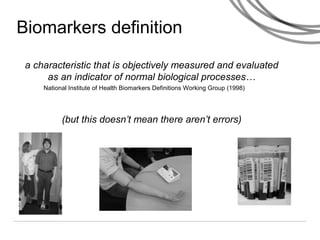
Biomarkers definition
a characteristic that is objectively measured and evaluated
as an indicator of normal biological processes…
(but this doesn’t mean there aren’t errors)
National Institute of Health Biomarkers Definitions Working Group (1998)
What do we measure in blood
(saliva, hair)?
•Clinical indicators of significant diseases eg glucosylated
hemoglobin (HbA1c) and diabetes
•Established risk factors for significant diseases eg
cholesterol and heart disease
•Markers for stress pathways between social and health eg
cortisol, inflammatory markers (e.g. CRP)
•Novel markers e.g. telomere, epigenetics, omics
•Composite risk scores e.g. Framingham (CVD), Allostatic
load ( cumulative physiological burden)
Why are biomarkers useful for social
science research?
 Earlier and more precise ‘objective’ measures of health and
illness
- how does health change over lifecourse?
- how can biomarkers and behaviours help us identify people
in need?
 Understanding the pathways by which social factors are
associated with health
 Intervention points and risk factors for policy intervention
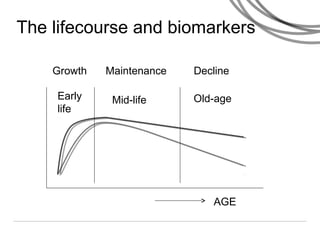
Example: how biomarkers
differ over the lifespan
The lifecourse and biomarkers
AGE
Early
life
Mid-life Old-age
Growth Maintenance Decline
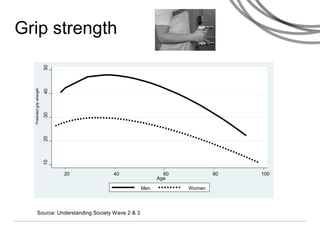
Grip strength
Source: Understanding Society Wave 2 & 3
1020304050
20 40 60 80 100
Age
Men Women
Predictedgripstrength
Examples: combining
biomarker and self report data
to understand illness
behaviour
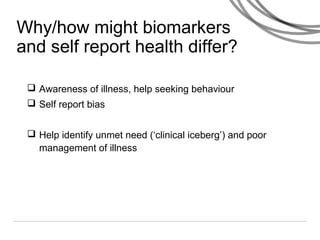
Why/how might biomarkers
and self report health differ?
 Awareness of illness, help seeking behaviour
 Self report bias
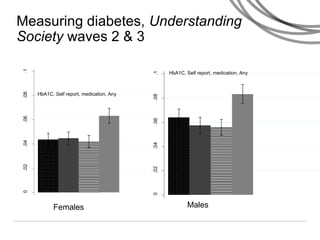
 Help identify unmet need (‘clinical iceberg’) and poor
management of illness
0.02.04.06.08.1
0.02.04.06.08.1
Measuring diabetes, Understanding
Society waves 2 & 3
MalesFemales
HbA1C, Self report, medication, Any
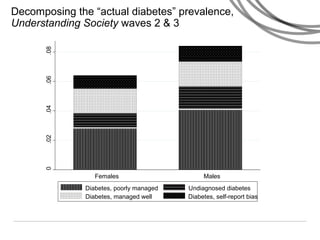
Decomposing the “actual diabetes” prevalence,
Understanding Society waves 2 & 3
15%
26%
14%
49%
18%
20%
13%
0.02.04.06.08
Females Males
Diabetes, poorly managed Undiagnosed diabetes
Diabetes, managed well Diabetes, self-report bias
Examples Do biomarkers give
us more confidence about
social pathways?
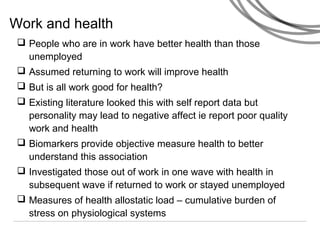
Work and health
 People who are in work have better health than those
unemployed
 Assumed returning to work will improve health
 But is all work good for health?
 Existing literature looked this with self report data but
personality may lead to negative affect ie report poor quality
work and health
 Biomarkers provide objective measure health to better
understand this association
 Investigated those out of work in one wave with health in
subsequent wave if returned to work or stayed unemployed
 Measures of health allostatic load – cumulative burden of
stress on physiological systems
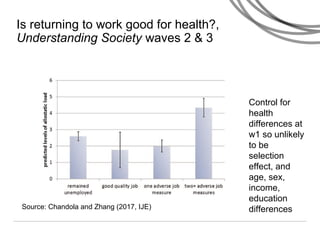
Is returning to work good for health?,
Understanding Society waves 2 & 3
Source: Chandola and Zhang (2017, IJE)
Control for
health
differences at
w1 so unlikely
to be
selection
effect, and
age, sex,
income,
education
differences
Useful websites for further
information
• www.understandingsociety.ac.uk (a ‘biosocial’
resource)
• www.closer.ac.uk (UK longitudinal studies)
• www.ukdataservice.ac.uk (access data)
• www.metadac.ac.uk (genetics data)
• www.ncrm.ac.uk (training and information)

Integrating biological and social research data - Michaela Benzeval

  • 1.
    Integrating biological andsocial data for (biosocial) research Michaela Benzeval Director, Understanding Society ISER, University of Essex
  • 2.
    Outline Part 1: Whatresearch questions can be answered by combining biological and social data? Note focus on biomarkers not genetics Part 2: How do you analyse biological data? Introduction to data Issues to consider with examples More information on data, advice etc
  • 3.
    The value ofintegrating social and biological perspectives The biomedical literature has generally treated socioeconomic position as a unitary construct. Likewise, the social science literature has tended to treat health as a unitary construct. To advance our understanding of the relationship between socioeconomic position and health, and ultimately to foster appropriate policies and practices to improve population health, a more nuanced approach is required—one that differentiates theoretically and empirically among dimensions of both socioeconomic position and health. Herd et al 2007, p.223
  • 4.
    Biomarkers definition a characteristicthat is objectively measured and evaluated as an indicator of normal biological processes… (but this doesn’t mean there aren’t errors) National Institute of Health Biomarkers Definitions Working Group (1998)
  • 5.
    What do wemeasure in blood (saliva, hair)? •Clinical indicators of significant diseases eg glucosylated hemoglobin (HbA1c) and diabetes •Established risk factors for significant diseases eg cholesterol and heart disease •Markers for stress pathways between social and health eg cortisol, inflammatory markers (e.g. CRP) •Novel markers e.g. telomere, epigenetics, omics •Composite risk scores e.g. Framingham (CVD), Allostatic load ( cumulative physiological burden)
  • 6.
    Why are biomarkersuseful for social science research?  Earlier and more precise ‘objective’ measures of health and illness - how does health change over lifecourse? - how can biomarkers and behaviours help us identify people in need?  Understanding the pathways by which social factors are associated with health  Intervention points and risk factors for policy intervention
  • 7.
  • 8.
    The lifecourse andbiomarkers AGE Early life Mid-life Old-age Growth Maintenance Decline
  • 9.
    Grip strength Source: UnderstandingSociety Wave 2 & 3 1020304050 20 40 60 80 100 Age Men Women Predictedgripstrength
  • 10.
    Examples: combining biomarker andself report data to understand illness behaviour
  • 11.
    Why/how might biomarkers andself report health differ?  Awareness of illness, help seeking behaviour  Self report bias  Help identify unmet need (‘clinical iceberg’) and poor management of illness
  • 12.
    0.02.04.06.08.1 0.02.04.06.08.1 Measuring diabetes, Understanding Societywaves 2 & 3 MalesFemales HbA1C, Self report, medication, Any HbA1C, Self report, medication, Any
  • 13.
    Decomposing the “actualdiabetes” prevalence, Understanding Society waves 2 & 3 15% 26% 14% 49% 18% 20% 13% 0.02.04.06.08 Females Males Diabetes, poorly managed Undiagnosed diabetes Diabetes, managed well Diabetes, self-report bias
  • 14.
    Examples Do biomarkersgive us more confidence about social pathways?
  • 15.
    Work and health People who are in work have better health than those unemployed  Assumed returning to work will improve health  But is all work good for health?  Existing literature looked this with self report data but personality may lead to negative affect ie report poor quality work and health  Biomarkers provide objective measure health to better understand this association  Investigated those out of work in one wave with health in subsequent wave if returned to work or stayed unemployed  Measures of health allostatic load – cumulative burden of stress on physiological systems
  • 16.
    Is returning towork good for health?, Understanding Society waves 2 & 3 Source: Chandola and Zhang (2017, IJE) Control for health differences at w1 so unlikely to be selection effect, and age, sex, income, education differences
  • 17.
    Useful websites forfurther information • www.understandingsociety.ac.uk (a ‘biosocial’ resource) • www.closer.ac.uk (UK longitudinal studies) • www.ukdataservice.ac.uk (access data) • www.metadac.ac.uk (genetics data) • www.ncrm.ac.uk (training and information)