case scenario
DR.MADHAVAN
• A 16-year-old boy falls while playing soccer. He
reports that his knee buckled when he planted his
leg to kick a ball. He noticed an obvious deformity
of his knee, which spontaneously resolved with a
“clunk.” He could not finish the game but was able
to bear weight with a limp. He has had two similar
episodes but has never sought medical attention.
An initial examination demonstrated an effusion,
tenderness at the proximal medial collateral region
and medial patellofemoral retinaculum, decreased
range of motion, and patella apprehension. A lateral
patellar glide performed at 30° of flexion was 3+. He
was otherwise ligamentously stable, and there were
no other noteworthy findings
OPTIONS
• A. Medial femoral condyle physeal
widening
• B. An osseous or osteochondral loose
fragment
• C. Osgood-Schlatter disease
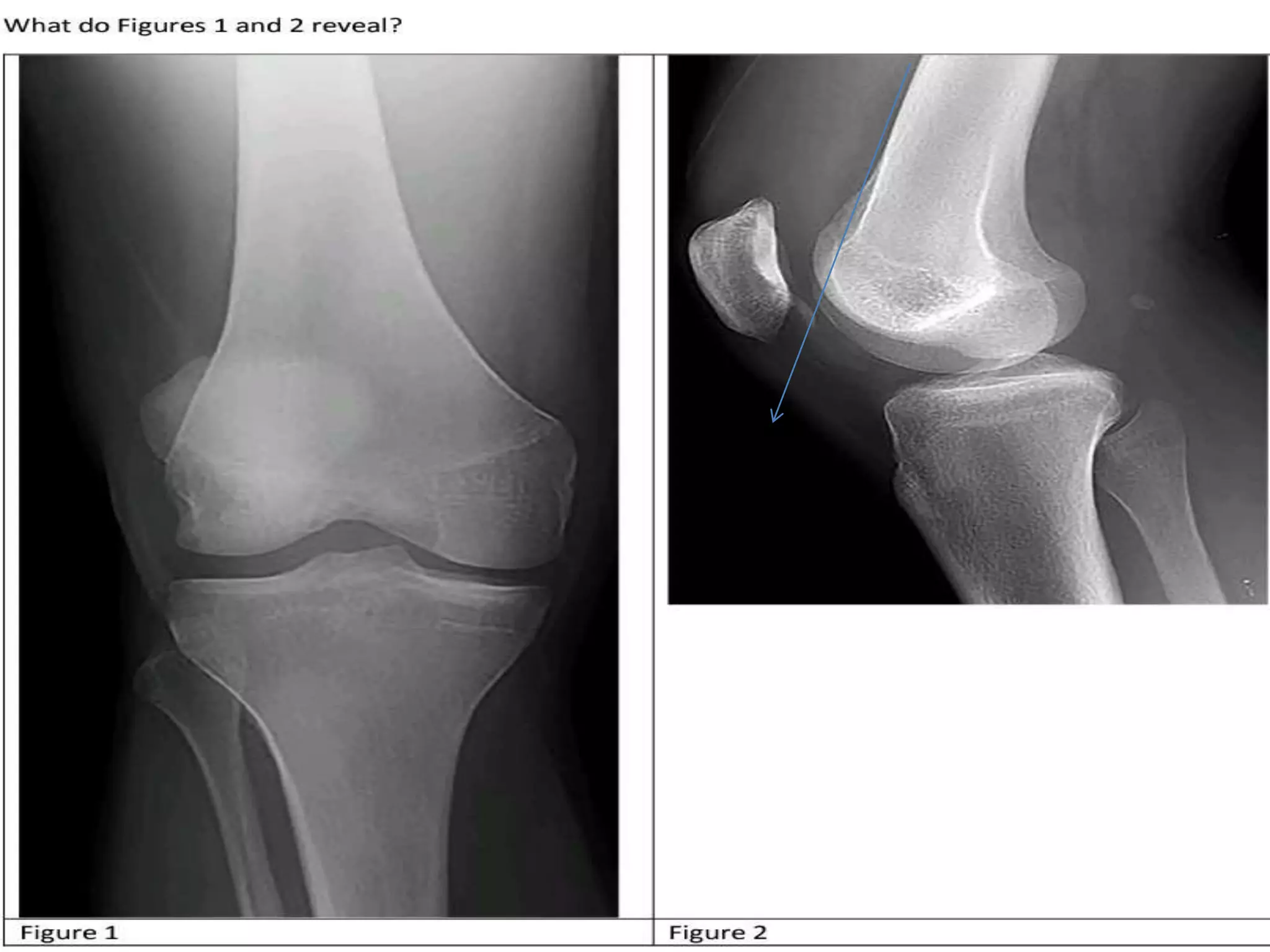
• D. A patella non displaced fracture
Medial femoral condyle physeal
widening
• Physeal widening observed on MRI as the result of a
metaphyseal insults
• Disruption of the metaphyseal blood flow
Patho physilology
• In the absence of normal blood flow
• Endochondral bone formation is disrupted
• Long columns of hypertrophic cartilage cells from
the physis extend into the metaphysis
• This produces the cartilage signal intensity with
apparent physeal widening on MRI
SEEN IN
• Skeletally immature children who participate in
high-level sports who participated in football,
basketball, gymnastics, soccer, or tennis and sustain
repetitive trauma
• Apparent widening of the physis described on
radiographs in children who have sustained fractures
from CHILD ABUSE
• The physeal widening may be broad or more focal,
described as “tonguelike” appearance
TREATMENT
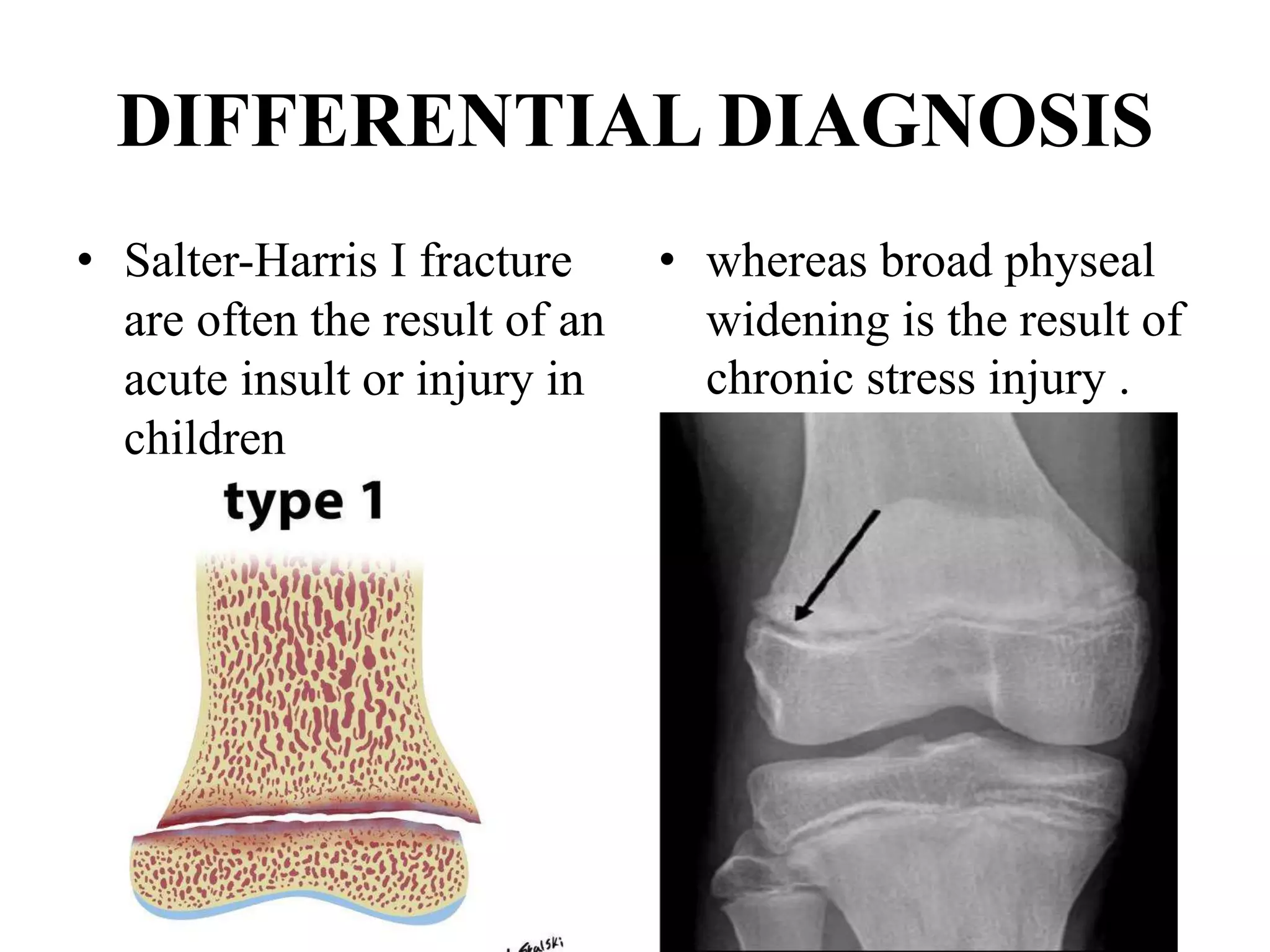
DIFFERENTIAL DIAGNOSIS
• Salter-Harris I fracture
are often the result of an
acute insult or injury in
children
•
• whereas broad physeal
widening is the result of
chronic stress injury .
An osseous or osteochondral loose
fragment
Osgood-Schlatter Disease
• The first described by Osgood and Schlatter in 1903
• Tibial tubercle apophysitis
• Characterized by pain over the tibial tubercle in a
child with skeletal immaturity
• The pain is aggravated by activities but usually
persists even at rest as well
PATHO PHYSIOLOGY
• A traction-induced inflammation of the patellar
tendon and adjacent cartilage of the tibial tubercle
growth plate
EXAMINATION
• Tenderness directly over the tibial tubercle and the
distal portion of the patellar tendon
• Enlargement of the tubercle, which is firm on
palpation
• Pain is produced by resisted knee extension
• MRI suggesting tendinitis of the patellar tendon NO
evidence of avulsion of the tubercle
• An ossicle developing in the area of insertion of the
patellar tendon may become symptomatic in
adulthood
TREATMENT
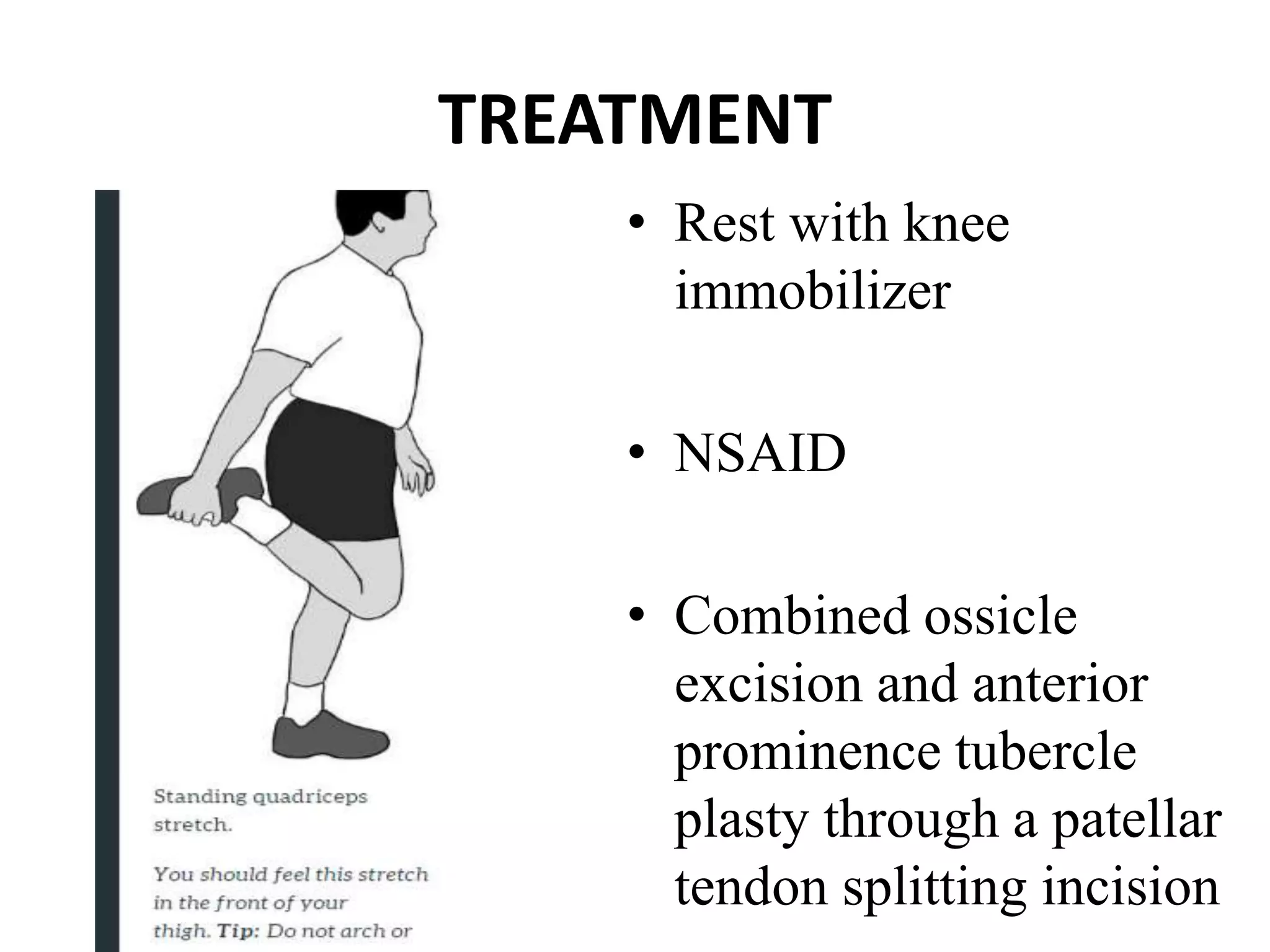
• Rest with knee
immobilizer
• NSAID
• Combined ossicle
excision and anterior
prominence tubercle
plasty through a patellar
tendon splitting incision
A patella nondisplaced fracture
• There is no oblivious patella fracture in the given x-
ray image
• Figures 3 and 4 are this patients proton density
fat saturated MRI images, his tibial tubercule -
trochlear groove (TT-- TG) distance is 12 mm,
and he has normal limb alignment film findings.
Treatment at this stage should include
OPTIONS
• A. Hinged knee bracing, protected weight
bearing, and physical therapy.
• B. Anteromedialization of the tibial tubercle.
• C. Internal fixation and medial patellofemoral
ligament (MPFL) reconstruction.
• D. Arthroscopic lateral retinacular release
Hinged knee bracing, protected
weight bearing, and physical therapy
• Jones-type compressive dressing and crutches are used for
ambulation
• Hemarthrosis : aspiration under sterile conditions indicated
• Quadriceps-setting exercises and three sets of 15 to 20 times
• straight-leg raises done four or five times a day
• Ice is applied for 20 minutes every 2 to 3 hours
• knee immobilizer and compressive bandage for 3- 5
days
• The crutches are discontinued when the patient is able
to do straight-leg raises with a 5-lb ankle weight
• Closed-chain exercises : including wall sets, in which
the patient squats to approximately 40 degrees while
keeping the back flat against the wall for 15 to 20
seconds, for a total of 10 to 15 repetitions
• Side and forward step-up exercises using a 6- to 8-inch
platform
• Patellar stabilizing brace is prescribed for the first 6 to 8
weeks during rehabilitation
PATELLA
STABILIZING
ORTHOSIS
Antero medialization of the tibial
tubercle
• His tibial tubercule -trochlear groove (TT-- TG)
distance is 12 mm
• normal: <15 mm
• borderline: 15-20 mm
• abnormal: >20 mm
TIBIAL TUBERCULE -TROCHLEAR
GROOVE (TT-- TG)
• Measurement of the linear distance between the
center of the patellar tendon insertion on the tibial
tubercle and the center of the trochlear groove
provides a measure of coronal and/or rotational
malalignment through the patellofemoral joint
MRI KNEE SUPERIMPOSED IMAGE
POSTERIOR MARGINS OF FEMORAL CONDYLES
FEMORAL TROCHLEAR
GROOVE
TIBIAL
TUBEROSITY
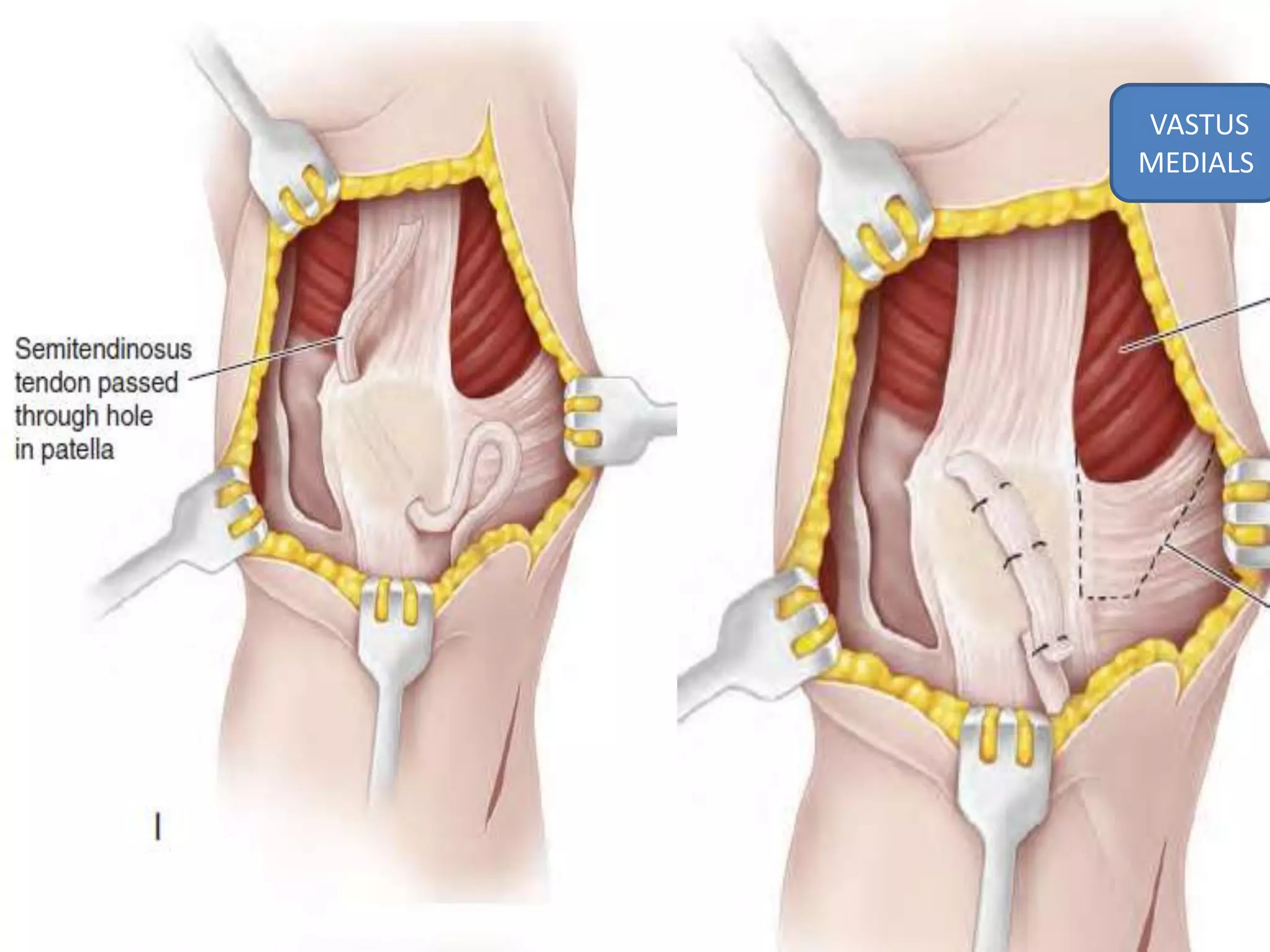
• Internal fixation and medial
patellofemoral ligament (MPFL)
reconstruction
VASTUS
MEDIALS
conversion of
oblique to
transverse
course of vastus
medialis muscle
Arthroscopic lateral retinacular
release
Alone wont be sufficient as the MPFL tear is
there so we have to reconstruct MPFL

Recurrent patellar dislocation case scenario

  • 1.
  • 2.
    • A 16-year-oldboy falls while playing soccer. He reports that his knee buckled when he planted his leg to kick a ball. He noticed an obvious deformity of his knee, which spontaneously resolved with a “clunk.” He could not finish the game but was able to bear weight with a limp. He has had two similar episodes but has never sought medical attention. An initial examination demonstrated an effusion, tenderness at the proximal medial collateral region and medial patellofemoral retinaculum, decreased range of motion, and patella apprehension. A lateral patellar glide performed at 30° of flexion was 3+. He was otherwise ligamentously stable, and there were no other noteworthy findings
  • 4.
    OPTIONS • A. Medialfemoral condyle physeal widening • B. An osseous or osteochondral loose fragment • C. Osgood-Schlatter disease • D. A patella non displaced fracture
  • 5.
    Medial femoral condylephyseal widening • Physeal widening observed on MRI as the result of a metaphyseal insults • Disruption of the metaphyseal blood flow
  • 6.
    Patho physilology • Inthe absence of normal blood flow • Endochondral bone formation is disrupted • Long columns of hypertrophic cartilage cells from the physis extend into the metaphysis • This produces the cartilage signal intensity with apparent physeal widening on MRI
  • 9.
    SEEN IN • Skeletallyimmature children who participate in high-level sports who participated in football, basketball, gymnastics, soccer, or tennis and sustain repetitive trauma • Apparent widening of the physis described on radiographs in children who have sustained fractures from CHILD ABUSE
  • 10.
    • The physealwidening may be broad or more focal, described as “tonguelike” appearance
  • 12.
  • 13.
    DIFFERENTIAL DIAGNOSIS • Salter-HarrisI fracture are often the result of an acute insult or injury in children • • whereas broad physeal widening is the result of chronic stress injury .
  • 15.
    An osseous orosteochondral loose fragment
  • 16.
    Osgood-Schlatter Disease • Thefirst described by Osgood and Schlatter in 1903 • Tibial tubercle apophysitis • Characterized by pain over the tibial tubercle in a child with skeletal immaturity • The pain is aggravated by activities but usually persists even at rest as well
  • 17.
    PATHO PHYSIOLOGY • Atraction-induced inflammation of the patellar tendon and adjacent cartilage of the tibial tubercle growth plate
  • 18.
    EXAMINATION • Tenderness directlyover the tibial tubercle and the distal portion of the patellar tendon • Enlargement of the tubercle, which is firm on palpation • Pain is produced by resisted knee extension
  • 19.
    • MRI suggestingtendinitis of the patellar tendon NO evidence of avulsion of the tubercle • An ossicle developing in the area of insertion of the patellar tendon may become symptomatic in adulthood
  • 21.
    TREATMENT • Rest withknee immobilizer • NSAID • Combined ossicle excision and anterior prominence tubercle plasty through a patellar tendon splitting incision
  • 22.
    A patella nondisplacedfracture • There is no oblivious patella fracture in the given x- ray image
  • 24.
    • Figures 3and 4 are this patients proton density fat saturated MRI images, his tibial tubercule - trochlear groove (TT-- TG) distance is 12 mm, and he has normal limb alignment film findings. Treatment at this stage should include
  • 25.
    OPTIONS • A. Hingedknee bracing, protected weight bearing, and physical therapy. • B. Anteromedialization of the tibial tubercle. • C. Internal fixation and medial patellofemoral ligament (MPFL) reconstruction. • D. Arthroscopic lateral retinacular release
  • 26.
    Hinged knee bracing,protected weight bearing, and physical therapy • Jones-type compressive dressing and crutches are used for ambulation • Hemarthrosis : aspiration under sterile conditions indicated • Quadriceps-setting exercises and three sets of 15 to 20 times • straight-leg raises done four or five times a day • Ice is applied for 20 minutes every 2 to 3 hours
  • 27.
    • knee immobilizerand compressive bandage for 3- 5 days • The crutches are discontinued when the patient is able to do straight-leg raises with a 5-lb ankle weight • Closed-chain exercises : including wall sets, in which the patient squats to approximately 40 degrees while keeping the back flat against the wall for 15 to 20 seconds, for a total of 10 to 15 repetitions • Side and forward step-up exercises using a 6- to 8-inch platform • Patellar stabilizing brace is prescribed for the first 6 to 8 weeks during rehabilitation
  • 28.
  • 29.
    Antero medialization ofthe tibial tubercle • His tibial tubercule -trochlear groove (TT-- TG) distance is 12 mm • normal: <15 mm • borderline: 15-20 mm • abnormal: >20 mm
  • 30.
    TIBIAL TUBERCULE -TROCHLEAR GROOVE(TT-- TG) • Measurement of the linear distance between the center of the patellar tendon insertion on the tibial tubercle and the center of the trochlear groove provides a measure of coronal and/or rotational malalignment through the patellofemoral joint
  • 31.
    MRI KNEE SUPERIMPOSEDIMAGE POSTERIOR MARGINS OF FEMORAL CONDYLES FEMORAL TROCHLEAR GROOVE TIBIAL TUBEROSITY
  • 32.
    • Internal fixationand medial patellofemoral ligament (MPFL) reconstruction
  • 37.
  • 38.
  • 39.
    Arthroscopic lateral retinacular release Alonewont be sufficient as the MPFL tear is there so we have to reconstruct MPFL