Recruitment and Selection  Refresher Sue Kellaway
Agenda Why have a recruitment process? eRecruitment and its impact What makes a good Job Description and Person Specification  Selection methods Shortlisting Interviewing Skills – Refresher The Chairs Role Diversity and Legal Aspects
Introductions Find a person in the room you don’t know very well and take two to three minutes each to ask what they do, and find out about an unfulfilled ambition or a surprising or unusual thing about them.  Now introduce your partner to the group.
Why have a recruitment process? Shared expectations Best practice, modern, streamlined processes Best candidates possible Candidates feel positive You feel positive  All underpinned by Legislation
Future of Recruitment Dramatic changes due to Internet and eRecruitment  System – on line applications, on-line review of applications, killer questions Social Networking Specialist Advice Team Employer Brand Wider and on line use of Selection methods
Job Descriptions Clear purpose,  in 1 or 2 sentences Responsibilities/Key accountabilities in 6-8 main points Not a list of all day to day duties or tasks Include important dimensions eg £, staff nos Relationships and customers  Measures of success?  KPI’s?
Person Specifications Essential Education, Qualifications and Training Essential Knowledge, Skills and Experience Required Essential Personal Qualities and Behavioural Requirements   Desirable Criteria Behavioural competences – conduct, team skills, attitude to work, attitude to authority, to colleagues – Positive? Flexible? Adaptable?
Competences - Communications Key competence we all use Means different things in different jobs  What does it mean in your job? Write down exactly what “good communications” means in your job? What would be an acceptable, poor or  exceptional standard in a candidate?
Competences – Team Player Key to success in teams What does it mean in your team? Write down exactly what “team player” means to you and your team? What are positive indicators/negative indicators? What would be an acceptable, poor or exceptional standard in a candidate?
Team Player Level 1-Actively participates in the team; maintains a  positive outlook and shows flexibility to new ideas and approaches  2 -Contributes to improved team work by sharing information, accepting and offering help on tasks and responding positively to others’ points of view;  3 -Positively influences the way the team works together 4 - Understands the strengths and weaknesses of  members to build team work development
How do we Source Applicants? Local Press National press Notice boards Circulars Specialist media Niche web sites Job boards Head hunters Societies Professional membership groups Buses and shelters Doctors surgeries Fairs Personal contacts Our web site :  www.Qinetiq.com
Measure Success? Good response – suitably qualified people Self-selection out of process Positive experience More effective and targeted recruitment More offers accepted Faster recruitment – time to offer TIME : COST : QUALITY
Shortlisting Go back to slide 4 –  Why follow a procedure?  Why give reasons for non-selection?  Why use a grid? Is it useful for you or is it to make sure you follow rules/processes/law etc? (when it doesn’t work, it is usually because the person specification was not detailed enough or was not complete)
Purpose of an Interview Does candidate meet person specification – knowledge, skills, experience, personal qualities, behaviours? Does candidate know enough to decide this is right job and organisation for them? (so they stay) Good impression of QinetiQ? (even if – especially if - not successful)
Criteria-Based Behavioural Interviews Recruit for attitude, train for skills  Best indicator of future behaviour is past behaviour Evidence-based approach Based on thorough person specification Relaxed but not informal format Candidate stretched not stressed Probing questions not personal Do not reveal personal views
What makes a good Interview? In your group, take 10 minutes to discuss personal experiences of good and bad interviews Summarise good practice from your collective experiences to feedback to wider group Summarise bad practice from your collective experiences to wider group
What makes a good Interview? Good practice “ friendly” “ stretching” “ made me think” “ covered a lot” “ really tested my skills” “ thorough” “ they listened to me” “ open” Poor practice “ they did most of talking” “ no questions on my presentation” “ read out a question” “ did not give an opportunity for me to expand   answers” “ finished interview quickly” “ looked out of window when I talked”
Communication in an Interview 60-80% of Communication is non-verbal Body language – posture, movement, fidgets, smiling, frowning, laughing, writing notes/not writing notes, eye contact, nodding, staring out of window, mirror actions, sudden changes in posture, folded arms.  Active listening is the key. Verbal communication Not interrupting, letting finish answers, not tutting, reflect back what they have said to show understood, clear expressions, straight forward questions, one question at a time, one person speaking at a time
First Impressions? Your personal bias or tricks your mind can play: First impressions Stereotype Mirror image/clones Central tendency
Hints and Tips – Do’s Prepare room for candidates comfort eg light, heat Prepare questions in advance Use pauses and silence Open questions to start Try to move smoothly from topic to topic Ask one question at a time Avoid jargon Try to look interested! Maintain eye contact Notes - minimum & regular Offer opportunity to ask questions Tell them about the job and sell benefits: Terms and conditions Pay scales and increases! Facilities Why its good to work here
Hints and Tips – Don’t Accept glib answers – probe Do most of the talking –  you only collect evidence when the candidate is talking React violently to anything said Criticise or argue Look for specific answers you have already determined
Probing Criteria/Skill = Able to do… What? How? When? With whom? How often? To what standard? How measure success/failure?
Opening an Interview- the Chair’s Role Introductions Establish rapport quickly, friendly informal questions re travel, parking, finding QinetiQ  Explain interview structure Explain make up of panel if necessary Explain note taking They can take notes if wish
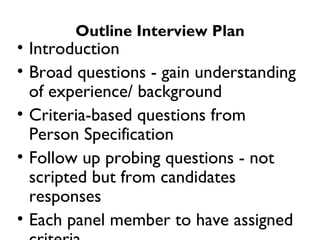
Outline Interview Plan Introduction Broad questions - gain understanding of experience/ background  Criteria-based questions from Person Specification  Follow up probing questions - not scripted but from candidates responses Each panel member to have assigned criteria Chair to “mop up” if not enough searching questions Candidates ask questions “ Sell” job, QinetiQ, terms and conditions Close
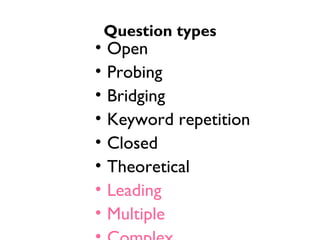
Question types Open Probing Bridging Keyword repetition Closed Theoretical Leading Multiple Complex
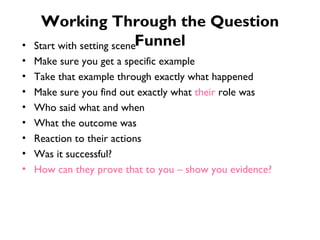
Working Through the Question Funnel Start with setting scene Make sure you get a specific example Take that example through exactly what happened Make sure you find out exactly what  their  role was Who said what and when What the outcome was Reaction to their actions Was it successful? How can they prove that to you – show you evidence?
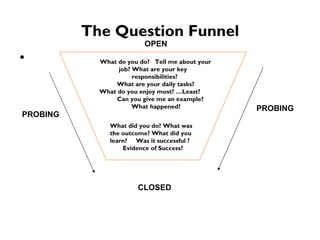
The Question Funnel OPEN CLOSED PROBING PROBING What do you do?  Tell me about your job? What are your key  responsibilities?  What are your daily tasks?  What do you enjoy most? …Least? Can you give me an example? What happened? What did you do? What was the outcome? What did you learn?  Was it successful ? Evidence of Success?
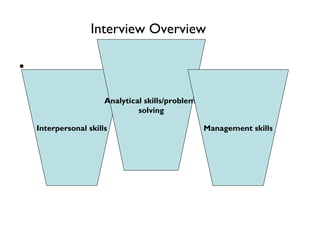
Interpersonal skills Analytical skills/problem  solving Management skills Interview Overview
A good Interview – the Chair’s role. Check there’s a good person specification – clear criteria to assess candidates Preparation ? E.g. Question plan. Check Panel - Selected by chair/recruiting manager; Able to assess candidates fully; Trained and able to make sound judgements ; Mixed gender, age, ethnicity where possible Sensible timings/numbers of candidates
Closing an Interview – the Chair’s role Good, experienced Interviewer could explore reservations Opportunity for candidates questions/issues Explain the role, the structure, the rewards Next step in process Timescales Thanks for interest
Assessment – using Interview grids Not just bureaucracy -use as a tool to help discussion/decision Complete the person criteria before advertising, before sifting, before the interview ! Set standards for person criteria eg good communication skills before you interview Share understanding with panel Assess each candidate separately and then in plenary Observe, Record, Classify, Evaluate
Exercise- have go! (1) Prepare some criteria-based questions – use communication skills or team skills as your criteria. Take 15 minutes to prepare some questions to have a go at an interview. The interview will be 20 minutes. Working in a panel, try out your questions. Others to critique on: – rapport and NVC’s, open and close, questions, probing, evidence
Exercise- have go! (2) Others to critique on:  Opening Rapport and body language/NVC Types of questions Probing to get evidence Evidence to assess? All criteria covered? Close
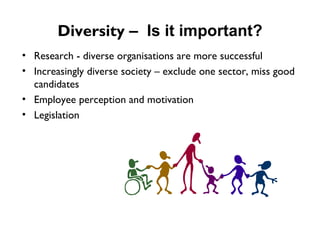
Diversity  –  Is it important? Research - diverse organisations are more successful  Increasingly diverse society – exclude one sector, miss good candidates Employee perception and motivation Legislation
Two Ticks Scheme to interview all disabled applicants who meet the minimum criteria for a job vacancy and consider them on their abilities  to ensure there is a mechanism in place to discuss, at any time, but at least once a year, with disabled employees what can be done to make sure they can develop and use their abilities  to make every effort when employees become disabled to make sure they stay in employment  to take action to ensure that all employees develop the appropriate level of disability awareness needed to make these commitments work  each year to review the five commitments and what has been achieved, plan ways to improve on them and let employees and Jobcentre Plus know about progress and future plans.
Ensure you only ask for attributes / qualifications which are necessary  Act on information given to adjust the selection process and seek advice from HR  Consider reasonable adjustments for disability – even think about when writing job description – how could this job be done by a disabled person? Points to Consider
Typical Issues(1) Gut feeling  Often a poorly articulated reservation – get it out and explore – be prepared to face your own prejudice or find that you have a real reservation Attitude Do not ignore attitudinal/behavioural signals - remember recruit for attitude, train for skills Accomplished Candidates Some people interview well - very polished/articulate. Ensure through good questioning that they can do the job Candidate talks too much/too little?  Use controlling techniques – silence for quiet candidate, interrupt if necessary with talkative candidate– “that’s interesting but can I bring you back to the question I asked?”
Typical Issues (2) Disabled applicants   Make reasonable adjustments in interview and in job -consider what is possible  before even advertising the post. Personal questions?  Eg domestic arrangements – what is it you really need to know? Hobbies/sports?   Human Rights Act section 8 References – when to take them up, how much reliance can be placed on them? Personal recommendations
Summary, Close and Evaluations Anything not covered that you wanted to cover? Objectives covered? Is there anything you will do, not do or do differently as a result of today? Any questions you had that are unanswered and need to be carried forward? Any feedback on the content or pace of the day? - Feedback forms  Thank you for your attention and involvement!
Final Summary Tips on Interviewing Be nervous! Build rapport No sudden movements/questions Friendly 80% talking by candidate ACTIVE  LISTENING and CURIOSITY
Questions?

Recruitment Refresher Training

  • 1.
    Recruitment and Selection Refresher Sue Kellaway
  • 2.
    Agenda Why havea recruitment process? eRecruitment and its impact What makes a good Job Description and Person Specification Selection methods Shortlisting Interviewing Skills – Refresher The Chairs Role Diversity and Legal Aspects
  • 3.
    Introductions Find aperson in the room you don’t know very well and take two to three minutes each to ask what they do, and find out about an unfulfilled ambition or a surprising or unusual thing about them. Now introduce your partner to the group.
  • 4.
    Why have arecruitment process? Shared expectations Best practice, modern, streamlined processes Best candidates possible Candidates feel positive You feel positive All underpinned by Legislation
  • 5.
    Future of RecruitmentDramatic changes due to Internet and eRecruitment System – on line applications, on-line review of applications, killer questions Social Networking Specialist Advice Team Employer Brand Wider and on line use of Selection methods
  • 6.
    Job Descriptions Clearpurpose, in 1 or 2 sentences Responsibilities/Key accountabilities in 6-8 main points Not a list of all day to day duties or tasks Include important dimensions eg £, staff nos Relationships and customers Measures of success? KPI’s?
  • 7.
    Person Specifications EssentialEducation, Qualifications and Training Essential Knowledge, Skills and Experience Required Essential Personal Qualities and Behavioural Requirements Desirable Criteria Behavioural competences – conduct, team skills, attitude to work, attitude to authority, to colleagues – Positive? Flexible? Adaptable?
  • 8.
    Competences - CommunicationsKey competence we all use Means different things in different jobs What does it mean in your job? Write down exactly what “good communications” means in your job? What would be an acceptable, poor or exceptional standard in a candidate?
  • 9.
    Competences – TeamPlayer Key to success in teams What does it mean in your team? Write down exactly what “team player” means to you and your team? What are positive indicators/negative indicators? What would be an acceptable, poor or exceptional standard in a candidate?
  • 10.
    Team Player Level1-Actively participates in the team; maintains a positive outlook and shows flexibility to new ideas and approaches 2 -Contributes to improved team work by sharing information, accepting and offering help on tasks and responding positively to others’ points of view; 3 -Positively influences the way the team works together 4 - Understands the strengths and weaknesses of members to build team work development
  • 11.
    How do weSource Applicants? Local Press National press Notice boards Circulars Specialist media Niche web sites Job boards Head hunters Societies Professional membership groups Buses and shelters Doctors surgeries Fairs Personal contacts Our web site : www.Qinetiq.com
  • 12.
    Measure Success? Goodresponse – suitably qualified people Self-selection out of process Positive experience More effective and targeted recruitment More offers accepted Faster recruitment – time to offer TIME : COST : QUALITY
  • 13.
    Shortlisting Go backto slide 4 – Why follow a procedure? Why give reasons for non-selection? Why use a grid? Is it useful for you or is it to make sure you follow rules/processes/law etc? (when it doesn’t work, it is usually because the person specification was not detailed enough or was not complete)
  • 14.
    Purpose of anInterview Does candidate meet person specification – knowledge, skills, experience, personal qualities, behaviours? Does candidate know enough to decide this is right job and organisation for them? (so they stay) Good impression of QinetiQ? (even if – especially if - not successful)
  • 15.
    Criteria-Based Behavioural InterviewsRecruit for attitude, train for skills Best indicator of future behaviour is past behaviour Evidence-based approach Based on thorough person specification Relaxed but not informal format Candidate stretched not stressed Probing questions not personal Do not reveal personal views
  • 16.
    What makes agood Interview? In your group, take 10 minutes to discuss personal experiences of good and bad interviews Summarise good practice from your collective experiences to feedback to wider group Summarise bad practice from your collective experiences to wider group
  • 17.
    What makes agood Interview? Good practice “ friendly” “ stretching” “ made me think” “ covered a lot” “ really tested my skills” “ thorough” “ they listened to me” “ open” Poor practice “ they did most of talking” “ no questions on my presentation” “ read out a question” “ did not give an opportunity for me to expand answers” “ finished interview quickly” “ looked out of window when I talked”
  • 18.
    Communication in anInterview 60-80% of Communication is non-verbal Body language – posture, movement, fidgets, smiling, frowning, laughing, writing notes/not writing notes, eye contact, nodding, staring out of window, mirror actions, sudden changes in posture, folded arms. Active listening is the key. Verbal communication Not interrupting, letting finish answers, not tutting, reflect back what they have said to show understood, clear expressions, straight forward questions, one question at a time, one person speaking at a time
  • 19.
    First Impressions? Yourpersonal bias or tricks your mind can play: First impressions Stereotype Mirror image/clones Central tendency
  • 20.
    Hints and Tips– Do’s Prepare room for candidates comfort eg light, heat Prepare questions in advance Use pauses and silence Open questions to start Try to move smoothly from topic to topic Ask one question at a time Avoid jargon Try to look interested! Maintain eye contact Notes - minimum & regular Offer opportunity to ask questions Tell them about the job and sell benefits: Terms and conditions Pay scales and increases! Facilities Why its good to work here
  • 21.
    Hints and Tips– Don’t Accept glib answers – probe Do most of the talking – you only collect evidence when the candidate is talking React violently to anything said Criticise or argue Look for specific answers you have already determined
  • 22.
    Probing Criteria/Skill =Able to do… What? How? When? With whom? How often? To what standard? How measure success/failure?
  • 23.
    Opening an Interview-the Chair’s Role Introductions Establish rapport quickly, friendly informal questions re travel, parking, finding QinetiQ Explain interview structure Explain make up of panel if necessary Explain note taking They can take notes if wish
  • 24.
    Outline Interview PlanIntroduction Broad questions - gain understanding of experience/ background Criteria-based questions from Person Specification Follow up probing questions - not scripted but from candidates responses Each panel member to have assigned criteria Chair to “mop up” if not enough searching questions Candidates ask questions “ Sell” job, QinetiQ, terms and conditions Close
  • 25.
    Question types OpenProbing Bridging Keyword repetition Closed Theoretical Leading Multiple Complex
  • 26.
    Working Through theQuestion Funnel Start with setting scene Make sure you get a specific example Take that example through exactly what happened Make sure you find out exactly what their role was Who said what and when What the outcome was Reaction to their actions Was it successful? How can they prove that to you – show you evidence?
  • 27.
    The Question FunnelOPEN CLOSED PROBING PROBING What do you do? Tell me about your job? What are your key responsibilities? What are your daily tasks? What do you enjoy most? …Least? Can you give me an example? What happened? What did you do? What was the outcome? What did you learn? Was it successful ? Evidence of Success?
  • 28.
    Interpersonal skills Analyticalskills/problem solving Management skills Interview Overview
  • 29.
    A good Interview– the Chair’s role. Check there’s a good person specification – clear criteria to assess candidates Preparation ? E.g. Question plan. Check Panel - Selected by chair/recruiting manager; Able to assess candidates fully; Trained and able to make sound judgements ; Mixed gender, age, ethnicity where possible Sensible timings/numbers of candidates
  • 30.
    Closing an Interview– the Chair’s role Good, experienced Interviewer could explore reservations Opportunity for candidates questions/issues Explain the role, the structure, the rewards Next step in process Timescales Thanks for interest
  • 31.
    Assessment – usingInterview grids Not just bureaucracy -use as a tool to help discussion/decision Complete the person criteria before advertising, before sifting, before the interview ! Set standards for person criteria eg good communication skills before you interview Share understanding with panel Assess each candidate separately and then in plenary Observe, Record, Classify, Evaluate
  • 32.
    Exercise- have go!(1) Prepare some criteria-based questions – use communication skills or team skills as your criteria. Take 15 minutes to prepare some questions to have a go at an interview. The interview will be 20 minutes. Working in a panel, try out your questions. Others to critique on: – rapport and NVC’s, open and close, questions, probing, evidence
  • 33.
    Exercise- have go!(2) Others to critique on: Opening Rapport and body language/NVC Types of questions Probing to get evidence Evidence to assess? All criteria covered? Close
  • 34.
    Diversity – Is it important? Research - diverse organisations are more successful Increasingly diverse society – exclude one sector, miss good candidates Employee perception and motivation Legislation
  • 35.
    Two Ticks Schemeto interview all disabled applicants who meet the minimum criteria for a job vacancy and consider them on their abilities to ensure there is a mechanism in place to discuss, at any time, but at least once a year, with disabled employees what can be done to make sure they can develop and use their abilities to make every effort when employees become disabled to make sure they stay in employment to take action to ensure that all employees develop the appropriate level of disability awareness needed to make these commitments work each year to review the five commitments and what has been achieved, plan ways to improve on them and let employees and Jobcentre Plus know about progress and future plans.
  • 36.
    Ensure you onlyask for attributes / qualifications which are necessary Act on information given to adjust the selection process and seek advice from HR Consider reasonable adjustments for disability – even think about when writing job description – how could this job be done by a disabled person? Points to Consider
  • 37.
    Typical Issues(1) Gutfeeling Often a poorly articulated reservation – get it out and explore – be prepared to face your own prejudice or find that you have a real reservation Attitude Do not ignore attitudinal/behavioural signals - remember recruit for attitude, train for skills Accomplished Candidates Some people interview well - very polished/articulate. Ensure through good questioning that they can do the job Candidate talks too much/too little? Use controlling techniques – silence for quiet candidate, interrupt if necessary with talkative candidate– “that’s interesting but can I bring you back to the question I asked?”
  • 38.
    Typical Issues (2)Disabled applicants Make reasonable adjustments in interview and in job -consider what is possible before even advertising the post. Personal questions? Eg domestic arrangements – what is it you really need to know? Hobbies/sports? Human Rights Act section 8 References – when to take them up, how much reliance can be placed on them? Personal recommendations
  • 39.
    Summary, Close andEvaluations Anything not covered that you wanted to cover? Objectives covered? Is there anything you will do, not do or do differently as a result of today? Any questions you had that are unanswered and need to be carried forward? Any feedback on the content or pace of the day? - Feedback forms Thank you for your attention and involvement!
  • 40.
    Final Summary Tipson Interviewing Be nervous! Build rapport No sudden movements/questions Friendly 80% talking by candidate ACTIVE LISTENING and CURIOSITY
  • 41.

Editor's Notes

  • #4 Lessons are : interviews are best when relaxed as you need to get to the real person and that’s the best way most difficult probing questions are best placed nearer end of interview when candidate at most relaxed and off guard Many of you gradually turned around to make good eye contact As you progresses, became more friendly, nodding, smiling at each other– all interviews should be like that noise level in group rose – nerves even amongst friends and colleagues! Instructions on slide simple yet you kept looking to check what you were meant to be doing – yet interviews have more complex aims and yet you have no plan, nor prep in many cases Best intros with most detail from those who took notes Remember this – this is your interview in microcosm
  • #8 Red lettering – this is the HARD data – what you shortlist against Green lettering – SOFT data that’s what you interview against or assess with tests, exercises etc