Edwin B. Flippo, “Recruitment is the process of searching the candidates for employment and stimulating them to apply for jobs in the organization”.
A process of finding and attracting capable applicants for employment. The process begins when new recruits are sought and ends when their applications are submitted.  The result is a pool of applications from which new employees are selected. It is the process to discover sources of manpower to meet the requirement of staffing schedule and to employ effective
Recruitment Process Identify vacancy Prepare job description and person specification Advertising the vacancy Managing the response Short-listing Arrange interviews Conducting interview and decision making   The  recruitment process  is immediately followed by the selection process i.e. the final interviews and the decision making, conveying the decision and the appointment formalities.
Sources of Recruitment Every organization has the option of choosing the candidates for its  recruitment processes  from two kinds of sources:  External Sources  Internal Sources.
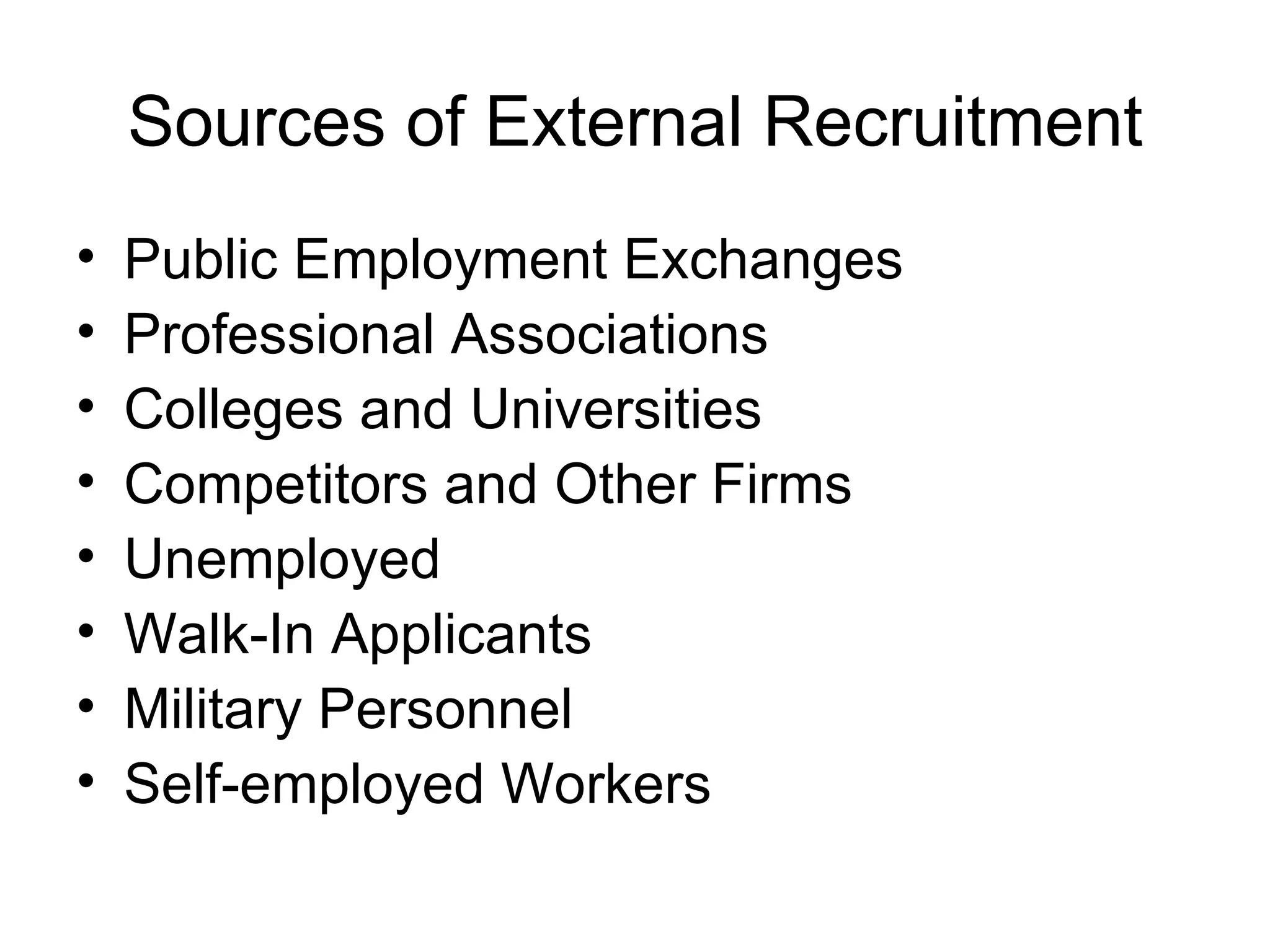
Sources of External Recruitment Public Employment Exchanges Professional Associations Colleges and Universities Competitors and Other Firms Unemployed Walk-In Applicants Military Personnel Self-employed Workers
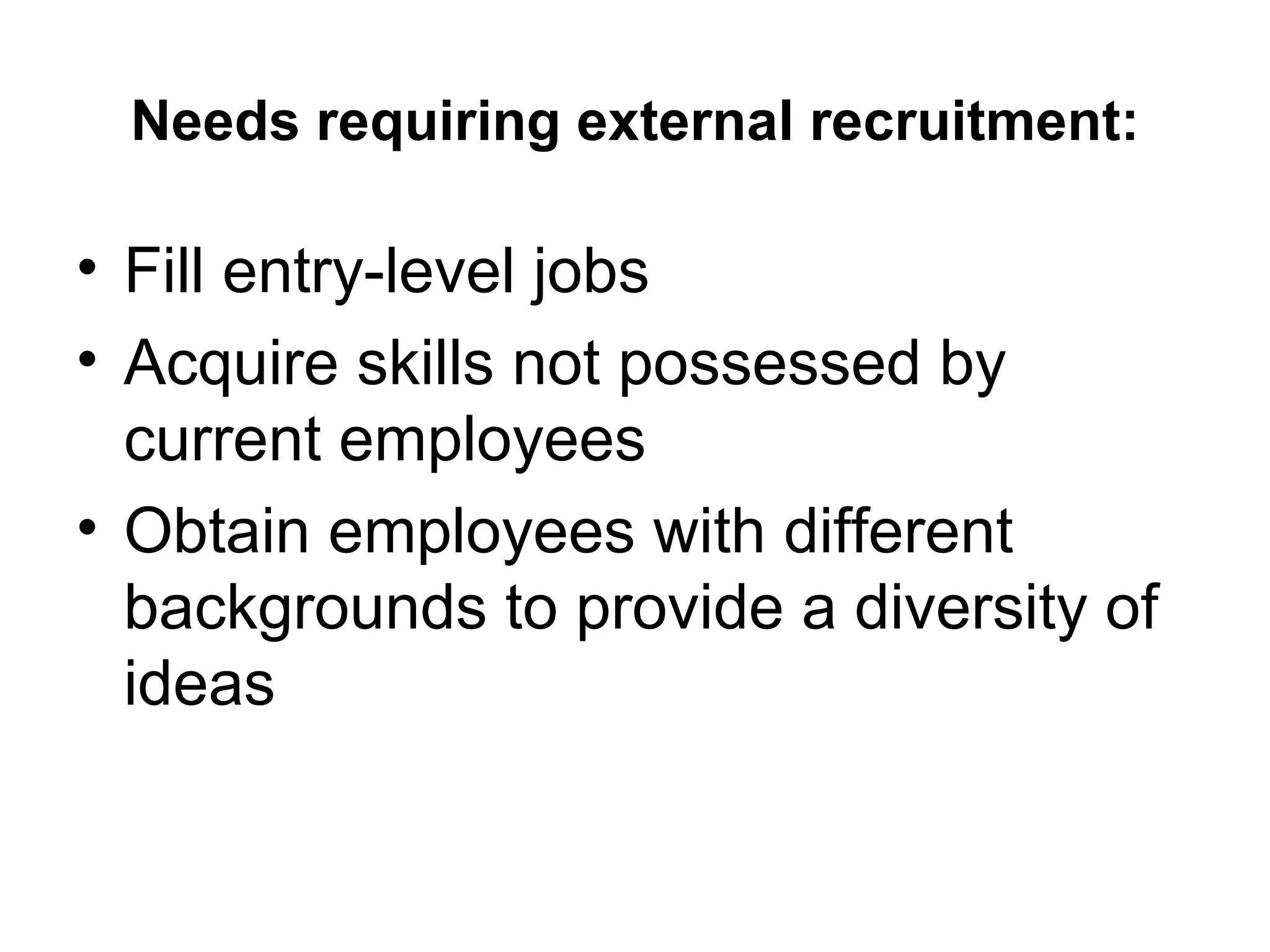
Needs requiring external recruitment: Fill entry-level jobs Acquire skills not possessed by current employees Obtain employees with different backgrounds to provide a diversity of ideas
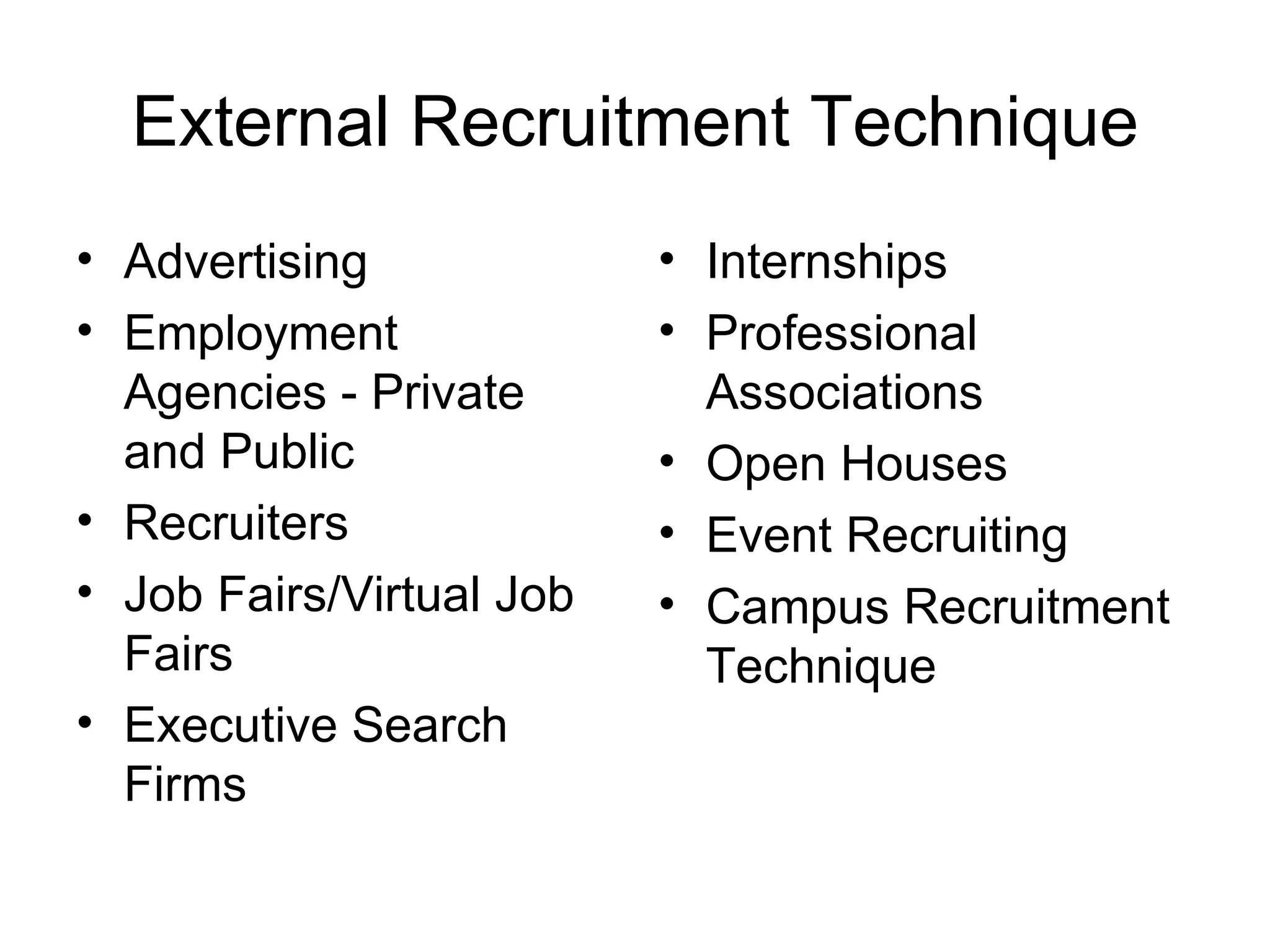
External Recruitment Technique Advertising Employment Agencies - Private and Public Recruiters Job Fairs/Virtual Job Fairs Executive Search Firms Internships Professional Associations Open Houses Event Recruiting Campus Recruitment Technique
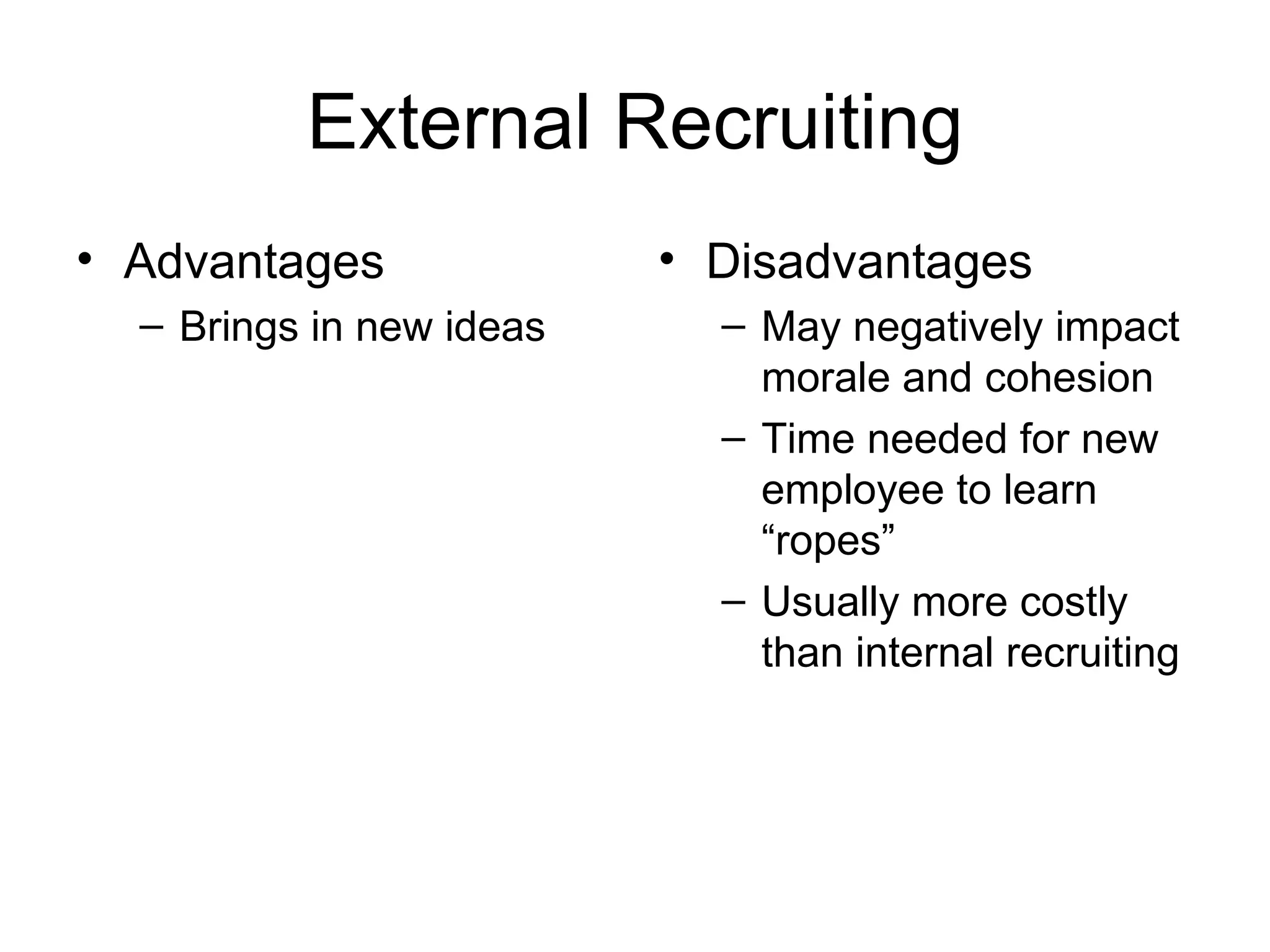
External Recruiting Advantages Brings in new ideas Disadvantages May negatively impact morale and cohesion Time needed for new employee to learn “ropes” Usually more costly than internal recruiting
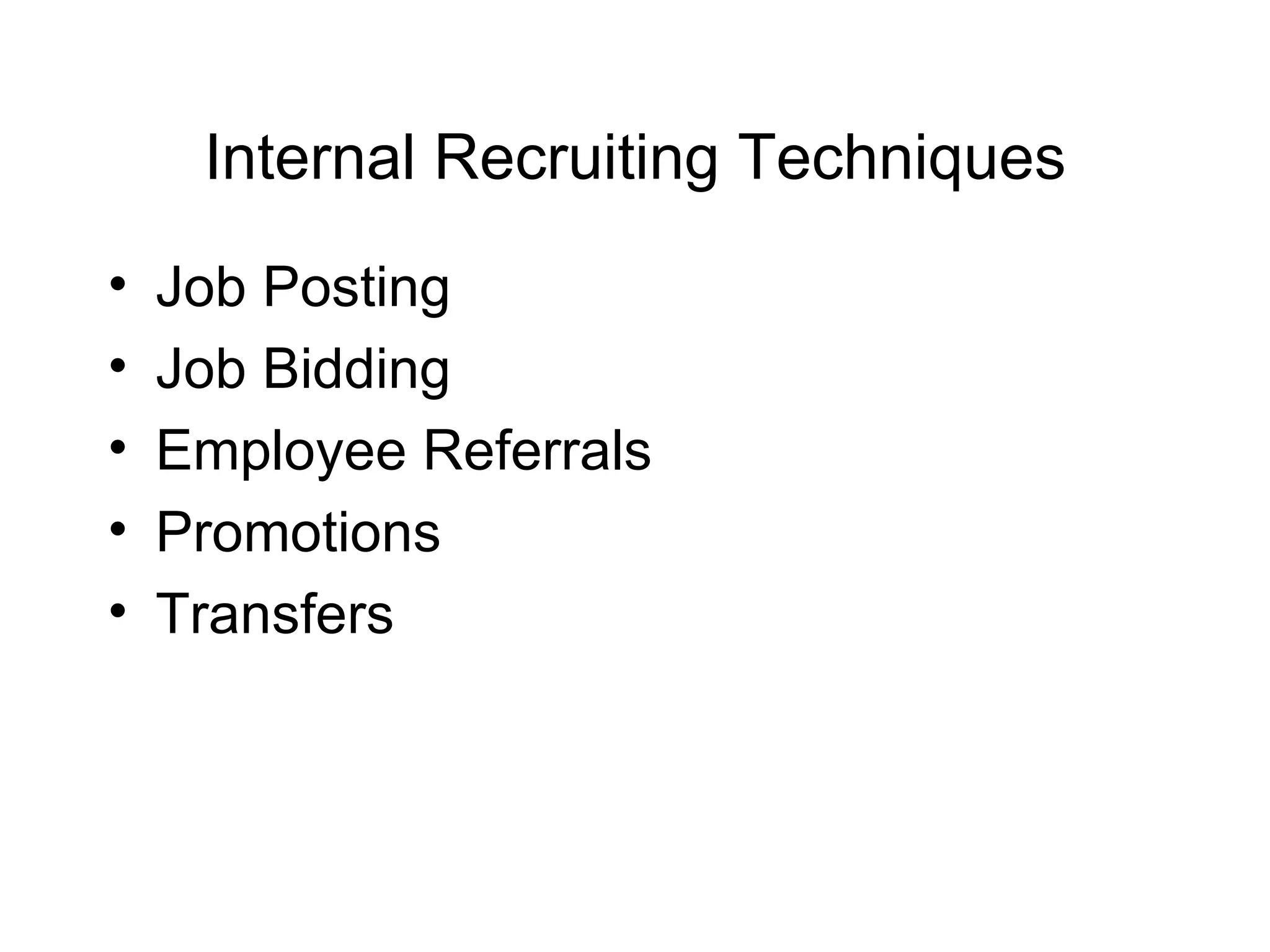
Internal Recruiting Techniques Job Posting Job Bidding Employee Referrals Promotions Transfers
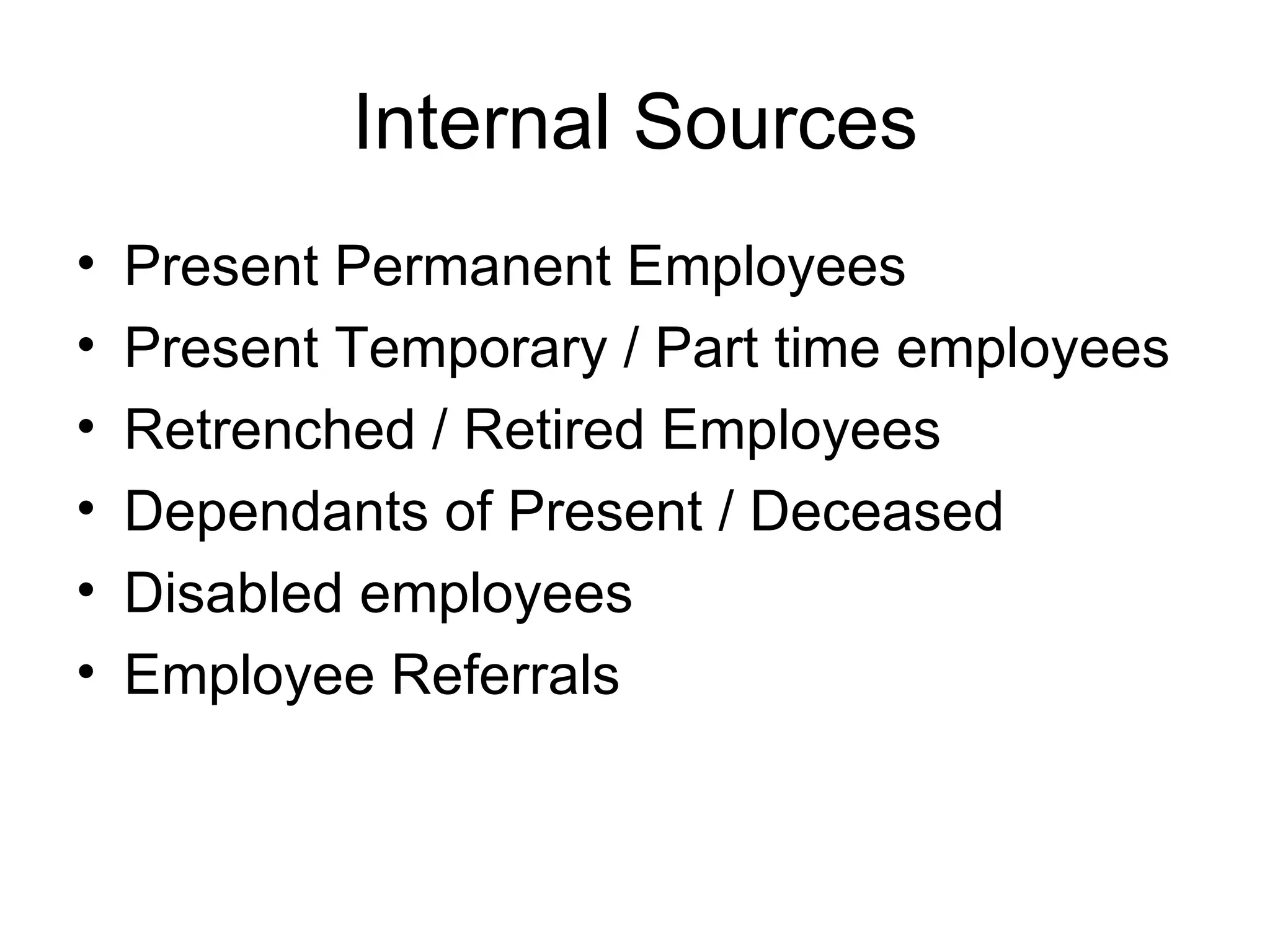
Internal Sources Present Permanent Employees Present Temporary / Part time employees Retrenched / Retired Employees Dependants of Present / Deceased Disabled employees Employee Referrals
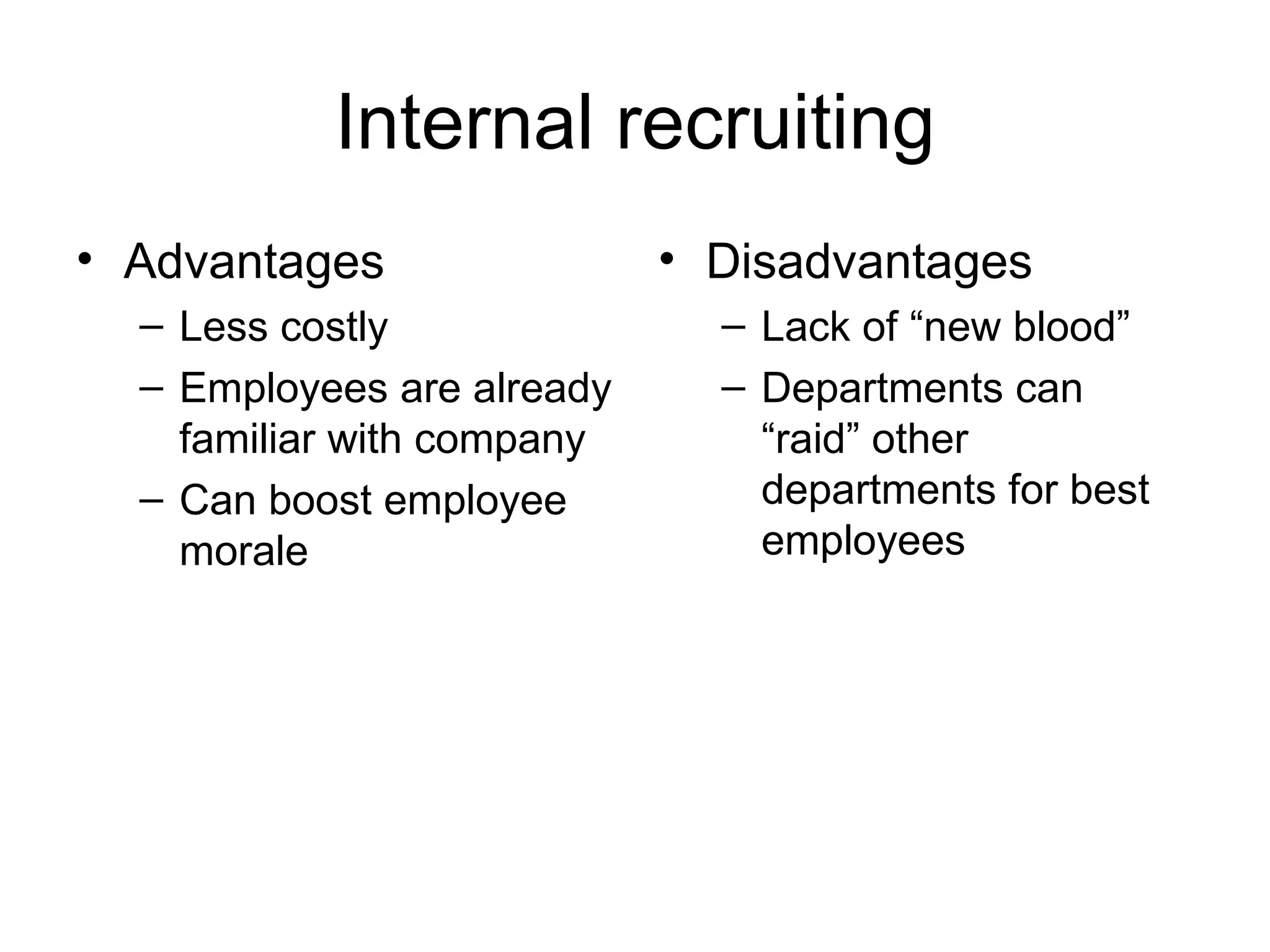
Internal recruiting Advantages Less costly Employees are already familiar with company Can boost employee morale Disadvantages Lack of “new blood” Departments can “raid” other departments for best employees
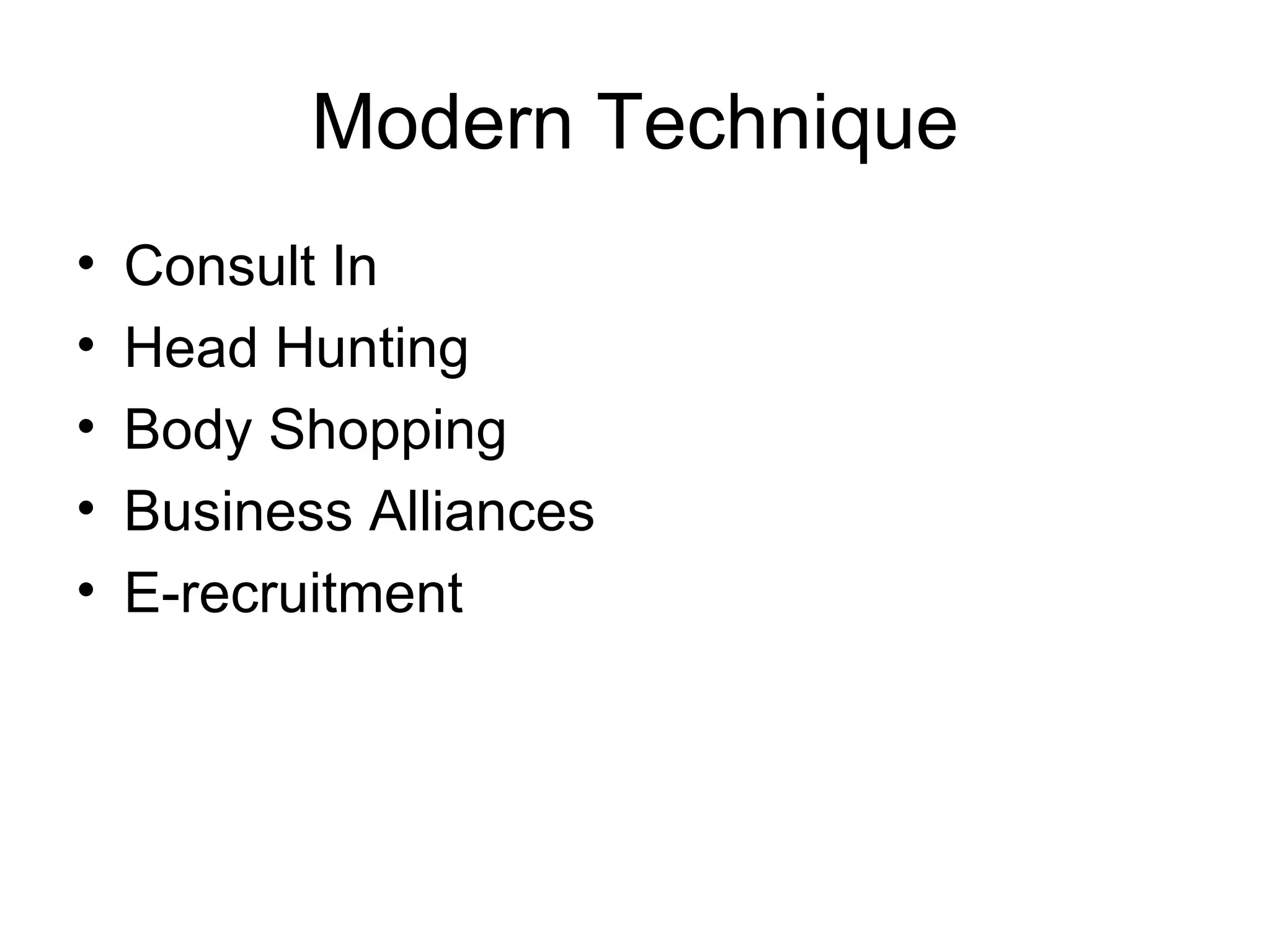
Modern Technique Consult In Head Hunting Body Shopping Business Alliances E-recruitment
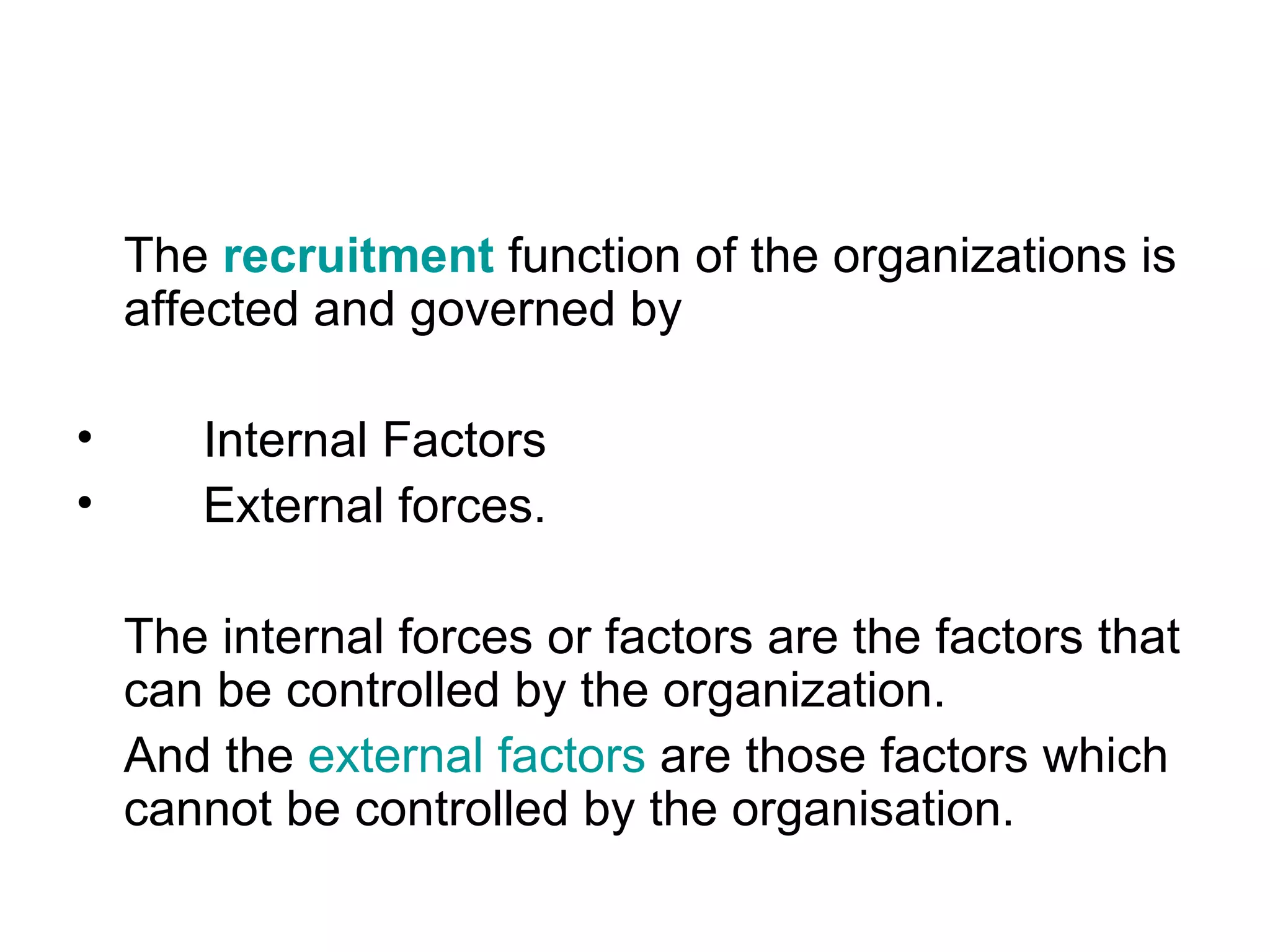
The  recruitment  function of the organizations is affected and governed by  Internal Factors External forces.  The internal forces or factors are the factors that can be controlled by the organization.  And the  external factors  are those factors which cannot be controlled by the organisation.
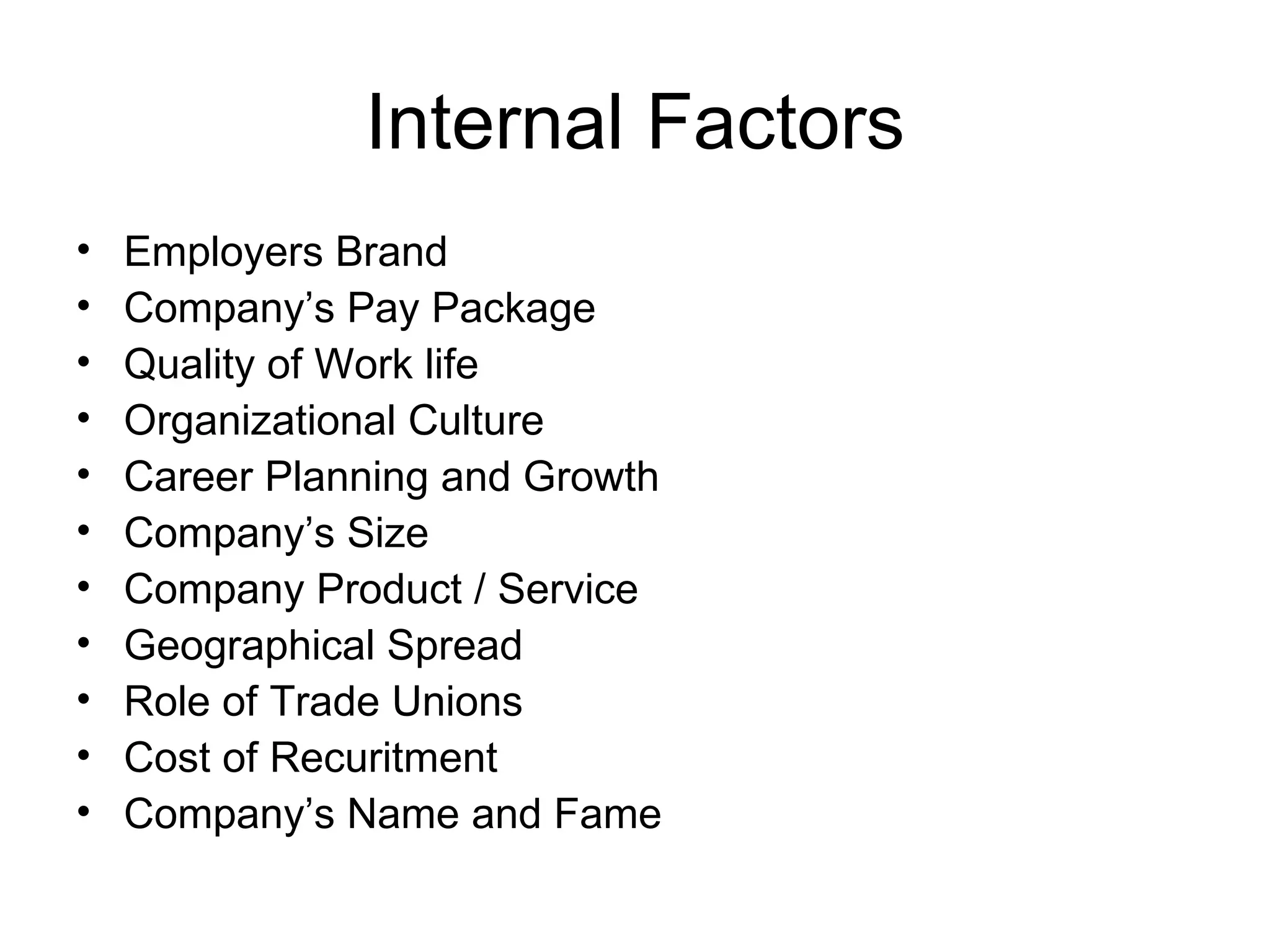
Internal Factors Employers Brand Company’s Pay Package Quality of Work life Organizational Culture Career Planning and Growth Company’s Size Company Product / Service Geographical Spread Role of Trade Unions Cost of Recuritment Company’s Name and Fame
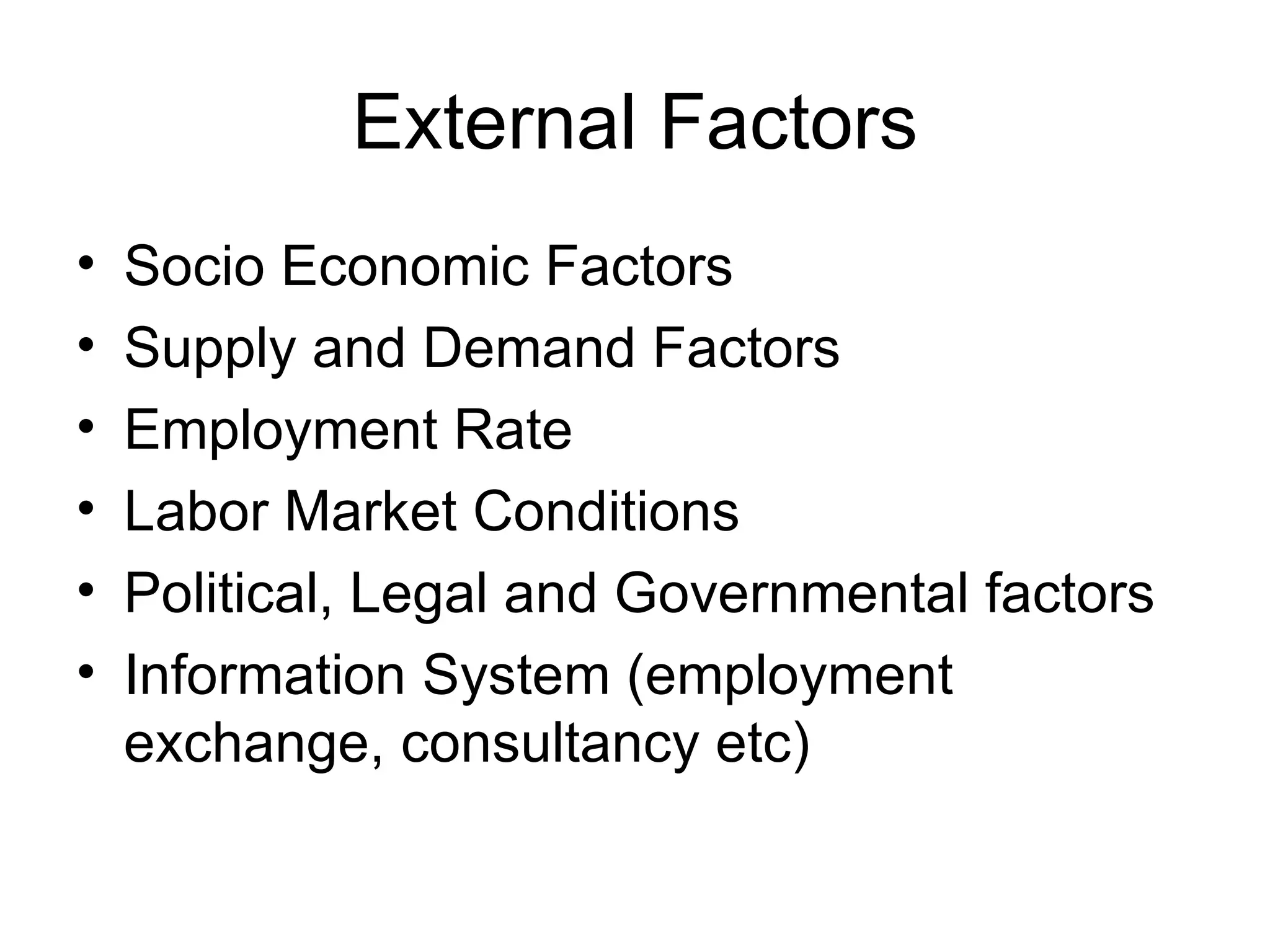
External Factors Socio Economic Factors Supply and Demand Factors Employment Rate Labor Market Conditions Political, Legal and Governmental factors Information System (employment exchange, consultancy etc)
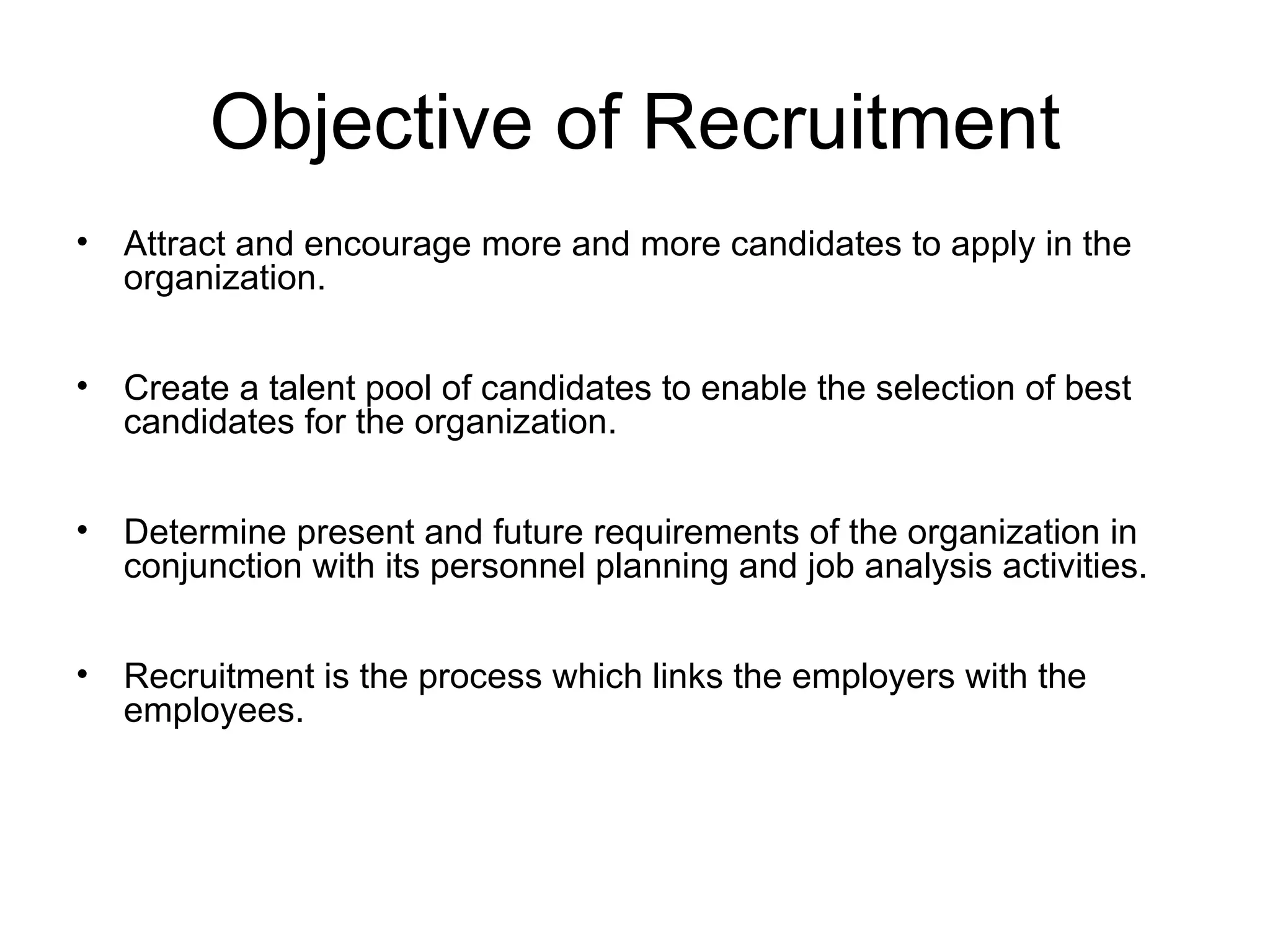
Objective of Recruitment Attract and encourage more and more candidates to apply in the organization. Create a talent pool of candidates to enable the selection of best candidates for the organization. Determine present and future requirements of the organization in conjunction with its personnel planning and job analysis activities. Recruitment is the process which links the employers with the employees.
Increase the pool of job candidates at minimum cost. Help increase the success rate of selection process by decreasing number of visibly under qualified or overqualified job applicants. Help reduce the probability that job applicants once recruited and selected will leave the organization only after a short period of time. Meet the organizations legal and social obligations regarding the composition of its workforce. Begin identifying and preparing potential job applicants who will be appropriate candidates. To induct outsiders with a new perspectdive
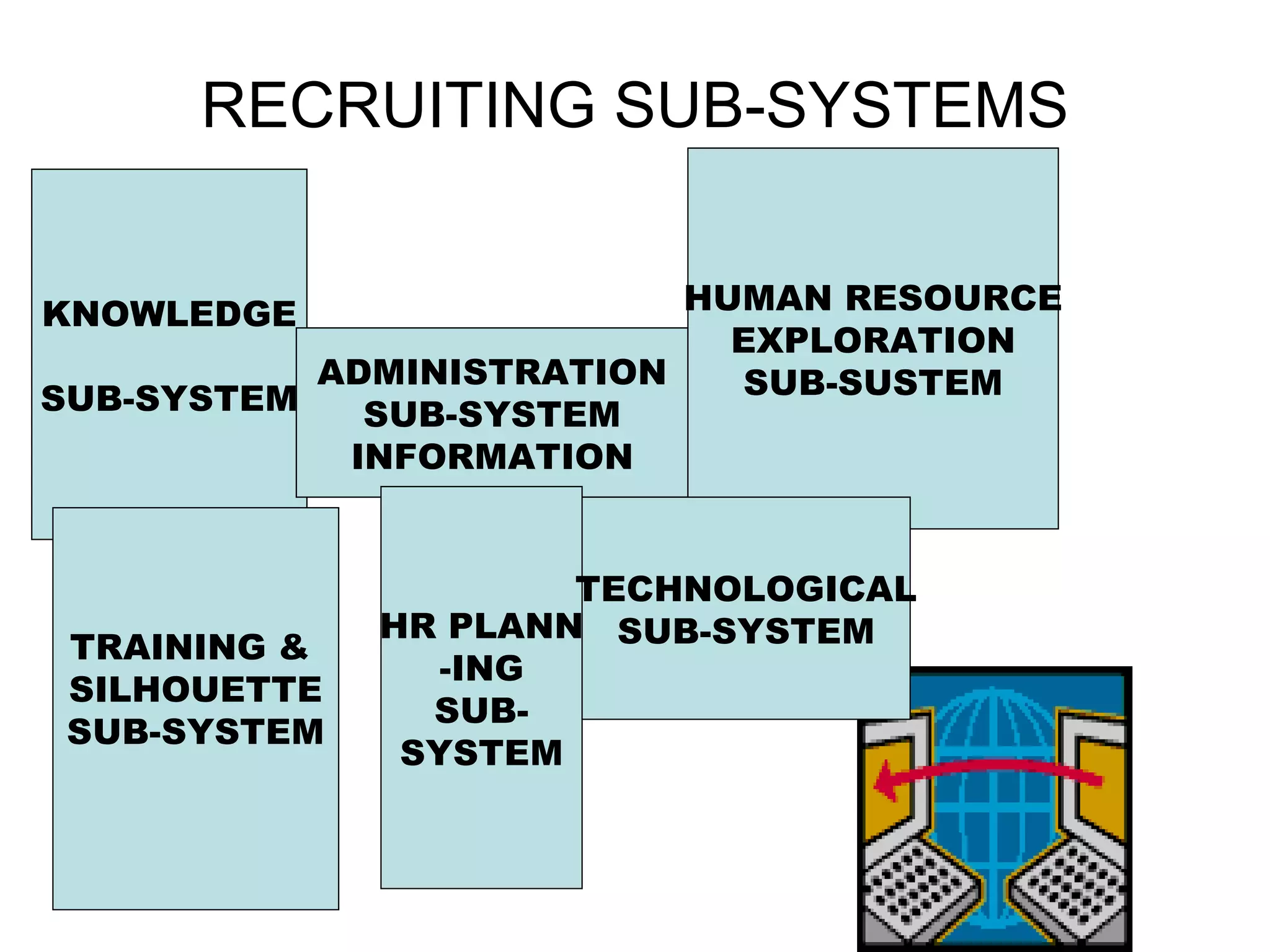
RECRUITING SUB-SYSTEMS KNOWLEDGE SUB-SYSTEM TRAINING &  SILHOUETTE SUB-SYSTEM ADMINISTRATION SUB-SYSTEM INFORMATION HUMAN RESOURCE EXPLORATION SUB-SUSTEM HR PLANN -ING SUB- SYSTEM TECHNOLOGICAL SUB-SYSTEM
RECRUITING SUB-SYSTEMS KNOWLEDGE SUB-SYSTEM ADMINISTRATION SUB-SYSTEM INFORMATION TRAINING SUB-SYSTEM HUMAN RESOURCE EXPLORATION SUB-SUSTEM HR PLANNING SUB-SYSTEM TECHNOLOGICAL SUB-SYSTEM
KNOWLEDGE & ADM’N SUB-SYSTEM Knowledge Subsystem facilities reaching the right knowledge to the right person in right time. combination of culture, process and technology . Administration Subsystem internal/external advertisement module . applicant's profile, [curriculum vita/resume] appointment, types of appointment i.e. adhoc based, honorary, visiting/guest, temporary, apprentice etc.,
TRAINING & HR EXPLORATION SUB-SYSTEM Training Subsystem user specifications & information input into the system. Career planning, development needs analysis & as development advisor through feedback of employees   HR Exploration Subsystem bank of current & historic data about employee's attitude, mentality, absenteeism ., well informed of companies new issues in additional to financial details pertaining to health and well being of the employee
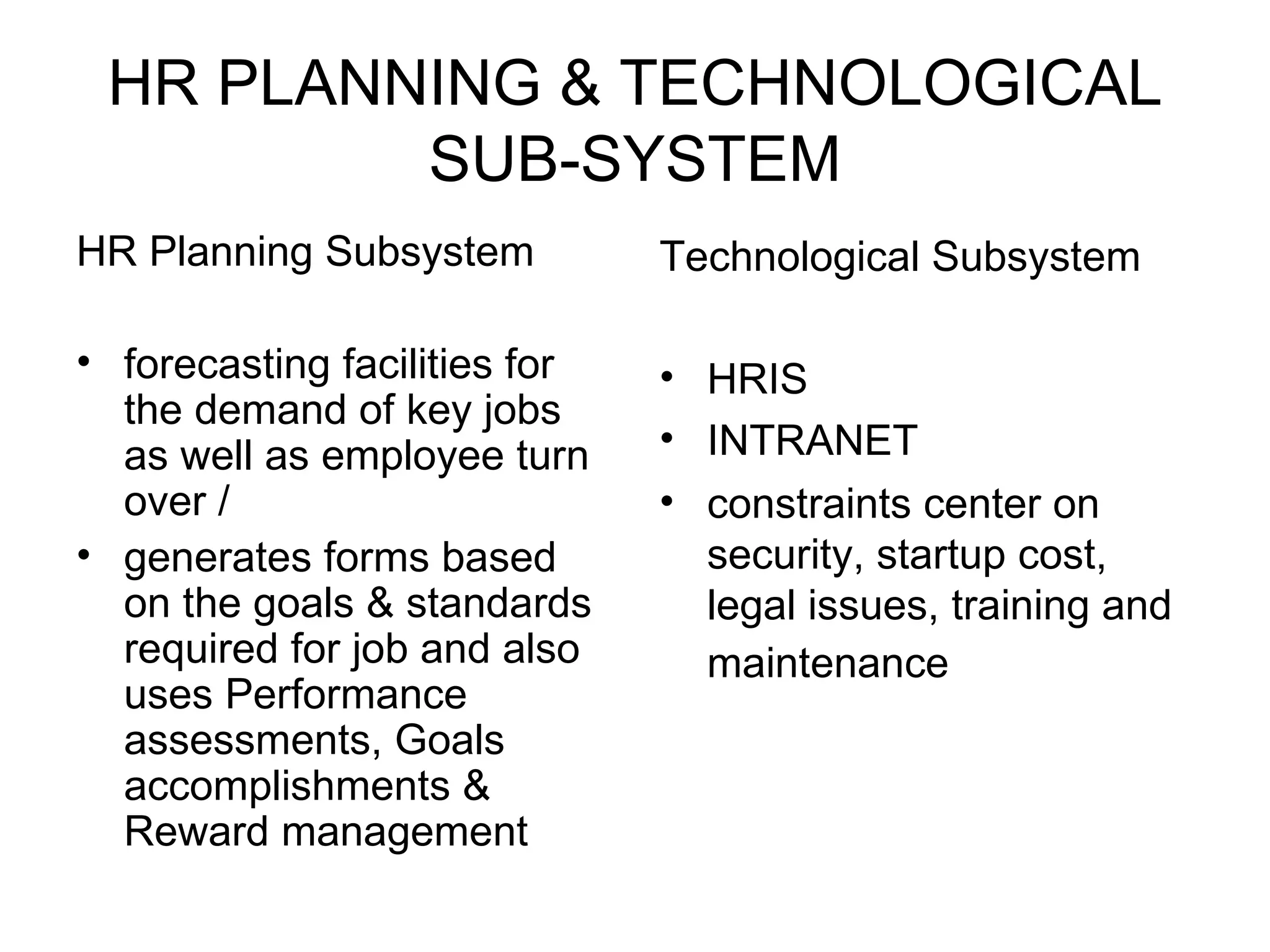
HR PLANNING & TECHNOLOGICAL SUB-SYSTEM HR Planning Subsystem forecasting facilities for the demand of key jobs as well as employee turn over / generates forms based on the goals & standards required for job and also uses Performance assessments, Goals accomplishments & Reward management  Technological Subsystem HRIS INTRANET constraints center on security, startup cost, legal issues, training and maintenance
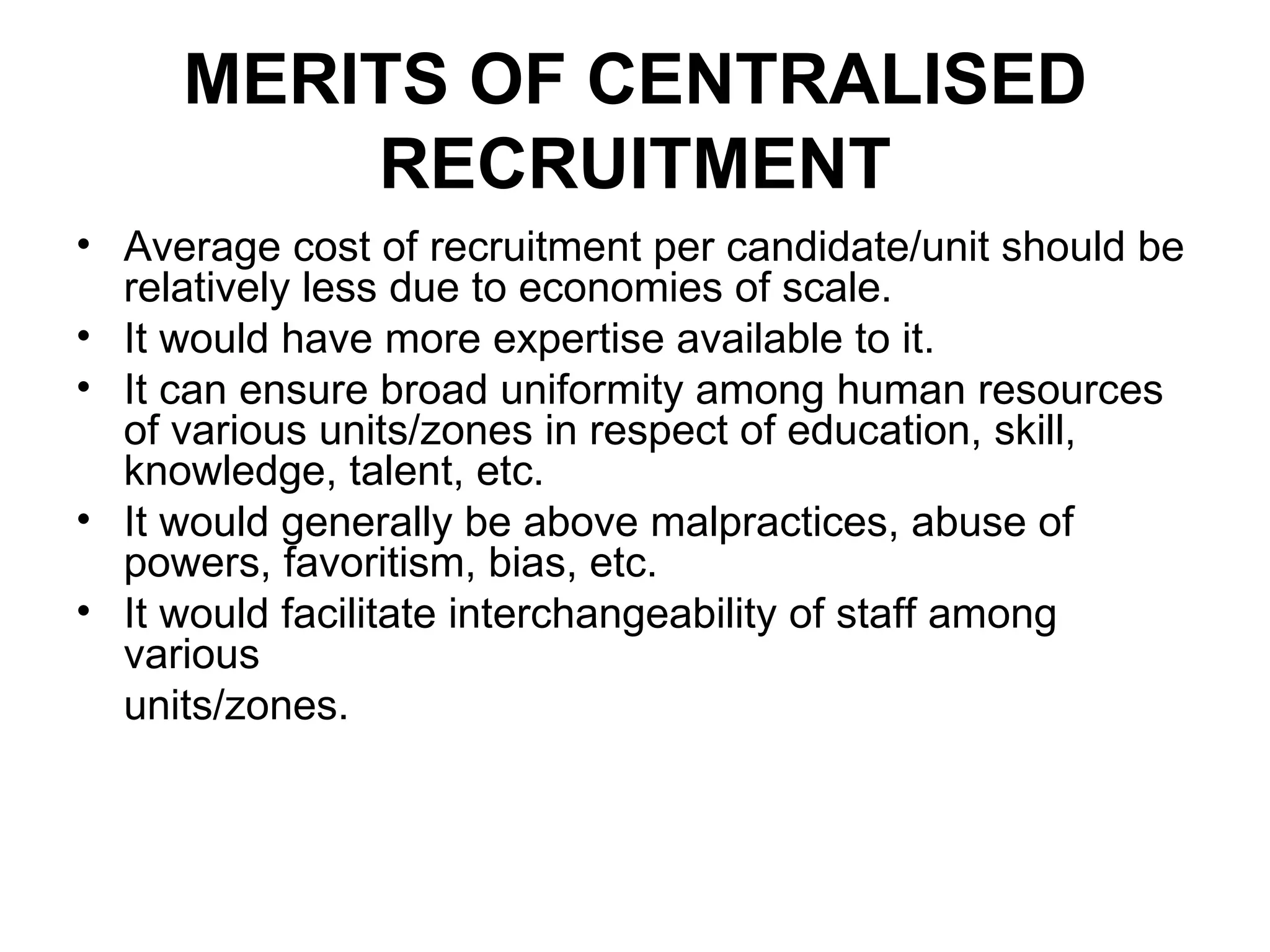
MERITS OF CENTRALISED RECRUITMENT Average cost of recruitment per candidate/unit should be relatively less due to economies of scale. It would have more expertise available to it. It can ensure broad uniformity among human resources of various units/zones in respect of education, skill, knowledge, talent, etc. It would generally be above malpractices, abuse of powers, favoritism, bias, etc. It would facilitate interchangeability of staff among various units/zones.
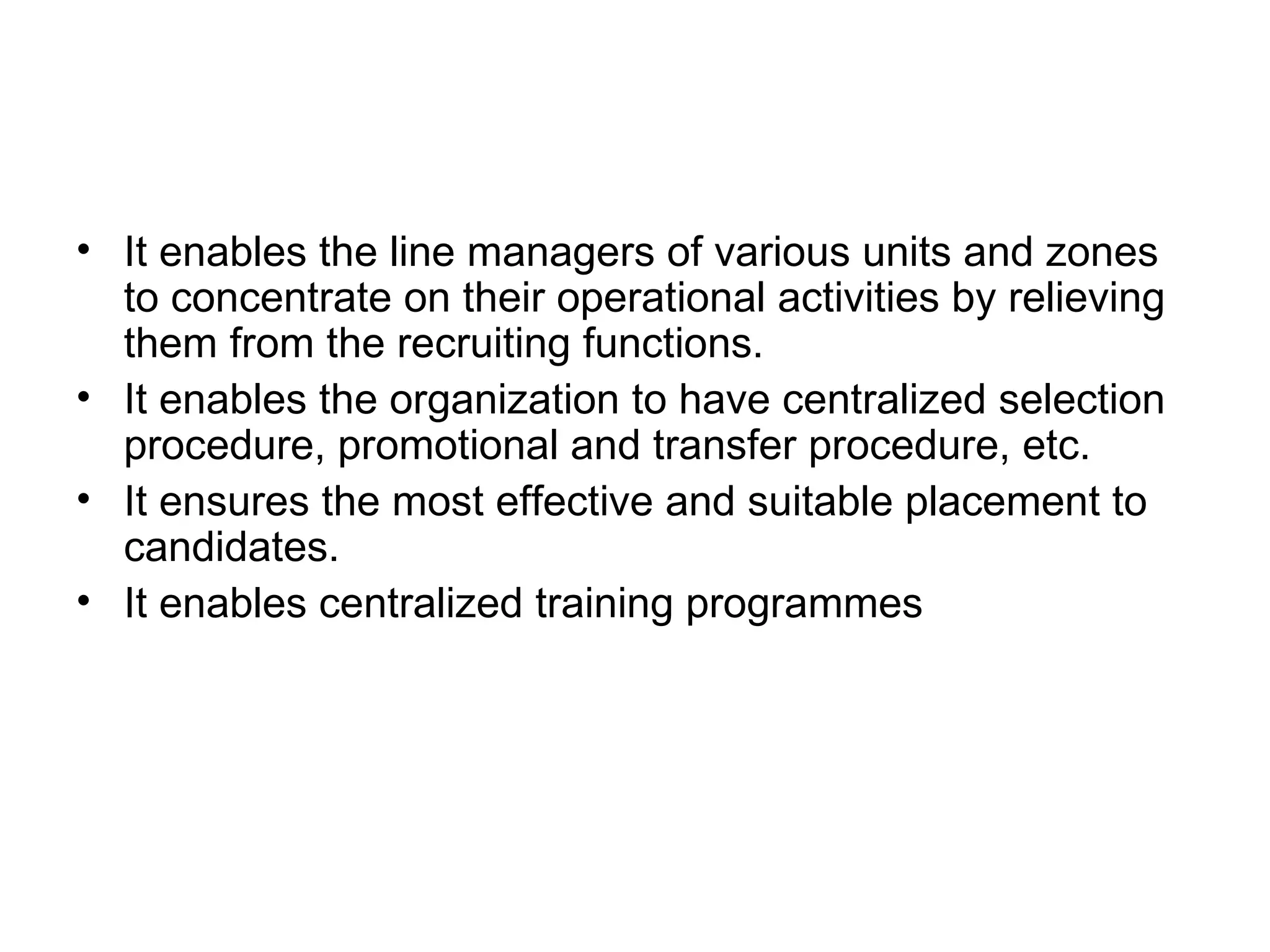
It enables the line managers of various units and zones to concentrate on their operational activities by relieving them from the recruiting functions. It enables the organization to have centralized selection procedure, promotional and transfer procedure, etc. It ensures the most effective and suitable placement to candidates. It enables centralized training programmes
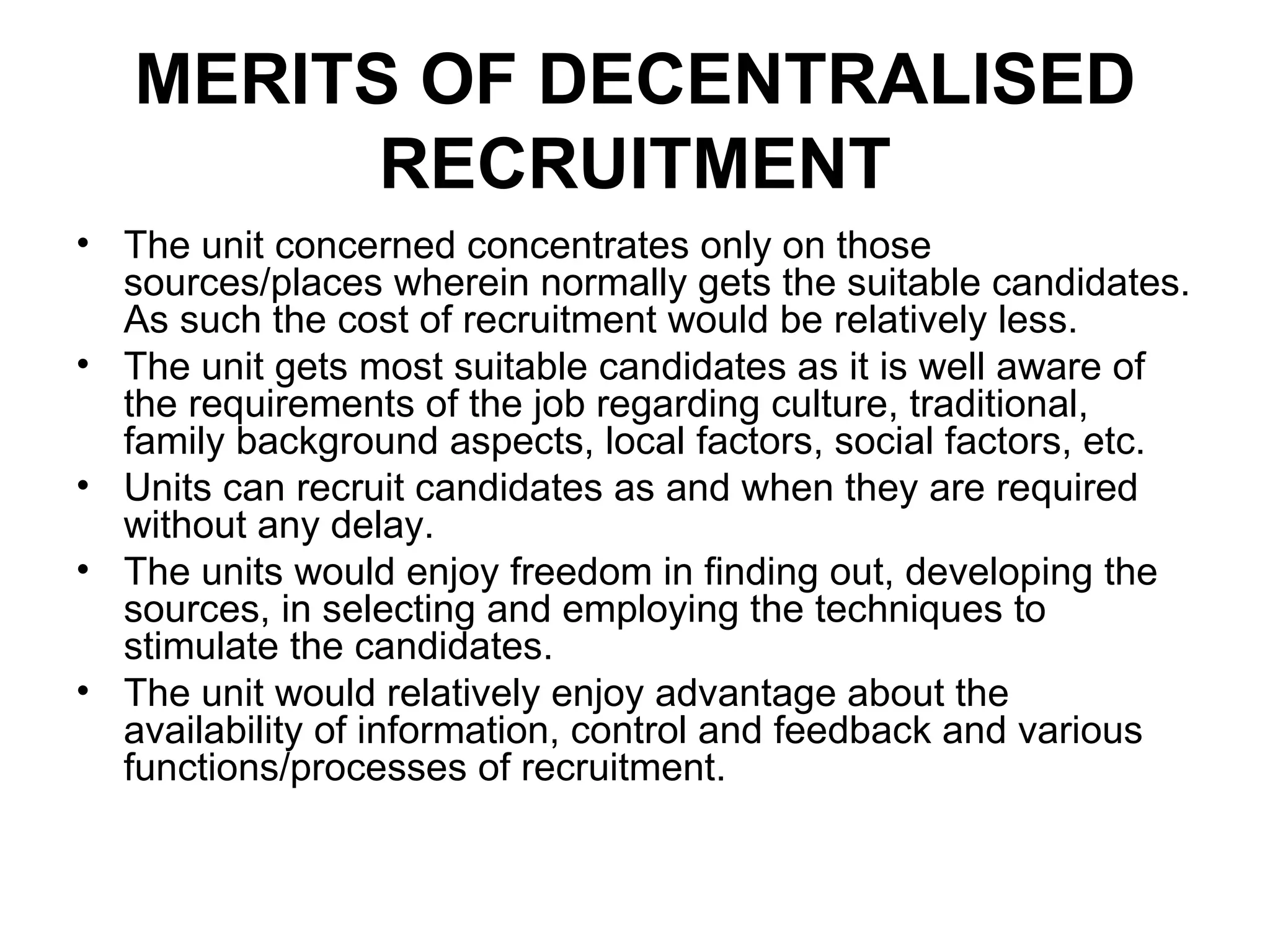
MERITS OF DECENTRALISED RECRUITMENT The unit concerned concentrates only on those sources/places wherein normally gets the suitable candidates. As such the cost of recruitment would be relatively less. The unit gets most suitable candidates as it is well aware of the requirements of the job regarding culture, traditional, family background aspects, local factors, social factors, etc. Units can recruit candidates as and when they are required without any delay. The units would enjoy freedom in finding out, developing the sources, in selecting and employing the techniques to stimulate the candidates. The unit would relatively enjoy advantage about the availability of information, control and feedback and various functions/processes of recruitment.
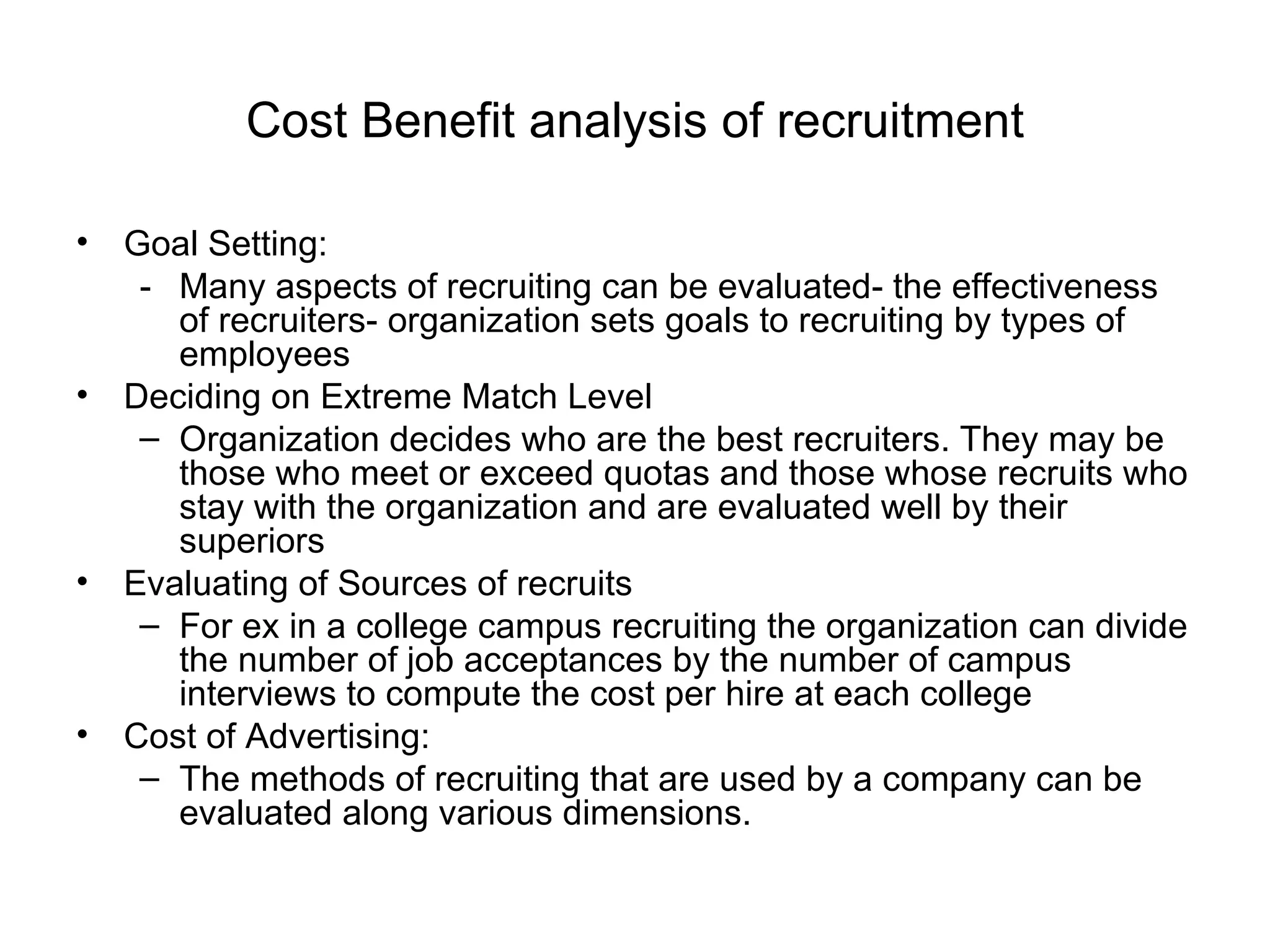
Cost Benefit analysis of recruitment Goal Setting: -  Many aspects of recruiting can be evaluated- the effectiveness of recruiters- organization sets goals to recruiting by types of employees Deciding on Extreme Match Level Organization decides who are the best recruiters. They may be those who meet or exceed quotas and those whose recruits who stay with the organization and are evaluated well by their superiors Evaluating of Sources of recruits  For ex in a college campus recruiting the organization can divide the number of job acceptances by the number of campus interviews to compute the cost per hire at each college Cost of Advertising: The methods of recruiting that are used by a company can be evaluated along various dimensions.

Module 3 recruitment

  • 1.
    Edwin B. Flippo,“Recruitment is the process of searching the candidates for employment and stimulating them to apply for jobs in the organization”.
  • 2.
    A process offinding and attracting capable applicants for employment. The process begins when new recruits are sought and ends when their applications are submitted. The result is a pool of applications from which new employees are selected. It is the process to discover sources of manpower to meet the requirement of staffing schedule and to employ effective
  • 3.
    Recruitment Process Identifyvacancy Prepare job description and person specification Advertising the vacancy Managing the response Short-listing Arrange interviews Conducting interview and decision making The recruitment process is immediately followed by the selection process i.e. the final interviews and the decision making, conveying the decision and the appointment formalities.
  • 4.
    Sources of RecruitmentEvery organization has the option of choosing the candidates for its recruitment processes from two kinds of sources: External Sources Internal Sources.
  • 5.
    Sources of ExternalRecruitment Public Employment Exchanges Professional Associations Colleges and Universities Competitors and Other Firms Unemployed Walk-In Applicants Military Personnel Self-employed Workers
  • 6.
    Needs requiring externalrecruitment: Fill entry-level jobs Acquire skills not possessed by current employees Obtain employees with different backgrounds to provide a diversity of ideas
  • 7.
    External Recruitment TechniqueAdvertising Employment Agencies - Private and Public Recruiters Job Fairs/Virtual Job Fairs Executive Search Firms Internships Professional Associations Open Houses Event Recruiting Campus Recruitment Technique
  • 8.
    External Recruiting AdvantagesBrings in new ideas Disadvantages May negatively impact morale and cohesion Time needed for new employee to learn “ropes” Usually more costly than internal recruiting
  • 9.
    Internal Recruiting TechniquesJob Posting Job Bidding Employee Referrals Promotions Transfers
  • 10.
    Internal Sources PresentPermanent Employees Present Temporary / Part time employees Retrenched / Retired Employees Dependants of Present / Deceased Disabled employees Employee Referrals
  • 11.
    Internal recruiting AdvantagesLess costly Employees are already familiar with company Can boost employee morale Disadvantages Lack of “new blood” Departments can “raid” other departments for best employees
  • 12.
    Modern Technique ConsultIn Head Hunting Body Shopping Business Alliances E-recruitment
  • 13.
    The recruitment function of the organizations is affected and governed by Internal Factors External forces. The internal forces or factors are the factors that can be controlled by the organization. And the external factors are those factors which cannot be controlled by the organisation.
  • 14.
    Internal Factors EmployersBrand Company’s Pay Package Quality of Work life Organizational Culture Career Planning and Growth Company’s Size Company Product / Service Geographical Spread Role of Trade Unions Cost of Recuritment Company’s Name and Fame
  • 15.
    External Factors SocioEconomic Factors Supply and Demand Factors Employment Rate Labor Market Conditions Political, Legal and Governmental factors Information System (employment exchange, consultancy etc)
  • 16.
    Objective of RecruitmentAttract and encourage more and more candidates to apply in the organization. Create a talent pool of candidates to enable the selection of best candidates for the organization. Determine present and future requirements of the organization in conjunction with its personnel planning and job analysis activities. Recruitment is the process which links the employers with the employees.
  • 17.
    Increase the poolof job candidates at minimum cost. Help increase the success rate of selection process by decreasing number of visibly under qualified or overqualified job applicants. Help reduce the probability that job applicants once recruited and selected will leave the organization only after a short period of time. Meet the organizations legal and social obligations regarding the composition of its workforce. Begin identifying and preparing potential job applicants who will be appropriate candidates. To induct outsiders with a new perspectdive
  • 18.
    RECRUITING SUB-SYSTEMS KNOWLEDGESUB-SYSTEM TRAINING & SILHOUETTE SUB-SYSTEM ADMINISTRATION SUB-SYSTEM INFORMATION HUMAN RESOURCE EXPLORATION SUB-SUSTEM HR PLANN -ING SUB- SYSTEM TECHNOLOGICAL SUB-SYSTEM
  • 19.
    RECRUITING SUB-SYSTEMS KNOWLEDGESUB-SYSTEM ADMINISTRATION SUB-SYSTEM INFORMATION TRAINING SUB-SYSTEM HUMAN RESOURCE EXPLORATION SUB-SUSTEM HR PLANNING SUB-SYSTEM TECHNOLOGICAL SUB-SYSTEM
  • 20.
    KNOWLEDGE & ADM’NSUB-SYSTEM Knowledge Subsystem facilities reaching the right knowledge to the right person in right time. combination of culture, process and technology . Administration Subsystem internal/external advertisement module . applicant's profile, [curriculum vita/resume] appointment, types of appointment i.e. adhoc based, honorary, visiting/guest, temporary, apprentice etc.,
  • 21.
    TRAINING & HREXPLORATION SUB-SYSTEM Training Subsystem user specifications & information input into the system. Career planning, development needs analysis & as development advisor through feedback of employees HR Exploration Subsystem bank of current & historic data about employee's attitude, mentality, absenteeism ., well informed of companies new issues in additional to financial details pertaining to health and well being of the employee
  • 22.
    HR PLANNING &TECHNOLOGICAL SUB-SYSTEM HR Planning Subsystem forecasting facilities for the demand of key jobs as well as employee turn over / generates forms based on the goals & standards required for job and also uses Performance assessments, Goals accomplishments & Reward management Technological Subsystem HRIS INTRANET constraints center on security, startup cost, legal issues, training and maintenance
  • 23.
    MERITS OF CENTRALISEDRECRUITMENT Average cost of recruitment per candidate/unit should be relatively less due to economies of scale. It would have more expertise available to it. It can ensure broad uniformity among human resources of various units/zones in respect of education, skill, knowledge, talent, etc. It would generally be above malpractices, abuse of powers, favoritism, bias, etc. It would facilitate interchangeability of staff among various units/zones.
  • 24.
    It enables theline managers of various units and zones to concentrate on their operational activities by relieving them from the recruiting functions. It enables the organization to have centralized selection procedure, promotional and transfer procedure, etc. It ensures the most effective and suitable placement to candidates. It enables centralized training programmes
  • 25.
    MERITS OF DECENTRALISEDRECRUITMENT The unit concerned concentrates only on those sources/places wherein normally gets the suitable candidates. As such the cost of recruitment would be relatively less. The unit gets most suitable candidates as it is well aware of the requirements of the job regarding culture, traditional, family background aspects, local factors, social factors, etc. Units can recruit candidates as and when they are required without any delay. The units would enjoy freedom in finding out, developing the sources, in selecting and employing the techniques to stimulate the candidates. The unit would relatively enjoy advantage about the availability of information, control and feedback and various functions/processes of recruitment.
  • 26.
    Cost Benefit analysisof recruitment Goal Setting: - Many aspects of recruiting can be evaluated- the effectiveness of recruiters- organization sets goals to recruiting by types of employees Deciding on Extreme Match Level Organization decides who are the best recruiters. They may be those who meet or exceed quotas and those whose recruits who stay with the organization and are evaluated well by their superiors Evaluating of Sources of recruits For ex in a college campus recruiting the organization can divide the number of job acceptances by the number of campus interviews to compute the cost per hire at each college Cost of Advertising: The methods of recruiting that are used by a company can be evaluated along various dimensions.