Recruitment & Selection
 Factors affecting recruitment
 Recruitment Policy
 Sources of recruitment
Recruitment
 The process of seeking and
attracting a pool of people
from which qualified
candidates for job vacancies
can be chosen (Byers & Rue)
 Recruitment is the process of
searching for prospective
employees and stimulating
them to apply for jobs in the
organizations.
Recruitment Policy
 Recruitment policy gives guidelines for
manpower staffing w.r.t. quantity and
quality. (Yodder)

A good recruitment policy-
 Compiles with govt. policy
 Provides optimum employment security
 Ensures management interest in employee
development
 Prevents formation of cliques
 Reflects social commitment of
organisation by employing disabled and
underprivileged.
Recruitment policy –
We value the best
 The key objective of ICICI Lombard’s recruitment
policy is to identify and hire people with relevant
competencies and appropriate value system.
 The approach is to source people through
consultants, advertisements, job-sites, internal job
postings and referrals.
 The recruitment plan for various business functions
is based on organizational business growth
projections.
 It is our endeavor to deploy right-person-for-the-
right-job based on hisher strength and further hone
functional competencies by providing a cross-
functional exposure.
Factors affecting recruitment
Organizational Factors
 Reputation of the organisation
 Organization's culture and
management attitude
 Geographical location
 Amount of resources allocated
 Channels and method used to adv.
vacancy
Factors affecting recruitment
Environmental Factors
 Situation in the Labour market
 Stage of development of the industry
 Cultural, social attitude and belief
20 Lakh Jobs In The Aviation
Sector Soon
 The civil aviation industry will generate
about 20 lakh (2 mn) jobs in the next five
years.
 With the opening of the civil aviation
sector there will be plenty of jobs
available and this will come through a
number of services not just technical but
also non-technical such as marketing and
finance.
Retail to create 8 mn jobs in six years
 The ongoing retail boom is expected to
translate into 8 million new jobs over five to
six years. This is in addition to the 21 million
jobs already sustained by retailers, including
‘mom & pop’ stores.
The situation could turn even better once
retail gets industry status and big-time
investments flow in –– either from
multinational chains or home-grown
corporates.
RIL talent hunt puts big retail chains on alert
 Announcing its retail foray, RIL has started hiring staff to
fill up as many as 25 CEO posts in 700 cities.
 Poaching, offering high salaries, everything seems to be
in place for RIL to get its retail plans off the ground.
 The company is handpicking talent itself and is believed to
have kept out headhunters.
 “Any company that announces a retail foray of this scale
and size has to invariably look at the talent pool outside
India, for there is a functional and leadership scarcity in
the organized Indian retail sector as it’s a new industry
here
Sources of Recruitment
 Internal Search:
 Selecting employees from within the
organisation to be groomed to take on
higher responsibilities.
Advantages:
 Economical : The cost of recruitment is
minimal. Time and resources are saved
 Satisfying: It boosts the morale of the
employees.
 Reliable: Applicant’s performance could
be assured.
 Suitable : It helps in selecting the right
candidate.
 It helps in maintain good relationship.
Internal Search:
Demerits:
Scarifying quality: Settling down for less qualified
candidate within will lead to scarifying quality.
 Inbreeding:
 Existing employees may fail to inject necessary
dynamics to enterprise.
 Inefficient:
Promotion based on tenure leads to reduction in
efficiency.
Bone of contention:
Source of conflict
External Search
1. Advertisement
 Analyze the requirement
 Decide who does what
 Write the copy
 Design the advertisement
 Plan the media
 Evaluate the response
External Search
2. Employment Agencies
 Brief them about job specification and any
special req.
 Give them every assistances in defining
the job.
 Check carefully the proposed prog. And
draft text of adv.
 Clarify the basis upon which fees and
expenses will be charged.
 Ensure that arrangements are made to
deal directly with the consultants who will
handle the assignments.
Attrition Costs Weigh Down
BPOs: Study
 A study by the Indian arm of Hay Group, a global HR
consultancy firm, revealed that employee turnover costs
in low-end-voice-based-process firms are about 76 pct of
their annual salary costs working out to more than nine
months' annual compensation.
 Three fourths of what is shown as wage costs in a BPO
may actually be the money that goes towards costs of
hiring, training and rehiring.
 Now BPOs are making recruitment agencies more
accountable and have put replacement clauses in place.
 This means any employee exit before 60 days has to be
made good with another suitable candidate.
 They are also recruiting through other channels such as
referrals, thus, making employees themselves more
accountable.
External Search
4. Employee referrals : Employee
working within the organization
recommend their friends or
acquaintances for vacant position.
5. Educational Institutes:
6. Unsolicited applications:
The Show With A Difference:
JOB SHOW
 Naukri.com, India’s No.1 job site
collaborated with CNBC TV18 to telecast
India’s first-ever Job Show.
With participation from some of the best
companies, the show serves as a unique
platform for job seekers as they can walk
away with their dream job in just 30
minutes.
 The companies gets quality branding
through a dedicated micro site on
naukri.com.
Talent recruitment
 Talent recruitment, Wipro Technologies,
told Business Line that in a highly
competitive recruitment environment, it
was essential to use an optimal mix of
sources to ensure lesser sourcing cost,
reduced hiring time and higher joining
rates. Employee referrals and e-
recruitment contribute significantly
towards achieving these objectives in
Wipro Technologies.
Evaluation of a recruitment program
 The number of successful
placements
 The number of hiring
 The numbers of offers made
 The number of applicants
 The cost involved
 Time taken for filling applicants
19
Definition of Fit
 Fit = match = congruence
 Many different types of fit in HRM
20
Person - Job Fit
 A match between the a person’s skills
and ability with
 Examples:
 Basic accounting knowledge  accounting
jobs
 No tennis training  Tennis couch
 Outcomes?
 HR practices that increase person-job fit?
21
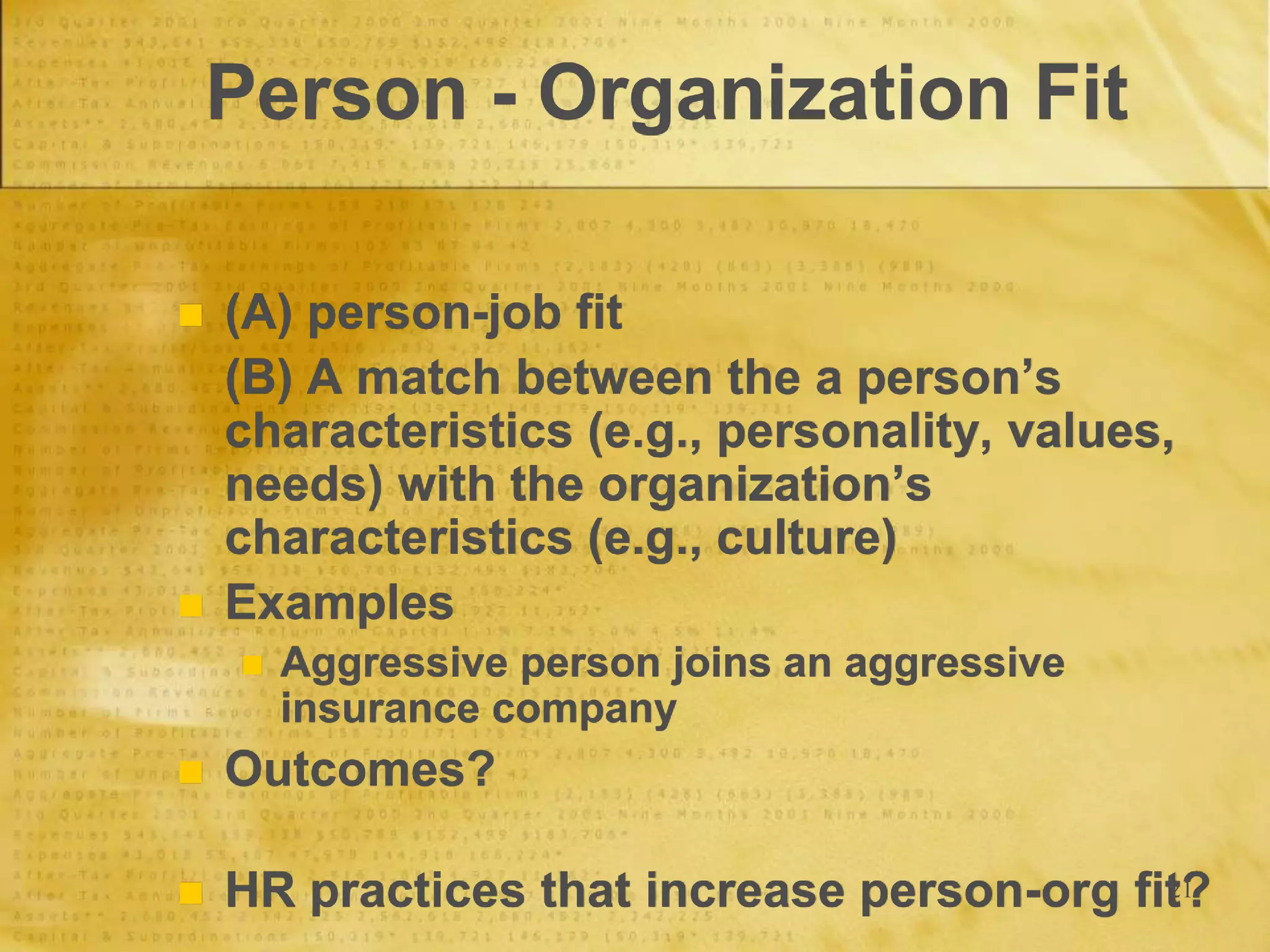
Person - Organization Fit
 (A) person-job fit
(B) A match between the a person’s
characteristics (e.g., personality, values,
needs) with the organization’s
characteristics (e.g., culture)
 Examples
 Aggressive person joins an aggressive
insurance company
 Outcomes?
 HR practices that increase person-org fit?
Selection
 The process of choosing the most
suitable candidate for a job from
among the available applicants is
called selection
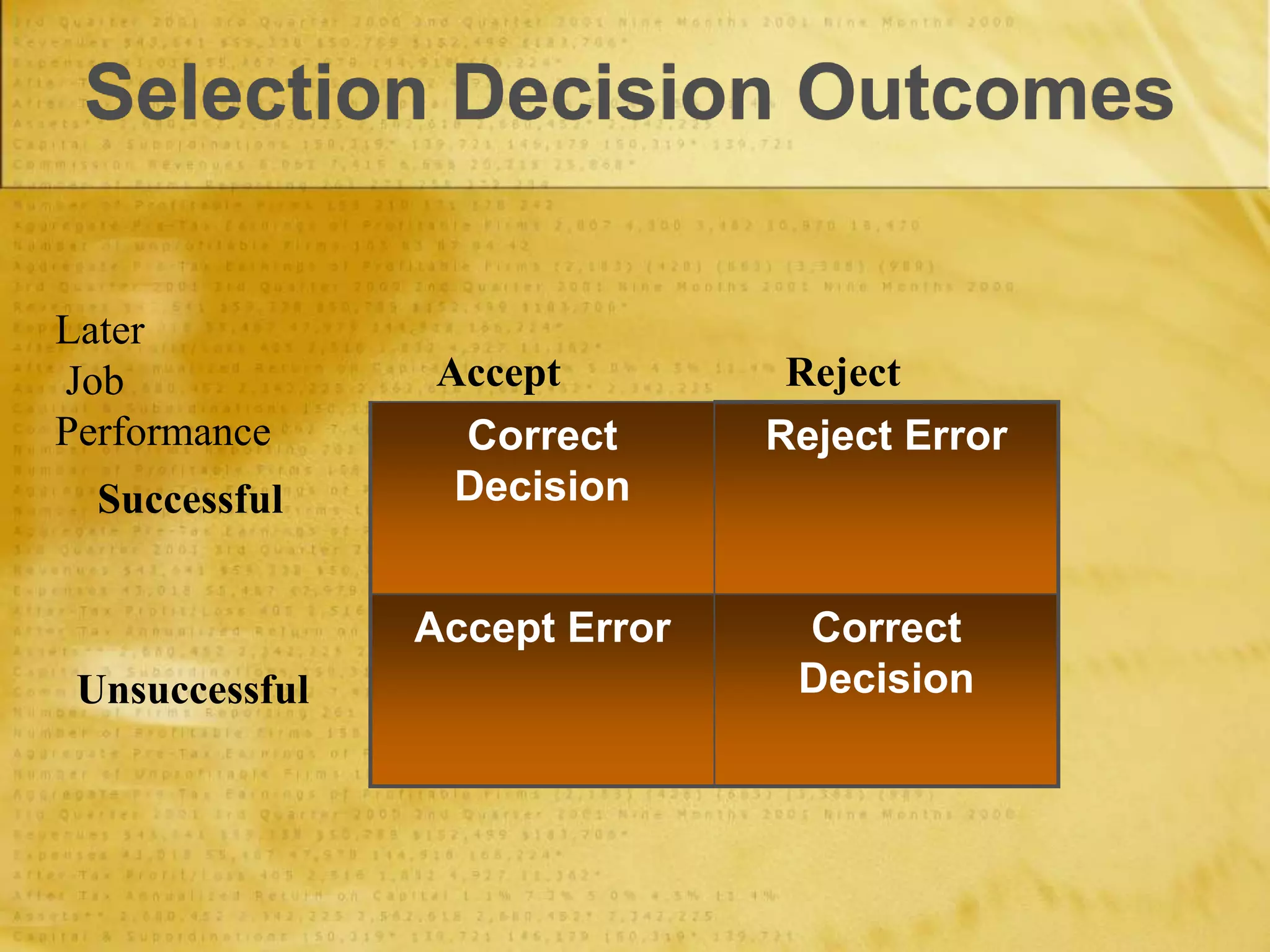
Selection Decision Outcomes
Correct
Decision
Reject Error
Accept Error Correct
Decision
Accept Reject
Successful
Unsuccessful
Later
Job
Performance
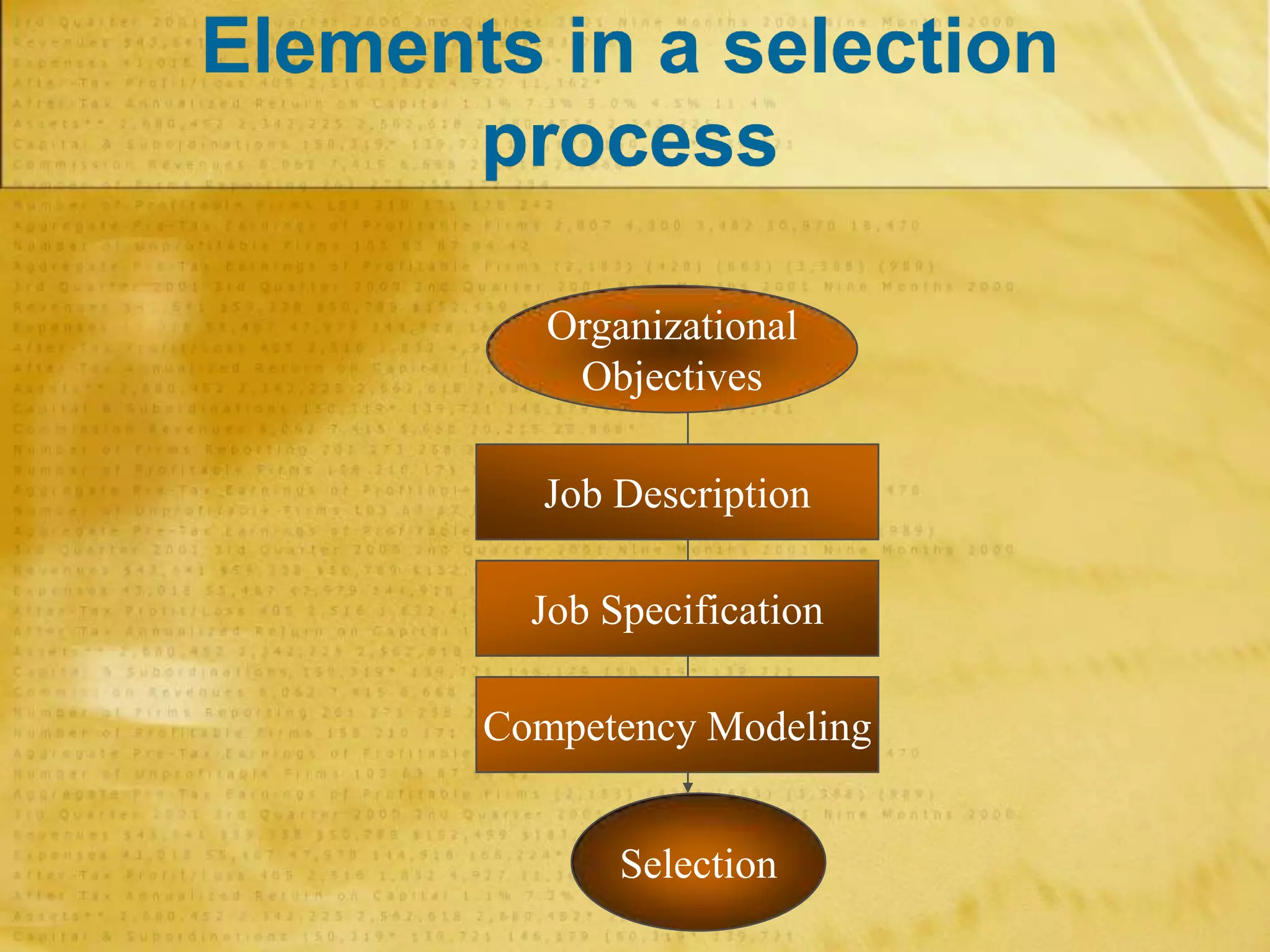
Elements in a selection
process
Organizational
Objectives
Job Description
Job Specification
Competency Modeling
Selection
Steps in selection process
1. Resumes / CV’s Review
2. Initial screening
3. Analyze the application blank
4. Conducting test and evaluating
performance
5. Preliminary Interview
6. Core & Departmental interview
7. Reference checks
8. Job offer
9. Medical examination
10. Placement
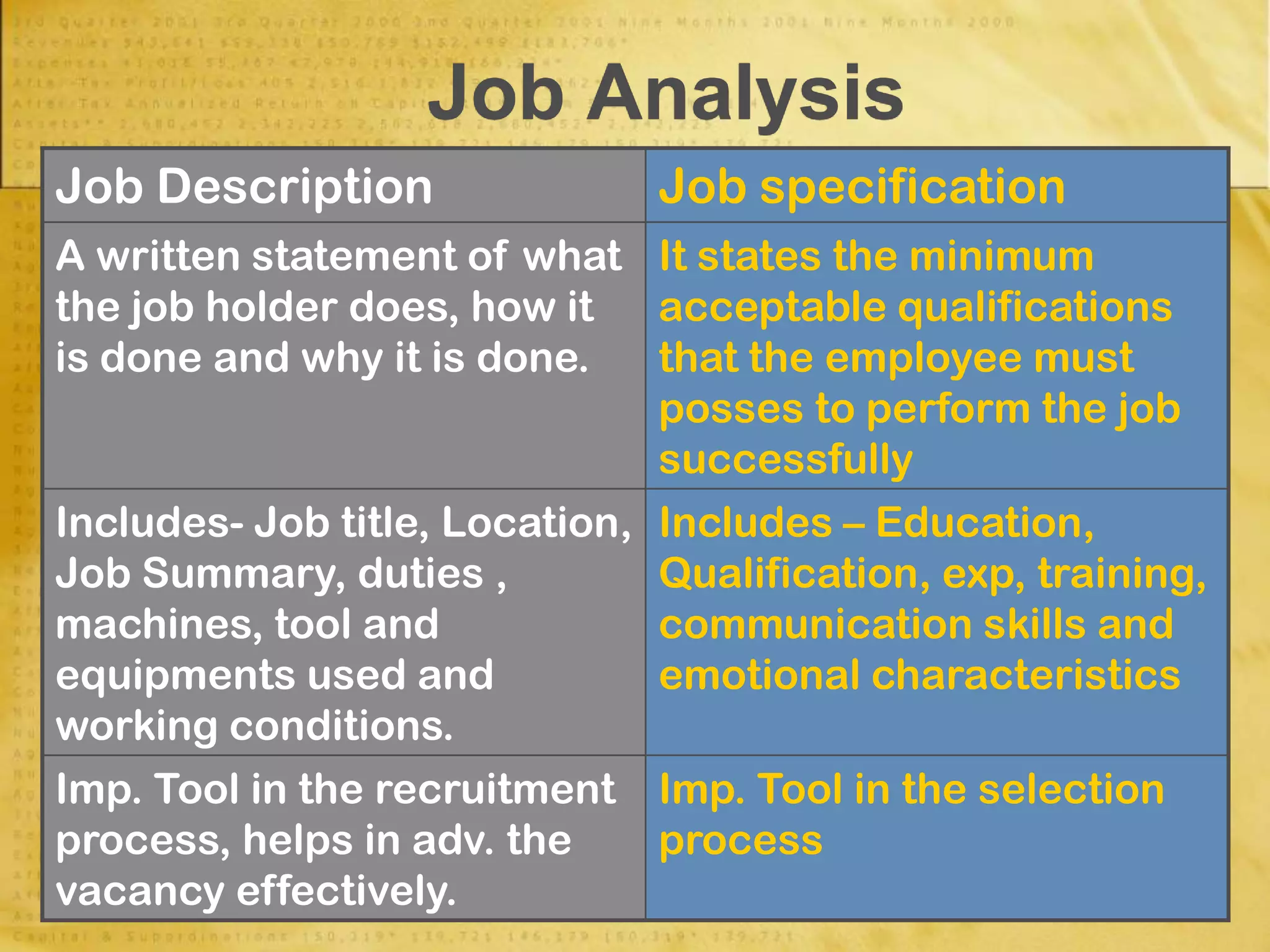
Job Analysis
Job Description Job specification
A written statement of what
the job holder does, how it
is done and why it is done.
It states the minimum
acceptable qualifications
that the employee must
posses to perform the job
successfully
Includes- Job title, Location,
Job Summary, duties ,
machines, tool and
equipments used and
working conditions.
Includes – Education,
Qualification, exp, training,
communication skills and
emotional characteristics
Imp. Tool in the recruitment
process, helps in adv. the
vacancy effectively.
Imp. Tool in the selection
process
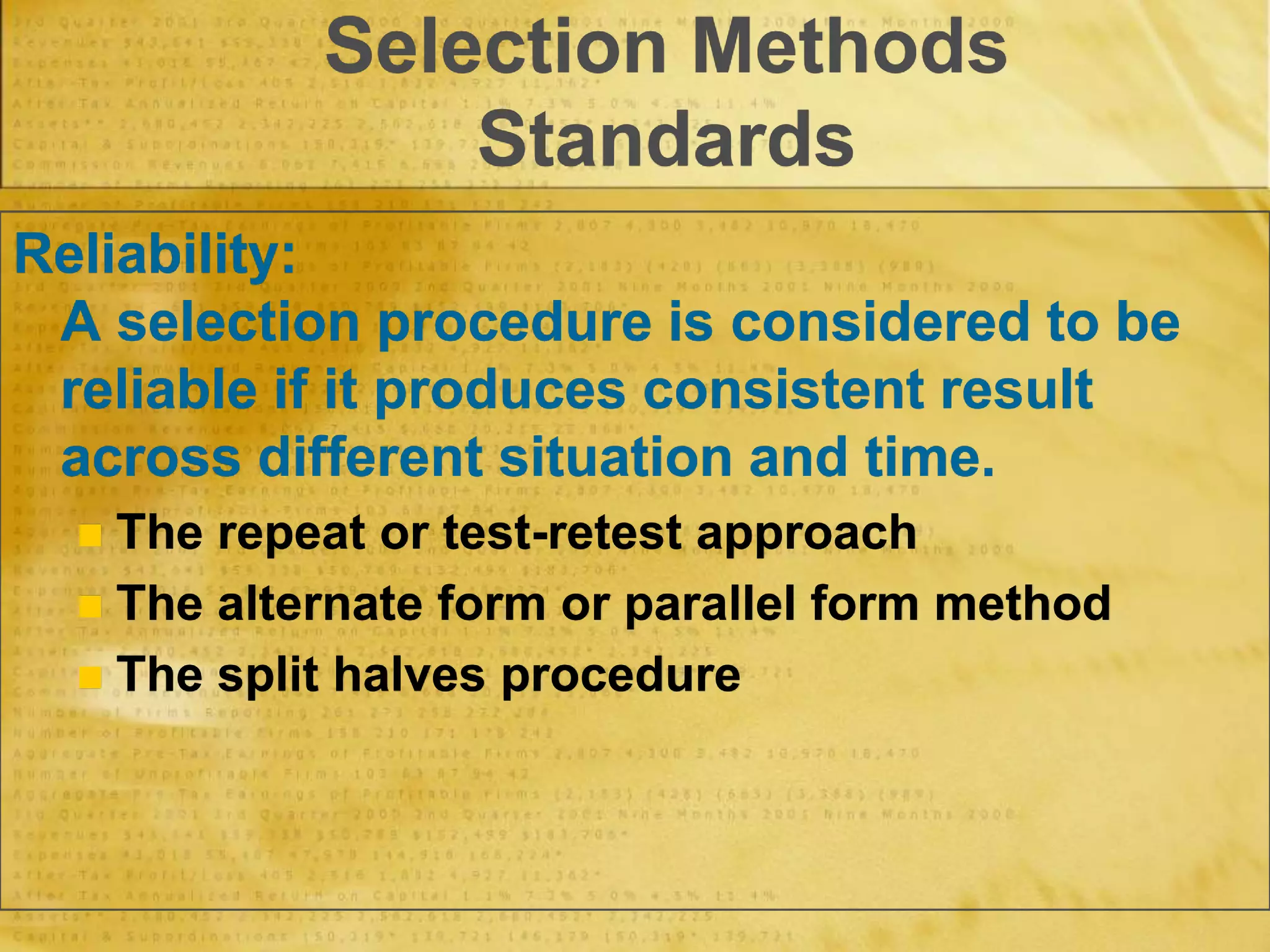
Selection Methods
Standards
Reliability:
A selection procedure is considered to be
reliable if it produces consistent result
across different situation and time.
 The repeat or test-retest approach
 The alternate form or parallel form method
 The split halves procedure
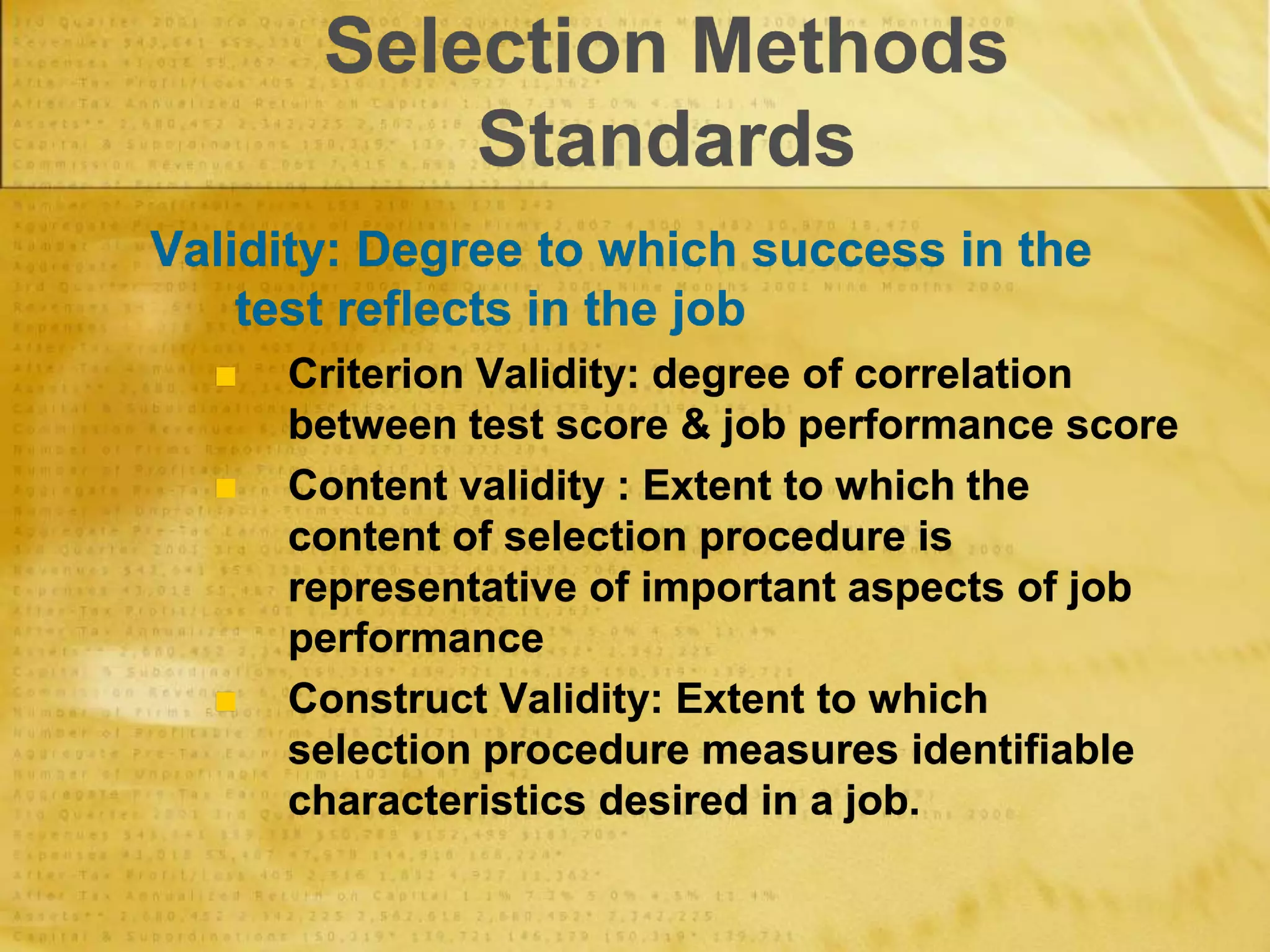
Selection Methods
Standards
Validity: Degree to which success in the
test reflects in the job
 Criterion Validity: degree of correlation
between test score & job performance score
 Content validity : Extent to which the
content of selection procedure is
representative of important aspects of job
performance
 Construct Validity: Extent to which
selection procedure measures identifiable
characteristics desired in a job.
Selection Methods Standards
 Generalizability
 Utility
 Legality
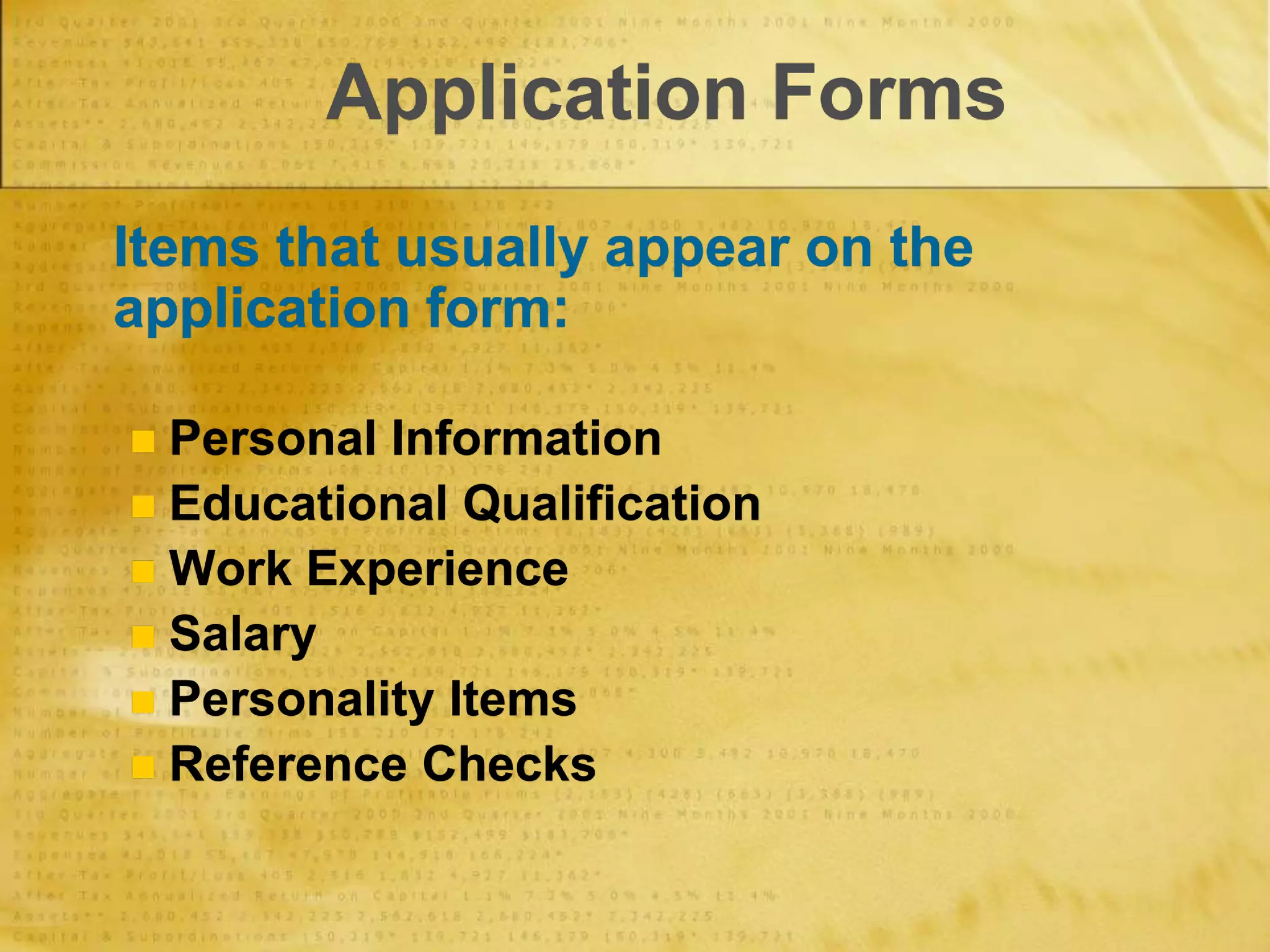
Application Forms
Items that usually appear on the
application form:
 Personal Information
 Educational Qualification
 Work Experience
 Salary
 Personality Items
 Reference Checks
Selection Test
 Intelligence Test
Theodore simon component of
intelligence are “reasoning,
judgment, memory and the power of
abstraction.
IQ test (Logical reasoning, analytical
skills & general knowledge)
Selection Test
Aptitude Test
 Measure an individuals ability to
learn a given job, when given
adequate training
 Psychomotor test
 Clerical aptitude test
Selection Test
 Achievement Test:
 This test measures individuals job
related proficiency or knowledge of
the applicant.
 Job knowledge test
 Work sample test
Selection Test
 Situational Test:
 This test helps us in assessing
applicant’s response to real life
situation.
 Group discussion
 In basket exercise
 Simulated business games
Selection Test
 Interest Test
 Personality Test:
 (self confidence, decisiveness,
optimism, value system, dominance)
 Graphology: Examining individuals
handwriting to assess his
personality, emotional
characteristics and honesty.
Other test….
 Leadership Skills profile
 Multidimensional emotional intelligence assessment workplace (MEIA –
W)
 Six Sigma Personality questionnaire
 Sigma Performance Index.
Interview
 Preliminary Interview
Selection Interview
 Structured Interview
 Unstructured Interview
 Stress Interview
 Group Interview Method
 Panel Interview
 In-depth interview
The Interview Process
 Preparation
 Setting
 Conduct of interview
 Closing an interview
 Evaluation of candidates
 Reference Checks
 Medical Examination
 Placement
Selection Methodology at
HSBC
1. Soft bio-data
2. Questionnaire (50q to assess
candidate job specific
competency)
3. Assessment Centre Test
Personality Test
Intray – CSA
Aptitude Test
1.
Thank you !!
5. recruitment & selection

5. recruitment & selection

  • 1.
    Recruitment & Selection Factors affecting recruitment  Recruitment Policy  Sources of recruitment
  • 2.
    Recruitment  The processof seeking and attracting a pool of people from which qualified candidates for job vacancies can be chosen (Byers & Rue)  Recruitment is the process of searching for prospective employees and stimulating them to apply for jobs in the organizations.
  • 3.
    Recruitment Policy  Recruitmentpolicy gives guidelines for manpower staffing w.r.t. quantity and quality. (Yodder)  A good recruitment policy-  Compiles with govt. policy  Provides optimum employment security  Ensures management interest in employee development  Prevents formation of cliques  Reflects social commitment of organisation by employing disabled and underprivileged.
  • 4.
    Recruitment policy – Wevalue the best  The key objective of ICICI Lombard’s recruitment policy is to identify and hire people with relevant competencies and appropriate value system.  The approach is to source people through consultants, advertisements, job-sites, internal job postings and referrals.  The recruitment plan for various business functions is based on organizational business growth projections.  It is our endeavor to deploy right-person-for-the- right-job based on hisher strength and further hone functional competencies by providing a cross- functional exposure.
  • 5.
    Factors affecting recruitment OrganizationalFactors  Reputation of the organisation  Organization's culture and management attitude  Geographical location  Amount of resources allocated  Channels and method used to adv. vacancy
  • 6.
    Factors affecting recruitment EnvironmentalFactors  Situation in the Labour market  Stage of development of the industry  Cultural, social attitude and belief
  • 7.
    20 Lakh JobsIn The Aviation Sector Soon  The civil aviation industry will generate about 20 lakh (2 mn) jobs in the next five years.  With the opening of the civil aviation sector there will be plenty of jobs available and this will come through a number of services not just technical but also non-technical such as marketing and finance.
  • 8.
    Retail to create8 mn jobs in six years  The ongoing retail boom is expected to translate into 8 million new jobs over five to six years. This is in addition to the 21 million jobs already sustained by retailers, including ‘mom & pop’ stores. The situation could turn even better once retail gets industry status and big-time investments flow in –– either from multinational chains or home-grown corporates.
  • 9.
    RIL talent huntputs big retail chains on alert  Announcing its retail foray, RIL has started hiring staff to fill up as many as 25 CEO posts in 700 cities.  Poaching, offering high salaries, everything seems to be in place for RIL to get its retail plans off the ground.  The company is handpicking talent itself and is believed to have kept out headhunters.  “Any company that announces a retail foray of this scale and size has to invariably look at the talent pool outside India, for there is a functional and leadership scarcity in the organized Indian retail sector as it’s a new industry here
  • 10.
    Sources of Recruitment Internal Search:  Selecting employees from within the organisation to be groomed to take on higher responsibilities. Advantages:  Economical : The cost of recruitment is minimal. Time and resources are saved  Satisfying: It boosts the morale of the employees.  Reliable: Applicant’s performance could be assured.  Suitable : It helps in selecting the right candidate.  It helps in maintain good relationship.
  • 11.
    Internal Search: Demerits: Scarifying quality:Settling down for less qualified candidate within will lead to scarifying quality.  Inbreeding:  Existing employees may fail to inject necessary dynamics to enterprise.  Inefficient: Promotion based on tenure leads to reduction in efficiency. Bone of contention: Source of conflict
  • 12.
    External Search 1. Advertisement Analyze the requirement  Decide who does what  Write the copy  Design the advertisement  Plan the media  Evaluate the response
  • 13.
    External Search 2. EmploymentAgencies  Brief them about job specification and any special req.  Give them every assistances in defining the job.  Check carefully the proposed prog. And draft text of adv.  Clarify the basis upon which fees and expenses will be charged.  Ensure that arrangements are made to deal directly with the consultants who will handle the assignments.
  • 14.
    Attrition Costs WeighDown BPOs: Study  A study by the Indian arm of Hay Group, a global HR consultancy firm, revealed that employee turnover costs in low-end-voice-based-process firms are about 76 pct of their annual salary costs working out to more than nine months' annual compensation.  Three fourths of what is shown as wage costs in a BPO may actually be the money that goes towards costs of hiring, training and rehiring.  Now BPOs are making recruitment agencies more accountable and have put replacement clauses in place.  This means any employee exit before 60 days has to be made good with another suitable candidate.  They are also recruiting through other channels such as referrals, thus, making employees themselves more accountable.
  • 15.
    External Search 4. Employeereferrals : Employee working within the organization recommend their friends or acquaintances for vacant position. 5. Educational Institutes: 6. Unsolicited applications:
  • 16.
    The Show WithA Difference: JOB SHOW  Naukri.com, India’s No.1 job site collaborated with CNBC TV18 to telecast India’s first-ever Job Show. With participation from some of the best companies, the show serves as a unique platform for job seekers as they can walk away with their dream job in just 30 minutes.  The companies gets quality branding through a dedicated micro site on naukri.com.
  • 17.
    Talent recruitment  Talentrecruitment, Wipro Technologies, told Business Line that in a highly competitive recruitment environment, it was essential to use an optimal mix of sources to ensure lesser sourcing cost, reduced hiring time and higher joining rates. Employee referrals and e- recruitment contribute significantly towards achieving these objectives in Wipro Technologies.
  • 18.
    Evaluation of arecruitment program  The number of successful placements  The number of hiring  The numbers of offers made  The number of applicants  The cost involved  Time taken for filling applicants
  • 19.
    19 Definition of Fit Fit = match = congruence  Many different types of fit in HRM
  • 20.
    20 Person - JobFit  A match between the a person’s skills and ability with  Examples:  Basic accounting knowledge  accounting jobs  No tennis training  Tennis couch  Outcomes?  HR practices that increase person-job fit?
  • 21.
    21 Person - OrganizationFit  (A) person-job fit (B) A match between the a person’s characteristics (e.g., personality, values, needs) with the organization’s characteristics (e.g., culture)  Examples  Aggressive person joins an aggressive insurance company  Outcomes?  HR practices that increase person-org fit?
  • 22.
    Selection  The processof choosing the most suitable candidate for a job from among the available applicants is called selection
  • 23.
    Selection Decision Outcomes Correct Decision RejectError Accept Error Correct Decision Accept Reject Successful Unsuccessful Later Job Performance
  • 24.
    Elements in aselection process Organizational Objectives Job Description Job Specification Competency Modeling Selection
  • 25.
    Steps in selectionprocess 1. Resumes / CV’s Review 2. Initial screening 3. Analyze the application blank 4. Conducting test and evaluating performance 5. Preliminary Interview 6. Core & Departmental interview 7. Reference checks 8. Job offer 9. Medical examination 10. Placement
  • 26.
    Job Analysis Job DescriptionJob specification A written statement of what the job holder does, how it is done and why it is done. It states the minimum acceptable qualifications that the employee must posses to perform the job successfully Includes- Job title, Location, Job Summary, duties , machines, tool and equipments used and working conditions. Includes – Education, Qualification, exp, training, communication skills and emotional characteristics Imp. Tool in the recruitment process, helps in adv. the vacancy effectively. Imp. Tool in the selection process
  • 27.
    Selection Methods Standards Reliability: A selectionprocedure is considered to be reliable if it produces consistent result across different situation and time.  The repeat or test-retest approach  The alternate form or parallel form method  The split halves procedure
  • 28.
    Selection Methods Standards Validity: Degreeto which success in the test reflects in the job  Criterion Validity: degree of correlation between test score & job performance score  Content validity : Extent to which the content of selection procedure is representative of important aspects of job performance  Construct Validity: Extent to which selection procedure measures identifiable characteristics desired in a job.
  • 29.
    Selection Methods Standards Generalizability  Utility  Legality
  • 30.
    Application Forms Items thatusually appear on the application form:  Personal Information  Educational Qualification  Work Experience  Salary  Personality Items  Reference Checks
  • 31.
    Selection Test  IntelligenceTest Theodore simon component of intelligence are “reasoning, judgment, memory and the power of abstraction. IQ test (Logical reasoning, analytical skills & general knowledge)
  • 32.
    Selection Test Aptitude Test Measure an individuals ability to learn a given job, when given adequate training  Psychomotor test  Clerical aptitude test
  • 33.
    Selection Test  AchievementTest:  This test measures individuals job related proficiency or knowledge of the applicant.  Job knowledge test  Work sample test
  • 34.
    Selection Test  SituationalTest:  This test helps us in assessing applicant’s response to real life situation.  Group discussion  In basket exercise  Simulated business games
  • 35.
    Selection Test  InterestTest  Personality Test:  (self confidence, decisiveness, optimism, value system, dominance)  Graphology: Examining individuals handwriting to assess his personality, emotional characteristics and honesty.
  • 36.
    Other test….  LeadershipSkills profile  Multidimensional emotional intelligence assessment workplace (MEIA – W)  Six Sigma Personality questionnaire  Sigma Performance Index.
  • 37.
    Interview  Preliminary Interview SelectionInterview  Structured Interview  Unstructured Interview  Stress Interview  Group Interview Method  Panel Interview  In-depth interview
  • 38.
    The Interview Process Preparation  Setting  Conduct of interview  Closing an interview  Evaluation of candidates  Reference Checks  Medical Examination  Placement
  • 39.
    Selection Methodology at HSBC 1.Soft bio-data 2. Questionnaire (50q to assess candidate job specific competency) 3. Assessment Centre Test Personality Test Intray – CSA Aptitude Test 1.
  • 40.