REFERRAL SYSTEM
Prepared by
Hitha Udayabhanu
DEFINITION
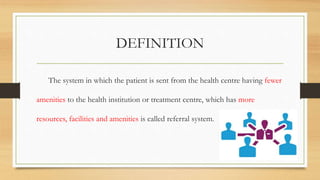
The system in which the patient is sent from the health centre having fewer
amenities to the health institution or treatment centre, which has more
resources, facilities and amenities is called referral system.
OR
Referral system is defined as a system of transferring cases which are
beyond the technical competence of one infrastructure to a higher level
infrastructure/ institution having technical competency and all other resources
to provide desired health services.
OR
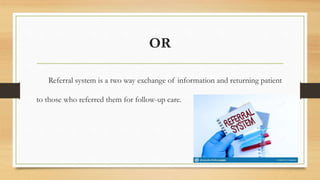
Referral system is a two way exchange of information and returning patient
to those who referred them for follow-up care.
OBJECTIVES
• Provision to healthcare as priority.
• To categorize the patient by triaging.
• To prevent further complications.
• To sent the patient comfortably to the facility.
• To reduce the waste of time.
• To provide specialist care as per availability of services.
• To provide diagnostic services to patient and community.
s
PRINCIPLES
• The referral should meet the needs and objectives of the client, should be
necessary and appropriate.
• The client should be able to use the referral in an efficient and effective
manner.
• The referral should be individualized to the client.
• The referral should be timely.
• The referral should be co-ordinated with other activities.
• The referral should in-corporate the client and family members.
• The client should have right to refuse the referral.
• There should be proper follow-up care for the ones who were referred.
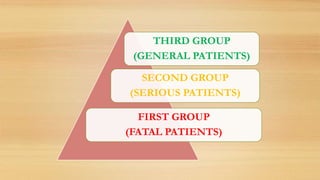
THIRD GROUP
(GENERAL PATIENTS)
SECOND GROUP
(SERIOUS PATIENTS)
FIRST GROUP
(FATAL PATIENTS)
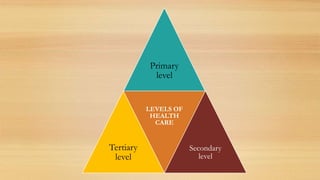
LEVELS OF
HEALTHCARE
Primary
level
Tertiary
level
LEVELS OF
HEALTH
CARE
Secondary
level
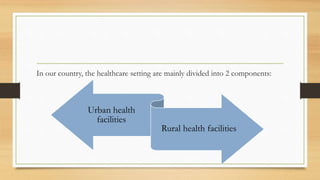
In our country, the healthcare setting are mainly divided into 2 components:
Urban health
facilities
Rural health facilities
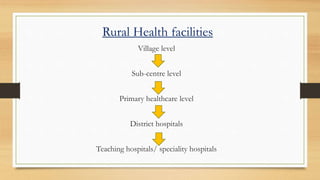
Rural Health facilities
Village level
Sub-centre level
Primary healthcare level
District hospitals
Teaching hospitals/ speciality hospitals
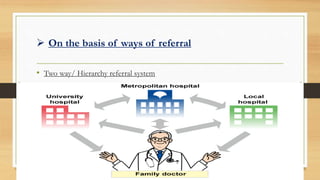
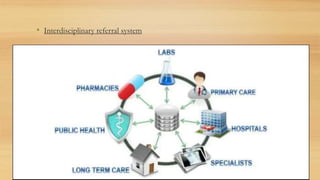
 On the basis of ways of referral
• Two way/ Hierarchy referral system
• Interdisciplinary referral system
• Horizontal referral system
A patient in one ward of a teaching hospital is referred to the wards of
other specialities.
 Modern classification
• Interval referral
Patient is admitted in hospital for a period, then return for continuity of care/
treatment.
 Modern classification contd…
• Collateral referral
Patient of one problem is referred to another specialists.
 Modern classification contd….
• Split
It is referral of patient in multi-speciality of the same hospital or centre.
 Modern classification contd…
• Cross referral
It is self-referral of patient as his wish.
NEED FOR
REFERRAL
REQUIREMENT FOR
EFFECTIVE REFERRAL
• Well trained professionals, medical equipment and supplies, organization
structure etc.
• Continuing training, guidance and supervision of HW.
• Guidance on sanitary measures and to disseminate information on disease
control methods.
• Conduct health education sessions.
• Provide logistic support in terms of equipment and supplies required at
PHC.
• Establish liaison and functional relation with other sectors.
• Organize transportation facilities for the cases to be referred.
STEPS IN REFERRAL
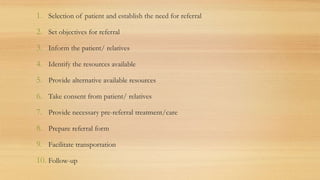
1. Selection of patient and establish the need for referral
2. Set objectives for referral
3. Inform the patient/ relatives
4. Identify the resources available
5. Provide alternative available resources
6. Take consent from patient/ relatives
7. Provide necessary pre-referral treatment/care
8. Prepare referral form
9. Facilitate transportation
10. Follow-up
BENEFITS OF
REFERRAL
 For the patient
• Prompt diagnosis and management
• Save time, money and effort
• Better outcome
 For the physician
• Learning and training
• Gaining self-confidence
• Increase communication between the healthcare staff
BARRIERS OF
REFERRAL PROCESS
 RESOURCE BARRIERS
• Attitudes of healthcare professionals
• Physical accessibility of resource
• Cost of resource services
 CLIENT BARRIERS
• Priorities
• Motivation
• Previous experience with resources
• Lack of knowledge about available resources
• Lack of understanding regarding need for referral
• Client self-image
• Finances
• Accessibility
ROLES AND
RESPONSIBILITIES OF
CHN
• Observe and collect the information.
• Nurses should be aware of their limitations and responsibilities in referral
system.
• In case of emergency, they should attempt to save the life of the patient
before referral.
• Entries in the referral form should be clear and correct.
• While sending serious patients, life-saving equipment/ medicines should be
arranged.
• Nurse should explore and use the available resources for transportation.
• Nurse should accompany the patient while sending him for referral.
• Assure the casualty/ family members.
• Explains about the seriousness of the situation/ problem.
• Maintain the records and reports.
Referral system