Recommender
Systems
João Paulo L. F. Dias da Silva
Oct 2014
Background
(5 min)
Implementation
(5 min)
Demonstration
(5 min)
Agenda
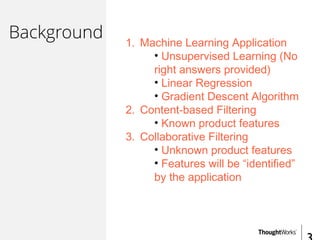
Background 1. Machine Learning Application
• Unsupervised Learning (No
right answers provided)
• Linear Regression
• Gradient Descent Algorithm
2. Content-based Filtering
• Known product features
3. Collaborative Filtering
• Unknown product features
• Features will be “identified”
by the application
Linear Regression
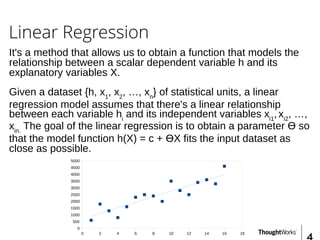
It's a method that allows us to obtain a function that models the
relationship between a scalar dependent variable h and its
explanatory variables X.
Given a dataset {h, x1
, x2
, …, xn
} of statistical units, a linear
regression model assumes that there's a linear relationship
between each variable hi
and its independent variables xi1
, xi2
, …,
xin.
The goal of the linear regression is to obtain a parameter Ɵ so
that the model function h(X) = c + ƟX fits the input dataset as
close as possible.
0 2 4 6 8 10 12 14 16 18
0
500
1000
1500
2000
2500
3000
3500
4000
4500
5000
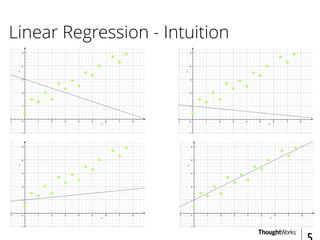
Linear Regression - Intuition
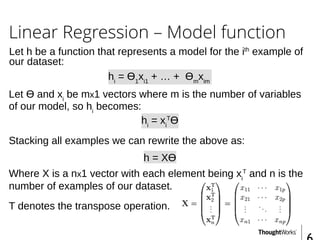
Linear Regression – Model function
hi
= Ɵ1
xi1
+ … + Ɵm
xim
Stacking all examples we can rewrite the above as:
hi
= xi
T
Ɵ
Where X is a nx1 vector with each element being xi
T
and n is the
number of examples of our dataset.
T denotes the transpose operation.
Let h be a function that represents a model for the ith
example of
our dataset:
h = XƟ
Let Ɵ and xi
be mx1 vectors where m is the number of variables
of our model, so hi
becomes:
Linear Regression – Error function
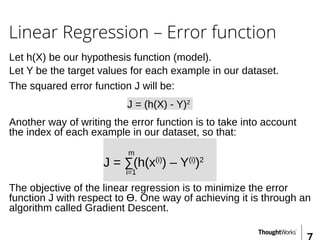
Let h(X) be our hypothesis function (model).
J = (h(X) - Y)2
Let Y be the target values for each example in our dataset.
The squared error function J will be:
Another way of writing the error function is to take into account
the index of each example in our dataset, so that:
m
J = ∑(h(x(i)
) – Y(i)
)2
i=1
The objective of the linear regression is to minimize the error
function J with respect to Ɵ. One way of achieving it is through an
algorithm called Gradient Descent.
Gradient Descent Algorithm
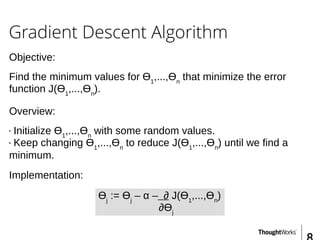
Objective:
Find the minimum values for Ɵ1
,...,Ɵn
that minimize the error
function J(Ɵ1
,...,Ɵn
).
Overview:
• Initialize Ɵ1
,...,Ɵn
with some random values.
• Keep changing Ɵ1
,...,Ɵn
to reduce J(Ɵ1
,...,Ɵn
) until we find a
minimum.
Implementation:
Ɵj
:= Ɵj
– α – ∂ J(Ɵ1
,...,Ɵn
)
∂Ɵj
Gradient Descent
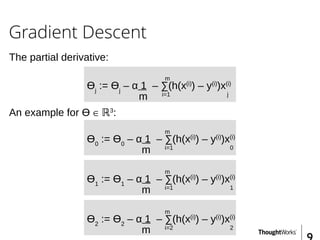
The partial derivative:
m
Ɵj
:= Ɵj
– α 1 – ∑(h(x(i)
) – y(i)
)x(i)
m i=1 j
An example for Ɵ ∈ ℝ3
:
m
Ɵ0
:= Ɵ0
– α 1 – ∑(h(x(i)
) – y(i)
)x(i)
m i=1 0
m
Ɵ1
:= Ɵ1
– α 1 – ∑(h(x(i)
) – y(i)
)x(i)
m i=1 1
m
Ɵ2
:= Ɵ2
– α 1 – ∑(h(x(i)
) – y(i)
)x(i)
m i=2 2
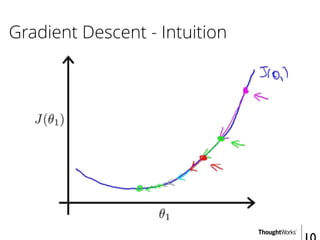
Gradient Descent - Intuition
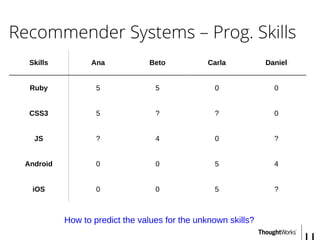
Recommender Systems – Prog. Skills
Skills Ana Beto Carla Daniel
Ruby 5 5 0 0
CSS3 5 ? ? 0
JS ? 4 0 ?
Android 0 0 5 4
iOS 0 0 5 ?
How to predict the values for the unknown skills?
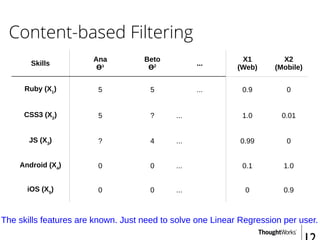
Content-based Filtering
Skills
Ana
Ɵ¹
Beto
Ɵ2 ...
X1
(Web)
X2
(Mobile)
Ruby (X1
) 5 5 ... 0.9 0
CSS3 (X2
) 5 ? ... 1.0 0.01
JS (X3
) ? 4 ... 0.99 0
Android (X4
) 0 0 ... 0.1 1.0
iOS (X5
) 0 0 ... 0 0.9
The skills features are known. Just need to solve one Linear Regression per user.
Content-based Filtering - Predicting
Skills
Ana
Ɵ¹ = [5, 0]
...
X1
(Web)
X2
(Mobile)
Ruby (X1
) 5 ... 0.9 0
CSS3 (X2
) 5 ... 1.0 0.01
JS (X3
) 5 ... 0.99 0
Android (X4
) 0 ... 0.1 1.0
iOS (X5
) 0 ... 0 0.9
Ana(JS) => Ɵ¹ * X3
=> [5, 0] * [0.99, 0] = (5 * 0.99) + (0 * 0) = 5
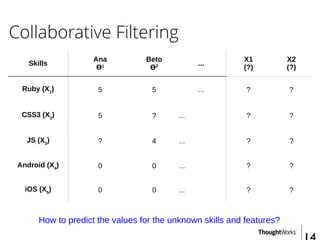
Collaborative Filtering
Skills
Ana
Ɵ¹
Beto
Ɵ2 ...
X1
(?)
X2
(?)
Ruby (X1
) 5 5 ... ? ?
CSS3 (X2
) 5 ? ... ? ?
JS (X3
) ? 4 ... ? ?
Android (X4
) 0 0 ... ? ?
iOS (X5
) 0 0 ... ? ?
How to predict the values for the unknown skills and features?
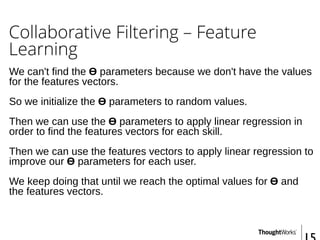
Collaborative Filtering – Feature
Learning
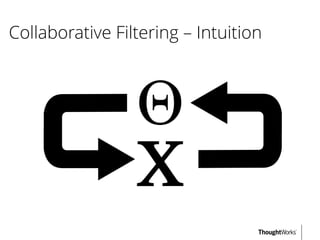
We can't find the Ɵ parameters because we don't have the values
for the features vectors.
So we initialize the Ɵ parameters to random values.
Then we can use the Ɵ parameters to apply linear regression in
order to find the features vectors for each skill.
Then we can use the features vectors to apply linear regression to
improve our Ɵ parameters for each user.
We keep doing that until we reach the optimal values for Ɵ and
the features vectors.
Collaborative Filtering – Intuition
Collaborative Filtering - Predicting
Skills
Ana
Ɵ¹ = [5, 0]
... X1 X2
Ruby (X1
) 5 ... 0.9 0
CSS3 (X2
) 5 ... 1.0 0.01
JS (X3
) 5 ... 0.99 0
Android (X4
) 0 ... 0.1 1.0
iOS (X5
) 0 ... 0 0.9
Ana(JS) => Ɵ¹ * X3
=> [5, 0] * [0.99, 0] = (5 * 0.99) + (0 * 0) = 5
Implementa
tion
Python for data scraping
Octave for LR/GD matrix calculations
Missing UI
Hardcoded input
Demo
Programming
Skills
QA & Next Steps

Recommender Systems

  • 1.
    Recommender Systems João Paulo L.F. Dias da Silva Oct 2014
  • 2.
  • 3.
    Background 1. MachineLearning Application • Unsupervised Learning (No right answers provided) • Linear Regression • Gradient Descent Algorithm 2. Content-based Filtering • Known product features 3. Collaborative Filtering • Unknown product features • Features will be “identified” by the application
  • 4.
    Linear Regression It's amethod that allows us to obtain a function that models the relationship between a scalar dependent variable h and its explanatory variables X. Given a dataset {h, x1 , x2 , …, xn } of statistical units, a linear regression model assumes that there's a linear relationship between each variable hi and its independent variables xi1 , xi2 , …, xin. The goal of the linear regression is to obtain a parameter Ɵ so that the model function h(X) = c + ƟX fits the input dataset as close as possible. 0 2 4 6 8 10 12 14 16 18 0 500 1000 1500 2000 2500 3000 3500 4000 4500 5000
  • 5.
  • 6.
    Linear Regression –Model function hi = Ɵ1 xi1 + … + Ɵm xim Stacking all examples we can rewrite the above as: hi = xi T Ɵ Where X is a nx1 vector with each element being xi T and n is the number of examples of our dataset. T denotes the transpose operation. Let h be a function that represents a model for the ith example of our dataset: h = XƟ Let Ɵ and xi be mx1 vectors where m is the number of variables of our model, so hi becomes:
  • 7.
    Linear Regression –Error function Let h(X) be our hypothesis function (model). J = (h(X) - Y)2 Let Y be the target values for each example in our dataset. The squared error function J will be: Another way of writing the error function is to take into account the index of each example in our dataset, so that: m J = ∑(h(x(i) ) – Y(i) )2 i=1 The objective of the linear regression is to minimize the error function J with respect to Ɵ. One way of achieving it is through an algorithm called Gradient Descent.
  • 8.
    Gradient Descent Algorithm Objective: Findthe minimum values for Ɵ1 ,...,Ɵn that minimize the error function J(Ɵ1 ,...,Ɵn ). Overview: • Initialize Ɵ1 ,...,Ɵn with some random values. • Keep changing Ɵ1 ,...,Ɵn to reduce J(Ɵ1 ,...,Ɵn ) until we find a minimum. Implementation: Ɵj := Ɵj – α – ∂ J(Ɵ1 ,...,Ɵn ) ∂Ɵj
  • 9.
    Gradient Descent The partialderivative: m Ɵj := Ɵj – α 1 – ∑(h(x(i) ) – y(i) )x(i) m i=1 j An example for Ɵ ∈ ℝ3 : m Ɵ0 := Ɵ0 – α 1 – ∑(h(x(i) ) – y(i) )x(i) m i=1 0 m Ɵ1 := Ɵ1 – α 1 – ∑(h(x(i) ) – y(i) )x(i) m i=1 1 m Ɵ2 := Ɵ2 – α 1 – ∑(h(x(i) ) – y(i) )x(i) m i=2 2
  • 10.
  • 11.
    Recommender Systems –Prog. Skills Skills Ana Beto Carla Daniel Ruby 5 5 0 0 CSS3 5 ? ? 0 JS ? 4 0 ? Android 0 0 5 4 iOS 0 0 5 ? How to predict the values for the unknown skills?
  • 12.
    Content-based Filtering Skills Ana Ɵ¹ Beto Ɵ2 ... X1 (Web) X2 (Mobile) Ruby(X1 ) 5 5 ... 0.9 0 CSS3 (X2 ) 5 ? ... 1.0 0.01 JS (X3 ) ? 4 ... 0.99 0 Android (X4 ) 0 0 ... 0.1 1.0 iOS (X5 ) 0 0 ... 0 0.9 The skills features are known. Just need to solve one Linear Regression per user.
  • 13.
    Content-based Filtering -Predicting Skills Ana Ɵ¹ = [5, 0] ... X1 (Web) X2 (Mobile) Ruby (X1 ) 5 ... 0.9 0 CSS3 (X2 ) 5 ... 1.0 0.01 JS (X3 ) 5 ... 0.99 0 Android (X4 ) 0 ... 0.1 1.0 iOS (X5 ) 0 ... 0 0.9 Ana(JS) => Ɵ¹ * X3 => [5, 0] * [0.99, 0] = (5 * 0.99) + (0 * 0) = 5
  • 14.
    Collaborative Filtering Skills Ana Ɵ¹ Beto Ɵ2 ... X1 (?) X2 (?) Ruby(X1 ) 5 5 ... ? ? CSS3 (X2 ) 5 ? ... ? ? JS (X3 ) ? 4 ... ? ? Android (X4 ) 0 0 ... ? ? iOS (X5 ) 0 0 ... ? ? How to predict the values for the unknown skills and features?
  • 15.
    Collaborative Filtering –Feature Learning We can't find the Ɵ parameters because we don't have the values for the features vectors. So we initialize the Ɵ parameters to random values. Then we can use the Ɵ parameters to apply linear regression in order to find the features vectors for each skill. Then we can use the features vectors to apply linear regression to improve our Ɵ parameters for each user. We keep doing that until we reach the optimal values for Ɵ and the features vectors.
  • 16.
  • 17.
    Collaborative Filtering -Predicting Skills Ana Ɵ¹ = [5, 0] ... X1 X2 Ruby (X1 ) 5 ... 0.9 0 CSS3 (X2 ) 5 ... 1.0 0.01 JS (X3 ) 5 ... 0.99 0 Android (X4 ) 0 ... 0.1 1.0 iOS (X5 ) 0 ... 0 0.9 Ana(JS) => Ɵ¹ * X3 => [5, 0] * [0.99, 0] = (5 * 0.99) + (0 * 0) = 5
  • 18.
    Implementa tion Python for datascraping Octave for LR/GD matrix calculations Missing UI Hardcoded input
  • 19.
  • 20.
    QA & NextSteps