Chapter 25 - Beyond C & C++: Operators, Methods, and Arrays in Java Outline 25.1 Introduction 25.2 Primitive Data Types and Keywords 25.3 Logical Operators 25.4 Method Definitions 25.5 Java API Packages 25.6 Random Number Generation 25.7 Example: A Game of Chance 25.8 Methods of Class  JApplet 25.9 Defining and Allocating Arrays 25.10 Examples Using Arrays 25.11 References and Reference Parameters 25.12 Multiple-Subscripted Arrays
Objectives In this chapter, you will learn: To understand primitive types and logical operators as they are used in Java. To introduce the common math methods available in the Java API. To be able to create new methods. To understand the mechanisms used to pass information between methods. To introduce simulation techniques using random number generation. To understand array objects in Java. To understand how to write and use methods that call themselves.
25.1 Introduction In this chapter Differences between C, C++, and Java Java's logical operators and methods Packages that comprise Applications Programming Interface (API) Craps simulator Random numbers in Java Arrays in Java
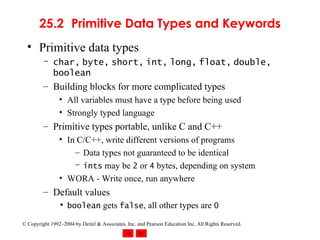
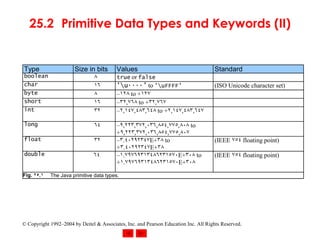
25.2 Primitive Data Types and Keywords Primitive data types char ,   byte ,   short ,   int ,   long ,   float ,   double ,   boolean Building blocks for more complicated types All variables must have a type before being used Strongly typed language Primitive types portable, unlike C and C++ In C/C++, write different versions of programs Data types not guaranteed to be identical ints  may be  2  or  4  bytes, depending on system WORA - Write once, run anywhere  Default values boolean  gets  false , all other types are  0
25.2 Primitive Data Types and Keywords (II)
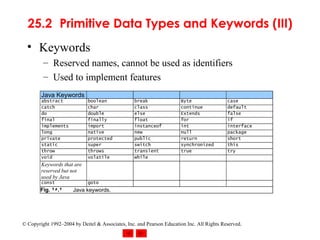
25.2 Primitive Data Types and Keywords (III) Keywords Reserved names, cannot be used as identifiers Used to implement features
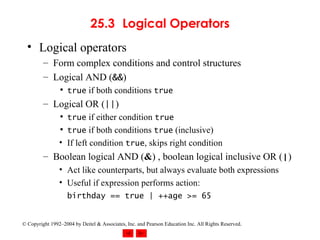
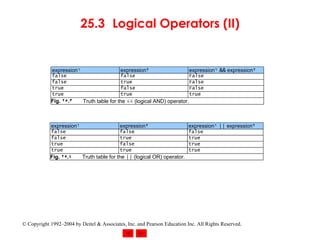
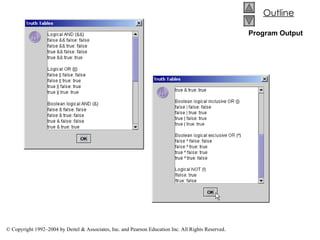
25.3 Logical Operators Logical operators Form complex conditions and control structures Logical AND ( && ) true  if both conditions  true Logical OR ( || ) true  if either condition  true true  if both conditions  true  (inclusive) If left condition  true , skips right condition Boolean logical AND ( & ) , boolean logical inclusive OR ( | ) Act like counterparts, but always evaluate both expressions Useful if expression performs action:  birthday == true | ++age >= 65
25.3 Logical Operators (II)
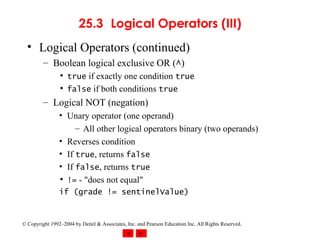
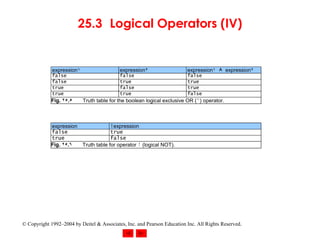
25.3 Logical Operators (III) Logical Operators (continued) Boolean logical exclusive OR ( ^ ) true  if exactly one condition  true false  if both conditions  true Logical NOT (negation) Unary operator (one operand) All other logical operators binary (two operands) Reverses condition If  true , returns  false If  false , returns  true !=  - "does not equal" if (grade != sentinelValue)
25.3 Logical Operators (IV)
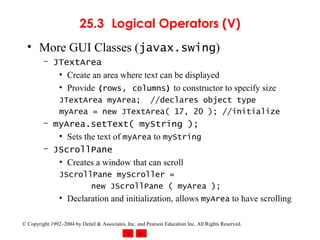
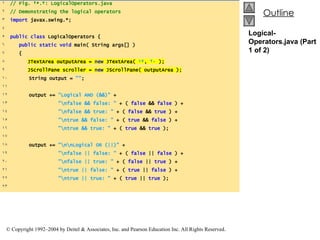
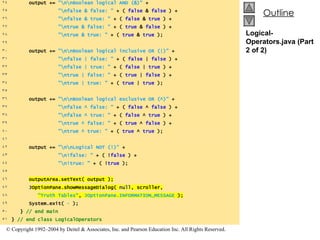
25.3 Logical Operators (V) More GUI Classes ( javax.swing ) JTextArea Create an area where text can be displayed Provide  ( rows ,  columns )  to constructor to specify size JTextArea myArea;  //declares object type myArea = new JTextArea( 17, 20 ); //initialize myArea.setText( myString ); Sets the text of  myArea  to  myString JScrollPane Creates a window that can scroll JScrollPane myScroller =  new JScrollPane ( myArea ); Declaration and initialization, allows  myArea  to have scrolling
25.3 Logical Operators (VI) More GUI classes showMessageDialog(null, myScroller, titleString, type); Second argument indicates that  myScroller  (and attached  myArea ) should be displayed in message dialog
Logical-Operators.java (Part 1 of 2)
Logical-Operators.java (Part 2 of 2)
Program Output
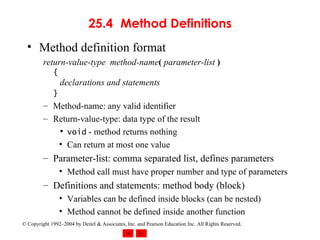
25.4 Method Definitions Method definition format return-value-type  method-name (   parameter-list   ) {   declarations and statements }   Method-name: any valid identifier Return-value-type: data type of the result void  - method returns nothing Can return at most one value Parameter-list: comma separated list, defines parameters Method call must have proper number and type of parameters Definitions and statements: method body (block) Variables can be defined inside blocks (can be nested) Method cannot be defined inside another function
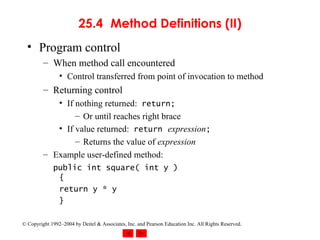
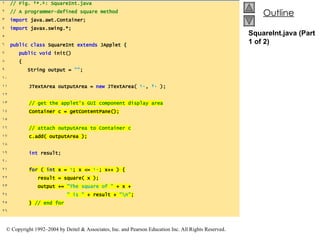
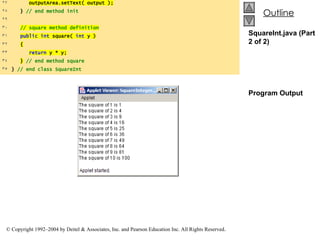
25.4 Method Definitions (II) Program control When method call encountered Control transferred from point of invocation to method Returning control If nothing returned:  return;   Or until reaches right brace If value returned:  return   expression ; Returns the value of  expression Example user-defined method: public int square( int y ) { return y * y }
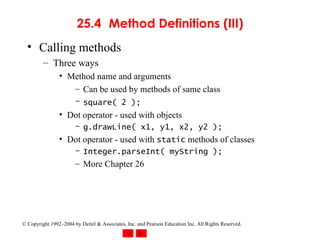
25.4 Method Definitions (III) Calling methods Three ways Method name and arguments Can be used by methods of same class square( 2 );   Dot operator - used with objects g.drawLine( x1, y1, x2, y2 ); Dot operator - used with  static  methods of classes Integer.parseInt( myString ); More Chapter 26
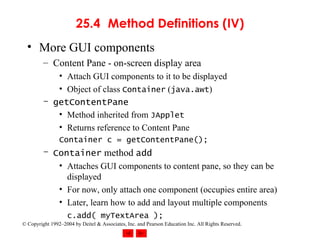
25.4 Method Definitions (IV) More GUI components Content Pane - on-screen display area Attach GUI components to it to be displayed Object of class  Container  ( java.awt ) getContentPane Method inherited from  JApplet Returns reference to Content Pane  Container c = getContentPane(); Container  method  add Attaches GUI components to content pane, so they can be displayed For now, only attach one component (occupies entire area) Later, learn how to add and layout multiple components c.add( myTextArea );
SquareInt.java (Part 1 of 2)
SquareInt.java (Part 2 of 2) Program Output
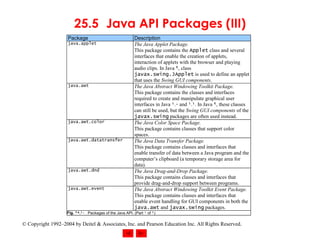
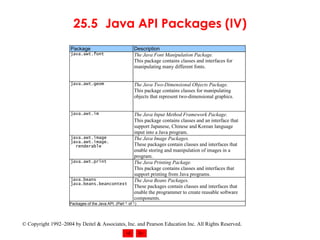
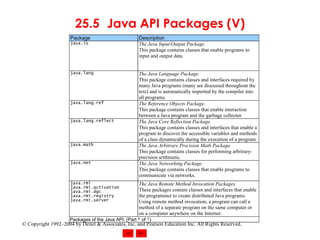
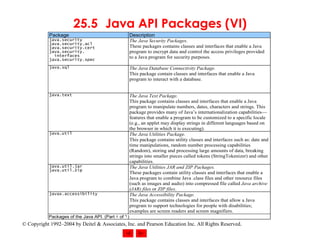
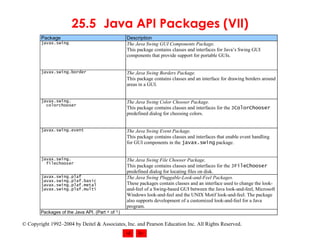
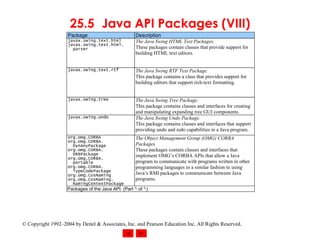
25.5 Java API Packages As we have seen Java has predefined, grouped classes called packages Together, all the packages are the Applications Programming Interface (API) Fig 25.10 has a list of the packages in the API Import Import statements specify location of classes Large number of classes, avoid reinventing the wheel
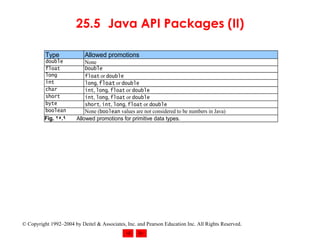
25.5 Java API Packages (II)
25.5 Java API Packages (III)
25.5 Java API Packages (IV)
25.5 Java API Packages (V)
25.5 Java API Packages (VI)
25.5 Java API Packages (VII)
25.5 Java API Packages (VIII)
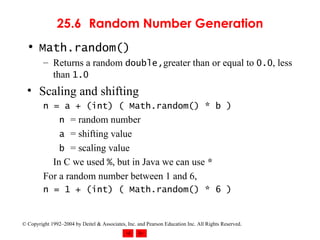
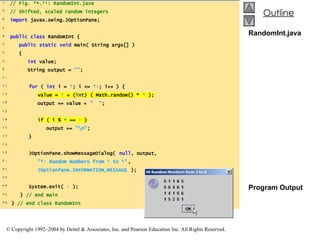
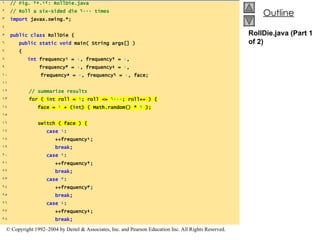
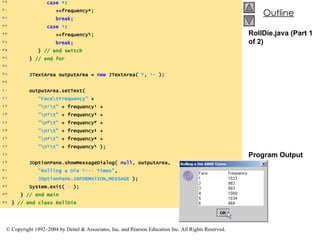
25.6 Random Number Generation Math.random()   Returns a random  double , greater than or equal to  0.0 , less than  1.0 Scaling and shifting n = a + (int) ( Math.random() * b ) n   = random number a   = shifting value b   = scaling value In C we used  % , but in Java we can use  * For a random number between 1 and 6,  n = 1 + (int) ( Math.random() * 6 )
RandomInt.java Program Output
RollDie.java (Part 1 of 2)
RollDie.java (Part 1 of 2) Program Output
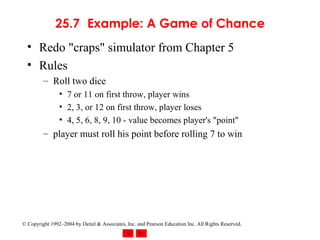
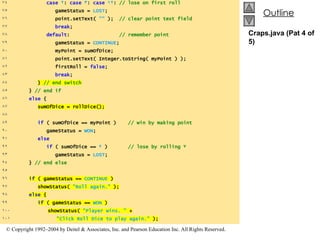
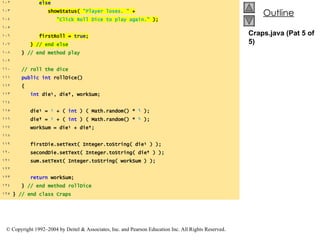
25.7 Example: A Game of Chance Redo "craps" simulator from Chapter 5 Rules Roll two dice 7 or 11 on first throw, player wins 2, 3, or 12 on first throw, player loses 4, 5, 6, 8, 9, 10 - value becomes player's "point" player must roll his point before rolling 7 to win
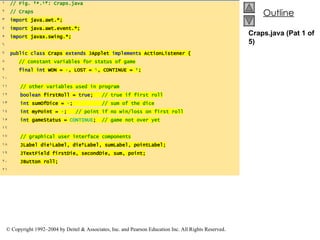
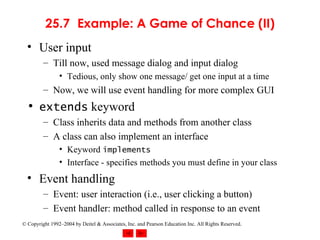
25.7 Example: A Game of Chance (II) User input Till now, used message dialog and input dialog Tedious, only show one message/ get one input at a time Now, we will use event handling for more complex GUI extends  keyword Class inherits data and methods from another class A class can also implement an interface Keyword  implements Interface - specifies methods you must define in your class Event handling Event: user interaction (i.e., user clicking a button) Event handler: method called in response to an event
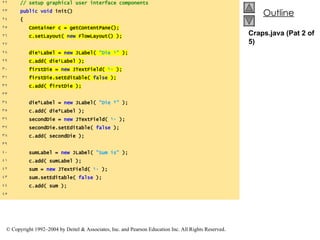
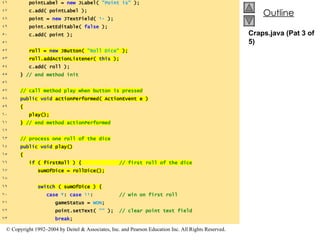
25.7 Example: A Game of Chance (III) Interface  ActionListener Requires that you define method  actionPerformed actionPerformed  is the event handler Class  JTextField Can display or input a line of text Class  JButton Displays a button which can perform an action if pushed Method  addActionListener( this ); Specifies this applet should listen for events from the  JButton  object Each component must know which method will handle its events Registering the event handler
25.7 Example: A Game of Chance (IV) Class  JButton  (continued) We registered  this  applet with our  JButton The applet "listens" for events from the actionPerformed  is the event handler Event-driven programming User's interaction with GUI drives program final Defines a variable constant Cannot be modified Must be initialized at definition const int MYINT = 3; Use all uppercase for  final  variables
25.7 Example: A Game of Chance (V) Methods of class  Container Recall that the Content Pane is of class   Container Method  setLayout Define layout managers (determine position and size of all components attached to container) FlowLayout  - Most basic layout manager Items placed left to right in order added to container When end of line reached, continues on next line c = getContentPane(); c.setLayout( new FlowLayout() ); Initialized with object of class   FlowLayout
Craps.java (Pat 1 of 5)
Craps.java (Pat 2 of 5)
Craps.java (Pat 3 of 5)
Craps.java (Pat 4 of 5)
Craps.java (Pat 5 of 5)
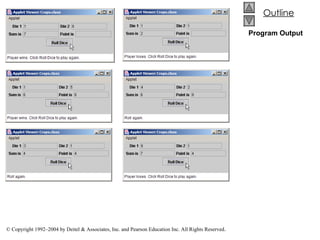
Program Output
25.8 Methods of Class  JApplet Methods of Class  JApplet init, start, stop, paint, destroy Called automatically during execution By default, have empty bodies Must define yourself, using proper first line Otherwise, will not be called automatically See Figure 25.14 for proper first lines Method  repaint Dynamically change appearance of applet Cannot call  paint  (do not have a  Graphics  object) repaint();  calls  update  which passes  Graphics  object for us Erases previous drawings and calls  paint
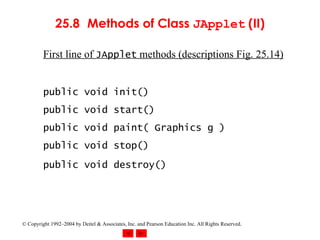
25.8 Methods of Class  JApplet   (II) First line of  JApplet  methods (descriptions Fig. 25.14) public void init()   public void start()   public void paint( Graphics g )   public void stop()   public void destroy()
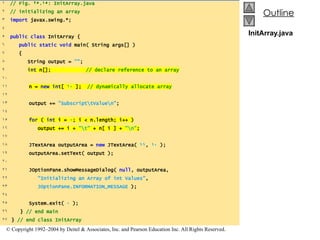
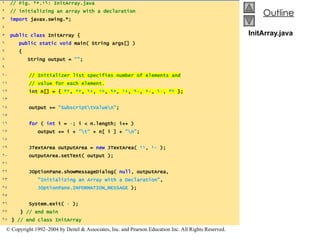
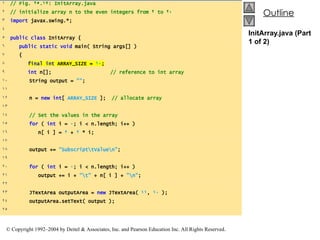
25.9 Defining and Allocating Arrays Arrays Specify type, use  new  operator Two steps: int c[];   //definition c = new int[ 12 ]; //initialization One step: int c[] = new int[12]; Primitive elements initialized to  zero  or  false Non-primitive references are  null Multiple definitions: String b[] = new String[ 100 ], x[] = new String[ 27 ]; Also: double[] array1, array2;   Put brackets after data type
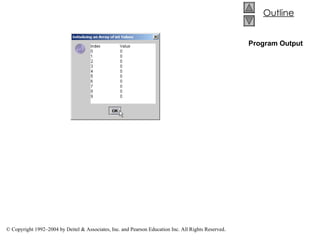
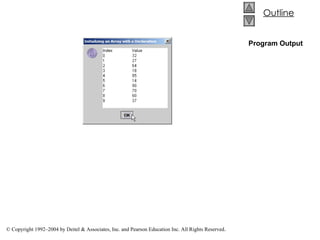
25.10  Examples Using Arrays new Dynamically creates arrays Method  length Returns  length  of the array myArray.length Initializer lists int myArray[] = { 1, 2, 3, 4, 5 };   new  operator not needed, provided automatically
InitArray.java
Program Output
InitArray.java
Program Output
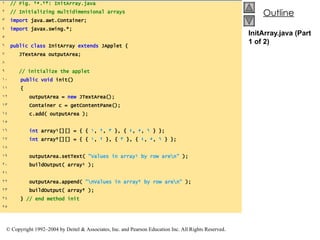
InitArray.java (Part 1 of 2)
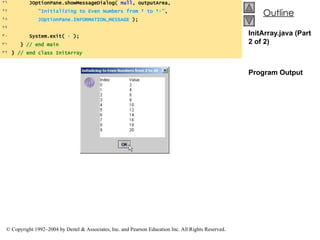
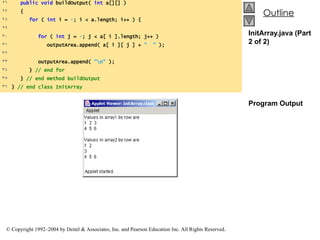
InitArray.java (Part 2 of 2) Program Output
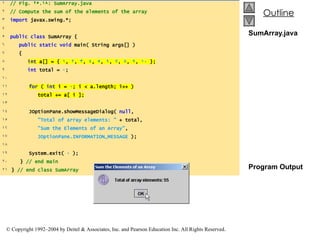
SumArray.java Program Output
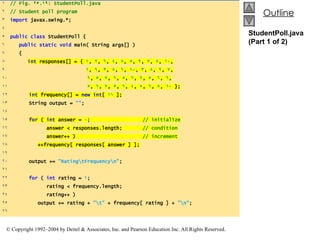
StudentPoll.java (Part 1 of 2)
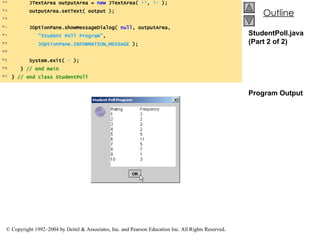
StudentPoll.java (Part 2 of 2) Program Output
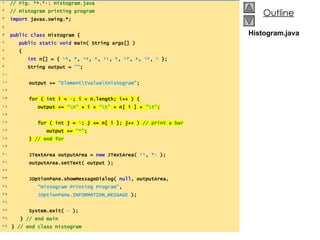
Histogram.java
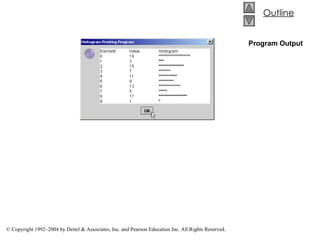
Program Output
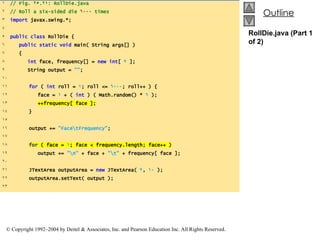
RollDie.java (Part 1 of 2)
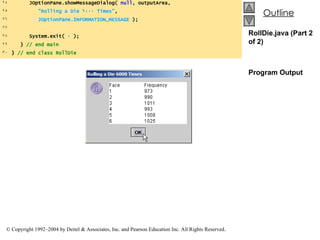
RollDie.java (Part 2 of 2) Program Output
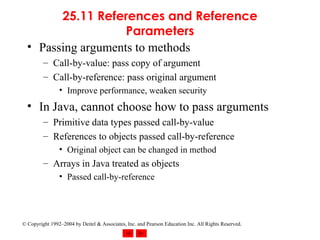
25.11 References and Reference Parameters Passing arguments to methods Call-by-value: pass copy of argument Call-by-reference: pass original argument Improve performance, weaken security In Java, cannot choose how to pass arguments Primitive data types passed call-by-value References to objects passed call-by-reference Original object can be changed in method Arrays in Java treated as objects Passed call-by-reference
25.12  Multiple-Subscripted Arrays Multiple-Subscripted Arrays Represent tables Arranged by  m  rows and  n  columns ( m  by  n  array) Can have more than two subscripts Java does not support multiple subscripts directly Create an array with arrays as its elements Array of arrays Definition Double brackets int b[][]; b = new int[ 3 ][ 3 ];   Defines a 3 by 3 array
25.12  Multiple-Subscripted Arrays (II) Definition (continued) Initializer lists int b[][] = { { 1, 2 }, { 3, 4 } };   Each row can have a different number of columns: int b[][]; b = new int[ 2 ][ ];  // allocate rows b[ 0 ] = new int[ 5 ]; // allocate columns for row 0 b[ 1 ] = new int[ 3 ]; // allocate columns for row 1 Notice how  b[ 0 ]  is initialized as a new  int  array 4 3 2 1
InitArray.java (Part 1 of 2)
InitArray.java (Part 2 of 2) Program Output
y given as a character which will be stored as it is in the char type variable c. Code of the program :  public class  conversion{    public static void  main(String[] args){      boolean  t =  true ;      byte  b = 2;      short  s = 100;      char  c = 'C';      int  i = 200;      long  l = 24000;      float  f = 3.14f;      double  d = 0.000000000000053;     String g = "string";     System.out.println("Value of all the variables like");     System.out.println("t = " + t );     System.out.println("b = " + b );     System.out.println("s = " + s );     System.out.println("c = " + c );     System.out.println("i = " + i );     System.out.println("l = " + l );     System.out.println("f = " + f );     System.out.println("d = " + d );     System.out.println("g = " + g );     System.out.println();     //Convert from boolean to byte.     b = ( byte )(t?1:0);     System.out.println("Value of b after conversion : " + b);     //Convert from boolean to short.     s = ( short )(t?1:0);     System.out.println("Value of s after conversion : " + s);     //Convert from boolean to int.     i = ( int )(t?1:0);     System.out.println("Value of i after conversion : " + i);     //Convert from boolean to char.     c = ( char )(t?'1':'0');     System.out.println("Value of c after conversion : " + c);     c = ( char )(t?1:0);     System.out.println("Value of c after conversion in unicode : " + c);     //Convert from boolean to long.     l = ( long )(t?1:0);     System.out.println("Value of l after conversion : " + l);     //Convert from boolean to float.     f = ( float )(t?1:0);     System.out.println("Value of f after conversion : " + f);     //Convert from boolean to double.     d = ( double )(t?1:0);     System.out.println("Value of d after conversion : " + d);     //Convert from boolean to String.     g = String.valueOf(t);     System.out.println("Value of g after conversion : " + g);     g = (String)(t?"1":"0");     System.out.println("Value of g after conversion : " + g);      int  sum = ( int )(b + i + l + d + f);     System.out.println("Value of sum after conversion : " + sum);   } }

basic concepts

  • 1.
    Chapter 25 -Beyond C & C++: Operators, Methods, and Arrays in Java Outline 25.1 Introduction 25.2 Primitive Data Types and Keywords 25.3 Logical Operators 25.4 Method Definitions 25.5 Java API Packages 25.6 Random Number Generation 25.7 Example: A Game of Chance 25.8 Methods of Class JApplet 25.9 Defining and Allocating Arrays 25.10 Examples Using Arrays 25.11 References and Reference Parameters 25.12 Multiple-Subscripted Arrays
  • 2.
    Objectives In thischapter, you will learn: To understand primitive types and logical operators as they are used in Java. To introduce the common math methods available in the Java API. To be able to create new methods. To understand the mechanisms used to pass information between methods. To introduce simulation techniques using random number generation. To understand array objects in Java. To understand how to write and use methods that call themselves.
  • 3.
    25.1 Introduction Inthis chapter Differences between C, C++, and Java Java's logical operators and methods Packages that comprise Applications Programming Interface (API) Craps simulator Random numbers in Java Arrays in Java
  • 4.
    25.2 Primitive DataTypes and Keywords Primitive data types char , byte , short , int , long , float , double , boolean Building blocks for more complicated types All variables must have a type before being used Strongly typed language Primitive types portable, unlike C and C++ In C/C++, write different versions of programs Data types not guaranteed to be identical ints may be 2 or 4 bytes, depending on system WORA - Write once, run anywhere Default values boolean gets false , all other types are 0
  • 5.
    25.2 Primitive DataTypes and Keywords (II)
  • 6.
    25.2 Primitive DataTypes and Keywords (III) Keywords Reserved names, cannot be used as identifiers Used to implement features
  • 7.
    25.3 Logical OperatorsLogical operators Form complex conditions and control structures Logical AND ( && ) true if both conditions true Logical OR ( || ) true if either condition true true if both conditions true (inclusive) If left condition true , skips right condition Boolean logical AND ( & ) , boolean logical inclusive OR ( | ) Act like counterparts, but always evaluate both expressions Useful if expression performs action: birthday == true | ++age >= 65
  • 8.
  • 9.
    25.3 Logical Operators(III) Logical Operators (continued) Boolean logical exclusive OR ( ^ ) true if exactly one condition true false if both conditions true Logical NOT (negation) Unary operator (one operand) All other logical operators binary (two operands) Reverses condition If true , returns false If false , returns true != - "does not equal" if (grade != sentinelValue)
  • 10.
  • 11.
    25.3 Logical Operators(V) More GUI Classes ( javax.swing ) JTextArea Create an area where text can be displayed Provide ( rows , columns ) to constructor to specify size JTextArea myArea; //declares object type myArea = new JTextArea( 17, 20 ); //initialize myArea.setText( myString ); Sets the text of myArea to myString JScrollPane Creates a window that can scroll JScrollPane myScroller = new JScrollPane ( myArea ); Declaration and initialization, allows myArea to have scrolling
  • 12.
    25.3 Logical Operators(VI) More GUI classes showMessageDialog(null, myScroller, titleString, type); Second argument indicates that myScroller (and attached myArea ) should be displayed in message dialog
  • 13.
  • 14.
  • 15.
  • 16.
    25.4 Method DefinitionsMethod definition format return-value-type method-name ( parameter-list ) { declarations and statements } Method-name: any valid identifier Return-value-type: data type of the result void - method returns nothing Can return at most one value Parameter-list: comma separated list, defines parameters Method call must have proper number and type of parameters Definitions and statements: method body (block) Variables can be defined inside blocks (can be nested) Method cannot be defined inside another function
  • 17.
    25.4 Method Definitions(II) Program control When method call encountered Control transferred from point of invocation to method Returning control If nothing returned: return; Or until reaches right brace If value returned: return expression ; Returns the value of expression Example user-defined method: public int square( int y ) { return y * y }
  • 18.
    25.4 Method Definitions(III) Calling methods Three ways Method name and arguments Can be used by methods of same class square( 2 ); Dot operator - used with objects g.drawLine( x1, y1, x2, y2 ); Dot operator - used with static methods of classes Integer.parseInt( myString ); More Chapter 26
  • 19.
    25.4 Method Definitions(IV) More GUI components Content Pane - on-screen display area Attach GUI components to it to be displayed Object of class Container ( java.awt ) getContentPane Method inherited from JApplet Returns reference to Content Pane Container c = getContentPane(); Container method add Attaches GUI components to content pane, so they can be displayed For now, only attach one component (occupies entire area) Later, learn how to add and layout multiple components c.add( myTextArea );
  • 20.
  • 21.
    SquareInt.java (Part 2of 2) Program Output
  • 22.
    25.5 Java APIPackages As we have seen Java has predefined, grouped classes called packages Together, all the packages are the Applications Programming Interface (API) Fig 25.10 has a list of the packages in the API Import Import statements specify location of classes Large number of classes, avoid reinventing the wheel
  • 23.
    25.5 Java APIPackages (II)
  • 24.
    25.5 Java APIPackages (III)
  • 25.
    25.5 Java APIPackages (IV)
  • 26.
    25.5 Java APIPackages (V)
  • 27.
    25.5 Java APIPackages (VI)
  • 28.
    25.5 Java APIPackages (VII)
  • 29.
    25.5 Java APIPackages (VIII)
  • 30.
    25.6 Random NumberGeneration Math.random() Returns a random double , greater than or equal to 0.0 , less than 1.0 Scaling and shifting n = a + (int) ( Math.random() * b ) n = random number a = shifting value b = scaling value In C we used % , but in Java we can use * For a random number between 1 and 6, n = 1 + (int) ( Math.random() * 6 )
  • 31.
  • 32.
  • 33.
    RollDie.java (Part 1of 2) Program Output
  • 34.
    25.7 Example: AGame of Chance Redo "craps" simulator from Chapter 5 Rules Roll two dice 7 or 11 on first throw, player wins 2, 3, or 12 on first throw, player loses 4, 5, 6, 8, 9, 10 - value becomes player's "point" player must roll his point before rolling 7 to win
  • 35.
    25.7 Example: AGame of Chance (II) User input Till now, used message dialog and input dialog Tedious, only show one message/ get one input at a time Now, we will use event handling for more complex GUI extends keyword Class inherits data and methods from another class A class can also implement an interface Keyword implements Interface - specifies methods you must define in your class Event handling Event: user interaction (i.e., user clicking a button) Event handler: method called in response to an event
  • 36.
    25.7 Example: AGame of Chance (III) Interface ActionListener Requires that you define method actionPerformed actionPerformed is the event handler Class JTextField Can display or input a line of text Class JButton Displays a button which can perform an action if pushed Method addActionListener( this ); Specifies this applet should listen for events from the JButton object Each component must know which method will handle its events Registering the event handler
  • 37.
    25.7 Example: AGame of Chance (IV) Class JButton (continued) We registered this applet with our JButton The applet "listens" for events from the actionPerformed is the event handler Event-driven programming User's interaction with GUI drives program final Defines a variable constant Cannot be modified Must be initialized at definition const int MYINT = 3; Use all uppercase for final variables
  • 38.
    25.7 Example: AGame of Chance (V) Methods of class Container Recall that the Content Pane is of class Container Method setLayout Define layout managers (determine position and size of all components attached to container) FlowLayout - Most basic layout manager Items placed left to right in order added to container When end of line reached, continues on next line c = getContentPane(); c.setLayout( new FlowLayout() ); Initialized with object of class FlowLayout
  • 39.
  • 40.
  • 41.
  • 42.
  • 43.
  • 44.
  • 45.
    25.8 Methods ofClass JApplet Methods of Class JApplet init, start, stop, paint, destroy Called automatically during execution By default, have empty bodies Must define yourself, using proper first line Otherwise, will not be called automatically See Figure 25.14 for proper first lines Method repaint Dynamically change appearance of applet Cannot call paint (do not have a Graphics object) repaint(); calls update which passes Graphics object for us Erases previous drawings and calls paint
  • 46.
    25.8 Methods ofClass JApplet (II) First line of JApplet methods (descriptions Fig. 25.14) public void init() public void start() public void paint( Graphics g ) public void stop() public void destroy()
  • 47.
    25.9 Defining andAllocating Arrays Arrays Specify type, use new operator Two steps: int c[]; //definition c = new int[ 12 ]; //initialization One step: int c[] = new int[12]; Primitive elements initialized to zero or false Non-primitive references are null Multiple definitions: String b[] = new String[ 100 ], x[] = new String[ 27 ]; Also: double[] array1, array2; Put brackets after data type
  • 48.
    25.10 ExamplesUsing Arrays new Dynamically creates arrays Method length Returns length of the array myArray.length Initializer lists int myArray[] = { 1, 2, 3, 4, 5 }; new operator not needed, provided automatically
  • 49.
  • 50.
  • 51.
  • 52.
  • 53.
  • 54.
    InitArray.java (Part 2of 2) Program Output
  • 55.
  • 56.
  • 57.
    StudentPoll.java (Part 2of 2) Program Output
  • 58.
  • 59.
  • 60.
  • 61.
    RollDie.java (Part 2of 2) Program Output
  • 62.
    25.11 References andReference Parameters Passing arguments to methods Call-by-value: pass copy of argument Call-by-reference: pass original argument Improve performance, weaken security In Java, cannot choose how to pass arguments Primitive data types passed call-by-value References to objects passed call-by-reference Original object can be changed in method Arrays in Java treated as objects Passed call-by-reference
  • 63.
    25.12 Multiple-SubscriptedArrays Multiple-Subscripted Arrays Represent tables Arranged by m rows and n columns ( m by n array) Can have more than two subscripts Java does not support multiple subscripts directly Create an array with arrays as its elements Array of arrays Definition Double brackets int b[][]; b = new int[ 3 ][ 3 ]; Defines a 3 by 3 array
  • 64.
    25.12 Multiple-SubscriptedArrays (II) Definition (continued) Initializer lists int b[][] = { { 1, 2 }, { 3, 4 } }; Each row can have a different number of columns: int b[][]; b = new int[ 2 ][ ]; // allocate rows b[ 0 ] = new int[ 5 ]; // allocate columns for row 0 b[ 1 ] = new int[ 3 ]; // allocate columns for row 1 Notice how b[ 0 ] is initialized as a new int array 4 3 2 1
  • 65.
  • 66.
    InitArray.java (Part 2of 2) Program Output
  • 67.
    y given asa character which will be stored as it is in the char type variable c. Code of the program : public class  conversion{    public static void  main(String[] args){      boolean  t =  true ;      byte  b = 2;      short  s = 100;      char  c = 'C';      int  i = 200;      long  l = 24000;      float  f = 3.14f;      double  d = 0.000000000000053;     String g = "string";     System.out.println("Value of all the variables like");     System.out.println("t = " + t );     System.out.println("b = " + b );     System.out.println("s = " + s );     System.out.println("c = " + c );     System.out.println("i = " + i );     System.out.println("l = " + l );     System.out.println("f = " + f );     System.out.println("d = " + d );     System.out.println("g = " + g );     System.out.println();     //Convert from boolean to byte.     b = ( byte )(t?1:0);     System.out.println("Value of b after conversion : " + b);     //Convert from boolean to short.     s = ( short )(t?1:0);     System.out.println("Value of s after conversion : " + s);     //Convert from boolean to int.     i = ( int )(t?1:0);     System.out.println("Value of i after conversion : " + i);     //Convert from boolean to char.     c = ( char )(t?'1':'0');     System.out.println("Value of c after conversion : " + c);     c = ( char )(t?1:0);     System.out.println("Value of c after conversion in unicode : " + c);     //Convert from boolean to long.     l = ( long )(t?1:0);     System.out.println("Value of l after conversion : " + l);     //Convert from boolean to float.     f = ( float )(t?1:0);     System.out.println("Value of f after conversion : " + f);     //Convert from boolean to double.     d = ( double )(t?1:0);     System.out.println("Value of d after conversion : " + d);     //Convert from boolean to String.     g = String.valueOf(t);     System.out.println("Value of g after conversion : " + g);     g = (String)(t?"1":"0");     System.out.println("Value of g after conversion : " + g);      int  sum = ( int )(b + i + l + d + f);     System.out.println("Value of sum after conversion : " + sum);   } }