Assessing Premium and
costing Benefit package


Nehal Jain
Institute of Public Health
Overview of the session


• Definition of Premium
• Different Rating Methods used by Health
  Insurers
• Factors Influencing Health Insurance Premium
• Strategies for collecting premium
• Calculating premium
Definition of Premium


• Premium is the consideration paid to the insurer
  by the insured for the health insurance coverage.
Different Rating Methods used by Health
Insurers
                 1) Community Rating

This is a system of determining uniform health insurance
   premium rate for all individuals in a community, based
   on the cost of providing medical services to all people in
   the community, without adjusting for individual risks
   and medical history.
Different Rating Methods used by Health
Insurers
                    2) Risk Rating

This is a system of determining health insurance premium
 for each individual based on the risk perceived by the
 insurer, and involves consideration of the individual’s
 medical history, occupation, lifestyle and other
 individual characteristics in the determination of his or
 her premium.
Different Rating Methods used by Health
Insurers
                  3) Income Rating

This is a system of determining health insurance premium
 based on the income or wages of the individual, and is
 typically a defined proportion of the income, where a
 limit or a floor premium may also apply.
Different Rating Methods used by Health
Insurers
                 4) Experience Rating
This is a system of determining health insurance premium
 based on the insured’s past loss experience. Thus, the
 method is used for individuals and groups who have
 been covered for a sufficiently long length of time to
 enable the insurer to assess the loss experience or service
 utilization by the insured.
Factors Influencing Health Insurance
Premium
• Claim costs: claim costs are usually the predominant
  expense of a health insurance plan, factors affecting
  claim costs are important in determining the amount of
  premium that is necessary to be charged under a health
  insurance plan.
Factors Influencing Health Insurance
 Premium
• Administrative costs: Administrative costs
  include the costs of collecting premium, costs of
  underwriting, costs of issuing policy documents and
  identification documents to the beneficiaries, costs of
  enrolling and accrediting/ monitoring providers of
  care, costs of processing and paying claims,
  government taxes and levies like stamp duty on
  policies etc., and also the costs of planning, supervising
  and managing the health insurance scheme.
Factors Influencing Health Insurance
Premium
• Marketing costs
Marketing costs include not only the commissions and
  incentives paid out to agents, advisors, brokers and other
  sales functionaries, but also the costs of acquiring and
  maintaining a sales network, costs incurred on print and
  visual media, and also, especially in the case of
  community based schemes, costs of advocacy and
  awareness generation in the community.
Factors Influencing Health Insurance
Premium
• Contingency margins
Insurers also need to provide contingency margins
  in their premium structure, as the claims
  experience could be greater than what was
  expected by them. Such contingency margins
  also help build reserves which could see the
  insurer tide over a ‘bad’ year when exceptional
  claim costs may arise.
Factors Influencing Health Insurance
Premium
• Profit margin
Finally, over and above all these costs, insurers
  may provide for a profit margin, if they are a for-
  profit organization.
Factors Influencing Health Insurance
Premium
• Reinsurance
A part of the premium collected is given or ‘ceded’
  to a reinsurance company, in return for various
  types of reinsurance covers which reduce the
  exposure of the insurer.
Strategies for collecting premium


•   Pay roll deductions
•   Deductions at source
•   Membership payments
•   Voluntary payment
Costing Benefit Package – A case
study
Dharampur village wants to implement a
 community based health insurance for its
 people. The details of the village are as
 below:

• Population of the village – 5000 people
• Around 20% of the population is willing to
  join the scheme
• Benefit Package expected – Outpatient
  cover, Inpatient cover, deliveries
Incidence of Illness
• Number of outpatient treatment expected
  per person per year – 1.5 episodes
• Number of admissions expected per 100 –
  5 episodes
• Number of deliveries expected per 100
  women – 5 episodes
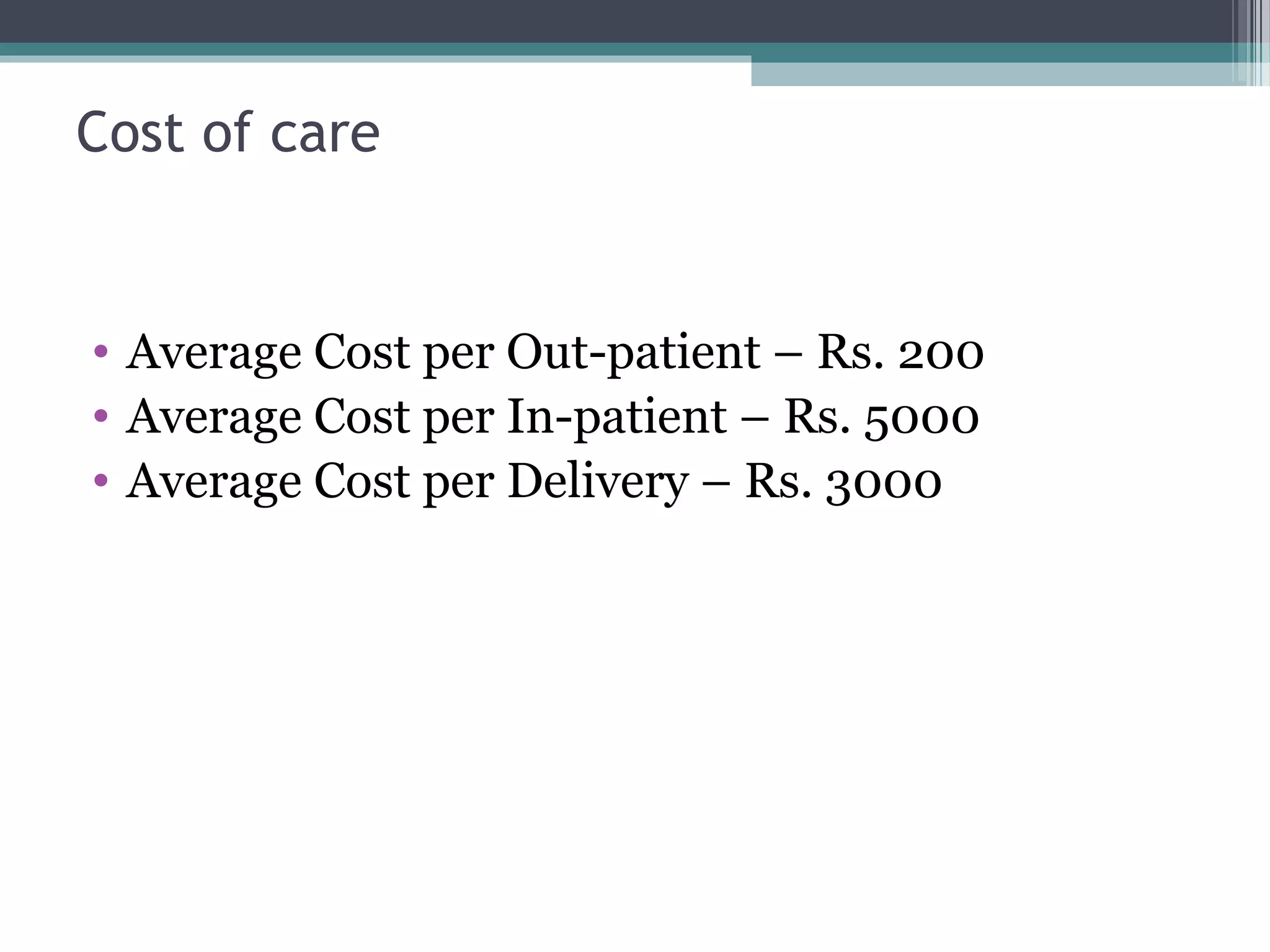
Cost of care


• Average Cost per Out-patient – Rs. 200
• Average Cost per In-patient – Rs. 5000
• Average Cost per Delivery – Rs. 3000
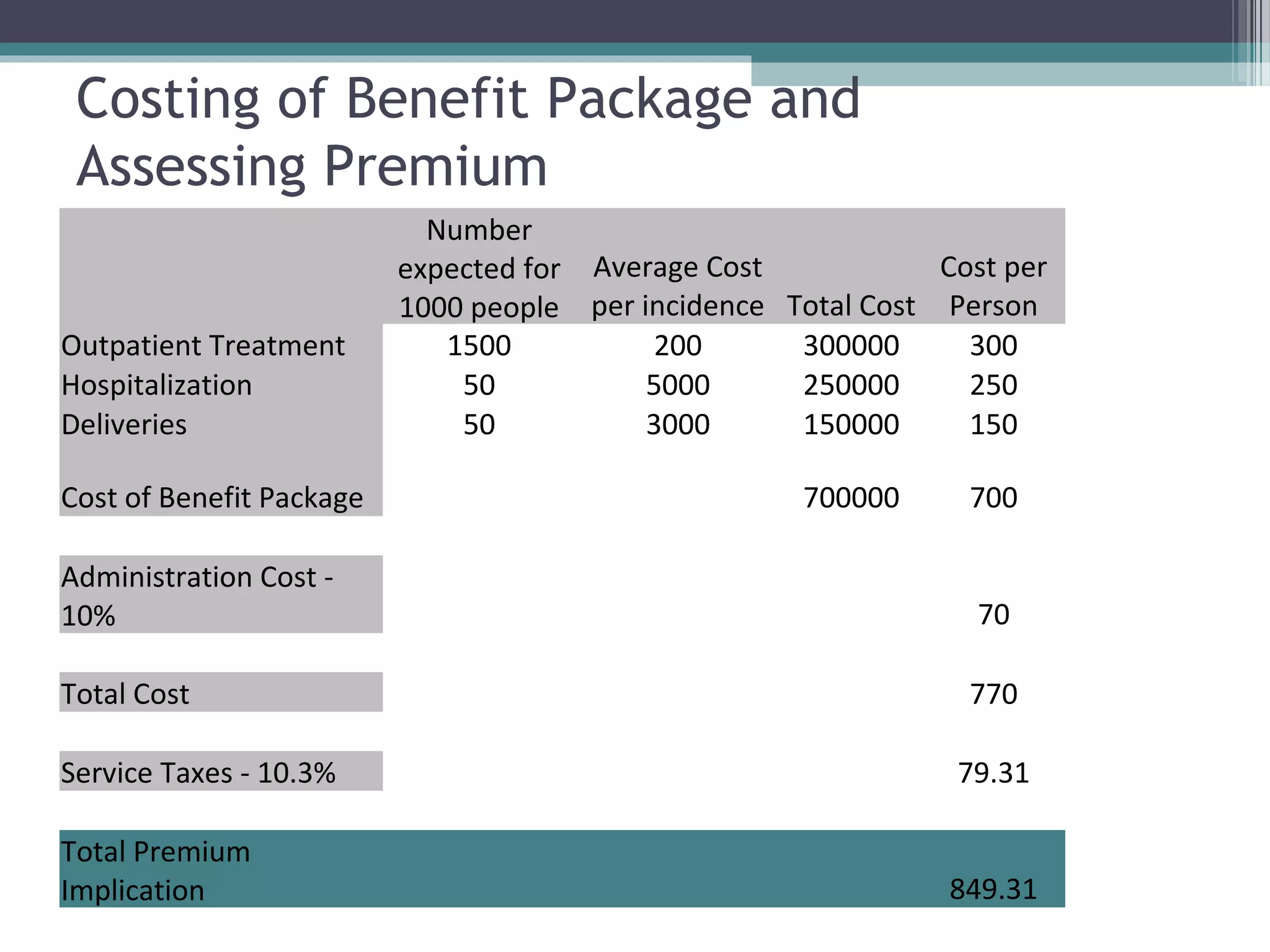
Costing of Benefit Package and
 Assessing Premium
                            Number 
                          expected for  Average Cost           Cost per 
                          1000 people per incidence Total Cost Person
Outpatient Treatment         1500           200       300000     300
Hospitalization               50           5000       250000     250
Deliveries                    50           3000       150000     150

Cost of Benefit Package                               700000      700
                                                                    
Administration Cost - 
10%                                                                70
                                                                     
Total Cost                                                        770
                                                                     
Service Taxes - 10.3%                                            79.31
                                                                     
Total Premium 
Implication                                                     849.31
Data

• Collecting primary data through survey
• Secondary Data: Data about morbidity rate,
  utilisation rate, unit cost of treatment and
  demographic profile of the community from
  secondary sources e.g. Census, NSSO, SRS,
  NCMH etc.
Thank you
Email: nehal.sanghvi@yahoo.com

3.premium nrs

  • 1.
    Assessing Premium and costingBenefit package Nehal Jain Institute of Public Health
  • 2.
    Overview of thesession • Definition of Premium • Different Rating Methods used by Health Insurers • Factors Influencing Health Insurance Premium • Strategies for collecting premium • Calculating premium
  • 4.
    Definition of Premium •Premium is the consideration paid to the insurer by the insured for the health insurance coverage.
  • 6.
    Different Rating Methodsused by Health Insurers 1) Community Rating This is a system of determining uniform health insurance premium rate for all individuals in a community, based on the cost of providing medical services to all people in the community, without adjusting for individual risks and medical history.
  • 7.
    Different Rating Methodsused by Health Insurers 2) Risk Rating This is a system of determining health insurance premium for each individual based on the risk perceived by the insurer, and involves consideration of the individual’s medical history, occupation, lifestyle and other individual characteristics in the determination of his or her premium.
  • 8.
    Different Rating Methodsused by Health Insurers 3) Income Rating This is a system of determining health insurance premium based on the income or wages of the individual, and is typically a defined proportion of the income, where a limit or a floor premium may also apply.
  • 9.
    Different Rating Methodsused by Health Insurers 4) Experience Rating This is a system of determining health insurance premium based on the insured’s past loss experience. Thus, the method is used for individuals and groups who have been covered for a sufficiently long length of time to enable the insurer to assess the loss experience or service utilization by the insured.
  • 11.
    Factors Influencing HealthInsurance Premium • Claim costs: claim costs are usually the predominant expense of a health insurance plan, factors affecting claim costs are important in determining the amount of premium that is necessary to be charged under a health insurance plan.
  • 12.
    Factors Influencing HealthInsurance Premium • Administrative costs: Administrative costs include the costs of collecting premium, costs of underwriting, costs of issuing policy documents and identification documents to the beneficiaries, costs of enrolling and accrediting/ monitoring providers of care, costs of processing and paying claims, government taxes and levies like stamp duty on policies etc., and also the costs of planning, supervising and managing the health insurance scheme.
  • 13.
    Factors Influencing HealthInsurance Premium • Marketing costs Marketing costs include not only the commissions and incentives paid out to agents, advisors, brokers and other sales functionaries, but also the costs of acquiring and maintaining a sales network, costs incurred on print and visual media, and also, especially in the case of community based schemes, costs of advocacy and awareness generation in the community.
  • 14.
    Factors Influencing HealthInsurance Premium • Contingency margins Insurers also need to provide contingency margins in their premium structure, as the claims experience could be greater than what was expected by them. Such contingency margins also help build reserves which could see the insurer tide over a ‘bad’ year when exceptional claim costs may arise.
  • 15.
    Factors Influencing HealthInsurance Premium • Profit margin Finally, over and above all these costs, insurers may provide for a profit margin, if they are a for- profit organization.
  • 16.
    Factors Influencing HealthInsurance Premium • Reinsurance A part of the premium collected is given or ‘ceded’ to a reinsurance company, in return for various types of reinsurance covers which reduce the exposure of the insurer.
  • 17.
    Strategies for collectingpremium • Pay roll deductions • Deductions at source • Membership payments • Voluntary payment
  • 19.
    Costing Benefit Package– A case study Dharampur village wants to implement a community based health insurance for its people. The details of the village are as below: • Population of the village – 5000 people • Around 20% of the population is willing to join the scheme • Benefit Package expected – Outpatient cover, Inpatient cover, deliveries
  • 20.
    Incidence of Illness •Number of outpatient treatment expected per person per year – 1.5 episodes • Number of admissions expected per 100 – 5 episodes • Number of deliveries expected per 100 women – 5 episodes
  • 21.
    Cost of care •Average Cost per Out-patient – Rs. 200 • Average Cost per In-patient – Rs. 5000 • Average Cost per Delivery – Rs. 3000
  • 22.
    Costing of BenefitPackage and Assessing Premium Number  expected for  Average Cost  Cost per    1000 people per incidence Total Cost Person Outpatient Treatment 1500 200 300000 300 Hospitalization 50 5000 250000 250 Deliveries 50 3000 150000 150 Cost of Benefit Package     700000 700           Administration Cost -  10%       70           Total Cost       770           Service Taxes - 10.3%       79.31           Total Premium  Implication       849.31
  • 23.
    Data • Collecting primarydata through survey • Secondary Data: Data about morbidity rate, utilisation rate, unit cost of treatment and demographic profile of the community from secondary sources e.g. Census, NSSO, SRS, NCMH etc.
  • 24.