EFFECTIVE
COMMUNICATION
Objectives
• Define and understand communication and
  the communication process

• Identify and overcome the various barriers
  in a communication process

• Understand Effective Communication

• Various means of communication in the
  community

• Counseling & Counseling skills
Why do we Communicate???
   to express our emotions
   achieve joint understanding
   to get things done
   pass on and obtain information
   reach decisions
   develop relationships
Communication Skills


    Types & Methods of Communication

    Written      Letters, Memos, Reports…

    Spoken       Conversations, Interviews,
                 Phone Calls, Requests…
    Non-Verbal Facial expressions, Postures,
               Actions, Voice Tone, Silence…
    Visuals    Photographs, Paintings, Videos,
                Film…
    Multimedia Television, Newspaper,
               Magazines, Internet…
4
Communication Process: The Flow


                                   Channel


        Formulating                                 Delivery


                                        Message

    Sender                                          Receiver
                             Feedback


                                                   Perception
           Response


                                   Understanding
5   Aksh Optifibre Limited
Effective Communication…

     Is scarcer than quality water
     Is measured by results or actions
     Does not need to be very complex
     Is aimed at informing others
     Is complete and clear


     ….. Complete sharing of meaning and understanding
      between the person sending the message and the
               person receiving the message.

6
Barriers to
      communication


• Internal Barriers

• External Barriers
Internal barriers
    Personal Barriers:

    Fatigue, low energy, exhausted
    Poor listening skills,
    Attitude towards the sender or the information,
    Lack of interest in the message,
    Fear, mistrust, past experiences,
    Negative attitude,
    Problems at home,
    Lack of common experiences,
    Lack of clarity in the message,
    Emotions.

8
External barriers

 Noise,
 Distractions,
 E-mail not working,
 Bad phone connections,
 Time of day,
 Environment,
 Attenuation (message passing through many
    persons)


9
Tips for effective communication

         Simplify language
         Listen actively
         Break the barriers
         Use feedback
         Do not depend upon grapevine/rumours
         Be aware of others levels, feelings and attitudes
         Do not act on assumptions
         Do not jump into conclusions.


10
Hearing Vs Listening
  Objective of Listening is…
 to receive information
 to understand effectively
 to enhance clarity
 to empathize


 Good listening skill can improve social relations and
                     conversation.
Counseling Skills
 Counseling is one person helping another as they
 talk person-to-person. When you help a client
 make a decision or solve a problem, you are
 counseling.
Counseling involves
 Rapport building with the client
 Show that you understand and care about
  them. Build Trust.
 Give clients useful, accurate information. Help
  them understand what this information means
  to them.
 Help clients to make their own choices, based
  on clear information and their own feelings,
  situation, and needs.
 Help them remember what to do.
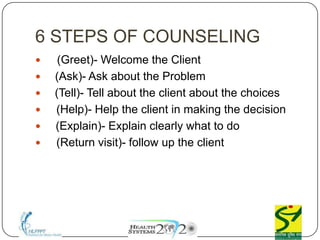
6 STEPS OF COUNSELING
 G (Greet)- Welcome the Client
 A (Ask)- Ask about the Problem
 T (Tell)- Tell about the client about the choices
 H (Help)- Help the client in making the decision
 E (Explain)- Explain clearly what to do
 R (Return visit)- follow up the client
Qualities of a Good Counselor
Means of Communication approaches at
     community level
1.  Interpersonal Communication (one to one meetings)
2. Group Interactions (Group meetings)
3. Community /outreach events (Village Health
    Nutrition Day, Health Camps etc)
4. Media Channels
 Print Media
  (Newspaper, Magazines, Journals, Newsletter)
 Audio-visual Media (Radio, TV, Local Cable )
 Folk /Traditional Media (Nukkad Natak, Magic
  shows, Puppet shows)
 Outdoor Media (Hoarding, Banners, Wall paintings
  etc)
 Information Communication Technology (ICT)- Internet
Video on interpersonal
communication

Communication ppt Deliotte Project

  • 1.
  • 2.
    Objectives • Define andunderstand communication and the communication process • Identify and overcome the various barriers in a communication process • Understand Effective Communication • Various means of communication in the community • Counseling & Counseling skills
  • 3.
    Why do weCommunicate???  to express our emotions  achieve joint understanding  to get things done  pass on and obtain information  reach decisions  develop relationships
  • 4.
    Communication Skills Types & Methods of Communication Written Letters, Memos, Reports… Spoken Conversations, Interviews, Phone Calls, Requests… Non-Verbal Facial expressions, Postures, Actions, Voice Tone, Silence… Visuals Photographs, Paintings, Videos, Film… Multimedia Television, Newspaper, Magazines, Internet… 4
  • 5.
    Communication Process: TheFlow Channel Formulating Delivery Message Sender Receiver Feedback Perception Response Understanding 5 Aksh Optifibre Limited
  • 6.
    Effective Communication…  Is scarcer than quality water  Is measured by results or actions  Does not need to be very complex  Is aimed at informing others  Is complete and clear ….. Complete sharing of meaning and understanding between the person sending the message and the person receiving the message. 6
  • 7.
    Barriers to communication • Internal Barriers • External Barriers
  • 8.
    Internal barriers Personal Barriers: Fatigue, low energy, exhausted Poor listening skills, Attitude towards the sender or the information, Lack of interest in the message, Fear, mistrust, past experiences, Negative attitude, Problems at home, Lack of common experiences, Lack of clarity in the message, Emotions. 8
  • 9.
    External barriers  Noise, Distractions,  E-mail not working,  Bad phone connections,  Time of day,  Environment,  Attenuation (message passing through many persons) 9
  • 10.
    Tips for effectivecommunication  Simplify language  Listen actively  Break the barriers  Use feedback  Do not depend upon grapevine/rumours  Be aware of others levels, feelings and attitudes  Do not act on assumptions  Do not jump into conclusions. 10
  • 11.
    Hearing Vs Listening Objective of Listening is…  to receive information  to understand effectively  to enhance clarity  to empathize Good listening skill can improve social relations and conversation.
  • 12.
    Counseling Skills Counselingis one person helping another as they talk person-to-person. When you help a client make a decision or solve a problem, you are counseling.
  • 13.
    Counseling involves  Rapportbuilding with the client  Show that you understand and care about them. Build Trust.  Give clients useful, accurate information. Help them understand what this information means to them.  Help clients to make their own choices, based on clear information and their own feelings, situation, and needs.  Help them remember what to do.
  • 14.
    6 STEPS OFCOUNSELING  G (Greet)- Welcome the Client  A (Ask)- Ask about the Problem  T (Tell)- Tell about the client about the choices  H (Help)- Help the client in making the decision  E (Explain)- Explain clearly what to do  R (Return visit)- follow up the client
  • 15.
    Qualities of aGood Counselor
  • 16.
    Means of Communicationapproaches at community level 1. Interpersonal Communication (one to one meetings) 2. Group Interactions (Group meetings) 3. Community /outreach events (Village Health Nutrition Day, Health Camps etc) 4. Media Channels  Print Media (Newspaper, Magazines, Journals, Newsletter)  Audio-visual Media (Radio, TV, Local Cable )  Folk /Traditional Media (Nukkad Natak, Magic shows, Puppet shows)  Outdoor Media (Hoarding, Banners, Wall paintings etc)  Information Communication Technology (ICT)- Internet
  • 17.