

© 2014 MapR Technologies 1© 2014 MapR Technologies
© 2014 MapR Technologies 2
Who I am
Ted Dunning, Chief Applications Architect, MapR Technologies
Email tdunning@mapr.com tdunning@apache.org
Twitter @Ted_Dunning
Apache Mahout https://mahout.apache.org/
Twitter @ApacheMahout
22 June 2014 Big Data Everywhere Conference #DataIsrael
© 2014 MapR Technologies 3
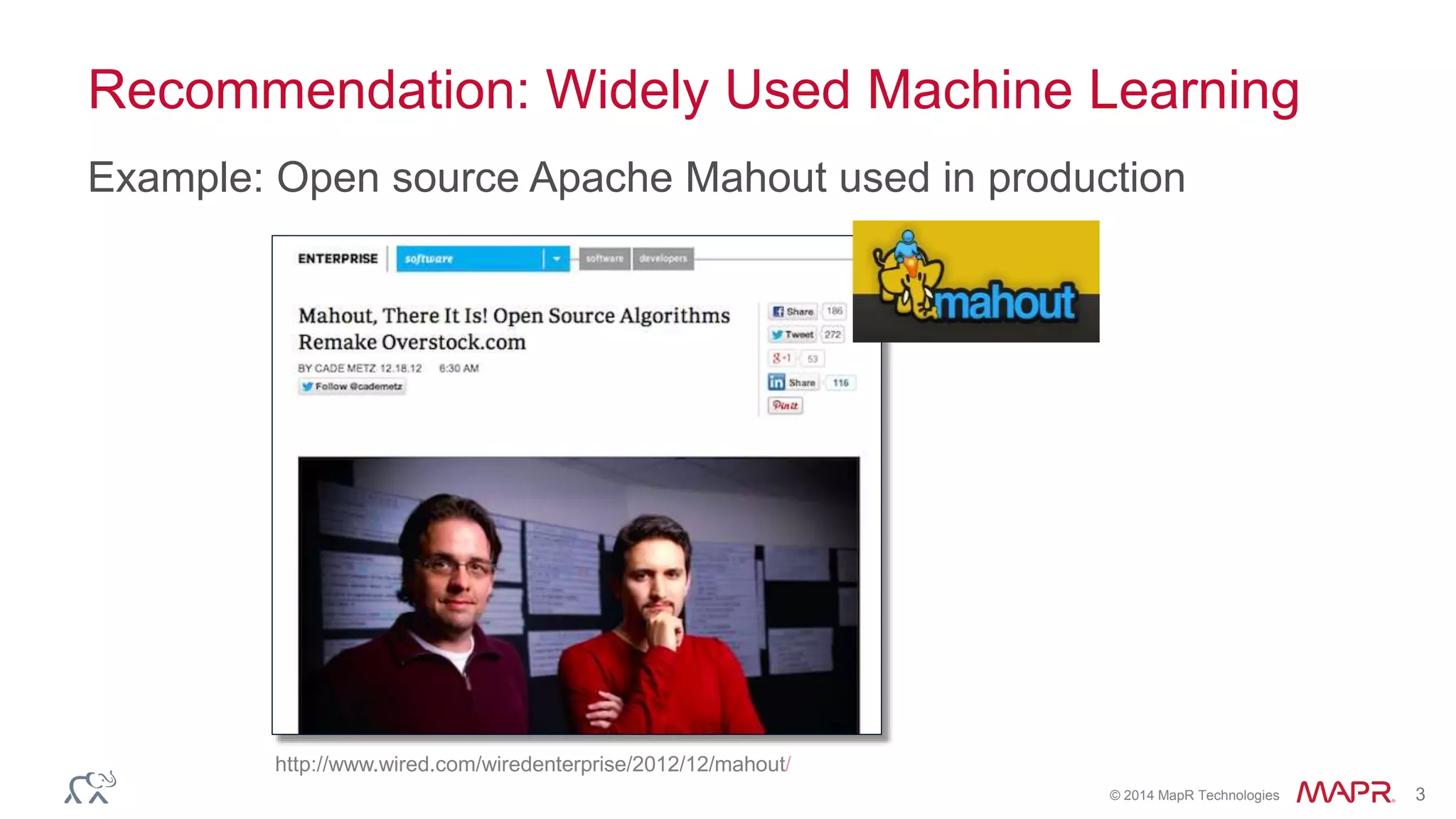
http://www.wired.com/wiredenterprise/2012/12/mahout/
Recommendation: Widely Used Machine Learning
Example: Open source Apache Mahout used in production
© 2014 MapR Technologies 4
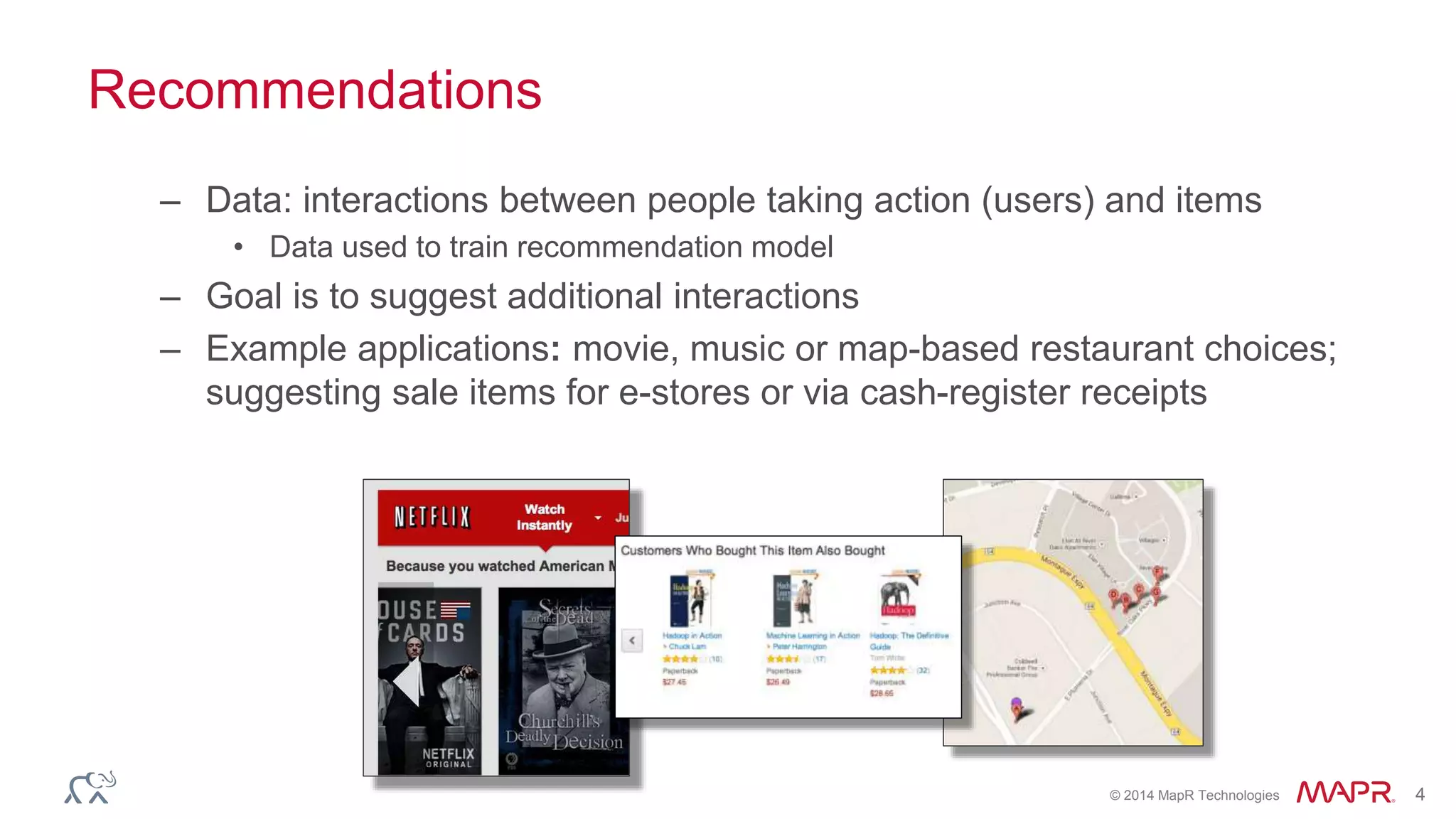
Recommendations
– Data: interactions between people taking action (users) and items
• Data used to train recommendation model
– Goal is to suggest additional interactions
– Example applications: movie, music or map-based restaurant choices;
suggesting sale items for e-stores or via cash-register receipts
© 2014 MapR Technologies 5
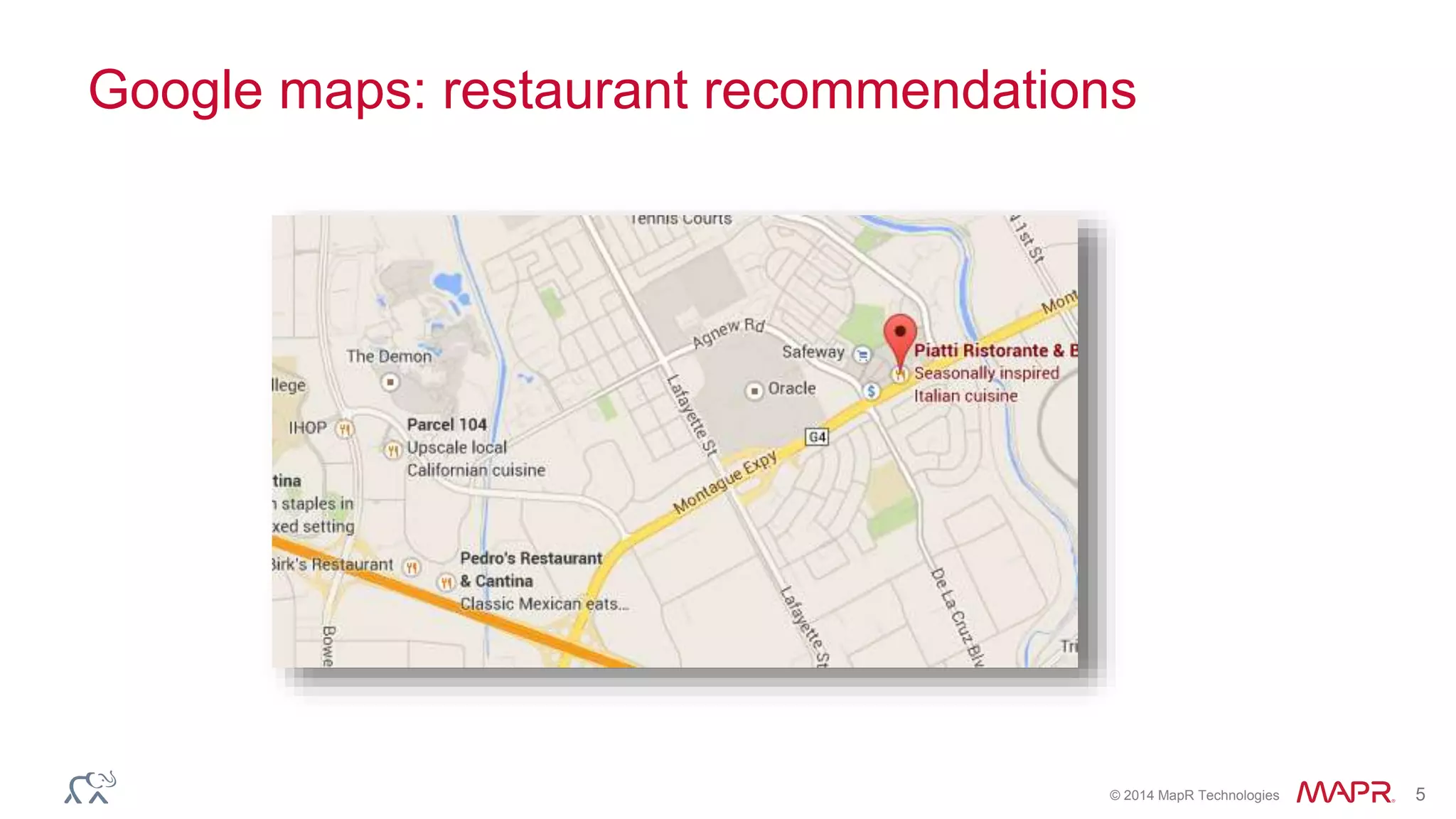
Google maps: restaurant recommendations
© 2014 MapR Technologies 6
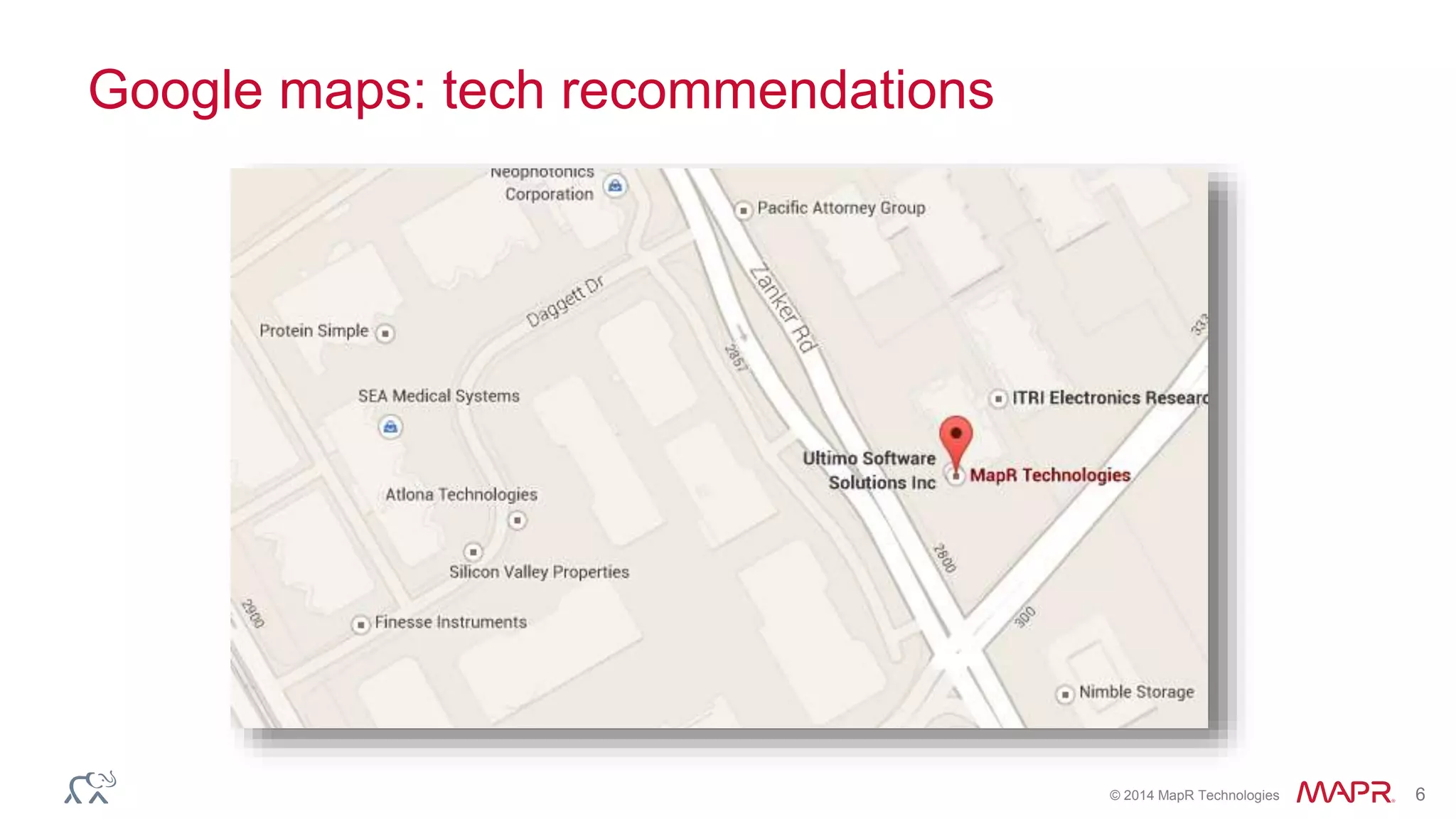
Google maps: tech recommendations
© 2014 MapR Technologies 7
Tutorial Part 1:
How recommendation works,
or “I want a pony”…
© 2014 MapR Technologies 9
First question:
Are you using the right data?
© 2014 MapR Technologies 10
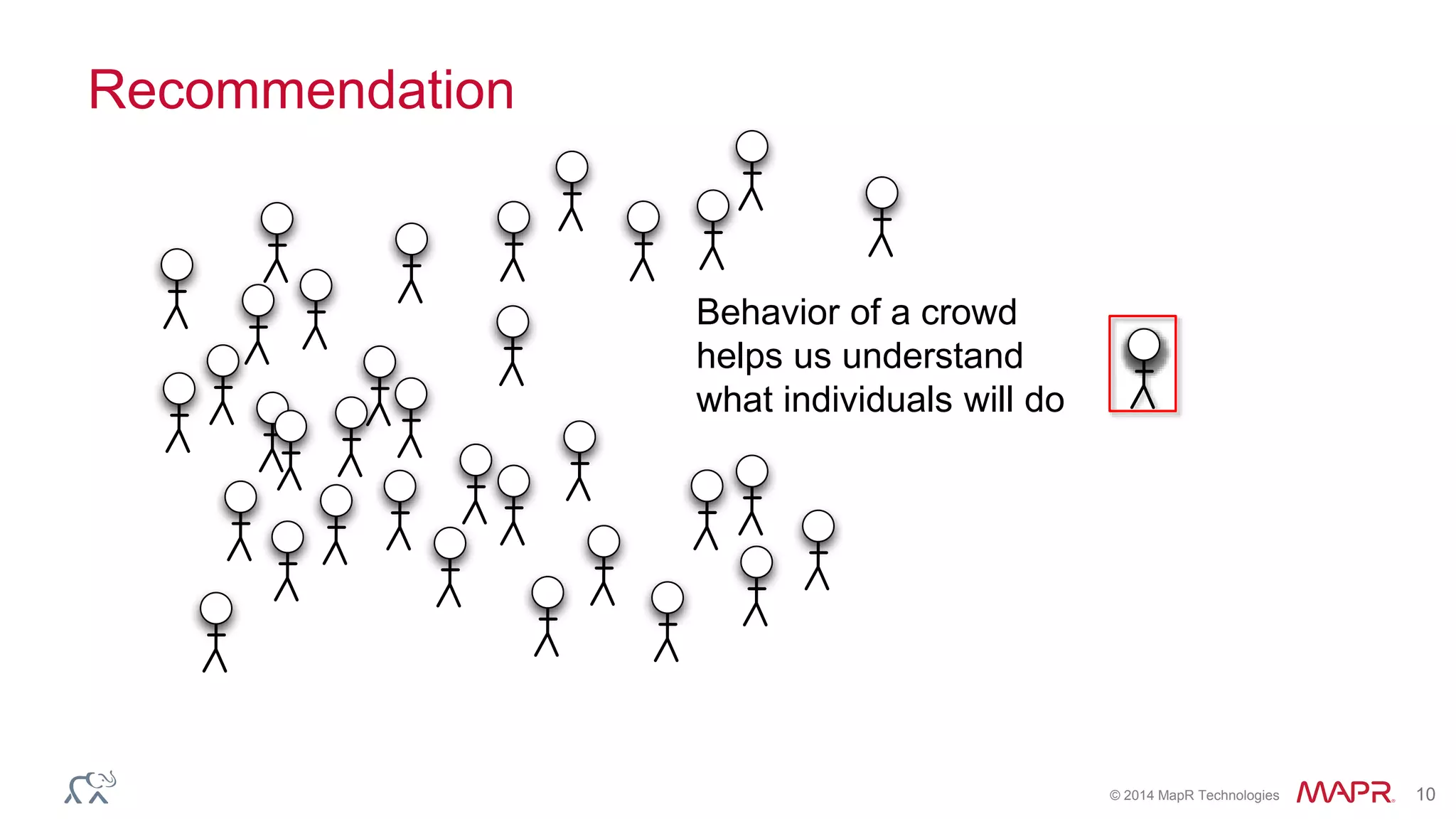
Recommendation
Behavior of a crowd
helps us understand
what individuals will do
© 2014 MapR Technologies 11
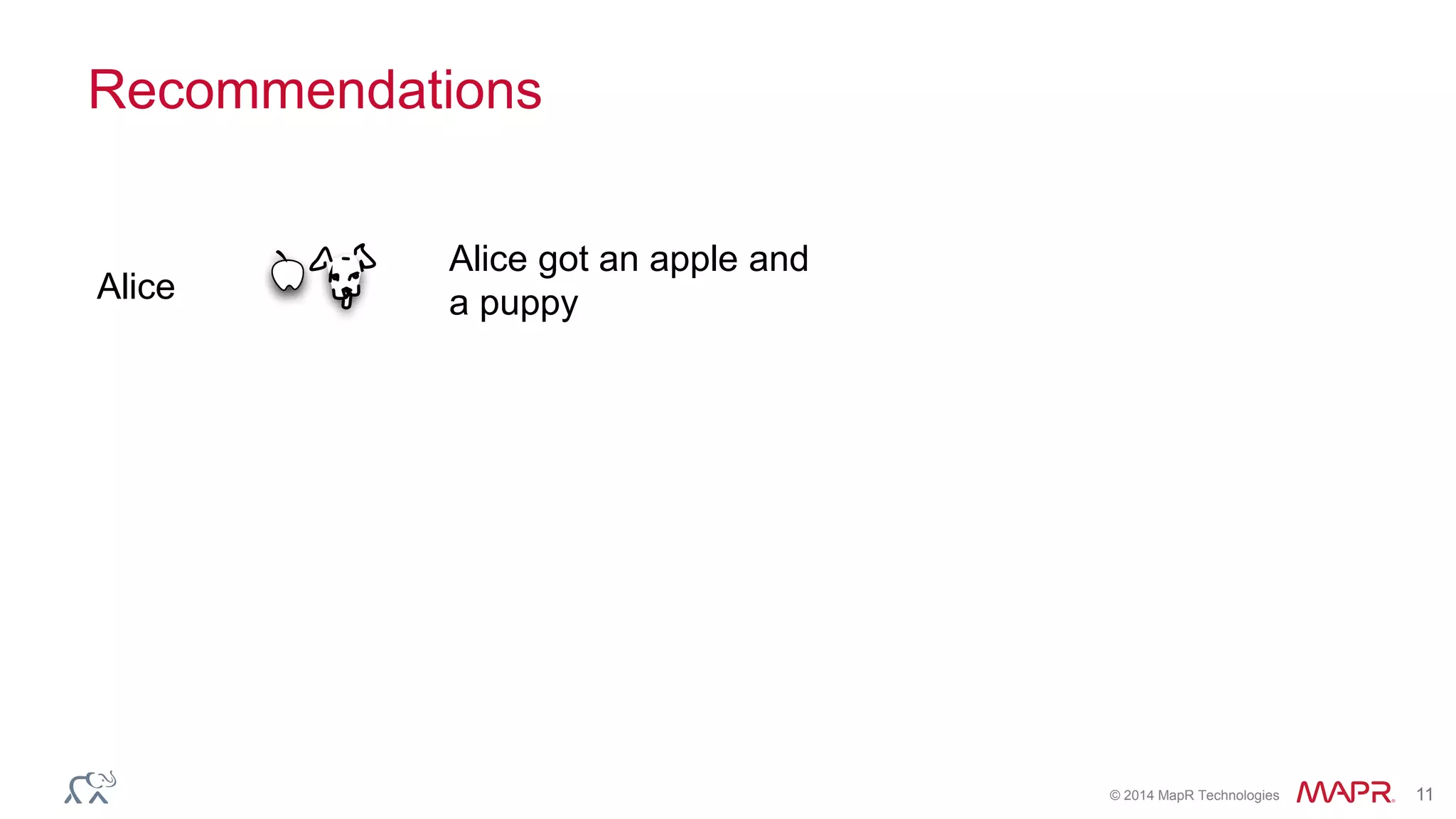
Recommendations
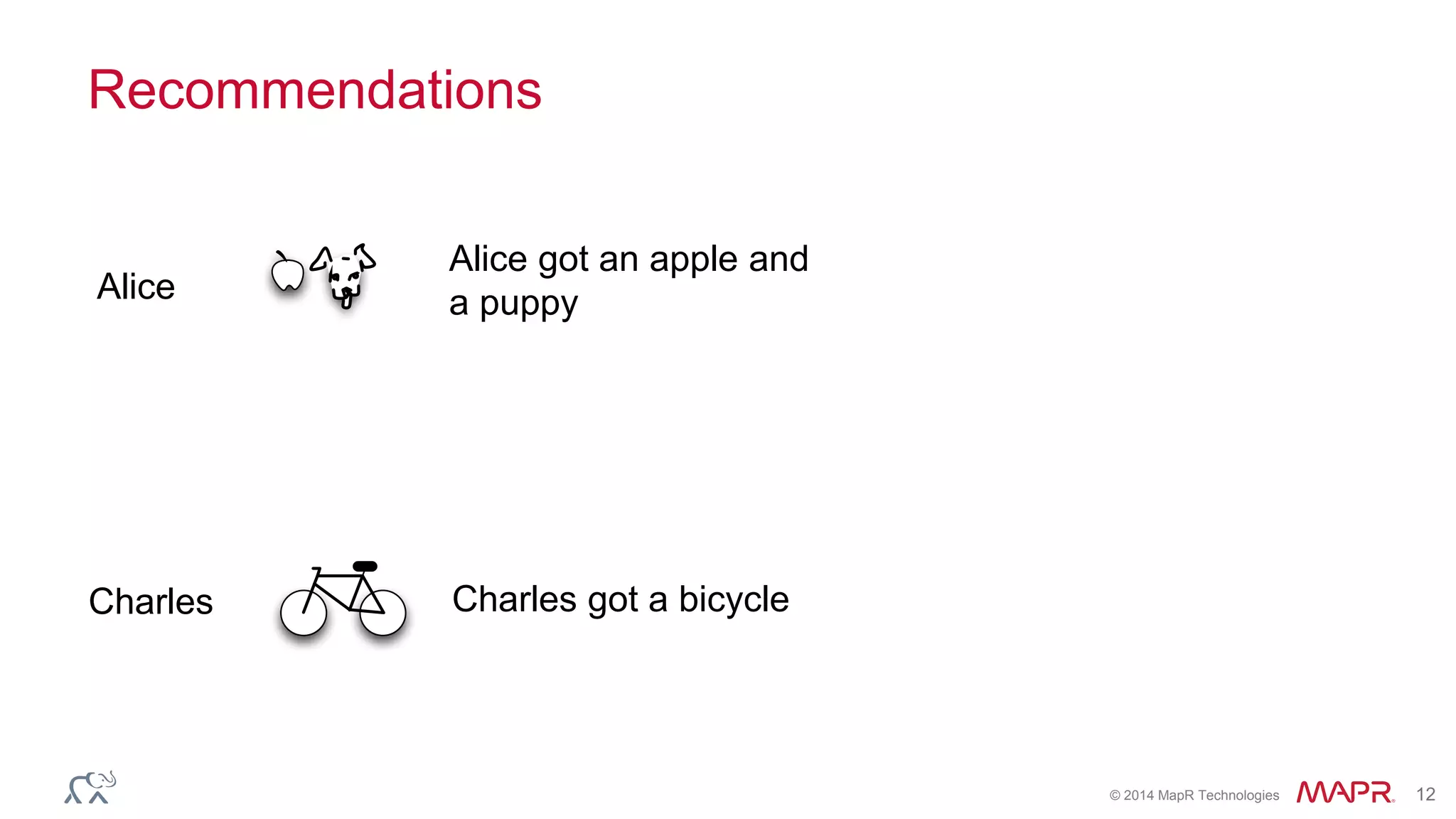
Alice got an apple and
a puppyAlice
© 2014 MapR Technologies 12
Recommendations
Alice got an apple and
a puppyAlice
Charles got a bicycleCharles
© 2014 MapR Technologies 13
Recommendations
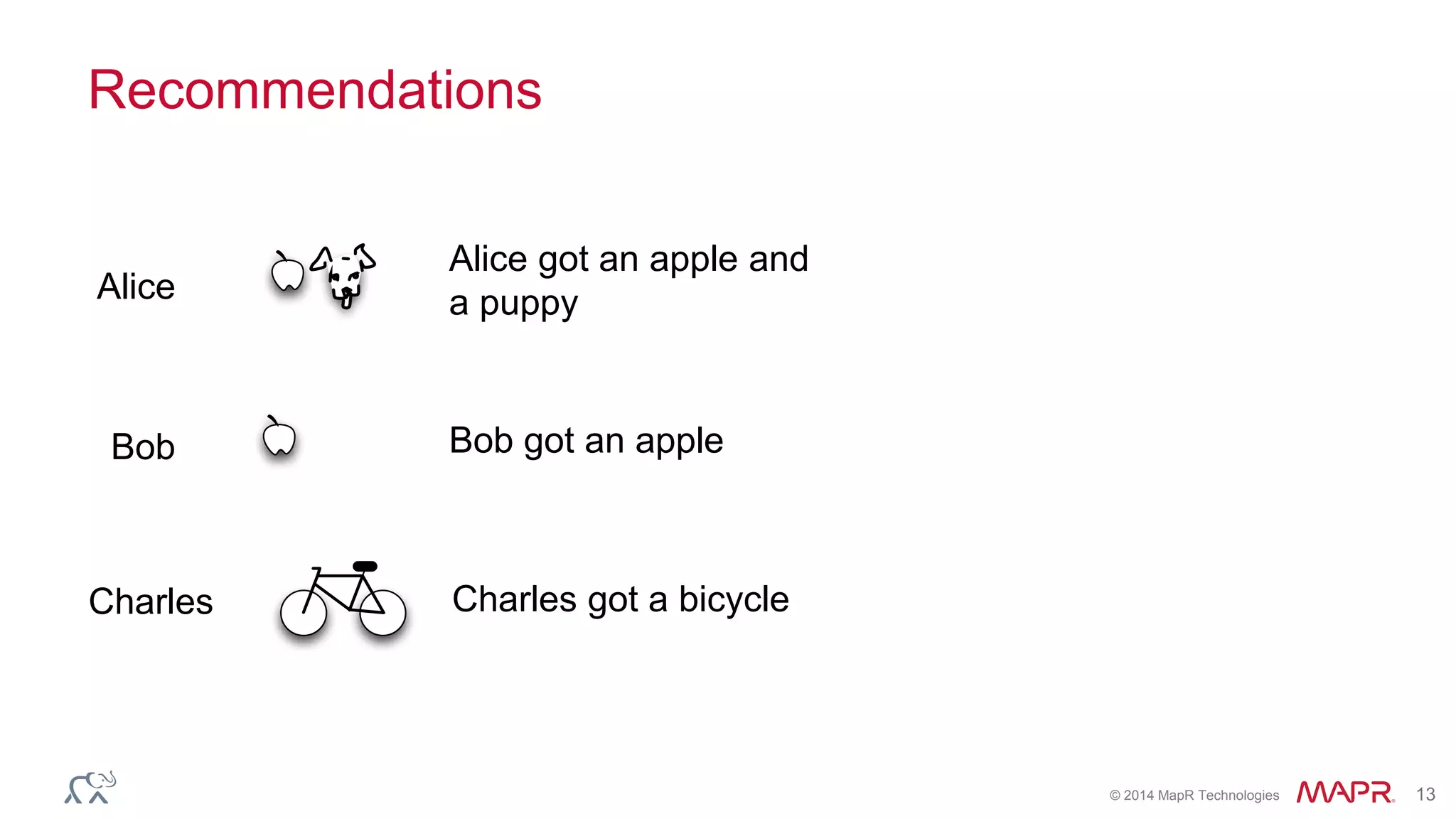
Alice got an apple and
a puppyAlice
Charles got a bicycleCharles
Bob Bob got an apple
© 2014 MapR Technologies 14
Recommendations
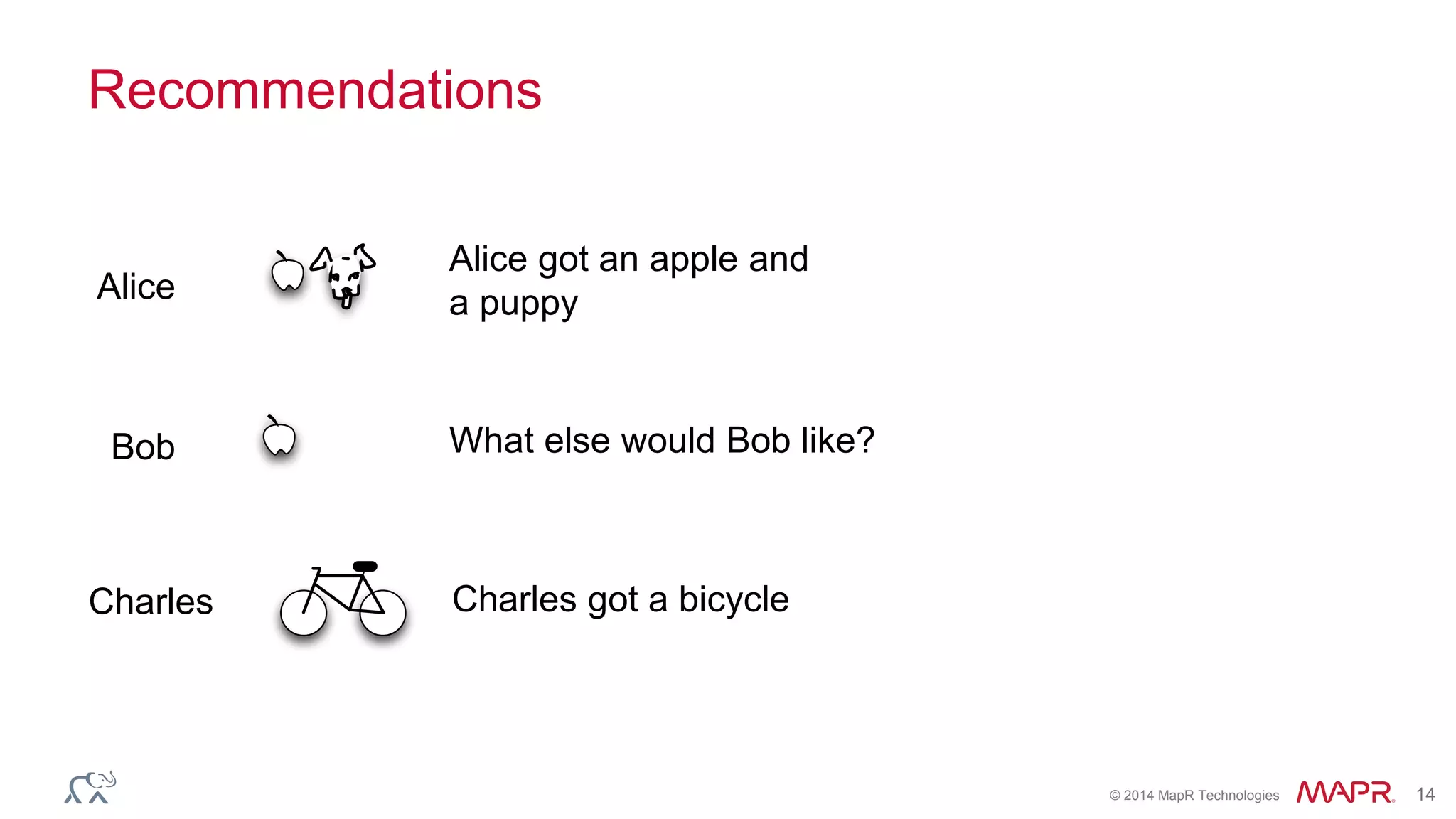
Alice got an apple and
a puppyAlice
Charles got a bicycleCharles
Bob What else would Bob like?
© 2014 MapR Technologies 15
Recommendations
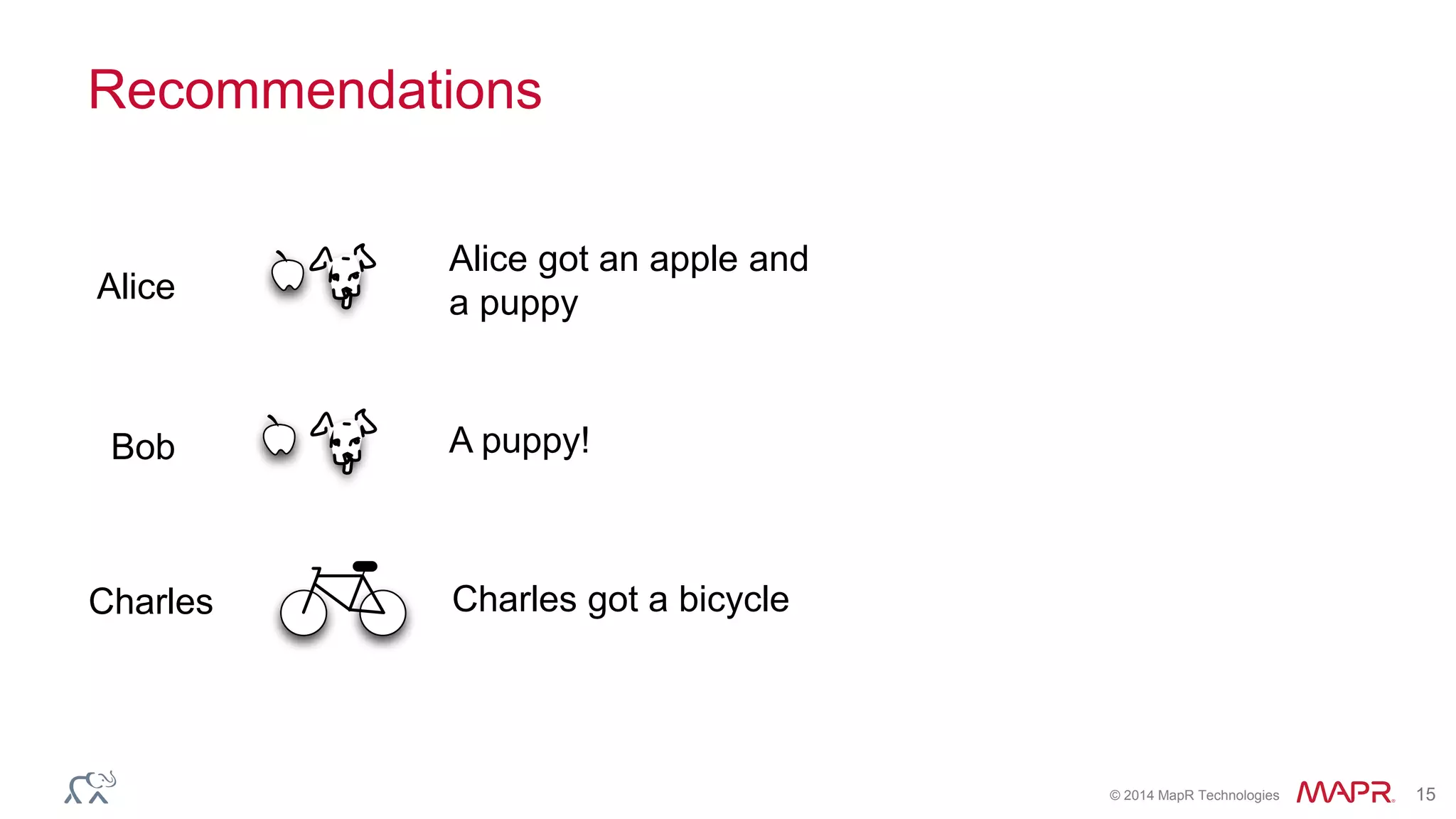
Alice got an apple and
a puppyAlice
Charles got a bicycleCharles
Bob A puppy!
© 2014 MapR Technologies 16
You get the idea of how
recommenders can work…
© 2014 MapR Technologies 17
By the way, like me, Bob also
wants a pony…
© 2014 MapR Technologies 18
Recommendations
?
Alice
Bob
Charles
Amelia
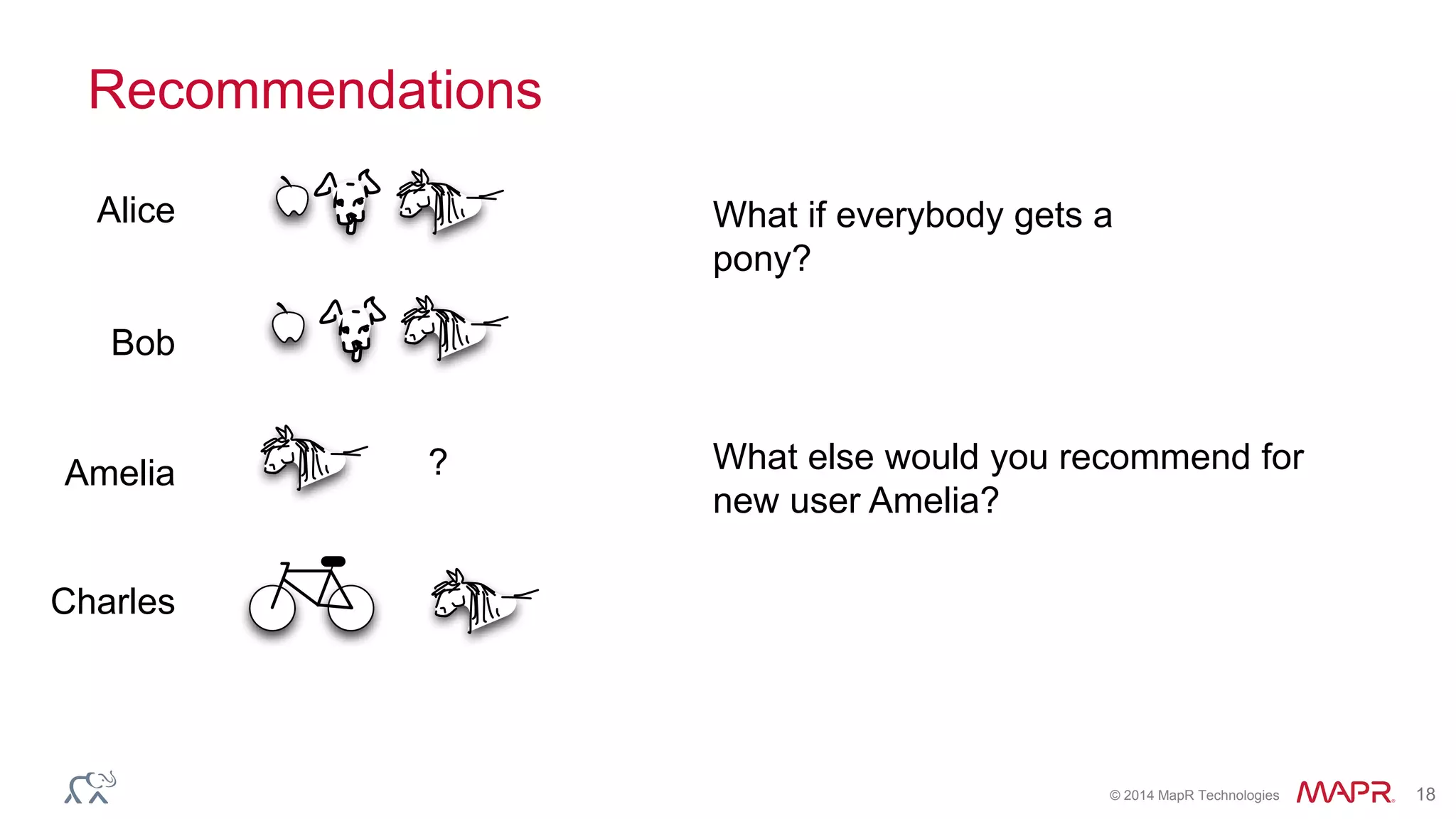
What if everybody gets a
pony?
What else would you recommend for
new user Amelia?
© 2014 MapR Technologies 19
Recommendations
?
Alice
Bob
Charles
Amelia
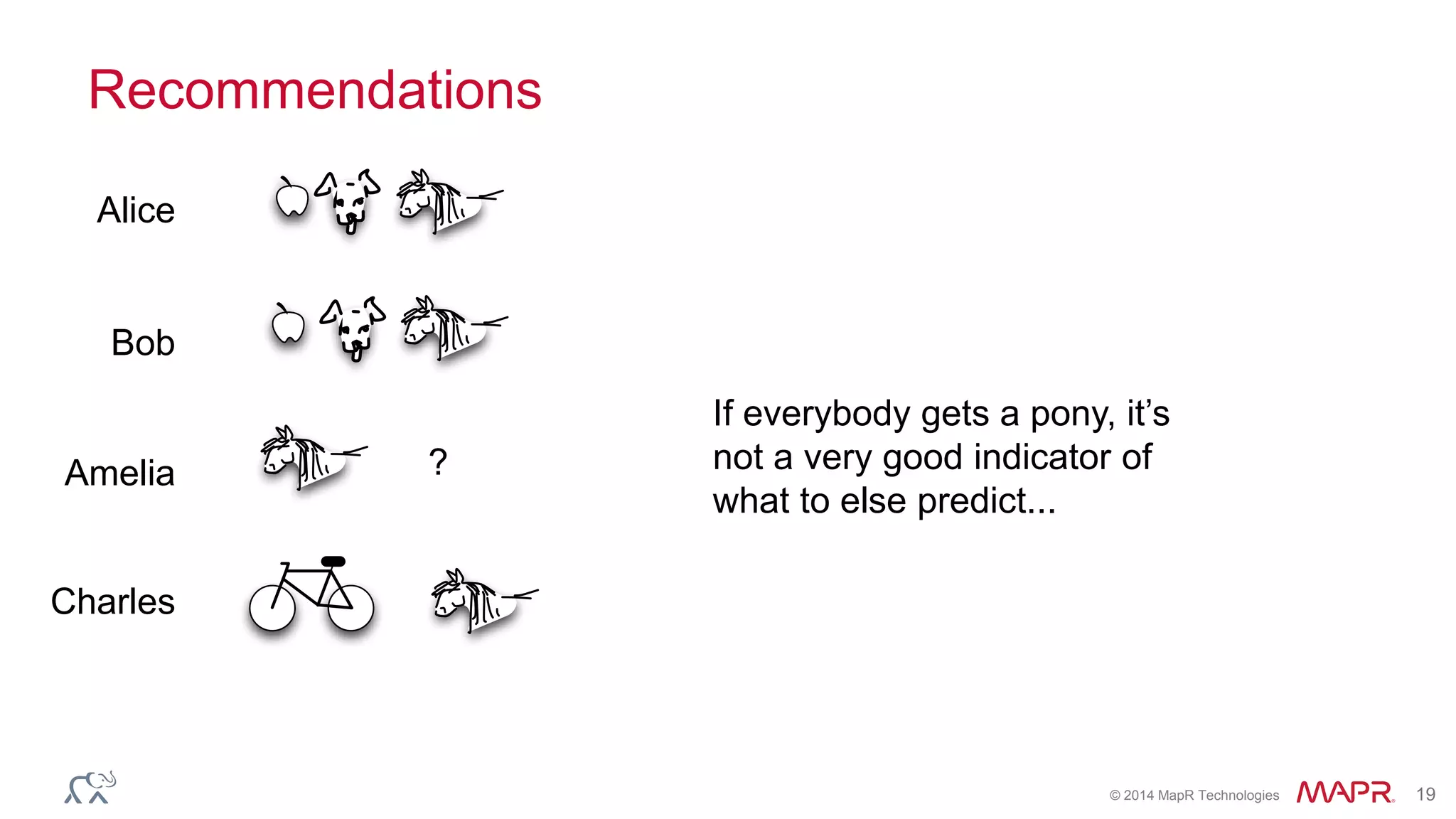
If everybody gets a pony, it’s
not a very good indicator of
what to else predict...
© 2014 MapR Technologies 20
Problems with Raw Co-occurrence
• Very popular items co-occur with everything or why it’s not very
helpful to know that everybody wants a pony…
– Examples: Welcome document; Elevator music
• Very widespread occurrence is not interesting to generate indicators
for recommendation
– Unless you want to offer an item that is constantly desired, such as
razor blades (or ponies)
• What we want is anomalous co-occurrence
– This is the source of interesting indicators of preference on which to
base recommendation
© 2014 MapR Technologies 21
Overview: Get Useful Indicators from Behaviors
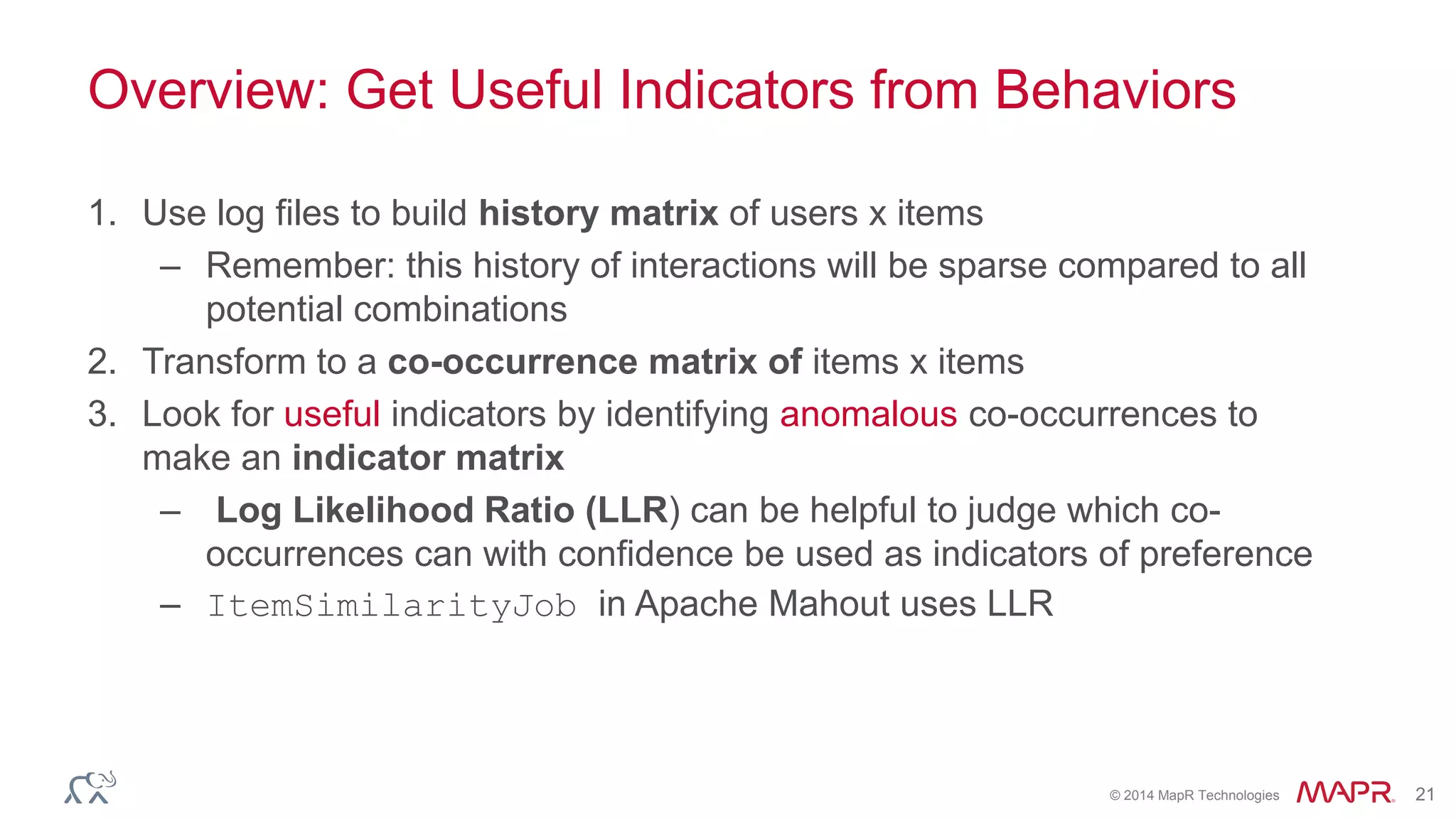
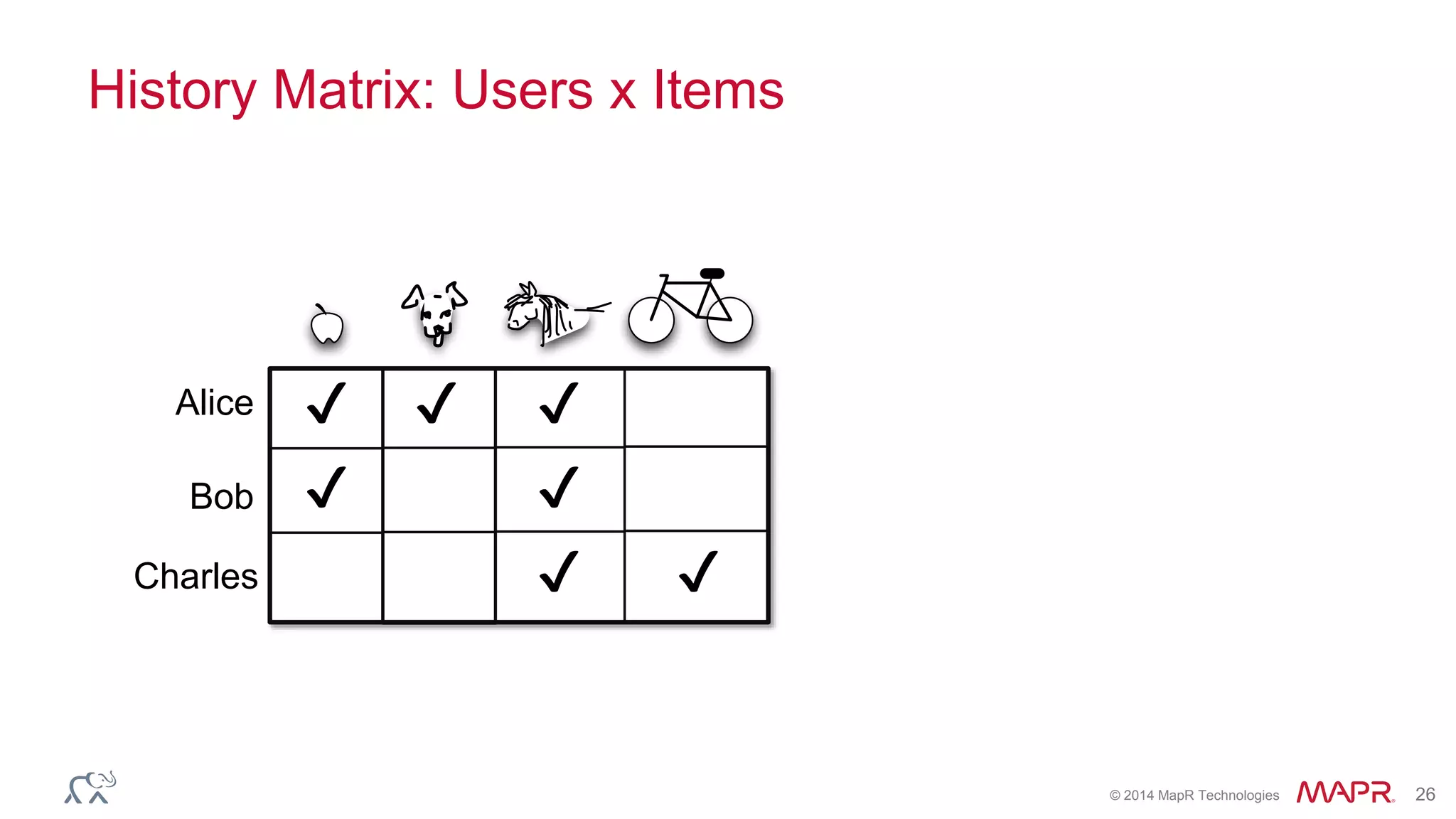
1. Use log files to build history matrix of users x items
– Remember: this history of interactions will be sparse compared to all
potential combinations
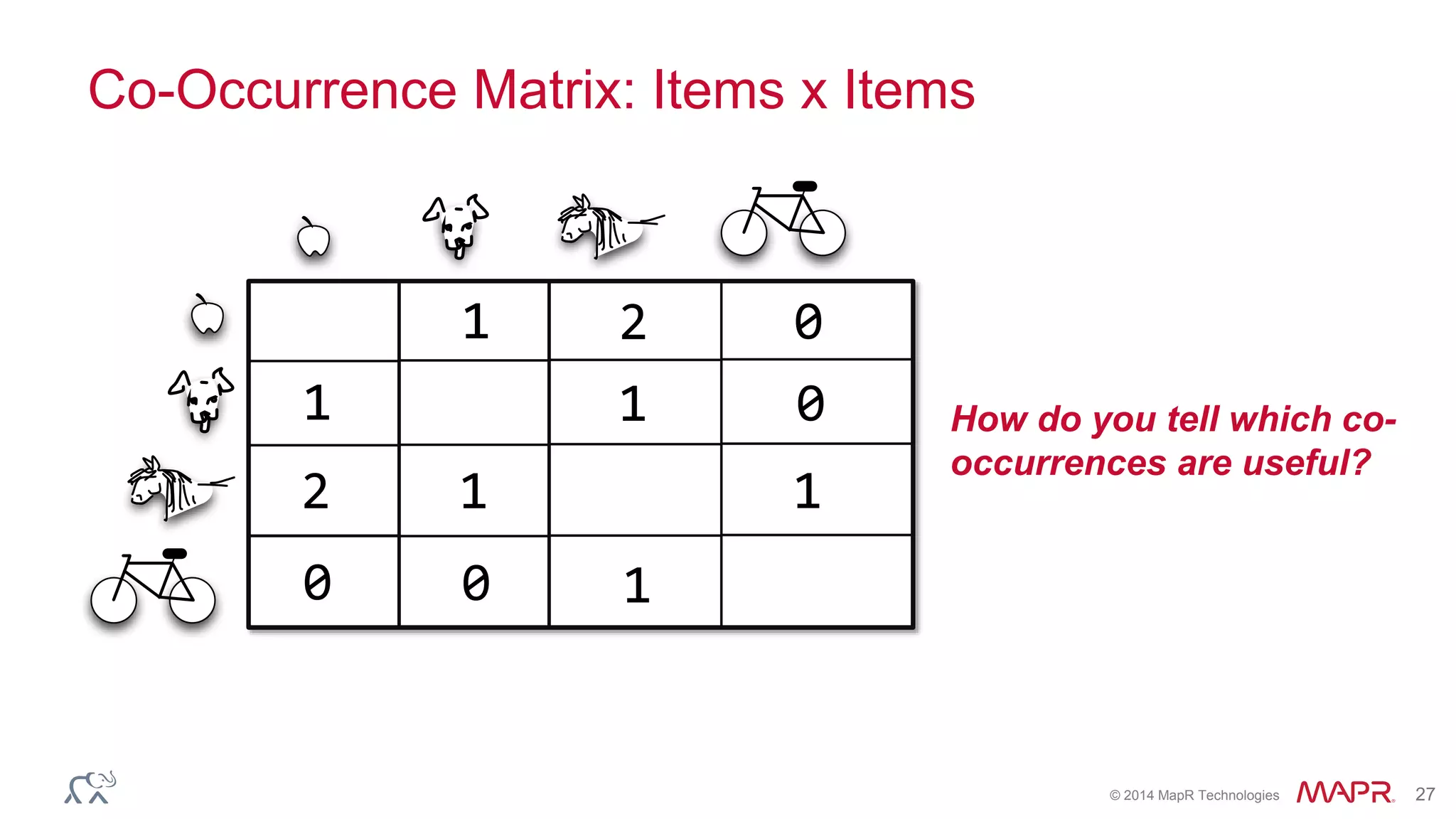
2. Transform to a co-occurrence matrix of items x items
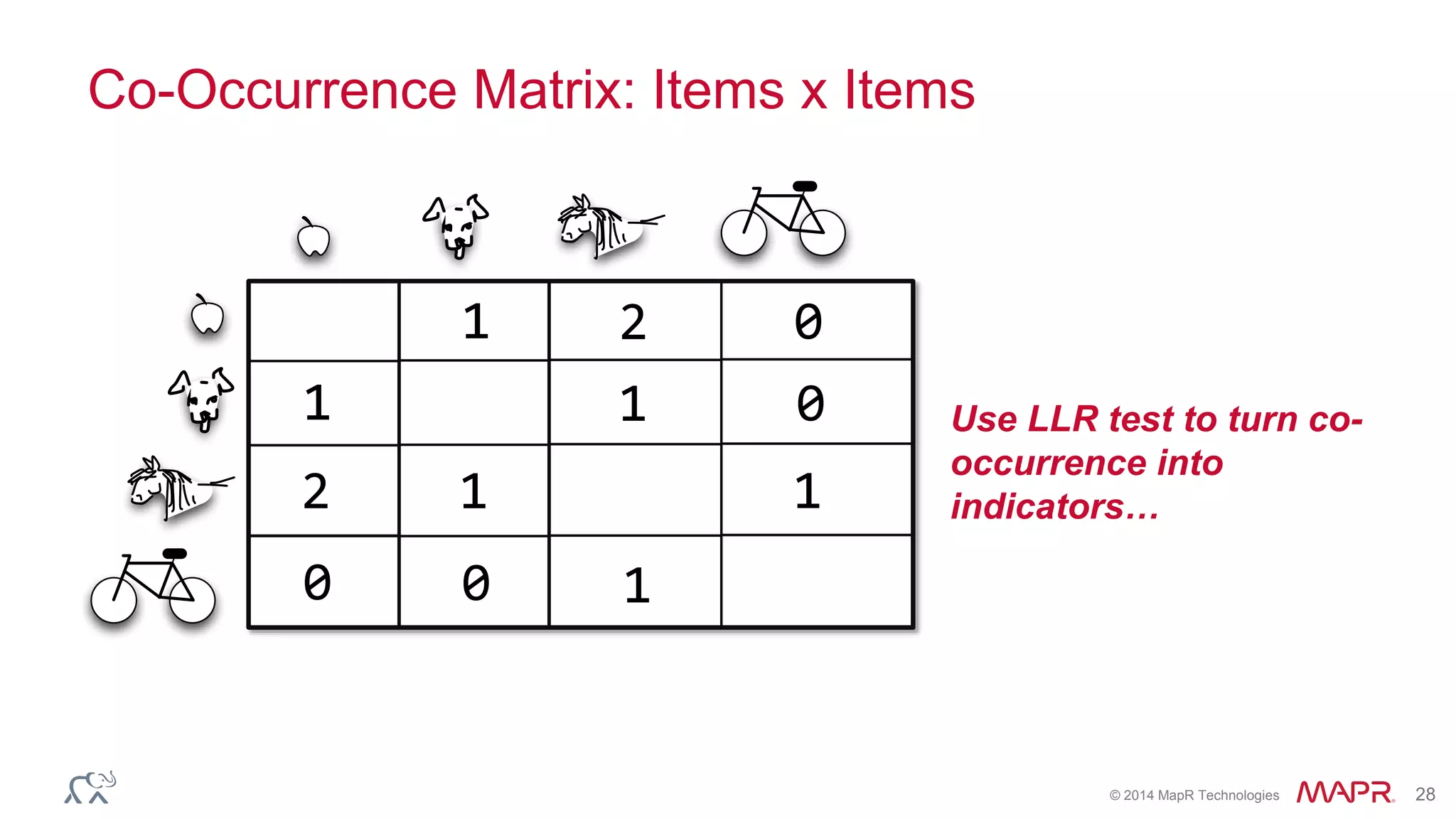
3. Look for useful indicators by identifying anomalous co-occurrences to
make an indicator matrix
– Log Likelihood Ratio (LLR) can be helpful to judge which co-
occurrences can with confidence be used as indicators of preference
– ItemSimilarityJob in Apache Mahout uses LLR
© 2014 MapR Technologies 22
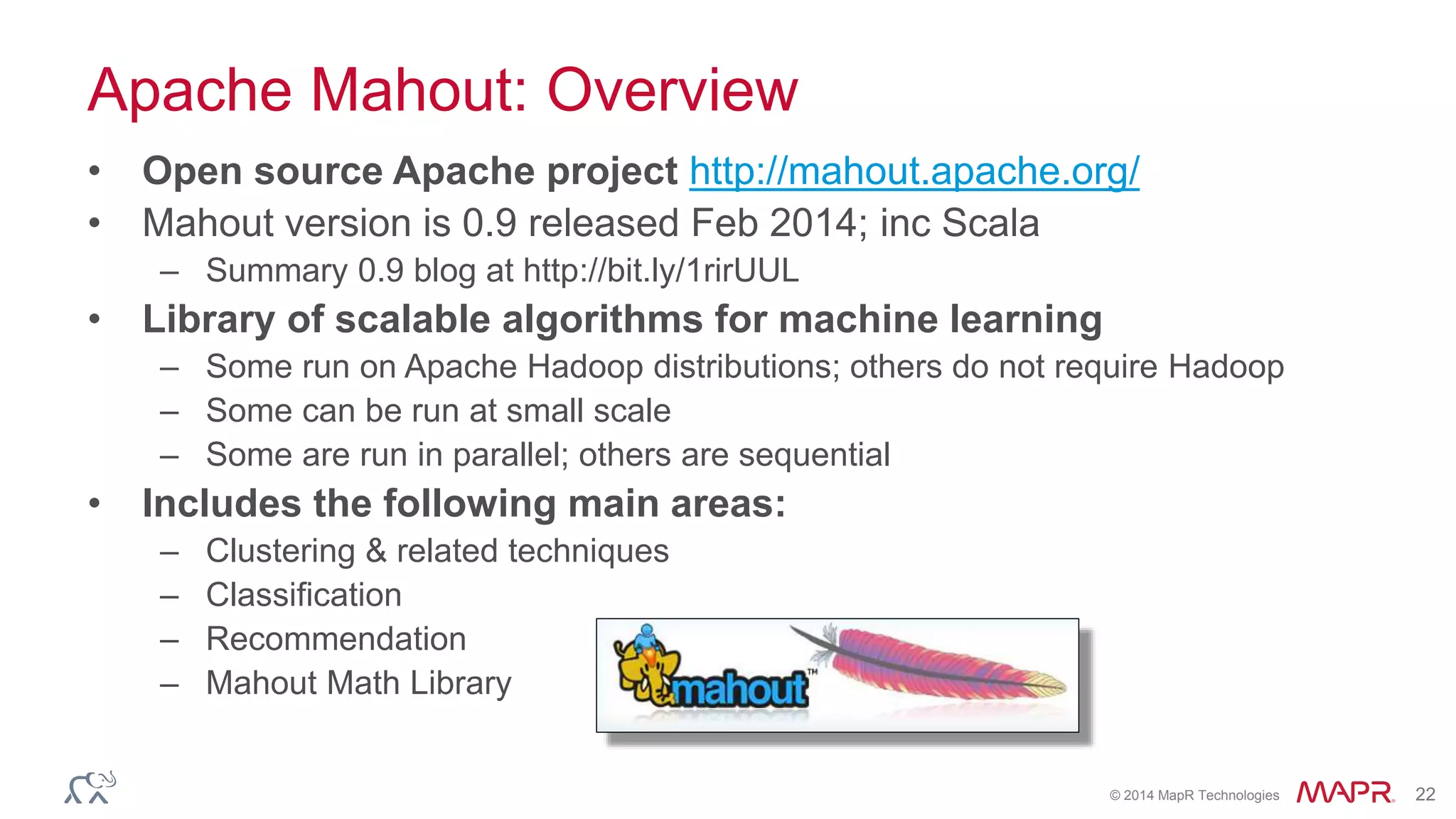
Apache Mahout: Overview
• Open source Apache project http://mahout.apache.org/
• Mahout version is 0.9 released Feb 2014; inc Scala
– Summary 0.9 blog at http://bit.ly/1rirUUL
• Library of scalable algorithms for machine learning
– Some run on Apache Hadoop distributions; others do not require Hadoop
– Some can be run at small scale
– Some are run in parallel; others are sequential
• Includes the following main areas:
– Clustering & related techniques
– Classification
– Recommendation
– Mahout Math Library
© 2014 MapR Technologies 24
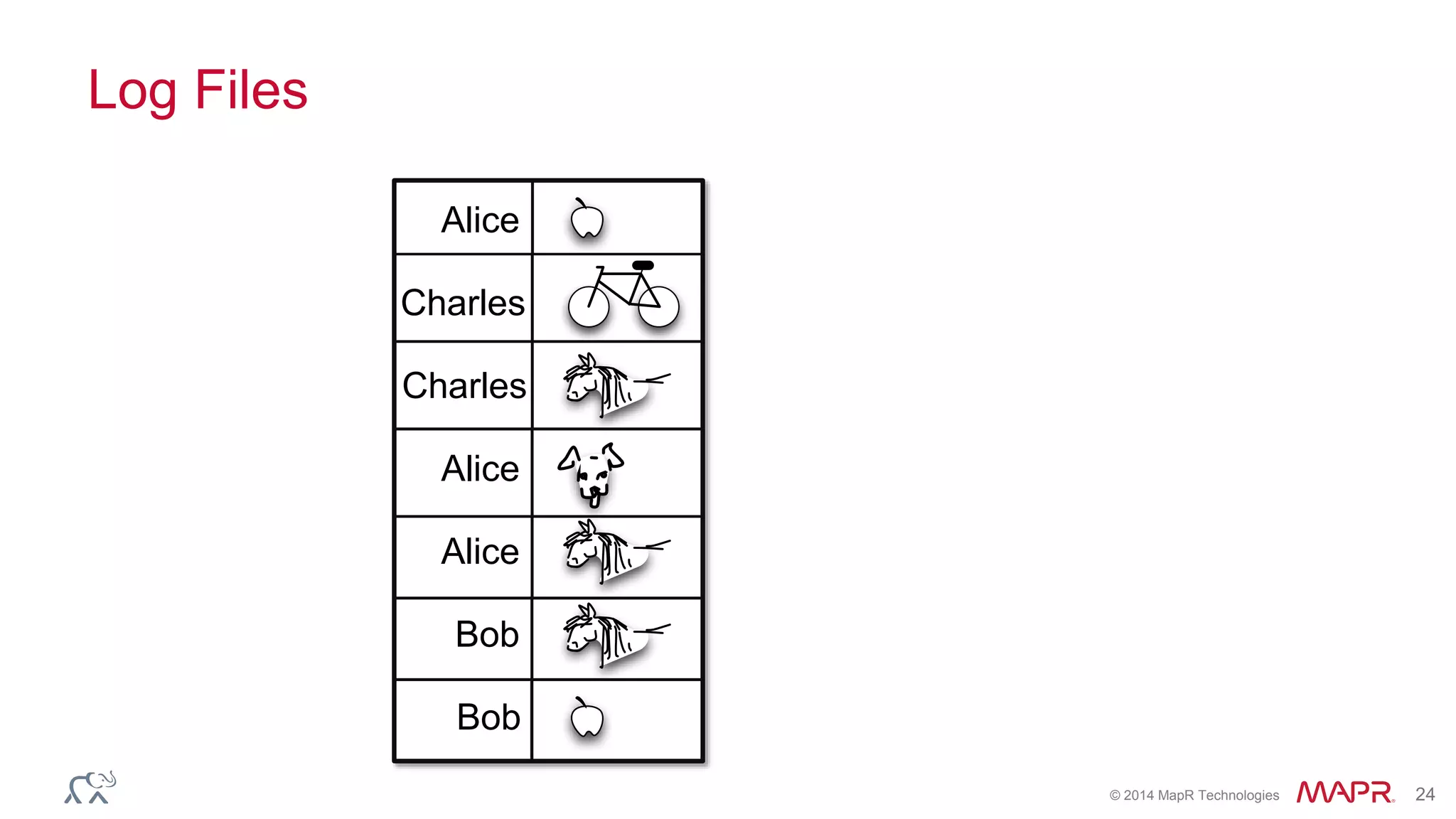
Log Files
Alice
Bob
Charles
Alice
Bob
Charles
Alice
© 2014 MapR Technologies 25
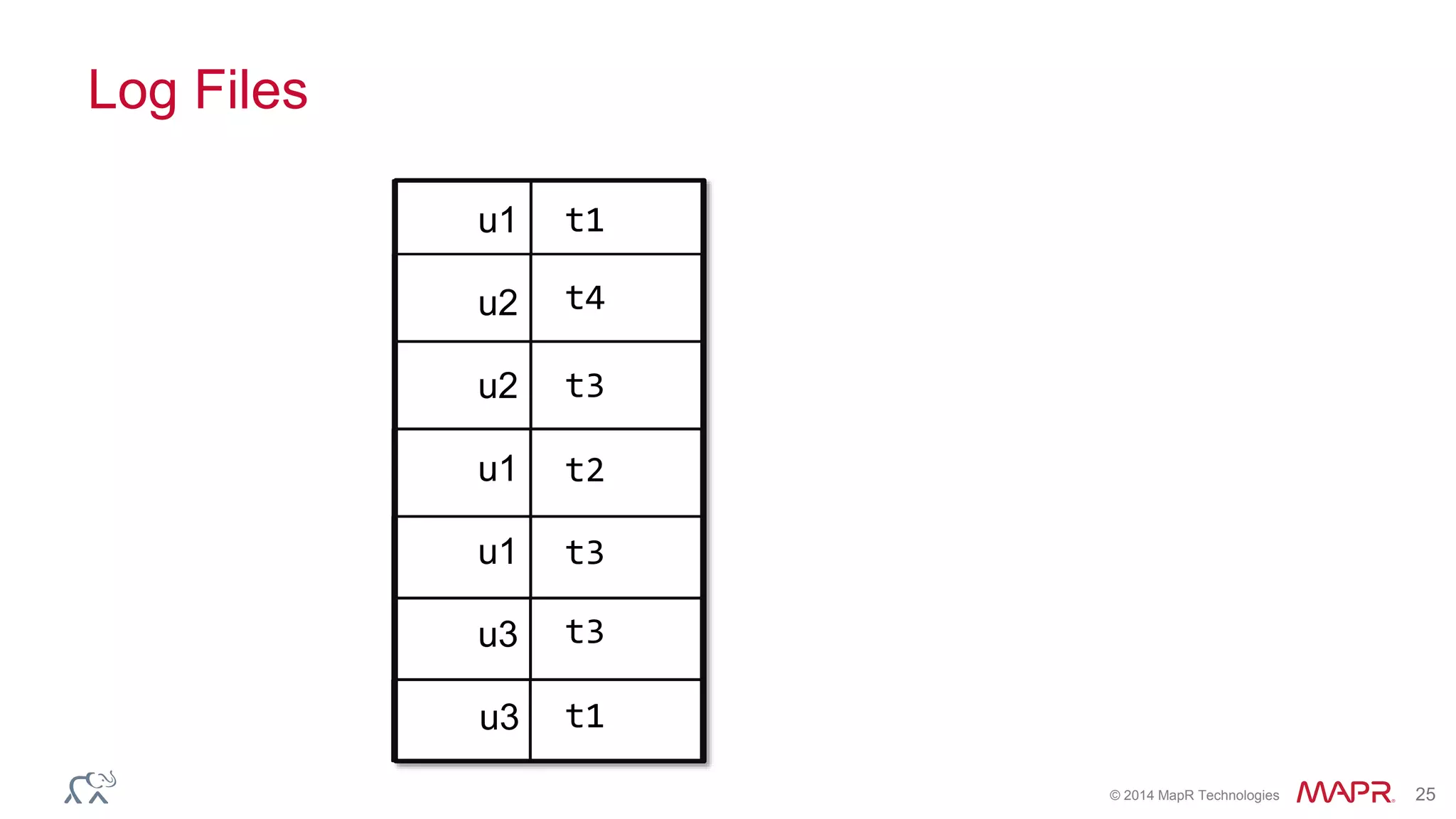
Log Files
u1
u3
u2
u1
u3
u2
u1
t1
t4
t3
t2
t3
t3
t1
© 2014 MapR Technologies 26
History Matrix: Users x Items
Alice
Bob
Charles
✔ ✔ ✔
✔ ✔
✔ ✔
© 2014 MapR Technologies 27
Co-Occurrence Matrix: Items x Items
1 2 0
1
1 1
1
1
0
00
2
How do you tell which co-
occurrences are useful?
© 2014 MapR Technologies 28
Co-Occurrence Matrix: Items x Items
1 2 0
1
1 1
1
1
0
00
2
Use LLR test to turn co-
occurrence into
indicators…
© 2014 MapR Technologies 29
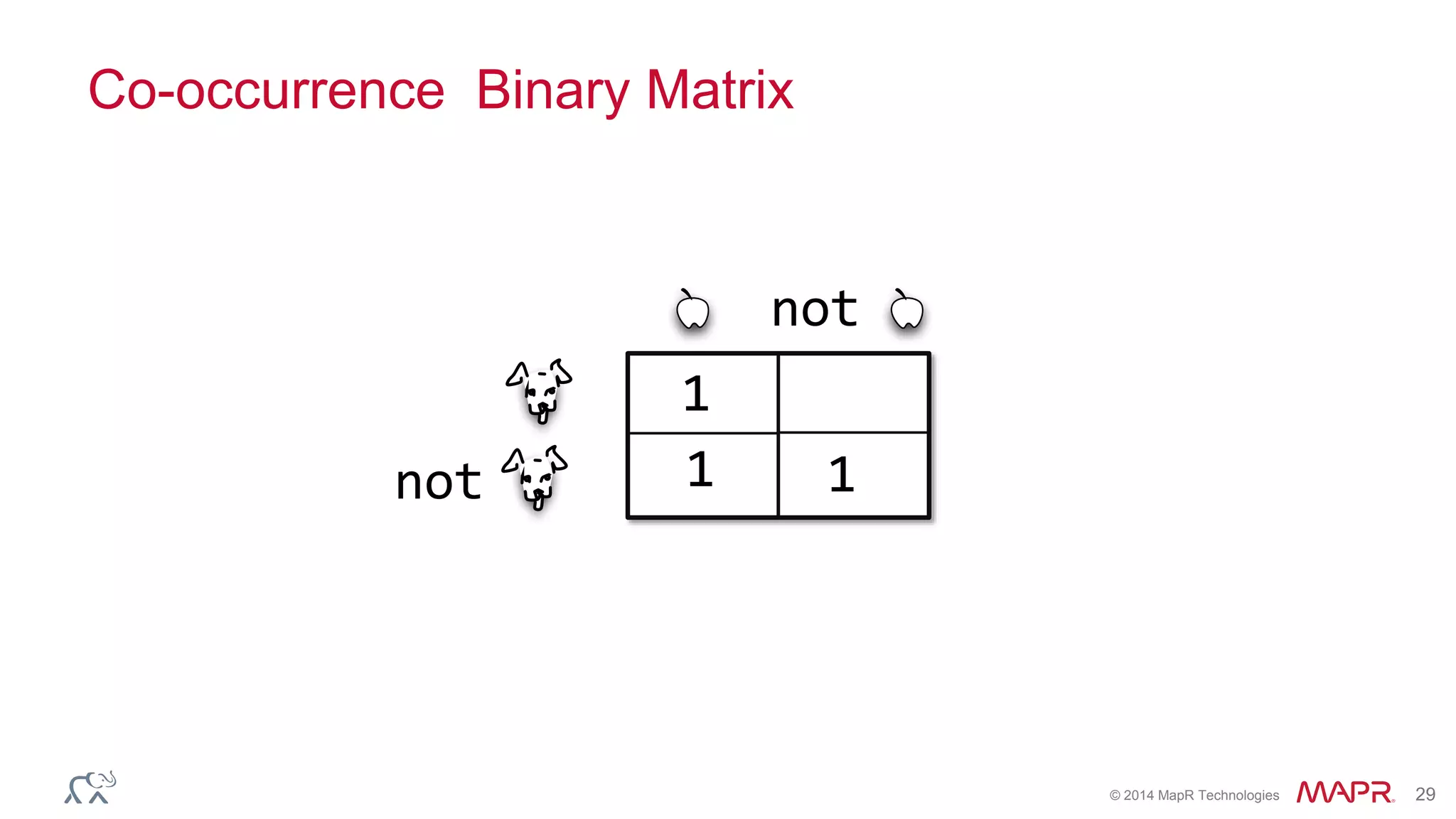
Co-occurrence Binary Matrix
1
1not
not
1
© 2014 MapR Technologies 30
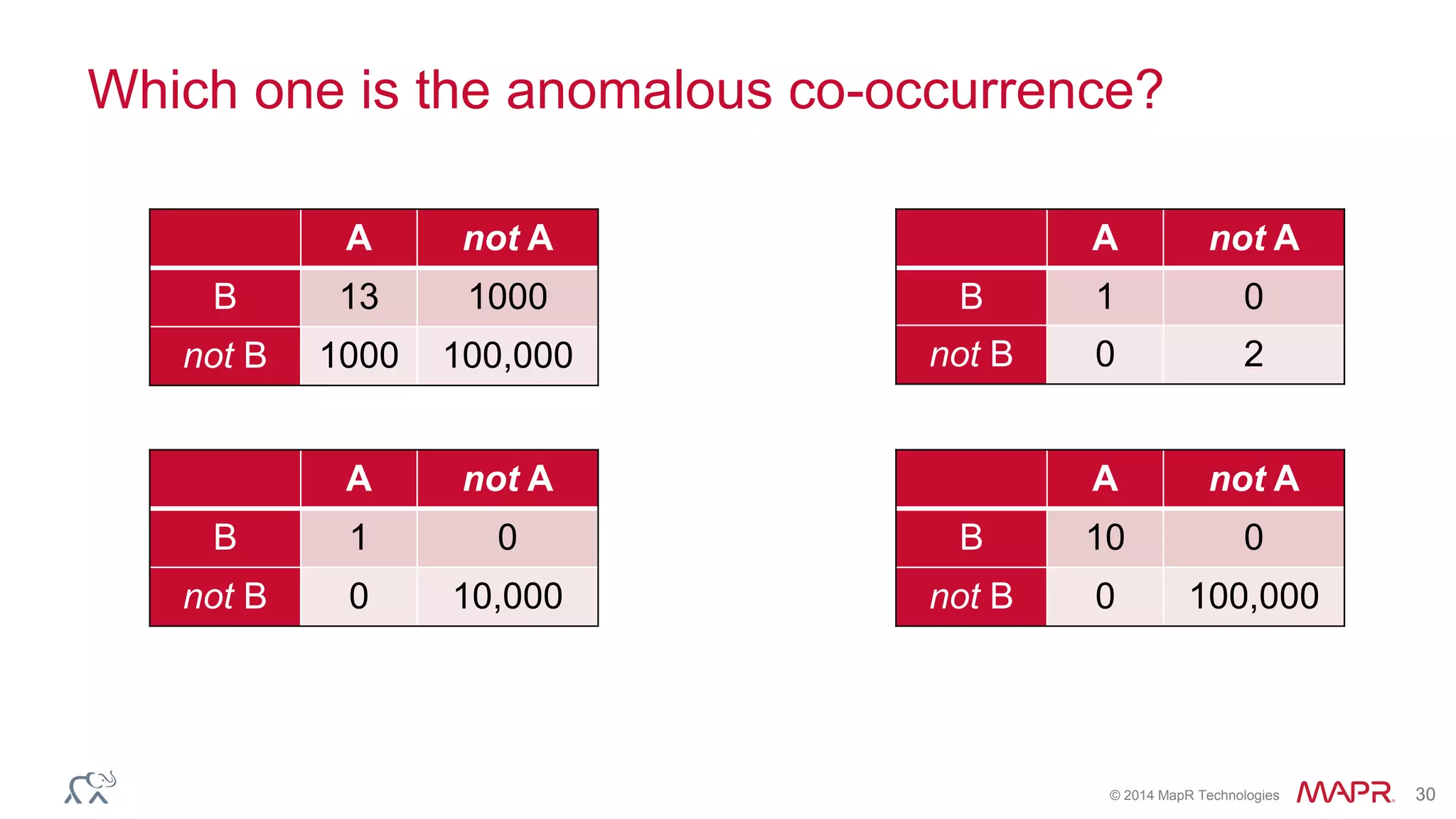
Which one is the anomalous co-occurrence?
A not A
B 13 1000
not B 1000 100,000
A not A
B 1 0
not B 0 10,000
A not A
B 10 0
not B 0 100,000
A not A
B 1 0
not B 0 2
© 2014 MapR Technologies 31
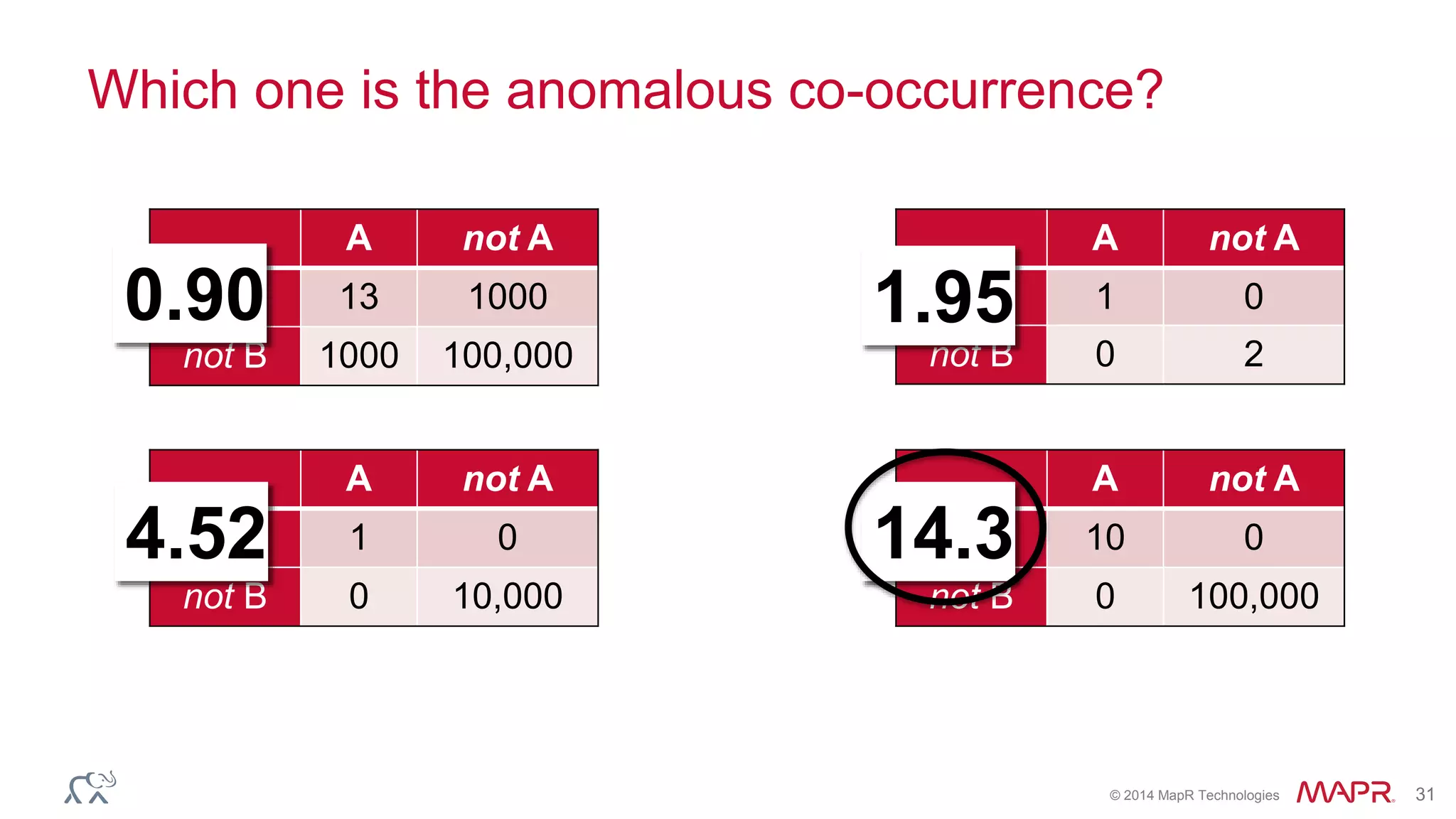
Which one is the anomalous co-occurrence?
A not A
B 13 1000
not B 1000 100,000
A not A
B 1 0
not B 0 10,000
A not A
B 10 0
not B 0 100,000
A not A
B 1 0
not B 0 2
0.90 1.95
4.52 14.3
© 2014 MapR Technologies 32
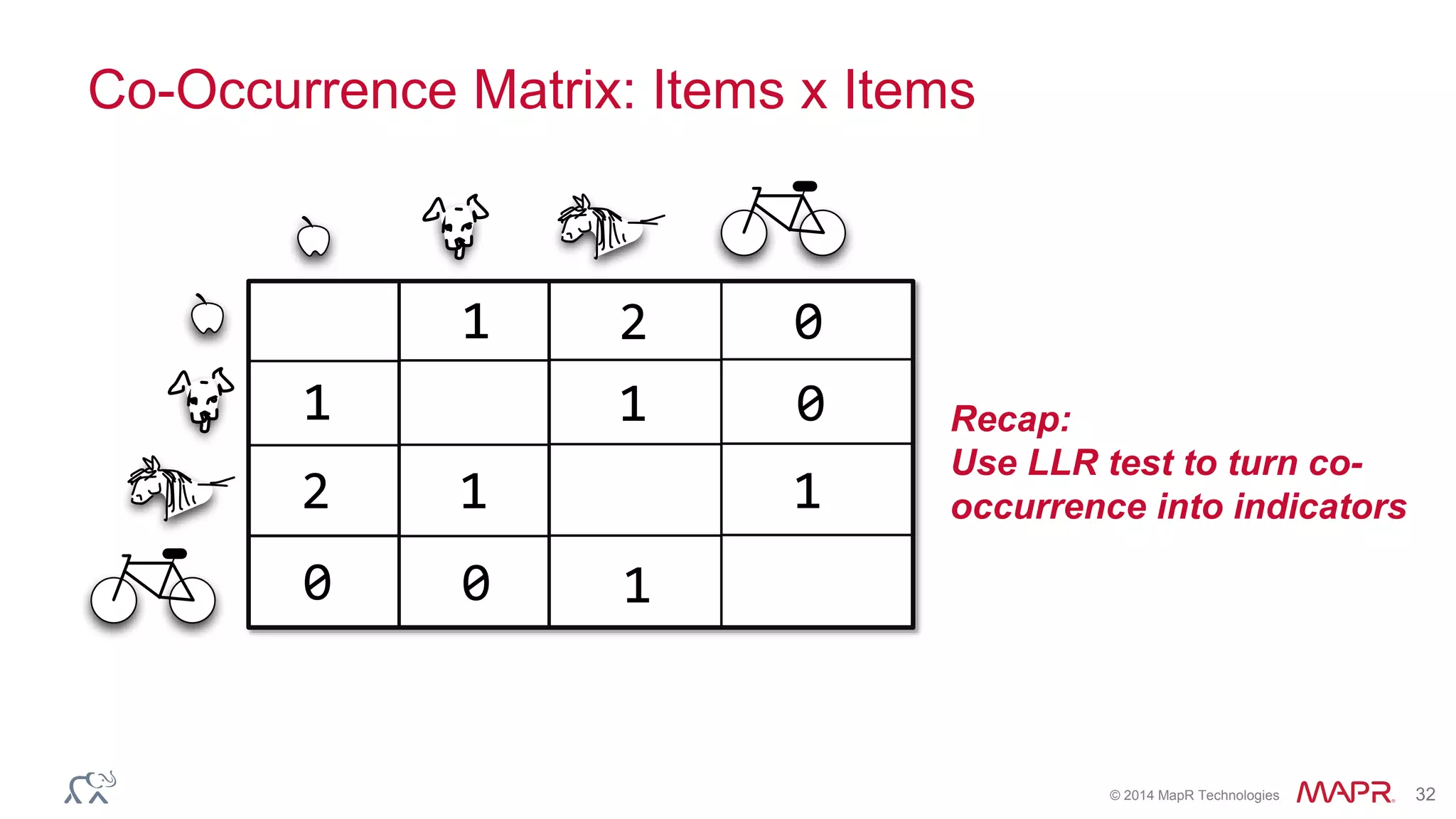
Co-Occurrence Matrix: Items x Items
1 2 0
1
1 1
1
1
0
00
2
Recap:
Use LLR test to turn co-
occurrence into indicators
© 2014 MapR Technologies 33
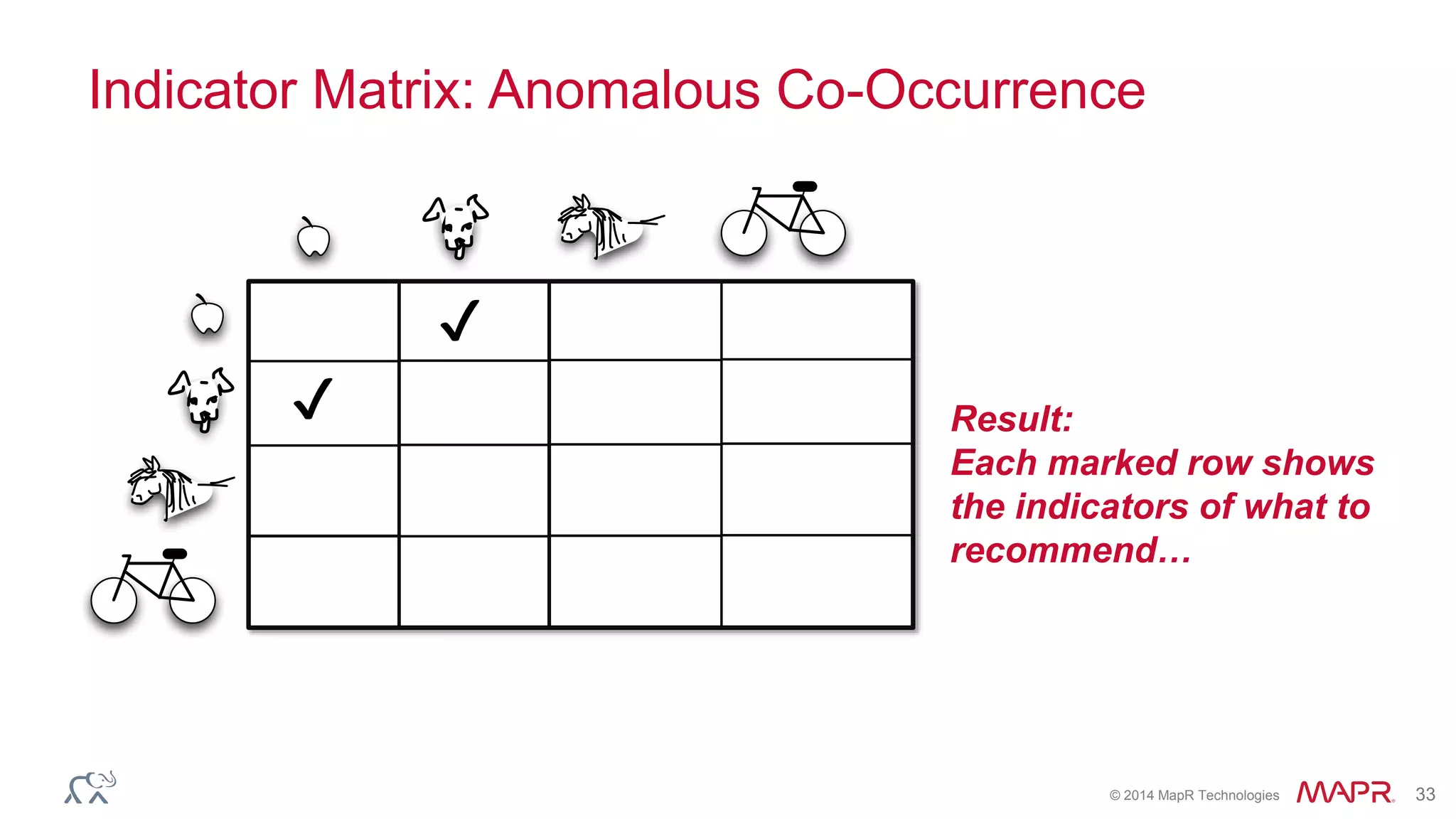
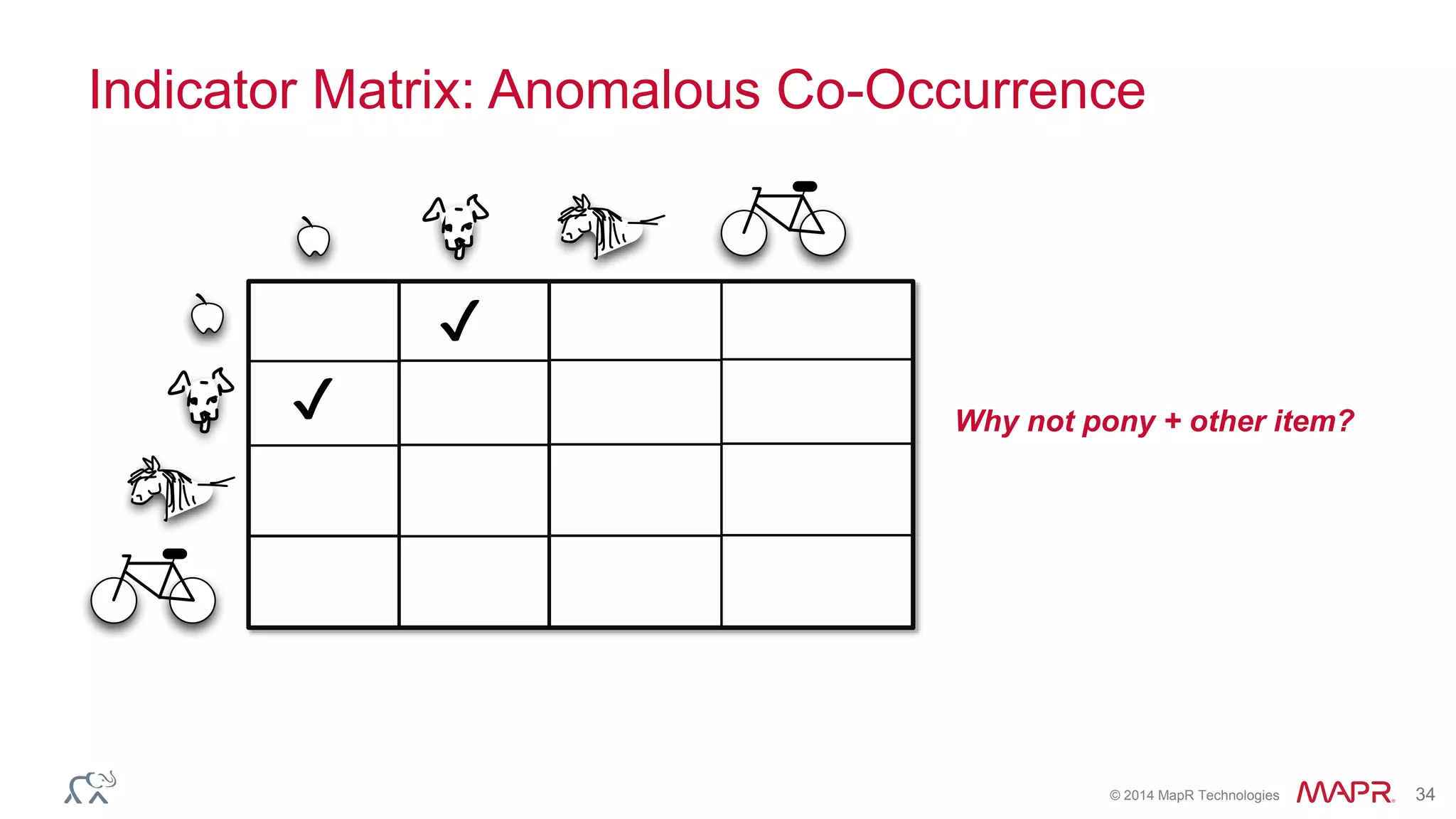
Indicator Matrix: Anomalous Co-Occurrence
Result:
Each marked row shows
the indicators of what to
recommend…
✔
✔
© 2014 MapR Technologies 34
Indicator Matrix: Anomalous Co-Occurrence
✔
✔
Why not pony + other item?
© 2014 MapR Technologies 36
How will you deliver
recommendations to users?
© 2014 MapR Technologies 37
Seeking Simplicity
Innovation:
Exploit search technology to deploy
your recommendation system
© 2014 MapR Technologies 38
But first, a look at how
search works…
© 2014 MapR Technologies 39
Apache Solr/Apache Lucene
• Apache Solr/Lucene is an open-source powerful search
engine used for flexible, heavily indexed queries including data
such as
– Full text, geographical data, statistically weighted data
• Lucene
– Provides core retrieval
– Is a low-level library
• Solr
– Is a web-based wrapper around Lucene
– Is easy to integrate because you talk to it via a web-interface
• URL http://host machine:8888
© 2014 MapR Technologies 40
LucidWorks
• Enterprise platform and collection of applications based on
Apache Solr/Lucene
– Wrapper around Solr
– A free version ships with MapR
• LucidWorks leaves Solr exposed but makes Solr
administration much easier, which in turn makes it easier to
use Lucene
• URL http://host machine:8989
© 2014 MapR Technologies 41
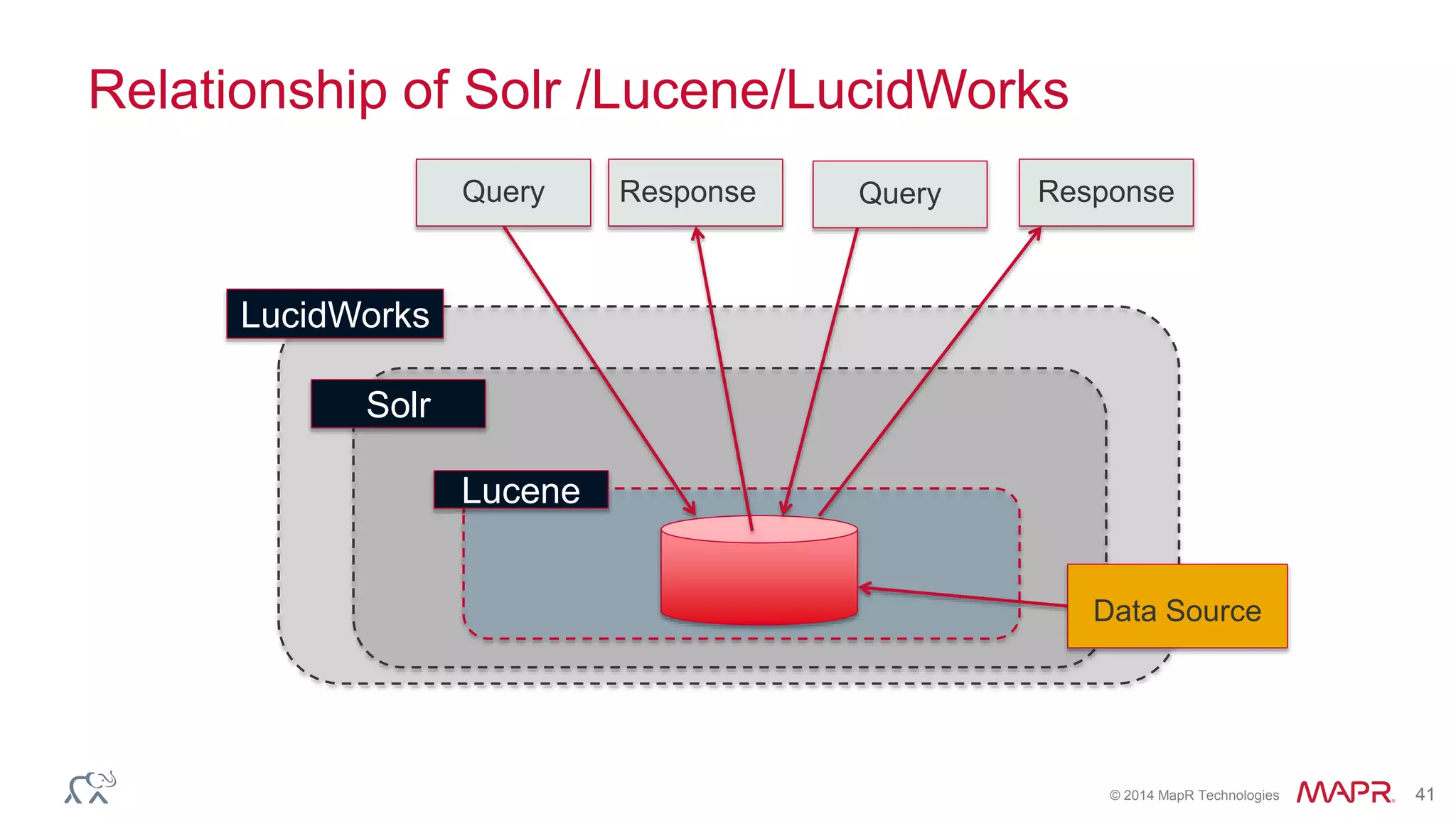
Solr
LucidWorks
Query Response
Index
Lucene
Query Response
Data Source
Relationship of Solr /Lucene/LucidWorks
© 2014 MapR Technologies 42
Other Options: Elastic Search
• Apache Lucene library at the heart of several approaches
– It can also be used on its own
• Elastic Search is a different web interface for Lucene
– Real time search and analytics
– Open source (not Apache)
– Big advantage is less accumulated cruft
http://www.elasticsearch.com/
© 2014 MapR Technologies 44
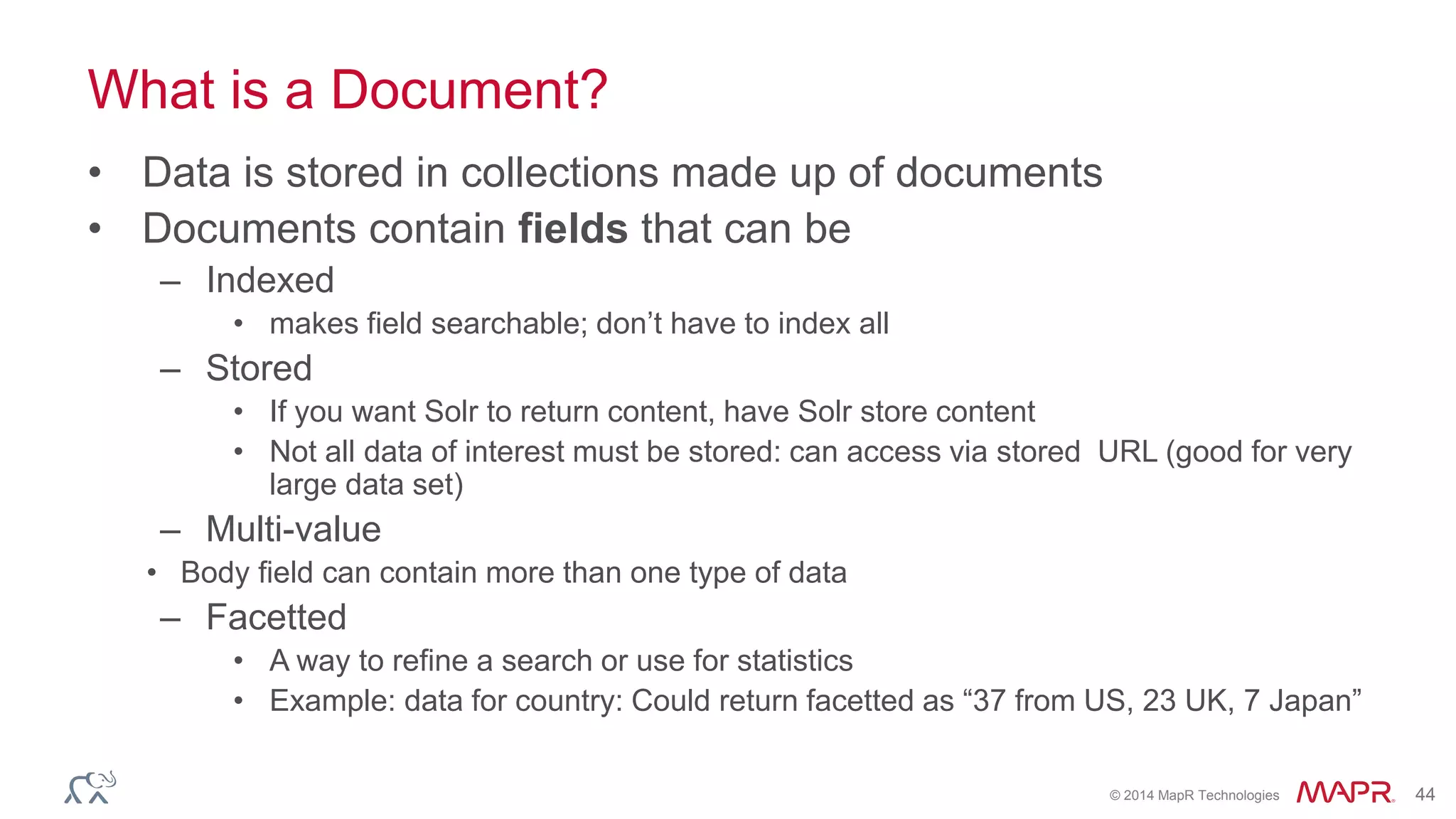
What is a Document?
• Data is stored in collections made up of documents
• Documents contain fields that can be
– Indexed
• makes field searchable; don’t have to index all
– Stored
• If you want Solr to return content, have Solr store content
• Not all data of interest must be stored: can access via stored URL (good for very
large data set)
– Multi-value
• Body field can contain more than one type of data
– Facetted
• A way to refine a search or use for statistics
• Example: data for country: Could return facetted as “37 from US, 23 UK, 7 Japan”
© 2014 MapR Technologies 45
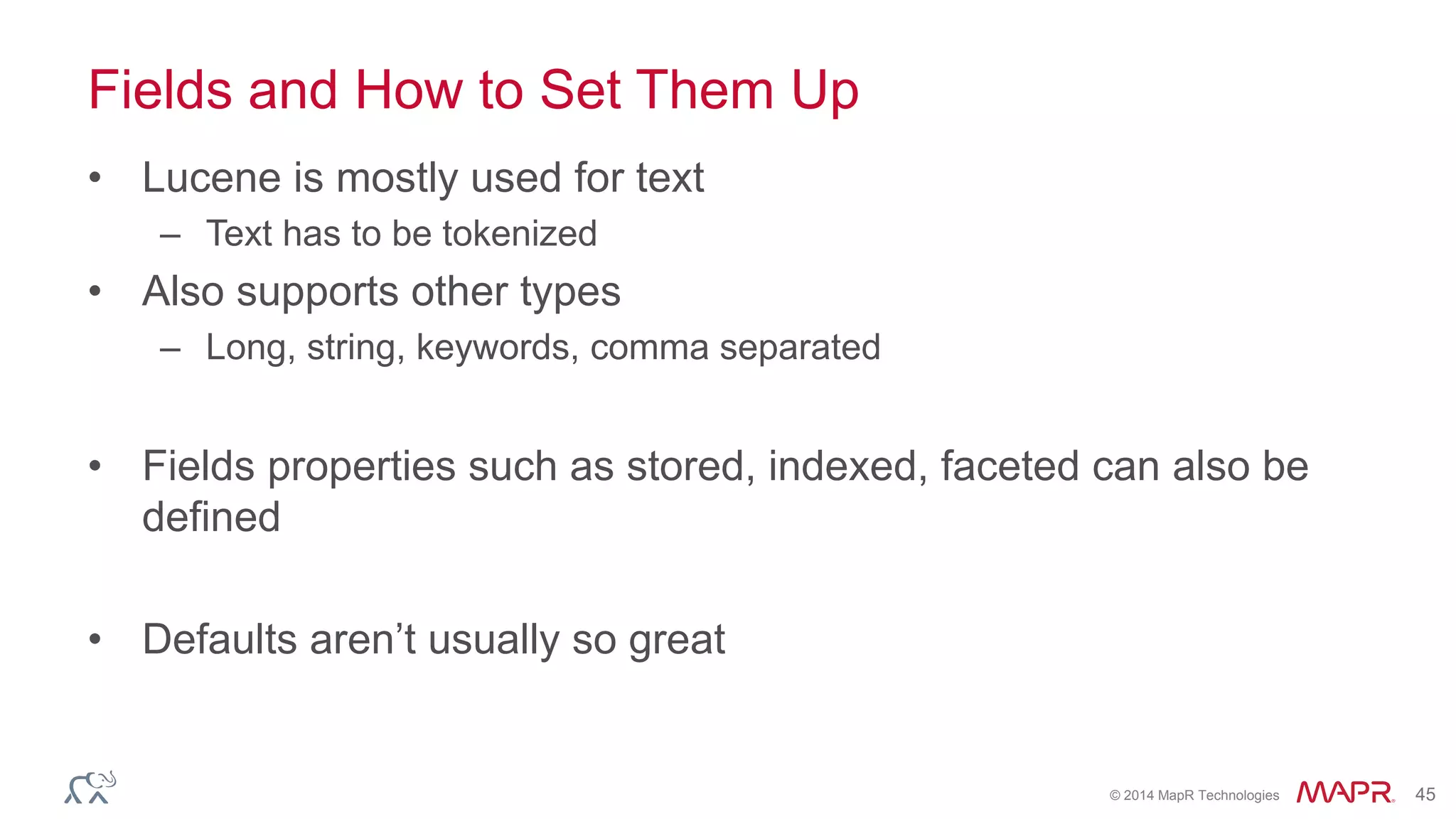
Fields and How to Set Them Up
• Lucene is mostly used for text
– Text has to be tokenized
• Also supports other types
– Long, string, keywords, comma separated
• Fields properties such as stored, indexed, faceted can also be
defined
• Defaults aren’t usually so great
© 2014 MapR Technologies 46
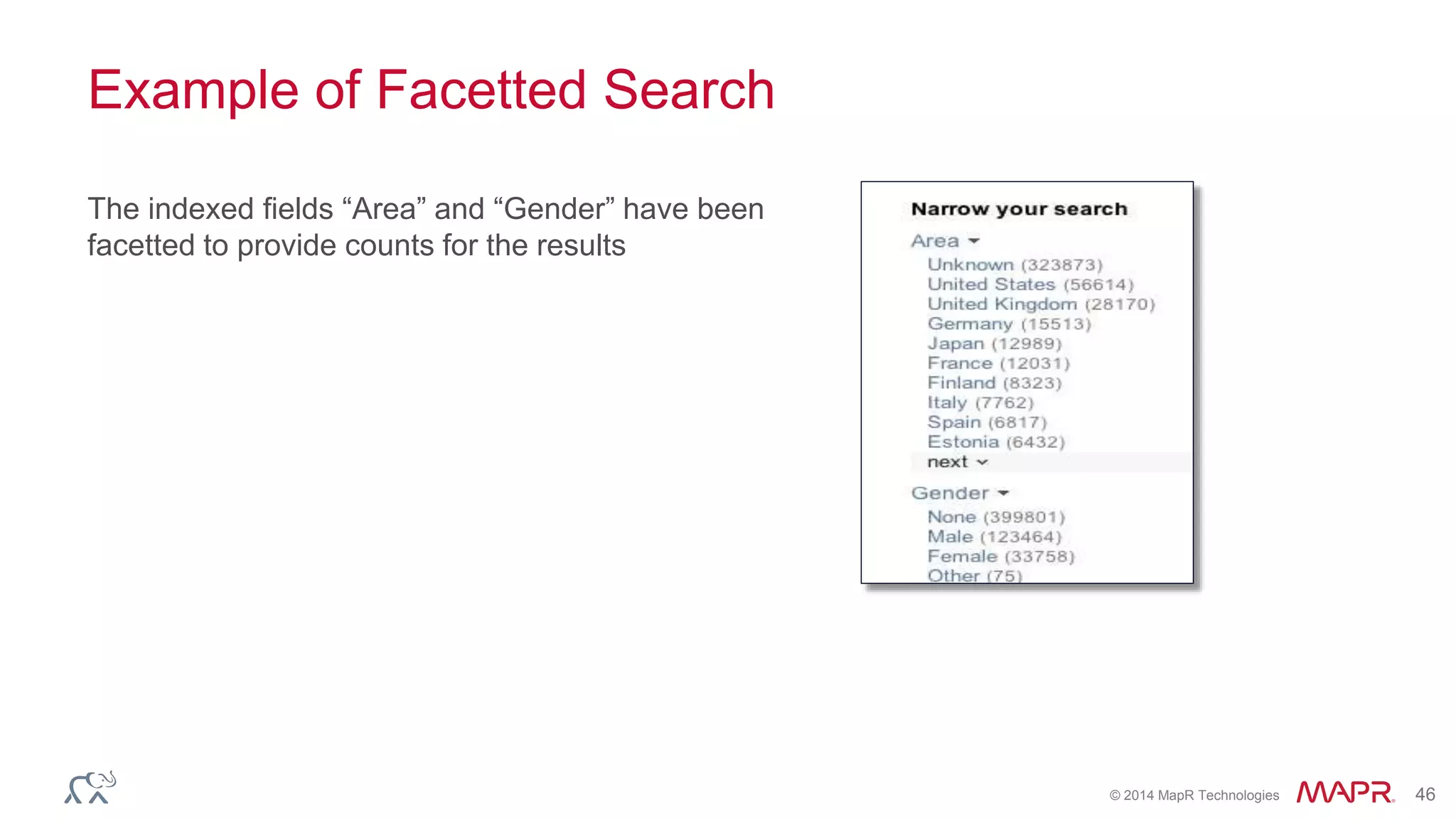
Example of Facetted Search
The indexed fields “Area” and “Gender” have been
facetted to provide counts for the results
© 2014 MapR Technologies 48
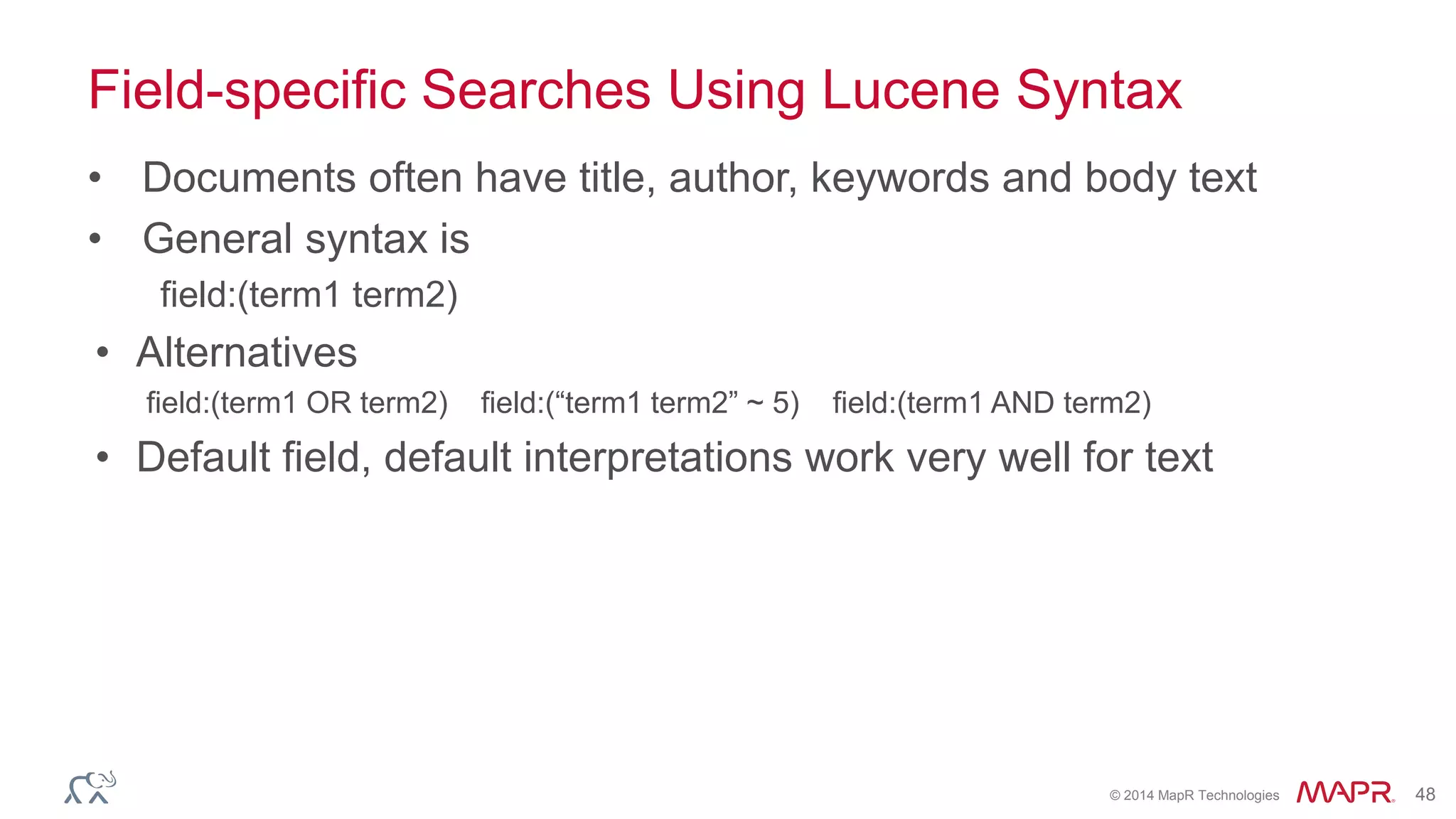
Field-specific Searches Using Lucene Syntax
• Documents often have title, author, keywords and body text
• General syntax is
field:(term1 term2)
• Alternatives
field:(term1 OR term2) field:(“term1 term2” ~ 5) field:(term1 AND term2)
• Default field, default interpretations work very well for text
© 2014 MapR Technologies 49
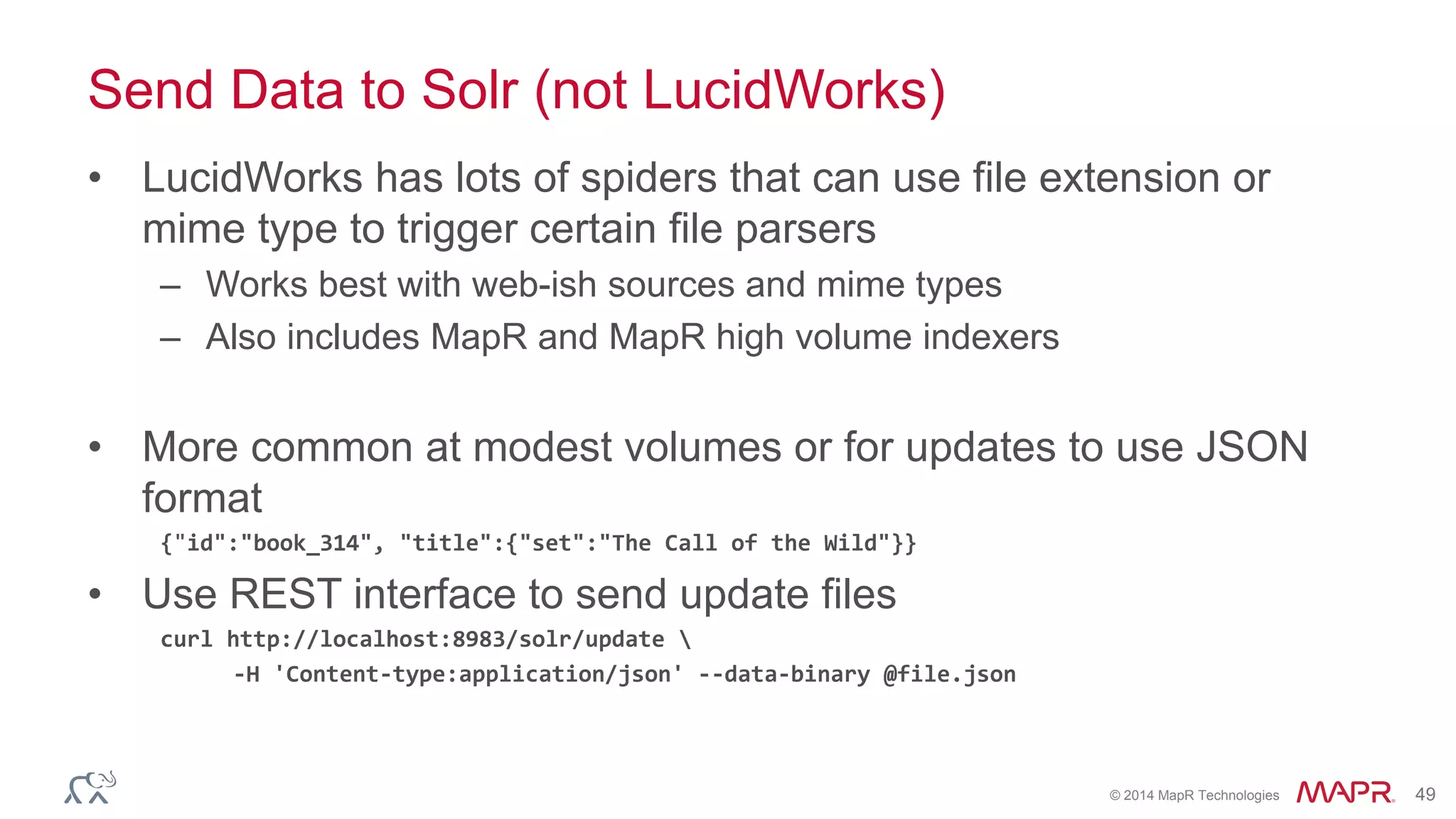
Send Data to Solr (not LucidWorks)
• LucidWorks has lots of spiders that can use file extension or
mime type to trigger certain file parsers
– Works best with web-ish sources and mime types
– Also includes MapR and MapR high volume indexers
• More common at modest volumes or for updates to use JSON
format
{"id":"book_314", "title":{"set":"The Call of the Wild"}}
• Use REST interface to send update files
curl http://localhost:8983/solr/update 
-H 'Content-type:application/json' --data-binary @file.json
© 2014 MapR Technologies 51
Back to recommendation:
How do you abuse search to make
recommendation easy?
© 2014 MapR Technologies 52
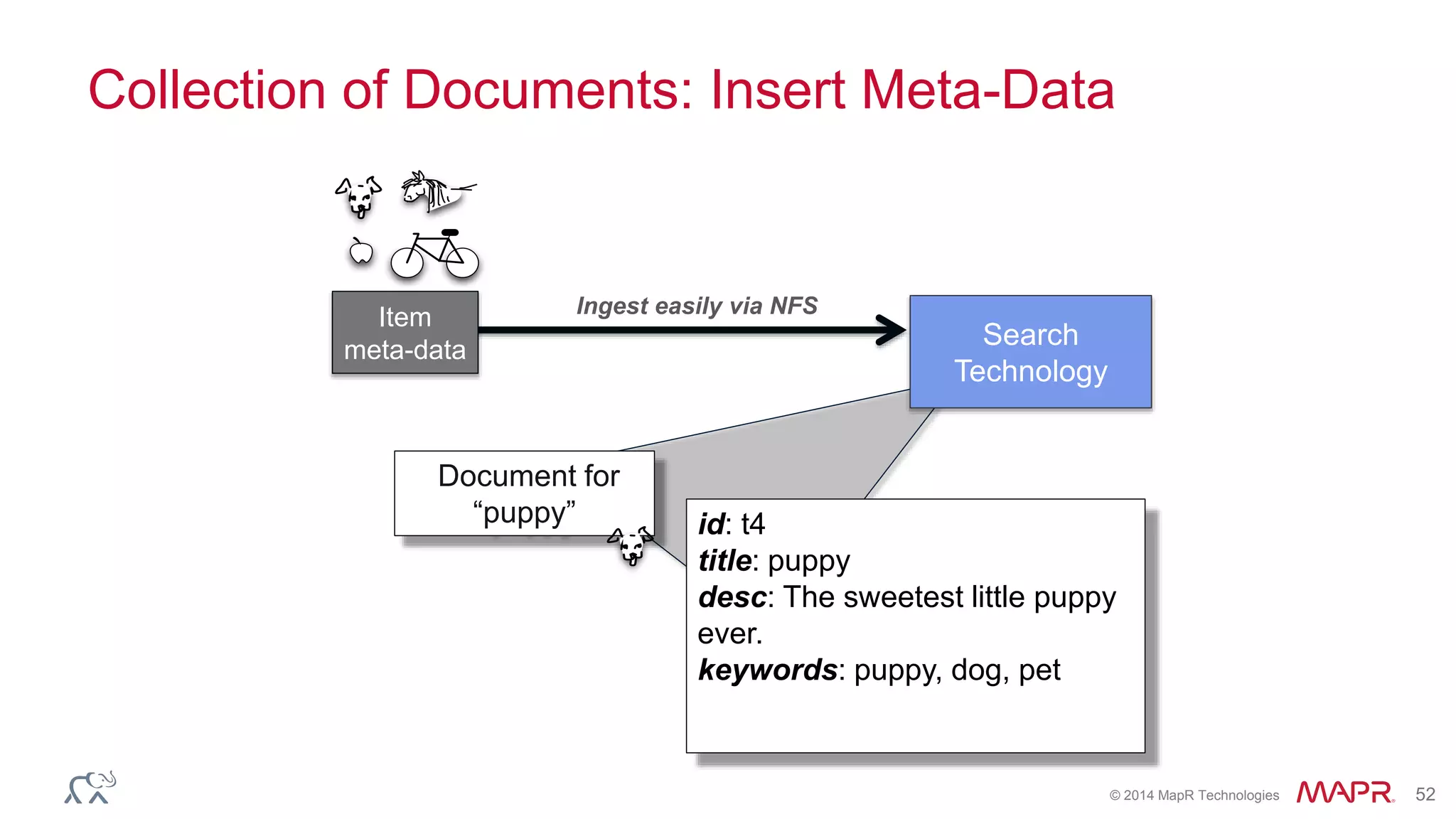
Collection of Documents: Insert Meta-Data
Search
Technology
Item
meta-data
Document for
“puppy” id: t4
title: puppy
desc: The sweetest little puppy
ever.
keywords: puppy, dog, pet
Ingest easily via NFS
© 2014 MapR Technologies 53
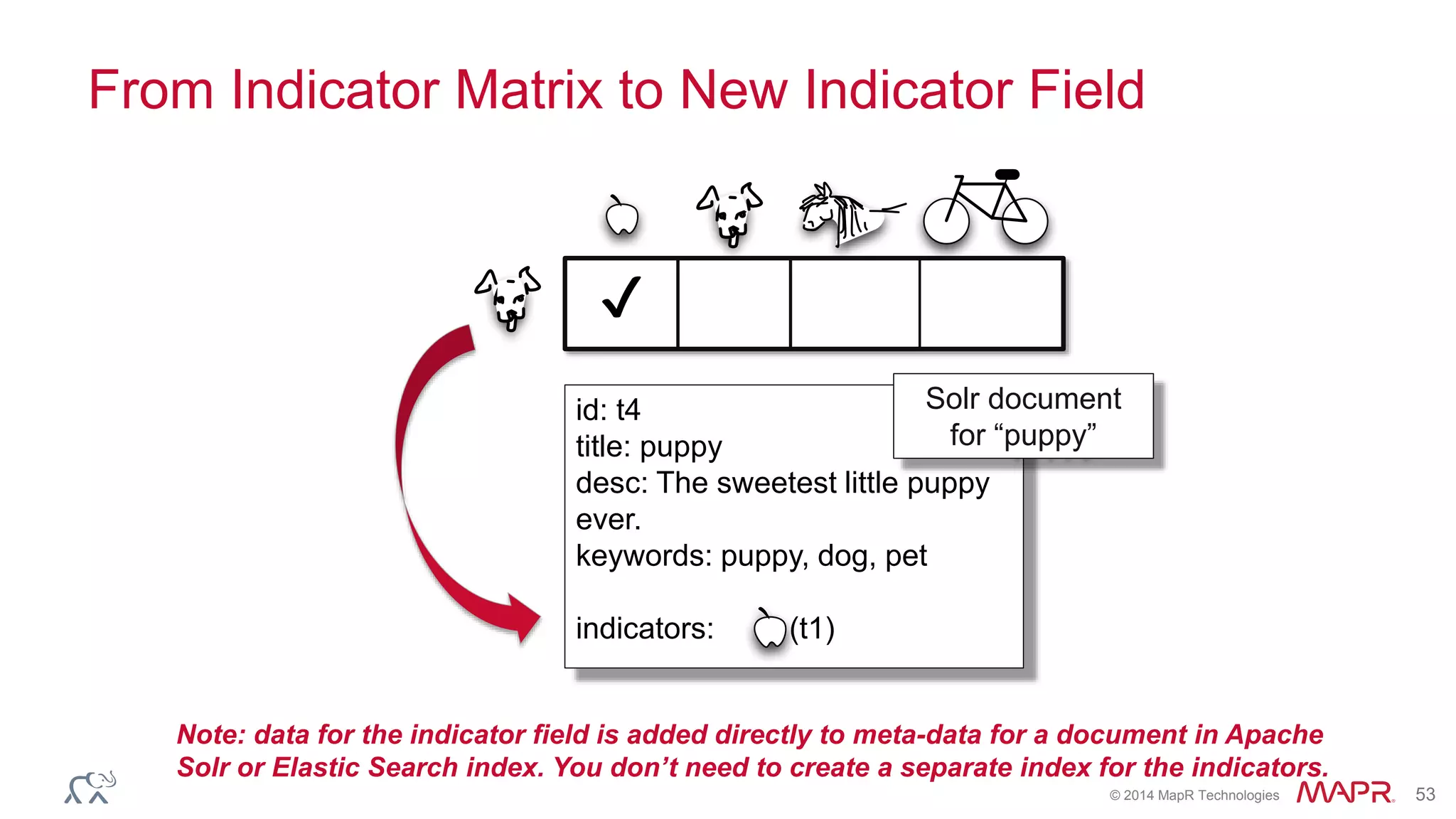
From Indicator Matrix to New Indicator Field
✔
id: t4
title: puppy
desc: The sweetest little puppy
ever.
keywords: puppy, dog, pet
indicators: (t1)
Solr document
for “puppy”
Note: data for the indicator field is added directly to meta-data for a document in Apache
Solr or Elastic Search index. You don’t need to create a separate index for the indicators.
© 2014 MapR Technologies 54
Let’s look at a real example:
we built a music recommender
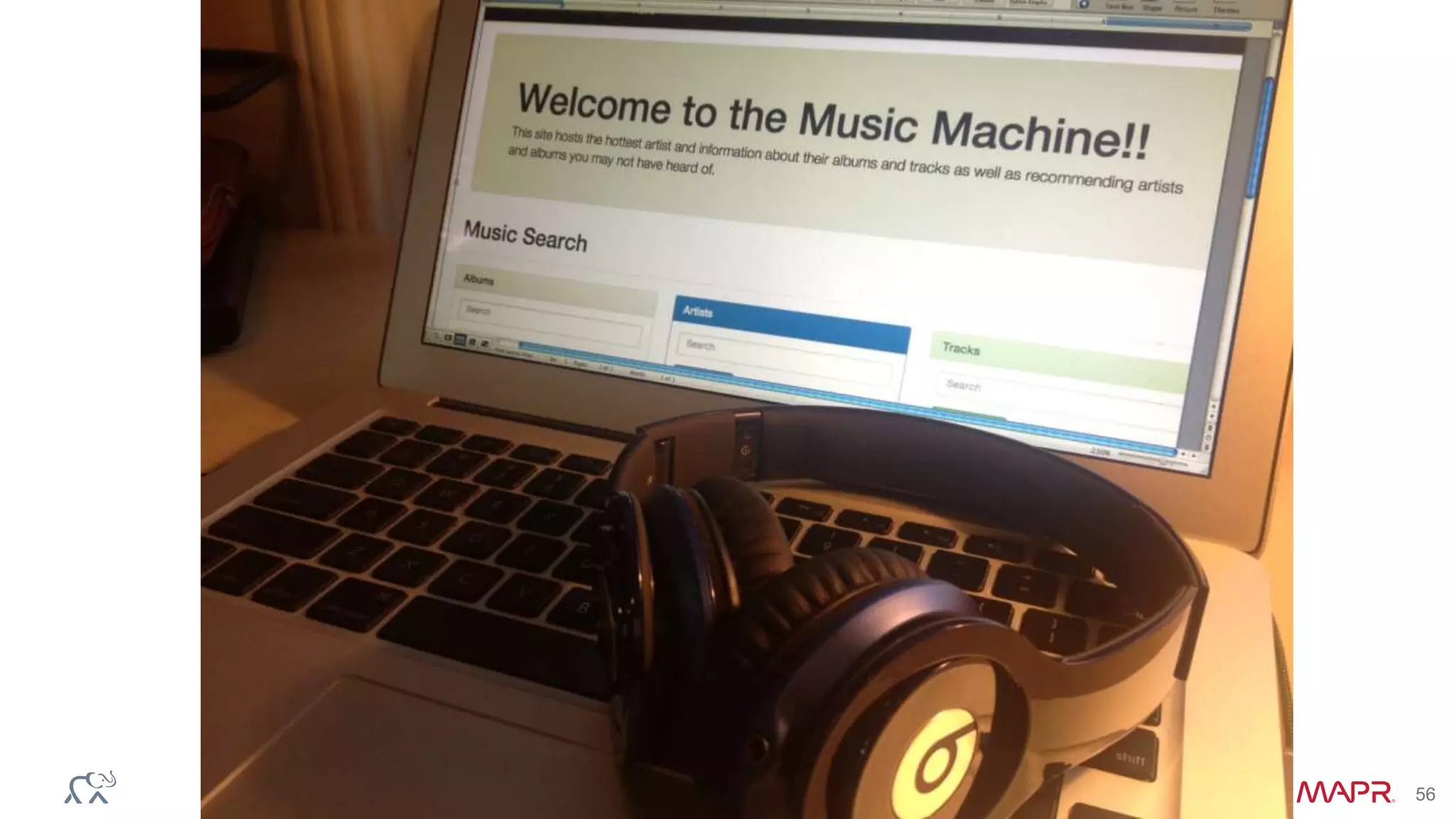
© 2014 MapR Technologies 56
© 2014 MapR Technologies 57
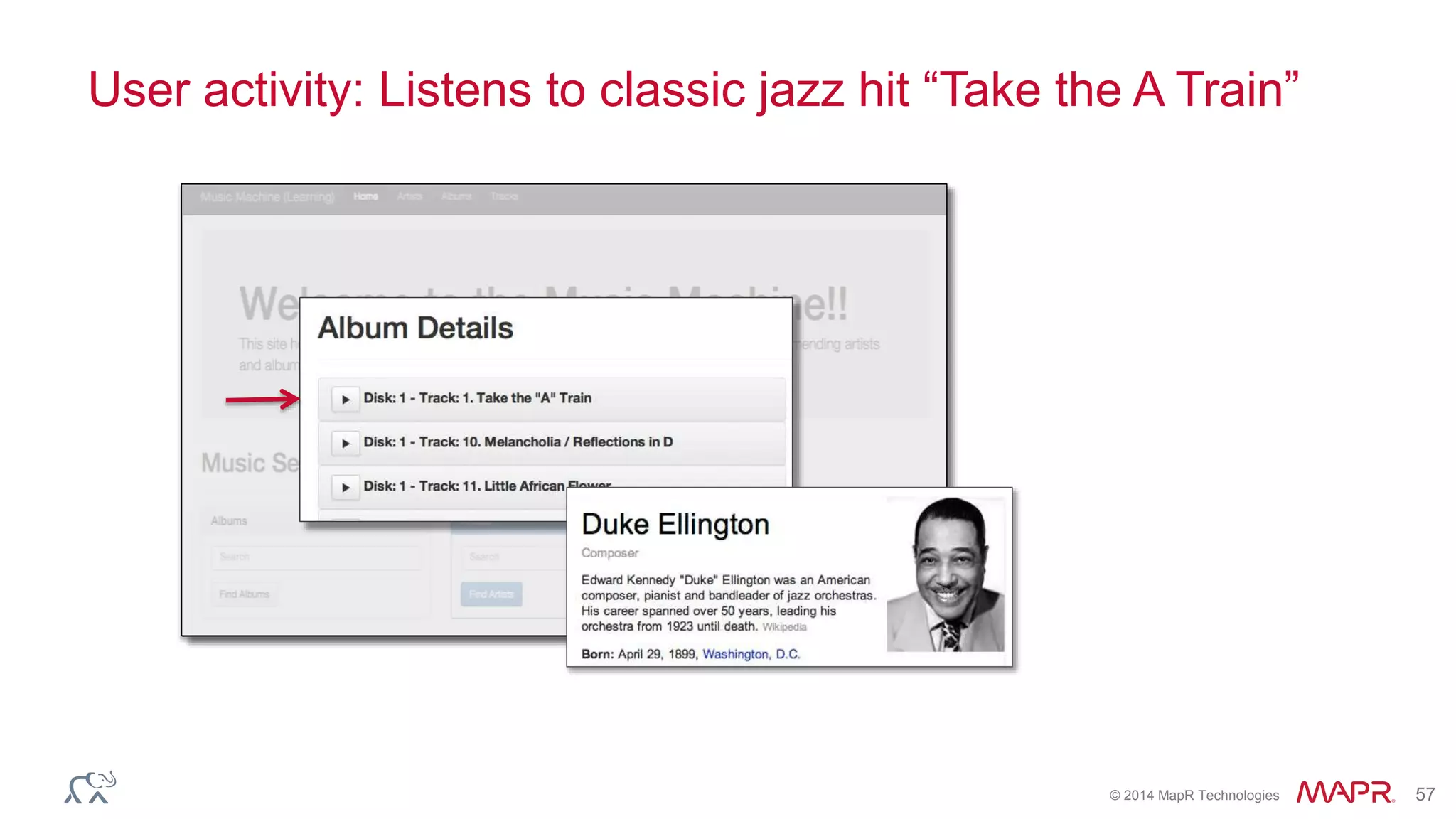
User activity: Listens to classic jazz hit “Take the A Train”
© 2014 MapR Technologies 58
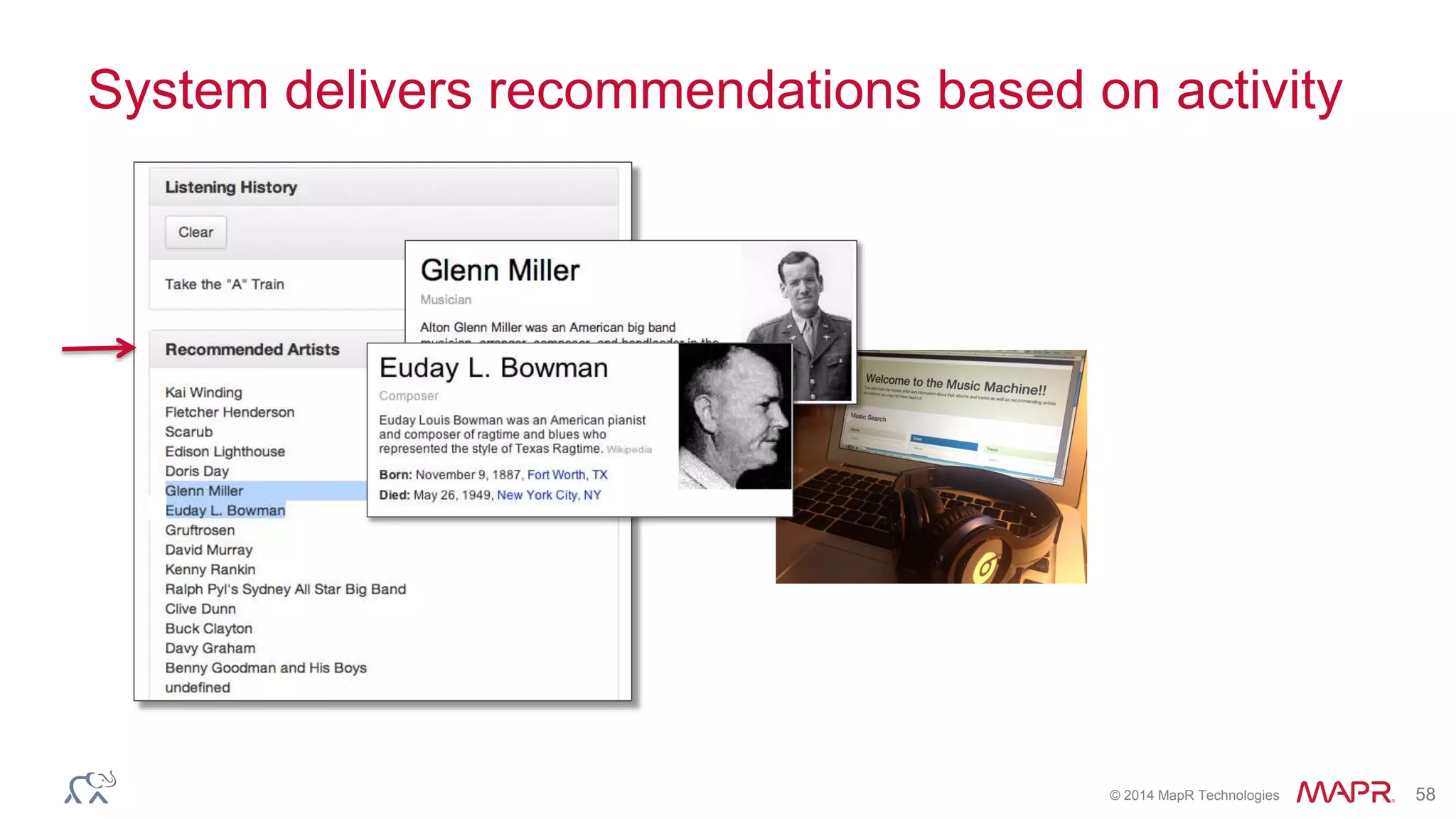
System delivers recommendations based on activity
© 2014 MapR Technologies 59
Let’s look inside the music
recommender…
© 2014 MapR Technologies 60
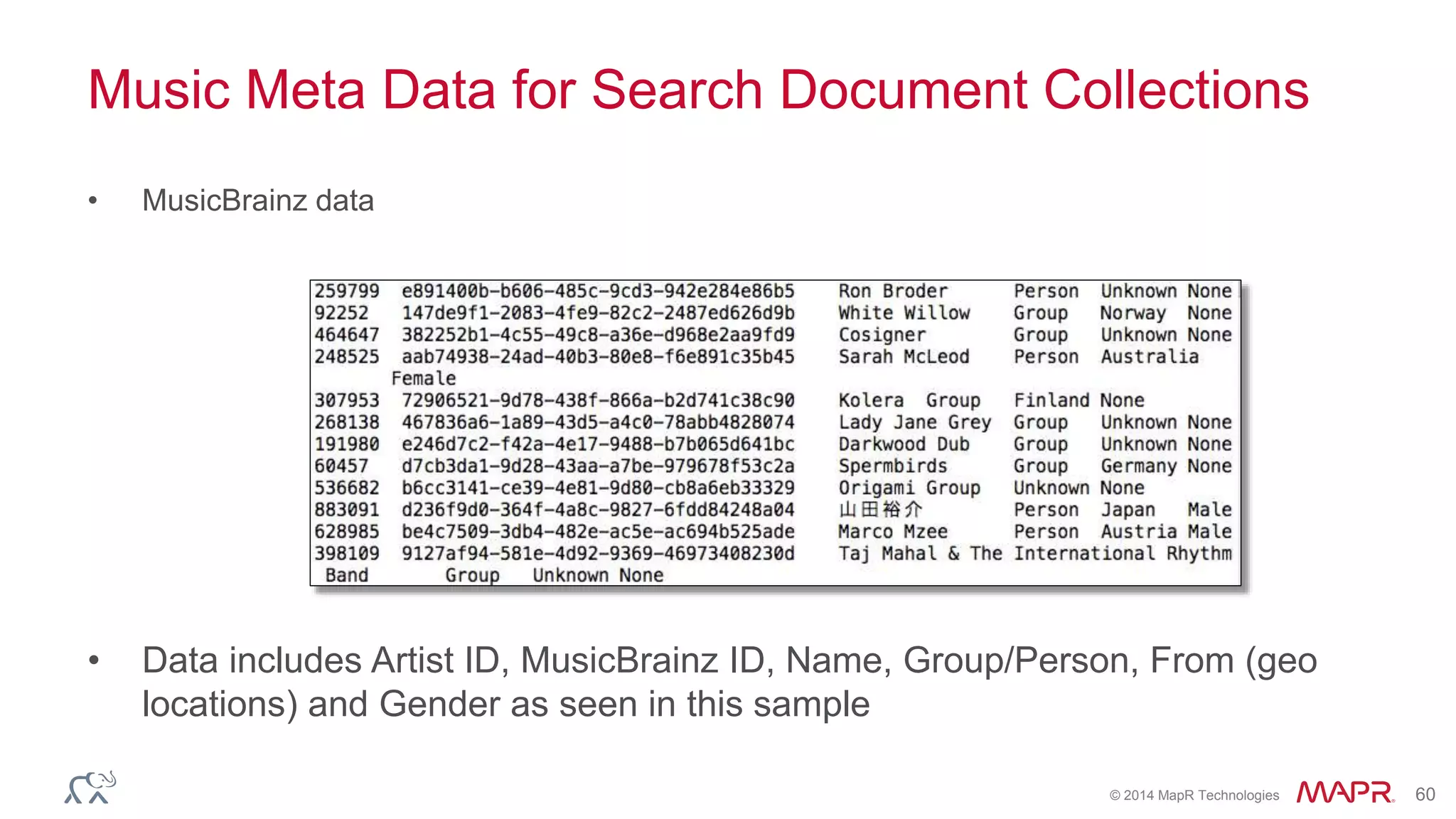
Music Meta Data for Search Document Collections
• MusicBrainz data
• Data includes Artist ID, MusicBrainz ID, Name, Group/Person, From (geo
locations) and Gender as seen in this sample
© 2014 MapR Technologies 62
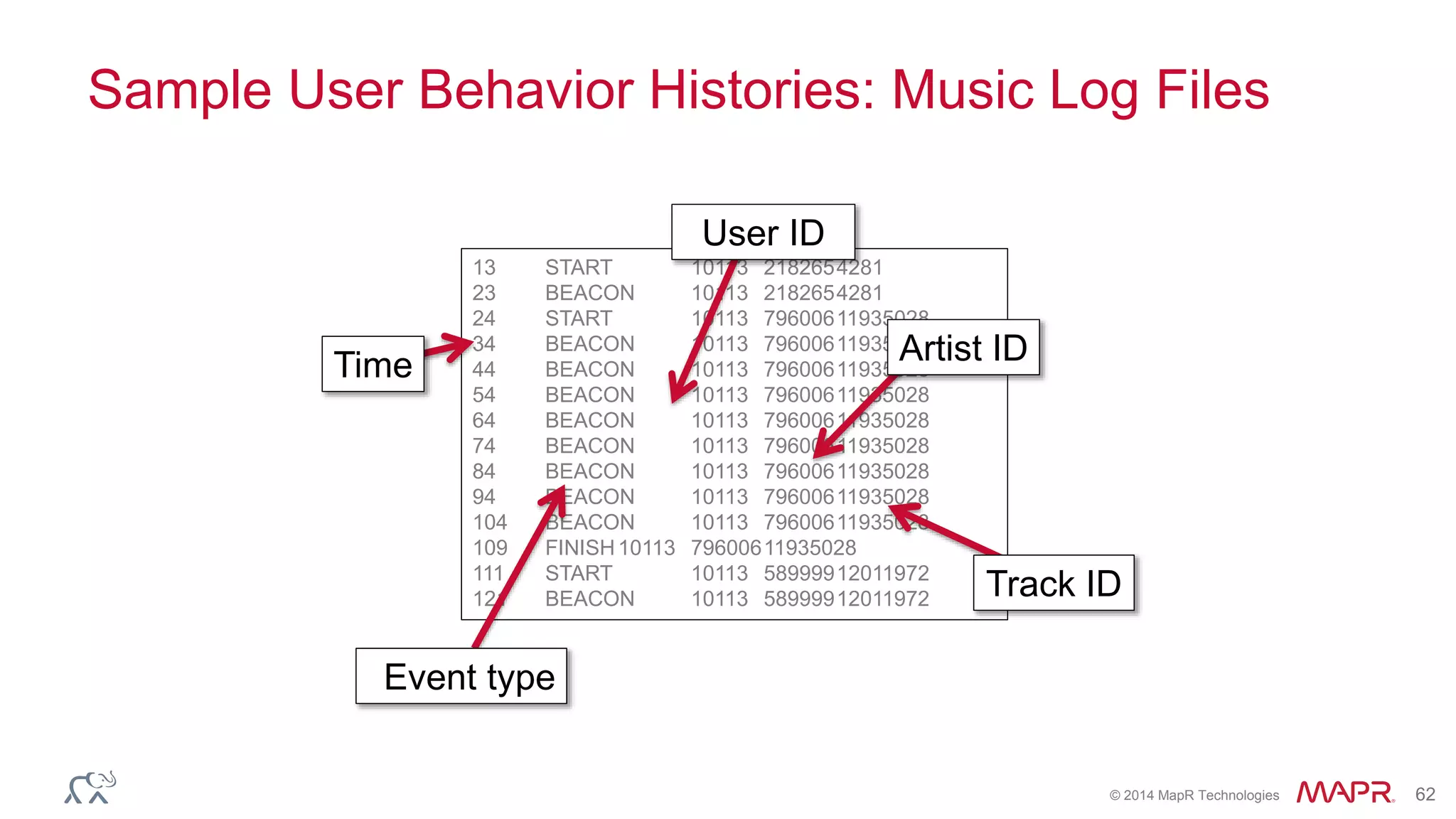
Sample User Behavior Histories: Music Log Files
13 START 10113 2182654281
23 BEACON 10113 2182654281
24 START 10113 79600611935028
34 BEACON 10113 79600611935028
44 BEACON 10113 79600611935028
54 BEACON 10113 79600611935028
64 BEACON 10113 79600611935028
74 BEACON 10113 79600611935028
84 BEACON 10113 79600611935028
94 BEACON 10113 79600611935028
104 BEACON 10113 79600611935028
109 FINISH10113 79600611935028
111 START 10113 58999912011972
121 BEACON 10113 58999912011972
Time
Event type
User ID
Artist ID
Track ID
© 2014 MapR Technologies 63
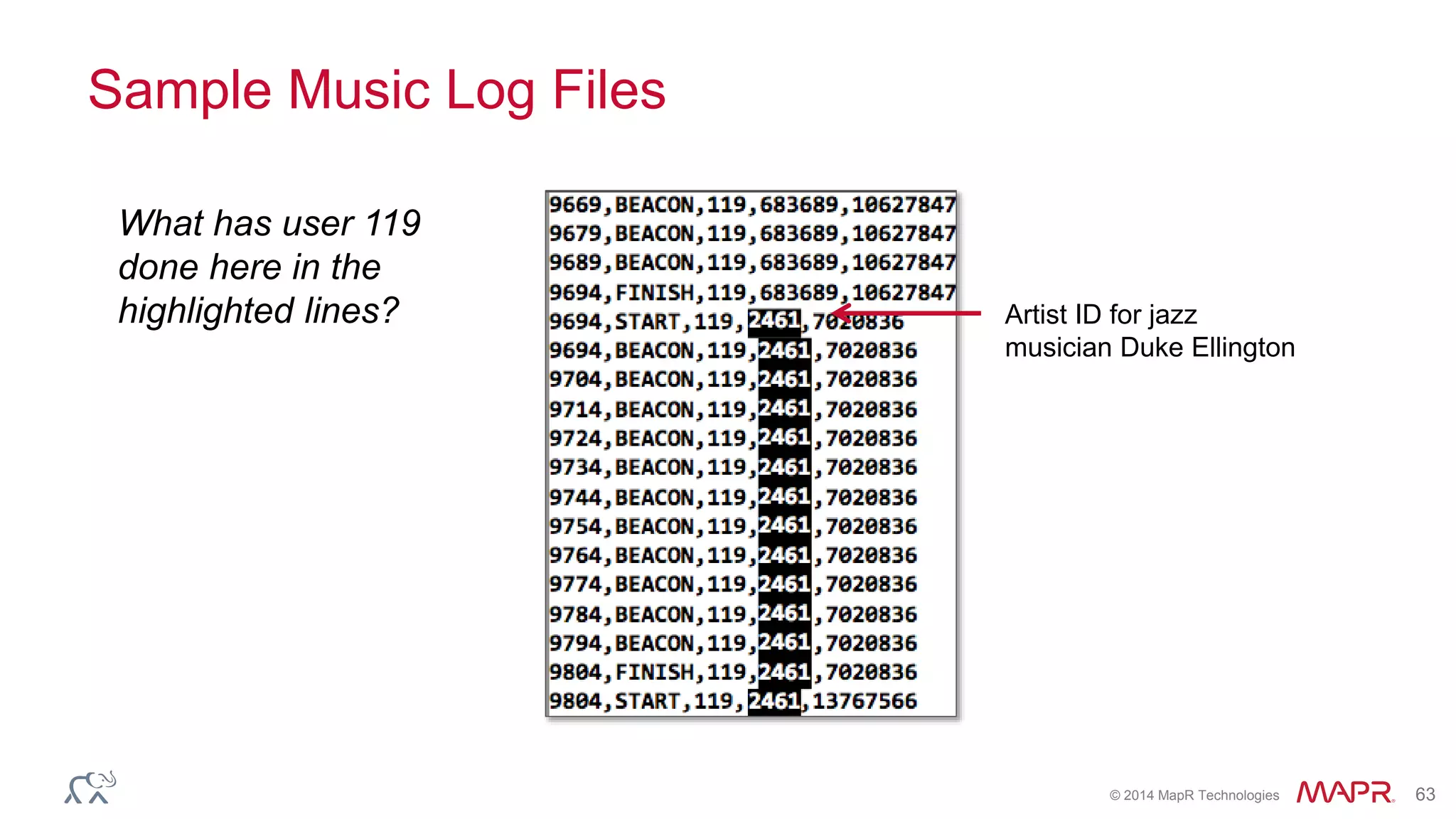
Sample Music Log Files
Artist ID for jazz
musician Duke Ellington
What has user 119
done here in the
highlighted lines?
© 2014 MapR Technologies 64
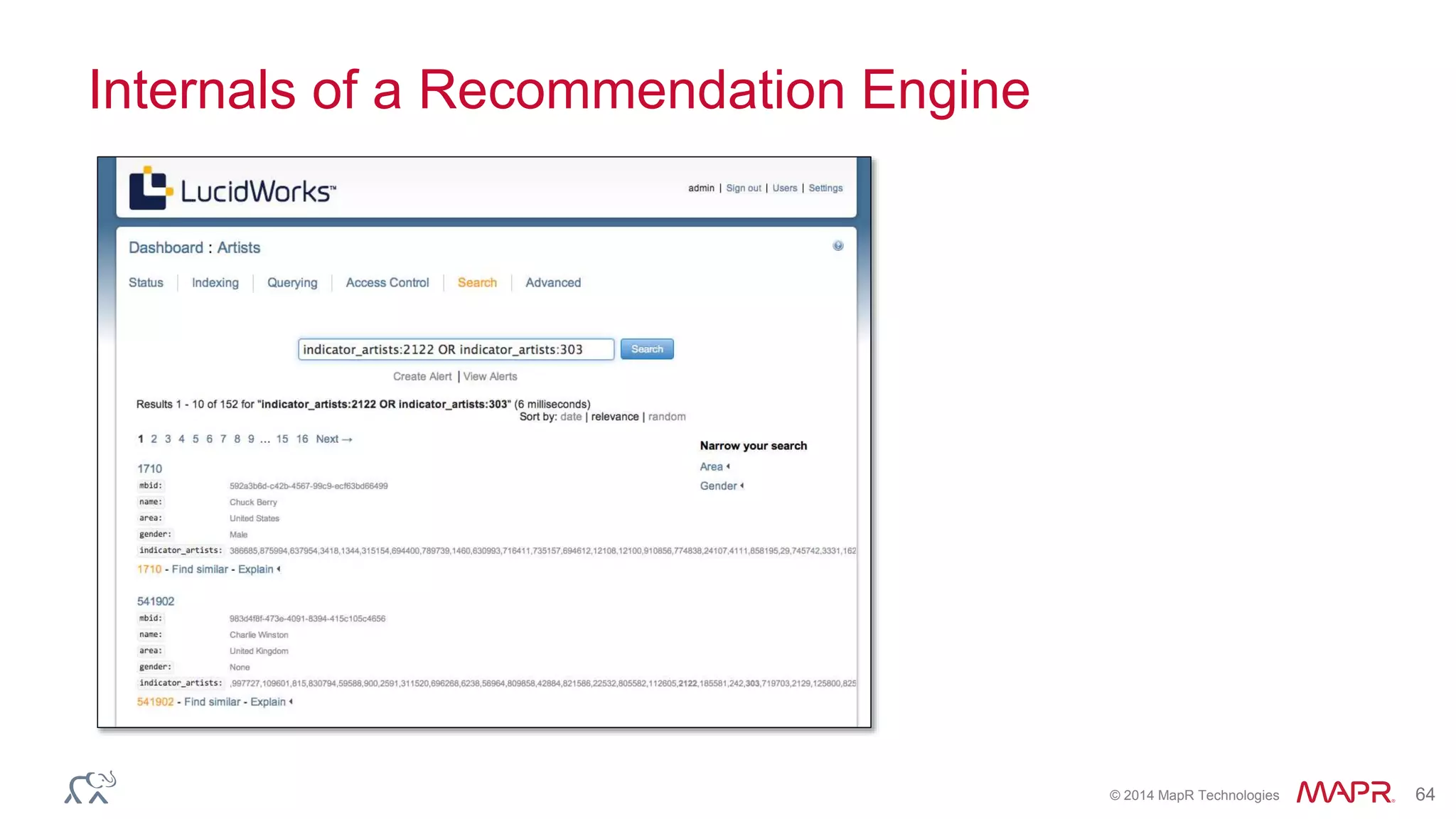
Internals of a Recommendation Engine
© 2014 MapR Technologies 65
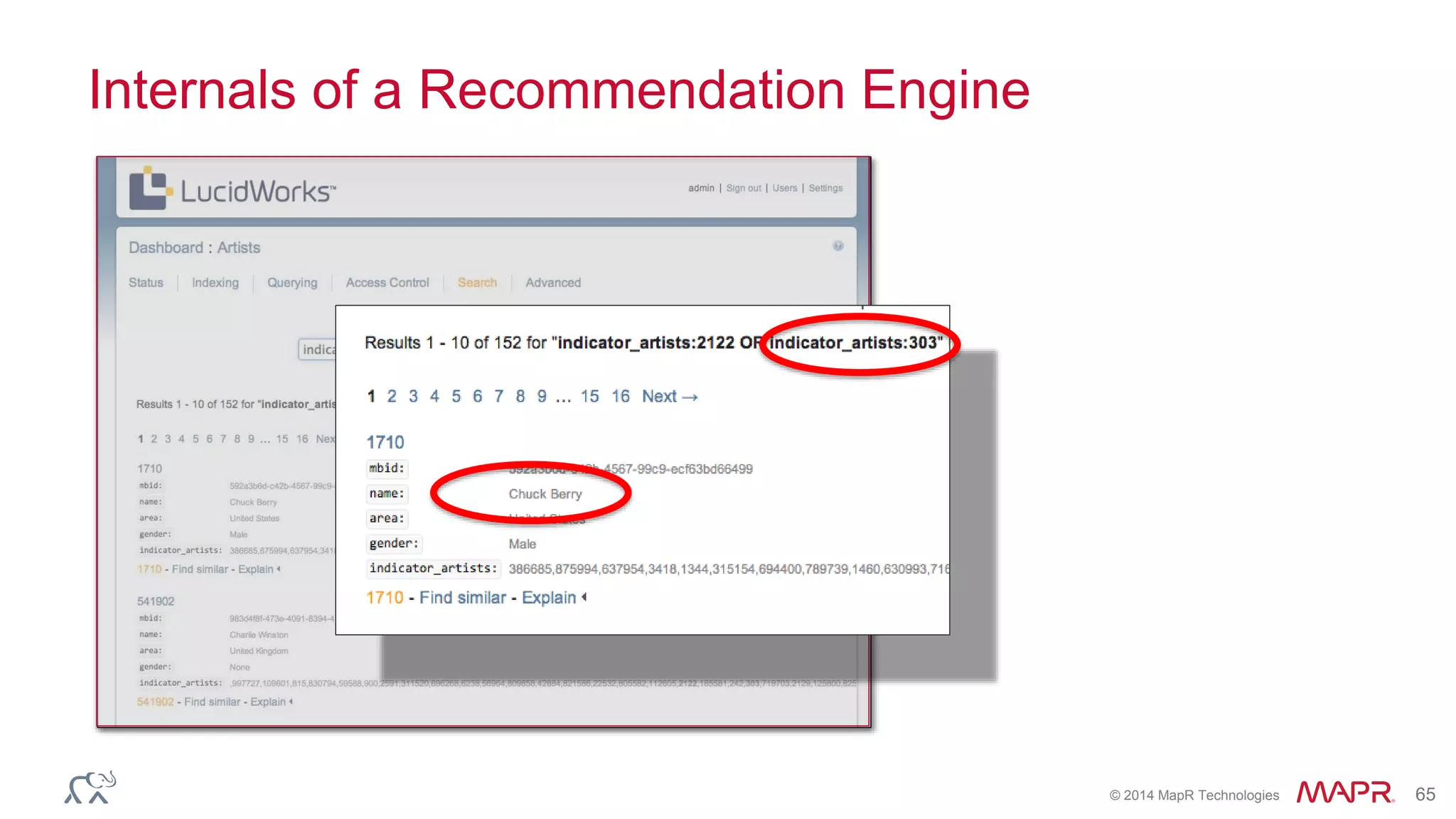
Internals of a Recommendation Engine
© 2014 MapR Technologies 66
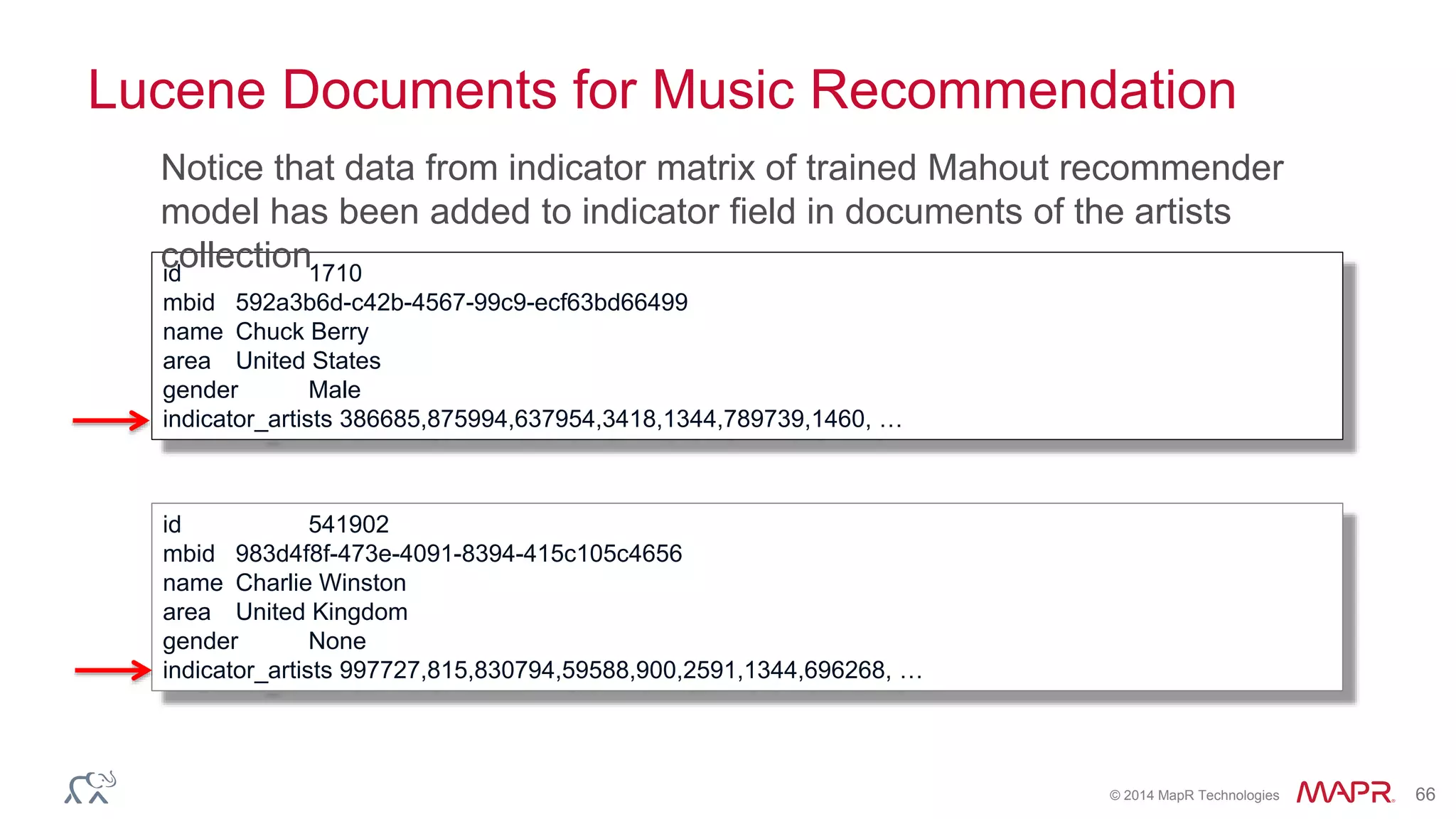
id 1710
mbid 592a3b6d-c42b-4567-99c9-ecf63bd66499
name Chuck Berry
area United States
gender Male
indicator_artists 386685,875994,637954,3418,1344,789739,1460, …
id 541902
mbid 983d4f8f-473e-4091-8394-415c105c4656
name Charlie Winston
area United Kingdom
gender None
indicator_artists 997727,815,830794,59588,900,2591,1344,696268, …
Lucene Documents for Music Recommendation
Notice that data from indicator matrix of trained Mahout recommender
model has been added to indicator field in documents of the artists
collection
© 2014 MapR Technologies 68
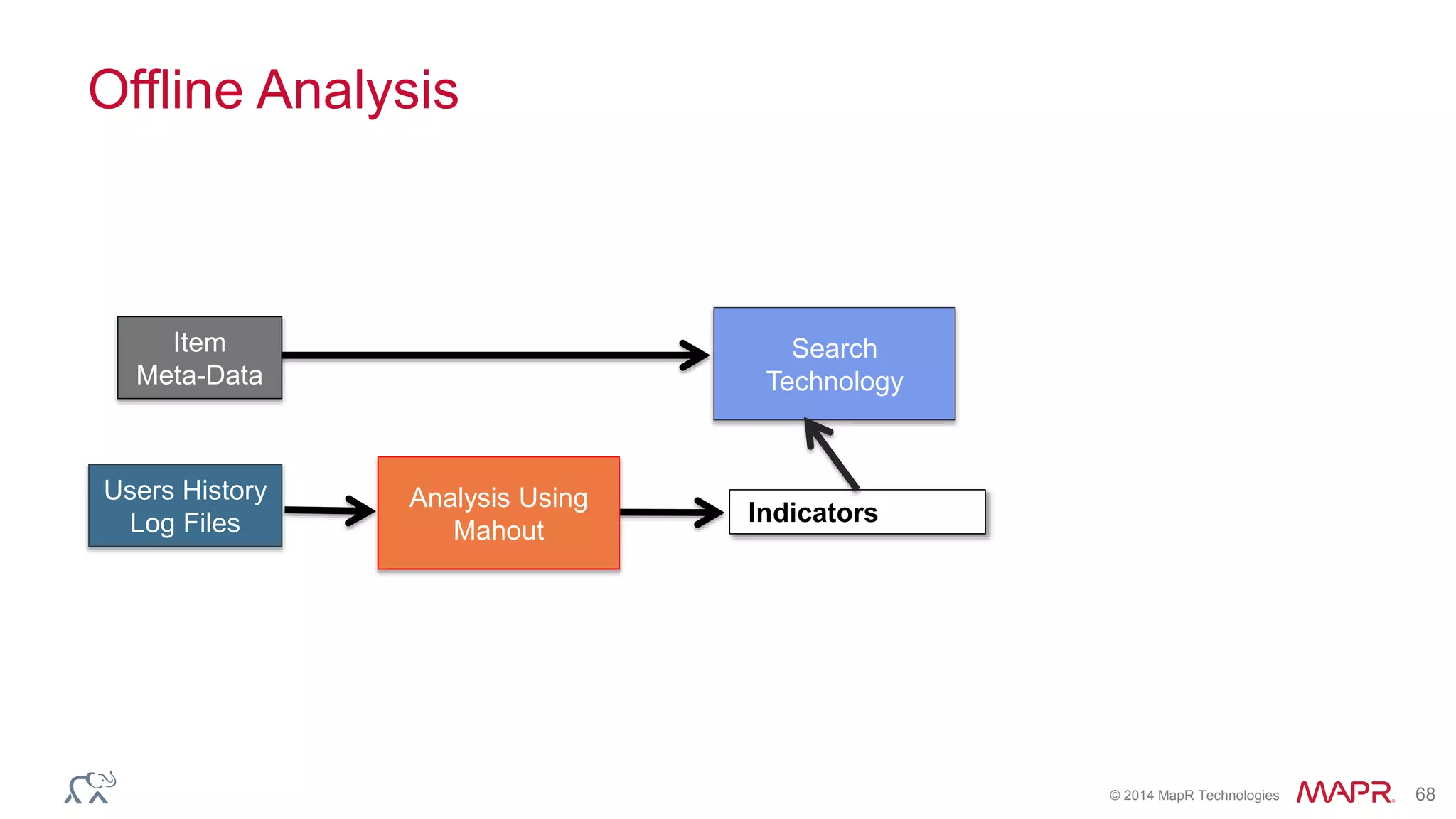
Offline Analysis
Analysis Using
Mahout
Users History
Log Files Indicators
Search
Technology
Item
Meta-Data
© 2014 MapR Technologies 69
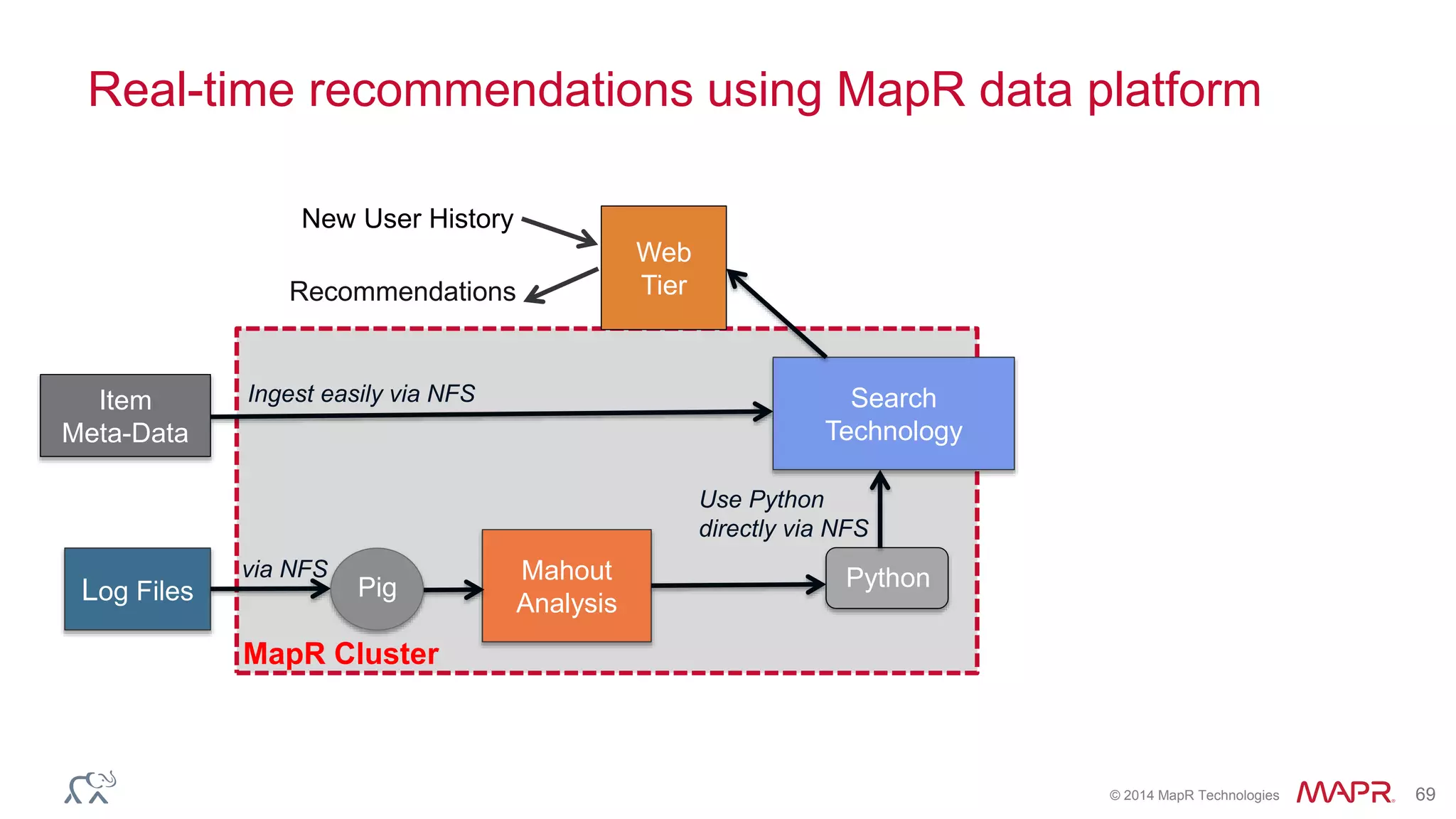
Log Files
Mahout
Analysis
Search
Technology
Item
Meta-Data
Ingest easily via NFS
MapR Cluster
via NFS Python
Use Python
directly via NFS
Pig
Web
TierRecommendations
New User History
Real-time recommendations using MapR data platform
© 2014 MapR Technologies 70
A Quick Simplification
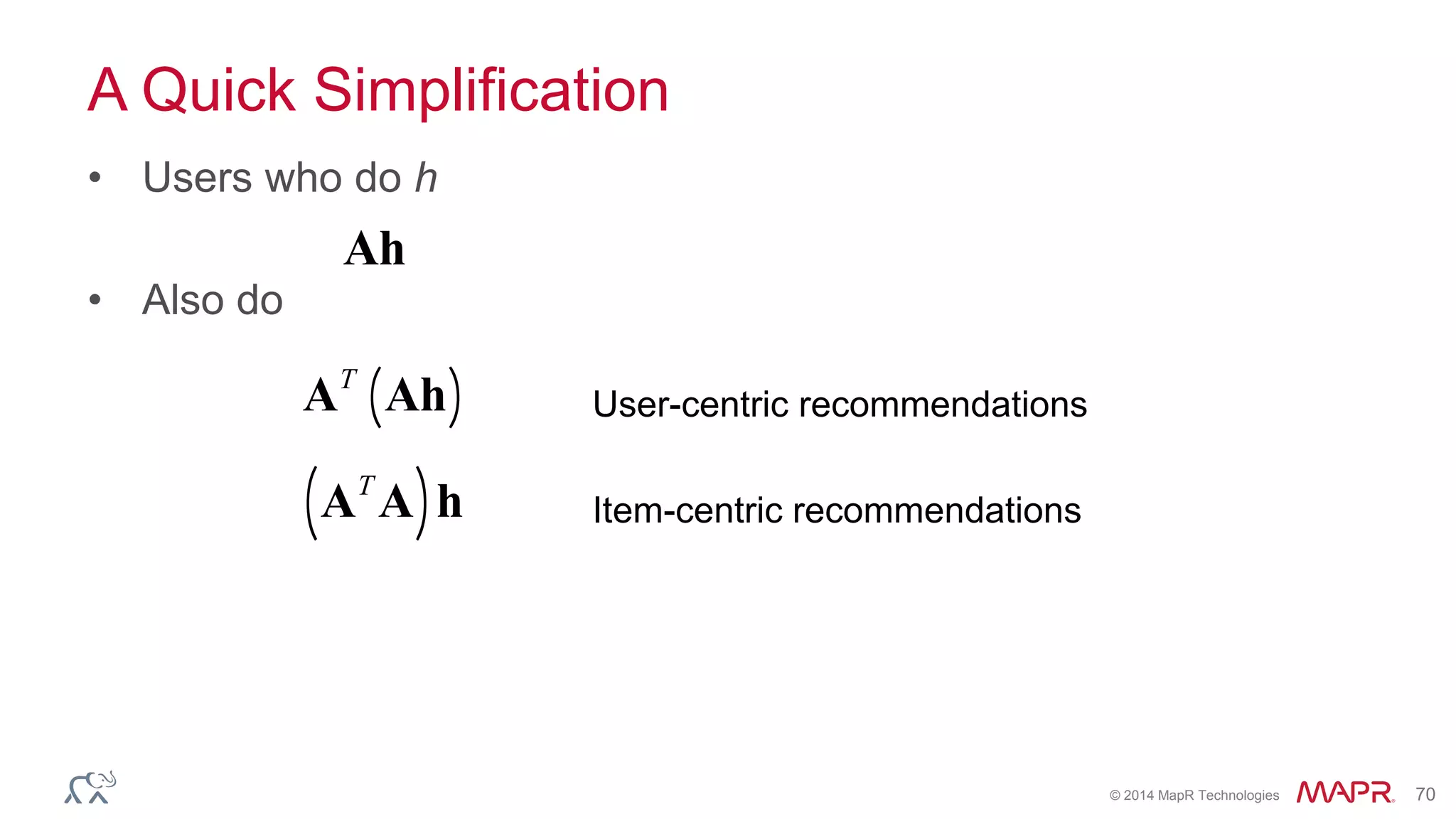
• Users who do h
• Also do
Ah
AT
Ah( )
AT
A( )h
User-centric recommendations
Item-centric recommendations
© 2014 MapR Technologies 71
Architectural Advantage
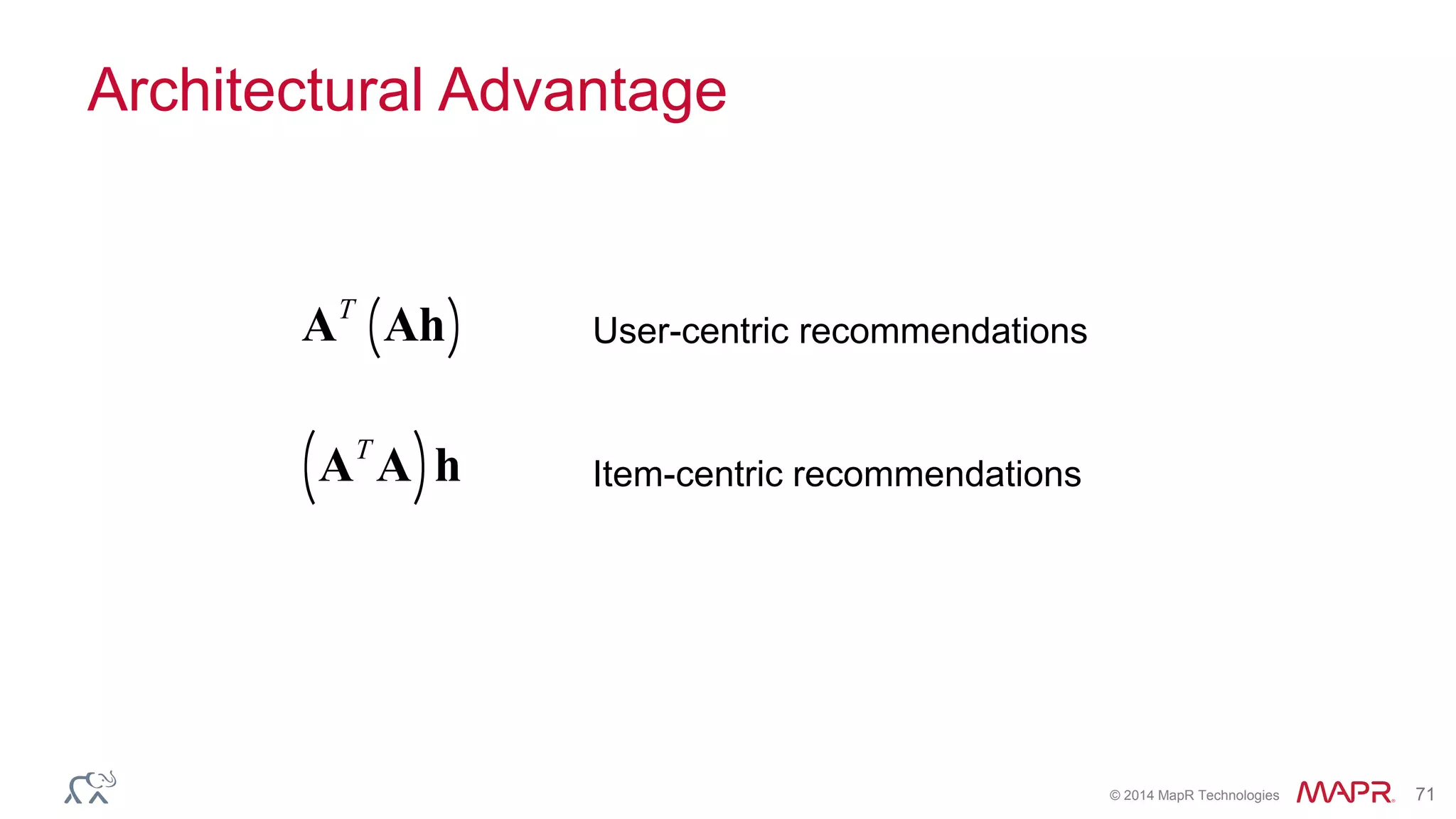
AT
Ah( )
AT
A( )h
User-centric recommendations
Item-centric recommendations
© 2014 MapR Technologies 72
Architectural Advantage
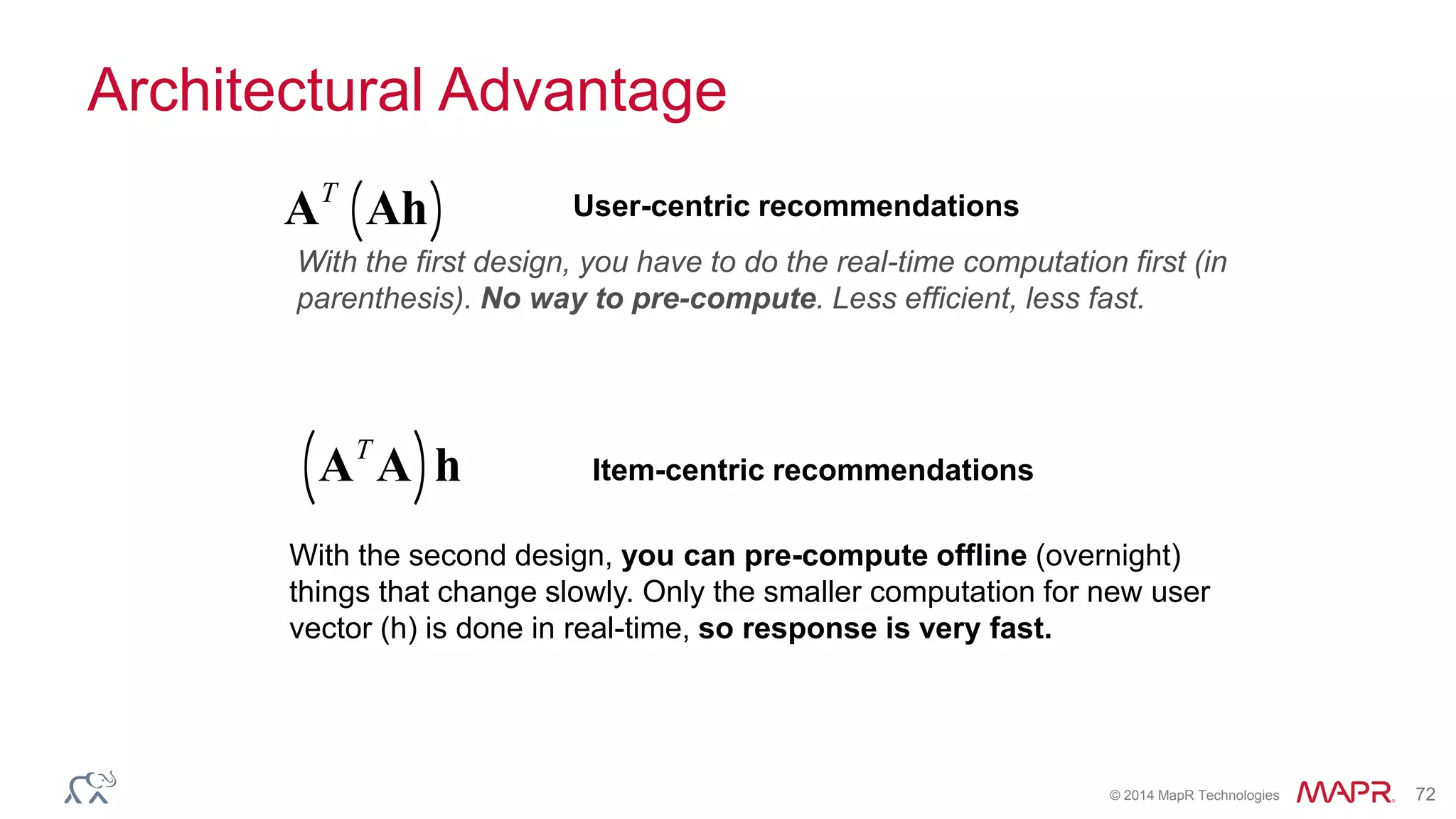
AT
Ah( ) User-centric recommendations
With the first design, you have to do the real-time computation first (in
parenthesis). No way to pre-compute. Less efficient, less fast.
With the second design, you can pre-compute offline (overnight)
things that change slowly. Only the smaller computation for new user
vector (h) is done in real-time, so response is very fast.
AT
A( )h Item-centric recommendations
© 2014 MapR Technologies 74
Tutorial Part 2:
How to make recommendation better
© 2014 MapR Technologies 75
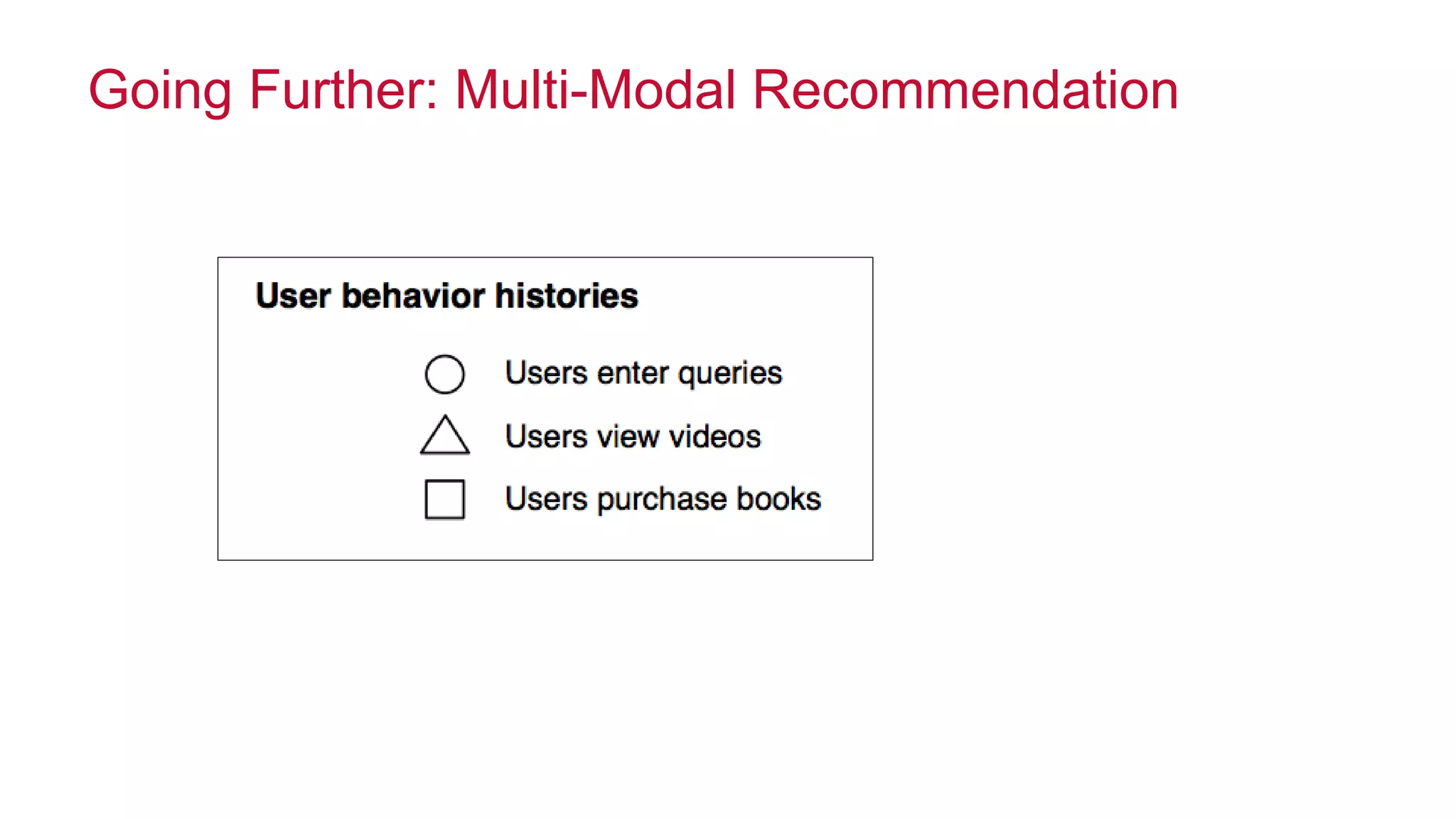
Going Further: Multi-Modal Recommendation
© 2014 MapR Technologies 76
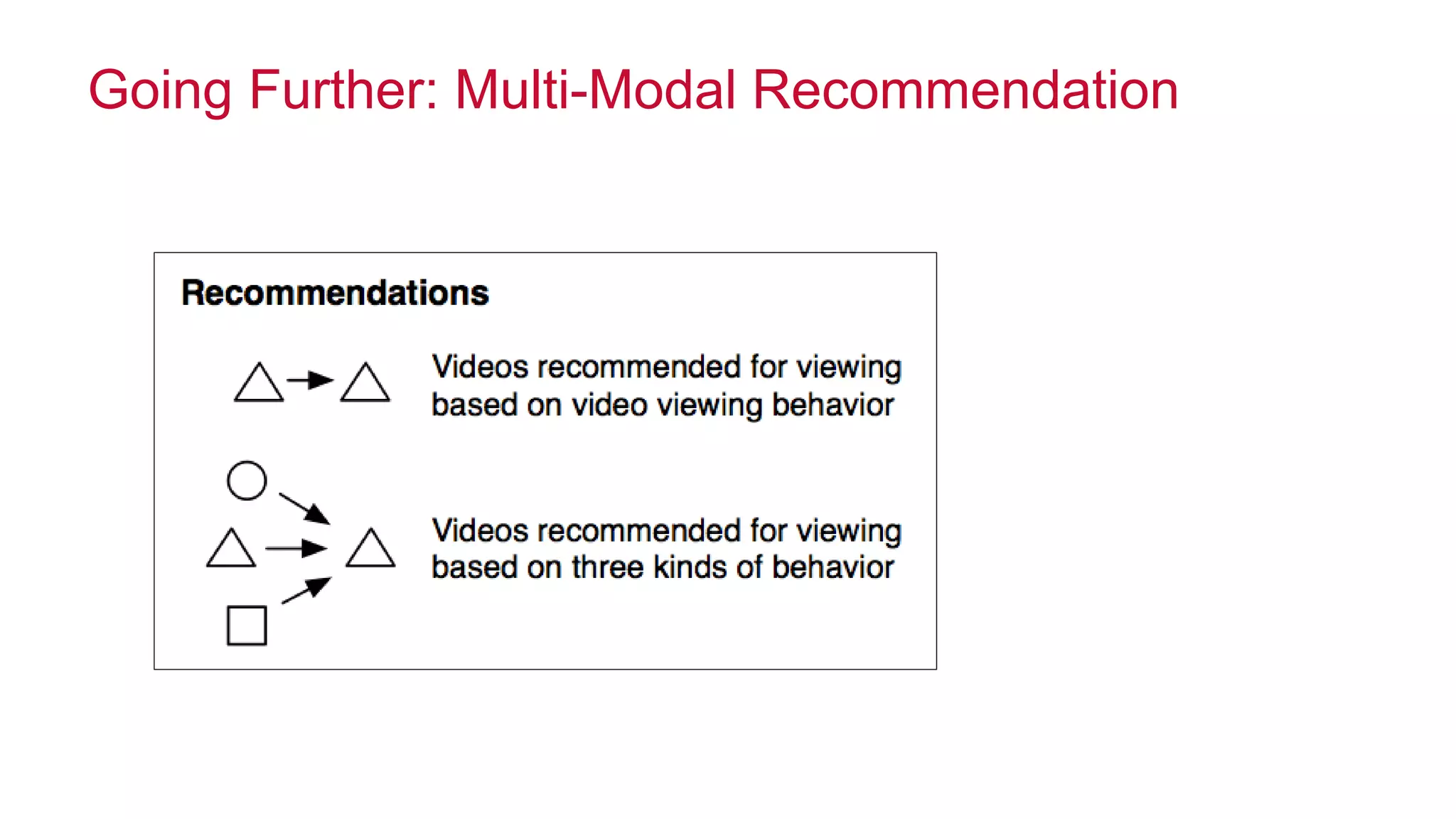
Going Further: Multi-Modal Recommendation
© 2014 MapR Technologies 77
For example
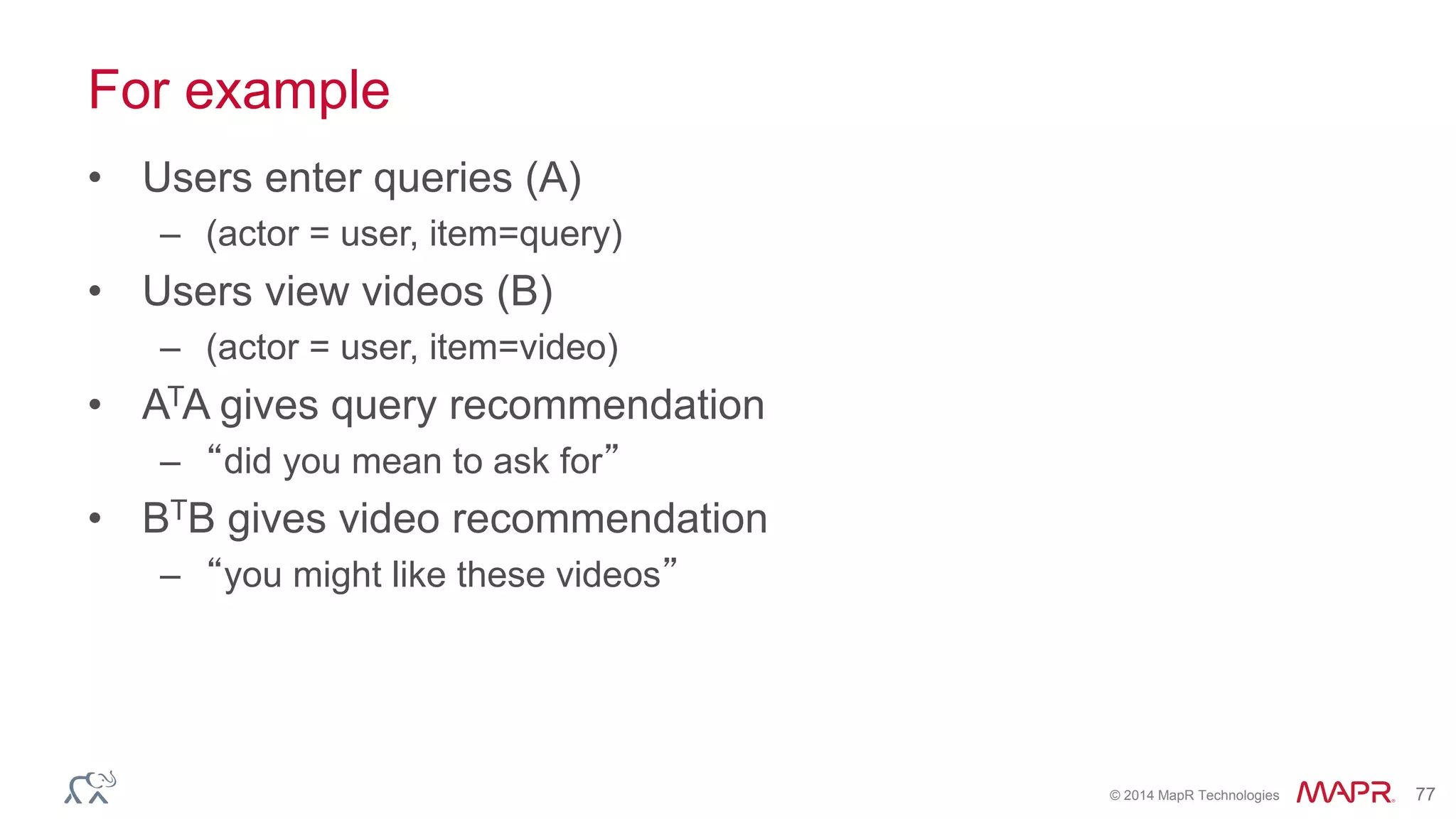
• Users enter queries (A)
– (actor = user, item=query)
• Users view videos (B)
– (actor = user, item=video)
• ATA gives query recommendation
– “did you mean to ask for”
• BTB gives video recommendation
– “you might like these videos”
© 2014 MapR Technologies 78
The punch-line
• BTA recommends videos in response to a query
– (isn’t that a search engine?)
– (not quite, it doesn’t look at content or meta-data)
© 2014 MapR Technologies 79
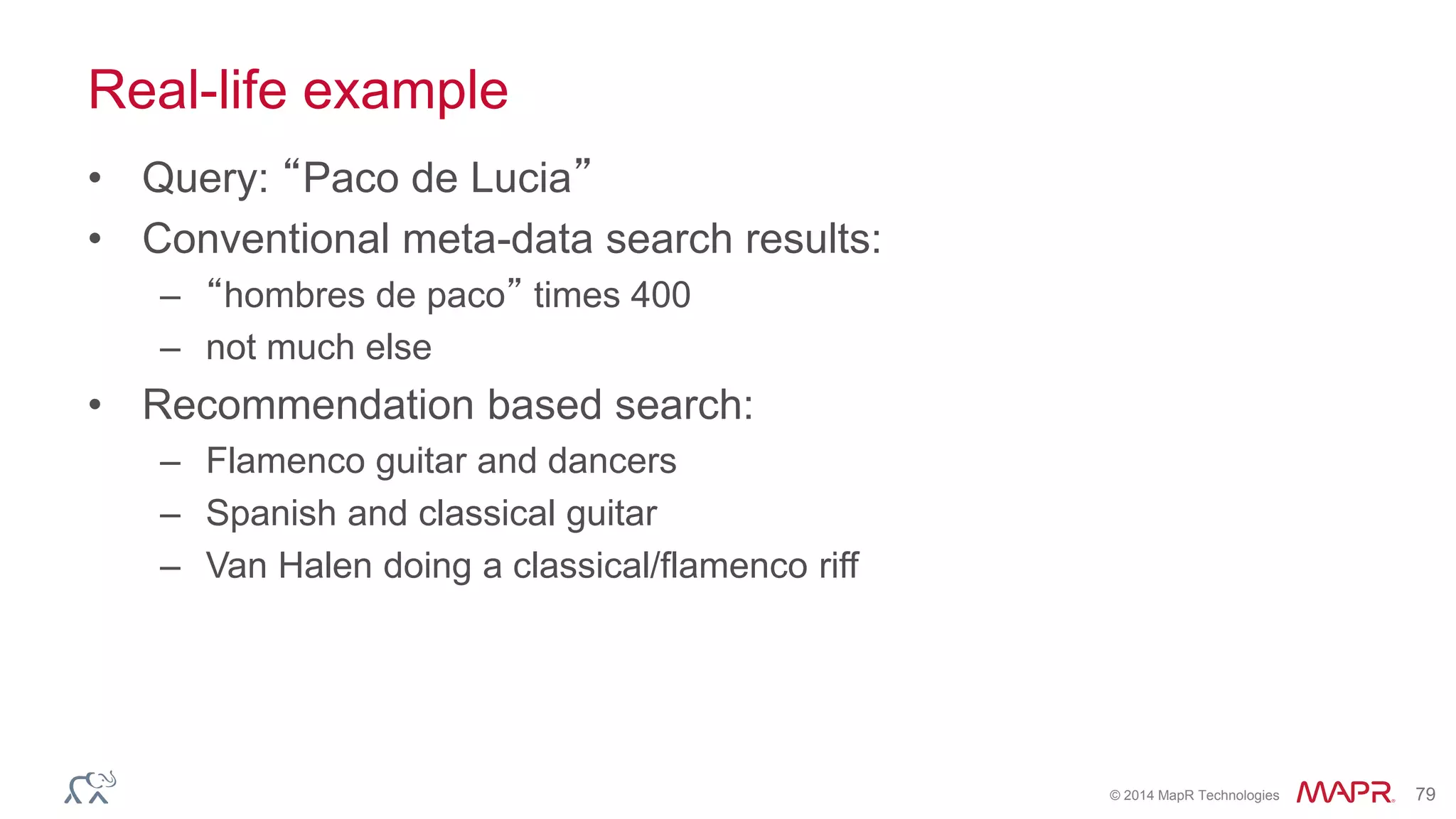
Real-life example
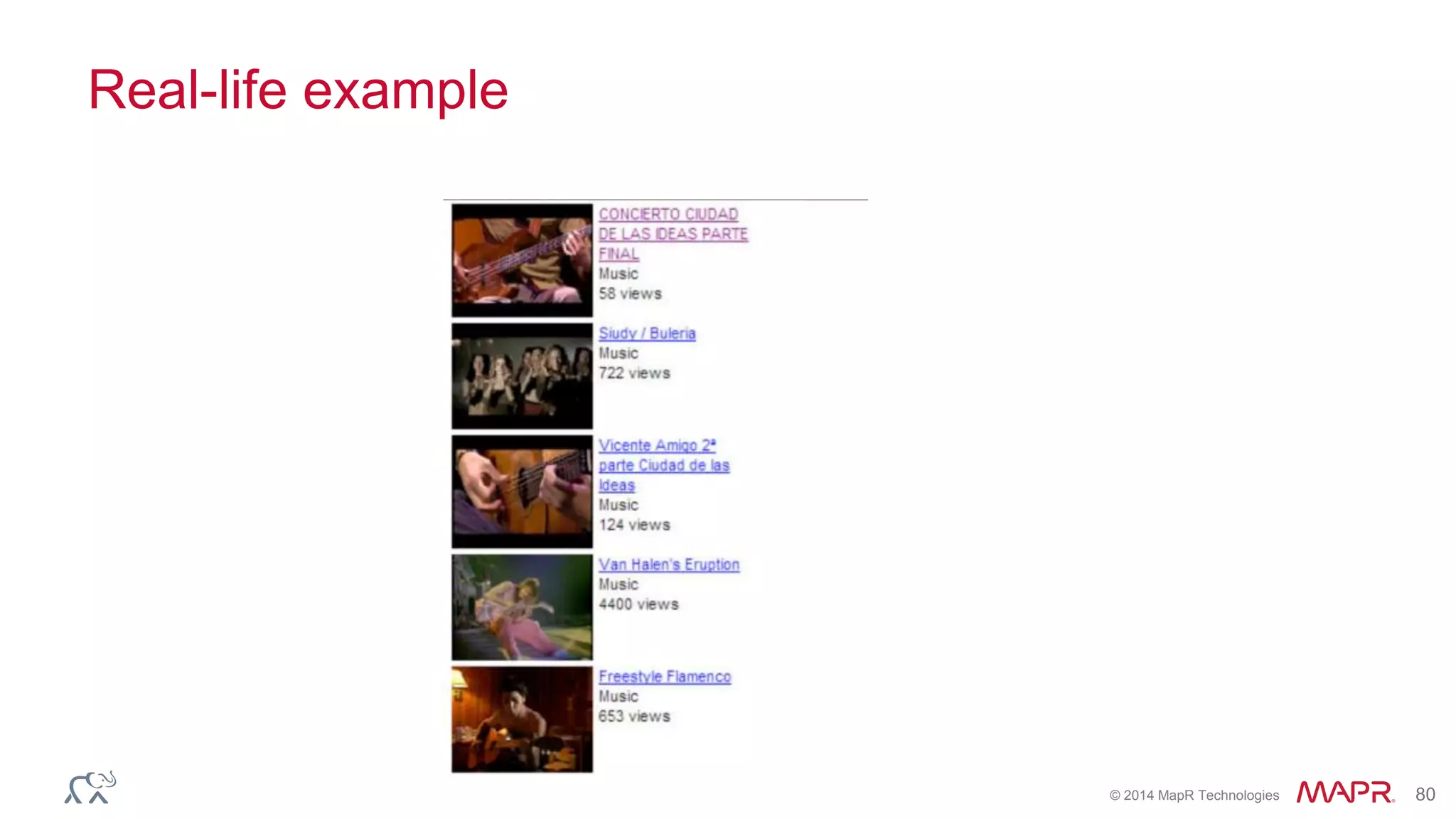
• Query: “Paco de Lucia”
• Conventional meta-data search results:
– “hombres de paco” times 400
– not much else
• Recommendation based search:
– Flamenco guitar and dancers
– Spanish and classical guitar
– Van Halen doing a classical/flamenco riff
© 2014 MapR Technologies 80
Real-life example
© 2014 MapR Technologies 81
Hypothetical Example
• Want a navigational ontology?
• Just put labels on a web page with traffic
– This gives A = users x label clicks
• Remember viewing history
– This gives B = users x items
• Cross recommend
– B’A = label to item mapping
• After several users click, results are whatever users think they
should be
© 2014 MapR Technologies 82
Nice. But we can
do better?
© 2014 MapR Technologies 84
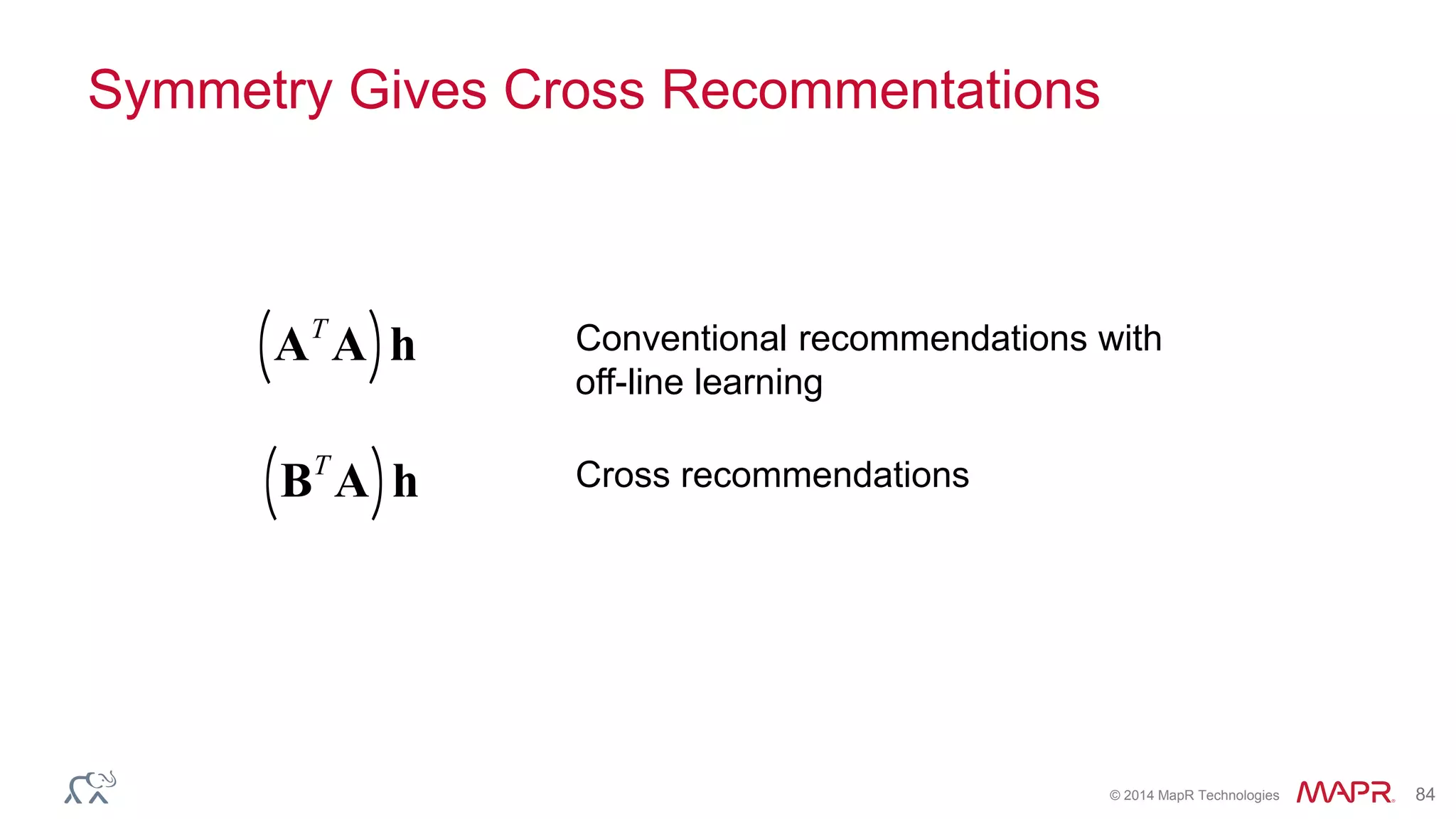
Symmetry Gives Cross Recommentations
AT
A( )h
BT
A( )h
Conventional recommendations with
off-line learning
Cross recommendations
© 2014 MapR Technologies 85
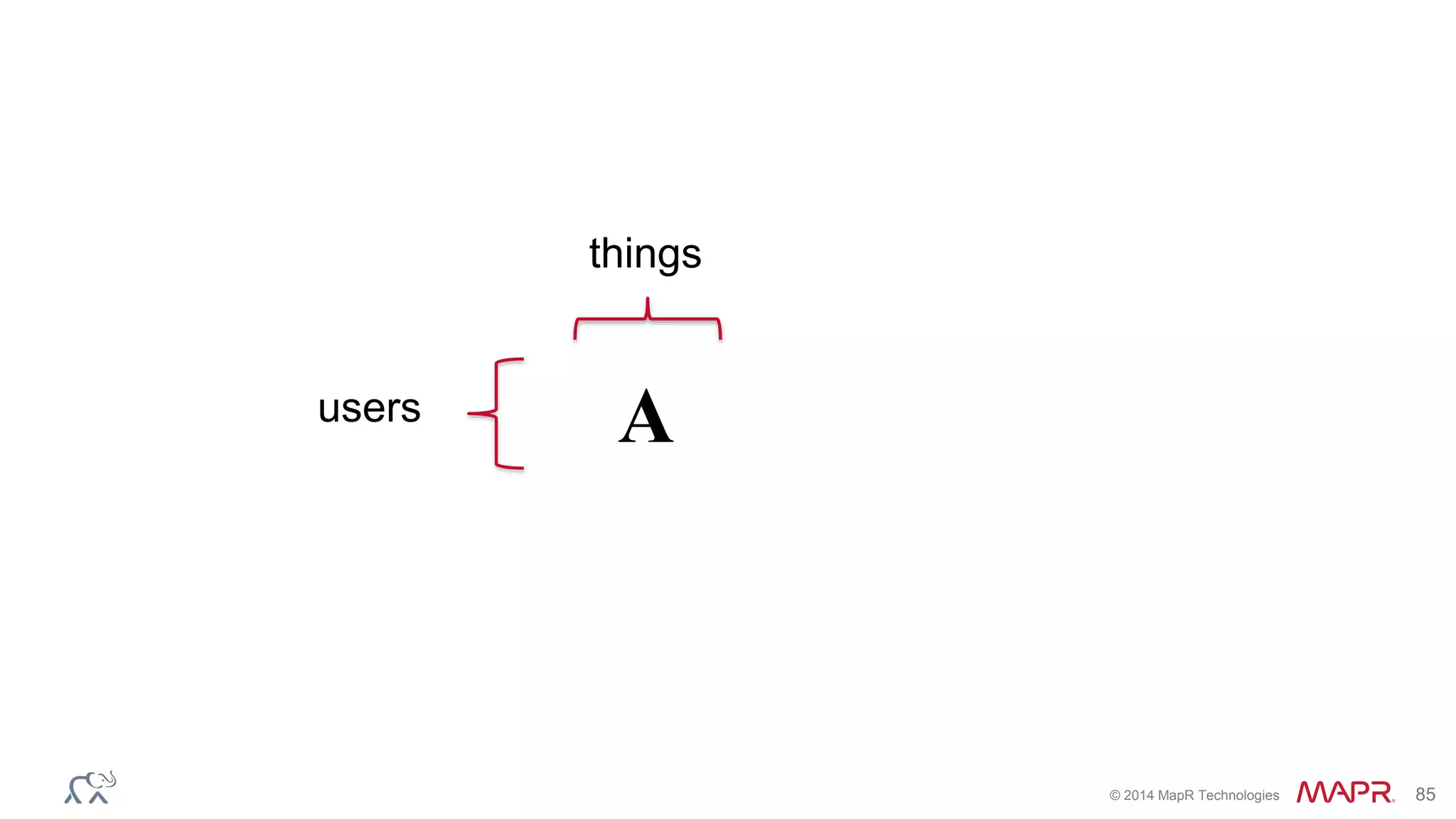
Ausers
things
© 2014 MapR Technologies 86
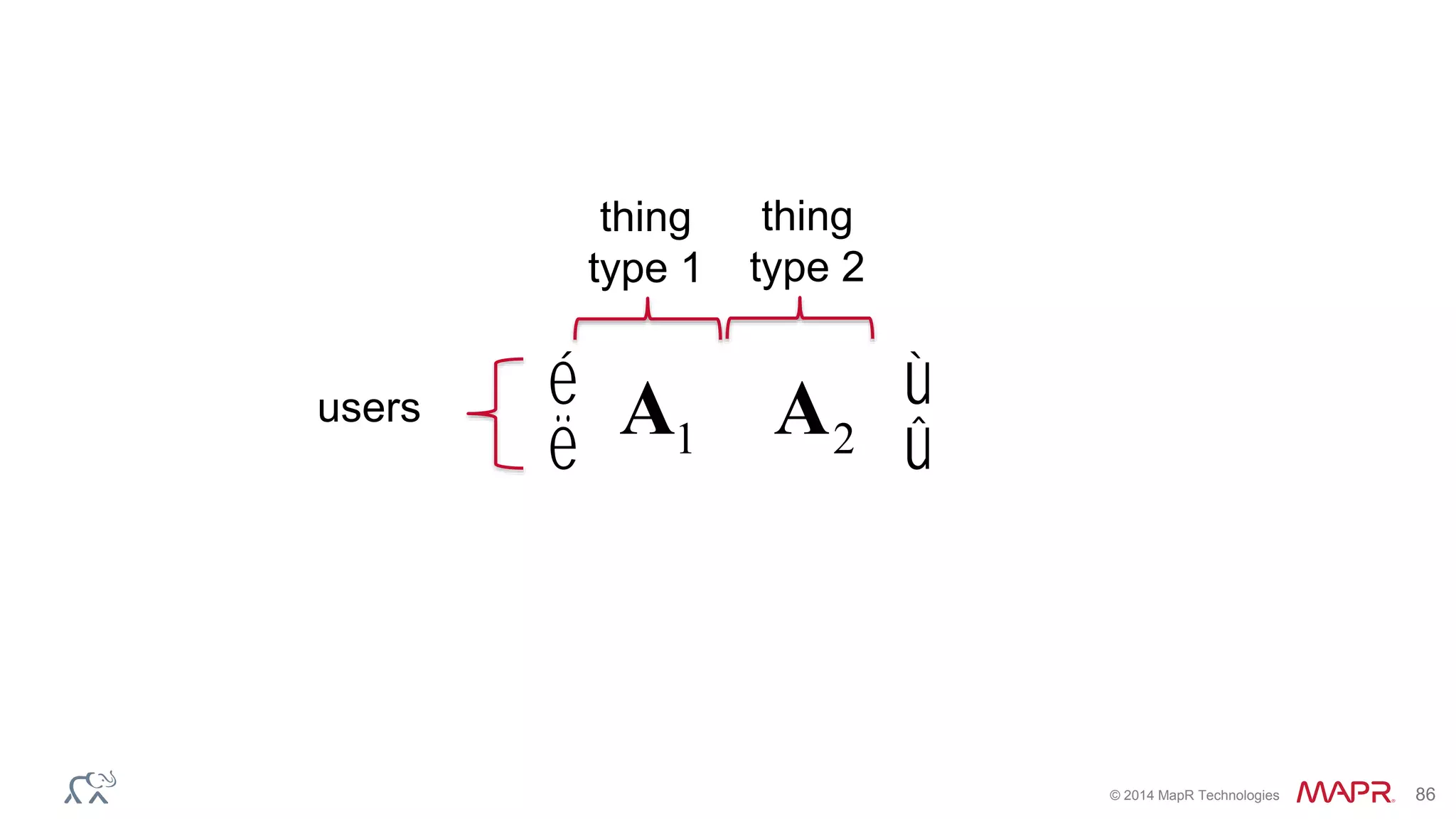
A1 A2
é
ë
ù
û
users
thing
type 1
thing
type 2
© 2014 MapR Technologies 87
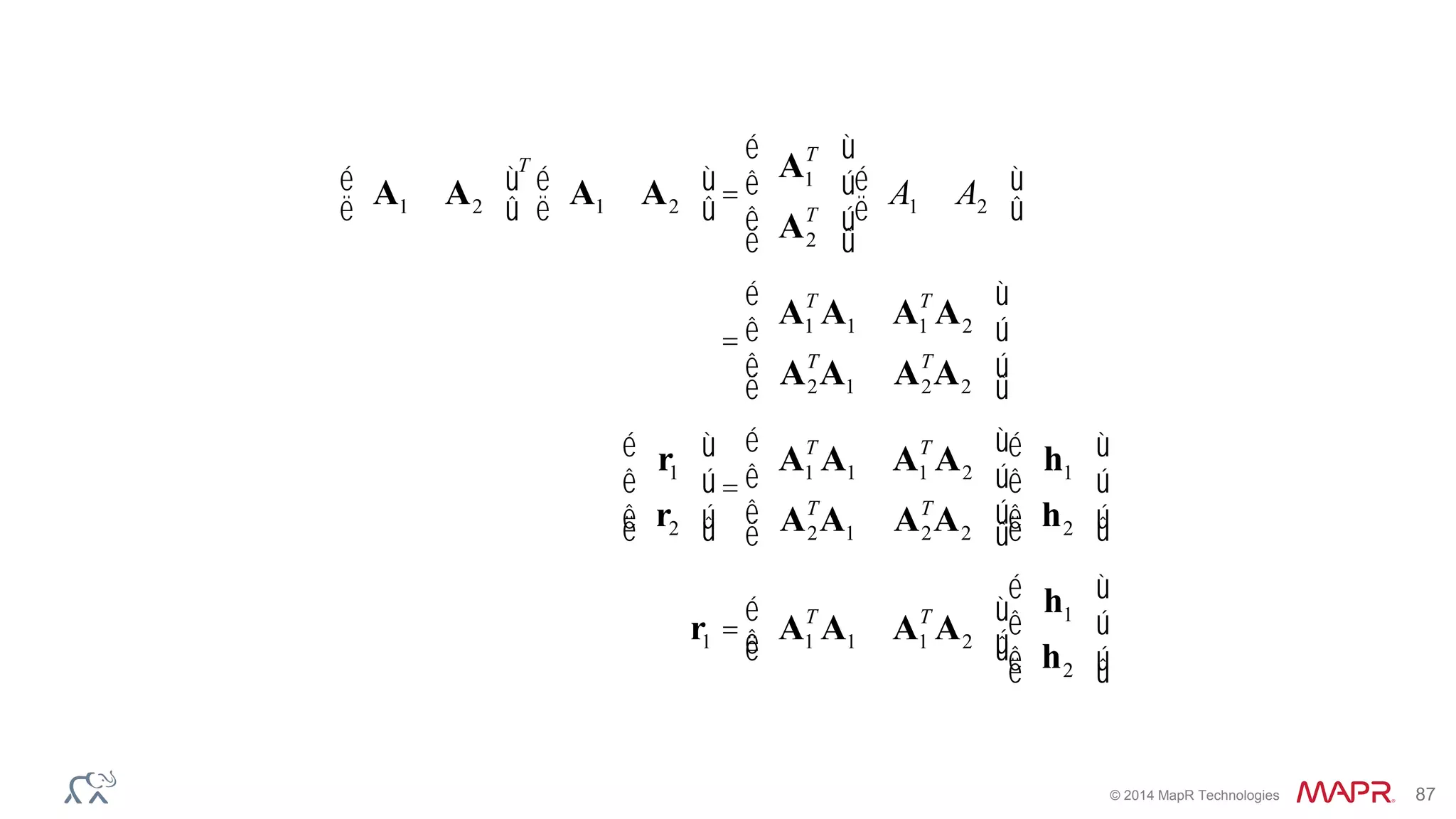
A1 A2
é
ë
ù
û
T
A1 A2
é
ë
ù
û=
A1
T
A2
T
é
ë
ê
ê
ù
û
ú
ú
A1 A2
é
ë
ù
û
=
A1
T
A1 A1
T
A2
AT
2A1 AT
2A2
é
ë
ê
ê
ù
û
ú
ú
r1
r2
é
ë
ê
ê
ù
û
ú
ú
=
A1
T
A1 A1
T
A2
AT
2A1 AT
2A2
é
ë
ê
ê
ù
û
ú
ú
h1
h2
é
ë
ê
ê
ù
û
ú
ú
r1 = A1
T
A1 A1
T
A2
é
ëê
ù
ûú
h1
h2
é
ë
ê
ê
ù
û
ú
ú
© 2014 MapR Technologies 88
Bonus Round:
When worse is better
© 2014 MapR Technologies 89
The Real Issues After First Production
• Exploration
• Diversity
• Speed
• Not the last fraction of a percent
© 2014 MapR Technologies 90
Result Dithering
• Dithering is used to re-order recommendation results
– Re-ordering is done randomly
• Dithering is guaranteed to make off-line performance worse
• Dithering also has a near perfect record of making actual performance
much better
© 2014 MapR Technologies 91
Result Dithering
• Dithering is used to re-order recommendation results
– Re-ordering is done randomly
• Dithering is guaranteed to make off-line performance worse
• Dithering also has a near perfect record of making actual performance
much better
“Made more difference than any other change”
© 2014 MapR Technologies 92
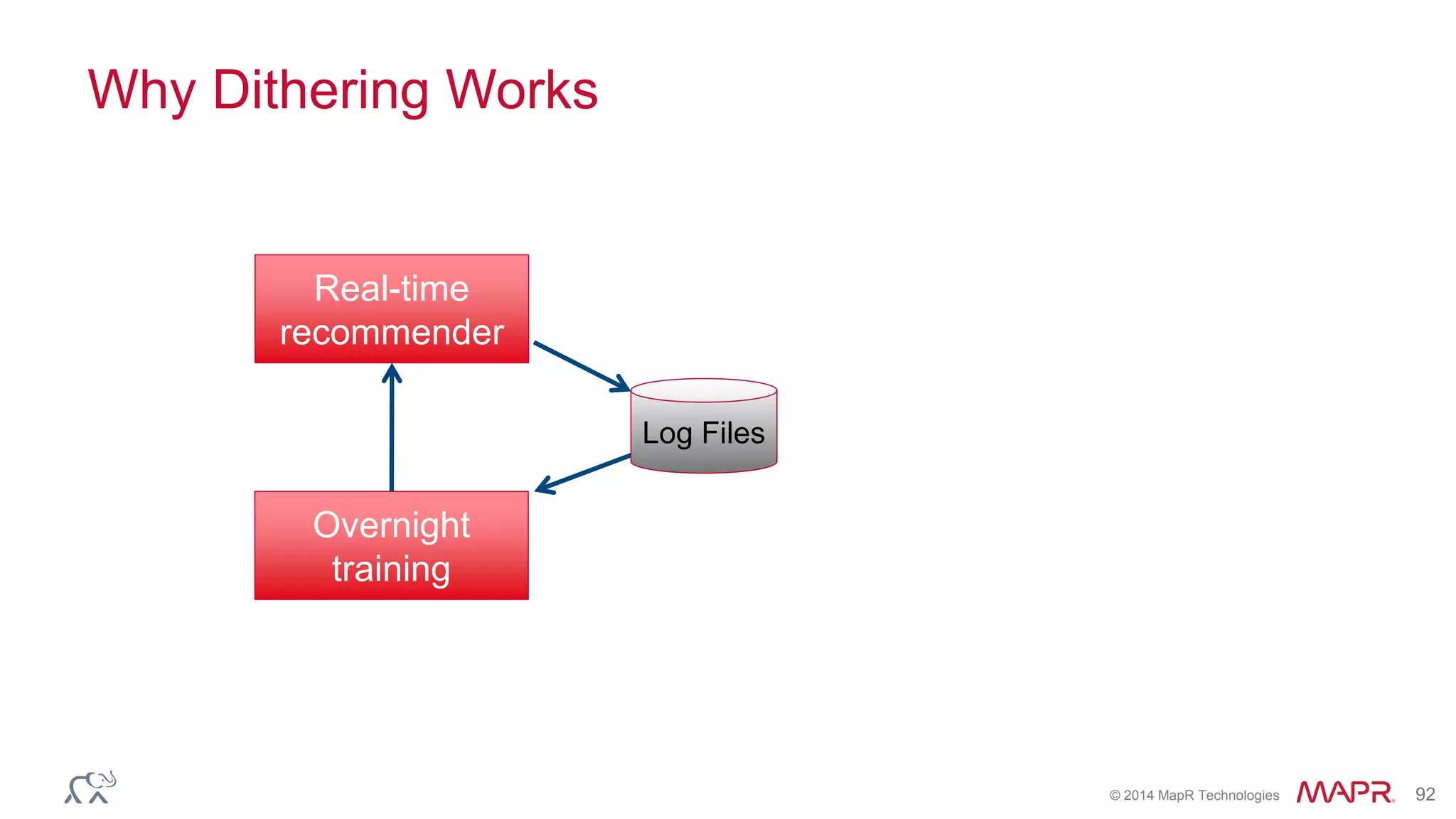
Why Dithering Works
Real-time
recommender
Overnight
training
Log Files
© 2014 MapR Technologies 93
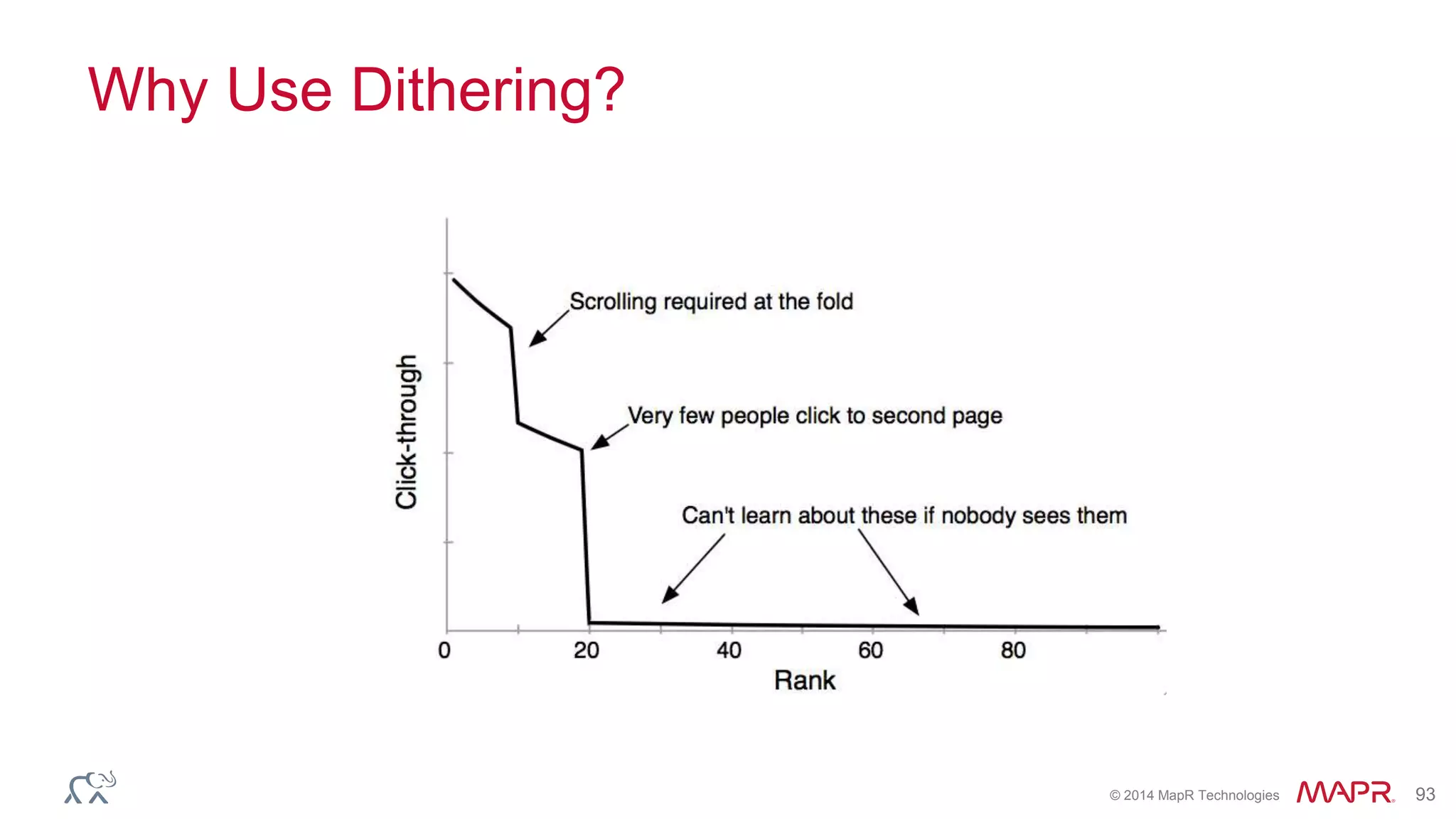
Why Use Dithering?
© 2014 MapR Technologies 94
Simple Dithering Algorithm
• Synthetic score from log rank plus Gaussian
• Pick noise scale to provide desired level of mixing
• Typically
• Also… use floor(t/T) as seed
s = logr + N(0,loge)
Dr
r
µe
e Î 1.5,3[ ]
© 2014 MapR Technologies 95
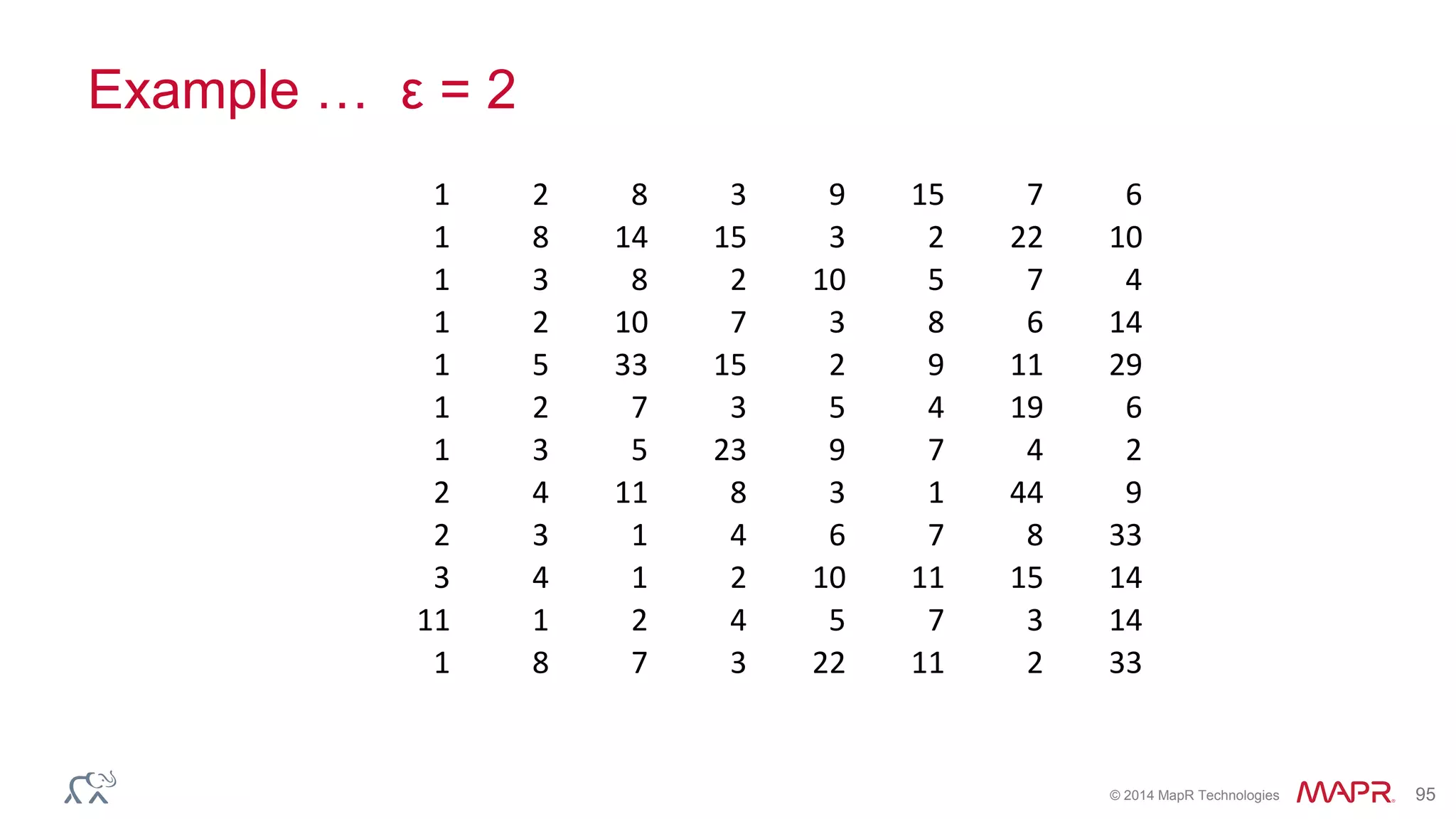
Example … ε = 2
1 2 8 3 9 15 7 6
1 8 14 15 3 2 22 10
1 3 8 2 10 5 7 4
1 2 10 7 3 8 6 14
1 5 33 15 2 9 11 29
1 2 7 3 5 4 19 6
1 3 5 23 9 7 4 2
2 4 11 8 3 1 44 9
2 3 1 4 6 7 8 33
3 4 1 2 10 11 15 14
11 1 2 4 5 7 3 14
1 8 7 3 22 11 2 33
© 2014 MapR Technologies 96
Lesson:
Exploration is good
© 2014 MapR Technologies 97
Thank you
Ted Dunning, Chief Applications Architect, MapR Technologies
Email tdunning@mapr.com tdunning@apache.org
Twitter @Ted_Dunning
Apache Mahout https://mahout.apache.org/
Twitter @ApacheMahout
22 June 2014 Big Data Everywhere Conference #DataIsrael

Practical Machine Learning: Innovations in Recommendation Workshop

  • 1.
    © 2014 MapRTechnologies 1© 2014 MapR Technologies
  • 2.
    © 2014 MapRTechnologies 2 Who I am Ted Dunning, Chief Applications Architect, MapR Technologies Email tdunning@mapr.com tdunning@apache.org Twitter @Ted_Dunning Apache Mahout https://mahout.apache.org/ Twitter @ApacheMahout 22 June 2014 Big Data Everywhere Conference #DataIsrael
  • 3.
    © 2014 MapRTechnologies 3 http://www.wired.com/wiredenterprise/2012/12/mahout/ Recommendation: Widely Used Machine Learning Example: Open source Apache Mahout used in production
  • 4.
    © 2014 MapRTechnologies 4 Recommendations – Data: interactions between people taking action (users) and items • Data used to train recommendation model – Goal is to suggest additional interactions – Example applications: movie, music or map-based restaurant choices; suggesting sale items for e-stores or via cash-register receipts
  • 5.
    © 2014 MapRTechnologies 5 Google maps: restaurant recommendations
  • 6.
    © 2014 MapRTechnologies 6 Google maps: tech recommendations
  • 7.
    © 2014 MapRTechnologies 7 Tutorial Part 1: How recommendation works, or “I want a pony”…
  • 8.
    © 2014 MapRTechnologies 9 First question: Are you using the right data?
  • 9.
    © 2014 MapRTechnologies 10 Recommendation Behavior of a crowd helps us understand what individuals will do
  • 10.
    © 2014 MapRTechnologies 11 Recommendations Alice got an apple and a puppyAlice
  • 11.
    © 2014 MapRTechnologies 12 Recommendations Alice got an apple and a puppyAlice Charles got a bicycleCharles
  • 12.
    © 2014 MapRTechnologies 13 Recommendations Alice got an apple and a puppyAlice Charles got a bicycleCharles Bob Bob got an apple
  • 13.
    © 2014 MapRTechnologies 14 Recommendations Alice got an apple and a puppyAlice Charles got a bicycleCharles Bob What else would Bob like?
  • 14.
    © 2014 MapRTechnologies 15 Recommendations Alice got an apple and a puppyAlice Charles got a bicycleCharles Bob A puppy!
  • 15.
    © 2014 MapRTechnologies 16 You get the idea of how recommenders can work…
  • 16.
    © 2014 MapRTechnologies 17 By the way, like me, Bob also wants a pony…
  • 17.
    © 2014 MapRTechnologies 18 Recommendations ? Alice Bob Charles Amelia What if everybody gets a pony? What else would you recommend for new user Amelia?
  • 18.
    © 2014 MapRTechnologies 19 Recommendations ? Alice Bob Charles Amelia If everybody gets a pony, it’s not a very good indicator of what to else predict...
  • 19.
    © 2014 MapRTechnologies 20 Problems with Raw Co-occurrence • Very popular items co-occur with everything or why it’s not very helpful to know that everybody wants a pony… – Examples: Welcome document; Elevator music • Very widespread occurrence is not interesting to generate indicators for recommendation – Unless you want to offer an item that is constantly desired, such as razor blades (or ponies) • What we want is anomalous co-occurrence – This is the source of interesting indicators of preference on which to base recommendation
  • 20.
    © 2014 MapRTechnologies 21 Overview: Get Useful Indicators from Behaviors 1. Use log files to build history matrix of users x items – Remember: this history of interactions will be sparse compared to all potential combinations 2. Transform to a co-occurrence matrix of items x items 3. Look for useful indicators by identifying anomalous co-occurrences to make an indicator matrix – Log Likelihood Ratio (LLR) can be helpful to judge which co- occurrences can with confidence be used as indicators of preference – ItemSimilarityJob in Apache Mahout uses LLR
  • 21.
    © 2014 MapRTechnologies 22 Apache Mahout: Overview • Open source Apache project http://mahout.apache.org/ • Mahout version is 0.9 released Feb 2014; inc Scala – Summary 0.9 blog at http://bit.ly/1rirUUL • Library of scalable algorithms for machine learning – Some run on Apache Hadoop distributions; others do not require Hadoop – Some can be run at small scale – Some are run in parallel; others are sequential • Includes the following main areas: – Clustering & related techniques – Classification – Recommendation – Mahout Math Library
  • 22.
    © 2014 MapRTechnologies 24 Log Files Alice Bob Charles Alice Bob Charles Alice
  • 23.
    © 2014 MapRTechnologies 25 Log Files u1 u3 u2 u1 u3 u2 u1 t1 t4 t3 t2 t3 t3 t1
  • 24.
    © 2014 MapRTechnologies 26 History Matrix: Users x Items Alice Bob Charles ✔ ✔ ✔ ✔ ✔ ✔ ✔
  • 25.
    © 2014 MapRTechnologies 27 Co-Occurrence Matrix: Items x Items 1 2 0 1 1 1 1 1 0 00 2 How do you tell which co- occurrences are useful?
  • 26.
    © 2014 MapRTechnologies 28 Co-Occurrence Matrix: Items x Items 1 2 0 1 1 1 1 1 0 00 2 Use LLR test to turn co- occurrence into indicators…
  • 27.
    © 2014 MapRTechnologies 29 Co-occurrence Binary Matrix 1 1not not 1
  • 28.
    © 2014 MapRTechnologies 30 Which one is the anomalous co-occurrence? A not A B 13 1000 not B 1000 100,000 A not A B 1 0 not B 0 10,000 A not A B 10 0 not B 0 100,000 A not A B 1 0 not B 0 2
  • 29.
    © 2014 MapRTechnologies 31 Which one is the anomalous co-occurrence? A not A B 13 1000 not B 1000 100,000 A not A B 1 0 not B 0 10,000 A not A B 10 0 not B 0 100,000 A not A B 1 0 not B 0 2 0.90 1.95 4.52 14.3
  • 30.
    © 2014 MapRTechnologies 32 Co-Occurrence Matrix: Items x Items 1 2 0 1 1 1 1 1 0 00 2 Recap: Use LLR test to turn co- occurrence into indicators
  • 31.
    © 2014 MapRTechnologies 33 Indicator Matrix: Anomalous Co-Occurrence Result: Each marked row shows the indicators of what to recommend… ✔ ✔
  • 32.
    © 2014 MapRTechnologies 34 Indicator Matrix: Anomalous Co-Occurrence ✔ ✔ Why not pony + other item?
  • 33.
    © 2014 MapRTechnologies 36 How will you deliver recommendations to users?
  • 34.
    © 2014 MapRTechnologies 37 Seeking Simplicity Innovation: Exploit search technology to deploy your recommendation system
  • 35.
    © 2014 MapRTechnologies 38 But first, a look at how search works…
  • 36.
    © 2014 MapRTechnologies 39 Apache Solr/Apache Lucene • Apache Solr/Lucene is an open-source powerful search engine used for flexible, heavily indexed queries including data such as – Full text, geographical data, statistically weighted data • Lucene – Provides core retrieval – Is a low-level library • Solr – Is a web-based wrapper around Lucene – Is easy to integrate because you talk to it via a web-interface • URL http://host machine:8888
  • 37.
    © 2014 MapRTechnologies 40 LucidWorks • Enterprise platform and collection of applications based on Apache Solr/Lucene – Wrapper around Solr – A free version ships with MapR • LucidWorks leaves Solr exposed but makes Solr administration much easier, which in turn makes it easier to use Lucene • URL http://host machine:8989
  • 38.
    © 2014 MapRTechnologies 41 Solr LucidWorks Query Response Index Lucene Query Response Data Source Relationship of Solr /Lucene/LucidWorks
  • 39.
    © 2014 MapRTechnologies 42 Other Options: Elastic Search • Apache Lucene library at the heart of several approaches – It can also be used on its own • Elastic Search is a different web interface for Lucene – Real time search and analytics – Open source (not Apache) – Big advantage is less accumulated cruft http://www.elasticsearch.com/
  • 40.
    © 2014 MapRTechnologies 44 What is a Document? • Data is stored in collections made up of documents • Documents contain fields that can be – Indexed • makes field searchable; don’t have to index all – Stored • If you want Solr to return content, have Solr store content • Not all data of interest must be stored: can access via stored URL (good for very large data set) – Multi-value • Body field can contain more than one type of data – Facetted • A way to refine a search or use for statistics • Example: data for country: Could return facetted as “37 from US, 23 UK, 7 Japan”
  • 41.
    © 2014 MapRTechnologies 45 Fields and How to Set Them Up • Lucene is mostly used for text – Text has to be tokenized • Also supports other types – Long, string, keywords, comma separated • Fields properties such as stored, indexed, faceted can also be defined • Defaults aren’t usually so great
  • 42.
    © 2014 MapRTechnologies 46 Example of Facetted Search The indexed fields “Area” and “Gender” have been facetted to provide counts for the results
  • 43.
    © 2014 MapRTechnologies 48 Field-specific Searches Using Lucene Syntax • Documents often have title, author, keywords and body text • General syntax is field:(term1 term2) • Alternatives field:(term1 OR term2) field:(“term1 term2” ~ 5) field:(term1 AND term2) • Default field, default interpretations work very well for text
  • 44.
    © 2014 MapRTechnologies 49 Send Data to Solr (not LucidWorks) • LucidWorks has lots of spiders that can use file extension or mime type to trigger certain file parsers – Works best with web-ish sources and mime types – Also includes MapR and MapR high volume indexers • More common at modest volumes or for updates to use JSON format {"id":"book_314", "title":{"set":"The Call of the Wild"}} • Use REST interface to send update files curl http://localhost:8983/solr/update -H 'Content-type:application/json' --data-binary @file.json
  • 45.
    © 2014 MapRTechnologies 51 Back to recommendation: How do you abuse search to make recommendation easy?
  • 46.
    © 2014 MapRTechnologies 52 Collection of Documents: Insert Meta-Data Search Technology Item meta-data Document for “puppy” id: t4 title: puppy desc: The sweetest little puppy ever. keywords: puppy, dog, pet Ingest easily via NFS
  • 47.
    © 2014 MapRTechnologies 53 From Indicator Matrix to New Indicator Field ✔ id: t4 title: puppy desc: The sweetest little puppy ever. keywords: puppy, dog, pet indicators: (t1) Solr document for “puppy” Note: data for the indicator field is added directly to meta-data for a document in Apache Solr or Elastic Search index. You don’t need to create a separate index for the indicators.
  • 48.
    © 2014 MapRTechnologies 54 Let’s look at a real example: we built a music recommender
  • 49.
    © 2014 MapRTechnologies 56
  • 50.
    © 2014 MapRTechnologies 57 User activity: Listens to classic jazz hit “Take the A Train”
  • 51.
    © 2014 MapRTechnologies 58 System delivers recommendations based on activity
  • 52.
    © 2014 MapRTechnologies 59 Let’s look inside the music recommender…
  • 53.
    © 2014 MapRTechnologies 60 Music Meta Data for Search Document Collections • MusicBrainz data • Data includes Artist ID, MusicBrainz ID, Name, Group/Person, From (geo locations) and Gender as seen in this sample
  • 54.
    © 2014 MapRTechnologies 62 Sample User Behavior Histories: Music Log Files 13 START 10113 2182654281 23 BEACON 10113 2182654281 24 START 10113 79600611935028 34 BEACON 10113 79600611935028 44 BEACON 10113 79600611935028 54 BEACON 10113 79600611935028 64 BEACON 10113 79600611935028 74 BEACON 10113 79600611935028 84 BEACON 10113 79600611935028 94 BEACON 10113 79600611935028 104 BEACON 10113 79600611935028 109 FINISH10113 79600611935028 111 START 10113 58999912011972 121 BEACON 10113 58999912011972 Time Event type User ID Artist ID Track ID
  • 55.
    © 2014 MapRTechnologies 63 Sample Music Log Files Artist ID for jazz musician Duke Ellington What has user 119 done here in the highlighted lines?
  • 56.
    © 2014 MapRTechnologies 64 Internals of a Recommendation Engine
  • 57.
    © 2014 MapRTechnologies 65 Internals of a Recommendation Engine
  • 58.
    © 2014 MapRTechnologies 66 id 1710 mbid 592a3b6d-c42b-4567-99c9-ecf63bd66499 name Chuck Berry area United States gender Male indicator_artists 386685,875994,637954,3418,1344,789739,1460, … id 541902 mbid 983d4f8f-473e-4091-8394-415c105c4656 name Charlie Winston area United Kingdom gender None indicator_artists 997727,815,830794,59588,900,2591,1344,696268, … Lucene Documents for Music Recommendation Notice that data from indicator matrix of trained Mahout recommender model has been added to indicator field in documents of the artists collection
  • 59.
    © 2014 MapRTechnologies 68 Offline Analysis Analysis Using Mahout Users History Log Files Indicators Search Technology Item Meta-Data
  • 60.
    © 2014 MapRTechnologies 69 Log Files Mahout Analysis Search Technology Item Meta-Data Ingest easily via NFS MapR Cluster via NFS Python Use Python directly via NFS Pig Web TierRecommendations New User History Real-time recommendations using MapR data platform
  • 61.
    © 2014 MapRTechnologies 70 A Quick Simplification • Users who do h • Also do Ah AT Ah( ) AT A( )h User-centric recommendations Item-centric recommendations
  • 62.
    © 2014 MapRTechnologies 71 Architectural Advantage AT Ah( ) AT A( )h User-centric recommendations Item-centric recommendations
  • 63.
    © 2014 MapRTechnologies 72 Architectural Advantage AT Ah( ) User-centric recommendations With the first design, you have to do the real-time computation first (in parenthesis). No way to pre-compute. Less efficient, less fast. With the second design, you can pre-compute offline (overnight) things that change slowly. Only the smaller computation for new user vector (h) is done in real-time, so response is very fast. AT A( )h Item-centric recommendations
  • 64.
    © 2014 MapRTechnologies 74 Tutorial Part 2: How to make recommendation better
  • 65.
    © 2014 MapRTechnologies 75 Going Further: Multi-Modal Recommendation
  • 66.
    © 2014 MapRTechnologies 76 Going Further: Multi-Modal Recommendation
  • 67.
    © 2014 MapRTechnologies 77 For example • Users enter queries (A) – (actor = user, item=query) • Users view videos (B) – (actor = user, item=video) • ATA gives query recommendation – “did you mean to ask for” • BTB gives video recommendation – “you might like these videos”
  • 68.
    © 2014 MapRTechnologies 78 The punch-line • BTA recommends videos in response to a query – (isn’t that a search engine?) – (not quite, it doesn’t look at content or meta-data)
  • 69.
    © 2014 MapRTechnologies 79 Real-life example • Query: “Paco de Lucia” • Conventional meta-data search results: – “hombres de paco” times 400 – not much else • Recommendation based search: – Flamenco guitar and dancers – Spanish and classical guitar – Van Halen doing a classical/flamenco riff
  • 70.
    © 2014 MapRTechnologies 80 Real-life example
  • 71.
    © 2014 MapRTechnologies 81 Hypothetical Example • Want a navigational ontology? • Just put labels on a web page with traffic – This gives A = users x label clicks • Remember viewing history – This gives B = users x items • Cross recommend – B’A = label to item mapping • After several users click, results are whatever users think they should be
  • 72.
    © 2014 MapRTechnologies 82 Nice. But we can do better?
  • 73.
    © 2014 MapRTechnologies 84 Symmetry Gives Cross Recommentations AT A( )h BT A( )h Conventional recommendations with off-line learning Cross recommendations
  • 74.
    © 2014 MapRTechnologies 85 Ausers things
  • 75.
    © 2014 MapRTechnologies 86 A1 A2 é ë ù û users thing type 1 thing type 2
  • 76.
    © 2014 MapRTechnologies 87 A1 A2 é ë ù û T A1 A2 é ë ù û= A1 T A2 T é ë ê ê ù û ú ú A1 A2 é ë ù û = A1 T A1 A1 T A2 AT 2A1 AT 2A2 é ë ê ê ù û ú ú r1 r2 é ë ê ê ù û ú ú = A1 T A1 A1 T A2 AT 2A1 AT 2A2 é ë ê ê ù û ú ú h1 h2 é ë ê ê ù û ú ú r1 = A1 T A1 A1 T A2 é ëê ù ûú h1 h2 é ë ê ê ù û ú ú
  • 77.
    © 2014 MapRTechnologies 88 Bonus Round: When worse is better
  • 78.
    © 2014 MapRTechnologies 89 The Real Issues After First Production • Exploration • Diversity • Speed • Not the last fraction of a percent
  • 79.
    © 2014 MapRTechnologies 90 Result Dithering • Dithering is used to re-order recommendation results – Re-ordering is done randomly • Dithering is guaranteed to make off-line performance worse • Dithering also has a near perfect record of making actual performance much better
  • 80.
    © 2014 MapRTechnologies 91 Result Dithering • Dithering is used to re-order recommendation results – Re-ordering is done randomly • Dithering is guaranteed to make off-line performance worse • Dithering also has a near perfect record of making actual performance much better “Made more difference than any other change”
  • 81.
    © 2014 MapRTechnologies 92 Why Dithering Works Real-time recommender Overnight training Log Files
  • 82.
    © 2014 MapRTechnologies 93 Why Use Dithering?
  • 83.
    © 2014 MapRTechnologies 94 Simple Dithering Algorithm • Synthetic score from log rank plus Gaussian • Pick noise scale to provide desired level of mixing • Typically • Also… use floor(t/T) as seed s = logr + N(0,loge) Dr r µe e Î 1.5,3[ ]
  • 84.
    © 2014 MapRTechnologies 95 Example … ε = 2 1 2 8 3 9 15 7 6 1 8 14 15 3 2 22 10 1 3 8 2 10 5 7 4 1 2 10 7 3 8 6 14 1 5 33 15 2 9 11 29 1 2 7 3 5 4 19 6 1 3 5 23 9 7 4 2 2 4 11 8 3 1 44 9 2 3 1 4 6 7 8 33 3 4 1 2 10 11 15 14 11 1 2 4 5 7 3 14 1 8 7 3 22 11 2 33
  • 85.
    © 2014 MapRTechnologies 96 Lesson: Exploration is good
  • 86.
    © 2014 MapRTechnologies 97 Thank you Ted Dunning, Chief Applications Architect, MapR Technologies Email tdunning@mapr.com tdunning@apache.org Twitter @Ted_Dunning Apache Mahout https://mahout.apache.org/ Twitter @ApacheMahout 22 June 2014 Big Data Everywhere Conference #DataIsrael

Editor's Notes

  • #7 Timing: Assume 5 min to here
  • #22 Mention that the Pony book said “RowSimilarityJob”…
  • #23 Talk track: Apache Mahout is an open-source project with international contributors and a vibrant community of users and developers. A new version – 0.8 – was recently released. Mahout is a library of scalable algorithms used for clustering, classification and recommendation. Mahout also includes a math library that is low level, flexible, scalable and makes certain functions very easy to carry out. Talk track: First let’s make a quick comparison of the three main areas of Mahout machine learning…
  • #30 Old joke: all the world can be divided into 2 categories: Scotch tape and non-Scotch tape… This is a way to think about the co-occurrence
  • #40 Talk track: Solr is a small data tool that has flourished in a big data world
  • #41 *For the hands-on lab in this course, we will use a free part of LucidWorks that comes as part of the MapR distribution
  • #42 Needed???
  • #43 Optional: don’t spend time on this
  • #44 Note to speaker: fast on this slide as overview and reference only; additional slides and labs will explain this
  • #45 TED: Do you need to talk about term locations? I left off SEE NEXT SLIDE FOR MORE ON FACETTING
  • #46 FOR HOW TO SET THEM UP, is it done from dashboard (see next slide) or as a command?
  • #47 Nice to show but don’t have to … they can just find it in the lab. I would show this slide very briefly and move on
  • #48 Skip this?
  • #50 Note to speaker: point out that using Solr is a state-of-the-art approach that simplifies deploying recommender
  • #57 Talk track: We built a real music recommender on MapR and deployed it to a website for a mock company, Music Machine. Everything worked except you didn’t really hear music play…
  • #67 Talk track: Here are documents for two different artists with indicator IDs that are part of the recommendation model. When recommendations are needed, the web-site uses recent visitor behavior to query against the indicators in these documents.
  • #71 Notes to trainer: A lot of work to do a grid. Represent by math A is history matrix Ah finds users who do the same things as in h H is vector of items for one (new current) user A transpose times Ah gives you the things That computes what these users do Shape of matrix multiplications and many of the same properties. Sometimes have weights etc. Had they been exactly the same, we could just move the parentheses. Our recommender does the item-centric version General relationships in data don’t change fast (what is related to what; nothing happens to change mozart related to Hayden overnight. ) What does change fast is what the user did in the last five minutes. //in first case, we have to compute Ah first. Inputs to that compution (h) only available now, in RT so nothing can be computed ahead of time Second case (Atranspose A) only involves things that change slowly. So pre-compute. Makes it possible to do this offline. Significant because we move a lot of computation for all users into an overnight process. So each RT recommendation involves only a small part, only 1 big matrix multiply in RT. Result: you get a fast response for the recommendations Second form runs on one machine for one user (the RT part)
  • #72 A lot of work to do a grid. Represent by math A is history matrix Ah finds users who do the same things as in h H is vector of items for one (new current) user A transpose times Ah gives you the things That computes what these users do Shape of matrix multiplications and many of the same properties. Sometimes have weights etc. Had they been exactly the same, we could just move the parentheses. Our recommender does the item-centric version General relationships in data don’t change fast (what is related to what; nothing happens to change mozart related to Hayden overnight. ) What does change fast is what the user did in the last five minutes. //in first case, we have to compute Ah first. Inputs to that computation (h) only available now, in RT so nothing can be computed ahead of time Second case (A transpose A) only involves things that change slowly. So pre-compute. Makes it possible to do this offline. Significant because we move a lot of computation for all users into an overnight process. So each RT recommendation involves only a small part, only 1 big matrix multiply in RT. Result: you get a fast response for the recommendations Second form runs on one machine for one user (the RT part)
  • #73 A lot of work to do a grid. Represent by math A is history matrix Ah finds users who do the same things as in h H is vector of items for one (new current) user A transpose times Ah gives you the things That computes what these users do Shape of matrix multiplications and many of the same properties. Sometimes have weights etc. Had they been exactly the same, we could just move the parentheses. Our recommender does the item-centric version General relationships in data don’t change fast (what is related to what; nothing happens to change mozart related to Hayden overnight. ) What does change fast is what the user did in the last five minutes. //in first case, we have to compute Ah first. Inputs to that computation (h) only available now, in RT so nothing can be computed ahead of time Second case (A transpose A) only involves things that change slowly. So pre-compute. Makes it possible to do this offline. Significant because we move a lot of computation for all users into an overnight process. So each RT recommendation involves only a small part, only 1 big matrix multiply in RT. Result: you get a fast response for the recommendations Second form runs on one machine for one user (the RT part)
  • #78 Problem starts here…
  • #107 Note to trainer: take a little time to explore this here and on the next couple of slides. Details enlarged on next slide
  • #108 Note to trainer: take a little time to explore this here and on the next couple of slides. Details enlarged on next slide
  • #109 This is a diagnostics window in the LucidWorks Solr index (not the web interface a user would see). It’s a way for the developer to do a rough evaluation (laugh test) of the choices offered by the recommendation engine. In other words, do these indicator artists represented by their indicator Id make reasonable recommendations Note to trainer: artist 303 happens to be The Beatles. Is that a good match for Chuck Berry?