RECOMBINANT
DNA TECHNOLOGY
RVS Chaitanya Koppala
Assistant Professor
Vignan Institute of Pharmaceutical Technology
Visakhapatnam
RECOMBINANT DNA TECHNOLOGY
DNA= Deoxyribu-Nucelic Acid
DNA is a very large molecule, made up of smaller units called
Nucleotides Each nucleotide has three parts: a sugar (ribose), a phosphate molecule, and a
nitrogenous base. The nitrogenous base is the part of the nucleotide that carries genetic
information The bases found in DNA are four: adenine, cytosine, guanine, and thymine ( ATP,
CTP, GTP, and TTP)
Recombinant DNA Technology
 Recombinant DNA technology procedures by which DNA from different species can
be isolated, cut and spliced together -- new "recombinant " molecules are then multiplied
in quantity in populations of rapidly dividing cells (e.g. bacteria, yeast).
 In the early 1970s it became possible to isolate a specific piece of DNA out of the
millions of base pairs in a typical genome.
 Recombinant DNA technology is based on a number of important things:
 Bacteria contain extra chromosomal molecules of DNA called plasmids which are
circular.
 Bacteria also produce enzymes calledrestriction endonucleases that cut DNA
molecules at specific places into many smaller fragments called restriction fragments.
There are many different kinds of restriction Endonucleases
Restriction Enzymes and plasmid
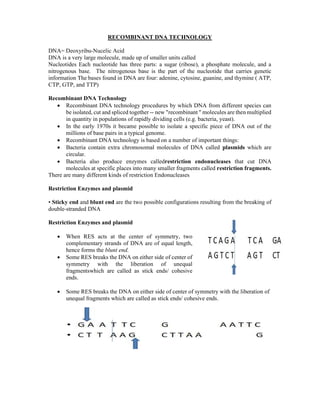
• Sticky end and blunt end are the two possible configurations resulting from the breaking of
double-stranded DNA
Restriction Enzymes and plasmid
 When RES acts at the center of symmetry, two
complementary strands of DNA are of equal length,
hence forms the blunt end.
 Some RES breaks the DNA on either side of center of
symmetry with the liberation of unequal
fragmentswhich are called as stick ends/ cohesive
ends.
 Some RES breaks the DNA on either side of center of symmetry with the liberation of
unequal fragments which are called as stick ends/ cohesive ends.
Digestion of DNA by Eco RI to produce cohesive ends.
Restriction Enzymes and plasmid
 Restriction Enzymes are primarily found in bacteria and are given abbreviations based
on genus and species of the bacteria.
 One of the first restriction enzymes to be isolated was from EcoRI
 EcoRI is so named because it was isolated from Escherichia coli strain called RY13.
WHAT IS GENE:
• A gene is a stretch of DNA that codes for a type of protein that
has a function in the organism. • It is a unit of heredity in a living
organism. All living things depend on genes • Genes hold the
information to build and maintain an organism's cells and pass
genetic traits to offspring.
BASIC STEPS IN GENE CLONING.
Step 1
A fragment of DNA, containing the gene to be cloned, is inserted
into a circular DNA molecule called a vector, to produce a chimera
or recombinant DNA (rDNA) molecule.
Step 2
The vector acts as a vehicle that transports the gene into a host cell, which is usually a bacterium
although other types of living cell can be used. This process is called transformation.
Step 3
Within the host cell the vector multiplies producing numerous identical copies not only of itself
but also of the gene that it carries.
Step 4
When the host cell divides, copies of rDNA
molecule are passed to the progeny and further
vector replication takes place.
Step 5
After large no: of cell divisions a colony or clone of
identical host cells is produced.
Each cell in the clone contains one or more copies
of the rDNA molecule
Step 6
Then, the host cells are then lysed and rDNA can be
separated.
APPLICATIONS OF RDNA TECHNOLOGY IN MEDICINE
Recombinant DNA technology had made it possible to treat different diseases by inserting new
genes in place of damaged and diseased genes in the human body.
1. INSULIN: -
Insulin is a hormone made up of protein. It is secreted in the pancreas by some
cells called as islet cells. If a person has decreased amount of insulin in his body,
he will suffer from a disease called diabetes. Recombinant DNA technology has
allowed the scientists to develop human insulin by using the bacteria as a host
cell and it is also available in the market. It is believed that the drugs produced
through microbes are safer.
2. VACCINES:
Recombinant DNA technology enables the scientists to develop vaccines by
cloning the gene used for protective antigen protein. Viral vaccines are most
commonly developed through this technology for example, Herpes, Influenza,
Hepatitis and Foot and Mouth Diseases
3. HUMAN GROWTH HORMONES: -
In recent years, scientists have developed many growth hormones using
recombinant DNA technology. The disease of dwarfism is treated with this
hormone.
4. INFECTIOUS DISEASES: -
Many diseases are diagnosed by conducting certain tests. Recombinant DNA
technology has allowed the development of many tests which are being used to
diagnose diseases like TB and cancer.In the diagnosis process, certain pathogens
are isolated and identified, and then diagnostic kits are produced when the
genome of the specific pathogen is known to kill it or block its pathogenic
activity.
5. PRODUCTION OF NOVEL PLANTS:
Rdna is used in distinguishing of novel agricultural plants which are high
yielding and pest resistant Cloning of genes from wild pest resistant varieties has
been used.
6. STRAIN IMPROVEMENT FOR FERMENTATION:
Rdna uses extensively for improvement of strains of microbes.

RECOMBINANT DNA TECHNOLOGY

  • 1.
    RECOMBINANT DNA TECHNOLOGY RVS ChaitanyaKoppala Assistant Professor Vignan Institute of Pharmaceutical Technology Visakhapatnam
  • 2.
    RECOMBINANT DNA TECHNOLOGY DNA=Deoxyribu-Nucelic Acid DNA is a very large molecule, made up of smaller units called Nucleotides Each nucleotide has three parts: a sugar (ribose), a phosphate molecule, and a nitrogenous base. The nitrogenous base is the part of the nucleotide that carries genetic information The bases found in DNA are four: adenine, cytosine, guanine, and thymine ( ATP, CTP, GTP, and TTP) Recombinant DNA Technology  Recombinant DNA technology procedures by which DNA from different species can be isolated, cut and spliced together -- new "recombinant " molecules are then multiplied in quantity in populations of rapidly dividing cells (e.g. bacteria, yeast).  In the early 1970s it became possible to isolate a specific piece of DNA out of the millions of base pairs in a typical genome.  Recombinant DNA technology is based on a number of important things:  Bacteria contain extra chromosomal molecules of DNA called plasmids which are circular.  Bacteria also produce enzymes calledrestriction endonucleases that cut DNA molecules at specific places into many smaller fragments called restriction fragments. There are many different kinds of restriction Endonucleases Restriction Enzymes and plasmid • Sticky end and blunt end are the two possible configurations resulting from the breaking of double-stranded DNA Restriction Enzymes and plasmid  When RES acts at the center of symmetry, two complementary strands of DNA are of equal length, hence forms the blunt end.  Some RES breaks the DNA on either side of center of symmetry with the liberation of unequal fragmentswhich are called as stick ends/ cohesive ends.  Some RES breaks the DNA on either side of center of symmetry with the liberation of unequal fragments which are called as stick ends/ cohesive ends.
  • 3.
    Digestion of DNAby Eco RI to produce cohesive ends. Restriction Enzymes and plasmid  Restriction Enzymes are primarily found in bacteria and are given abbreviations based on genus and species of the bacteria.  One of the first restriction enzymes to be isolated was from EcoRI  EcoRI is so named because it was isolated from Escherichia coli strain called RY13. WHAT IS GENE: • A gene is a stretch of DNA that codes for a type of protein that has a function in the organism. • It is a unit of heredity in a living organism. All living things depend on genes • Genes hold the information to build and maintain an organism's cells and pass genetic traits to offspring. BASIC STEPS IN GENE CLONING. Step 1 A fragment of DNA, containing the gene to be cloned, is inserted into a circular DNA molecule called a vector, to produce a chimera or recombinant DNA (rDNA) molecule.
  • 4.
    Step 2 The vectoracts as a vehicle that transports the gene into a host cell, which is usually a bacterium although other types of living cell can be used. This process is called transformation. Step 3 Within the host cell the vector multiplies producing numerous identical copies not only of itself but also of the gene that it carries. Step 4 When the host cell divides, copies of rDNA molecule are passed to the progeny and further vector replication takes place. Step 5 After large no: of cell divisions a colony or clone of identical host cells is produced. Each cell in the clone contains one or more copies of the rDNA molecule Step 6 Then, the host cells are then lysed and rDNA can be separated.
  • 5.
    APPLICATIONS OF RDNATECHNOLOGY IN MEDICINE Recombinant DNA technology had made it possible to treat different diseases by inserting new genes in place of damaged and diseased genes in the human body. 1. INSULIN: - Insulin is a hormone made up of protein. It is secreted in the pancreas by some cells called as islet cells. If a person has decreased amount of insulin in his body, he will suffer from a disease called diabetes. Recombinant DNA technology has allowed the scientists to develop human insulin by using the bacteria as a host cell and it is also available in the market. It is believed that the drugs produced through microbes are safer. 2. VACCINES: Recombinant DNA technology enables the scientists to develop vaccines by cloning the gene used for protective antigen protein. Viral vaccines are most commonly developed through this technology for example, Herpes, Influenza, Hepatitis and Foot and Mouth Diseases 3. HUMAN GROWTH HORMONES: - In recent years, scientists have developed many growth hormones using recombinant DNA technology. The disease of dwarfism is treated with this hormone. 4. INFECTIOUS DISEASES: - Many diseases are diagnosed by conducting certain tests. Recombinant DNA technology has allowed the development of many tests which are being used to diagnose diseases like TB and cancer.In the diagnosis process, certain pathogens are isolated and identified, and then diagnostic kits are produced when the genome of the specific pathogen is known to kill it or block its pathogenic activity. 5. PRODUCTION OF NOVEL PLANTS: Rdna is used in distinguishing of novel agricultural plants which are high yielding and pest resistant Cloning of genes from wild pest resistant varieties has been used. 6. STRAIN IMPROVEMENT FOR FERMENTATION: Rdna uses extensively for improvement of strains of microbes.