PRESENTED BY: SHUBHAM SHARMA
M.PHARMACY 2ND SEMESTER
DEPARTMENT OF PHARMACOLOGY
G.H.G KHALSA COLLEGE OF
PHARMACY
PHARMACODYNAMICS
Principle of Pharmacodynamics
 Pharmacodynamics (PD) is the study of the biochemical
and physiologic effects of drugs (especially
pharmaceutical drugs).
 The effects can include those manifested within animals
(including humans), microorganisms, or combinations
of organisms (for example, infection).
 Pharmacodynamics and pharmacokinetics are the main
branches of pharmacology, being itself a topic of
biology interested in the study of the interactions
between both endogenous and exogenous chemical
substances with living organisms.
Introduction
Mechanism of drug action-
• the specific biochemical interaction through which a
drug substance produces its pharmacological effect
• A mechanism of action usually includes mention of
the specific molecular targets to which the drug
binds, such as an enzyme or receptor
Pharmacodynamics:
 Effects of drugs and the mechanism of their action
 What does a drug do and how does it do it
Mechanism of drug action
Mechanism of drug action-
 study of drug effects
 modification of one drug‘s action by another
Drugs acts in four different levels
1. molecular
2. Cellular
3. tissue
4. system
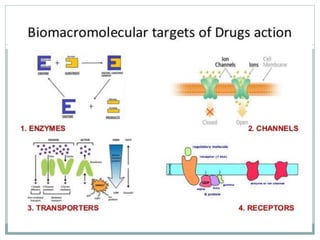
Molecular drug targets
 Hormones &neurotransmitter receptors
 Enzymes
 Carrier molecules
 Ion channels [ligand gated or voltage operated]
 Idiosyncratic targets such as metal ion, surfactant protein
etc.
 Nucleic acid
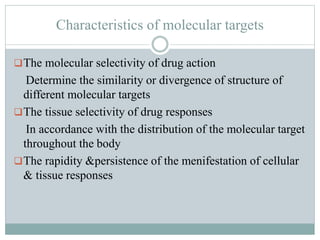
Characteristics of molecular targets
The molecular selectivity of drug action
Determine the similarity or divergence of structure of
different molecular targets
The tissue selectivity of drug responses
In accordance with the distribution of the molecular target
throughout the body
The rapidity &persistence of the menifestation of cellular
& tissue responses
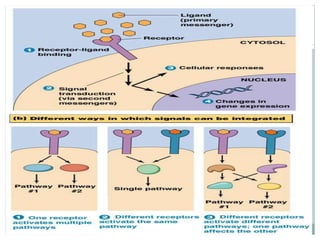
Receptors
 A protein molecular target for a drug
 The largest number of drug act through them control
effectors
 Endogenous substances & drug
Regulate cell function by altering
 Enzyme activity
 Permeability to ions
 Conformational features
 Genetic material
Receptor: it is defined as a macromolecule or binding
site located on the surface or inside the effector cell that
serves to recognize the signal molecule and initiate the
response to it but itself has no other function.
The following terms are used in describing drug
receptor interaction
Agonist
Inverse agonist
Antagonist
Partial agonist
Ligand
Nature of receptor
 Protein in nature
 Molecular weight 45-200kda
 Subunits, subtype depending on tissue
 Saturable
 Can be up & down regulated etc.
Types of receptors
 Ligand gated ion channel
 G-protein coupled receptors
 Enzyme linked receptor
 Nuclear receptors
Ion channel
Localised on the cell membrane.
Coupled directly to an ion channel.
It is a channel with a receptor site.
Agonists open the channel.
Antagonists prevent agonist from opening the channel
Inverse agonist closes an open channel
Channel properties are determined by the composition
of subunit isoforms
1. Agonist affinity
2. Ion permeability
3. Conductane properties
4. Activation and deactivation times
5. Desensitisation kinetics
 Activity can be regulated by varying composition of
different subunits
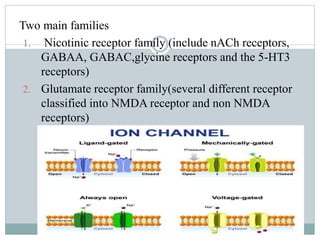
Two main families
1. Nicotinic receptor family (include nACh receptors,
GABAA, GABAC,glycine receptors and the 5-HT3
receptors)
2. Glutamate receptor family(several different receptor
classified into NMDA receptor and non NMDA
receptors)
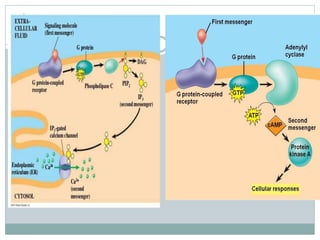
G-protein coupled receptor
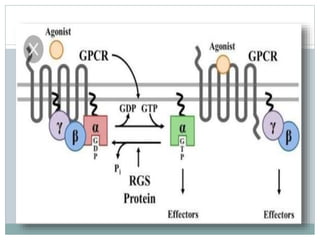
G-protein coupled receptor, also called seven
transmembrane receptor or heptahelical receptor,
located in the cell membrane that binds extracellular
substances to an intracellular molecule called a G-
protein(guanine nucleotide binding protein)
G protein coupled receptors are found only in
eukaryotes, including yeast and animals
The ligand that bind and activate these receptors include
light sensitive compounds, odors, hormones and
neurotransmitters, and vary in size from small molecule
to peptide to large protein
There are two principal signal transduction pathway
involving the G-protein coupled receptors:
1. The CAMP signal pathway: the CAMP dependent
pathway,so known as the adenylyl cyclase, is G
protein coupled receptor triggered signaling cascade
used in cell communication.
2. The phosphatidylinositol signal pathway:
phosphatidylinositol 4,5-bisphosphate is an essential
lipid involved in metabolic processes. It is integral to
the cell membrane of all animal and plant cells and
acts as a second messenger in a variety of signaling
pathway
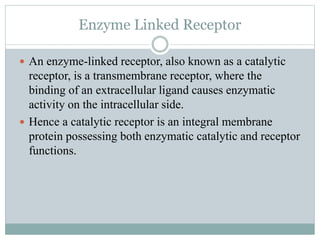
Enzyme Linked Receptor
 An enzyme-linked receptor, also known as a catalytic
receptor, is a transmembrane receptor, where the
binding of an extracellular ligand causes enzymatic
activity on the intracellular side.
 Hence a catalytic receptor is an integral membrane
protein possessing both enzymatic catalytic and receptor
functions.
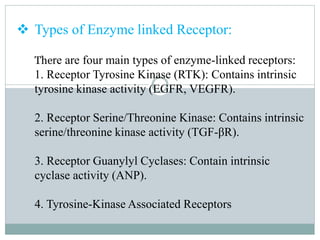
 Types of Enzyme linked Receptor:
There are four main types of enzyme-linked receptors:
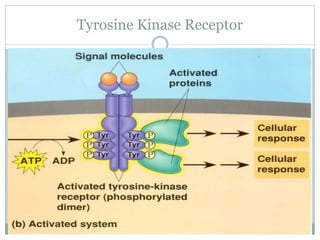
1. Receptor Tyrosine Kinase (RTK): Contains intrinsic
tyrosine kinase activity (EGFR, VEGFR).
2. Receptor Serine/Threonine Kinase: Contains intrinsic
serine/threonine kinase activity (TGF-βR).
3. Receptor Guanylyl Cyclases: Contain intrinsic
cyclase activity (ANP).
4. Tyrosine-Kinase Associated Receptors
Tyrosine Kinase Receptor
Nuclear receptor
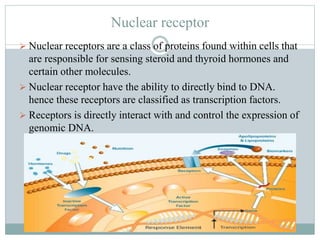
 Nuclear receptors are a class of proteins found within cells that
are responsible for sensing steroid and thyroid hormones and
certain other molecules.
 Nuclear receptor have the ability to directly bind to DNA.
hence these receptors are classified as transcription factors.
 Receptors is directly interact with and control the expression of
genomic DNA.
 JAK-STAT signaling pathway :
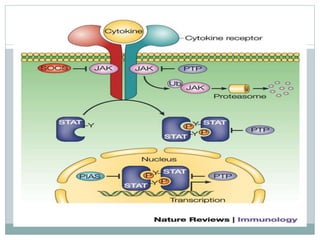
 The JAK-STAT signalling pathway is a chain of interactions
between proteins in a cell, and is involved in processes such as
immunity, cell division, cell death and tumour formation.
 The pathway communicates information from chemical signals
outside of a cell to the cell nucleus, resulting in the activation
of genes through a process called transcription.
 There are three key parts of JAK-STAT signalling: Janus
kinases (JAKs), signal transducer and activator of transcription
proteins (STATs), and receptors (which bind the chemical
signals).
 Disrupted JAK-STAT signalling may lead to a variety of
diseases, such as skin conditions, cancers, and disorders
affecting the immune system
Pharmacodynamics
Pharmacodynamics

Pharmacodynamics

  • 1.
    PRESENTED BY: SHUBHAMSHARMA M.PHARMACY 2ND SEMESTER DEPARTMENT OF PHARMACOLOGY G.H.G KHALSA COLLEGE OF PHARMACY PHARMACODYNAMICS
  • 2.
    Principle of Pharmacodynamics Pharmacodynamics (PD) is the study of the biochemical and physiologic effects of drugs (especially pharmaceutical drugs).  The effects can include those manifested within animals (including humans), microorganisms, or combinations of organisms (for example, infection).  Pharmacodynamics and pharmacokinetics are the main branches of pharmacology, being itself a topic of biology interested in the study of the interactions between both endogenous and exogenous chemical substances with living organisms.
  • 3.
    Introduction Mechanism of drugaction- • the specific biochemical interaction through which a drug substance produces its pharmacological effect • A mechanism of action usually includes mention of the specific molecular targets to which the drug binds, such as an enzyme or receptor Pharmacodynamics:  Effects of drugs and the mechanism of their action  What does a drug do and how does it do it
  • 4.
    Mechanism of drugaction Mechanism of drug action-  study of drug effects  modification of one drug‘s action by another Drugs acts in four different levels 1. molecular 2. Cellular 3. tissue 4. system
  • 5.
    Molecular drug targets Hormones &neurotransmitter receptors  Enzymes  Carrier molecules  Ion channels [ligand gated or voltage operated]  Idiosyncratic targets such as metal ion, surfactant protein etc.  Nucleic acid
  • 7.
    Characteristics of moleculartargets The molecular selectivity of drug action Determine the similarity or divergence of structure of different molecular targets The tissue selectivity of drug responses In accordance with the distribution of the molecular target throughout the body The rapidity &persistence of the menifestation of cellular & tissue responses
  • 8.
    Receptors  A proteinmolecular target for a drug  The largest number of drug act through them control effectors  Endogenous substances & drug Regulate cell function by altering  Enzyme activity  Permeability to ions  Conformational features  Genetic material
  • 10.
    Receptor: it isdefined as a macromolecule or binding site located on the surface or inside the effector cell that serves to recognize the signal molecule and initiate the response to it but itself has no other function. The following terms are used in describing drug receptor interaction Agonist Inverse agonist Antagonist Partial agonist Ligand
  • 11.
    Nature of receptor Protein in nature  Molecular weight 45-200kda  Subunits, subtype depending on tissue  Saturable  Can be up & down regulated etc.
  • 12.
    Types of receptors Ligand gated ion channel  G-protein coupled receptors  Enzyme linked receptor  Nuclear receptors Ion channel Localised on the cell membrane. Coupled directly to an ion channel. It is a channel with a receptor site. Agonists open the channel.
  • 13.
    Antagonists prevent agonistfrom opening the channel Inverse agonist closes an open channel Channel properties are determined by the composition of subunit isoforms 1. Agonist affinity 2. Ion permeability 3. Conductane properties 4. Activation and deactivation times 5. Desensitisation kinetics  Activity can be regulated by varying composition of different subunits
  • 14.
    Two main families 1.Nicotinic receptor family (include nACh receptors, GABAA, GABAC,glycine receptors and the 5-HT3 receptors) 2. Glutamate receptor family(several different receptor classified into NMDA receptor and non NMDA receptors)
  • 15.
    G-protein coupled receptor G-proteincoupled receptor, also called seven transmembrane receptor or heptahelical receptor, located in the cell membrane that binds extracellular substances to an intracellular molecule called a G- protein(guanine nucleotide binding protein) G protein coupled receptors are found only in eukaryotes, including yeast and animals The ligand that bind and activate these receptors include light sensitive compounds, odors, hormones and neurotransmitters, and vary in size from small molecule to peptide to large protein
  • 17.
    There are twoprincipal signal transduction pathway involving the G-protein coupled receptors: 1. The CAMP signal pathway: the CAMP dependent pathway,so known as the adenylyl cyclase, is G protein coupled receptor triggered signaling cascade used in cell communication. 2. The phosphatidylinositol signal pathway: phosphatidylinositol 4,5-bisphosphate is an essential lipid involved in metabolic processes. It is integral to the cell membrane of all animal and plant cells and acts as a second messenger in a variety of signaling pathway
  • 19.
    Enzyme Linked Receptor An enzyme-linked receptor, also known as a catalytic receptor, is a transmembrane receptor, where the binding of an extracellular ligand causes enzymatic activity on the intracellular side.  Hence a catalytic receptor is an integral membrane protein possessing both enzymatic catalytic and receptor functions.
  • 20.
     Types ofEnzyme linked Receptor: There are four main types of enzyme-linked receptors: 1. Receptor Tyrosine Kinase (RTK): Contains intrinsic tyrosine kinase activity (EGFR, VEGFR). 2. Receptor Serine/Threonine Kinase: Contains intrinsic serine/threonine kinase activity (TGF-βR). 3. Receptor Guanylyl Cyclases: Contain intrinsic cyclase activity (ANP). 4. Tyrosine-Kinase Associated Receptors
  • 21.
  • 22.
    Nuclear receptor  Nuclearreceptors are a class of proteins found within cells that are responsible for sensing steroid and thyroid hormones and certain other molecules.  Nuclear receptor have the ability to directly bind to DNA. hence these receptors are classified as transcription factors.  Receptors is directly interact with and control the expression of genomic DNA.
  • 23.
     JAK-STAT signalingpathway :  The JAK-STAT signalling pathway is a chain of interactions between proteins in a cell, and is involved in processes such as immunity, cell division, cell death and tumour formation.  The pathway communicates information from chemical signals outside of a cell to the cell nucleus, resulting in the activation of genes through a process called transcription.  There are three key parts of JAK-STAT signalling: Janus kinases (JAKs), signal transducer and activator of transcription proteins (STATs), and receptors (which bind the chemical signals).  Disrupted JAK-STAT signalling may lead to a variety of diseases, such as skin conditions, cancers, and disorders affecting the immune system