Submitted by:
T. Sri Teja
B. Pharmacy (IV/IV)
Guided by:
P. N. Subrahmanyeswari., M.Pharm
Department of Pharmacology
Vignan Pharmacy College
Vadlamudi, Guntur (Dst), Andhra Pradesh, India ,
Pin : 522213 1
Contents
Vignan Pharmacy College, Vadlamudi, Guntur, A.P. 2
S.NO Table of contents Slide Number
1. Introduction 3
2. Protein Targets for Drug Binding 4
3. Ion Channels 5-6
4. Enzymes 7-8
5. Carrier Molecules 9-10
6. Receptors 11
History 12-14
7. Drug Receptor Interactions 15
8. Classification Of receptors 16-33
9. Conclusion 34
10. References 35
11. Acknowledgement 37
Introduction (3)
(Targets for
drug binding)
Drug or
medicament
No therapeutic
response
Shows
therapeutic
response
3Vignan Pharmacy College, Vadlamudi, Guntur, A.P.
Protein Targets for Drug Binding (1,2)
Protein targets
4Vignan Pharmacy College, Vadlamudi, Guntur, A.P.
Ion Channels (1,2)
 Type of protein targets open only when agonist binds to receptors.
 Ex:
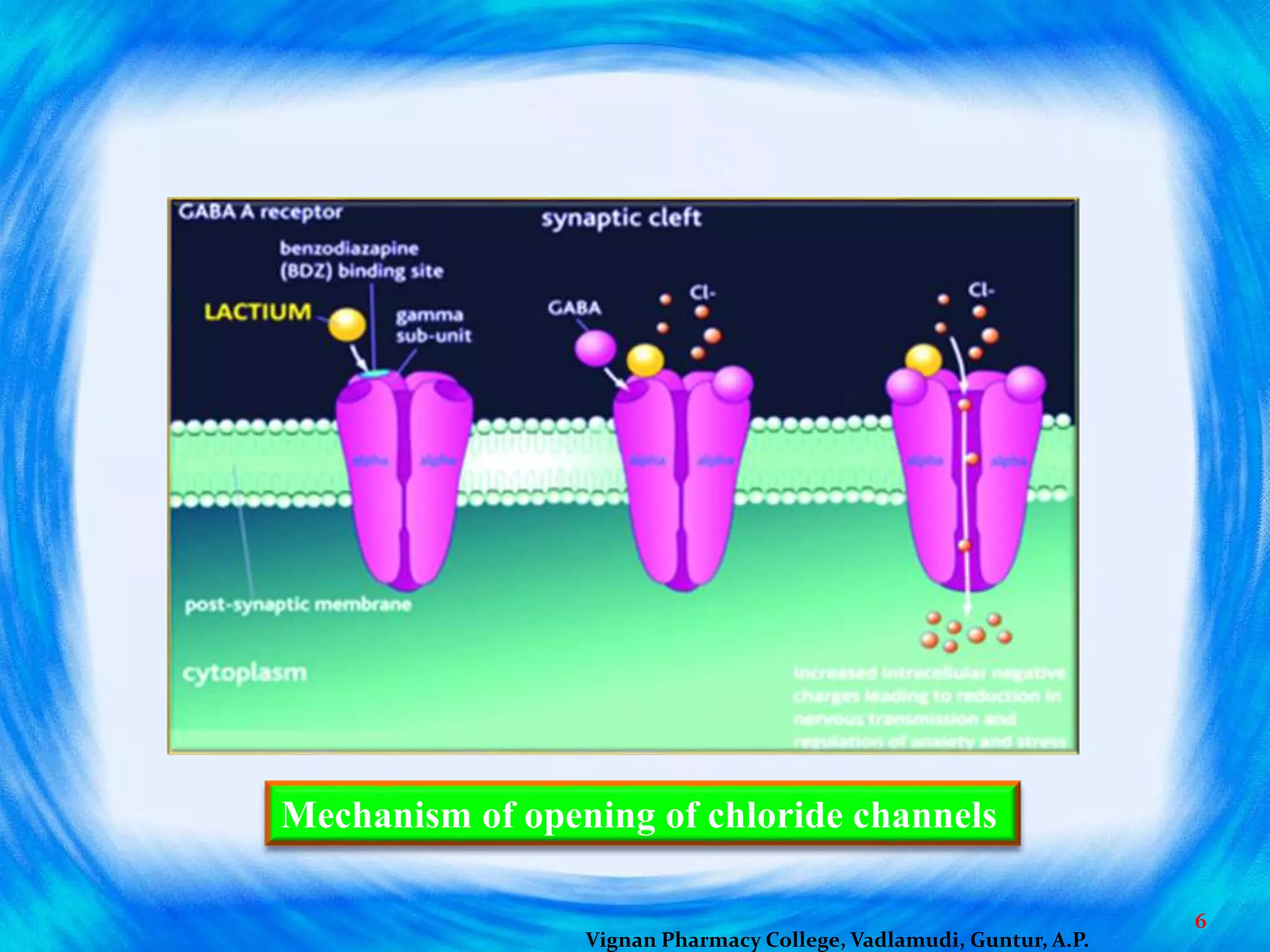
Benzodiazepine Tranquillizers Binds to GABA receptors
Opens chloride channel
Hyper polarisation
5
Vignan Pharmacy College, Vadlamudi, Guntur, A.P.
Mechanism of opening of chloride channels
6
Vignan Pharmacy College, Vadlamudi, Guntur, A.P.
Enzymes (1,3)
 Many drugs are targeted on enzymes.
Ex:
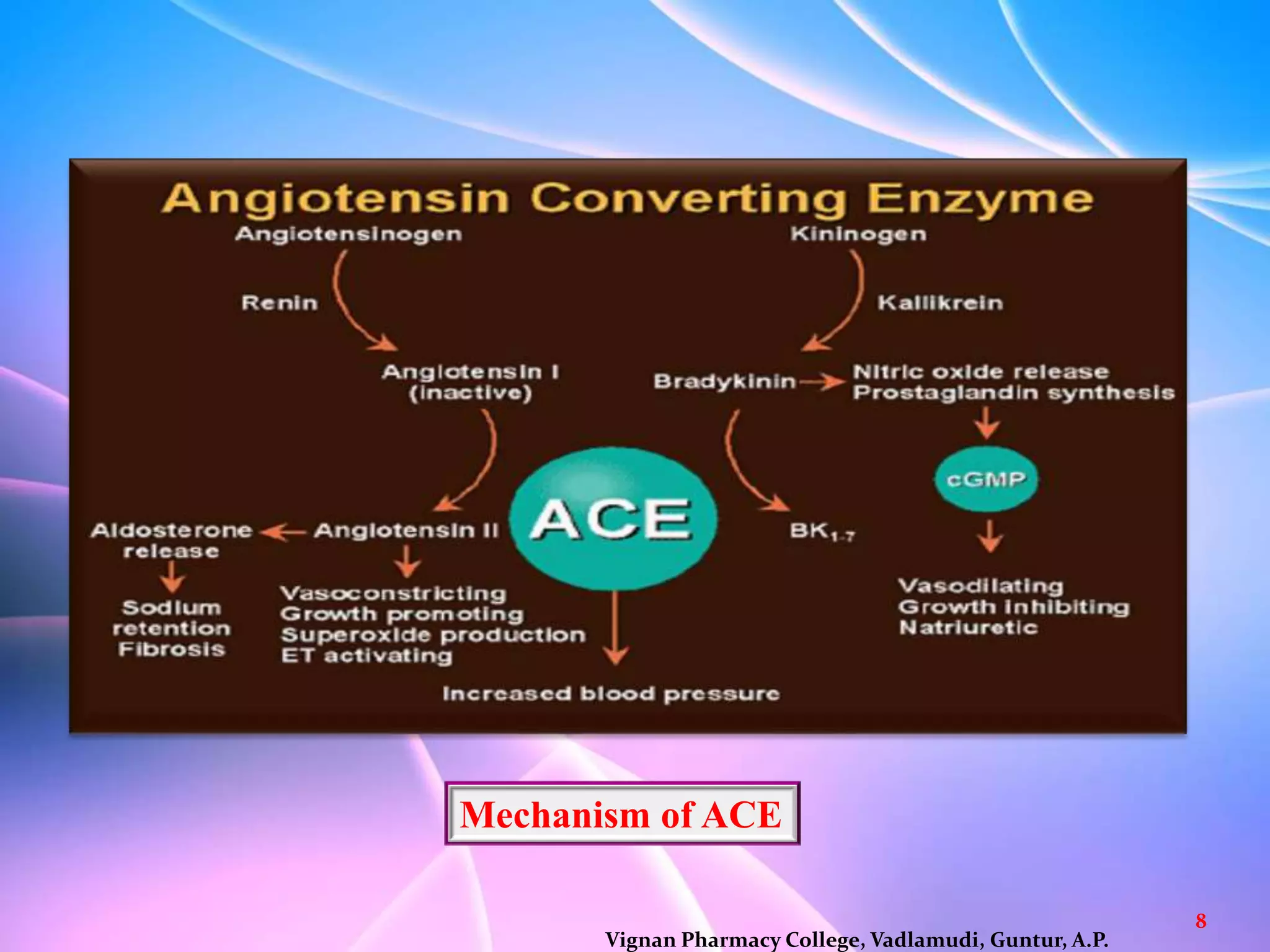
Captopril Acts on Angiotensin Converting Enzyme(ACE)
7
Vignan Pharmacy College, Vadlamudi, Guntur, A.P.
Mechanism of ACE
8
Vignan Pharmacy College, Vadlamudi, Guntur, A.P.
Carrier Molecules (1,3)
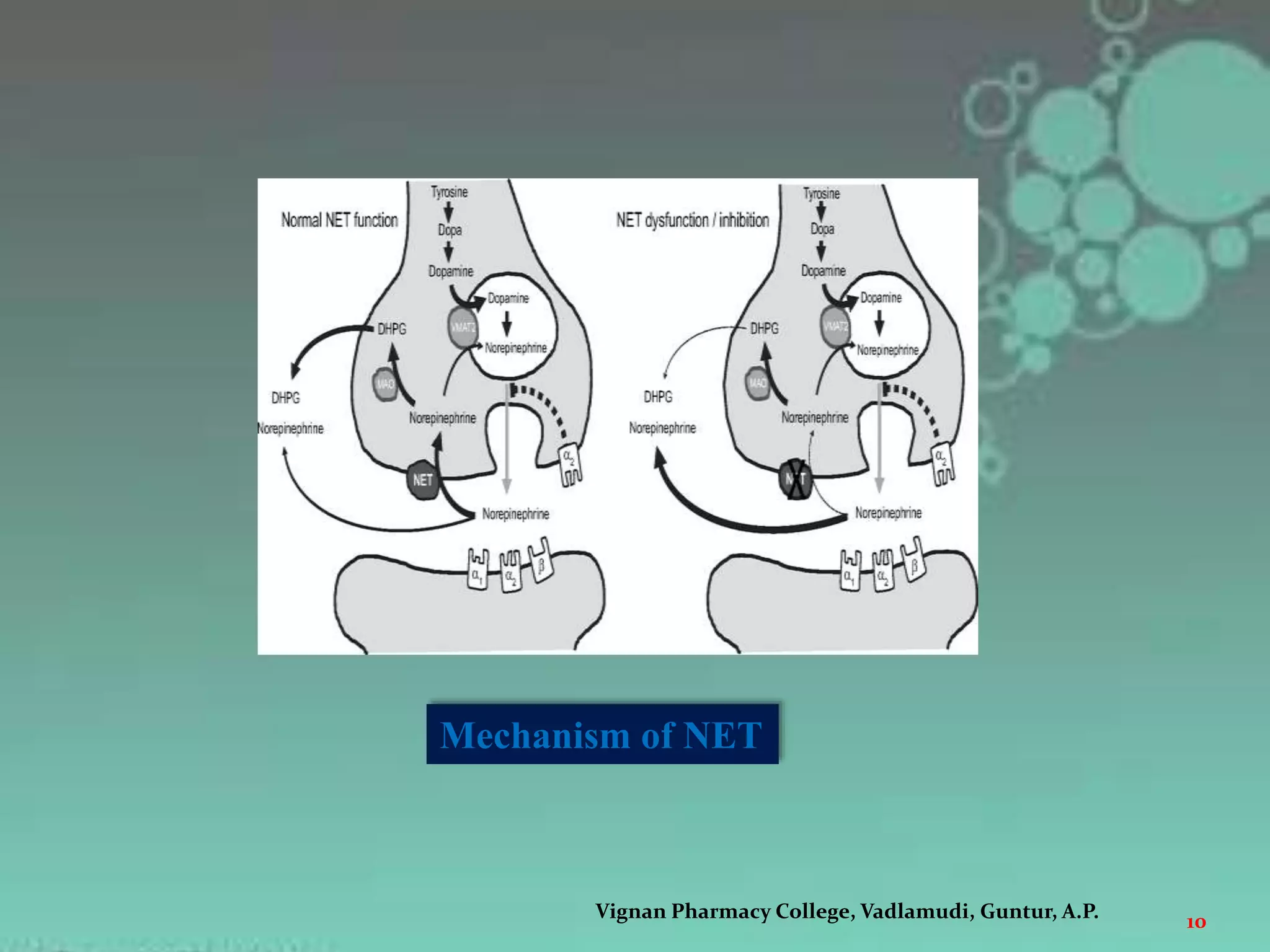
 These are also called Transporters.
 As cell membrane is lipophillic, it requires some carriers to facilitate
the transport of ions, organic molecules etc. across the membrane.
Ex:
Nor epinephrine Transporter(NET)
9Vignan Pharmacy College, Vadlamudi, Guntur, A.P.
Mechanism of NET
10Vignan Pharmacy College, Vadlamudi, Guntur, A.P.
Receptors (1,3)
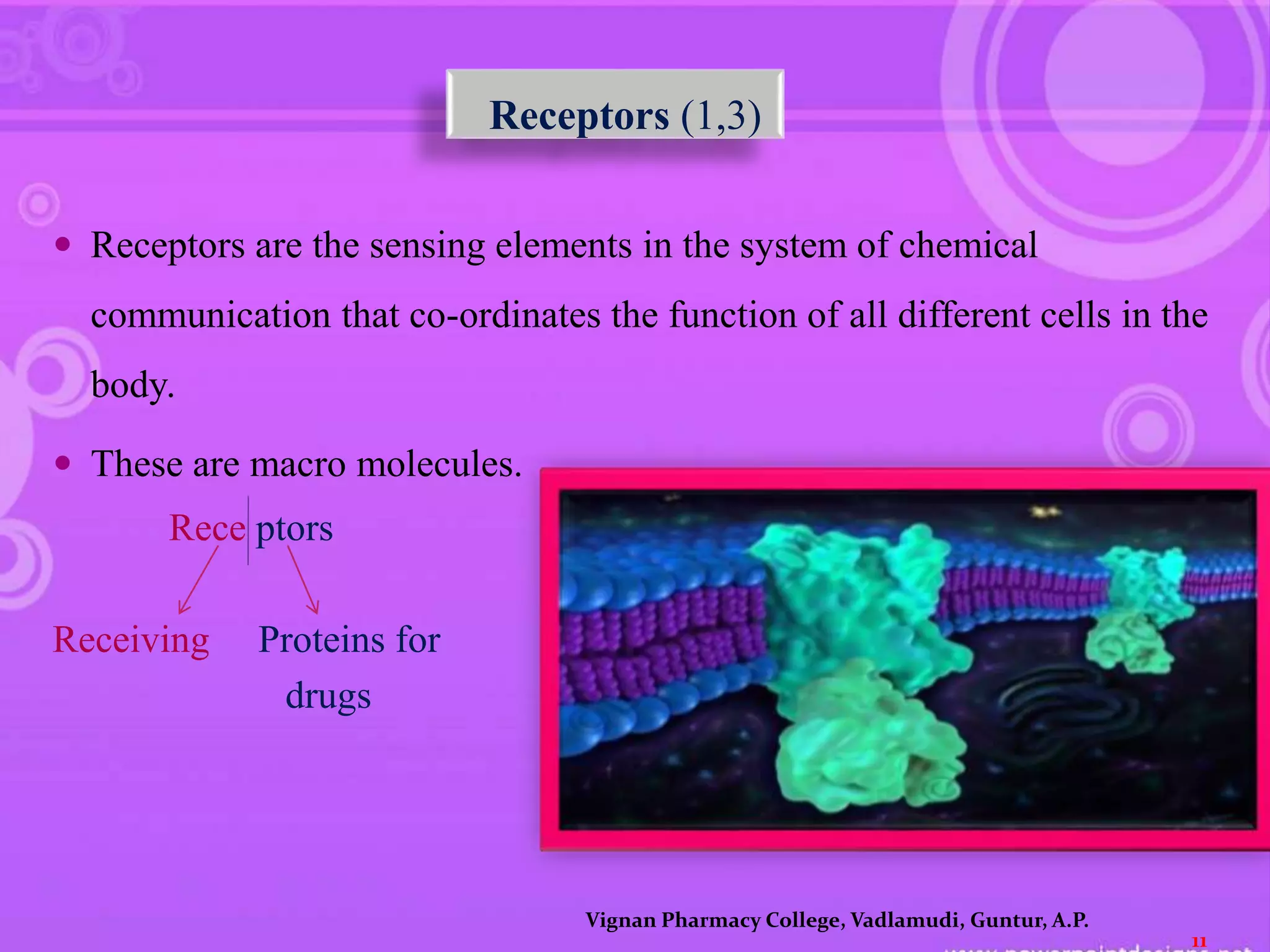
 Receptors are the sensing elements in the system of chemical
communication that co-ordinates the function of all different cells in the
body.
 These are macro molecules.
Rece ptors
Receiving Proteins for
drugs
11
Vignan Pharmacy College, Vadlamudi, Guntur, A.P.
History (1,2)
 Paul Ehrlich – 20th century
 John N. Langley- 1878, antagonism of Atropine
and pilocarpine.
 1970- Development of Receptor-labelling techniques, helped to extract and
purify the receptor material (nicotinic R).
 Extraction is done in 2 methods:
A. From electric organs of many fishes.
B. From venom of snakes of cobra family.
Extracted α-toxins
(Best is α-Bungarotoxin - Bungarus multicinctus)
12
Vignan Pharmacy College, Vadlamudi, Guntur, A.P.
Postulates of Receptor Theory (2)
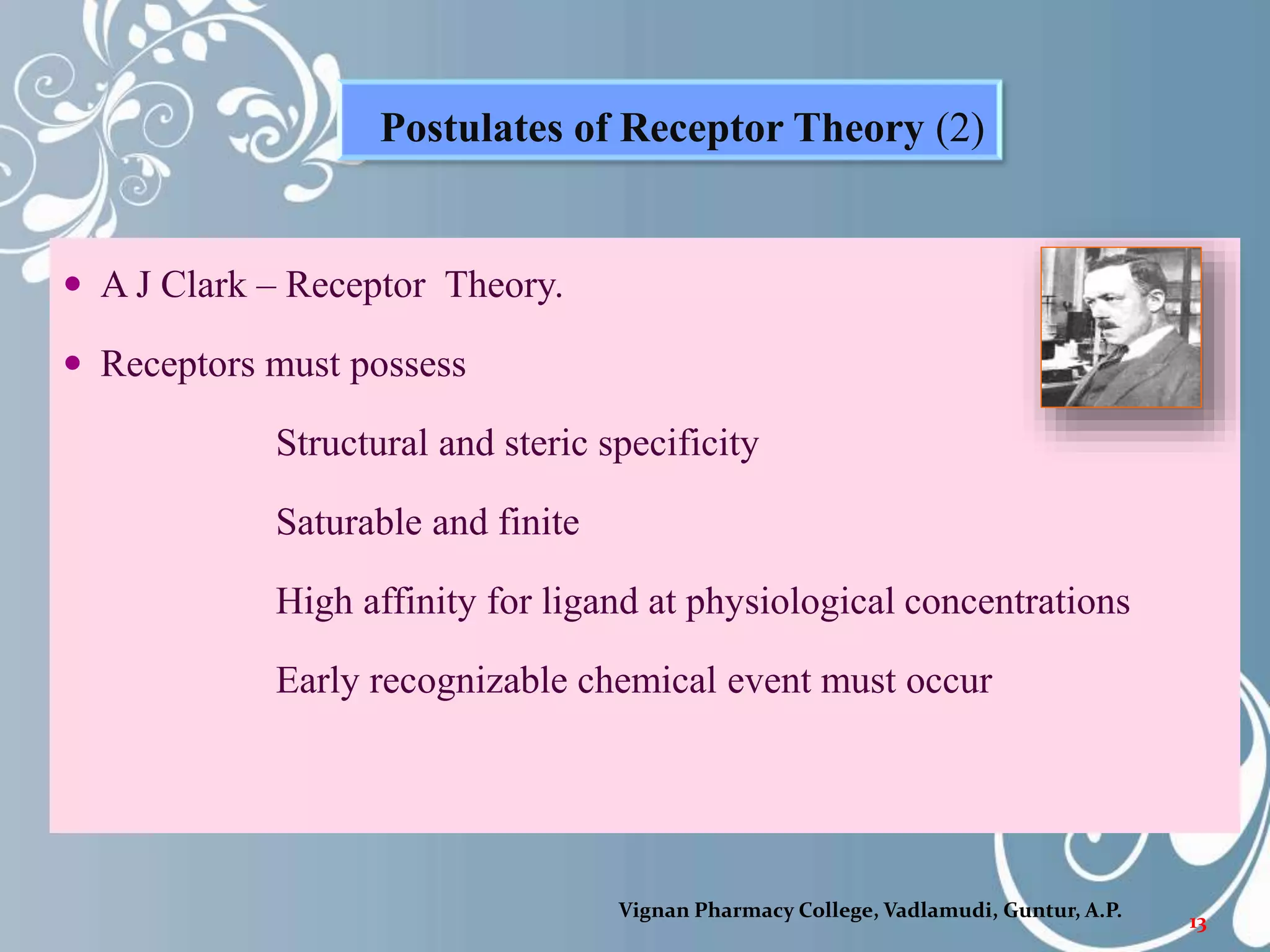
 A J Clark – Receptor Theory.
 Receptors must possess
Structural and steric specificity
Saturable and finite
High affinity for ligand at physiological concentrations
Early recognizable chemical event must occur
13
Vignan Pharmacy College, Vadlamudi, Guntur, A.P.
Lock and Key Mechanism of Receptors
14Vignan Pharmacy College, Vadlamudi, Guntur, A.P.
Drug-Receptor Interactions (1)
 Affinity: Ability of an agent to bind with the receptors.
 Efficacy or Intrinsic Activity: Ability of an agent to activate the
receptors and produce pharmacological action.
 Agonist: Affinity + Maximum Intrinsic activity [I.A = +1]
 Antagonist: Affinity + No Intrinsic activity [I.A = 0]
 Inverse Agonist: Affinity + Negative Intrinsic activity [I .A = -1]
 Partial Agonist: Affinity + Sub max. Intrinsic activity [I.A = 0.1-0.9]
15Vignan Pharmacy College, Vadlamudi, Guntur, A.P.
Classification of receptors (1)
Based on
molecular
structure and the
nature of the
linkage
Receptor are
distinguished
into 4 super
families
Ligand-
gated ion
channels
G-protein
coupled
receptors
Kinase
linked
receptors
Nuclear
receptors
16Vignan Pharmacy College, Vadlamudi, Guntur, A.P.
Ligand-Gated Ion Channels (Ionotropic Receptors) (1,3,4)
Structure
• Pentameric Structure,
contains 2α, β, γ, δ subunits.
• 2 Acetylcholine binding
sites between interface one
of 2α subunits.
•2 α helices are present
which are responsible for
formation of gate
•Molecular weight of each
subunit is 40-58 KDa. 17
Vignan Pharmacy College, Vadlamudi, Guntur, A.P.
Mechanism of action
Depolarisation (or) Hyper polarisation
Cellular effects
Agonist
Channel opensMovement of ions
18Vignan Pharmacy College, Vadlamudi, Guntur, A.P.
19Vignan Pharmacy College, Vadlamudi, Guntur, A.P.
Ions
Extracellular ions
Na, Ca, Cl
Intracellular ions
K
Ions In/Efflux Response Example
Sodium Influx Stimulation Lidocaine
Calcium Influx Stimulation Nifedipine
Chloride Influx Inhibition Benzodiazepines
Potassium Efflux Inhibition Diazoxide
20
Vignan Pharmacy College, Vadlamudi, Guntur, A.P.
Table:1
G-Protein Coupled Receptors (1,3,4)
 Structure:
 Single polypeptide
chain containing
Residues.
 7-Transmembrane
α- helices
 It contains:
N-Terminal Domain(Extra cellular)
C- Terminal Domain(Intra cellular)
2 agonist binding domains, 1 G-Protein binding domain
21Vignan Pharmacy College, Vadlamudi, Guntur, A.P.
G-Protein (1,3)
α+GDP & βγ Dimers
Agonist binds
Phosphorylation
GTP formation
Dimer shows action
Agonist leaves
Conversion of GTP to GDP
22
Vignan Pharmacy College, Vadlamudi, Guntur, A.P.
23Vignan Pharmacy College, Vadlamudi, Guntur, A.P.
Adenylate Cyclase pathway
ATP
cAMP Protein Kinase(Inactive) Protein Kinase(Active)
Lipase(IA)
ATP
ADP
Lipase (A)
Glycogen Synthase(A)
ATP
ADP
Glycogen Synthase(IA)
Phosphorylase Kinase(IA)
ATP
ADP
Phosphorylase Kinase(A)
Phosphorylase b(IA)
ATP
ADP
Phosphorylase a(A)
Reduced Glycogen
synthesis
Increased
Lipolysis
Glycogen moieties(IA)
ATP
ADP
Glucose-1-phosphate
Increased glycogen breakdown
24Vignan Pharmacy College, Vadlamudi, Guntur, A.P.
Phosphodiesterase
Adenylate
Cyclase
Phospholipase C Pathway (1)
25Vignan Pharmacy College, Vadlamudi, Guntur, A.P.
Location Receptor Shows Action
on
Inhibition/
Stimulation
Pharmacological
Action
Cardiac
Muscle
Gs Adenylate
Cyclase
Stimulation Increase Cardiac
output
Bronchi Gs Adenylate
Cyclase
Stimulation Relaxation &
bronchodilation
Heart Gi Adenylate
Cyclase
Inhibition Decrease force of
contraction
Uterus Gi Adenylate
Cyclase
Inhibition Contraction
Glands Gq Phospholipase C Stimulation Increase Secretions
Small
Intestine
Gq Phospholipase C Stimulation Contraction
(Motility of S.I)
26Vignan Pharmacy College, Vadlamudi, Guntur, A.P.Table:2
Kinase Linked Receptors (or) Enzymatic Receptors (1)
Structure:
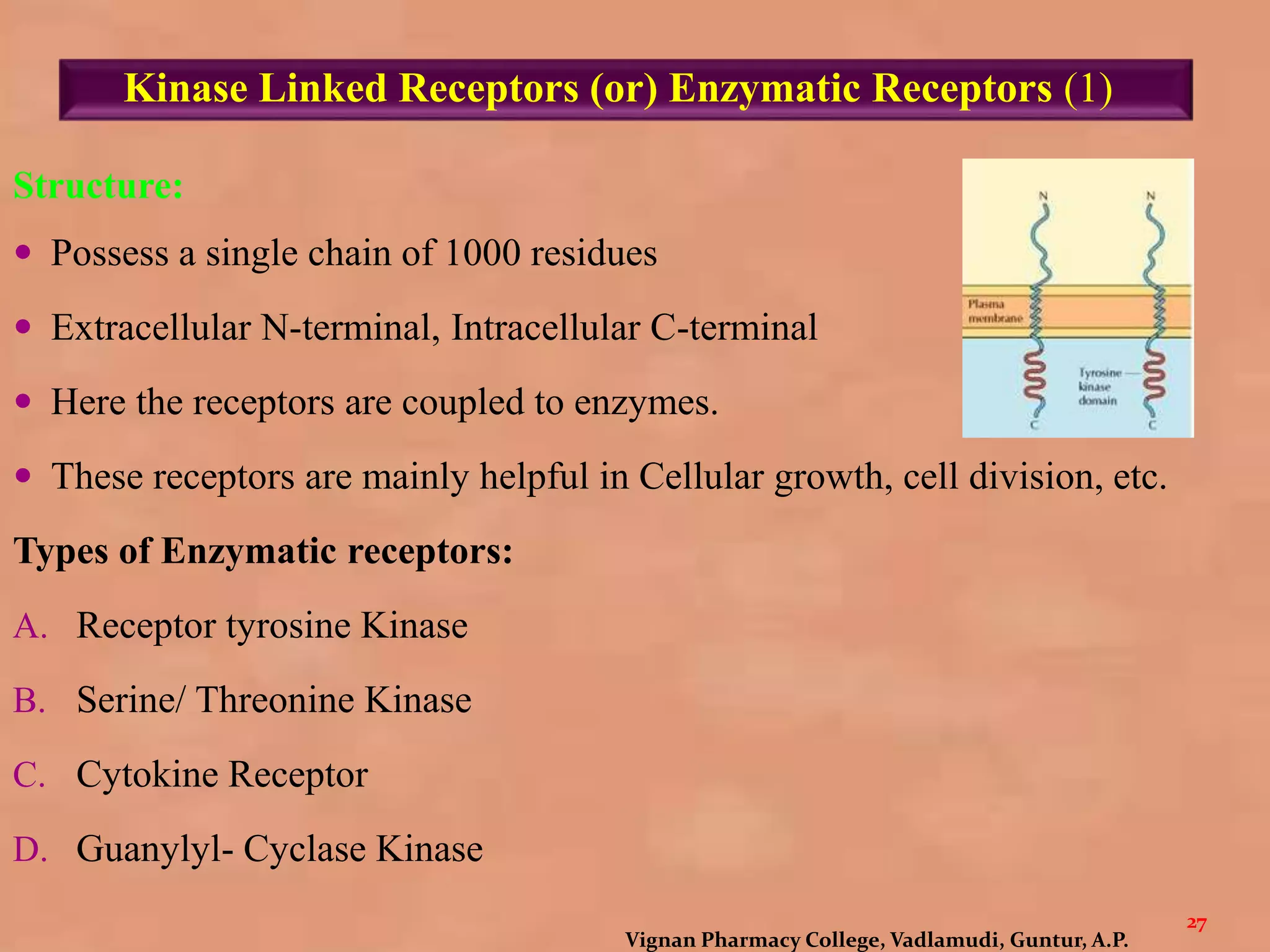
 Possess a single chain of 1000 residues
 Extracellular N-terminal, Intracellular C-terminal
 Here the receptors are coupled to enzymes.
 These receptors are mainly helpful in Cellular growth, cell division, etc.
Types of Enzymatic receptors:
A. Receptor tyrosine Kinase
B. Serine/ Threonine Kinase
C. Cytokine Receptor
D. Guanylyl- Cyclase Kinase
27
Vignan Pharmacy College, Vadlamudi, Guntur, A.P.
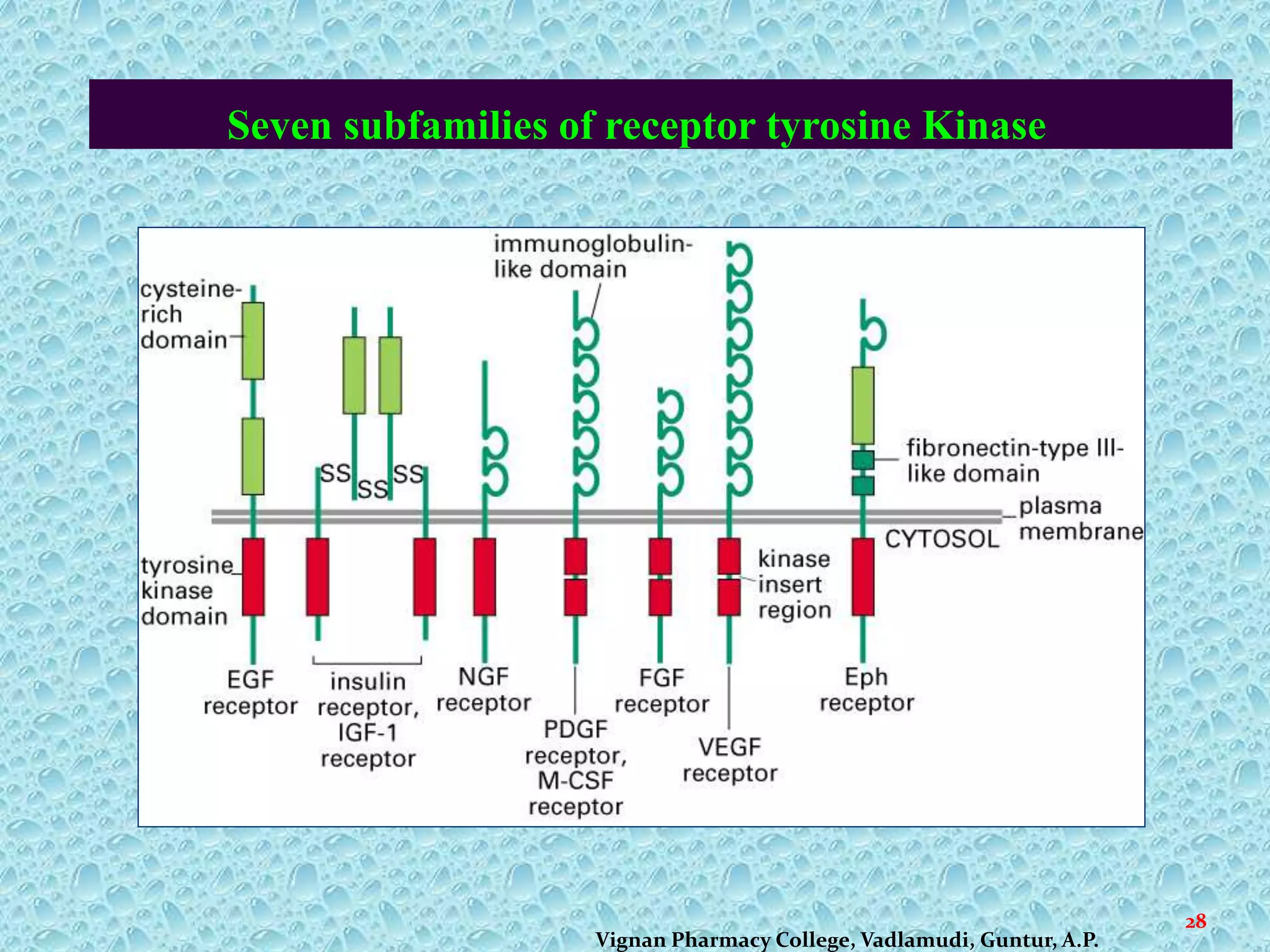
Seven subfamilies of receptor tyrosine Kinase
28
Vignan Pharmacy College, Vadlamudi, Guntur, A.P.
Mechanism of receptor Tyrosine Pathway (1)
1) Binding of Ligand
2) Dimerisation
of reseptor
-OH -OH -OHTyr kinase
domain
(Janus kinase)
Phosphoryl of Tyr
O P O P
STATS
protein
O P O P STATS
protein 1) Phosphoryl. of STAT
2) Release of STAT in cytoplasma
3) STATto cell nucleus
4) Intitation of transcription
Ras
GDP
GTP
Ref
P
Mek
P
Map Kinase
P
Various Transcription
factors
P
Gene Transcription
29
Vignan Pharmacy College, Vadlamudi, Guntur, A.P.
Mechanism of Cytokine Receptors (JAK/STAT Pathway) (1)
30
Vignan Pharmacy College, Vadlamudi, Guntur, A.P.
Nuclear Receptors (3)
Structure:
31
Vignan Pharmacy College, Vadlamudi, Guntur, A.P.
• Intracellular Receptors
• Transcription Factors
transduce the signals
by modifying
Gene Transcription
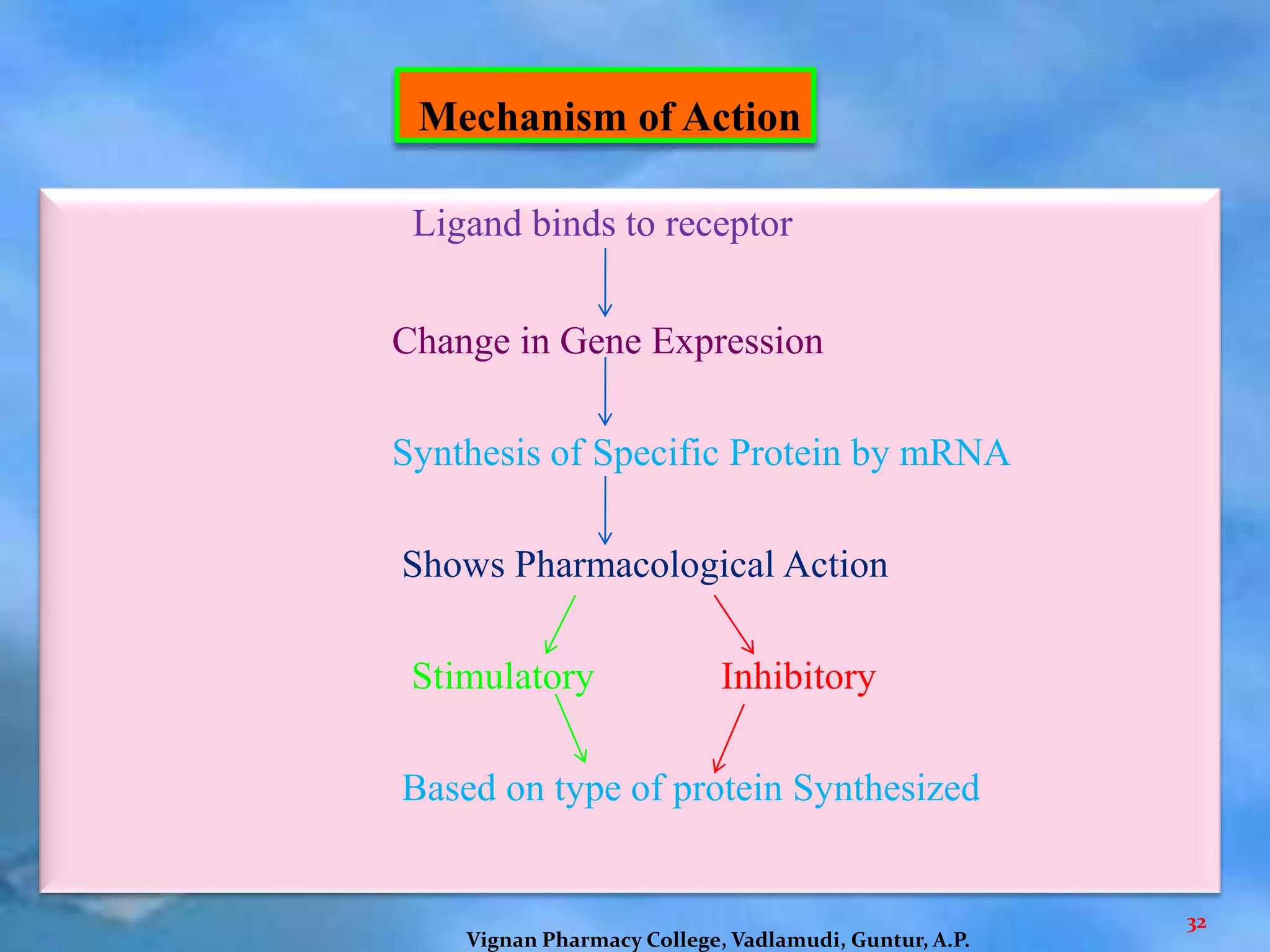
Mechanism of Action
Ligand binds to receptor
Change in Gene Expression
Synthesis of Specific Protein by mRNA
Shows Pharmacological Action
Stimulatory Inhibitory
Based on type of protein Synthesized
32
Vignan Pharmacy College, Vadlamudi, Guntur, A.P.
Name of the Receptors Examples
Ligand Gated Ion Channels Nicotinic AcH Receptors
GABA Receptors
NMDA Type of glutamate Receptors
G- Protein Coupled
Receptors
Muscarnic AcH Receptors
Adreno Receptors
Opiate Receptors
Kinase Linked Receptors Growth Factors
Cytokines
Hormones like Insulin, Leptin
Nuclear Receptors Steroidal Receptors
Aldosterone Receptors
Vignan Pharmacy College, Vadlamudi, Guntur, A.P.
33
Conclusion
 Extensive research done on receptor pharmacology lead to discovery
of new drug targets for treatment of several diseases.
 Still requires discovery of new receptor types and mechanism of
many orphan receptors that can result in effective treatment of many
diseases.
 Requires development of receptor crystallization.
 Must to be discovered about the nuclear receptors.
Vignan Pharmacy College, Vadlamudi, Guntur, A.P. 34
References:
 Rang and Dale; Pharmacology; Pg.no: 20-22, 24-52
 Dr. S. S. Kadam; Principles of Medicinal Chemistry; Pg.no: 43-44
 KD. Tripathi; Essentials Of Medical Pharmacology; Pg.no: 37-60
 Wilson And Griswold; Text Book of Organic, Medicinal And
Pharmaceutical Chemistry pg.no; 524-545, 548-580
35
Vignan Pharmacy College, Vadlamudi, Guntur, A.P.
36
ANY QUIRIES ?????
Vignan Pharmacy College, Vadlamudi, Guntur dist. A.P. 37
 I would like to express my gratitude to all those who gave me the
possibility to complete this seminar .
 I express my sincere gratitude to my guide P.N.Subrahmanyeswari
madam, who suggested with great patience.
 A special thanks to the Principal sir, Dr. P. Srinivasa Babu garu
and special thanks to Sowjanya madam and seminar committee
whose encouragement contributed immensely to complete my
seminar.
Vignan Pharmacy College, Vadlamudi, Guntur, A.P.
38

Receptors

  • 1.
    Submitted by: T. SriTeja B. Pharmacy (IV/IV) Guided by: P. N. Subrahmanyeswari., M.Pharm Department of Pharmacology Vignan Pharmacy College Vadlamudi, Guntur (Dst), Andhra Pradesh, India , Pin : 522213 1
  • 2.
    Contents Vignan Pharmacy College,Vadlamudi, Guntur, A.P. 2 S.NO Table of contents Slide Number 1. Introduction 3 2. Protein Targets for Drug Binding 4 3. Ion Channels 5-6 4. Enzymes 7-8 5. Carrier Molecules 9-10 6. Receptors 11 History 12-14 7. Drug Receptor Interactions 15 8. Classification Of receptors 16-33 9. Conclusion 34 10. References 35 11. Acknowledgement 37
  • 3.
    Introduction (3) (Targets for drugbinding) Drug or medicament No therapeutic response Shows therapeutic response 3Vignan Pharmacy College, Vadlamudi, Guntur, A.P.
  • 4.
    Protein Targets forDrug Binding (1,2) Protein targets 4Vignan Pharmacy College, Vadlamudi, Guntur, A.P.
  • 5.
    Ion Channels (1,2) Type of protein targets open only when agonist binds to receptors.  Ex: Benzodiazepine Tranquillizers Binds to GABA receptors Opens chloride channel Hyper polarisation 5 Vignan Pharmacy College, Vadlamudi, Guntur, A.P.
  • 6.
    Mechanism of openingof chloride channels 6 Vignan Pharmacy College, Vadlamudi, Guntur, A.P.
  • 7.
    Enzymes (1,3)  Manydrugs are targeted on enzymes. Ex: Captopril Acts on Angiotensin Converting Enzyme(ACE) 7 Vignan Pharmacy College, Vadlamudi, Guntur, A.P.
  • 8.
    Mechanism of ACE 8 VignanPharmacy College, Vadlamudi, Guntur, A.P.
  • 9.
    Carrier Molecules (1,3) These are also called Transporters.  As cell membrane is lipophillic, it requires some carriers to facilitate the transport of ions, organic molecules etc. across the membrane. Ex: Nor epinephrine Transporter(NET) 9Vignan Pharmacy College, Vadlamudi, Guntur, A.P.
  • 10.
    Mechanism of NET 10VignanPharmacy College, Vadlamudi, Guntur, A.P.
  • 11.
    Receptors (1,3)  Receptorsare the sensing elements in the system of chemical communication that co-ordinates the function of all different cells in the body.  These are macro molecules. Rece ptors Receiving Proteins for drugs 11 Vignan Pharmacy College, Vadlamudi, Guntur, A.P.
  • 12.
    History (1,2)  PaulEhrlich – 20th century  John N. Langley- 1878, antagonism of Atropine and pilocarpine.  1970- Development of Receptor-labelling techniques, helped to extract and purify the receptor material (nicotinic R).  Extraction is done in 2 methods: A. From electric organs of many fishes. B. From venom of snakes of cobra family. Extracted α-toxins (Best is α-Bungarotoxin - Bungarus multicinctus) 12 Vignan Pharmacy College, Vadlamudi, Guntur, A.P.
  • 13.
    Postulates of ReceptorTheory (2)  A J Clark – Receptor Theory.  Receptors must possess Structural and steric specificity Saturable and finite High affinity for ligand at physiological concentrations Early recognizable chemical event must occur 13 Vignan Pharmacy College, Vadlamudi, Guntur, A.P.
  • 14.
    Lock and KeyMechanism of Receptors 14Vignan Pharmacy College, Vadlamudi, Guntur, A.P.
  • 15.
    Drug-Receptor Interactions (1) Affinity: Ability of an agent to bind with the receptors.  Efficacy or Intrinsic Activity: Ability of an agent to activate the receptors and produce pharmacological action.  Agonist: Affinity + Maximum Intrinsic activity [I.A = +1]  Antagonist: Affinity + No Intrinsic activity [I.A = 0]  Inverse Agonist: Affinity + Negative Intrinsic activity [I .A = -1]  Partial Agonist: Affinity + Sub max. Intrinsic activity [I.A = 0.1-0.9] 15Vignan Pharmacy College, Vadlamudi, Guntur, A.P.
  • 16.
    Classification of receptors(1) Based on molecular structure and the nature of the linkage Receptor are distinguished into 4 super families Ligand- gated ion channels G-protein coupled receptors Kinase linked receptors Nuclear receptors 16Vignan Pharmacy College, Vadlamudi, Guntur, A.P.
  • 17.
    Ligand-Gated Ion Channels(Ionotropic Receptors) (1,3,4) Structure • Pentameric Structure, contains 2α, β, γ, δ subunits. • 2 Acetylcholine binding sites between interface one of 2α subunits. •2 α helices are present which are responsible for formation of gate •Molecular weight of each subunit is 40-58 KDa. 17 Vignan Pharmacy College, Vadlamudi, Guntur, A.P.
  • 18.
    Mechanism of action Depolarisation(or) Hyper polarisation Cellular effects Agonist Channel opensMovement of ions 18Vignan Pharmacy College, Vadlamudi, Guntur, A.P.
  • 19.
    19Vignan Pharmacy College,Vadlamudi, Guntur, A.P.
  • 20.
    Ions Extracellular ions Na, Ca,Cl Intracellular ions K Ions In/Efflux Response Example Sodium Influx Stimulation Lidocaine Calcium Influx Stimulation Nifedipine Chloride Influx Inhibition Benzodiazepines Potassium Efflux Inhibition Diazoxide 20 Vignan Pharmacy College, Vadlamudi, Guntur, A.P. Table:1
  • 21.
    G-Protein Coupled Receptors(1,3,4)  Structure:  Single polypeptide chain containing Residues.  7-Transmembrane α- helices  It contains: N-Terminal Domain(Extra cellular) C- Terminal Domain(Intra cellular) 2 agonist binding domains, 1 G-Protein binding domain 21Vignan Pharmacy College, Vadlamudi, Guntur, A.P.
  • 22.
    G-Protein (1,3) α+GDP &βγ Dimers Agonist binds Phosphorylation GTP formation Dimer shows action Agonist leaves Conversion of GTP to GDP 22 Vignan Pharmacy College, Vadlamudi, Guntur, A.P.
  • 23.
    23Vignan Pharmacy College,Vadlamudi, Guntur, A.P.
  • 24.
    Adenylate Cyclase pathway ATP cAMPProtein Kinase(Inactive) Protein Kinase(Active) Lipase(IA) ATP ADP Lipase (A) Glycogen Synthase(A) ATP ADP Glycogen Synthase(IA) Phosphorylase Kinase(IA) ATP ADP Phosphorylase Kinase(A) Phosphorylase b(IA) ATP ADP Phosphorylase a(A) Reduced Glycogen synthesis Increased Lipolysis Glycogen moieties(IA) ATP ADP Glucose-1-phosphate Increased glycogen breakdown 24Vignan Pharmacy College, Vadlamudi, Guntur, A.P. Phosphodiesterase Adenylate Cyclase
  • 25.
    Phospholipase C Pathway(1) 25Vignan Pharmacy College, Vadlamudi, Guntur, A.P.
  • 26.
    Location Receptor ShowsAction on Inhibition/ Stimulation Pharmacological Action Cardiac Muscle Gs Adenylate Cyclase Stimulation Increase Cardiac output Bronchi Gs Adenylate Cyclase Stimulation Relaxation & bronchodilation Heart Gi Adenylate Cyclase Inhibition Decrease force of contraction Uterus Gi Adenylate Cyclase Inhibition Contraction Glands Gq Phospholipase C Stimulation Increase Secretions Small Intestine Gq Phospholipase C Stimulation Contraction (Motility of S.I) 26Vignan Pharmacy College, Vadlamudi, Guntur, A.P.Table:2
  • 27.
    Kinase Linked Receptors(or) Enzymatic Receptors (1) Structure:  Possess a single chain of 1000 residues  Extracellular N-terminal, Intracellular C-terminal  Here the receptors are coupled to enzymes.  These receptors are mainly helpful in Cellular growth, cell division, etc. Types of Enzymatic receptors: A. Receptor tyrosine Kinase B. Serine/ Threonine Kinase C. Cytokine Receptor D. Guanylyl- Cyclase Kinase 27 Vignan Pharmacy College, Vadlamudi, Guntur, A.P.
  • 28.
    Seven subfamilies ofreceptor tyrosine Kinase 28 Vignan Pharmacy College, Vadlamudi, Guntur, A.P.
  • 29.
    Mechanism of receptorTyrosine Pathway (1) 1) Binding of Ligand 2) Dimerisation of reseptor -OH -OH -OHTyr kinase domain (Janus kinase) Phosphoryl of Tyr O P O P STATS protein O P O P STATS protein 1) Phosphoryl. of STAT 2) Release of STAT in cytoplasma 3) STATto cell nucleus 4) Intitation of transcription Ras GDP GTP Ref P Mek P Map Kinase P Various Transcription factors P Gene Transcription 29 Vignan Pharmacy College, Vadlamudi, Guntur, A.P.
  • 30.
    Mechanism of CytokineReceptors (JAK/STAT Pathway) (1) 30 Vignan Pharmacy College, Vadlamudi, Guntur, A.P.
  • 31.
    Nuclear Receptors (3) Structure: 31 VignanPharmacy College, Vadlamudi, Guntur, A.P. • Intracellular Receptors • Transcription Factors transduce the signals by modifying Gene Transcription
  • 32.
    Mechanism of Action Ligandbinds to receptor Change in Gene Expression Synthesis of Specific Protein by mRNA Shows Pharmacological Action Stimulatory Inhibitory Based on type of protein Synthesized 32 Vignan Pharmacy College, Vadlamudi, Guntur, A.P.
  • 33.
    Name of theReceptors Examples Ligand Gated Ion Channels Nicotinic AcH Receptors GABA Receptors NMDA Type of glutamate Receptors G- Protein Coupled Receptors Muscarnic AcH Receptors Adreno Receptors Opiate Receptors Kinase Linked Receptors Growth Factors Cytokines Hormones like Insulin, Leptin Nuclear Receptors Steroidal Receptors Aldosterone Receptors Vignan Pharmacy College, Vadlamudi, Guntur, A.P. 33
  • 34.
    Conclusion  Extensive researchdone on receptor pharmacology lead to discovery of new drug targets for treatment of several diseases.  Still requires discovery of new receptor types and mechanism of many orphan receptors that can result in effective treatment of many diseases.  Requires development of receptor crystallization.  Must to be discovered about the nuclear receptors. Vignan Pharmacy College, Vadlamudi, Guntur, A.P. 34
  • 35.
    References:  Rang andDale; Pharmacology; Pg.no: 20-22, 24-52  Dr. S. S. Kadam; Principles of Medicinal Chemistry; Pg.no: 43-44  KD. Tripathi; Essentials Of Medical Pharmacology; Pg.no: 37-60  Wilson And Griswold; Text Book of Organic, Medicinal And Pharmaceutical Chemistry pg.no; 524-545, 548-580 35 Vignan Pharmacy College, Vadlamudi, Guntur, A.P.
  • 36.
    Vignan Pharmacy College,Vadlamudi, Guntur, A.P. 36 ANY QUIRIES ?????
  • 37.
    Vignan Pharmacy College,Vadlamudi, Guntur dist. A.P. 37  I would like to express my gratitude to all those who gave me the possibility to complete this seminar .  I express my sincere gratitude to my guide P.N.Subrahmanyeswari madam, who suggested with great patience.  A special thanks to the Principal sir, Dr. P. Srinivasa Babu garu and special thanks to Sowjanya madam and seminar committee whose encouragement contributed immensely to complete my seminar.
  • 38.
    Vignan Pharmacy College,Vadlamudi, Guntur, A.P. 38