FREEDOM
Chapter 2
Ideals of freedom
The autobiography of one of the greatest persons of the twentieth century, Nelson Mandela, is
titled Long Walk to Freedom. In this book he talks about his personal struggle against the
apartheid regime in South Africa, about the resistance of his people to the segregationist policies
of the white regime, about the humiliations, hardships and police brutalities suffered by the
black people of South Africa.
Aung San Suu Kyi’s book of essays bears the title Freedom from Fear. She says, “for me real
freedom is freedom from fear and unless you can live free from fear you cannot live a dignified
human life”.
Nelson Mandela of South Africa spent 28 years in jail to fight for independence movement and
Aung San Suu Kyi of Myanmar also spent years under house arrest to fight for independence.
From these two books, we can see the power of the ideal of freedom, an ideal that was at the
center of our national struggle and the struggles of the peoples of Asia and Africa against
British, French and Portuguese colonialism.
What is freedom?
◦ Freedom is absence of constraints.
◦ Freedom is said to exist when external constraints on the individual are absent. In terms of this
definition an individual could be considered if he/she is not subject to external controls or coercion
and is able to make independent decisions and act in an autonomous way.
◦ Freedom is also about expanding the ability of people to freely express themselves and develop their
potential.
◦ Aspects of freedom
1. Absence of external constraints.
2. Existence of conditions in which people can develop their talents.
◦ No individual living in society can hope to enjoy total absence of any kind of constraints or restrictions.
Sources of constraints
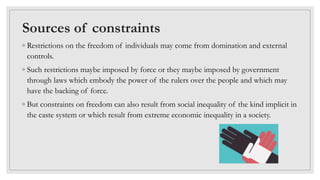
◦ Restrictions on the freedom of individuals may come from domination and external
controls.
◦ Such restrictions maybe imposed by force or they maybe imposed by government
through laws which embody the power of the rulers over the people and which may
have the backing of force.
◦ But constraints on freedom can also result from social inequality of the kind implicit in
the caste system or which result from extreme economic inequality in a society.
Why do we need constraints?
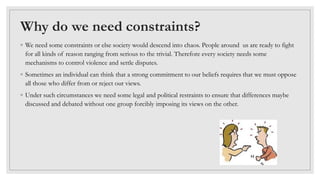
◦ We need some constraints or else society would descend into chaos. People around us are ready to fight
for all kinds of reason ranging from serious to the trivial. Therefore every society needs some
mechanisms to control violence and settle disputes.
◦ Sometimes an individual can think that a strong commitment to our beliefs requires that we must oppose
all those who differ from or reject our views.
◦ Under such circumstances we need some legal and political restraints to ensure that differences maybe
discussed and debated without one group forcibly imposing its views on the other.
Harm principle
◦ John Stuart Mill in his essay On Liberty called political theory the ‘harm principle’.
◦ Mill introduces here an important distinction. He distinguishes between ‘self regarding’
actions and ‘other regarding’ actions.
◦ He argues that with respect to actions or choices that affect only one’s self, self-
regarding actions, the state has no business to interfere. In contrast, with respect to
actions that have consequences for others, actions which may cause harm to them, there
is some case for external interference. In this case it is the state which can constrain a
person.
◦ Freedom is at the core of human society, is so crucial for a dignified human life, it
should only be constrained in special circumstances.
◦ For minor harm, Mill recommends only social disapproval and not the force of law.
◦ People should be ready to tolerate different ways of life, different points of view, and
the different interests, so long as they do not cause harm to others.
◦ In the Constitutional discussions in India, the term used for such justifiable constraints
is ‘reasonable restrictions’.
◦ The restrictions maybe there but they must be reasonable , i.e., capable of being
defended by reason, not effective, not out of proportion to the action being restricted,
since then it would impinge on the general condition of freedom in society.
NEGATIVE AND
POSITIVE LIBERTY
Negative Liberty
◦ ‘Negative liberty’ seeks to define and defend an area in which the
individuals would be inviolable, in which he or she could ’do, be or become’
whatever he or she wished to ‘do, be or become’.
◦ This is an area in which no external authority can interfere. It is a minimum
area that is sacred and in which whatever the individual does is not to be
interfered with.
◦ It is concerned with explaining the idea of ‘freedom from’.
Positive Liberty
◦ Positive liberty recognises that one can be free only in society and hence
tries to make that society such that it enables the development of the
individual.
◦ It is concerned with looking at the conditions and nature of the
relationship between the individual and society and of improving these
conditions such that they are fewer constraints to the development of the
individual personality.
◦ The arguments of positive liberty are concerned with explaining the idea of
‘freedom to’.
Freedom of Expression
◦ Freedom of expression is a fundamental value and for that society must be
willing to bear some inconvenience to protect it from people who want to
restrict it.
◦ Constraints of different kind thus exist and we are subject to them in
different situations.
◦ So, freedom embodies our capacity and our ability to make choices. We
have to also accept responsibility for our actions and their consequences.