1
Composite Resins
(Part II- Recent Advances)
GUIDED BY-Dr Suvarna patil
-Dr Ashish Medha
-Dr Sharanu srivastav
-Dr.Girish umashetty
-Dr.Snehal savagave
-Dr.Rutuja chopade
-Dr.Priyatam karade
-Dr.Anil bhaghat
-Dr.Ravindra jadhav
Presented by – Shivani M. Raghuwanshi
Contents:
• Introduction
• History
• Packable composites
• Expanding monomers
• Photoinitiators
• Packable composites
• Flowable composites
• Antimicrobial composites
• Smart composites
• Self healing composites
• Compomer
• Giomer
• Ormocers
• Siloranes
• Gingival masking composites
• Indirect posterior composites
• Compobond
2
• Fiber-reinforced composites were introduced by Smith in the 1960s.
• Touati and Mφrmann introduced the first generation of IRCs for
posterior inlays and onlays in the 1980s.
• Compomers : 1990
• Packable composites: 1995
• Flowable composites: 1996
• Ormocers : 1998
• Smart composites: 1998
• Self Healing composites: 2001
• Nanofilled composite resins: 2003
• Self adhesive composites: 2009
• Bulkfill composites: 2010
3
4
WHYTHERE IS NEED FOR ADVANCES??
• Polymerization shrinkage / induced stress
• COTE mismatch
• Fracture, Abrasion, Wear resistance
• Marginal leakage
• Biocompatibility
IMPROVE PERFORMANCE!!!
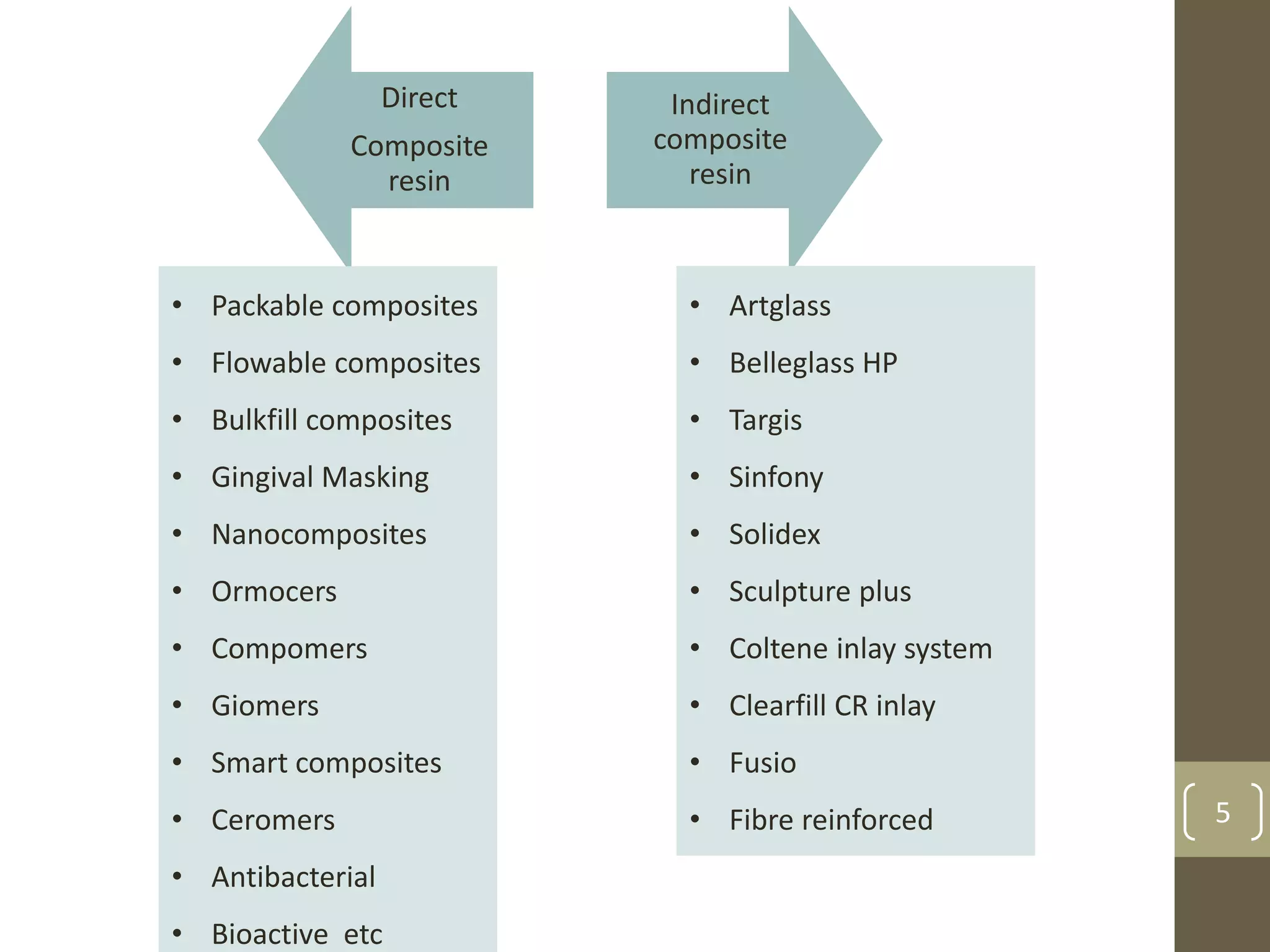
Direct
Composite
resin
Indirect
composite
resin
5
• Packable composites
• Flowable composites
• Bulkfill composites
• Gingival Masking
• Nanocomposites
• Ormocers
• Compomers
• Giomers
• Smart composites
• Ceromers
• Antibacterial
• Bioactive etc
• Artglass
• Belleglass HP
• Targis
• Sinfony
• Solidex
• Sculpture plus
• Coltene inlay system
• Clearfill CR inlay
• Fusio
• Fibre reinforced
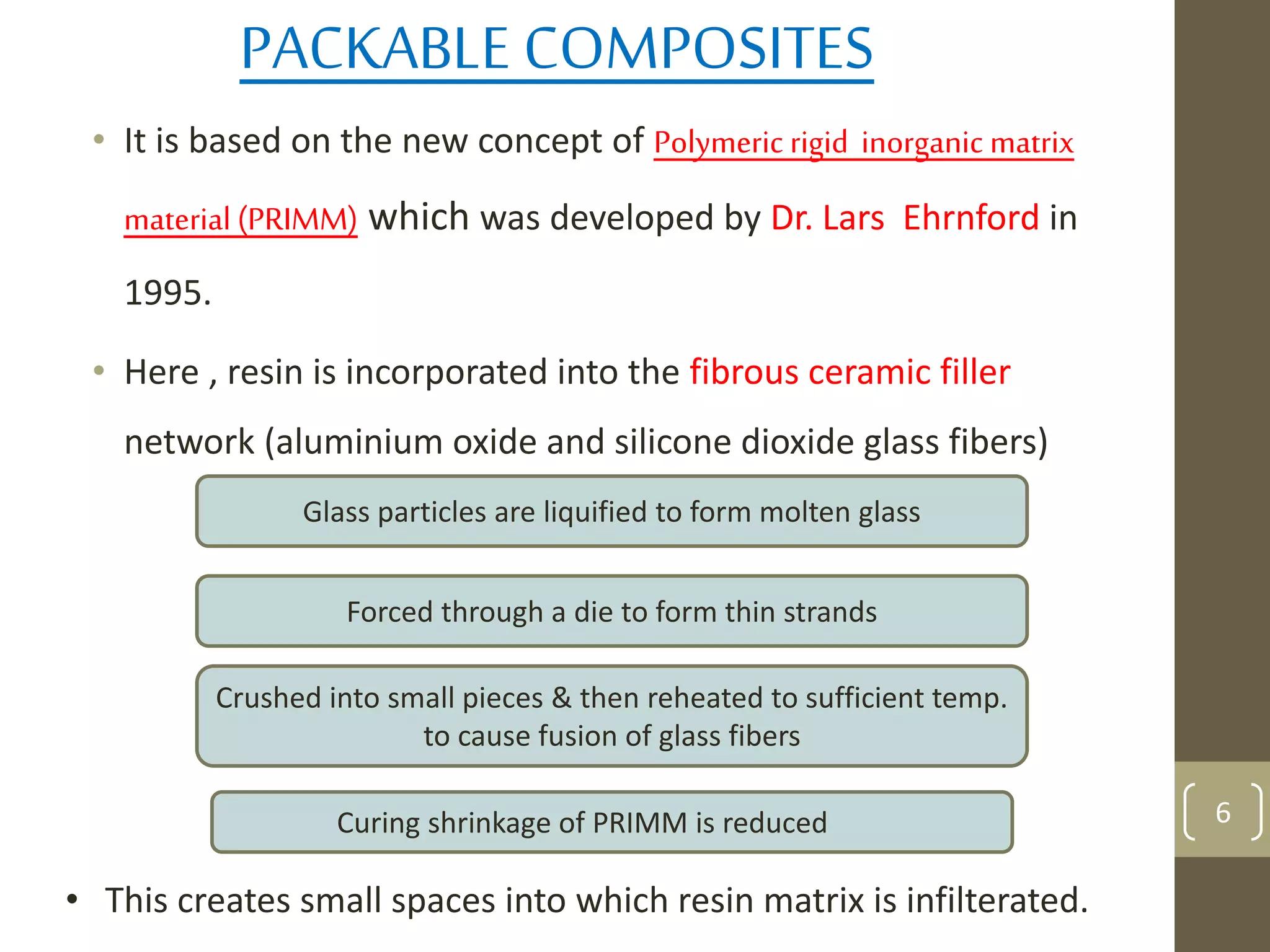
• It is based on the new concept of Polymeric rigid inorganic matrix
material (PRIMM) which was developed by Dr. Lars Ehrnford in
1995.
• Here , resin is incorporated into the fibrous ceramic filler
network (aluminium oxide and silicone dioxide glass fibers)
6
Glass particles are liquified to form molten glass
Forced through a die to form thin strands
Crushed into small pieces & then reheated to sufficient temp.
to cause fusion of glass fibers
• This creates small spaces into which resin matrix is infilterated.
PACKABLE COMPOSITES
Curing shrinkage of PRIMM is reduced
Advantages :
• Better marginal adaptation
• Reduced polymerization shrinkage (Filler loading > 80% by wt)
• Optimal mechanical characteristics like flexural strength,
modulus of elasticity and coefficient of thermal expansion
• Low wear rate
Uses:
• Class I & Class II restorations
7
Expandingmonomers
• Composite resin that expand slightly during polymerization
are highly desirable.
• Spiro-ortho carbonates consist of four rings ,two on each side
of spiro carbon & on polymerization double ring opens.
• Two covalent bonds break to form one new bond & thus
expansion.
8
Ex: Spiro ortho carbonate, bicyclic monolactone , cyclic carbonate
Applications:
• High-strength composites (e.g. in epoxy resins)
• Adhesives, coatings, precision castings, and sealant materials
to counteract shrinking during polymerization.
• In the composite resins at the bonding interface as it may
lead to debonding, microleakage, post-operative sensitivity.
9
Photoinitiators
• The concentration of camphorquinone affects the aesthetics
of a restoration by yellow discoloration.
• If any un-reacted molecules may return back to the ground
state which will cause discolouration of the final polymer. Such
discoloration may reduce aesthetic quality.
10
• 1-Phenyl-1, 2- propanedione (PPD) has been suggested as a
way to improve the polymerization kinetics and to reduce the
“yellowing effect” of the photo-initiator. The absorption peak
of this molecule is mainly in the near UV region and extends
slightly into the visible region.
• Other examples:
• Phosphine oxides, Thioxanthone Derivatives, Acylgermane
Derivatives, Hexaarylbiimidazole Derivatives, Silane Based
Derivatives.
11
International Journal of Applied Dental Sciences 2017; 3(1): 17-20 -Current photo-
initiators in dental materials
Flowablecomposites
• Flowable composites are hybrid composites obtained by
increasing particle size and reducing the filling amount.
• Reduction in the viscosity of flowable composites is
obtained by reducing the amount of filling content or by
increasing the ratio of diluent monomers (TEGDMA) in the
composite structure.
• Filler loading - 37%-53% (volume)
12
J Clin Diagn Res. 2015 Jun; 9(6): ZE18–ZE24.
Flowable Resin Composites: A Systematic Review and Clinical Considerations
Advantages Drawbacks
• High wet ability of the tooth surface
ensuring penetration into every
irregularity
• Eliminating air inclusion
• High flexibility
• Radio-opacity
•High curing shrinkage
•Weaker mechanical properties
13
1. Class III,V
2. Preventive resin restorations
3. Pit & Fissure sealants
4. Composite repair
5. Core build up
6. Incisal edge repair
7. Cavity liners
8. Minimally invasive class II restorations
9. Enamel defect repair
10. Bonding of fibre posts in the restoration
of endodontically treated teeth
Indications
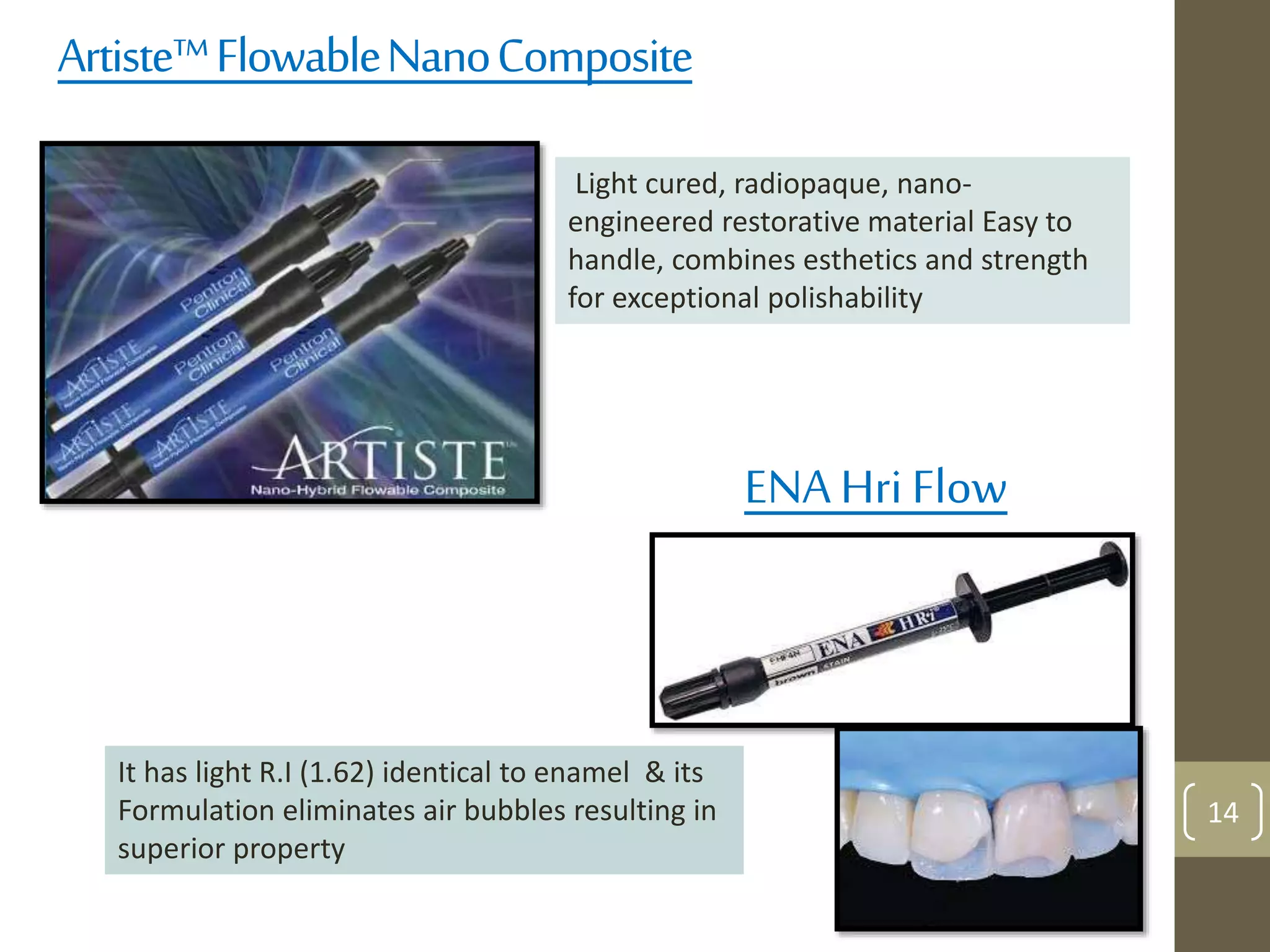
Artiste™FlowableNanoComposite
14
Light cured, radiopaque, nano-
engineered restorative material Easy to
handle, combines esthetics and strength
for exceptional polishability
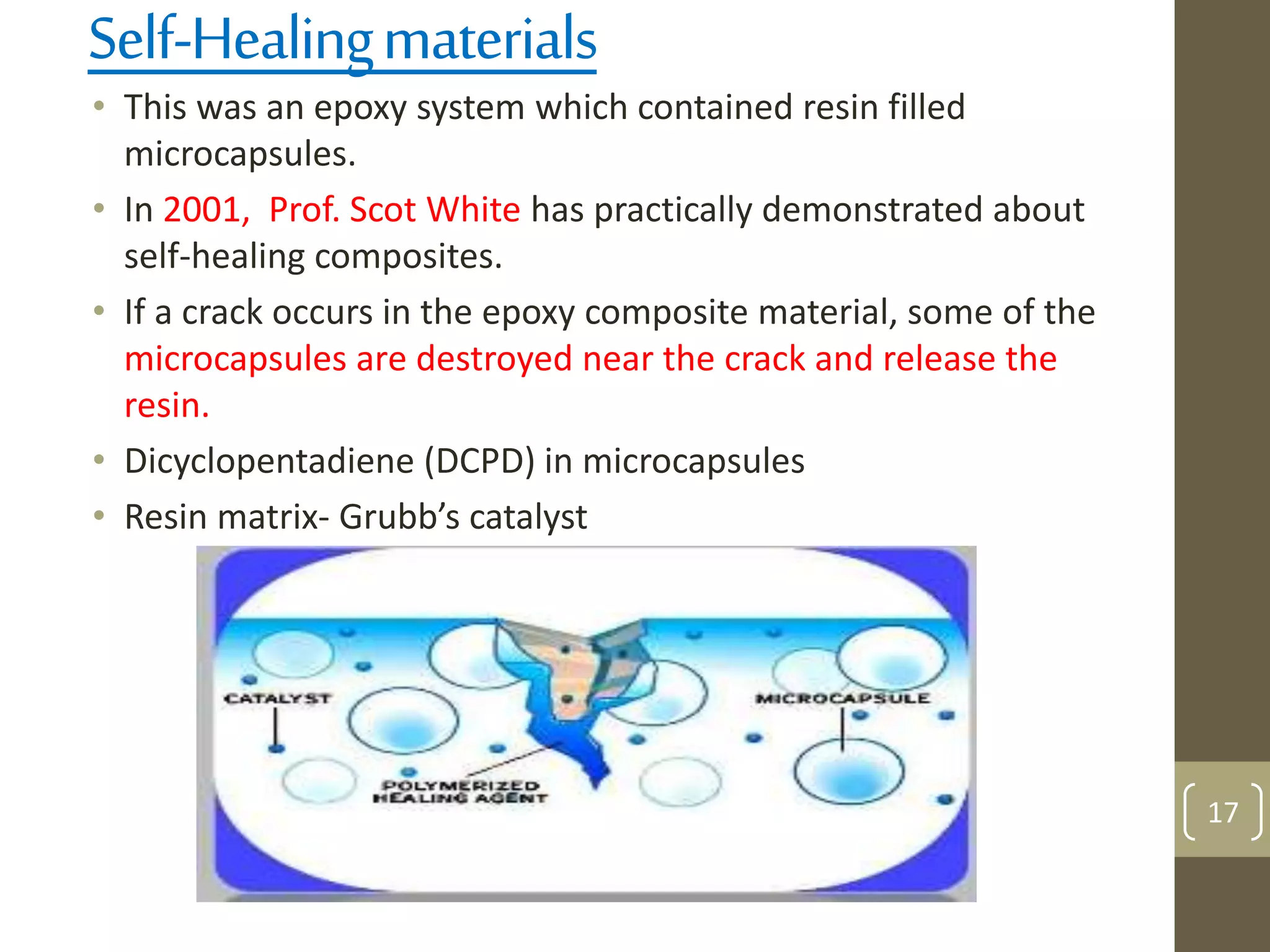
ENA Hri Flow
It has light R.I (1.62) identical to enamel & its
Formulation eliminates air bubbles resulting in
superior property
• Also known Ion releasing composites or Bioactive composites
• It contains amorphous calcium phosphate (ACP) filler
• When pH of saliva becomes less calcium & phosphate ions are
released.
• It was aimed to prevent the effect of bacteria and secondary
decay by the buffering capacity which will ensure the start of
remineralisation.
• It has drawbacks like low bonding ,resistance to wear, poor
physical properties and pulpal sensitivity. 15
Composites
16
ARISTON pHc
Ivoclair introduced this material .
• New composite material, white in colour , indicated for
posterior restorations & protects active caries production.
• It is a light cured filling material & contains mixture of
dimethacrylates & fillers like YF3,Ba-Al Fluoro silicate.
• It releases 3 different ions (fluoride,calcium,hydroxyl) when pH
value in oral cavity drops below 5.5 level due to active plaque.
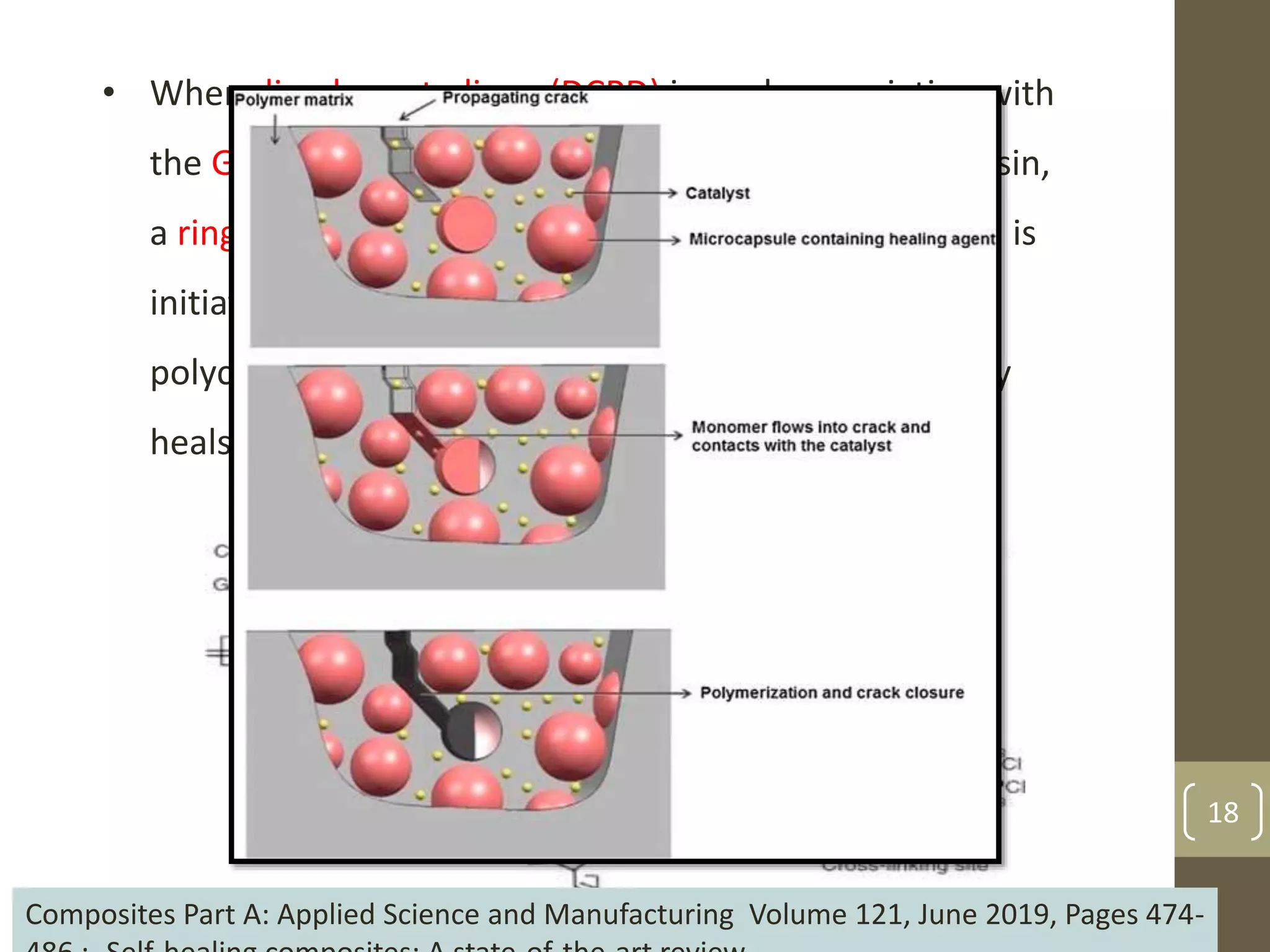
Self-Healingmaterials
• This was an epoxy system which contained resin filled
microcapsules.
• In 2001, Prof. Scot White has practically demonstrated about
self-healing composites.
• If a crack occurs in the epoxy composite material, some of the
microcapsules are destroyed near the crack and release the
resin.
• Dicyclopentadiene (DCPD) in microcapsules
• Resin matrix- Grubb’s catalyst
17
18
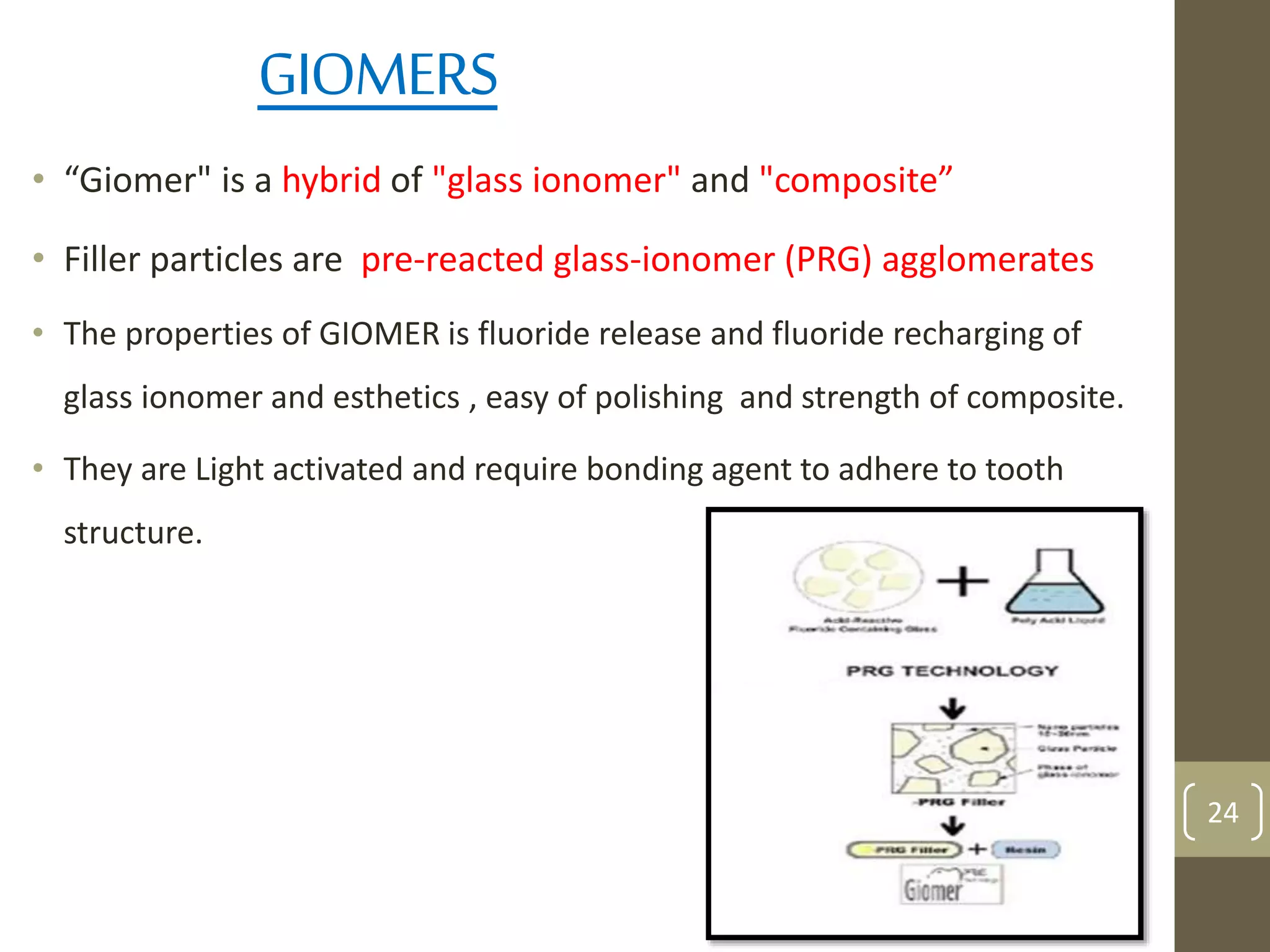
• When dicyclopentadiene (DCPD) is made association with
the Grubbs’ enzymes which is diffused in the epoxy resin,
a ring like opening metathesis polymerization (ROMP) is
initiated and a eminently cross-linked tough
polycyclopendiene is thereafter forming which actually
heals the damage.
Composites Part A: Applied Science and Manufacturing Volume 121, June 2019, Pages 474-
International Journal of Applied Dental Sciences 2017; 3(2): 38-40:- Bulkfill flowable composite
resins – A review
Bulk-fillcomposites
• In 2010, bulk-fill flowable composites were introduced the first being
Surefil® SDR® (Smart Dentin Replacement)
• Bulk fill composite resins are classified into high viscosity
and low-viscosity (flowable) materials.
• i) The low viscosity flowable bulk fill composites such as SDR,
Venus BulkFill , Filtek BulkFill (3M/ESPE), X-tra Base are placed at
lower part dentin layer and then after the placement of a second
layer as an enamel layer, polymerisation is applied.
19
20
• ii) High viscosity restorative materials Ex: SonicFill , X-tra Fill,
Filtek BulkFill (3M ESPE), Tetric Evo Ceram BulkFill do not
have good adaptation to cavity walls, a low-viscosity resin
is placed as a first layer and polymerisation is then applied
with light.
SDR (Smart Dentin Replacement)
• It is a single component, fluoride containing , visibly light cured
radiopaque resin composite restorative material.
• It has handling characteristics typical of a flowable composite but can
be placed in 4 mm increments with minimal polymerization stress.
• It allows intimate adaptation to the prepared cavity walls .
Available in one universal shade
Filtek Bulk Fill (3M ESPE)
• a low-viscosity, visible-light activated flowable material
Manufactured in four shades and two kinds of packaging, capsules
and syringes.
• It contains Bis-GMA, UDMA, Bis-EMA, and Procrylat resins
• Fillers : zirconia , silica and ytterbium trifluoride
X-tra base flowable
• Posterior bulk base composite cure 4mm in 10 sec, saves time, low
shrinkage stress allows bulk fill speed
• High strength makes it suitable for open and closed
sandwich technique.
21
International Journal of Applied Dental Sciences 2017; 3(2): 38-40:- Bulkfill
flowable composite resins – A review
TetricEvoCeramBulkfill
• It is a nanohybrid composite with a monomer matrix
containing dimethacrylates & fillers contain barium glass,
ytterbium trifluoride.
• It contains an inhibitor of sensitivity to light and thus provides
prolonged time for modeling of filling, an inhibitor of
shrinkage stress in order to achieve optimal marginal seal, and
Ivocerin polymerization photoinitiator allowing curing of 4
mm layers of material.
22
SonicBulk-Fillcompositedelivery
• SonicFill consists of a composite resin and a sonic handpiece
with a KaVo tip providing sonic application.
• The sonic energy generated by the handpiece causes a change
in the viscosity of the composite resin so that during
placement, it behaves similarly to a flowable liner in its ability
to adapt to the internal surfaces of the cavity preparation.
• It is around 86% filled by weight, special additives in the
composite allow the filler particles to slide very readily over
one another when activated by the sonic energy in the
handpiece.
23
Inside Dentistry Article Reprint Vol. 11 No. 12 :- Advances in Composite Resin Materials
GIOMERS
• “Giomer" is a hybrid of "glass ionomer" and "composite”
• Filler particles are pre-reacted glass-ionomer (PRG) agglomerates
• The properties of GIOMER is fluoride release and fluoride recharging of
glass ionomer and esthetics , easy of polishing and strength of composite.
• They are Light activated and require bonding agent to adhere to tooth
structure.
24
Compositionof Giomers:
• Bisphenol A glycidyl dimethacrylate &TEGDMA
• Inorganic glass filler-Aluminum oxide, silica
• Pre-reacted glass ionomer filler
• Camphorquinone
Advantages
• Fluoride release
• Biocompatibility
• Clinical Stability and Durability
• Excellent aesthetics
• Smooth Surface Finish
• Excellent Bonding
Ex: Shofu's Beautiful, FL-BOND II, Beautifil-Bulk Restorative, Beautifil-Bulk
Flowable, Beautifil Flow Plus
25
Compomers(Polyacid-modifiedcompositeresins)
• Composites and glass ionomer
• Resin component  Monomers like BisGMA or UDMA with
Diluents such as TEGDMA
• Fillers  fluoride containing glasses
• Resin composite containing acid modified monomers & basic
glass filler particles.
Strength and Wear Performance:
• GIC – 140 MPa,
• composite- 300 MPa,
• compomer 200 – 250 Mpa
26
• Examples : Dyract , Compoglass , F 2000 , Hytac , Vitremer ,
Z 100
27
• Cervical erosion & Abrasion
• Anterior proximal
restorations
• Laminate and sandwich
technique
• Temporary repair of broken
teeth
• Core material
• Direct or indirect pulp capping
• Isolation
• Alergic to dimethacrylate resins
INDICATIONS CONTRAINDICATIONS
28
AntibacterialComposites
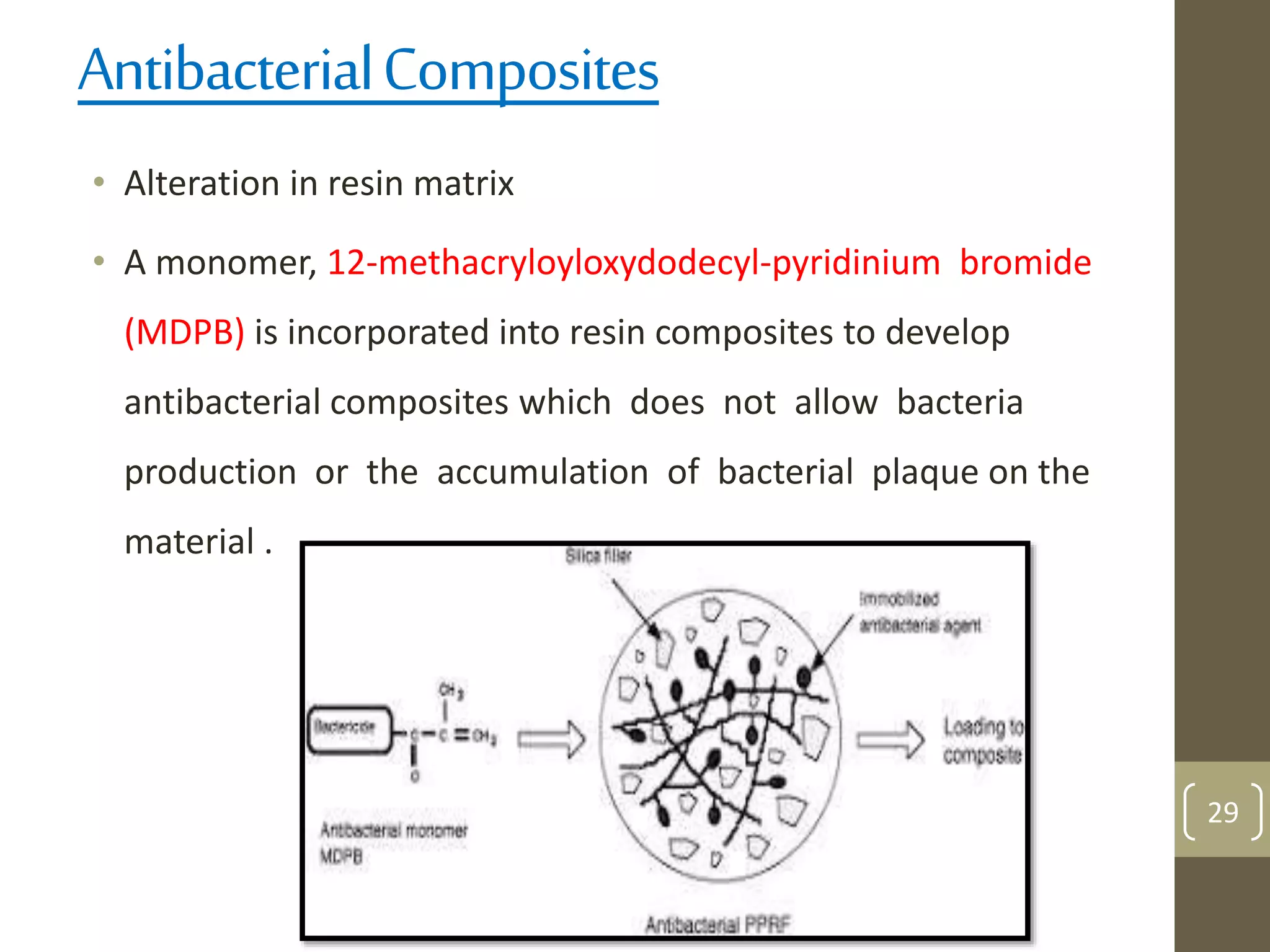
• Alteration in resin matrix
• A monomer, 12-methacryloyloxydodecyl-pyridinium bromide
(MDPB) is incorporated into resin composites to develop
antibacterial composites which does not allow bacteria
production or the accumulation of bacterial plaque on the
material .
29
• Earlier it was achieved by the addition of various antibacterial
components (chlorhexidine, tertiary ammonium compounds,
silver ions and antibacterial monomers) to the composite
30
Silorane-basedresincomposites(SBRC).
• A novel monomer technology with unique polymerization
characteristics to minimize polymerization shrinkage .
• The silorane matrix is formed by the cationic ring-opening
polymerization of the silorane monomer.
• Reduction in the polymerization shrinkage to a level < 1.0%
• Lower microleakage , improved marginal adaptation and
reduced cusp deflection.
31
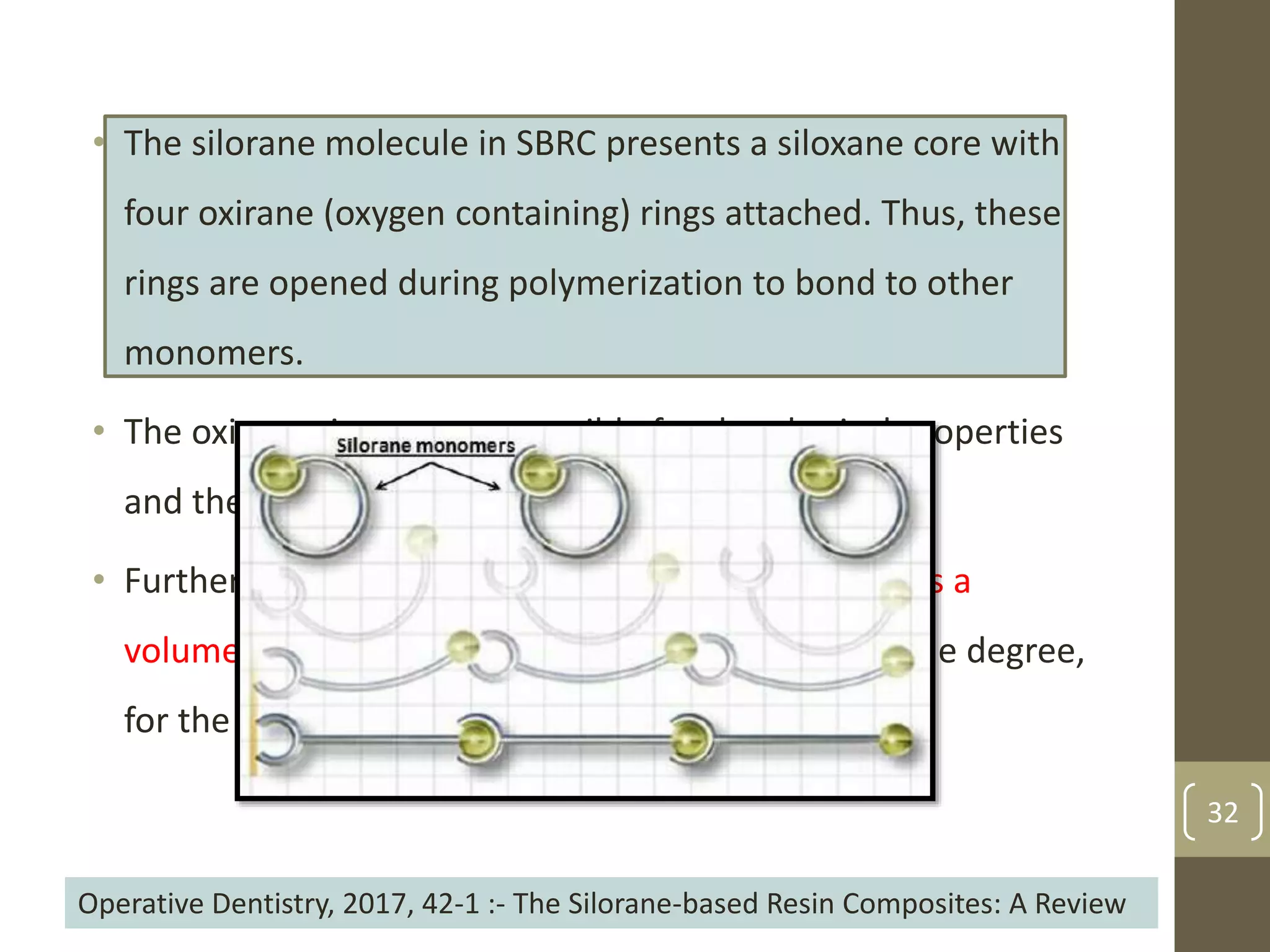
• The silorane molecule in SBRC presents a siloxane core with
four oxirane (oxygen containing) rings attached. Thus, these
rings are opened during polymerization to bond to other
monomers.
• The oxirane rings are responsible for the physical properties
and the reduced polymerization shrinkage.
• Furthermore, the opening of the oxirane ring causes a
volumetric expansion that may compensate, to some degree,
for the shrinkage resulting from molecular bonding.
32
Operative Dentistry, 2017, 42-1 :- The Silorane-based Resin Composites: A Review
Ormocers
• Dr. Herbert Wolters from Fraunhofer Institute for Silicate
Research introduced this class of material in 1994.
• acronym of Organically Modified Ceramic
• described as 3-dimensionally cross-linked copolymers with
multi-polymerization & no residual unreacted monomer.
33
Silicon oxide (a filler basic substance ) is modified by adding
polymerisable side chains in the form of methacrylate group
Filler 1-1.5 µm in size material contains 77% filler by weight and 61 %
by volume
Difference between ORMOCER and the previously available
composites is found in the matrix
• The matrix consisting of ceramic polysiloxane
• Ormocer was formulated in an attempt to overcome the problems
created by the polymerization shrinkage of conventional composites
because the coefficient of thermal expansion is very similar to
natural tooth structure. 34
Fibrereinforcedcomposites
• Fibre reinforced composites consist of fibre material held together
by a resinous matrix.
• Fibers act as crack stoppers and enhance the property of composite.
• Boron oxide, a glass-forming agent is present at 6-9 wt% in E-fibers
and <1 wt% in S-fibers.
• E- and S-fibers are the ones most commonly used in dentistry.
• They can be arranged in different directions to one another,
resulting either in a weave- or mesh-type architecture.
• When the directional orientation of the fiber long axis is
perpendicular to the applied forces, it will result in strength
reinforcement. 35
Annals of Prosthodontics and Restorative Dentistry, January-March,2016;2(1): 11-
16 :A Review on Fibre Reinforced Composite Resins
Advantages:
1. Mechanical properties.
2. Non-corrosive
3. Translucent
4. good bonding properties
5. ease of repair.
6. Minimally invasive
7. Low cost
8. Restoration of large cavities
9. post endodontic filling.
36
Disadvantages:
1. Fractures and occlusal wear
2. mechanical properties of
fibre-reinforced composites
decrease after hydrolytic
aging
USES
Restorations
Tooth stabilization & splints
Conservative t/t of missing tooth
replacement
Post endodontic restorations
Endodontic fibre reinforced composite
posts
Repair of acrylic resin prosthesis
Gingivalmaskingcomposites
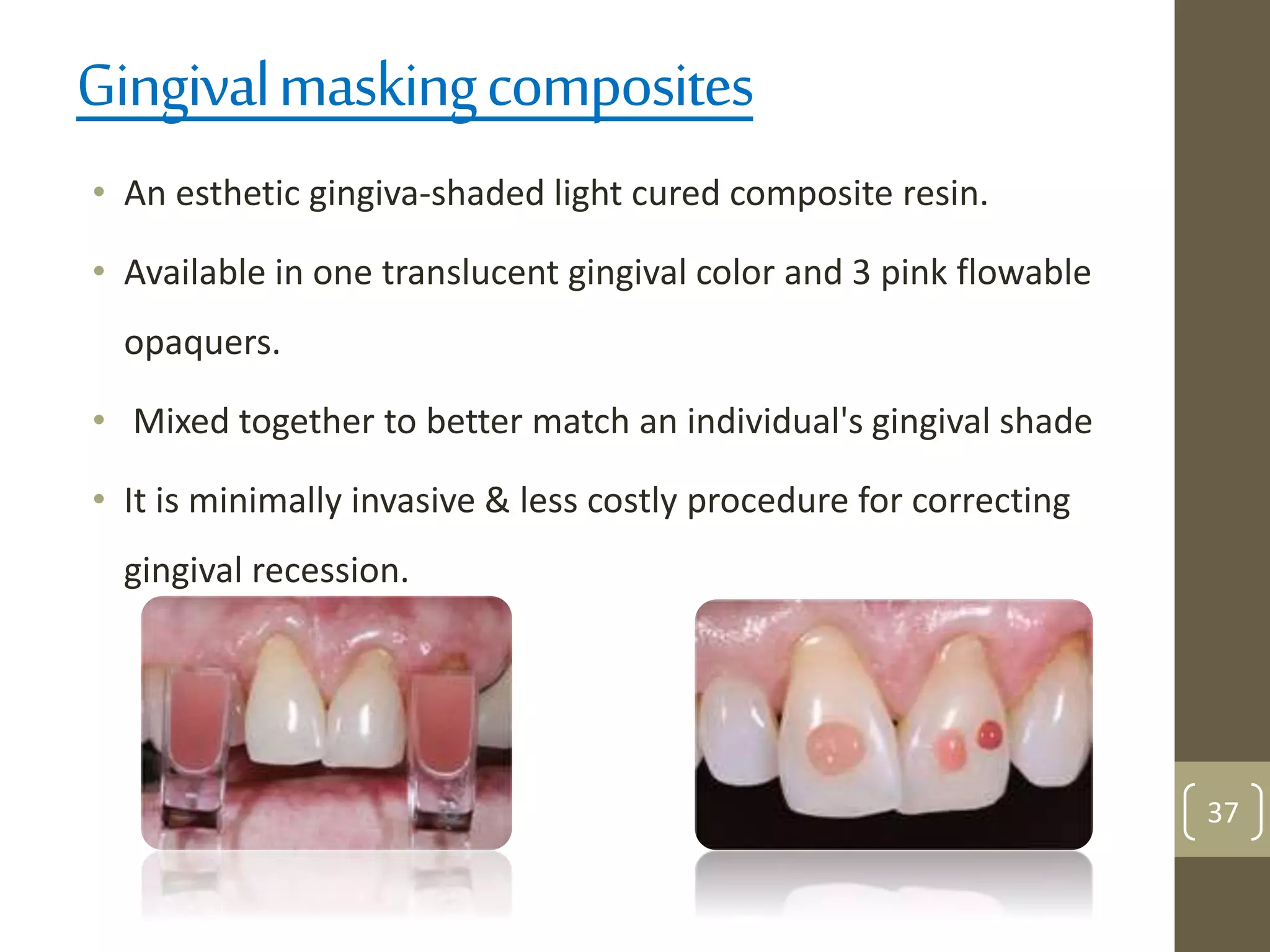
• An esthetic gingiva-shaded light cured composite resin.
• Available in one translucent gingival color and 3 pink flowable
opaquers.
• Mixed together to better match an individual's gingival shade
• It is minimally invasive & less costly procedure for correcting
gingival recession.
37
38
Cervical area, including
composite restorations
in gingival colours
V-shaped defects Exposed cervical areas
Aesthetic corrections of
the gingival area,
Primary splinting, and
the correction of
red/white aesthetics
Ability to mask exposed
crown margins to
improve aesthetics and
patient satisfaction.
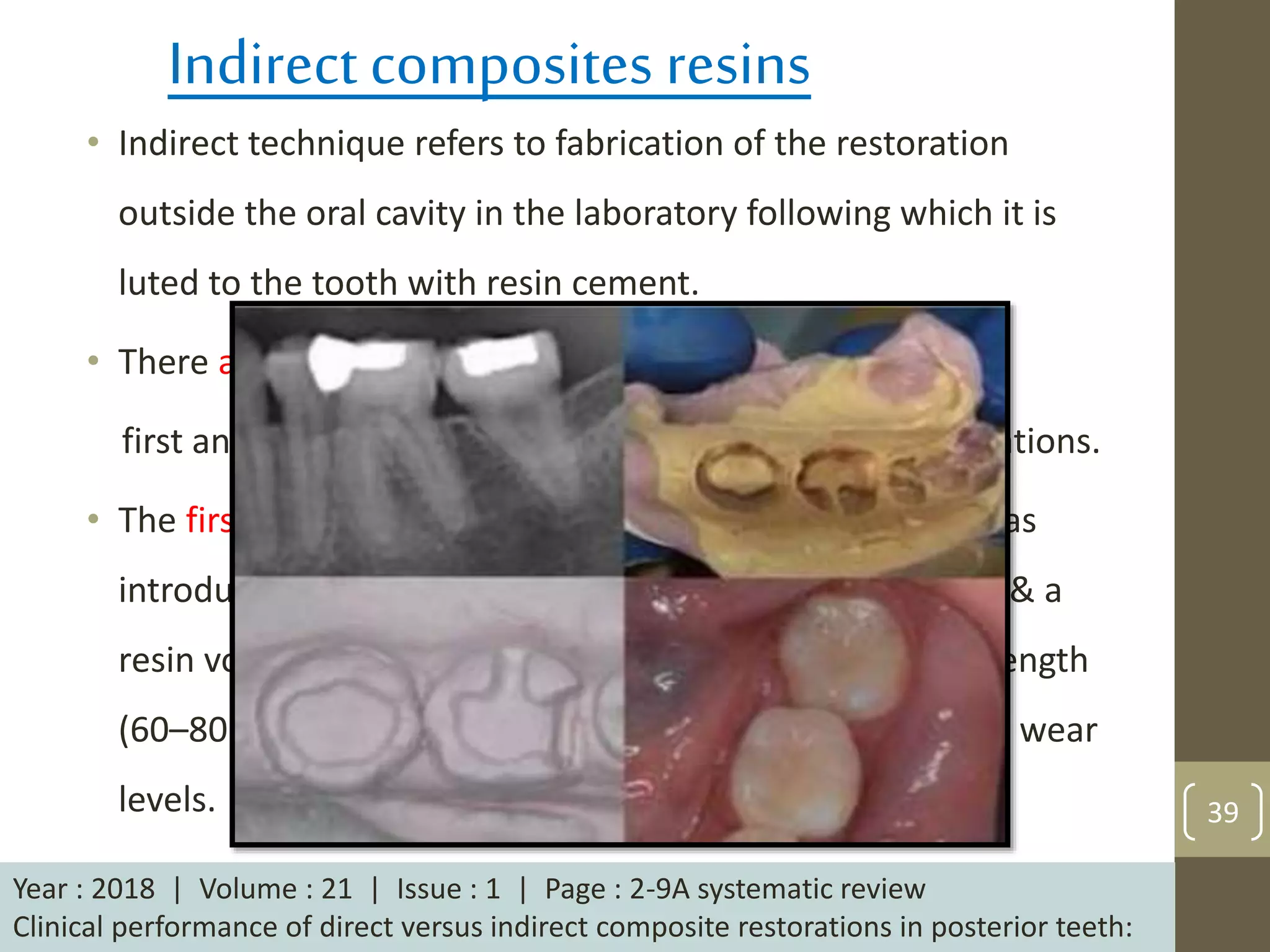
• Indirect technique refers to fabrication of the restoration
outside the oral cavity in the laboratory following which it is
luted to the tooth with resin cement.
• There are two types of indirect composite restorations,
first and second generation of indirect composite restorations.
• The first generation of indirect composite restorations was
introduced in the 1980s included microfilled composites & a
resin volume more than 50% which results in flexural strength
(60–80 MPa) and elastic modulus (2–3.5 Gpa) and higher wear
levels. 39
Indirect composites resins
Year : 2018 | Volume : 21 | Issue : 1 | Page : 2-9A systematic review
Clinical performance of direct versus indirect composite restorations in posterior teeth:
• In 1990s, a second generation of indirect composites was
introduced which included microhybrid composites with fillers
66% by volume which resulted in improved mechanical
properties with flexural strength of 120–160 MPa and elastic
modulus of 8.5–12 GPa.
40
ADVANTAGES
• Better contouring of
proximal surfaces
• Improved wear resistance
• Reduced polymerization
shrinkage
• Improved fracture
resistance
DISADVANTAGES
• Increased cost and time
• requires two appointments
• fabrication of a temporary
restoration
• low potential for repair.
Artglass
• Launched in 1995 by Heraeusl-Kulzer
• Filler- 70% wt barium glass of 0.7u
• Matrix – 30wt % organic resin, additional to bifunctional
molecules it contains 4-6 functional groups which provides the
opportunity for more double bond conversions.
• It is photocured in special unit using a xenon stroboscopic
light which emits 4.5 watts in range between 320-500 nm.
• This high intensity light is emitted for 20 sec followed by 80
sec of darkness & this type of light exposure increases
polymerization potential. 41
BelleglassHP
• Introduced by Belle de St. Claire in 1996.
• Filler- silanated microhybrid barium glass fillers of 0.6u &
chemically similar to BiSGMA.
• It is polymerized under pressure at an elevated temperature &
in presence of N2.
• The use of N2 atmosphere during polymerization produces an
O2 free environment resulting in higher level of
polymerization & increase in wear resistance.
42
TARGIS
• Also called as Ceromer launched in 1996 by Ivoclar Vivadent
• Contains 77 wt% of fillers & 23 wt% of organic matrix
• Filler part is trimodal containing – barium glass (1u), spheroidal silica
filler (0.25u) & colloidal silica (0.015-0.05u)
• It is coated with glycerin gel to prevent formation of oxygen-inhibited
surface layer & placed in the curing unit Targis Power for the following
cycle:
• Light emission in first 10 min along with increase in temp. to 95C for 25
mins & cooling for 5 min.
• It is a veneering composite material .
REVIEW Year : 2010 | Volume : 13 | Issue : 4 | Page : 184-194 Indirect resin
composites
43
Ceromers combine the advantages of ceramicsand
composites
• Durable esthetics
• High abrasion resistance
• High stability
• Ease of final adjustment
• Excellent polish ability
• Effective bond with luting composite
• Low degree of brittleness
• Conservation of tooth structure
44
Sinfony
• Introduced by 3M ESPE
• Filler – pyrogenic silica 0.05u & matrix polyfunctional methacrylate
polymer
• It consists of 2 polymerising units:
-Visio alpha : halogen lamp source 10 sec
-Visio beta : fluorescent lamp source 15 min
• Polymerization of this material with two light sources improves its
properties
• Used for full veneering of fixed & removable prosthesis on metal
frameworks & for inlays , onlays, fibre reinforced bridges.
45
Chitosancomposites
• Chitosan and chitosan derivatives appear to be good candidates for
the elastomeric matrix. These natural biopolymers are
biocompatible ,biodegradable and osteoconductive. They have been
used in surgical interventions for the reduction of periodontal
pockets.
• Biocompatibility , biodegradable, muco adherent
• CPC–chitosan composites are stable in a wet environment and had
sufficient physical strength for many clinical applications. The
strength did not decrease with time under simulated physiological
conditions. 46
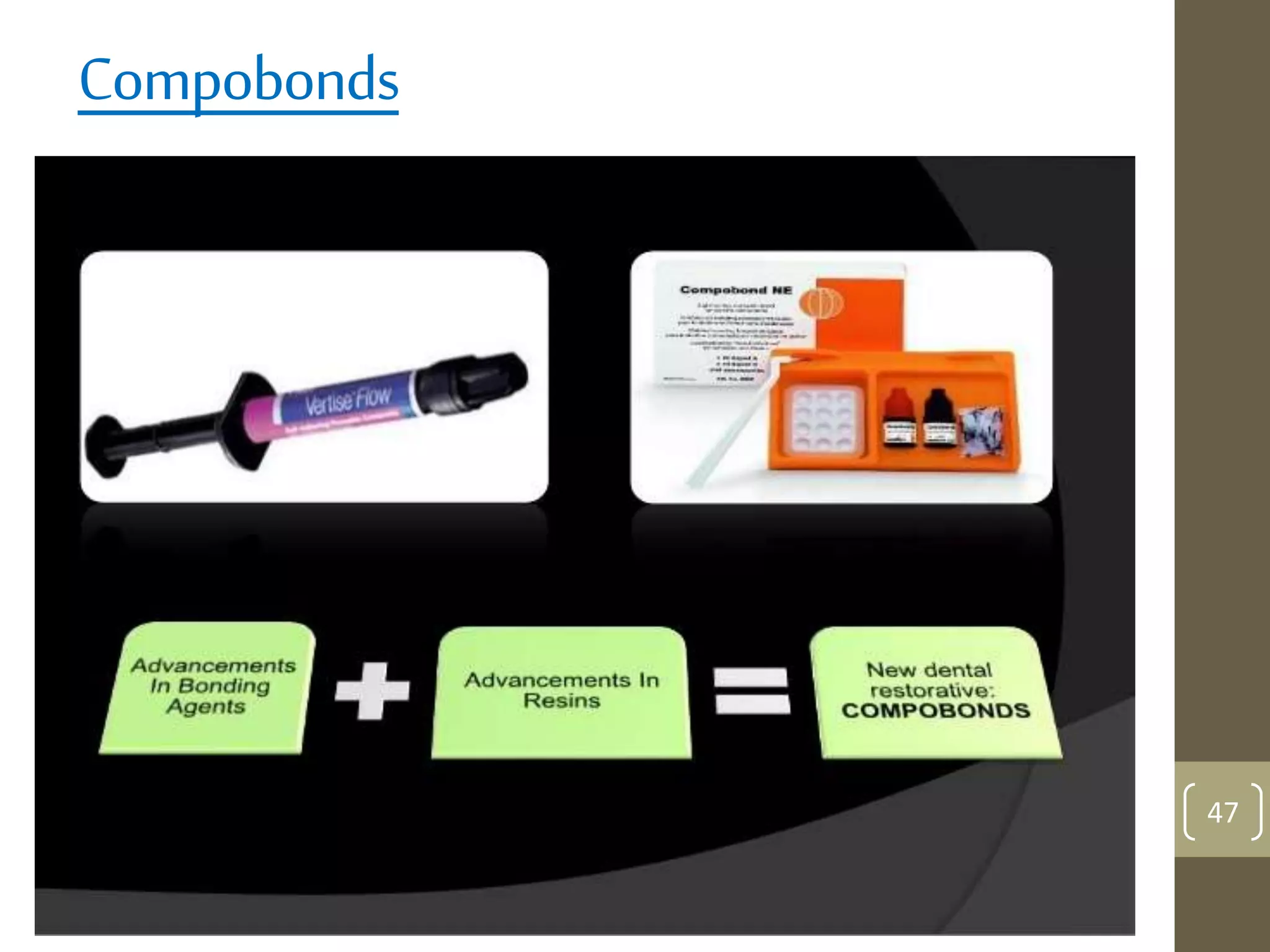
Compobonds
• Compobonds exploit the benefits of SE DBAs and nano-filled
resins, eliminating the precursory bonding stage necessary to
adhere a resin to tooth substrate, and are termed self-
adhering composites.
• The first compobond, called Vertise Flow (Kerr), was
introduced in 2009, a self-adhering flowable combining a
resin-based composite and an SE bonding agent based on the
seventh-generation DBA OptiBond All-in-One (Kerr).
47
cosmetic dentistry 2_2011 : industry report _ compobonds I
• It eliminates the bonding stage that is prerequisite before
using any resin-based restorative .
• Vertise Flow functions as both a dentine adhesive and a resin
restorative material, a longer curing time is necessary to
ensure that both constituents are fully polymerised.
• In addition, the light-curing reaction also halts the etching
process of the SE agent, increasing its pH from approximately
2 to 7, so that continual acidity does not erode the dentine
bond.
48
• ADVANTAGES :
• Dentine and enamel bonding
• High mechanical strength
• Low wear, better aesthetics
• Single-stage clinical procedure and fluoride release, but not
fluoride recharge.
• INDICATIONS :
• Fissure sealing, Small, non-stress-bearing, non-contacting
cavities, Class V and small buccal cavities, Stress-relieving
linings, Blocking undercuts, Repair.
49
References
• Flowable Resin Composites: A Systematic Review and Clinical
Considerations J Clin Diagn Res. 2015 Jun; 9(6): ZE18–ZE24.
• Annals of Prosthodontics and Restorative Dentistry, January-
March,2016;2(1): 11-16 :A Review on Fibre Reinforced
Composite Resins
• International Journal of Applied Dental Sciences 2017; 3(1):
17-20 -Current photo-initiators in dental materials
• International Journal of Applied Dental Sciences 2017; 3(2):
38-40:- Bulkfill flowable composite resins – A review
50
• Operative Dentistry, 2017, 42-1 :- The Silorane-based Resin
Composites: A Review
• Inside Dentistry Article Reprint Vol. 11 No. 12 :- Advances in
Composite Resin Materials
• Year : 2018 | Volume : 21 | Issue : 1 | Page : 2-9
A systematic review Clinical performance of direct versus indirect
composite restorations in posterior teeth
• Composites Part A: Applied Science and Manufacturing Volume 121,
June 2019, Pages 474-486 :- Self-healing composites: A state-of-the-
art review
• Composites Part A: Applied Science and Manufacturing Volume 121,
June 2019, Pages 474-486 :- Self-healing composites: A state-of-the-
art review 51
52
• J of conservative Dentistry ; INVITED REVIEW Year : 2010 |
Volume : 13 | Issue : 4 | Page : 184-194 - Indirect resin
composites
• Textbook of operative dentistry : vimal sikri 2nd edition

Composite resins part ii

  • 1.
    1 Composite Resins (Part II-Recent Advances) GUIDED BY-Dr Suvarna patil -Dr Ashish Medha -Dr Sharanu srivastav -Dr.Girish umashetty -Dr.Snehal savagave -Dr.Rutuja chopade -Dr.Priyatam karade -Dr.Anil bhaghat -Dr.Ravindra jadhav Presented by – Shivani M. Raghuwanshi
  • 2.
    Contents: • Introduction • History •Packable composites • Expanding monomers • Photoinitiators • Packable composites • Flowable composites • Antimicrobial composites • Smart composites • Self healing composites • Compomer • Giomer • Ormocers • Siloranes • Gingival masking composites • Indirect posterior composites • Compobond 2
  • 3.
    • Fiber-reinforced compositeswere introduced by Smith in the 1960s. • Touati and Mφrmann introduced the first generation of IRCs for posterior inlays and onlays in the 1980s. • Compomers : 1990 • Packable composites: 1995 • Flowable composites: 1996 • Ormocers : 1998 • Smart composites: 1998 • Self Healing composites: 2001 • Nanofilled composite resins: 2003 • Self adhesive composites: 2009 • Bulkfill composites: 2010 3
  • 4.
    4 WHYTHERE IS NEEDFOR ADVANCES?? • Polymerization shrinkage / induced stress • COTE mismatch • Fracture, Abrasion, Wear resistance • Marginal leakage • Biocompatibility IMPROVE PERFORMANCE!!!
  • 5.
    Direct Composite resin Indirect composite resin 5 • Packable composites •Flowable composites • Bulkfill composites • Gingival Masking • Nanocomposites • Ormocers • Compomers • Giomers • Smart composites • Ceromers • Antibacterial • Bioactive etc • Artglass • Belleglass HP • Targis • Sinfony • Solidex • Sculpture plus • Coltene inlay system • Clearfill CR inlay • Fusio • Fibre reinforced
  • 6.
    • It isbased on the new concept of Polymeric rigid inorganic matrix material (PRIMM) which was developed by Dr. Lars Ehrnford in 1995. • Here , resin is incorporated into the fibrous ceramic filler network (aluminium oxide and silicone dioxide glass fibers) 6 Glass particles are liquified to form molten glass Forced through a die to form thin strands Crushed into small pieces & then reheated to sufficient temp. to cause fusion of glass fibers • This creates small spaces into which resin matrix is infilterated. PACKABLE COMPOSITES Curing shrinkage of PRIMM is reduced
  • 7.
    Advantages : • Bettermarginal adaptation • Reduced polymerization shrinkage (Filler loading > 80% by wt) • Optimal mechanical characteristics like flexural strength, modulus of elasticity and coefficient of thermal expansion • Low wear rate Uses: • Class I & Class II restorations 7
  • 8.
    Expandingmonomers • Composite resinthat expand slightly during polymerization are highly desirable. • Spiro-ortho carbonates consist of four rings ,two on each side of spiro carbon & on polymerization double ring opens. • Two covalent bonds break to form one new bond & thus expansion. 8 Ex: Spiro ortho carbonate, bicyclic monolactone , cyclic carbonate
  • 9.
    Applications: • High-strength composites(e.g. in epoxy resins) • Adhesives, coatings, precision castings, and sealant materials to counteract shrinking during polymerization. • In the composite resins at the bonding interface as it may lead to debonding, microleakage, post-operative sensitivity. 9
  • 10.
    Photoinitiators • The concentrationof camphorquinone affects the aesthetics of a restoration by yellow discoloration. • If any un-reacted molecules may return back to the ground state which will cause discolouration of the final polymer. Such discoloration may reduce aesthetic quality. 10
  • 11.
    • 1-Phenyl-1, 2-propanedione (PPD) has been suggested as a way to improve the polymerization kinetics and to reduce the “yellowing effect” of the photo-initiator. The absorption peak of this molecule is mainly in the near UV region and extends slightly into the visible region. • Other examples: • Phosphine oxides, Thioxanthone Derivatives, Acylgermane Derivatives, Hexaarylbiimidazole Derivatives, Silane Based Derivatives. 11 International Journal of Applied Dental Sciences 2017; 3(1): 17-20 -Current photo- initiators in dental materials
  • 12.
    Flowablecomposites • Flowable compositesare hybrid composites obtained by increasing particle size and reducing the filling amount. • Reduction in the viscosity of flowable composites is obtained by reducing the amount of filling content or by increasing the ratio of diluent monomers (TEGDMA) in the composite structure. • Filler loading - 37%-53% (volume) 12 J Clin Diagn Res. 2015 Jun; 9(6): ZE18–ZE24. Flowable Resin Composites: A Systematic Review and Clinical Considerations
  • 13.
    Advantages Drawbacks • Highwet ability of the tooth surface ensuring penetration into every irregularity • Eliminating air inclusion • High flexibility • Radio-opacity •High curing shrinkage •Weaker mechanical properties 13 1. Class III,V 2. Preventive resin restorations 3. Pit & Fissure sealants 4. Composite repair 5. Core build up 6. Incisal edge repair 7. Cavity liners 8. Minimally invasive class II restorations 9. Enamel defect repair 10. Bonding of fibre posts in the restoration of endodontically treated teeth Indications
  • 14.
    Artiste™FlowableNanoComposite 14 Light cured, radiopaque,nano- engineered restorative material Easy to handle, combines esthetics and strength for exceptional polishability ENA Hri Flow It has light R.I (1.62) identical to enamel & its Formulation eliminates air bubbles resulting in superior property
  • 15.
    • Also knownIon releasing composites or Bioactive composites • It contains amorphous calcium phosphate (ACP) filler • When pH of saliva becomes less calcium & phosphate ions are released. • It was aimed to prevent the effect of bacteria and secondary decay by the buffering capacity which will ensure the start of remineralisation. • It has drawbacks like low bonding ,resistance to wear, poor physical properties and pulpal sensitivity. 15 Composites
  • 16.
    16 ARISTON pHc Ivoclair introducedthis material . • New composite material, white in colour , indicated for posterior restorations & protects active caries production. • It is a light cured filling material & contains mixture of dimethacrylates & fillers like YF3,Ba-Al Fluoro silicate. • It releases 3 different ions (fluoride,calcium,hydroxyl) when pH value in oral cavity drops below 5.5 level due to active plaque.
  • 17.
    Self-Healingmaterials • This wasan epoxy system which contained resin filled microcapsules. • In 2001, Prof. Scot White has practically demonstrated about self-healing composites. • If a crack occurs in the epoxy composite material, some of the microcapsules are destroyed near the crack and release the resin. • Dicyclopentadiene (DCPD) in microcapsules • Resin matrix- Grubb’s catalyst 17
  • 18.
    18 • When dicyclopentadiene(DCPD) is made association with the Grubbs’ enzymes which is diffused in the epoxy resin, a ring like opening metathesis polymerization (ROMP) is initiated and a eminently cross-linked tough polycyclopendiene is thereafter forming which actually heals the damage. Composites Part A: Applied Science and Manufacturing Volume 121, June 2019, Pages 474-
  • 19.
    International Journal ofApplied Dental Sciences 2017; 3(2): 38-40:- Bulkfill flowable composite resins – A review Bulk-fillcomposites • In 2010, bulk-fill flowable composites were introduced the first being Surefil® SDR® (Smart Dentin Replacement) • Bulk fill composite resins are classified into high viscosity and low-viscosity (flowable) materials. • i) The low viscosity flowable bulk fill composites such as SDR, Venus BulkFill , Filtek BulkFill (3M/ESPE), X-tra Base are placed at lower part dentin layer and then after the placement of a second layer as an enamel layer, polymerisation is applied. 19
  • 20.
    20 • ii) Highviscosity restorative materials Ex: SonicFill , X-tra Fill, Filtek BulkFill (3M ESPE), Tetric Evo Ceram BulkFill do not have good adaptation to cavity walls, a low-viscosity resin is placed as a first layer and polymerisation is then applied with light. SDR (Smart Dentin Replacement) • It is a single component, fluoride containing , visibly light cured radiopaque resin composite restorative material. • It has handling characteristics typical of a flowable composite but can be placed in 4 mm increments with minimal polymerization stress. • It allows intimate adaptation to the prepared cavity walls . Available in one universal shade
  • 21.
    Filtek Bulk Fill(3M ESPE) • a low-viscosity, visible-light activated flowable material Manufactured in four shades and two kinds of packaging, capsules and syringes. • It contains Bis-GMA, UDMA, Bis-EMA, and Procrylat resins • Fillers : zirconia , silica and ytterbium trifluoride X-tra base flowable • Posterior bulk base composite cure 4mm in 10 sec, saves time, low shrinkage stress allows bulk fill speed • High strength makes it suitable for open and closed sandwich technique. 21 International Journal of Applied Dental Sciences 2017; 3(2): 38-40:- Bulkfill flowable composite resins – A review
  • 22.
    TetricEvoCeramBulkfill • It isa nanohybrid composite with a monomer matrix containing dimethacrylates & fillers contain barium glass, ytterbium trifluoride. • It contains an inhibitor of sensitivity to light and thus provides prolonged time for modeling of filling, an inhibitor of shrinkage stress in order to achieve optimal marginal seal, and Ivocerin polymerization photoinitiator allowing curing of 4 mm layers of material. 22
  • 23.
    SonicBulk-Fillcompositedelivery • SonicFill consistsof a composite resin and a sonic handpiece with a KaVo tip providing sonic application. • The sonic energy generated by the handpiece causes a change in the viscosity of the composite resin so that during placement, it behaves similarly to a flowable liner in its ability to adapt to the internal surfaces of the cavity preparation. • It is around 86% filled by weight, special additives in the composite allow the filler particles to slide very readily over one another when activated by the sonic energy in the handpiece. 23 Inside Dentistry Article Reprint Vol. 11 No. 12 :- Advances in Composite Resin Materials
  • 24.
    GIOMERS • “Giomer" isa hybrid of "glass ionomer" and "composite” • Filler particles are pre-reacted glass-ionomer (PRG) agglomerates • The properties of GIOMER is fluoride release and fluoride recharging of glass ionomer and esthetics , easy of polishing and strength of composite. • They are Light activated and require bonding agent to adhere to tooth structure. 24
  • 25.
    Compositionof Giomers: • BisphenolA glycidyl dimethacrylate &TEGDMA • Inorganic glass filler-Aluminum oxide, silica • Pre-reacted glass ionomer filler • Camphorquinone Advantages • Fluoride release • Biocompatibility • Clinical Stability and Durability • Excellent aesthetics • Smooth Surface Finish • Excellent Bonding Ex: Shofu's Beautiful, FL-BOND II, Beautifil-Bulk Restorative, Beautifil-Bulk Flowable, Beautifil Flow Plus 25
  • 26.
    Compomers(Polyacid-modifiedcompositeresins) • Composites andglass ionomer • Resin component  Monomers like BisGMA or UDMA with Diluents such as TEGDMA • Fillers  fluoride containing glasses • Resin composite containing acid modified monomers & basic glass filler particles. Strength and Wear Performance: • GIC – 140 MPa, • composite- 300 MPa, • compomer 200 – 250 Mpa 26
  • 27.
    • Examples :Dyract , Compoglass , F 2000 , Hytac , Vitremer , Z 100 27 • Cervical erosion & Abrasion • Anterior proximal restorations • Laminate and sandwich technique • Temporary repair of broken teeth • Core material • Direct or indirect pulp capping • Isolation • Alergic to dimethacrylate resins INDICATIONS CONTRAINDICATIONS
  • 28.
  • 29.
    AntibacterialComposites • Alteration inresin matrix • A monomer, 12-methacryloyloxydodecyl-pyridinium bromide (MDPB) is incorporated into resin composites to develop antibacterial composites which does not allow bacteria production or the accumulation of bacterial plaque on the material . 29
  • 30.
    • Earlier itwas achieved by the addition of various antibacterial components (chlorhexidine, tertiary ammonium compounds, silver ions and antibacterial monomers) to the composite 30
  • 31.
    Silorane-basedresincomposites(SBRC). • A novelmonomer technology with unique polymerization characteristics to minimize polymerization shrinkage . • The silorane matrix is formed by the cationic ring-opening polymerization of the silorane monomer. • Reduction in the polymerization shrinkage to a level < 1.0% • Lower microleakage , improved marginal adaptation and reduced cusp deflection. 31
  • 32.
    • The siloranemolecule in SBRC presents a siloxane core with four oxirane (oxygen containing) rings attached. Thus, these rings are opened during polymerization to bond to other monomers. • The oxirane rings are responsible for the physical properties and the reduced polymerization shrinkage. • Furthermore, the opening of the oxirane ring causes a volumetric expansion that may compensate, to some degree, for the shrinkage resulting from molecular bonding. 32 Operative Dentistry, 2017, 42-1 :- The Silorane-based Resin Composites: A Review
  • 33.
    Ormocers • Dr. HerbertWolters from Fraunhofer Institute for Silicate Research introduced this class of material in 1994. • acronym of Organically Modified Ceramic • described as 3-dimensionally cross-linked copolymers with multi-polymerization & no residual unreacted monomer. 33
  • 34.
    Silicon oxide (afiller basic substance ) is modified by adding polymerisable side chains in the form of methacrylate group Filler 1-1.5 µm in size material contains 77% filler by weight and 61 % by volume Difference between ORMOCER and the previously available composites is found in the matrix • The matrix consisting of ceramic polysiloxane • Ormocer was formulated in an attempt to overcome the problems created by the polymerization shrinkage of conventional composites because the coefficient of thermal expansion is very similar to natural tooth structure. 34
  • 35.
    Fibrereinforcedcomposites • Fibre reinforcedcomposites consist of fibre material held together by a resinous matrix. • Fibers act as crack stoppers and enhance the property of composite. • Boron oxide, a glass-forming agent is present at 6-9 wt% in E-fibers and <1 wt% in S-fibers. • E- and S-fibers are the ones most commonly used in dentistry. • They can be arranged in different directions to one another, resulting either in a weave- or mesh-type architecture. • When the directional orientation of the fiber long axis is perpendicular to the applied forces, it will result in strength reinforcement. 35 Annals of Prosthodontics and Restorative Dentistry, January-March,2016;2(1): 11- 16 :A Review on Fibre Reinforced Composite Resins
  • 36.
    Advantages: 1. Mechanical properties. 2.Non-corrosive 3. Translucent 4. good bonding properties 5. ease of repair. 6. Minimally invasive 7. Low cost 8. Restoration of large cavities 9. post endodontic filling. 36 Disadvantages: 1. Fractures and occlusal wear 2. mechanical properties of fibre-reinforced composites decrease after hydrolytic aging USES Restorations Tooth stabilization & splints Conservative t/t of missing tooth replacement Post endodontic restorations Endodontic fibre reinforced composite posts Repair of acrylic resin prosthesis
  • 37.
    Gingivalmaskingcomposites • An estheticgingiva-shaded light cured composite resin. • Available in one translucent gingival color and 3 pink flowable opaquers. • Mixed together to better match an individual's gingival shade • It is minimally invasive & less costly procedure for correcting gingival recession. 37
  • 38.
    38 Cervical area, including compositerestorations in gingival colours V-shaped defects Exposed cervical areas Aesthetic corrections of the gingival area, Primary splinting, and the correction of red/white aesthetics Ability to mask exposed crown margins to improve aesthetics and patient satisfaction.
  • 39.
    • Indirect techniquerefers to fabrication of the restoration outside the oral cavity in the laboratory following which it is luted to the tooth with resin cement. • There are two types of indirect composite restorations, first and second generation of indirect composite restorations. • The first generation of indirect composite restorations was introduced in the 1980s included microfilled composites & a resin volume more than 50% which results in flexural strength (60–80 MPa) and elastic modulus (2–3.5 Gpa) and higher wear levels. 39 Indirect composites resins Year : 2018 | Volume : 21 | Issue : 1 | Page : 2-9A systematic review Clinical performance of direct versus indirect composite restorations in posterior teeth:
  • 40.
    • In 1990s,a second generation of indirect composites was introduced which included microhybrid composites with fillers 66% by volume which resulted in improved mechanical properties with flexural strength of 120–160 MPa and elastic modulus of 8.5–12 GPa. 40 ADVANTAGES • Better contouring of proximal surfaces • Improved wear resistance • Reduced polymerization shrinkage • Improved fracture resistance DISADVANTAGES • Increased cost and time • requires two appointments • fabrication of a temporary restoration • low potential for repair.
  • 41.
    Artglass • Launched in1995 by Heraeusl-Kulzer • Filler- 70% wt barium glass of 0.7u • Matrix – 30wt % organic resin, additional to bifunctional molecules it contains 4-6 functional groups which provides the opportunity for more double bond conversions. • It is photocured in special unit using a xenon stroboscopic light which emits 4.5 watts in range between 320-500 nm. • This high intensity light is emitted for 20 sec followed by 80 sec of darkness & this type of light exposure increases polymerization potential. 41
  • 42.
    BelleglassHP • Introduced byBelle de St. Claire in 1996. • Filler- silanated microhybrid barium glass fillers of 0.6u & chemically similar to BiSGMA. • It is polymerized under pressure at an elevated temperature & in presence of N2. • The use of N2 atmosphere during polymerization produces an O2 free environment resulting in higher level of polymerization & increase in wear resistance. 42
  • 43.
    TARGIS • Also calledas Ceromer launched in 1996 by Ivoclar Vivadent • Contains 77 wt% of fillers & 23 wt% of organic matrix • Filler part is trimodal containing – barium glass (1u), spheroidal silica filler (0.25u) & colloidal silica (0.015-0.05u) • It is coated with glycerin gel to prevent formation of oxygen-inhibited surface layer & placed in the curing unit Targis Power for the following cycle: • Light emission in first 10 min along with increase in temp. to 95C for 25 mins & cooling for 5 min. • It is a veneering composite material . REVIEW Year : 2010 | Volume : 13 | Issue : 4 | Page : 184-194 Indirect resin composites 43
  • 44.
    Ceromers combine theadvantages of ceramicsand composites • Durable esthetics • High abrasion resistance • High stability • Ease of final adjustment • Excellent polish ability • Effective bond with luting composite • Low degree of brittleness • Conservation of tooth structure 44
  • 45.
    Sinfony • Introduced by3M ESPE • Filler – pyrogenic silica 0.05u & matrix polyfunctional methacrylate polymer • It consists of 2 polymerising units: -Visio alpha : halogen lamp source 10 sec -Visio beta : fluorescent lamp source 15 min • Polymerization of this material with two light sources improves its properties • Used for full veneering of fixed & removable prosthesis on metal frameworks & for inlays , onlays, fibre reinforced bridges. 45
  • 46.
    Chitosancomposites • Chitosan andchitosan derivatives appear to be good candidates for the elastomeric matrix. These natural biopolymers are biocompatible ,biodegradable and osteoconductive. They have been used in surgical interventions for the reduction of periodontal pockets. • Biocompatibility , biodegradable, muco adherent • CPC–chitosan composites are stable in a wet environment and had sufficient physical strength for many clinical applications. The strength did not decrease with time under simulated physiological conditions. 46
  • 47.
    Compobonds • Compobonds exploitthe benefits of SE DBAs and nano-filled resins, eliminating the precursory bonding stage necessary to adhere a resin to tooth substrate, and are termed self- adhering composites. • The first compobond, called Vertise Flow (Kerr), was introduced in 2009, a self-adhering flowable combining a resin-based composite and an SE bonding agent based on the seventh-generation DBA OptiBond All-in-One (Kerr). 47 cosmetic dentistry 2_2011 : industry report _ compobonds I
  • 48.
    • It eliminatesthe bonding stage that is prerequisite before using any resin-based restorative . • Vertise Flow functions as both a dentine adhesive and a resin restorative material, a longer curing time is necessary to ensure that both constituents are fully polymerised. • In addition, the light-curing reaction also halts the etching process of the SE agent, increasing its pH from approximately 2 to 7, so that continual acidity does not erode the dentine bond. 48
  • 49.
    • ADVANTAGES : •Dentine and enamel bonding • High mechanical strength • Low wear, better aesthetics • Single-stage clinical procedure and fluoride release, but not fluoride recharge. • INDICATIONS : • Fissure sealing, Small, non-stress-bearing, non-contacting cavities, Class V and small buccal cavities, Stress-relieving linings, Blocking undercuts, Repair. 49
  • 50.
    References • Flowable ResinComposites: A Systematic Review and Clinical Considerations J Clin Diagn Res. 2015 Jun; 9(6): ZE18–ZE24. • Annals of Prosthodontics and Restorative Dentistry, January- March,2016;2(1): 11-16 :A Review on Fibre Reinforced Composite Resins • International Journal of Applied Dental Sciences 2017; 3(1): 17-20 -Current photo-initiators in dental materials • International Journal of Applied Dental Sciences 2017; 3(2): 38-40:- Bulkfill flowable composite resins – A review 50
  • 51.
    • Operative Dentistry,2017, 42-1 :- The Silorane-based Resin Composites: A Review • Inside Dentistry Article Reprint Vol. 11 No. 12 :- Advances in Composite Resin Materials • Year : 2018 | Volume : 21 | Issue : 1 | Page : 2-9 A systematic review Clinical performance of direct versus indirect composite restorations in posterior teeth • Composites Part A: Applied Science and Manufacturing Volume 121, June 2019, Pages 474-486 :- Self-healing composites: A state-of-the- art review • Composites Part A: Applied Science and Manufacturing Volume 121, June 2019, Pages 474-486 :- Self-healing composites: A state-of-the- art review 51
  • 52.
    52 • J ofconservative Dentistry ; INVITED REVIEW Year : 2010 | Volume : 13 | Issue : 4 | Page : 184-194 - Indirect resin composites • Textbook of operative dentistry : vimal sikri 2nd edition

Editor's Notes

  • #7 To a sufficient temp. to cause fusion of glass fibers ( silanation)....because of this curing shrinkage of the PRIMM can be reduced sunstantially
  • #8 Less porosities {disadv} = less polishable, limited shades, increased post op sensitivity
  • #9 And reduce postoperative sensitivity
  • #11 In order to eliminate these disadvantages various other substances were used as a substitute
  • #13 50-70% conventional
  • #14 Due to low filler load
  • #15 Restorations, diastema closure , direct veneers
  • #16 Also k/as stimulus response composites
  • #17 Ph control and counteract the decalcification of enamel and dentin
  • #18 Grubbs catalyst dispersed in resin matrix
  • #19 Cross-linking of polymeric composites is accomplished to get improved mechanical attributes such as high stiffness, solvent resistance, thereby improved fracture toughness
  • #20 Incremental placement technique is time consuming & also increased possibility of air bubbles inclusion/moisture between increments
  • #21 High viscosity contains greater amount of filler particles compared to low viscosity
  • #22 Available in 4 shades
  • #24 Combines advances in material formulation with a novel delivery system
  • #25 Unique/ they have a true hybridization of glass ionomers & composites as they have
  • #27 Contains no water, also lack ability to bond to tooth structure
  • #32 This change in chemistry resulted in
  • #36 Orthodontic space maintainer, postraumatic stabilization splint
  • #37 Due to abrasion
  • #40 To overcome the disadvantages of 1st generation indirect composites
  • #41 Multiple sessions
  • #42 This short exposure time followed by longer period of non exposure allow the already cured resin to partially relax
  • #43 140oC elevated temperature used to obtain an increased degree of conversion
  • #44 Particle size
  • #48 Ex: fusio liquid dentin
  • #49 necessary