PRESENTATION BY
ALIZAH ARSHAD
ESHMAL JOHN
IQRA
CRYO ELECTRON MICROSCOPY
INTRODUCTION
• Cryogenic electron microscopy is a cryomicroscopy technique applied
on samples cooled to cryogenic temperatures.
• In cryo-EM, samples are rapidly frozen (vitrified), preventing the
formation of crystalline ice and preserving samples in their natural
state. A transmission electron microscope (TEM) is then used to
image the sample, capturing a two-dimensional view, or projection, of
the specimen
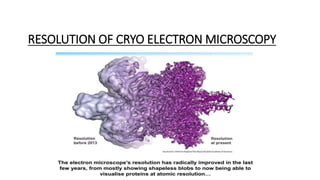
RESOLUTION OF CRYO ELECTRON MICROSCOPY
PRINCIPLE OF cryo-EM
• For biological specimens, the structure is preserved by embedding in
an environment of vitreous ice.
This technique is mainly aimed at the development of new approaches
to enhance the image resolution of protein structures within cellular
conditions.
PROCEDURE
• The sample must be vitrified.
• Strong beam of electrons is used.
• The grid on which sample is placed is made up of carbon.
• Cryogens are used for freezing purposes.
types of cryogens are used
• Common cryogen are liquid nitrogen, ethane or propane.
SAMPLE PREPARATION
• The sample is prepared by two methods
• Thin film:
• The sample is place on grid and is frozen without crystallization
• Vitreous section :
• The sample is placed on grid and is vitrified and thinly cut .
VITRIFICATION
• The grid preparation process, often referred to as vitrification, is conceptually
simple to understand: the aqueous sample is applied to a grid, the sample is
made thin on the grid, and then the grid is plunge frozen at a time scale that
prevents the formation of crystalline ice.
• Vitrified state can be maintain for long time
• Purified samples are vitrified by plunging in liquid ethane cooled by liquid
nitrogen.
• liquid ethane has higher heat transfer capacity and results in better vitrification
CRYO SECTIONING
• Cryo-electron microscopy of vitreous sections is, in principle, the ultimate
method of specimen preparation. It consists in ultra-rapid cooling of a sizable
sample of biological material that is cut into thin sections.
• vitrified sample are cut into thin sections using diamond knife.
INTERACTION OF ELECTRON WITH SPECIMEN
• It works by flash-freezing biological samples in glass-like ice and using a high-
energy electron beam to probe the specimen. Upon firing the electrons at the
sample, the atoms within the sample scatter and change their direction.
• Back or forward scattered of electrons .
• Once the beam hits the sample, electrons and X-rays are ejected from the
sample.
OBSERVATIONS
• Observations is made on the basis of
a. Specimen itself
b. Thickness of ice
c. Focus of objective lenses
• Methods of observation
a) Fluorescent screen
b) Photographic film
IMAGE ENHANCEMENT
• Cryo EM image are very noisy and have very low contrast
• Smooth the noise as well as enhance the contrast.
• Color information and brightness is produced by sensor
IMAGE ENHANCEMENT
PROS AND CONS
• Pros:
a) Easy sample preparation
b) Structure in native state
c) Small sample size
d) Précised image
• Cons:
a) Relatively low resolution
b) Highly dependent on EM techniques
c) Costly EM equipment
APPLICATIONS
• Electron microscopy (EM) is a technique for obtaining high resolution images of
biological and non-biological specimens. It is used in biomedical research to
investigate the detailed structure of tissues, cells, organelles and macromolecular
complexes.
• Determining the structure of proteins and other macromolecules: Cryo-EM can
be used to determine the three-dimensional structure of proteins and other
macromolecules at high resolution. This information can be used to understand
how these molecules function and how they interact with other molecules.
• Studying complex biological systems: Cryo-EM can be used to study complex
biological systems such as viruses, membrane proteins, and multi-protein
complexes. It can provide insights into the mechanisms of these systems and how
they interact with their environment
FUTURE PROSPECTS
• The future prospects for cryo-electron microscopy (cryo-EM) are very promising.
• As cryo-EM technology continues to improve, it is likely that we will be able to
obtain even higher resolution images of even larger and more complex biological
molecules. This will allow us to better understand the structure and function of
these molecules, which will have important implications for drug discovery,
biotechnology, and other areas of research.
FUTURE PROSPECTS
• In addition, cryo-EM is becoming more accessible to researchers around the
world as the technology becomes more affordable and user-friendly. This will
allow more scientists to use cryo-EM in their research, leading to even more
discoveries and breakthroughs in the coming years
CONCLUSION
• To summarize, cryo-EM has emerged as one of the effective imaging
techniques to determine the structures of biological assemblies and
macromolecules. In the future, cryo-EM can be potentially used for
structure-based drug discovery.
THANKS

CRYO ELECTRON MICROSCOPY.pptx

  • 1.
  • 2.
  • 3.
    INTRODUCTION • Cryogenic electronmicroscopy is a cryomicroscopy technique applied on samples cooled to cryogenic temperatures. • In cryo-EM, samples are rapidly frozen (vitrified), preventing the formation of crystalline ice and preserving samples in their natural state. A transmission electron microscope (TEM) is then used to image the sample, capturing a two-dimensional view, or projection, of the specimen
  • 4.
    RESOLUTION OF CRYOELECTRON MICROSCOPY
  • 5.
    PRINCIPLE OF cryo-EM •For biological specimens, the structure is preserved by embedding in an environment of vitreous ice. This technique is mainly aimed at the development of new approaches to enhance the image resolution of protein structures within cellular conditions.
  • 6.
    PROCEDURE • The samplemust be vitrified. • Strong beam of electrons is used. • The grid on which sample is placed is made up of carbon. • Cryogens are used for freezing purposes. types of cryogens are used • Common cryogen are liquid nitrogen, ethane or propane.
  • 7.
    SAMPLE PREPARATION • Thesample is prepared by two methods • Thin film: • The sample is place on grid and is frozen without crystallization • Vitreous section : • The sample is placed on grid and is vitrified and thinly cut .
  • 8.
    VITRIFICATION • The gridpreparation process, often referred to as vitrification, is conceptually simple to understand: the aqueous sample is applied to a grid, the sample is made thin on the grid, and then the grid is plunge frozen at a time scale that prevents the formation of crystalline ice. • Vitrified state can be maintain for long time • Purified samples are vitrified by plunging in liquid ethane cooled by liquid nitrogen. • liquid ethane has higher heat transfer capacity and results in better vitrification
  • 9.
    CRYO SECTIONING • Cryo-electronmicroscopy of vitreous sections is, in principle, the ultimate method of specimen preparation. It consists in ultra-rapid cooling of a sizable sample of biological material that is cut into thin sections. • vitrified sample are cut into thin sections using diamond knife.
  • 10.
    INTERACTION OF ELECTRONWITH SPECIMEN • It works by flash-freezing biological samples in glass-like ice and using a high- energy electron beam to probe the specimen. Upon firing the electrons at the sample, the atoms within the sample scatter and change their direction. • Back or forward scattered of electrons . • Once the beam hits the sample, electrons and X-rays are ejected from the sample.
  • 11.
    OBSERVATIONS • Observations ismade on the basis of a. Specimen itself b. Thickness of ice c. Focus of objective lenses • Methods of observation a) Fluorescent screen b) Photographic film
  • 12.
    IMAGE ENHANCEMENT • CryoEM image are very noisy and have very low contrast • Smooth the noise as well as enhance the contrast. • Color information and brightness is produced by sensor
  • 13.
  • 14.
    PROS AND CONS •Pros: a) Easy sample preparation b) Structure in native state c) Small sample size d) Précised image • Cons: a) Relatively low resolution b) Highly dependent on EM techniques c) Costly EM equipment
  • 15.
    APPLICATIONS • Electron microscopy(EM) is a technique for obtaining high resolution images of biological and non-biological specimens. It is used in biomedical research to investigate the detailed structure of tissues, cells, organelles and macromolecular complexes. • Determining the structure of proteins and other macromolecules: Cryo-EM can be used to determine the three-dimensional structure of proteins and other macromolecules at high resolution. This information can be used to understand how these molecules function and how they interact with other molecules. • Studying complex biological systems: Cryo-EM can be used to study complex biological systems such as viruses, membrane proteins, and multi-protein complexes. It can provide insights into the mechanisms of these systems and how they interact with their environment
  • 16.
    FUTURE PROSPECTS • Thefuture prospects for cryo-electron microscopy (cryo-EM) are very promising. • As cryo-EM technology continues to improve, it is likely that we will be able to obtain even higher resolution images of even larger and more complex biological molecules. This will allow us to better understand the structure and function of these molecules, which will have important implications for drug discovery, biotechnology, and other areas of research.
  • 17.
    FUTURE PROSPECTS • Inaddition, cryo-EM is becoming more accessible to researchers around the world as the technology becomes more affordable and user-friendly. This will allow more scientists to use cryo-EM in their research, leading to even more discoveries and breakthroughs in the coming years
  • 18.
    CONCLUSION • To summarize,cryo-EM has emerged as one of the effective imaging techniques to determine the structures of biological assemblies and macromolecules. In the future, cryo-EM can be potentially used for structure-based drug discovery.
  • 19.