Rebooting journalism
Finding new opportunities in a world of over abundant
            content and scarce attention
Are you suffering from IOS?


                      Source: Xerox and YouTube
Eric Schmidt of Google
       “Between the birth of the
world and 2003, there were five
exabytes of information created.
We [now] create five exabytes
every two days. See why it’s so
painful to operate in information
markets?”

            from interview at Atmosphere 2010 conference   Photo by Charles Haynes, Some Rights Reserved
How much is exabyte?


1 exabyte= 100,000
   10 terabytes=

                                 Photo by msmariamad, Some Rights Reserved


   An exabyte is 1 million terabytes
   The entire printed collection of the US Library of Congress
   is 10 terabytes
   An exabyte is 100,000 Libraries of Congress
Media: From scarcity to abundance


                  Eric Schmidt at the Guardian Activate 2010 conference
Source: Twitter by the Numbers, Raffi Krikorian

Record 3283 tweets per second set during Japan v Denmark
World Cup Match
Source: Image Week 17: 2011, LES GO! by ishawalia,
                                                   statistics USAToday
750m photos uploaded to Facebook on New Year’s 2011.
A decade ago, The Wall Street Journal
           wrote 22,000 articles.
                    In 2010, it created 21,000 articles in
                    the first six months.


                                                                              Source: The Hamster
                                                                                Wheel, Columbia
                                                                               Journalism Review


Photo: Rupert Murdoch is on my
  driveway by Kevin Dooley
Let’s look at what we in the media are doing:
A decade ago, The Wall Street Journal wrote 22,000 articles. In 2010, it has created 21,000
articles in the first six months.
Abundance breaks
         more things than
           scarcity does


                 Photo: Clay making a point by Joi Ito
            Source: Shirky at NFAIS: How Abundance Breaks
                      Everything by Ann Michael

Society knows how to react to scarcity.” We know how to ration, save, and preserve when we
need to do so. It’s much harder to set priorities and find our path when information
abounds. We may drown. We may get side-tracked. We may shut down. But, in any case,
abundance confuses and distracts us more than scarcity does.
Three challenges facing journalism

We’re losing the battle for attention
More content is leading to lower revenues
 We’re overwhelming audiences
into inaction
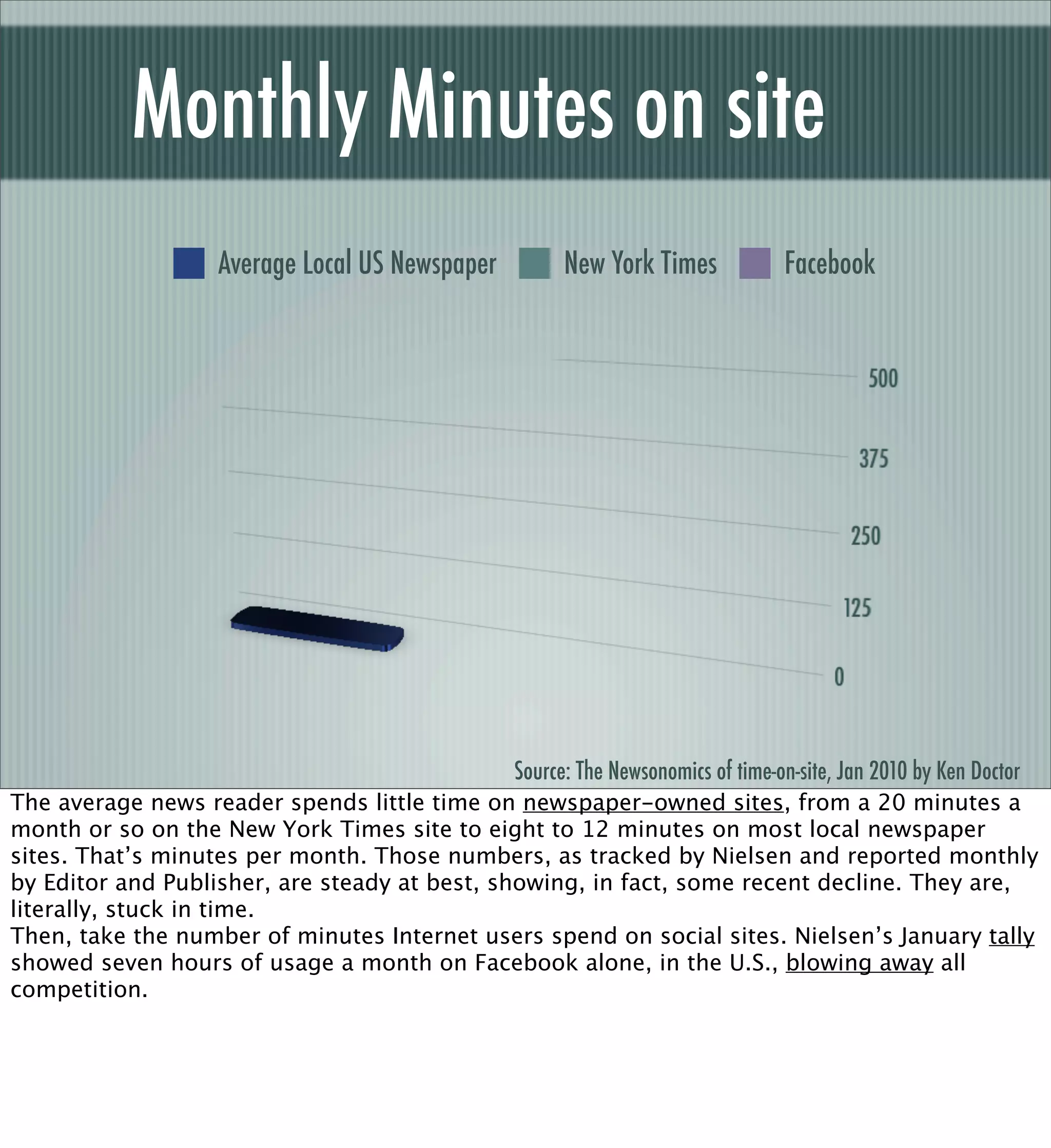
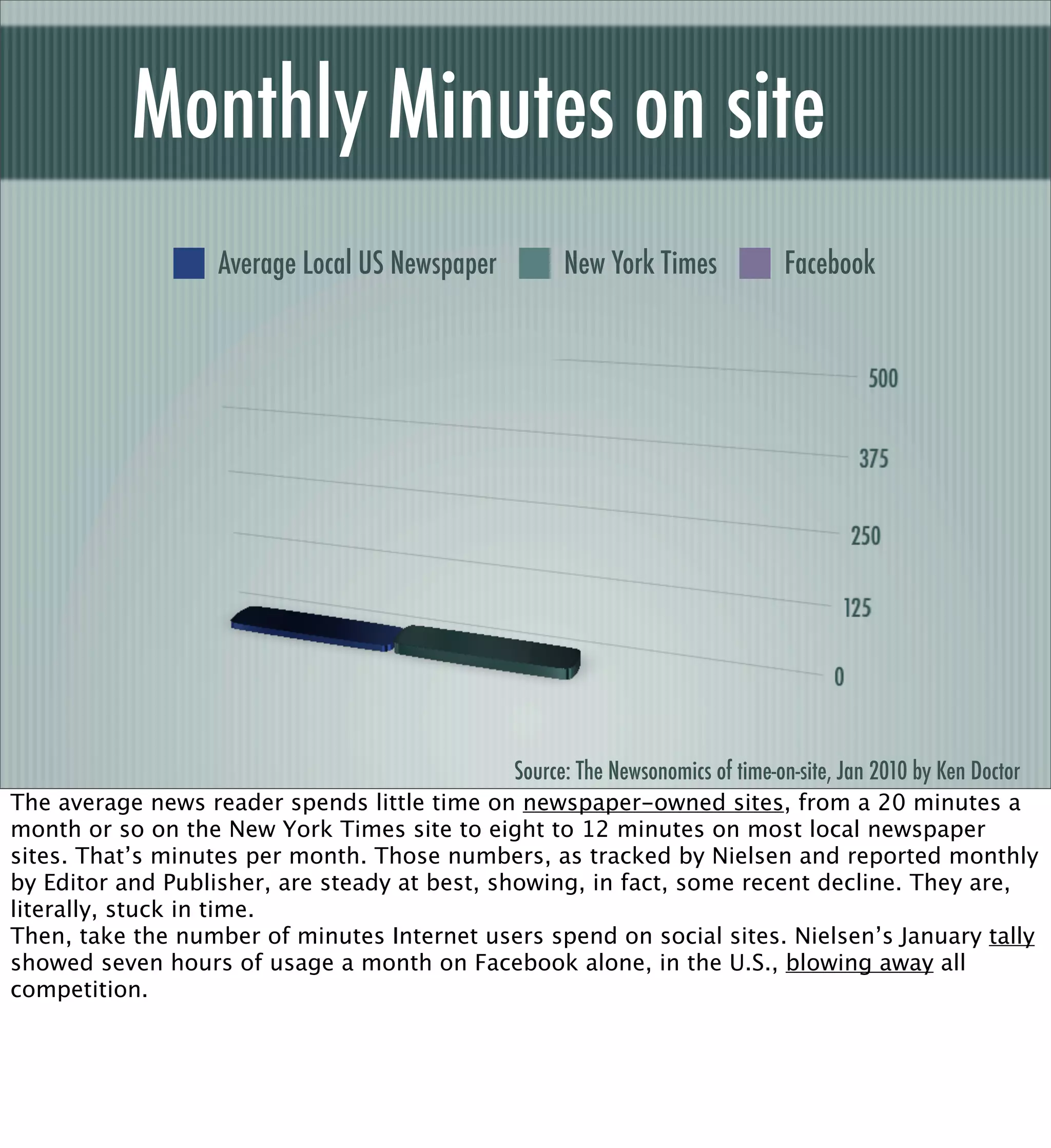
Monthly Minutes on site
                   Average Local US Newspaper         New York Times             Facebook


                                                Source: The Newsonomics of time-on-site, Jan 2010 by Ken Doctor
The average news reader spends little time on newspaper-owned sites, from a 20 minutes a
month or so on the New York Times site to eight to 12 minutes on most local newspaper
sites. That’s minutes per month. Those numbers, as tracked by Nielsen and reported monthly
by Editor and Publisher, are steady at best, showing, in fact, some recent decline. They are,
literally, stuck in time.
Then, take the number of minutes Internet users spend on social sites. Nielsen’s January tally
showed seven hours of usage a month on Facebook alone, in the U.S., blowing away all
competition.
(Information                      Overload) n

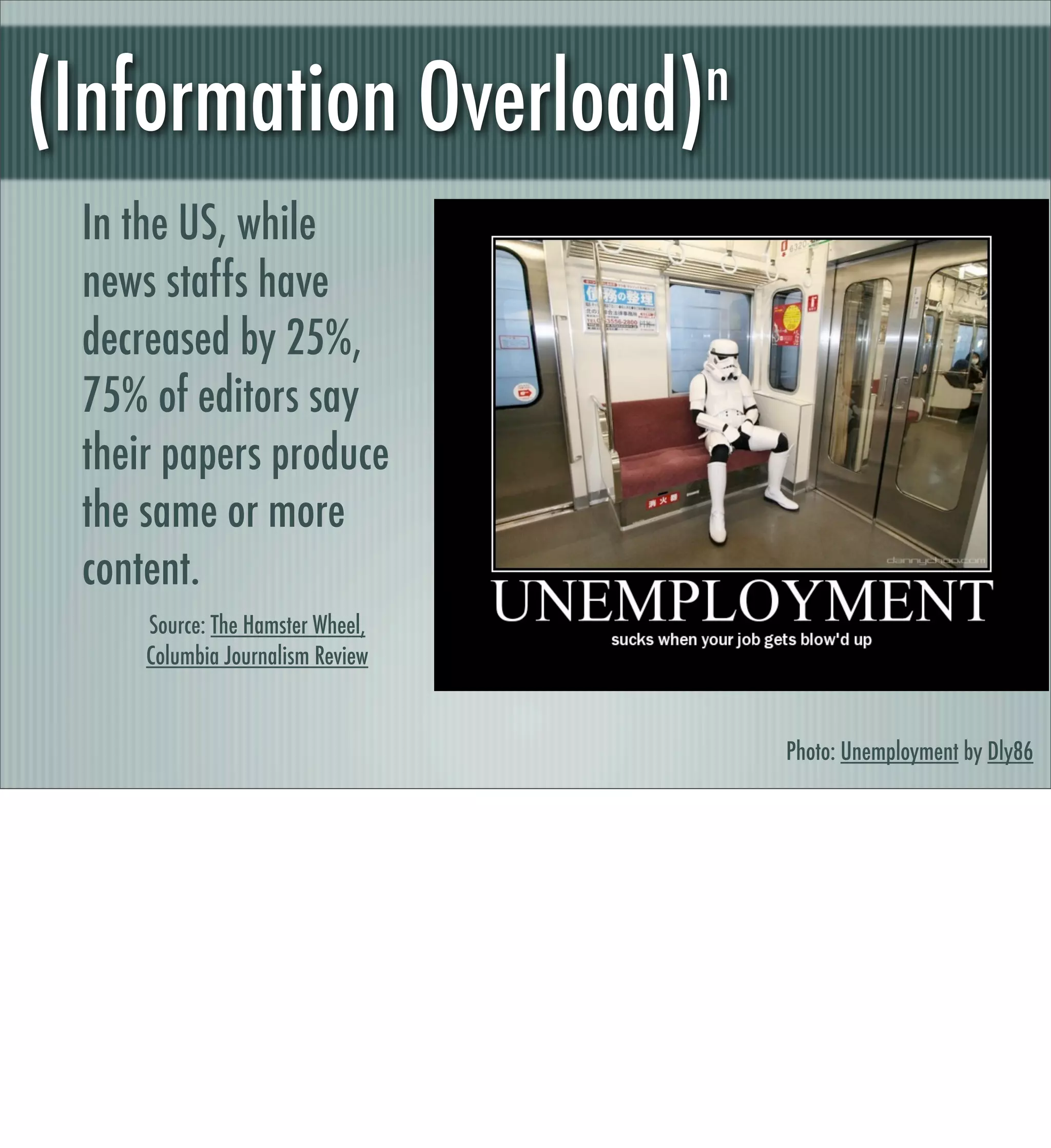
 In the US, while
 news staffs have
 decreased by 25%,
 75% of editors say
 their papers produce
 the same or more
 content.
     Source: The Hamster Wheel,
     Columbia Journalism Review


                                                Photo: Unemployment by Dly86
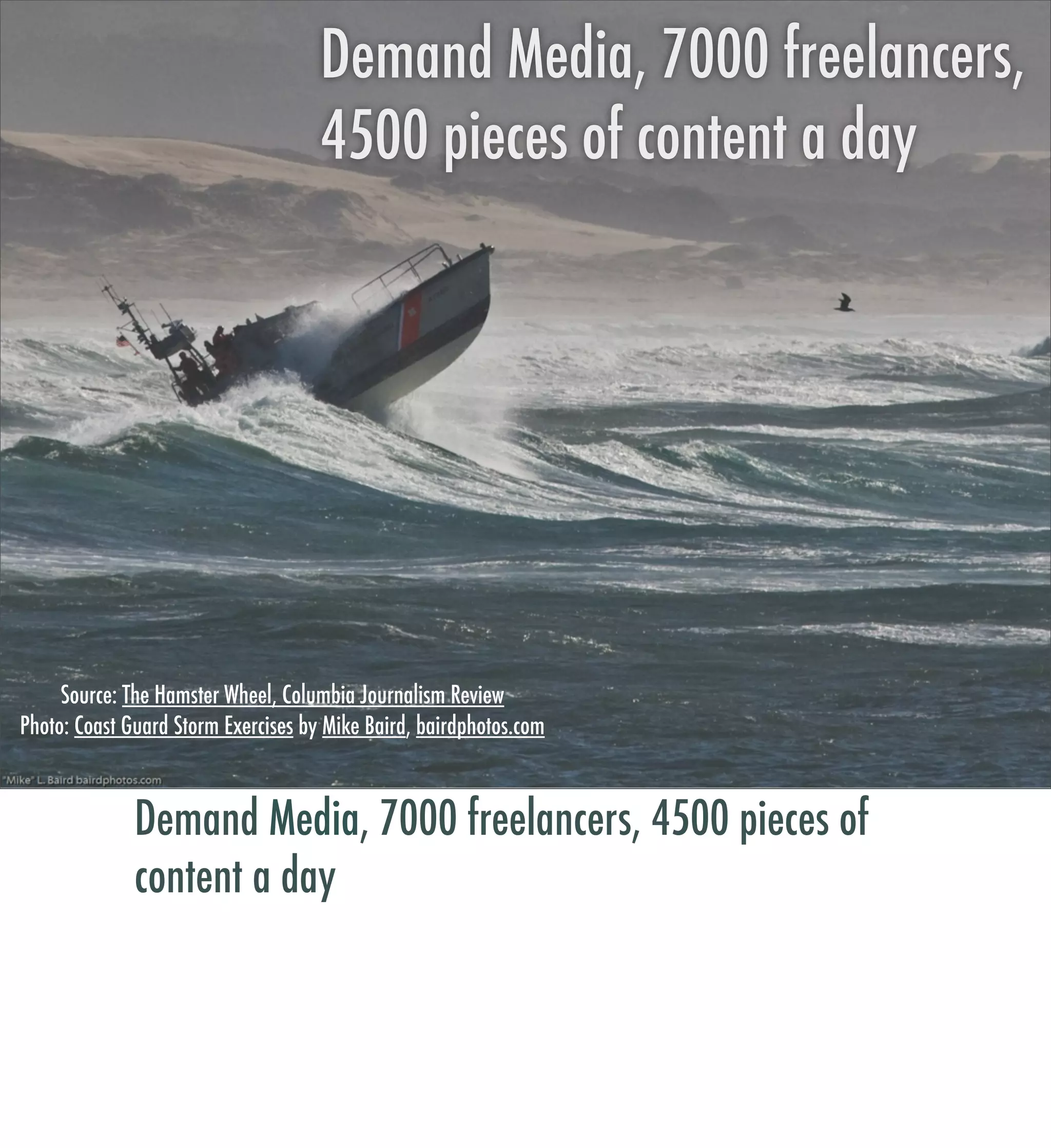
Demand Media, 7000 freelancers,
                                     4500 pieces of content a day


     Source: The Hamster Wheel, Columbia Journalism Review
Photo: Coast Guard Storm Exercises by Mike Baird, bairdphotos.com


              Demand Media, 7000 freelancers, 4500 pieces of
              content a day
Source on online revenue: Paid Content Photo: Newstand by Laura Bittner


           During recession, online ad rates plummeted due to
           oversupply of content Source: PaidContent
Huffington Post has very low returns compared to traditional media rivals. Average revenue
per user is just a little more than a dollar.

To put that in context, the New York Times digital revenue alone is $150m, according to an
estimate by analyst Henry Blodgett.
Source: Exhaustion by Jessica M. Cross


The Associated Press commissioned an ethnographic study of young news consumers, 18-34
but with an emphasis on 18-24.

One of the key findings: The subjects were overloaded with facts and updates and were
having trouble moving more deeply into the background and resolution of news stories.

Associated Press study
Source: Seedcamp winners riding
wave of relevant content by Jos White
 Photo: Where to begin by Bev Sykes


The Internet over the last few years has been about getting as much content to as many people as possible – bringing an incredible range of
content to our screens like never before. The problem is that we are now surrounded by too much content that takes too much time to find,
qualify and consume.
Seedcamp winners riding wave of relevant content by Jos White

Google and the other search engines do a decent job in a wide and shallow sort of way, but there is a growing need for technologies/
services that are able to work on a narrower and deeper level to make better sense of the content out there. There is lots of data available (if
we decide to give it) based on who we are, where we are, what we like and what we are looking for, and, if used intelligently it can enable
good decisions to be made in terms of providing us with more relevant content.
Out of the 12 winners at Seedcamp, seven are involved in optimising content in some way and making it more personalised to the user.
From mass to relevance


       The evolution from numbers to relevance by Mahendra Palsule
Source: Rebuild by Jewish Women's Archive

Bottom Line: Print media, particularly newspapers, need to rebuild the revenue model that
supports journalism and content creation
Relationship and relevance


                                                                          Photo: Intensely
                                                                       reading the newspaper
                                                                           in Addis Ababa
                                                                          by Terje Skjerdal


The future belongs to those who build a great relationship with their audience with best of
breed content and real engagement and those who are able to deliver the smartest, most
relevant content to audiences.
The social web as filter
Your social network as a filter
Social re-bundling of content


      Source: Building 43, Exclusive first look: A new kind of social media news reader: FlipBoard
Social media has to be social


                            Source: Cup of Robots - on White by Hobvias Sudoneighm
You cannot outsource your social media strategy to robots.
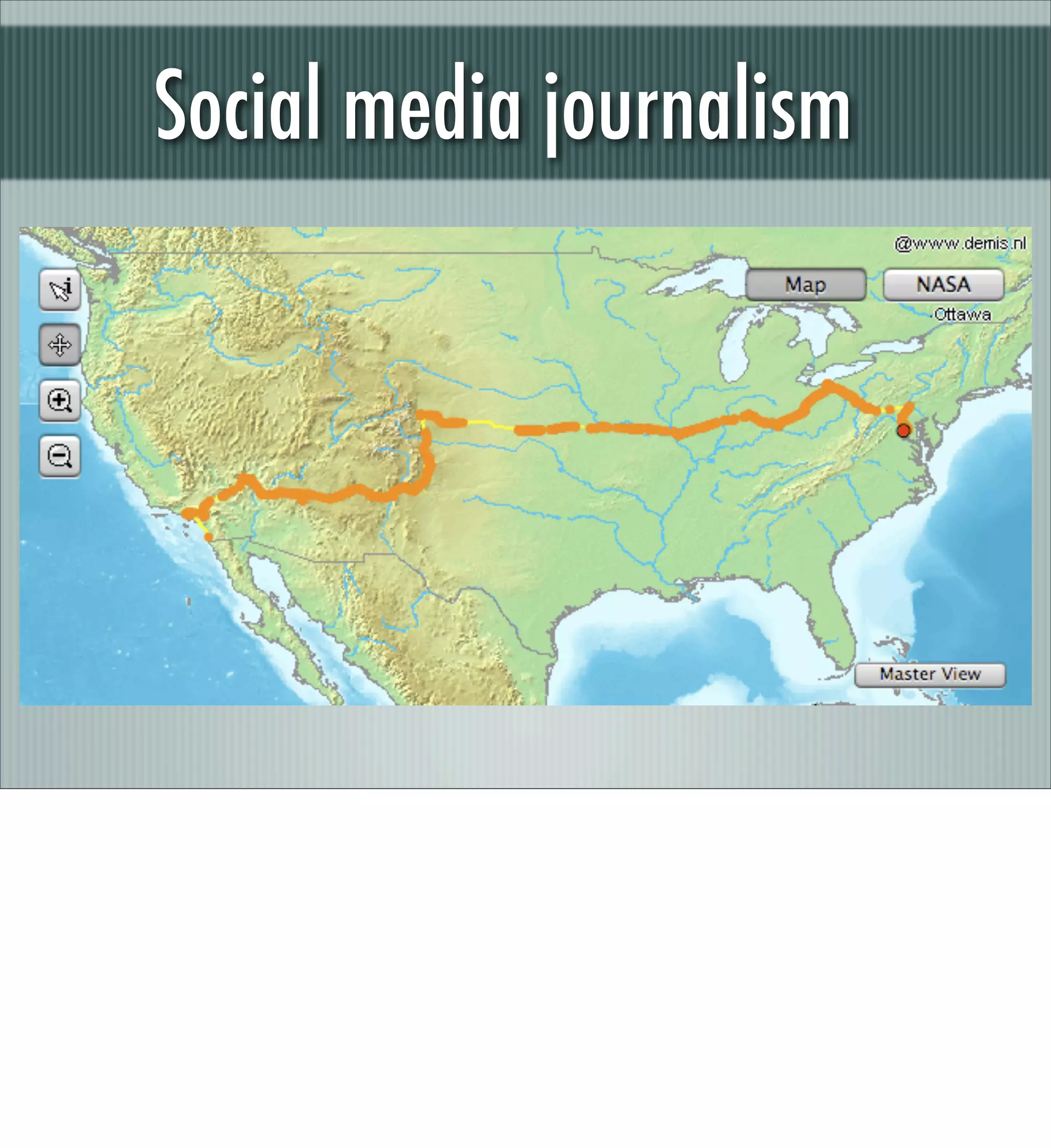
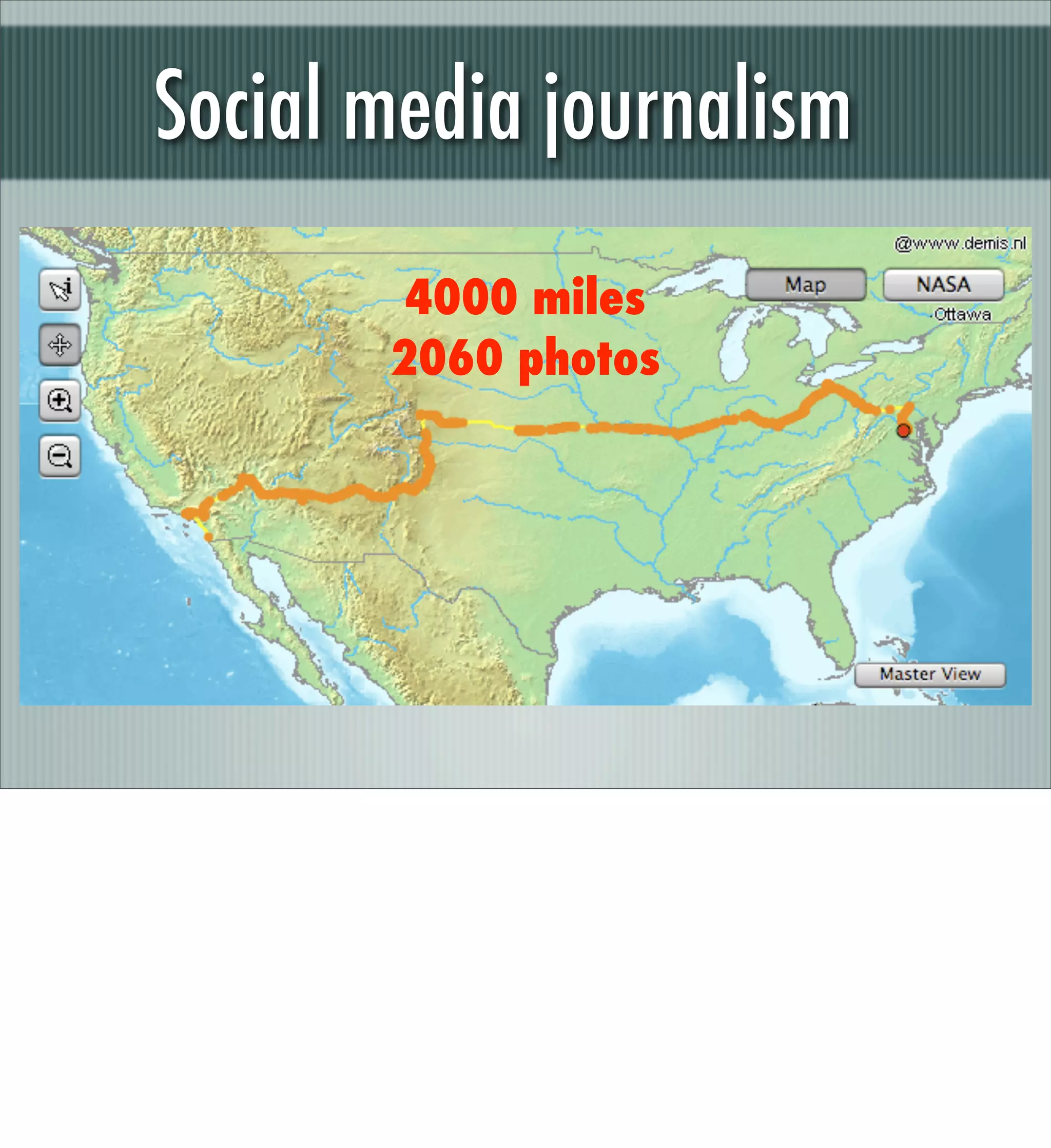
Social media journalism
          4000 miles
         2060 photos
     1600 Twitter upates
         50 blog posts
      4 blogger meetups
          2 podcasts
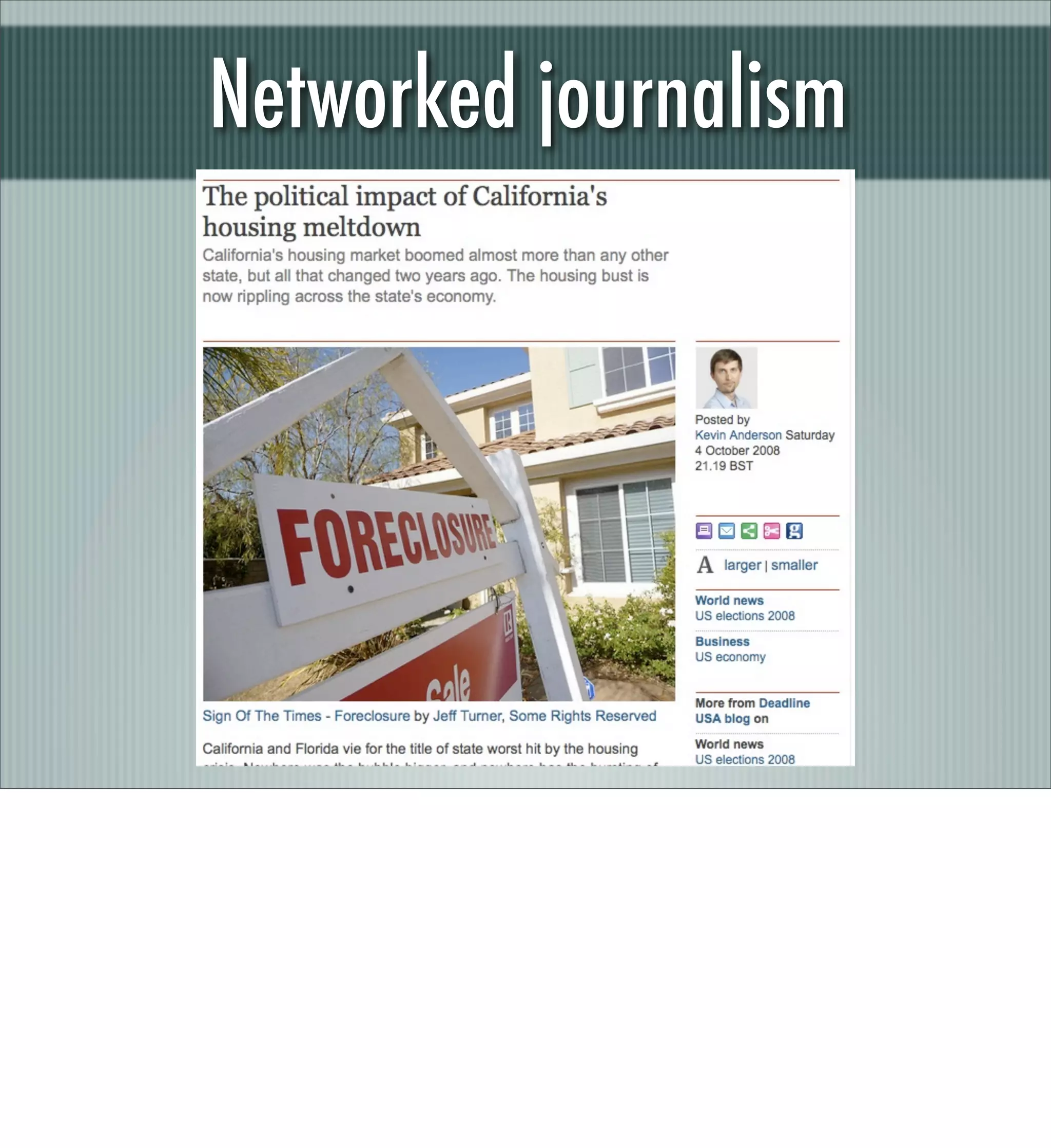
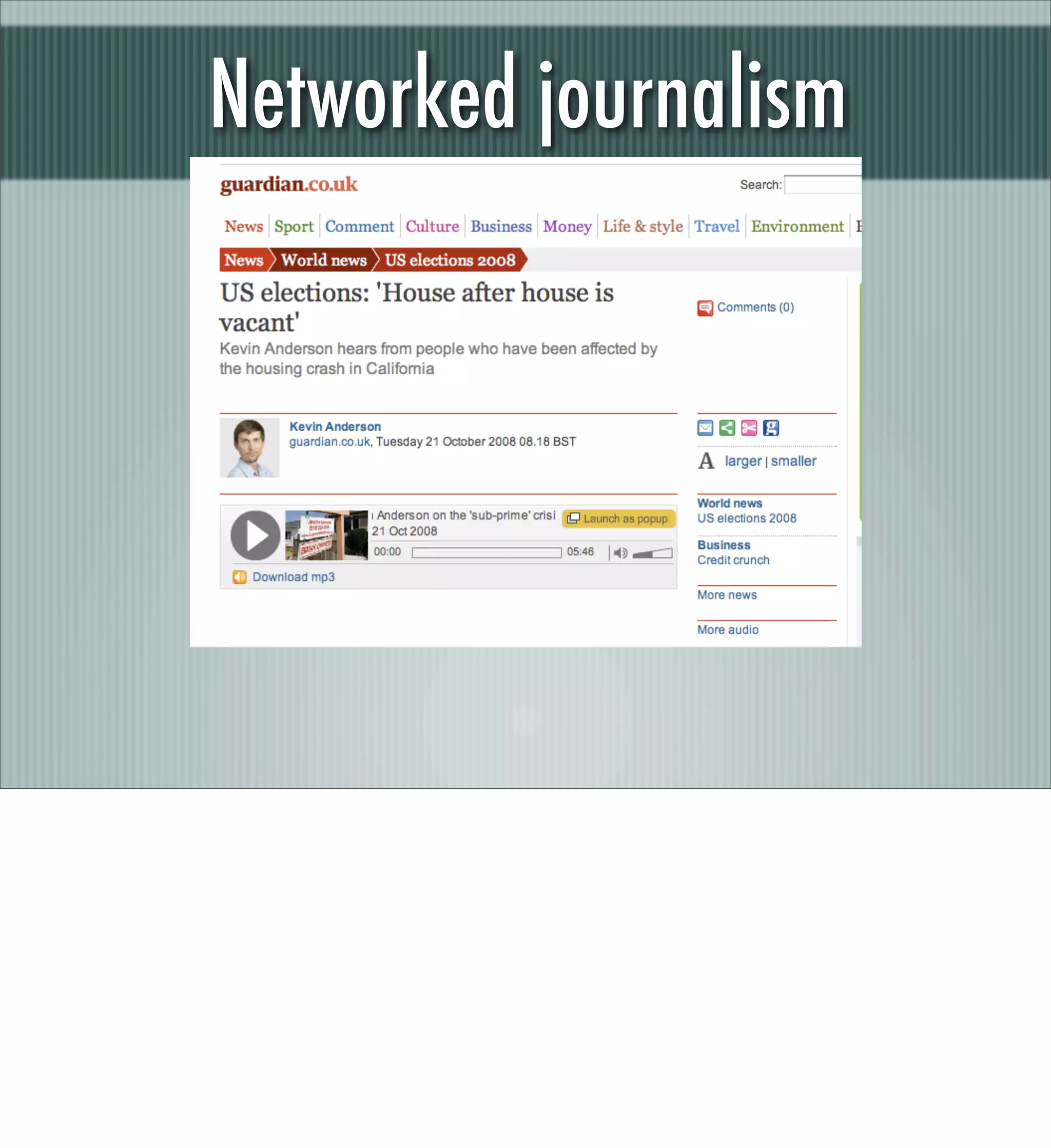
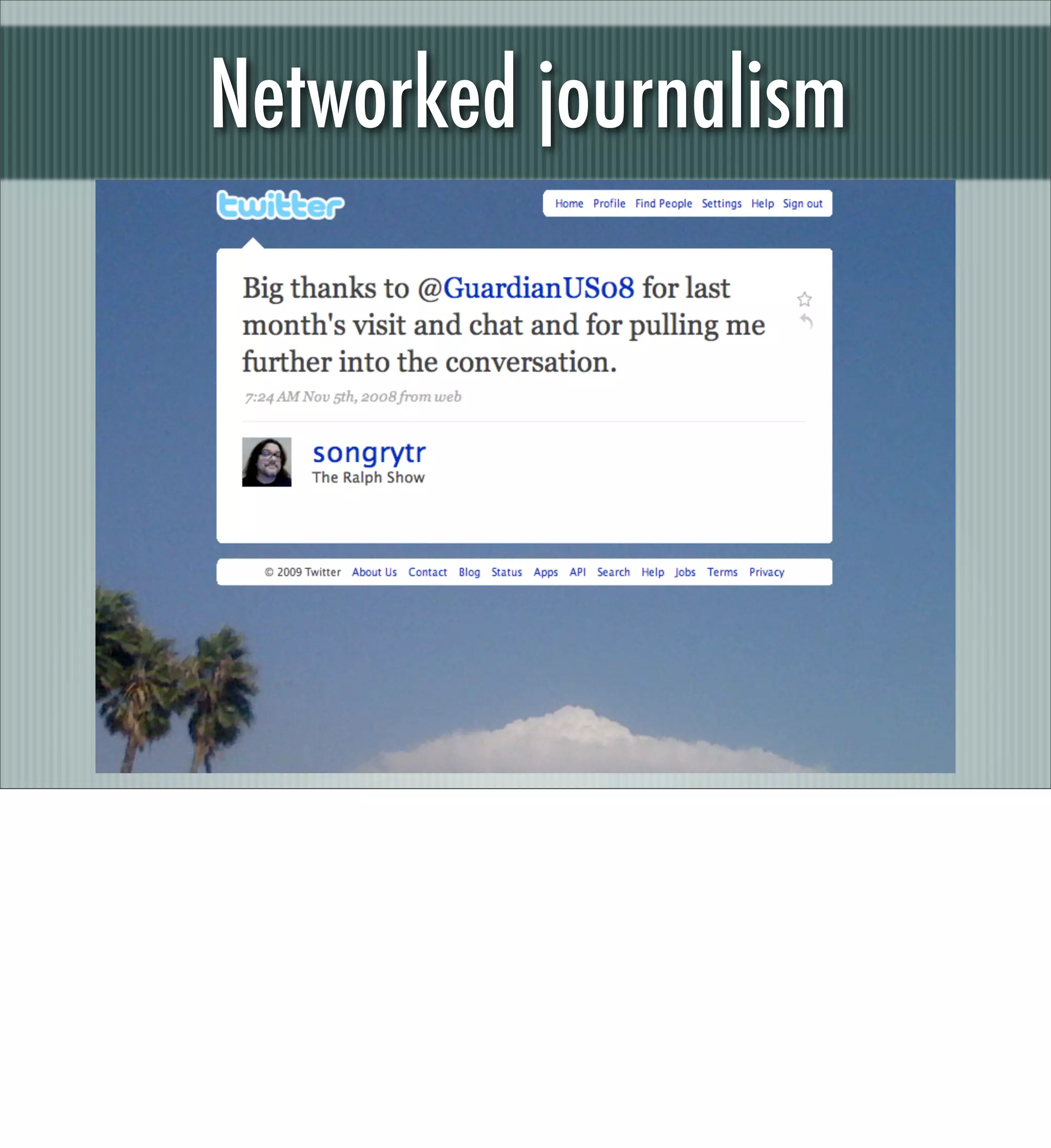
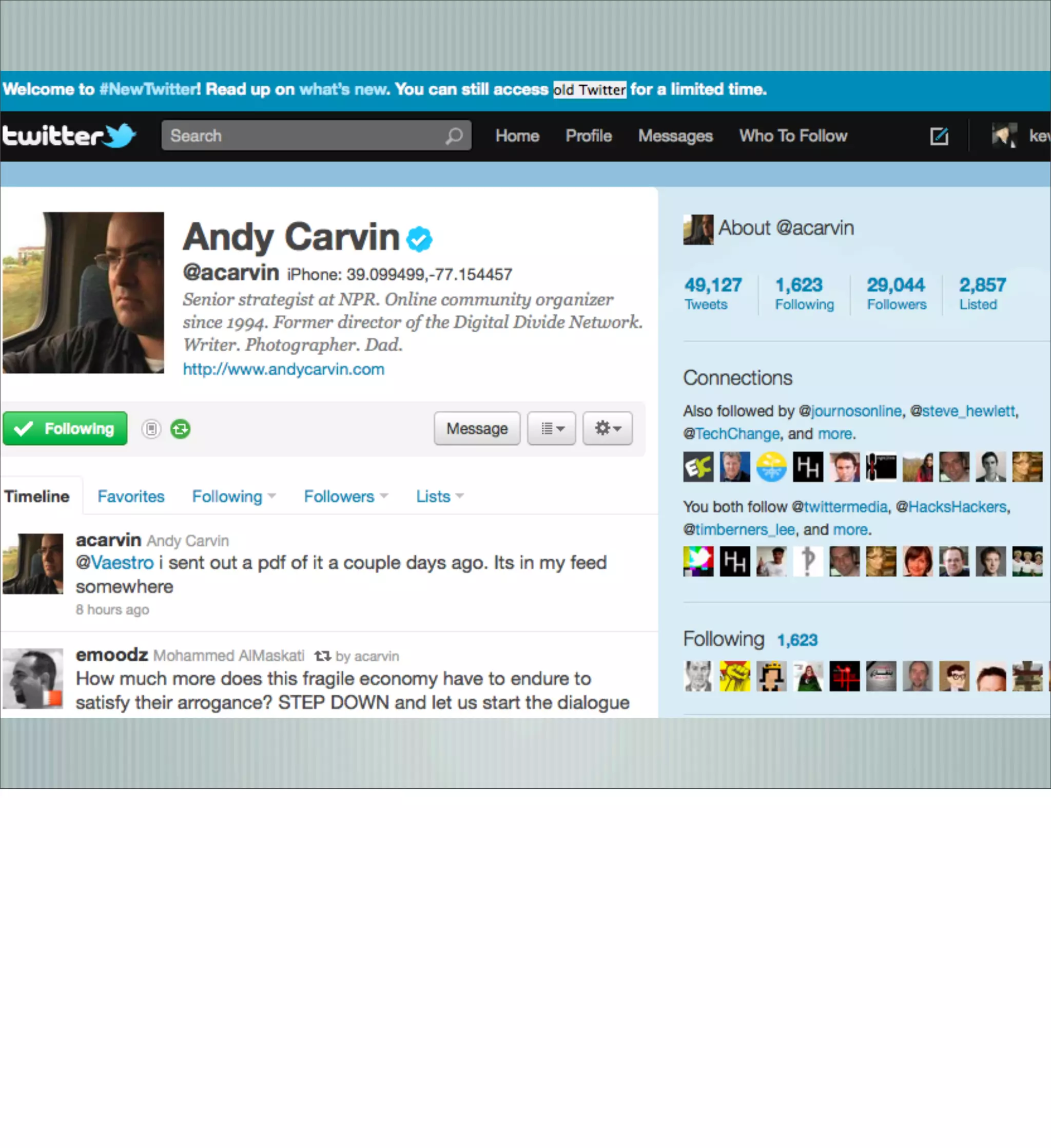
Networked journalism
Praise for Andy
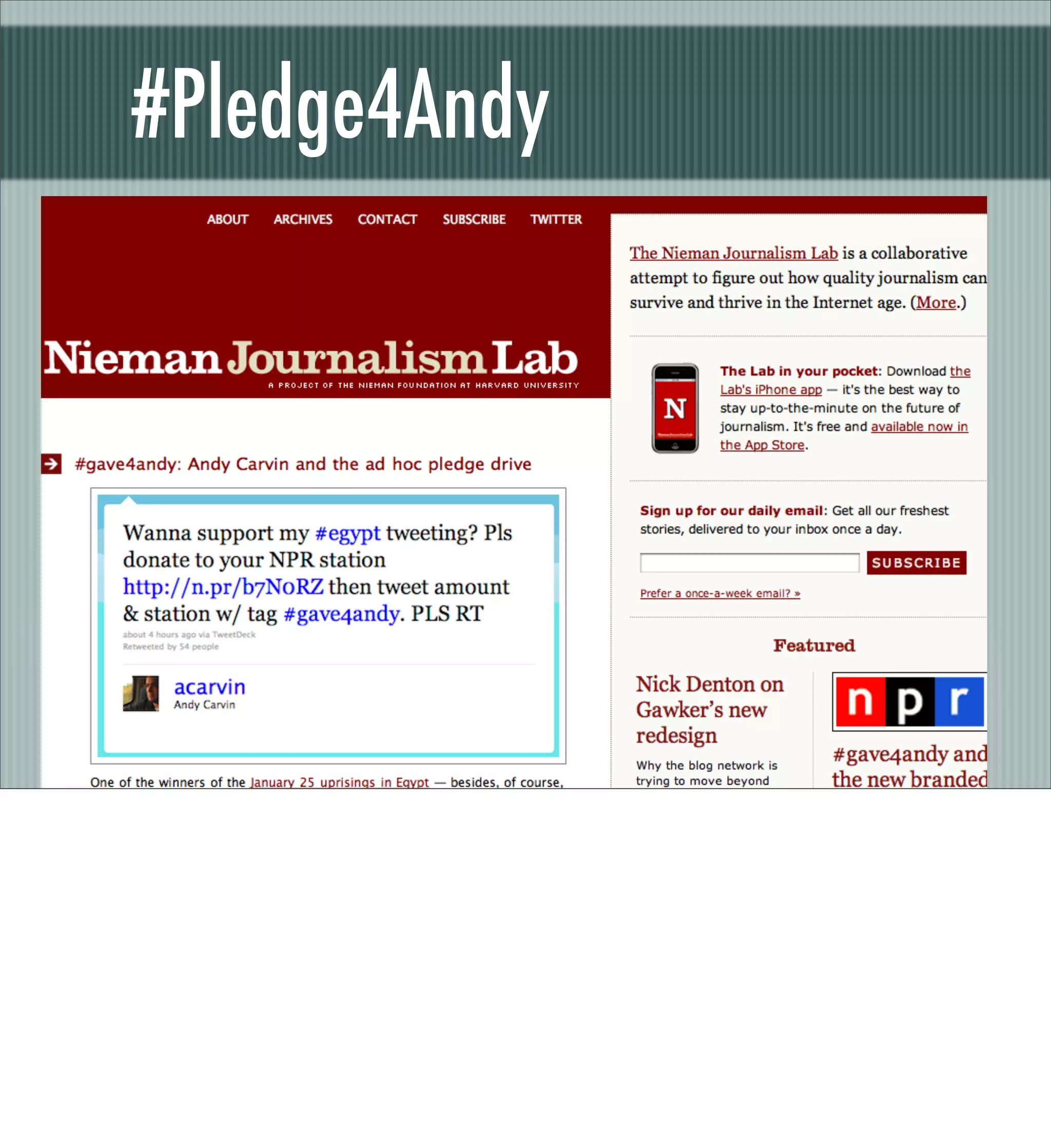
#Pledge4Andy
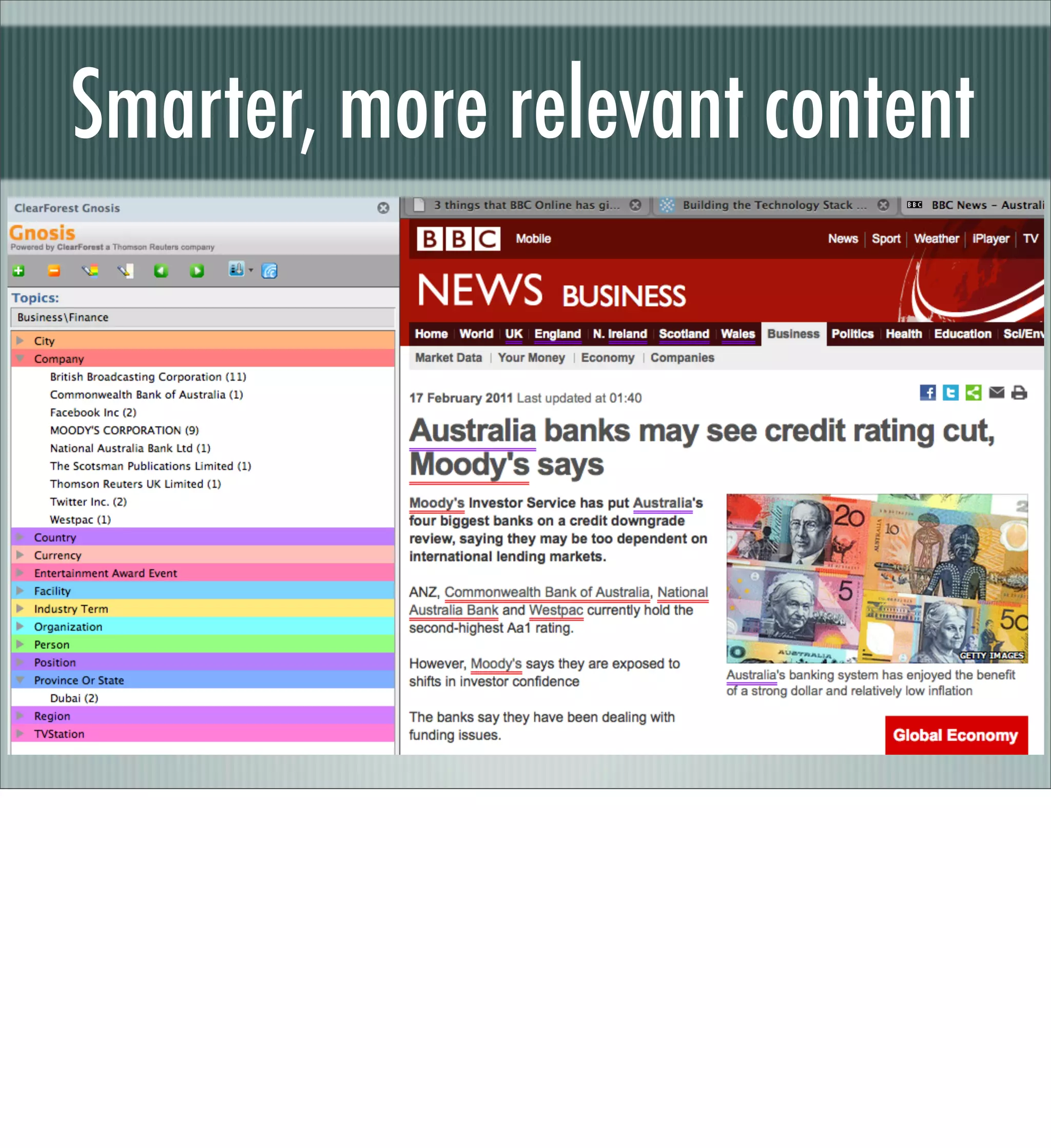
Smarter, more relevant content
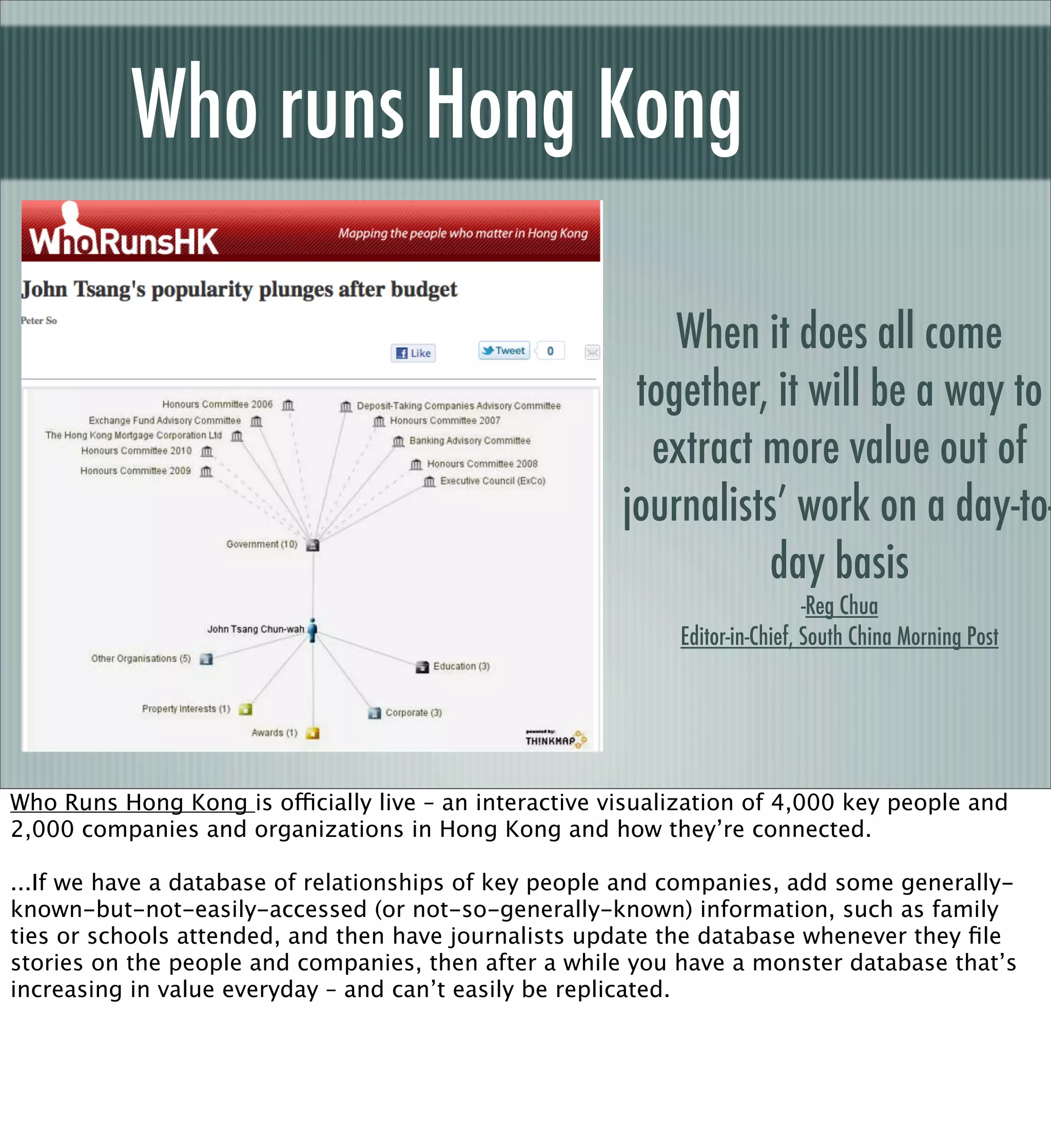
Who runs Hong Kong

                                                            When it does all come
                                                         together, it will be a way to
                                                          extract more value out of
                                                        journalists’ work on a day-to-
                                                                   day basis
                                                                              -Reg Chua
                                                             Editor-in-Chief, South China Morning Post


Who Runs Hong Kong is officially live – an interactive visualization of 4,000 key people and
2,000 companies and organizations in Hong Kong and how they’re connected.  

...If we have a database of relationships of key people and companies, add some generally-
known-but-not-easily-accessed (or not-so-generally-known) information, such as family
ties or schools attended, and then have journalists update the database whenever they file
stories on the people and companies, then after a while you have a monster database that’s
increasing in value everyday – and can’t easily be replicated.
Real-time and real-space


      Source: Google

And LOCATION
Location and the new loyalty


               Source: Location-based Marketing on Foursquare by Global X
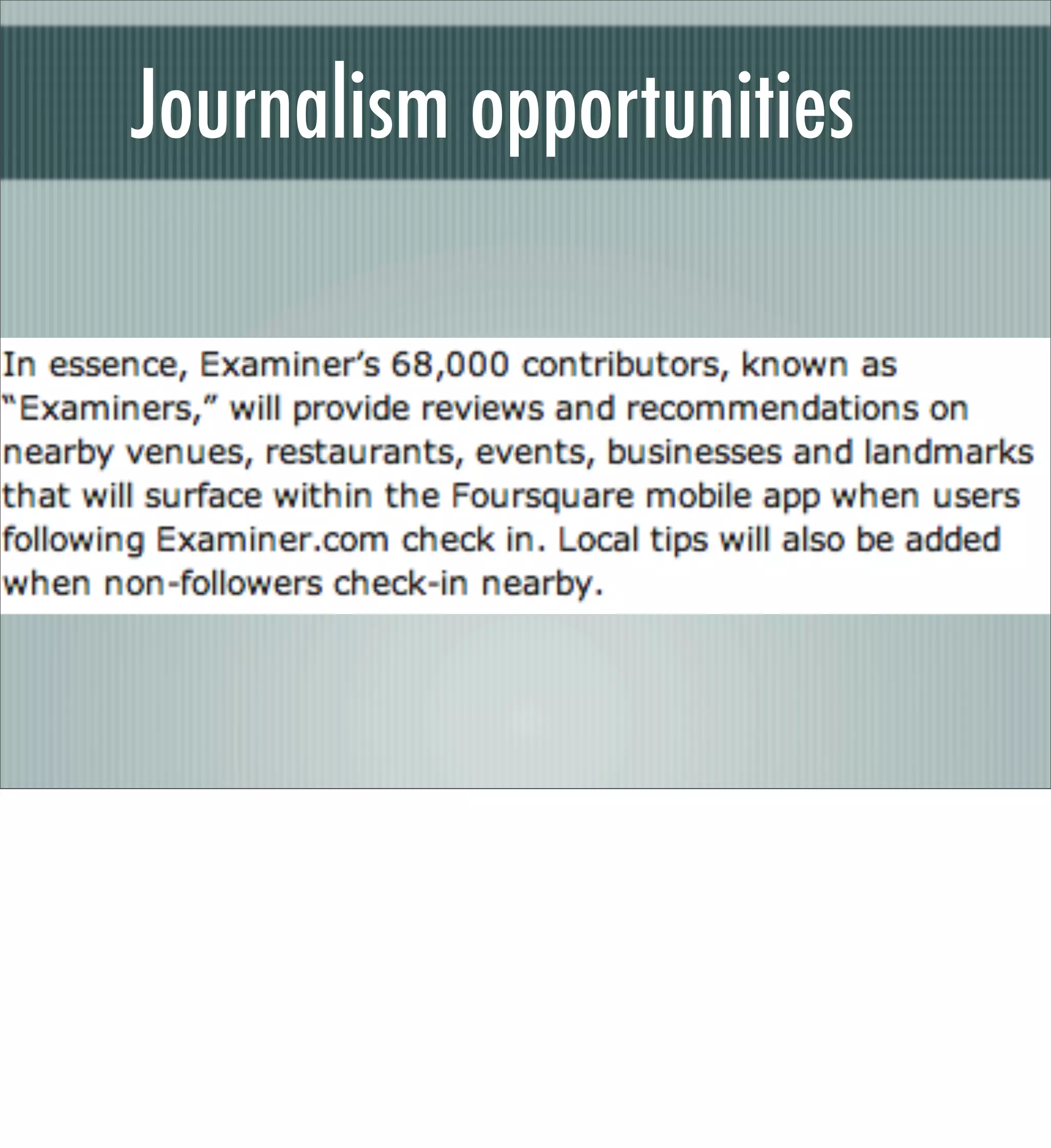
Journalism opportunities
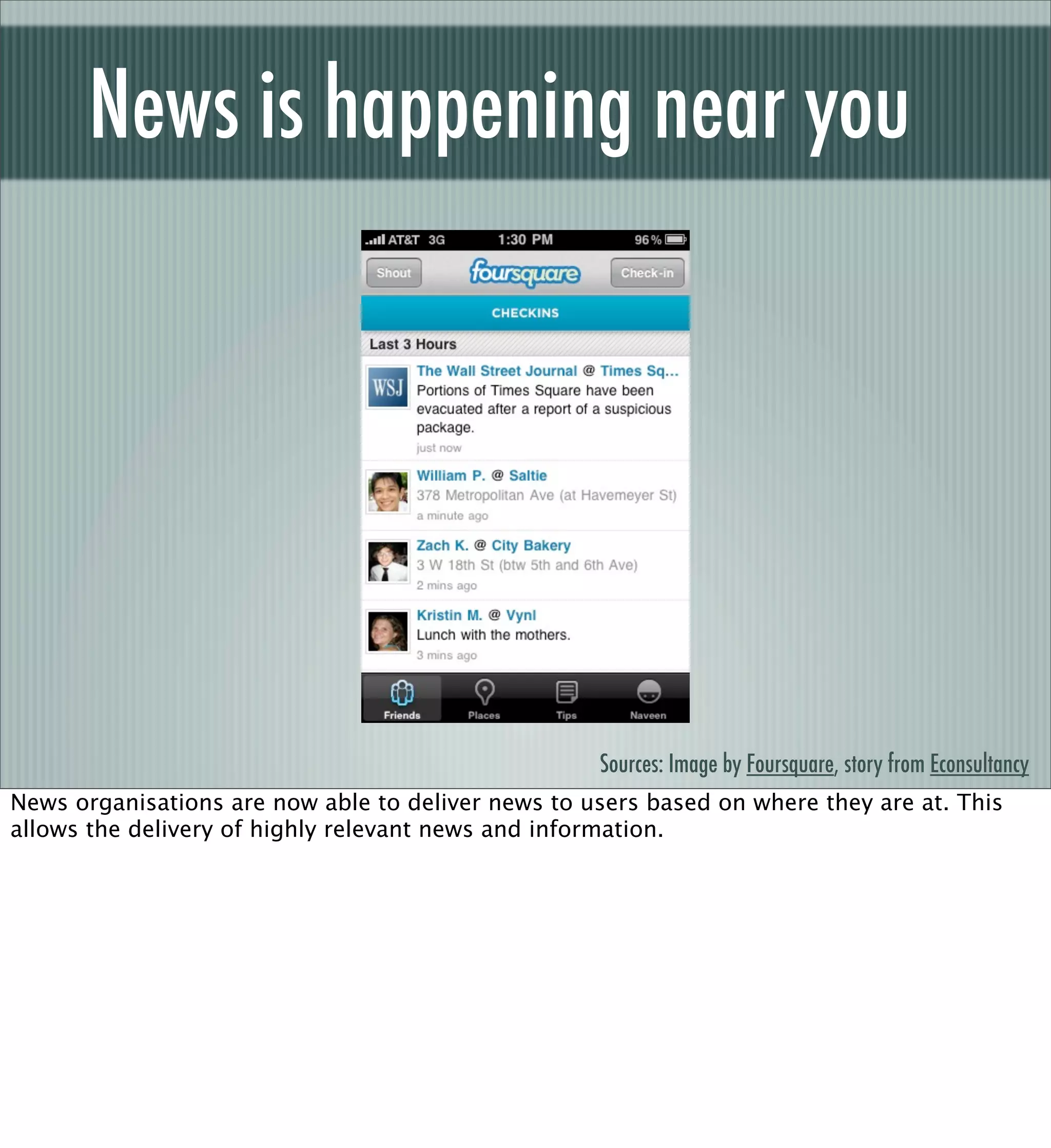
News is happening near you


                                                    Sources: Image by Foursquare, story from Econsultancy
News organisations are now able to deliver news to users based on where they are at. This
allows the delivery of highly relevant news and information.
What’s stopping you?

    How many
psychiatrists does it
 take to change a
    light bulb?
  Photo: an idea (the light bulb) by Alosh Bennet
One...but the light bulb has to want to change


                          Photo massive change by 416style
Kevin Anderson
       Twitter: kevglobal
kevin@charman-anderson.com
http://charman-anderson.com
Rebuilding Journalism: Winning the battle for attention

Rebuilding Journalism: Winning the battle for attention

  • 1.
    Rebooting journalism Finding newopportunities in a world of over abundant content and scarce attention
  • 2.
    Are you sufferingfrom IOS? Source: Xerox and YouTube
  • 3.
    Eric Schmidt ofGoogle “Between the birth of the world and 2003, there were five exabytes of information created. We [now] create five exabytes every two days. See why it’s so painful to operate in information markets?” from interview at Atmosphere 2010 conference Photo by Charles Haynes, Some Rights Reserved
  • 4.
    How much isexabyte? 1 exabyte= 100,000 10 terabytes= Photo by msmariamad, Some Rights Reserved An exabyte is 1 million terabytes The entire printed collection of the US Library of Congress is 10 terabytes An exabyte is 100,000 Libraries of Congress
  • 5.
    Media: From scarcityto abundance Eric Schmidt at the Guardian Activate 2010 conference
  • 6.
    Source: Twitter bythe Numbers, Raffi Krikorian Record 3283 tweets per second set during Japan v Denmark World Cup Match
  • 7.
    Source: Image Week17: 2011, LES GO! by ishawalia, statistics USAToday 750m photos uploaded to Facebook on New Year’s 2011.
  • 8.
    A decade ago,The Wall Street Journal wrote 22,000 articles. In 2010, it created 21,000 articles in the first six months. Source: The Hamster Wheel, Columbia Journalism Review Photo: Rupert Murdoch is on my driveway by Kevin Dooley Let’s look at what we in the media are doing: A decade ago, The Wall Street Journal wrote 22,000 articles. In 2010, it has created 21,000 articles in the first six months.
  • 9.
    Abundance breaks more things than scarcity does Photo: Clay making a point by Joi Ito Source: Shirky at NFAIS: How Abundance Breaks Everything by Ann Michael Society knows how to react to scarcity.” We know how to ration, save, and preserve when we need to do so. It’s much harder to set priorities and find our path when information abounds. We may drown. We may get side-tracked. We may shut down. But, in any case, abundance confuses and distracts us more than scarcity does.
  • 10.
    Three challenges facingjournalism We’re losing the battle for attention More content is leading to lower revenues We’re overwhelming audiences into inaction
  • 11.
    Monthly Minutes onsite Average Local US Newspaper New York Times Facebook Source: The Newsonomics of time-on-site, Jan 2010 by Ken Doctor The average news reader spends little time on newspaper-owned sites, from a 20 minutes a month or so on the New York Times site to eight to 12 minutes on most local newspaper sites. That’s minutes per month. Those numbers, as tracked by Nielsen and reported monthly by Editor and Publisher, are steady at best, showing, in fact, some recent decline. They are, literally, stuck in time. Then, take the number of minutes Internet users spend on social sites. Nielsen’s January tally showed seven hours of usage a month on Facebook alone, in the U.S., blowing away all competition.
  • 12.
    (Information Overload) n In the US, while news staffs have decreased by 25%, 75% of editors say their papers produce the same or more content. Source: The Hamster Wheel, Columbia Journalism Review Photo: Unemployment by Dly86
  • 13.
    Demand Media, 7000freelancers, 4500 pieces of content a day Source: The Hamster Wheel, Columbia Journalism Review Photo: Coast Guard Storm Exercises by Mike Baird, bairdphotos.com Demand Media, 7000 freelancers, 4500 pieces of content a day
  • 14.
    Source on onlinerevenue: Paid Content Photo: Newstand by Laura Bittner During recession, online ad rates plummeted due to oversupply of content Source: PaidContent Huffington Post has very low returns compared to traditional media rivals. Average revenue per user is just a little more than a dollar. To put that in context, the New York Times digital revenue alone is $150m, according to an estimate by analyst Henry Blodgett.
  • 15.
    Source: Exhaustion byJessica M. Cross The Associated Press commissioned an ethnographic study of young news consumers, 18-34 but with an emphasis on 18-24. One of the key findings: The subjects were overloaded with facts and updates and were having trouble moving more deeply into the background and resolution of news stories. Associated Press study
  • 16.
    Source: Seedcamp winnersriding wave of relevant content by Jos White Photo: Where to begin by Bev Sykes The Internet over the last few years has been about getting as much content to as many people as possible – bringing an incredible range of content to our screens like never before. The problem is that we are now surrounded by too much content that takes too much time to find, qualify and consume. Seedcamp winners riding wave of relevant content by Jos White Google and the other search engines do a decent job in a wide and shallow sort of way, but there is a growing need for technologies/ services that are able to work on a narrower and deeper level to make better sense of the content out there. There is lots of data available (if we decide to give it) based on who we are, where we are, what we like and what we are looking for, and, if used intelligently it can enable good decisions to be made in terms of providing us with more relevant content. Out of the 12 winners at Seedcamp, seven are involved in optimising content in some way and making it more personalised to the user.
  • 18.
    From mass torelevance The evolution from numbers to relevance by Mahendra Palsule
  • 19.
    Source: Rebuild byJewish Women's Archive Bottom Line: Print media, particularly newspapers, need to rebuild the revenue model that supports journalism and content creation
  • 20.
    Relationship and relevance Photo: Intensely reading the newspaper in Addis Ababa by Terje Skjerdal The future belongs to those who build a great relationship with their audience with best of breed content and real engagement and those who are able to deliver the smartest, most relevant content to audiences.
  • 21.
    The social webas filter
  • 22.
    Your social networkas a filter
  • 23.
    Social re-bundling ofcontent Source: Building 43, Exclusive first look: A new kind of social media news reader: FlipBoard
  • 24.
    Social media hasto be social Source: Cup of Robots - on White by Hobvias Sudoneighm You cannot outsource your social media strategy to robots.
  • 25.
    Social media journalism 4000 miles 2060 photos 1600 Twitter upates 50 blog posts 4 blogger meetups 2 podcasts
  • 26.
  • 28.
  • 29.
  • 30.
  • 31.
    Who runs HongKong When it does all come together, it will be a way to extract more value out of journalists’ work on a day-to- day basis -Reg Chua Editor-in-Chief, South China Morning Post Who Runs Hong Kong is officially live – an interactive visualization of 4,000 key people and 2,000 companies and organizations in Hong Kong and how they’re connected.   ...If we have a database of relationships of key people and companies, add some generally- known-but-not-easily-accessed (or not-so-generally-known) information, such as family ties or schools attended, and then have journalists update the database whenever they file stories on the people and companies, then after a while you have a monster database that’s increasing in value everyday – and can’t easily be replicated.
  • 32.
    Real-time and real-space Source: Google And LOCATION
  • 33.
    Location and thenew loyalty Source: Location-based Marketing on Foursquare by Global X
  • 34.
  • 35.
    News is happeningnear you Sources: Image by Foursquare, story from Econsultancy News organisations are now able to deliver news to users based on where they are at. This allows the delivery of highly relevant news and information.
  • 36.
    What’s stopping you? How many psychiatrists does it take to change a light bulb? Photo: an idea (the light bulb) by Alosh Bennet
  • 37.
    One...but the lightbulb has to want to change Photo massive change by 416style
  • 38.
    Kevin Anderson Twitter: kevglobal kevin@charman-anderson.com http://charman-anderson.com