Future of News(papers) A review of business models, experiments, innovations, and more Seth C. Lewis School of Journalism, UT-Austin [email_address]
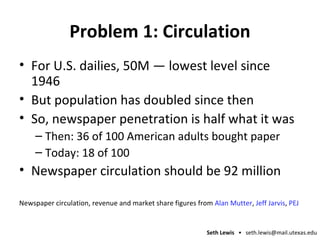
Overview State of the newspaper industry Fundamental shift from print to online Emerging forms of journalism But, wait—  show me the money! Are these  really  profitable business models? How should we restructure the newsroom? Seeing a post-print future
State of the News(paper) Industry
In a word …
UGLY
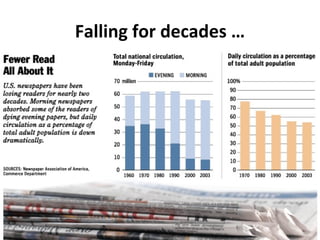
Problem 1: Circulation For U.S. dailies, 50M — lowest level since 1946 But population has doubled since then So, newspaper penetration is half what it was Then: 36 of 100 American adults bought paper Today: 18 of 100 Newspaper circulation should be 92 million Newspaper circulation, revenue and market share figures from  Alan Mutter ,  Jeff Jarvis ,  PEJ
Falling for decades …
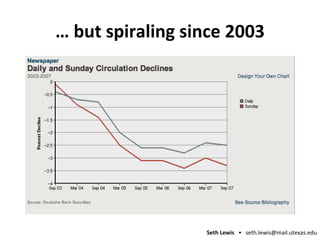
… but spiraling since 2003
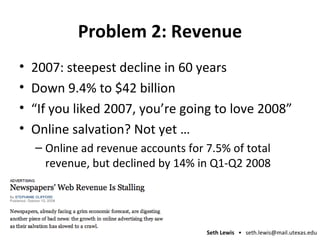
Problem 2: Revenue 2007: steepest decline in 60 years Down 9.4% to $42 billion “If you liked 2007, you’re going to love 2008” Online salvation? Not yet … Online ad revenue accounts for 7.5% of total revenue, but declined by 14% in Q1-Q2 2008
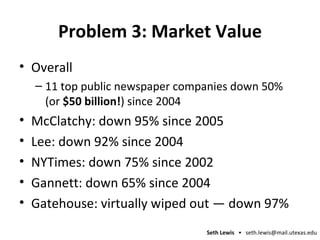
Problem 3: Market Value Overall 11 top public newspaper companies down 50%  (or  $50 billion! ) since 2004 McClatchy: down 95% since 2005 Lee: down 92% since 2004 NYTimes: down 75% since 2002 Gannett: down 65% since 2004 Gatehouse: virtually wiped out — down 97%
Newsroom jobs lost 2007: 2,185 2008:  8,118  so far
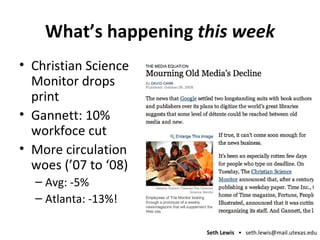
What’s happening  this week Christian Science Monitor drops print Gannett: 10% workfoce cut More circulation woes (’07 to ‘08) Avg: -5% Atlanta: -13%!
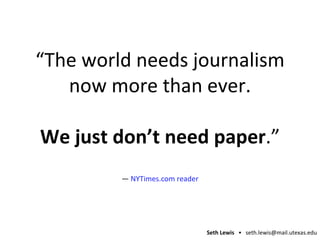
“ The world needs journalism now more than ever. We just don’t need paper .” —  NYTimes.com reader
Fundamental shift: analog --> digital
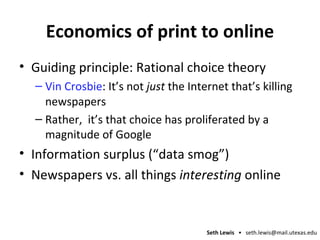
Economics of print to online Guiding principle: Rational choice theory Vin Crosbie : It’s not  just  the Internet that’s killing newspapers Rather,  it’s that choice has proliferated by a magnitude of Google Information surplus (“data smog”) Newspapers vs. all things  interesting  online
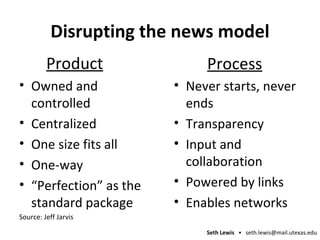
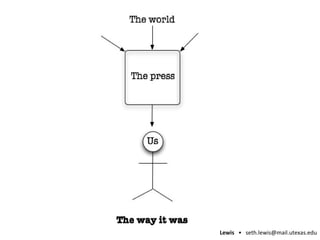
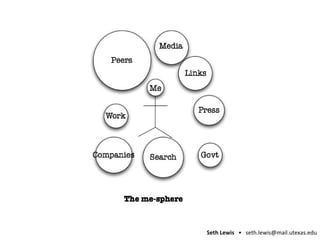
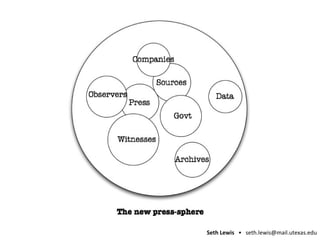
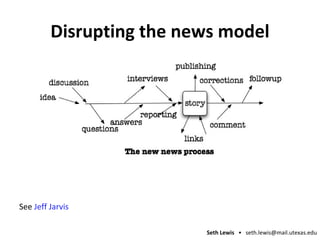
Disrupting the news model Owned and controlled Centralized One size fits all One-way “Perfection” as the standard package Source: Jeff Jarvis Never starts, never ends Transparency Input and collaboration Powered by links Enables networks Product Process


Disrupting the news model See  Jeff Jarvis
New models for news Pros … Hyperlocal coverage Link model Non-profit ventures Narrow and deep Amateurs … Citizen journalism Crowdsourcing
Bringing In the User: Emerging Forms of Journalism
What is user-generated content? Digital media content created and distributed by end-users formerly known as the audience Better put, it’s  “stuff from us”  Takes many forms: Blogs Wikis Social networking Visual communication sharing (Flickr, YouTube) And much more
UGC and Web 2.0: key characteristics Architecture:  Web  is  the platform; distributed, open-source feel to the software Participation : End-users play key role in  creating ,  rating  and  debating  content Network effects:  Value added as people use it Dynamic content:  Metadata, mashups, etc. Rich user interface Collectivity:  The crowd knows more than any one person individually
Creating platforms, not content Now, it’s all about  open  — open-source, open standards, open to everyone. No gates. Web publishers create platforms and let users create the content From one-way to multi-way communication From sealed-off information silos to empty warehouses waiting to be filled with “stuff” Source: Mark Briggs, “Journalism 2.0”
 
Rise of citizen media “In 2006, citizens made it clear that they wanted a voice. In 2007, more ways of doing that began to emerge and that voice became stronger. Now, 2008 looks to be the year the mainstream press tries to lure citizens toward creating the content within their own outlets.” State of the News Media 2008
Example 1: Citizen Journalism
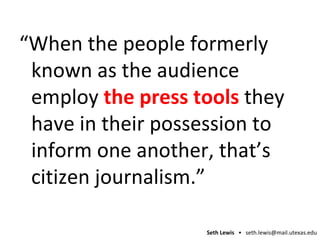
Jay Rosen’s definition Jay Rosen, 2008
“ When the  people formerly known as the audience   employ the press tools they have in their possession to inform one another, that’s citizen journalism.”
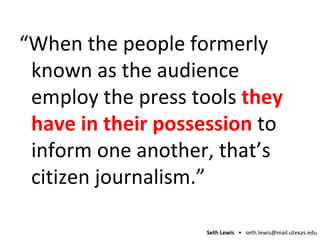
“ When the people formerly known as the audience  employ  the press tools they have in their possession to inform one another, that’s citizen journalism.”
“ When the people formerly known as the audience employ  the press tools  they have in their possession to inform one another, that’s citizen journalism.”
“ When the people formerly known as the audience employ the press tools  they have in their possession  to inform one another, that’s citizen journalism.”
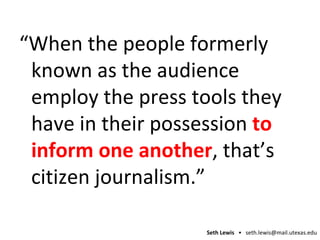
“ When the people formerly known as the audience  employ  the press tools they have in their possession  to inform one another , that’s citizen journalism.”
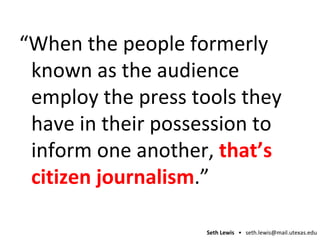
“ When the people formerly known as the audience  employ  the press tools they have in their possession to inform one another,  that’s citizen journalism .”
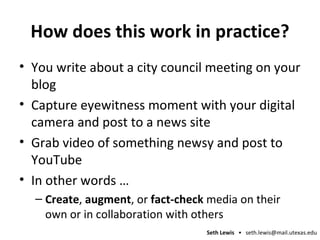
How does this work in practice? You write about a city council meeting on your blog Capture eyewitness moment with your digital camera and post to a news site Grab video of something newsy and post to YouTube In other words … Create ,  augment , or  fact-check  media on their own or in collaboration with others
 
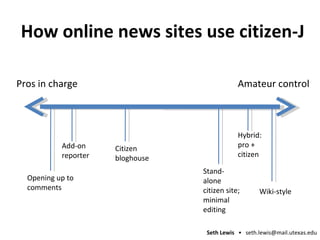
How online news sites use citizen-J Pros in charge Amateur control Opening up to comments Add-on reporter Citizen bloghouse Stand-alone citizen site; minimal editing Hybrid: pro + citizen Wiki-style
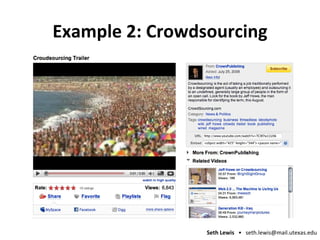
Example 2: Crowdsourcing
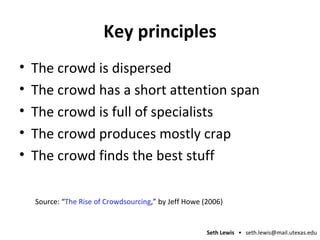
Key principles The crowd is dispersed The crowd has a short attention span The crowd is full of specialists The crowd produces mostly crap The crowd finds the best stuff Source: “ The Rise of Crowdsourcing ,” by Jeff Howe (2006)
Crowdsourcing and Journalism
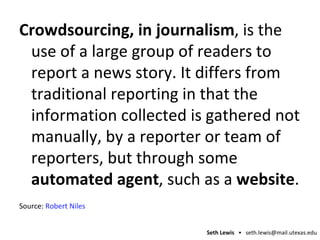
Crowdsourcing, in journalism , is the use of a large group of readers to report a news story. It differs from traditional reporting in that the information collected is gathered not manually, by a reporter or team of reporters, but through some  automated agent , such as a  website . Source:  Robert Niles
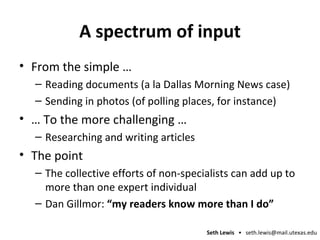
A spectrum of input From the simple … Reading documents (a la Dallas Morning News case) Sending in photos (of polling places, for instance) …  To the more challenging … Researching and writing articles The point The collective efforts of non-specialists can add up to more than one expert individual Dan Gillmor:  “my readers know more than I do”
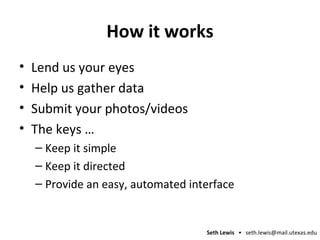
How it works Lend us your eyes Help us gather data Submit your photos/videos The keys … Keep it simple Keep it directed Provide an easy, automated interface
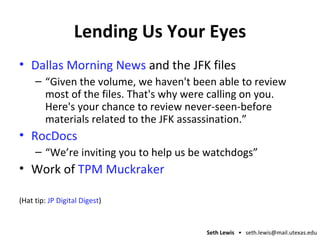
Lending Us Your Eyes Dallas Morning News  and the JFK files “ Given the volume, we haven't been able to review most of the files. That's why were calling on you. Here's your chance to review never-seen-before materials related to the JFK assassination.” RocDocs “ We’re inviting you to help us be watchdogs” Work of  TPM Muckraker (Hat tip:  JP Digital Digest )
Gathering ‘everyday’ info WNYC “ Are you being  gouged ?” Gas-guzzlers  on the street GasBuddy Problems at polling stations in  Cincy ?
And more Full articles written by users … Example:  NowPublic … or edited by users Example:  Wikinews Beyond journalism Google Image Labeler Amazon Mechanical Turk
Like citizen journalism, but … …  crowdsourcing is  easier Users are given bite-sized tasks to accomplish Time commitment can be small Unlike more traditional notions of “citizen journalism,” crowdsourcing does not ask readers to become anything more than what they’ve always been:  eyewitnesses to their daily lives .
Is crowdsourcing the future? “The failure of one citizen journalism Web business after another this year ought to be showing news publishers that a business model based on readers doing reporters’ jobs for free isn’t working.”  ( Robert Niles ) But be warned … Open-source journalism is  tough You have get the division of labor  just right
Show me the money! (or, can any of these ventures pay for themselves?)
Short answer:
Not yet.
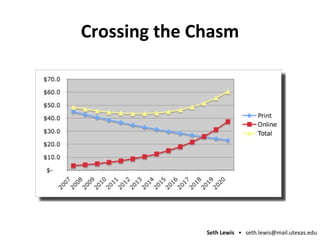
Let’s assume current conditions continue (same biz model, etc.)
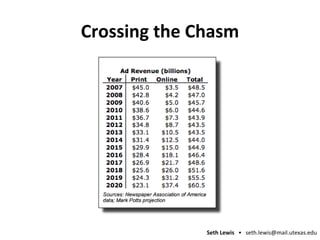
Crossing the Chasm: From Print to Online Revenue “ It’s going to be really bloody, incredibly devastating. And I think there are going to be a lot of major metros that don’t make it.” —  Mark Potts, recoveringjournalist.com
Crossing the Chasm
Crossing the Chasm
Is there hope in innovation?
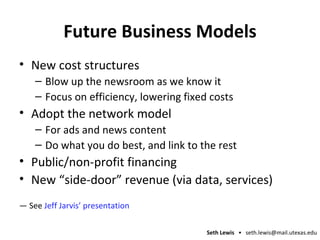
Future Business Models New cost structures Blow up the newsroom as we know it Focus on efficiency, lowering fixed costs Adopt the network model For ads and news content Do what you do best, and link to the rest Public/non-profit financing New “side-door” revenue (via data, services) —  See  Jeff Jarvis’ presentation
Or, be like Google

The Future of News(papers)

  • 1.
    Future of News(papers)A review of business models, experiments, innovations, and more Seth C. Lewis School of Journalism, UT-Austin [email_address]
  • 2.
    Overview State ofthe newspaper industry Fundamental shift from print to online Emerging forms of journalism But, wait— show me the money! Are these really profitable business models? How should we restructure the newsroom? Seeing a post-print future
  • 3.
    State of theNews(paper) Industry
  • 4.
  • 5.
  • 6.
    Problem 1: CirculationFor U.S. dailies, 50M — lowest level since 1946 But population has doubled since then So, newspaper penetration is half what it was Then: 36 of 100 American adults bought paper Today: 18 of 100 Newspaper circulation should be 92 million Newspaper circulation, revenue and market share figures from Alan Mutter , Jeff Jarvis , PEJ
  • 7.
  • 8.
  • 9.
    Problem 2: Revenue2007: steepest decline in 60 years Down 9.4% to $42 billion “If you liked 2007, you’re going to love 2008” Online salvation? Not yet … Online ad revenue accounts for 7.5% of total revenue, but declined by 14% in Q1-Q2 2008
  • 10.
    Problem 3: MarketValue Overall 11 top public newspaper companies down 50% (or $50 billion! ) since 2004 McClatchy: down 95% since 2005 Lee: down 92% since 2004 NYTimes: down 75% since 2002 Gannett: down 65% since 2004 Gatehouse: virtually wiped out — down 97%
  • 11.
    Newsroom jobs lost2007: 2,185 2008: 8,118 so far
  • 12.
    What’s happening this week Christian Science Monitor drops print Gannett: 10% workfoce cut More circulation woes (’07 to ‘08) Avg: -5% Atlanta: -13%!
  • 13.
    “ The worldneeds journalism now more than ever. We just don’t need paper .” — NYTimes.com reader
  • 14.
  • 15.
    Economics of printto online Guiding principle: Rational choice theory Vin Crosbie : It’s not just the Internet that’s killing newspapers Rather, it’s that choice has proliferated by a magnitude of Google Information surplus (“data smog”) Newspapers vs. all things interesting online
  • 16.
    Disrupting the newsmodel Owned and controlled Centralized One size fits all One-way “Perfection” as the standard package Source: Jeff Jarvis Never starts, never ends Transparency Input and collaboration Powered by links Enables networks Product Process
  • 17.
  • 18.
  • 19.
  • 20.
    Disrupting the newsmodel See Jeff Jarvis
  • 21.
    New models fornews Pros … Hyperlocal coverage Link model Non-profit ventures Narrow and deep Amateurs … Citizen journalism Crowdsourcing
  • 22.
    Bringing In theUser: Emerging Forms of Journalism
  • 23.
    What is user-generatedcontent? Digital media content created and distributed by end-users formerly known as the audience Better put, it’s “stuff from us” Takes many forms: Blogs Wikis Social networking Visual communication sharing (Flickr, YouTube) And much more
  • 24.
    UGC and Web2.0: key characteristics Architecture: Web is the platform; distributed, open-source feel to the software Participation : End-users play key role in creating , rating and debating content Network effects: Value added as people use it Dynamic content: Metadata, mashups, etc. Rich user interface Collectivity: The crowd knows more than any one person individually
  • 25.
    Creating platforms, notcontent Now, it’s all about open — open-source, open standards, open to everyone. No gates. Web publishers create platforms and let users create the content From one-way to multi-way communication From sealed-off information silos to empty warehouses waiting to be filled with “stuff” Source: Mark Briggs, “Journalism 2.0”
  • 26.
  • 27.
    Rise of citizenmedia “In 2006, citizens made it clear that they wanted a voice. In 2007, more ways of doing that began to emerge and that voice became stronger. Now, 2008 looks to be the year the mainstream press tries to lure citizens toward creating the content within their own outlets.” State of the News Media 2008
  • 28.
  • 29.
    Jay Rosen’s definitionJay Rosen, 2008
  • 30.
    “ When the people formerly known as the audience employ the press tools they have in their possession to inform one another, that’s citizen journalism.”
  • 31.
    “ When thepeople formerly known as the audience employ the press tools they have in their possession to inform one another, that’s citizen journalism.”
  • 32.
    “ When thepeople formerly known as the audience employ the press tools they have in their possession to inform one another, that’s citizen journalism.”
  • 33.
    “ When thepeople formerly known as the audience employ the press tools they have in their possession to inform one another, that’s citizen journalism.”
  • 34.
    “ When thepeople formerly known as the audience employ the press tools they have in their possession to inform one another , that’s citizen journalism.”
  • 35.
    “ When thepeople formerly known as the audience employ the press tools they have in their possession to inform one another, that’s citizen journalism .”
  • 36.
    How does thiswork in practice? You write about a city council meeting on your blog Capture eyewitness moment with your digital camera and post to a news site Grab video of something newsy and post to YouTube In other words … Create , augment , or fact-check media on their own or in collaboration with others
  • 37.
  • 38.
    How online newssites use citizen-J Pros in charge Amateur control Opening up to comments Add-on reporter Citizen bloghouse Stand-alone citizen site; minimal editing Hybrid: pro + citizen Wiki-style
  • 39.
  • 40.
    Key principles Thecrowd is dispersed The crowd has a short attention span The crowd is full of specialists The crowd produces mostly crap The crowd finds the best stuff Source: “ The Rise of Crowdsourcing ,” by Jeff Howe (2006)
  • 41.
  • 42.
    Crowdsourcing, in journalism, is the use of a large group of readers to report a news story. It differs from traditional reporting in that the information collected is gathered not manually, by a reporter or team of reporters, but through some automated agent , such as a website . Source: Robert Niles
  • 43.
    A spectrum ofinput From the simple … Reading documents (a la Dallas Morning News case) Sending in photos (of polling places, for instance) … To the more challenging … Researching and writing articles The point The collective efforts of non-specialists can add up to more than one expert individual Dan Gillmor: “my readers know more than I do”
  • 44.
    How it worksLend us your eyes Help us gather data Submit your photos/videos The keys … Keep it simple Keep it directed Provide an easy, automated interface
  • 45.
    Lending Us YourEyes Dallas Morning News and the JFK files “ Given the volume, we haven't been able to review most of the files. That's why were calling on you. Here's your chance to review never-seen-before materials related to the JFK assassination.” RocDocs “ We’re inviting you to help us be watchdogs” Work of TPM Muckraker (Hat tip: JP Digital Digest )
  • 46.
    Gathering ‘everyday’ infoWNYC “ Are you being gouged ?” Gas-guzzlers on the street GasBuddy Problems at polling stations in Cincy ?
  • 47.
    And more Fullarticles written by users … Example: NowPublic … or edited by users Example: Wikinews Beyond journalism Google Image Labeler Amazon Mechanical Turk
  • 48.
    Like citizen journalism,but … … crowdsourcing is easier Users are given bite-sized tasks to accomplish Time commitment can be small Unlike more traditional notions of “citizen journalism,” crowdsourcing does not ask readers to become anything more than what they’ve always been: eyewitnesses to their daily lives .
  • 49.
    Is crowdsourcing thefuture? “The failure of one citizen journalism Web business after another this year ought to be showing news publishers that a business model based on readers doing reporters’ jobs for free isn’t working.” ( Robert Niles ) But be warned … Open-source journalism is tough You have get the division of labor just right
  • 50.
    Show me themoney! (or, can any of these ventures pay for themselves?)
  • 51.
  • 52.
  • 53.
    Let’s assume currentconditions continue (same biz model, etc.)
  • 54.
    Crossing the Chasm:From Print to Online Revenue “ It’s going to be really bloody, incredibly devastating. And I think there are going to be a lot of major metros that don’t make it.” — Mark Potts, recoveringjournalist.com
  • 55.
  • 56.
  • 57.
    Is there hopein innovation?
  • 58.
    Future Business ModelsNew cost structures Blow up the newsroom as we know it Focus on efficiency, lowering fixed costs Adopt the network model For ads and news content Do what you do best, and link to the rest Public/non-profit financing New “side-door” revenue (via data, services) — See Jeff Jarvis’ presentation
  • 59.