Javier	Dominguez	Ferreiro,	Flickr
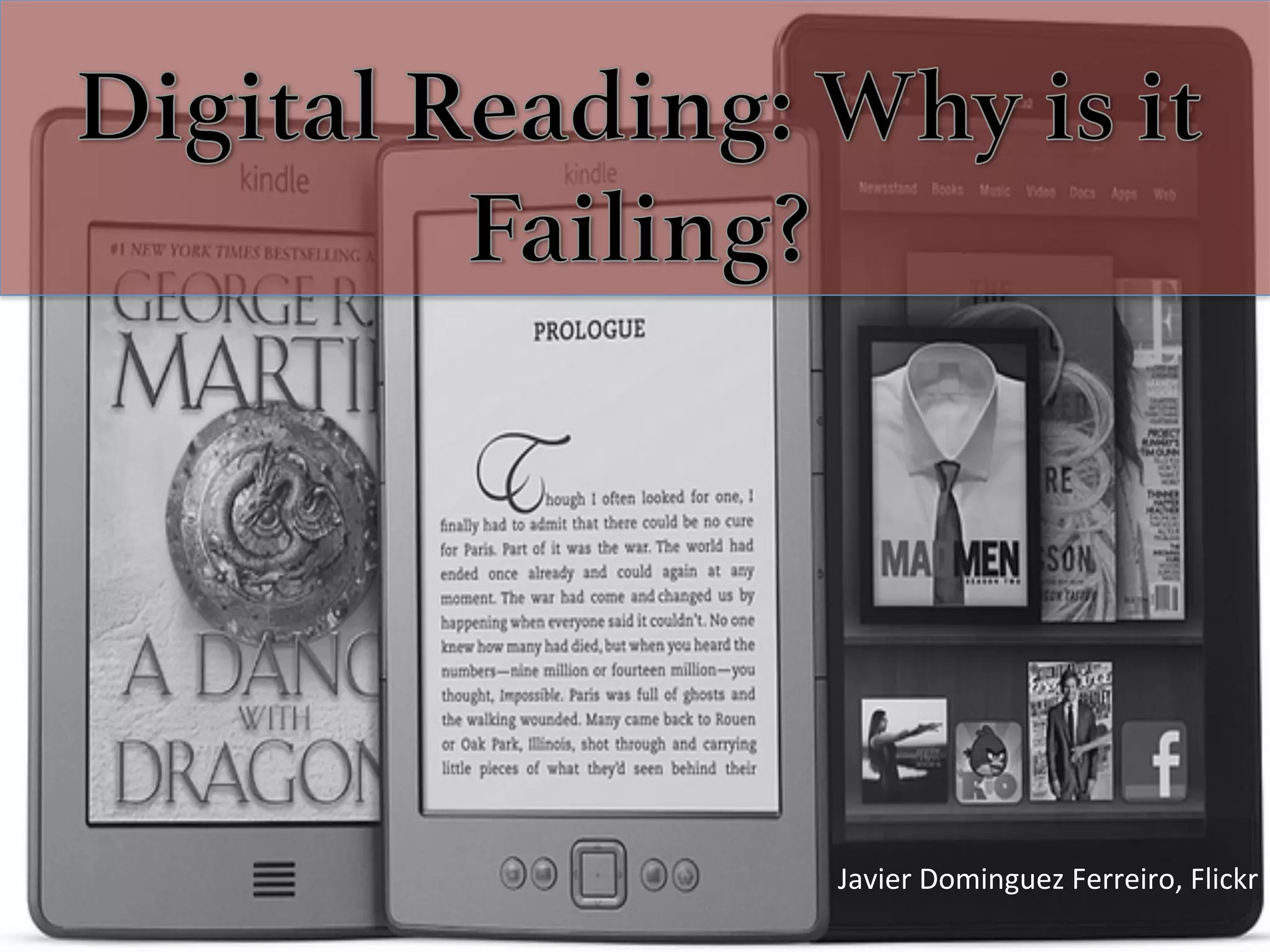
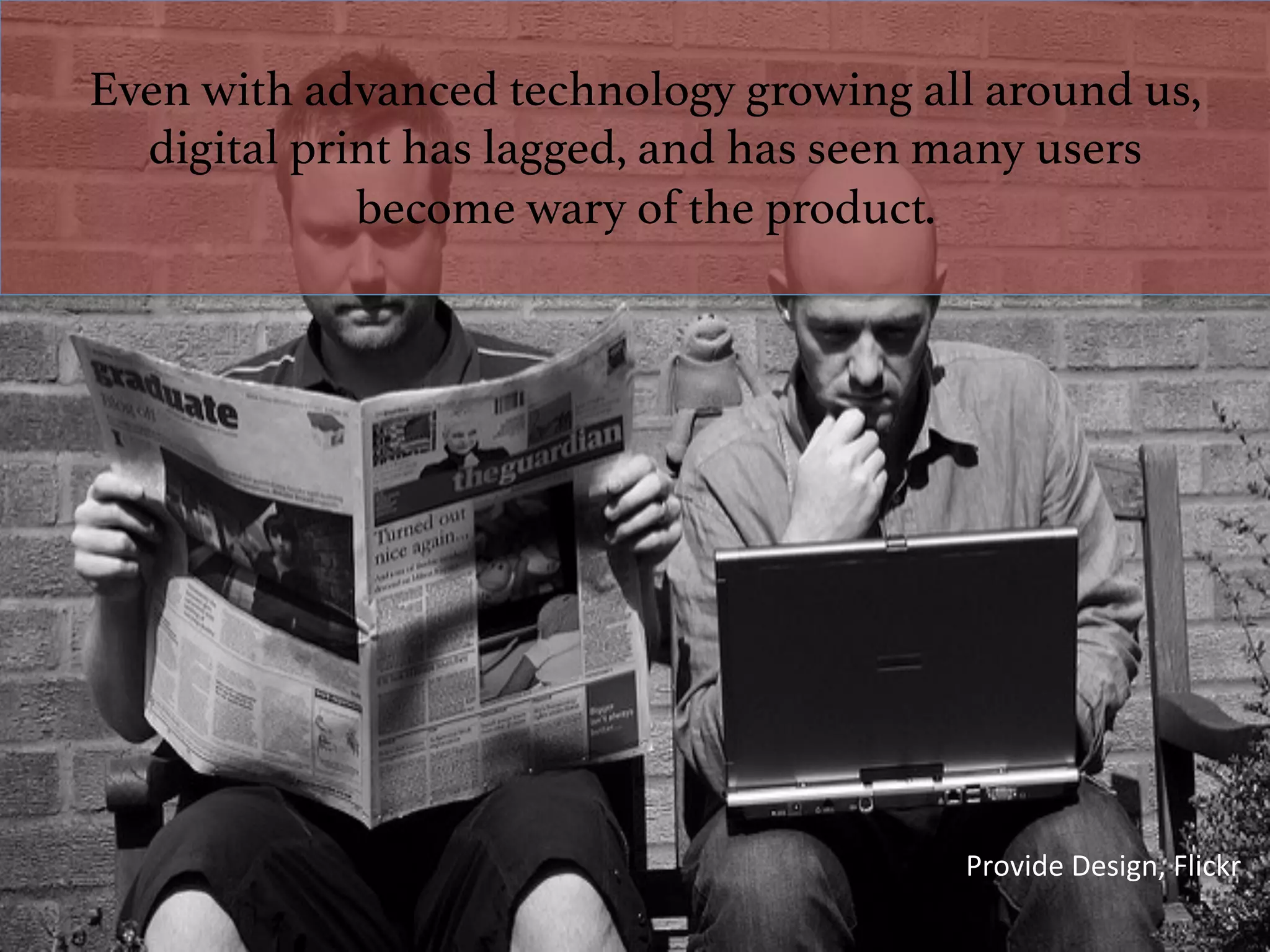
Even with advanced technology growing all around us,
digital print has lagged, and has seen many users
become wary of the product.!
Provide	Design,	Flickr
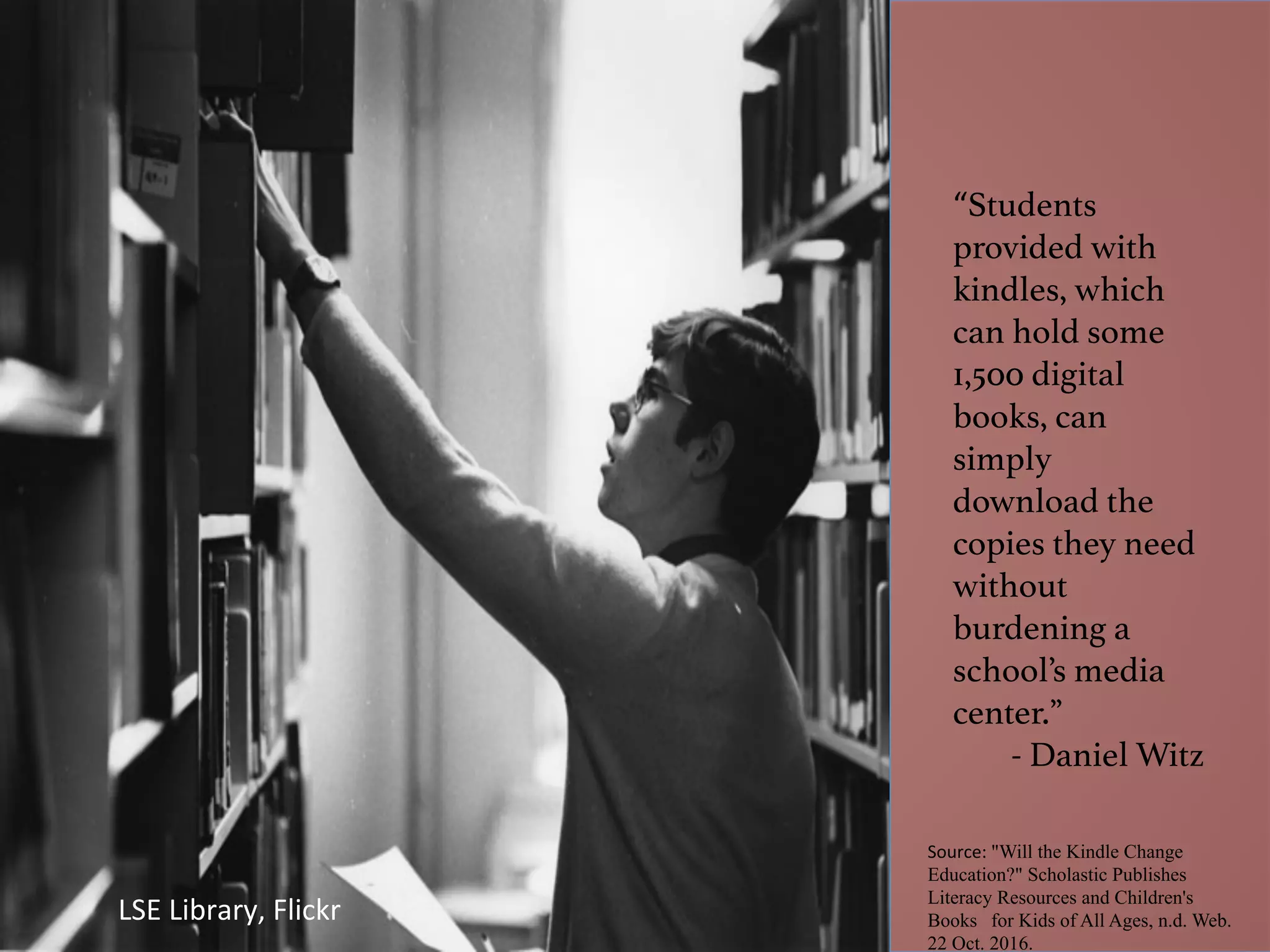
“Students
provided with
kindles, which
can hold some
1,500 digital
books, can
simply
download the
copies they need
without
burdening a
school’s media
center.”!
- Daniel Witz!
Source:	"Will the Kindle Change
Education?" Scholastic Publishes
Literacy Resources and Children's
Books for Kids of All Ages, n.d. Web.
22 Oct. 2016.
LSE	Library,	Flickr
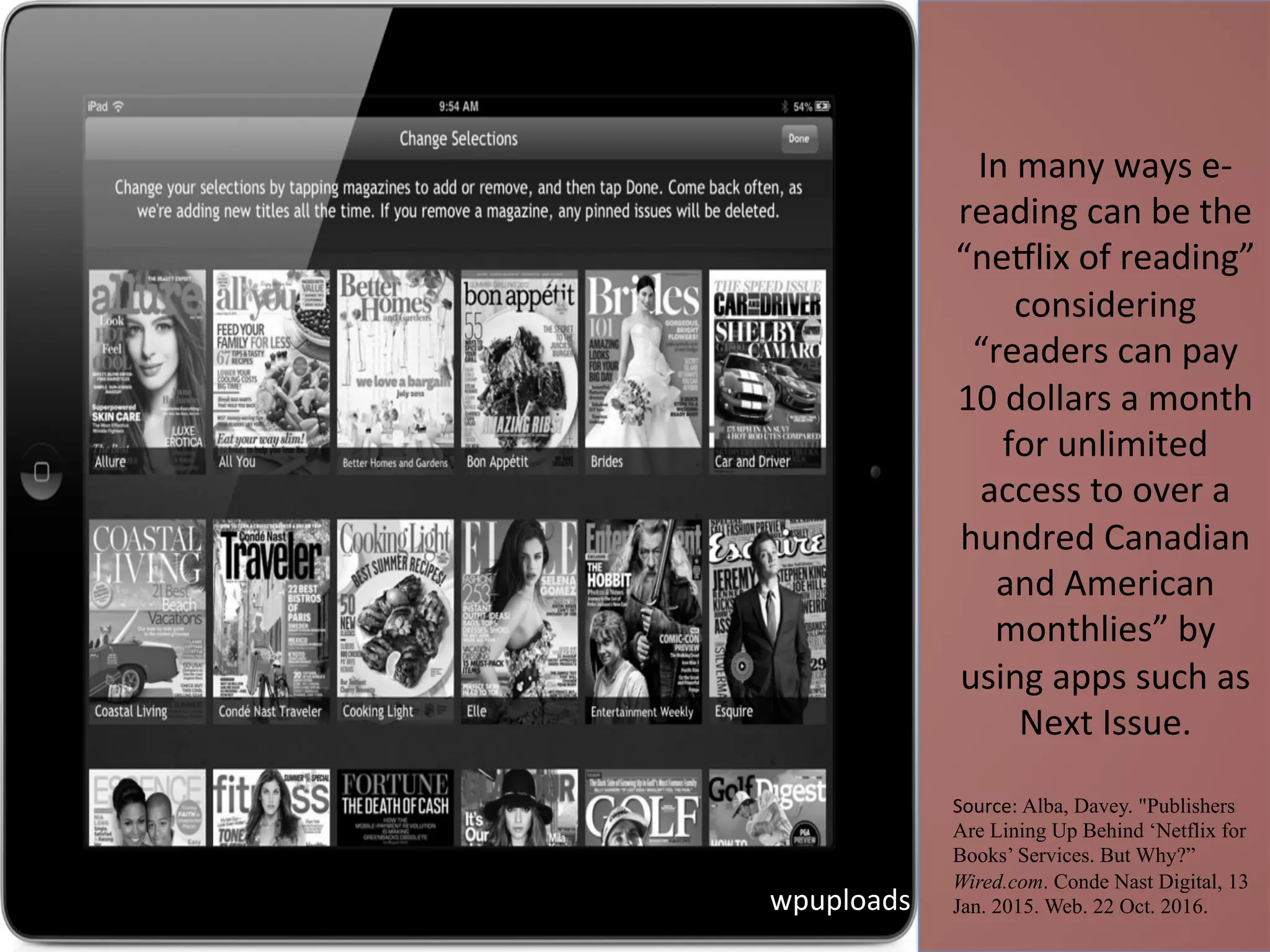
In	many	ways	e-
reading	can	be	the	
“neClix	of	reading”	
considering	
“readers	can	pay	
10	dollars	a	month	
for	unlimited	
access	to	over	a	
hundred	Canadian	
and	American	
monthlies”	by	
using	apps	such	as	
Next	Issue.	
Source:	Alba, Davey. "Publishers
Are Lining Up Behind ‘Netflix for
Books’ Services. But Why?”
Wired.com. Conde Nast Digital, 13
Jan. 2015. Web. 22 Oct. 2016.
	
wpuploads
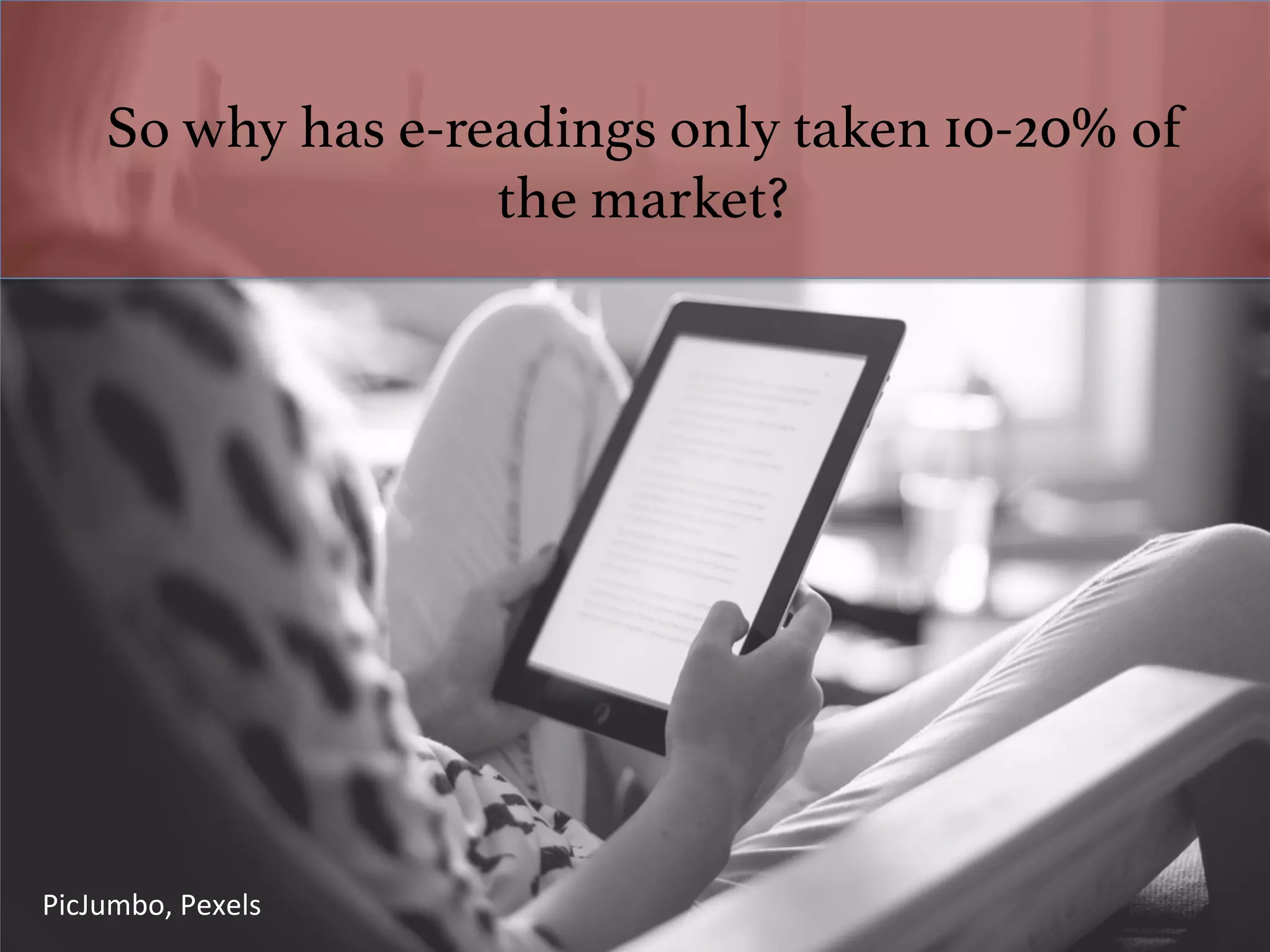
So why has e-readings only taken 10-20% of
the market?!
PicJumbo,	Pexels
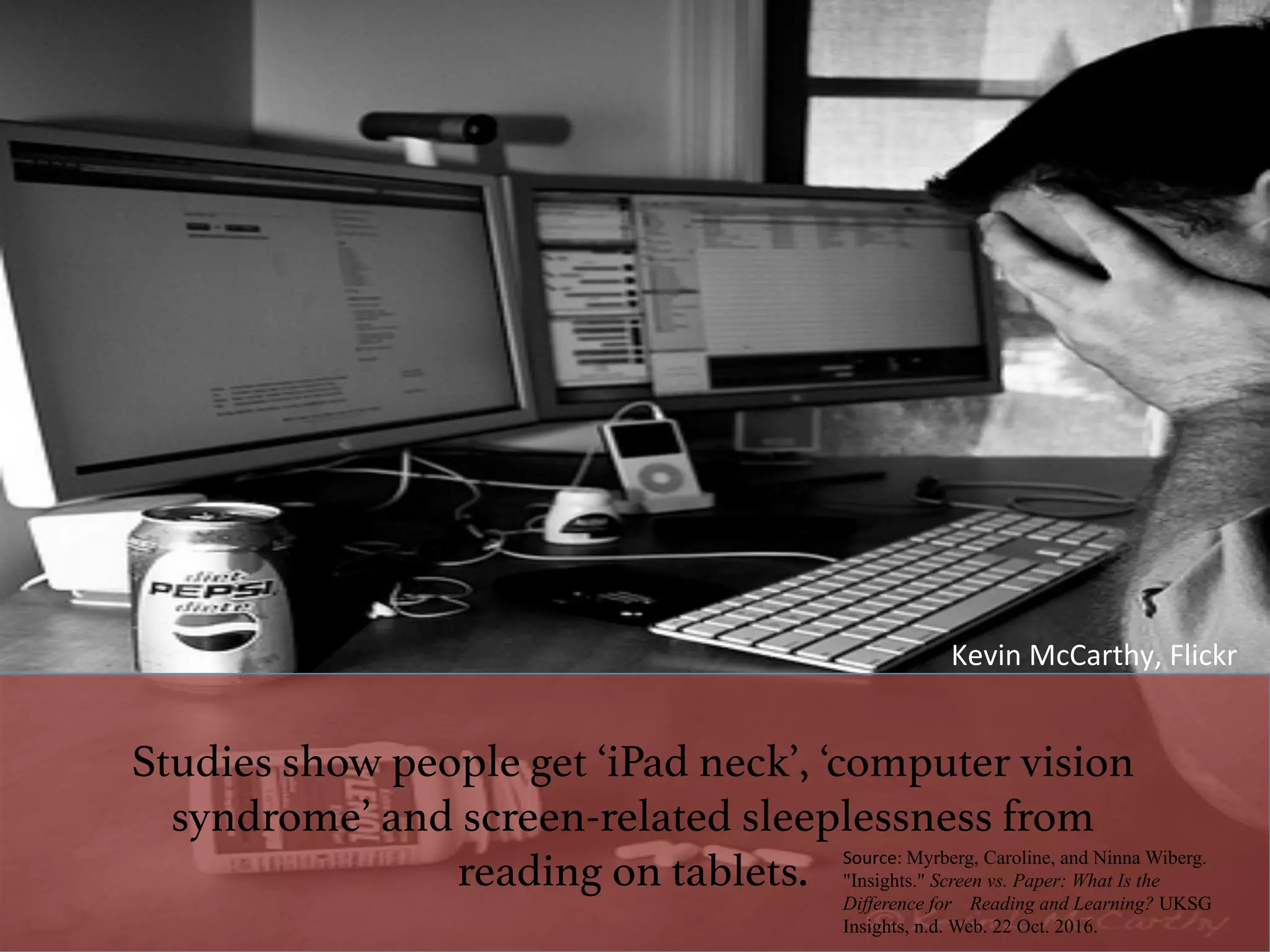
Studies show people get ‘iPad neck’, ‘computer vision
syndrome’ and screen-related sleeplessness from
reading on tablets. ! Source:	Myrberg, Caroline, and Ninna Wiberg.
"Insights." Screen vs. Paper: What Is the
Difference for Reading and Learning? UKSG
Insights, n.d. Web. 22 Oct. 2016.
Kevin	McCarthy,	Flickr
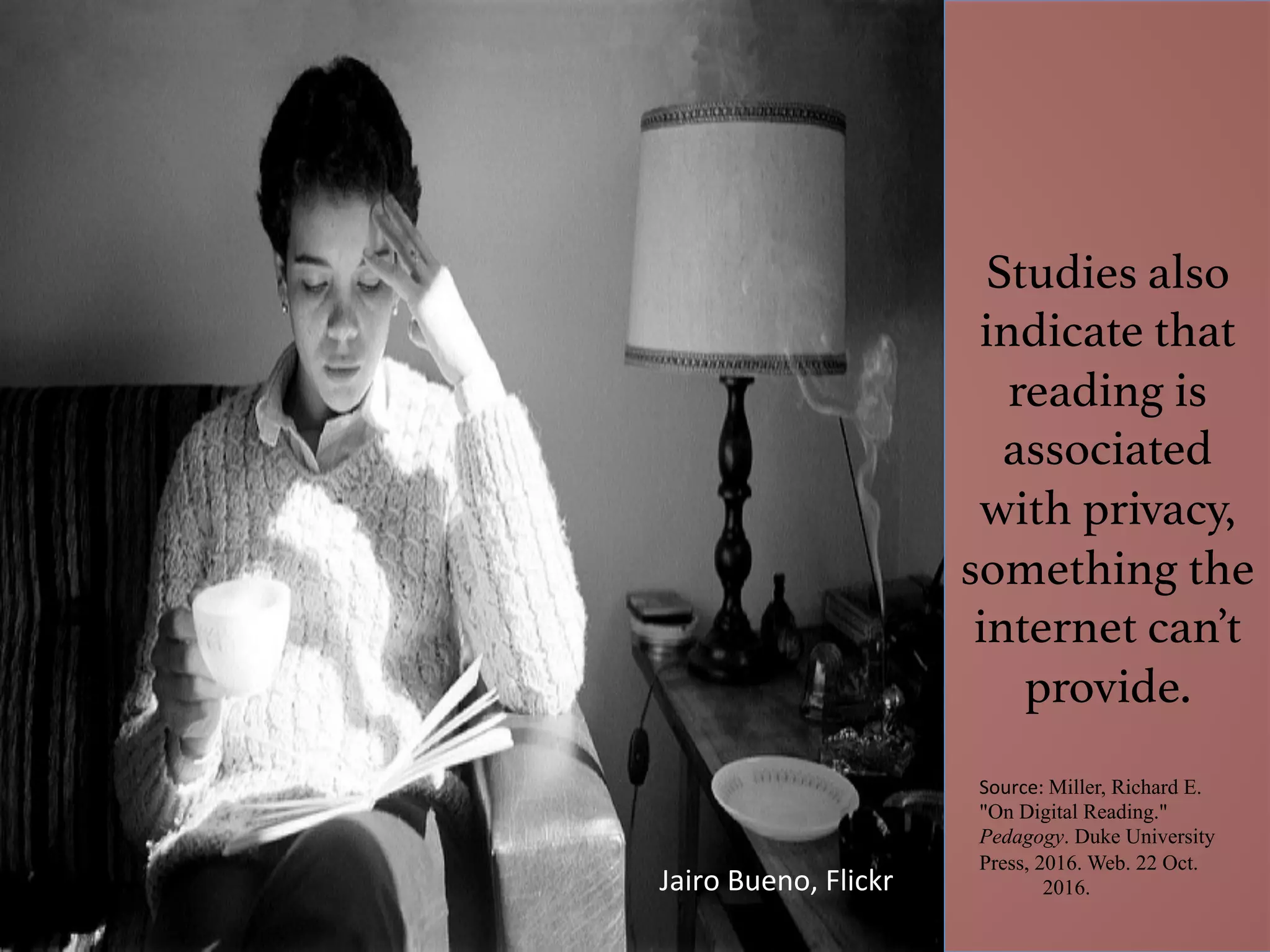
Studies also
indicate that
reading is
associated
with privacy,
something the
internet can’t
provide. !
Source:	Miller, Richard E.
"On Digital Reading."
Pedagogy. Duke University
Press, 2016. Web. 22 Oct.
2016.
	
Jairo	Bueno,	Flickr
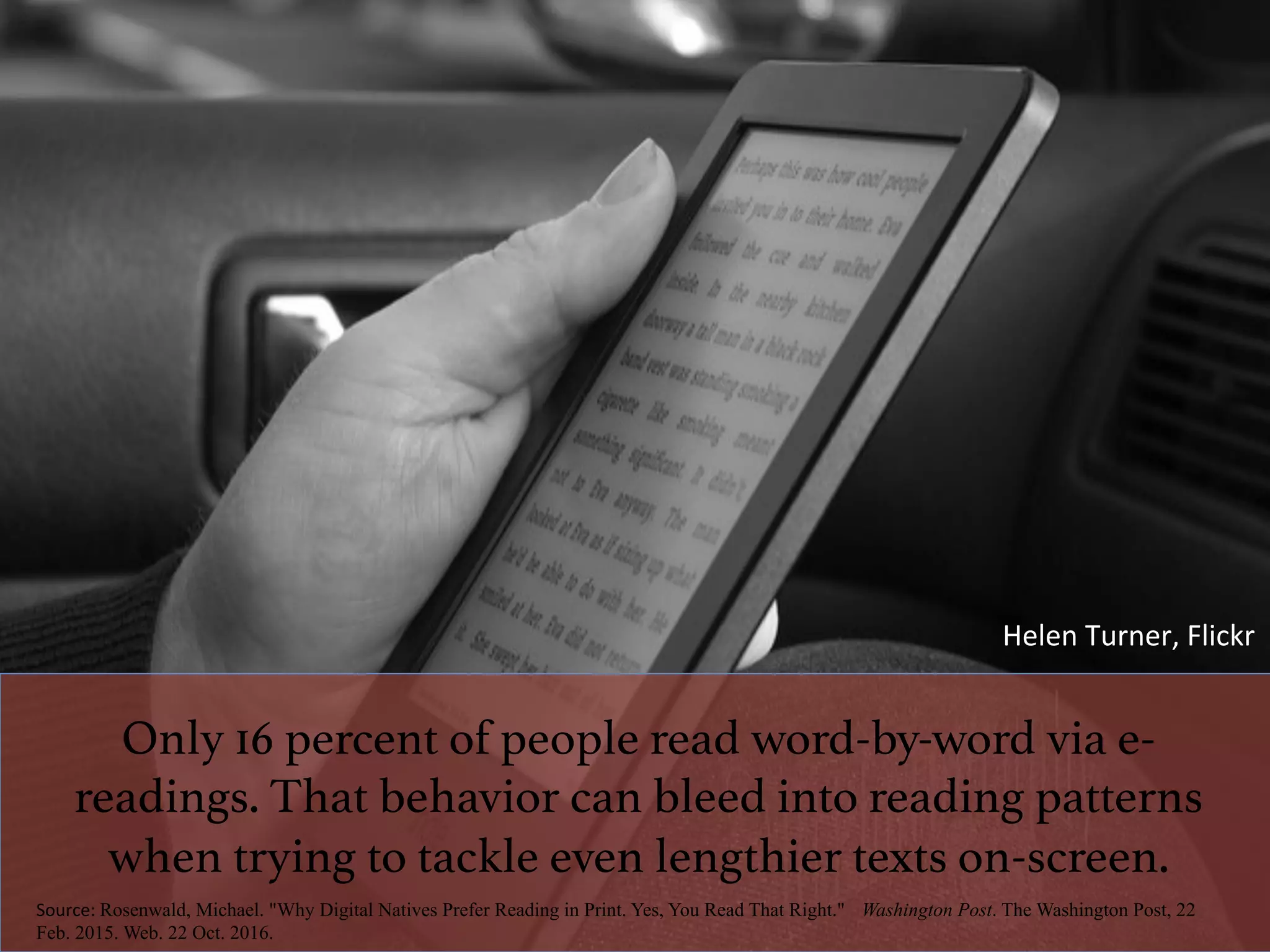
Only 16 percent of people read word-by-word via e-
readings. That behavior can bleed into reading patterns
when trying to tackle even lengthier texts on-screen.!
Source:	Rosenwald, Michael. "Why Digital Natives Prefer Reading in Print. Yes, You Read That Right." Washington Post. The Washington Post, 22
Feb. 2015. Web. 22 Oct. 2016.
Helen	Turner,	Flickr
So Why Are Hard Copy Books Preferable?!
Gloria	Gilli,	Flickr
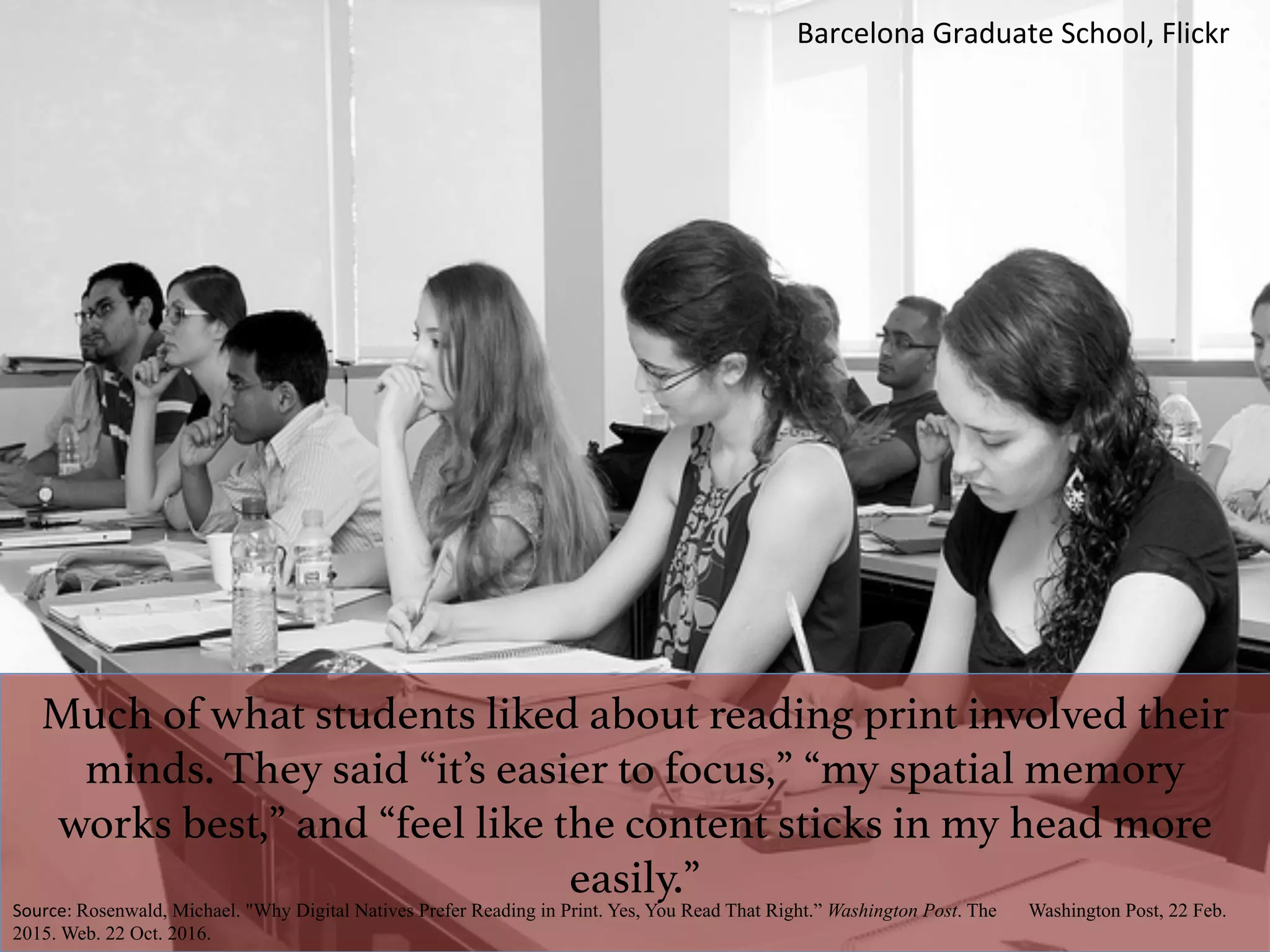
Much of what students liked about reading print involved their
minds. They said “it’s easier to focus,” “my spatial memory
works best,” and “feel like the content sticks in my head more
easily.”!
Source:	Rosenwald, Michael. "Why Digital Natives Prefer Reading in Print. Yes, You Read That Right.” Washington Post. The Washington Post, 22 Feb.
2015. Web. 22 Oct. 2016.
Barcelona	Graduate	School,	Flickr
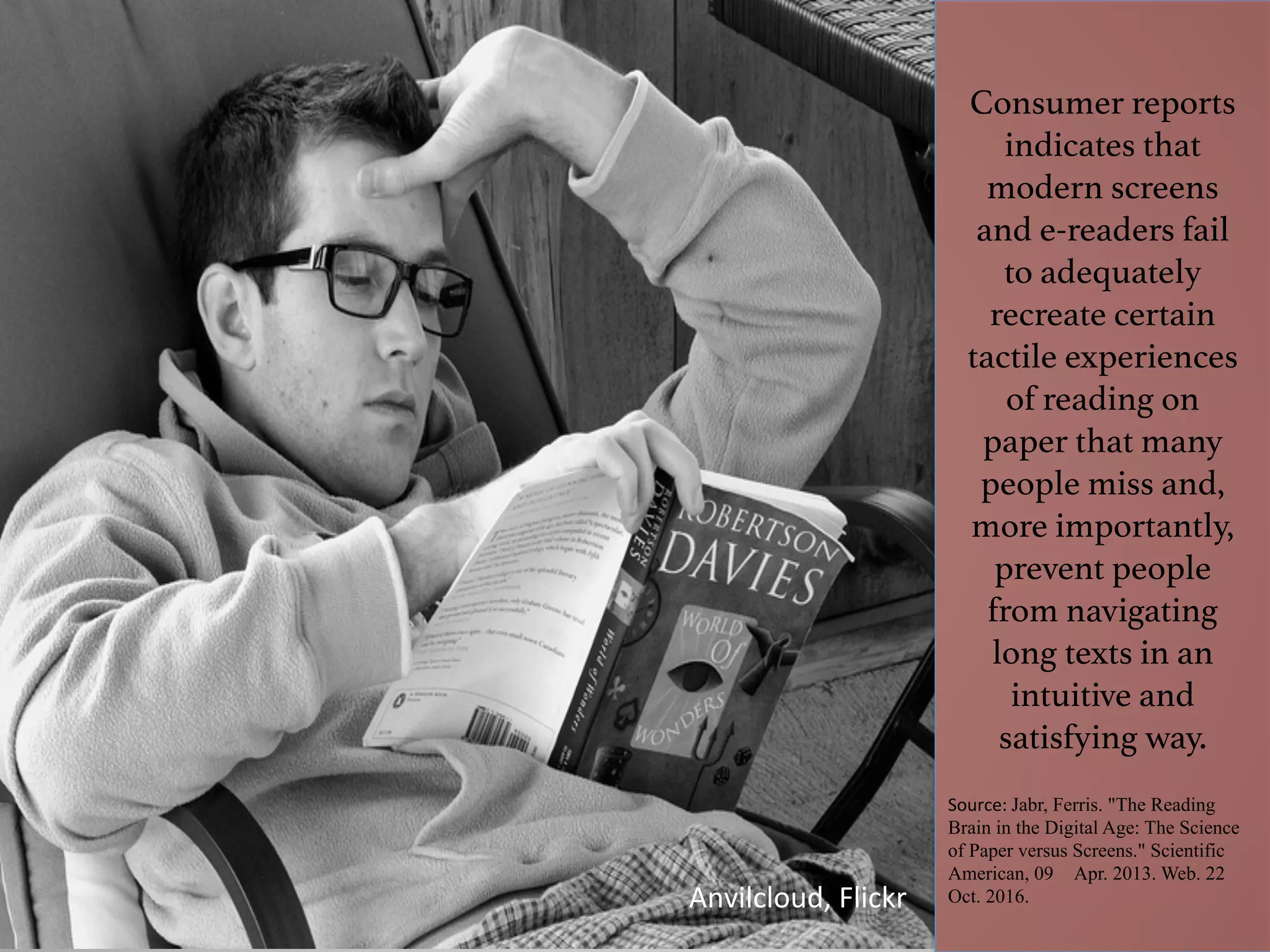
Consumer reports
indicates that
modern screens
and e-readers fail
to adequately
recreate certain
tactile experiences
of reading on
paper that many
people miss and,
more importantly,
prevent people
from navigating
long texts in an
intuitive and
satisfying way.!
Source:	Jabr, Ferris. "The Reading
Brain in the Digital Age: The Science
of Paper versus Screens." Scientific
American, 09 Apr. 2013. Web. 22
Oct. 2016.
	
Anvilcloud,	Flickr
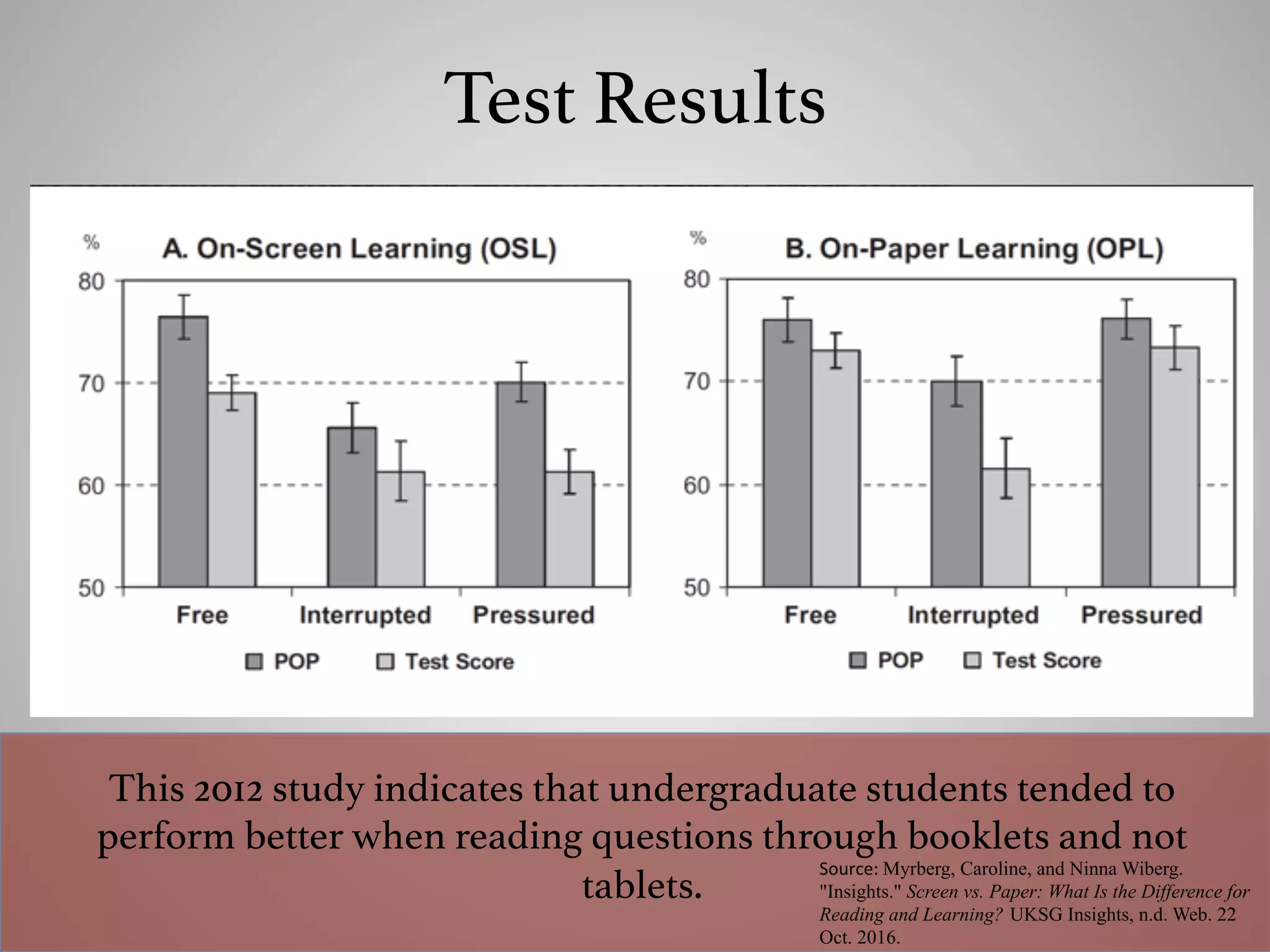
Test Results!
This 2012 study indicates that undergraduate students tended to
perform better when reading questions through booklets and not
tablets. !
Source:	Myrberg, Caroline, and Ninna Wiberg.
"Insights." Screen vs. Paper: What Is the Difference for
Reading and Learning? UKSG Insights, n.d. Web. 22
Oct. 2016.
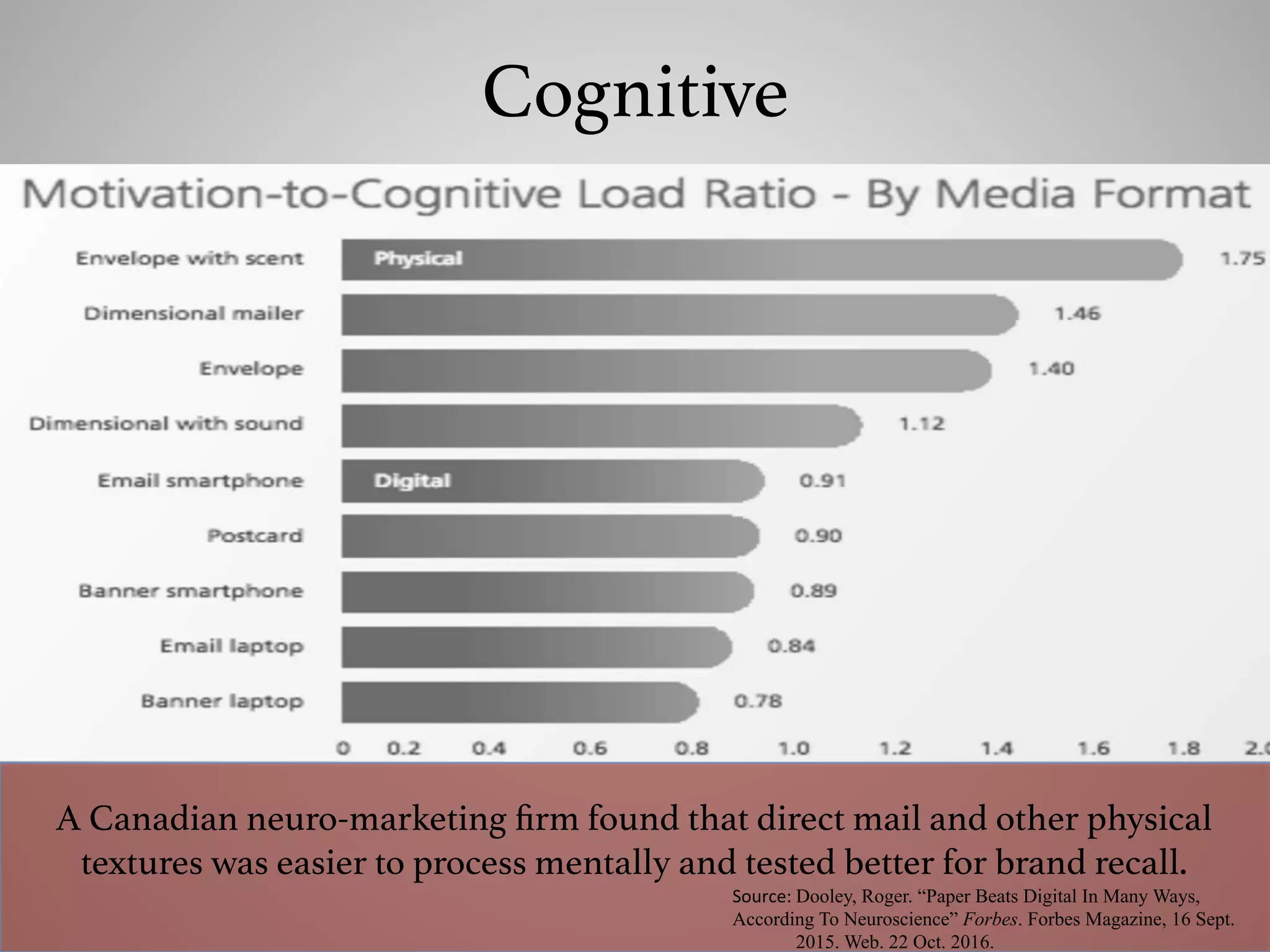
Cognitive !
A Canadian neuro-marketing firm found that direct mail and other physical
textures was easier to process mentally and tested better for brand recall. !
	 Source:	Dooley, Roger. “Paper Beats Digital In Many Ways,
According To Neuroscience” Forbes. Forbes Magazine, 16 Sept.
2015. Web. 22 Oct. 2016.
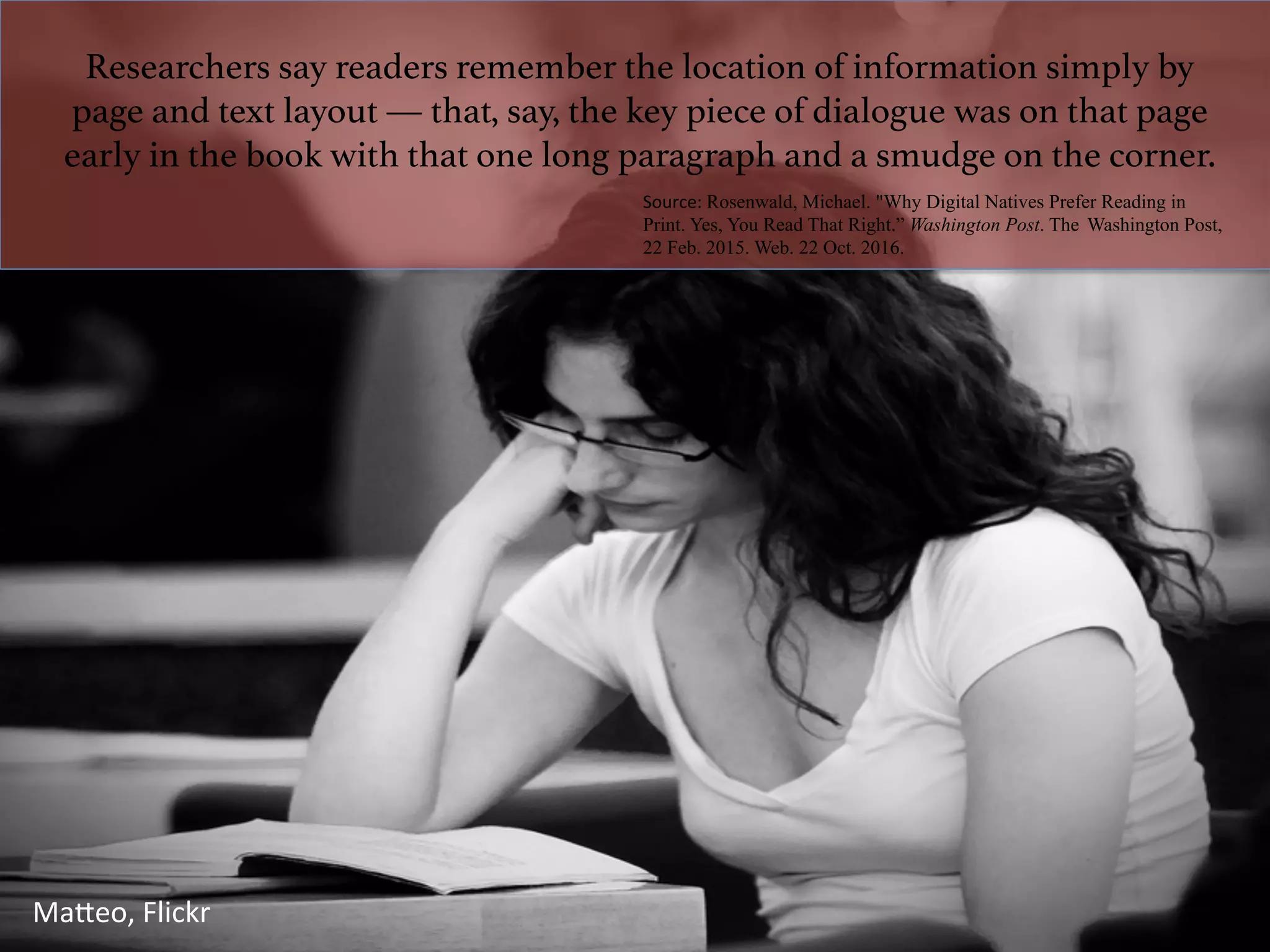
Researchers say readers remember the location of information simply by
page and text layout — that, say, the key piece of dialogue was on that page
early in the book with that one long paragraph and a smudge on the corner.!
Source:	Rosenwald, Michael. "Why Digital Natives Prefer Reading in
Print. Yes, You Read That Right.” Washington Post. The Washington Post,
22 Feb. 2015. Web. 22 Oct. 2016.
	
MaTeo,	Flickr
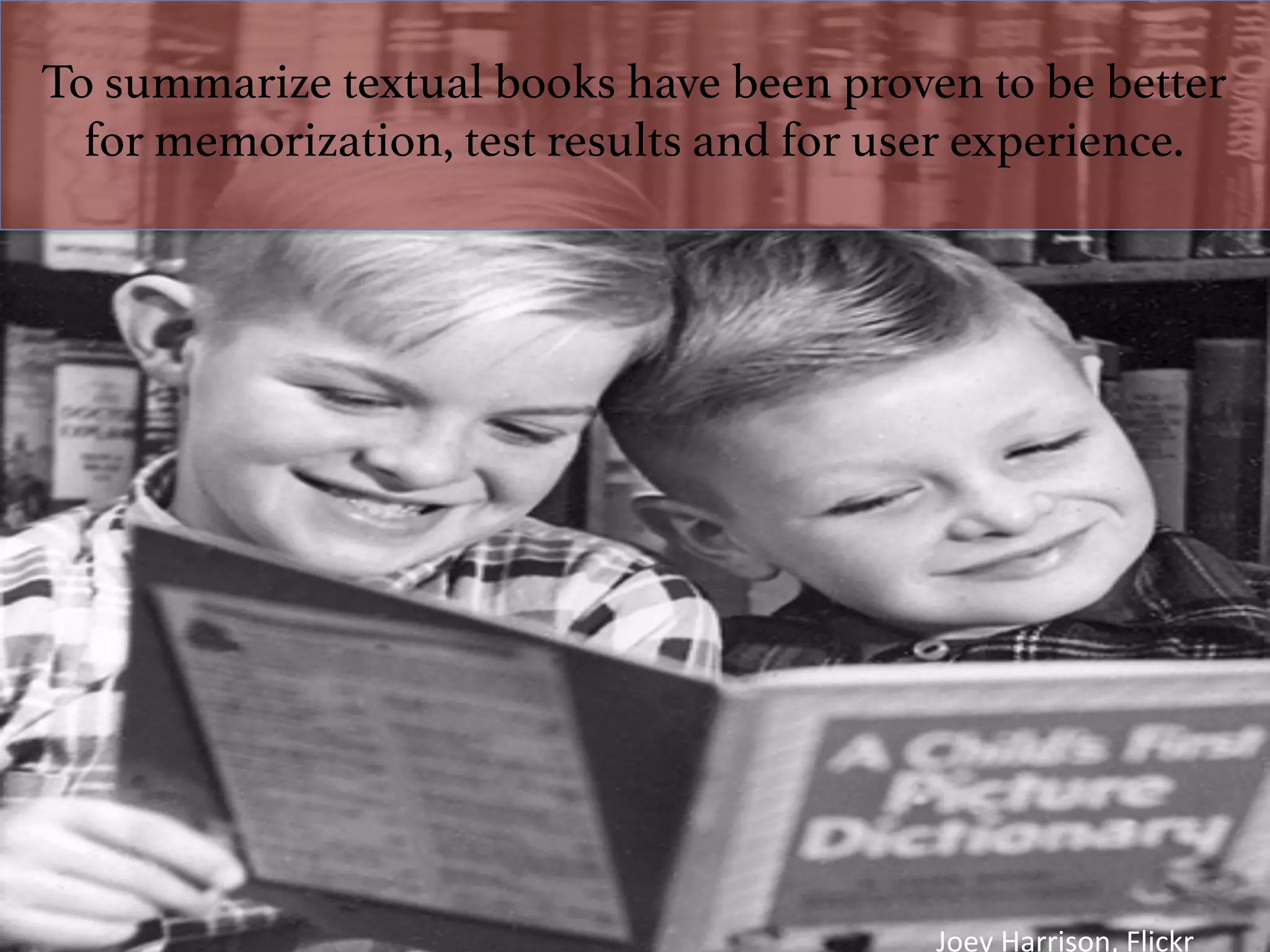
To summarize textual books have been proven to be better
for memorization, test results and for user experience. !
Joey	Harrison,	Flickr
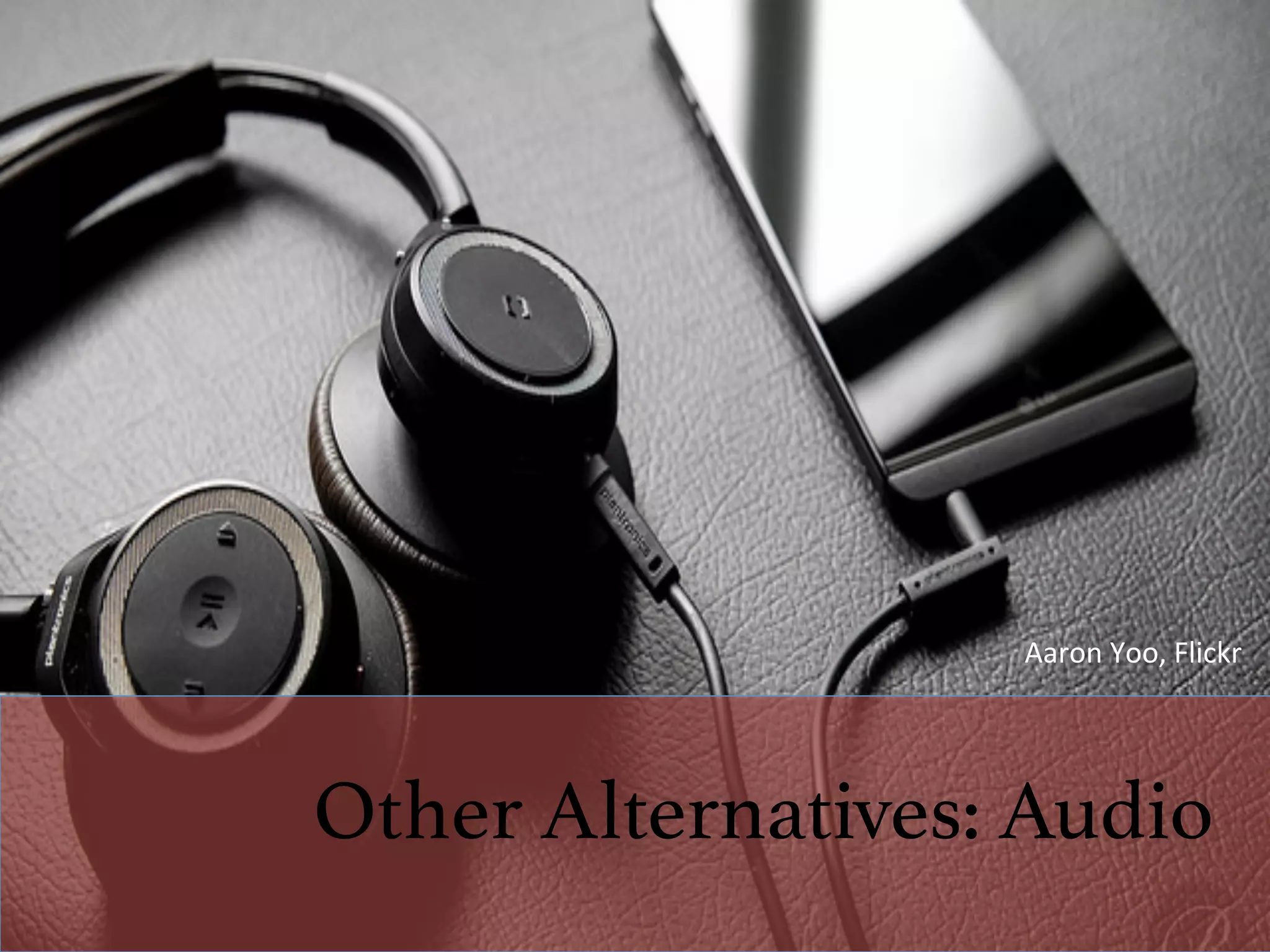
Other Alternatives: Audio!
Aaron	Yoo,	Flickr
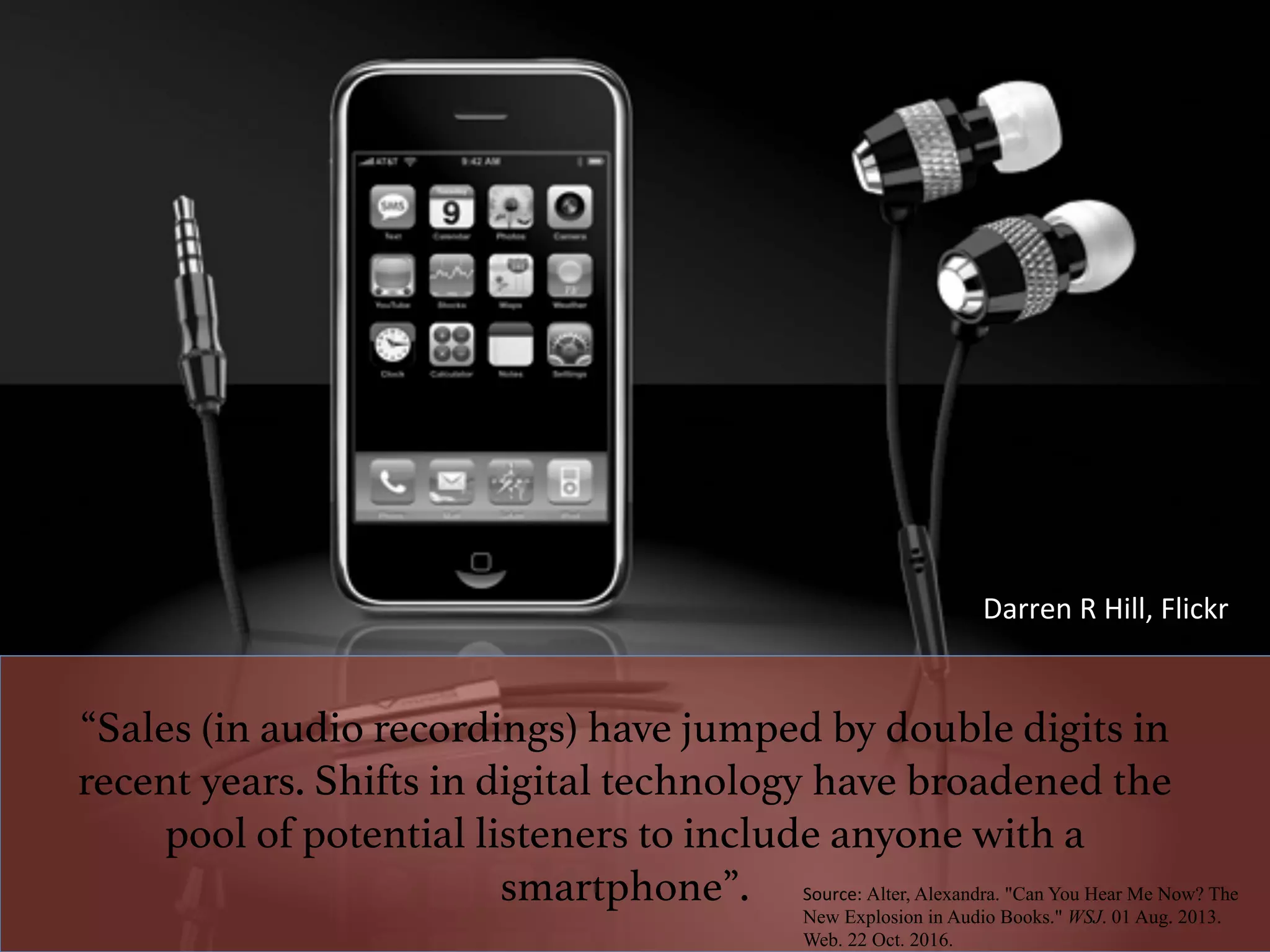
“Sales (in audio recordings) have jumped by double digits in
recent years. Shifts in digital technology have broadened the
pool of potential listeners to include anyone with a
smartphone”.!
	
Source:	Alter, Alexandra. "Can You Hear Me Now? The
New Explosion in Audio Books." WSJ. 01 Aug. 2013.
Web. 22 Oct. 2016.
Darren	R	Hill,	Flickr
The great thing
about audio books
is that a person
can adjust the
speed to read 2x as
fast or slow. A
Silicon Valley
investor said of the
invention “Audio
books can also be
mined of precious
information with
ruthless
efficiency”. !
Source:	Garber, Megan. “The Rise of Speed
Reading” The Atlantic. Atlantic Media
Company, 24 June 2015. Web. 22 Oct. 2016.
	
Yien	Yier-	Flickr
Amazon has seen the potential for this industry and plans on producing
and introducing up to 100,000 different audio books to the market. The
audio book industry is currently at $1.2 billion. !
Source:	Alter,	Alexandra.	"Can	You	Hear	Me	Now?	The	New	Explosion	in	Audio	Books."	WSJ.	01	Aug.	2013.	Web.	22	Oct.	2016.	
Albert	Bo^,	Flickr
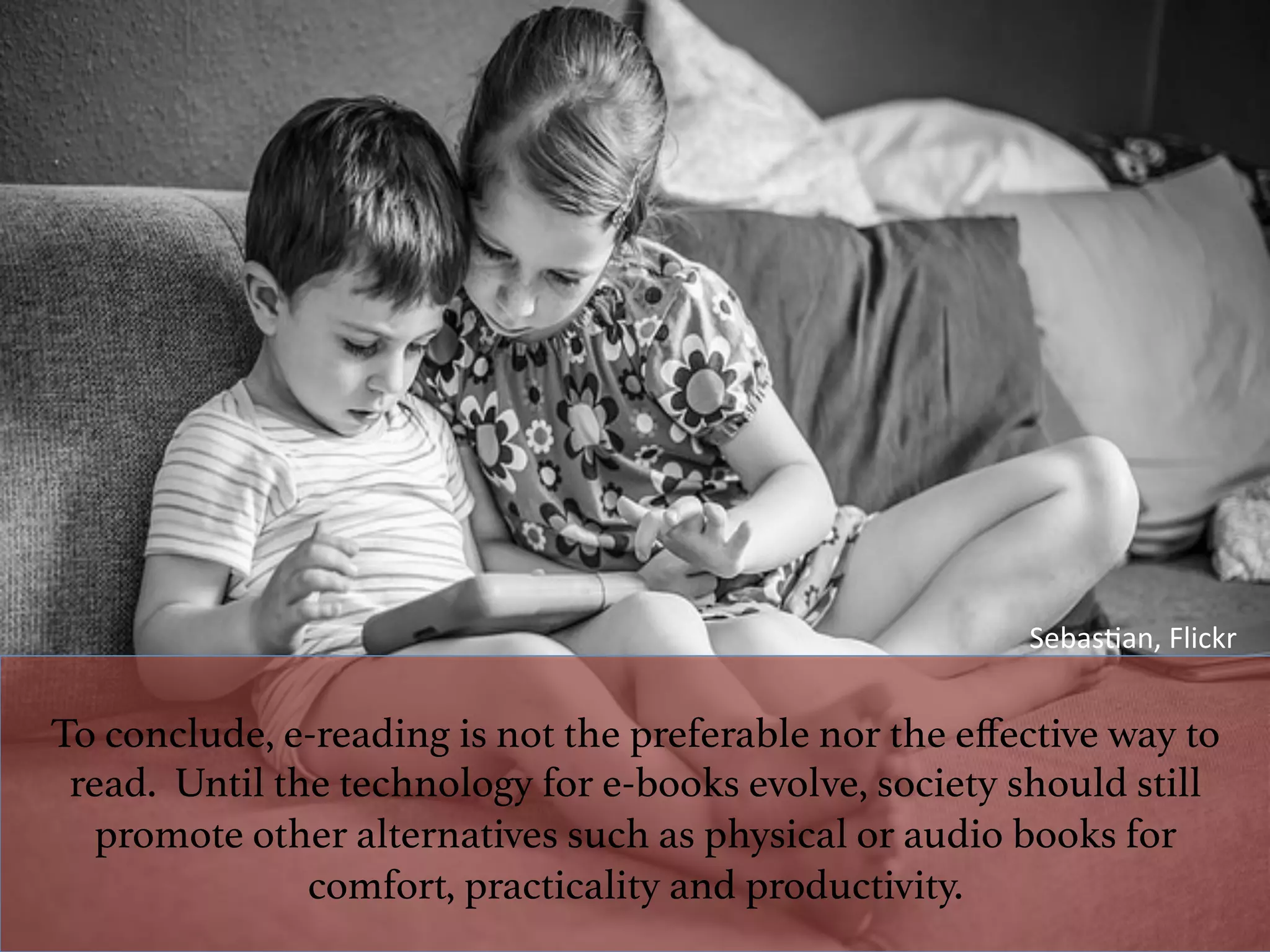
To conclude, e-reading is not the preferable nor the effective way to
read. Until the technology for e-books evolve, society should still
promote other alternatives such as physical or audio books for
comfort, practicality and productivity. !
Sebas^an,	Flickr
Work	Cited	
1. Alang, Naveet.. "Why the Next Issue Magazine App Is Not the Future of Publishing." The Globe and Mail. Special to
The Globe and Mail, 25 Oct. 2013. Web. 22 Oct. 2016.
2. Alba, Davey. "Publishers Are Lining Up Behind ‘Netflix for Books’ Services. But Why?” Wired.com. Conde Nast
Digital, 13 Jan. 2015. Web. 22 Oct. 2016.
3. Alter, Alexandra. "Can You Hear Me Now? The New Explosion in Audio Books." WSJ. 01 Aug. 2013. Web. 22
Oct. 2016.
3.Garber, Megan. “The Rise of Speed Reading” The Atlantic. Atlantic Media Company, 24 June 2015. Web. 22 Oct.
2016.
4. Dooley, Roger. “Paper Beats Digital In Many Ways, According To Neuroscience” Forbes. Forbes Magazine, 16 Sept.
2015. Web. 22 Oct. 2016.
5.Garber, Megan. “The Rise of Speed Reading” The Atlantic. Atlantic Media Company, 24 June 2015. Web. 22 Oct.
2016.
6. Jabr, Ferris. "The Reading Brain in the Digital Age: The Science of Paper versus Screens." Scientific American, 09
Apr. 2013. Web. 22 Oct. 2016.
7. Miller, Richard E. "On Digital Reading." Pedagogy. Duke University Press, 2016. Web. 22 Oct. 2016.
8. Myrberg, Caroline, and Ninna Wiberg. "Insights." Screen vs. Paper: What Is the Difference for Reading and Learning?
UKSG Insights, n.d. Web. 22 Oct. 2016.
9. Rosenwald, Michael. "Why Digital Natives Prefer Reading in Print. Yes, You Read That Right.” Washington Post. The
Washington Post, 22 Feb. 2015. Web. 22 Oct. 2016.
10. Tanner, Julee. "Digital vs. Print: Reading Comprehension and the Future of the Book." SLIS Student Research
Journal, Dec. 2014. Web. 22 Oct. 2016.
11. "Will the Kindle Change Education?" Scholastic Publishes Literacy Resources and Children's Books for Kids of All
Ages, n.d. Web. 22 Oct. 2016.

Digitial Reading: Why is it Failing?

  • 1.
  • 2.
    Even with advancedtechnology growing all around us, digital print has lagged, and has seen many users become wary of the product.! Provide Design, Flickr
  • 3.
    “Students provided with kindles, which canhold some 1,500 digital books, can simply download the copies they need without burdening a school’s media center.”! - Daniel Witz! Source: "Will the Kindle Change Education?" Scholastic Publishes Literacy Resources and Children's Books for Kids of All Ages, n.d. Web. 22 Oct. 2016. LSE Library, Flickr
  • 4.
  • 5.
    So why hase-readings only taken 10-20% of the market?! PicJumbo, Pexels
  • 6.
    Studies show peopleget ‘iPad neck’, ‘computer vision syndrome’ and screen-related sleeplessness from reading on tablets. ! Source: Myrberg, Caroline, and Ninna Wiberg. "Insights." Screen vs. Paper: What Is the Difference for Reading and Learning? UKSG Insights, n.d. Web. 22 Oct. 2016. Kevin McCarthy, Flickr
  • 7.
    Studies also indicate that readingis associated with privacy, something the internet can’t provide. ! Source: Miller, Richard E. "On Digital Reading." Pedagogy. Duke University Press, 2016. Web. 22 Oct. 2016. Jairo Bueno, Flickr
  • 8.
    Only 16 percentof people read word-by-word via e- readings. That behavior can bleed into reading patterns when trying to tackle even lengthier texts on-screen.! Source: Rosenwald, Michael. "Why Digital Natives Prefer Reading in Print. Yes, You Read That Right." Washington Post. The Washington Post, 22 Feb. 2015. Web. 22 Oct. 2016. Helen Turner, Flickr
  • 9.
    So Why AreHard Copy Books Preferable?! Gloria Gilli, Flickr
  • 10.
    Much of whatstudents liked about reading print involved their minds. They said “it’s easier to focus,” “my spatial memory works best,” and “feel like the content sticks in my head more easily.”! Source: Rosenwald, Michael. "Why Digital Natives Prefer Reading in Print. Yes, You Read That Right.” Washington Post. The Washington Post, 22 Feb. 2015. Web. 22 Oct. 2016. Barcelona Graduate School, Flickr
  • 11.
    Consumer reports indicates that modernscreens and e-readers fail to adequately recreate certain tactile experiences of reading on paper that many people miss and, more importantly, prevent people from navigating long texts in an intuitive and satisfying way.! Source: Jabr, Ferris. "The Reading Brain in the Digital Age: The Science of Paper versus Screens." Scientific American, 09 Apr. 2013. Web. 22 Oct. 2016. Anvilcloud, Flickr
  • 12.
    Test Results! This 2012study indicates that undergraduate students tended to perform better when reading questions through booklets and not tablets. ! Source: Myrberg, Caroline, and Ninna Wiberg. "Insights." Screen vs. Paper: What Is the Difference for Reading and Learning? UKSG Insights, n.d. Web. 22 Oct. 2016.
  • 13.
    Cognitive ! A Canadianneuro-marketing firm found that direct mail and other physical textures was easier to process mentally and tested better for brand recall. ! Source: Dooley, Roger. “Paper Beats Digital In Many Ways, According To Neuroscience” Forbes. Forbes Magazine, 16 Sept. 2015. Web. 22 Oct. 2016.
  • 14.
    Researchers say readersremember the location of information simply by page and text layout — that, say, the key piece of dialogue was on that page early in the book with that one long paragraph and a smudge on the corner.! Source: Rosenwald, Michael. "Why Digital Natives Prefer Reading in Print. Yes, You Read That Right.” Washington Post. The Washington Post, 22 Feb. 2015. Web. 22 Oct. 2016. MaTeo, Flickr
  • 15.
    To summarize textualbooks have been proven to be better for memorization, test results and for user experience. ! Joey Harrison, Flickr
  • 16.
  • 17.
    “Sales (in audiorecordings) have jumped by double digits in recent years. Shifts in digital technology have broadened the pool of potential listeners to include anyone with a smartphone”.! Source: Alter, Alexandra. "Can You Hear Me Now? The New Explosion in Audio Books." WSJ. 01 Aug. 2013. Web. 22 Oct. 2016. Darren R Hill, Flickr
  • 18.
    The great thing aboutaudio books is that a person can adjust the speed to read 2x as fast or slow. A Silicon Valley investor said of the invention “Audio books can also be mined of precious information with ruthless efficiency”. ! Source: Garber, Megan. “The Rise of Speed Reading” The Atlantic. Atlantic Media Company, 24 June 2015. Web. 22 Oct. 2016. Yien Yier- Flickr
  • 19.
    Amazon has seenthe potential for this industry and plans on producing and introducing up to 100,000 different audio books to the market. The audio book industry is currently at $1.2 billion. ! Source: Alter, Alexandra. "Can You Hear Me Now? The New Explosion in Audio Books." WSJ. 01 Aug. 2013. Web. 22 Oct. 2016. Albert Bo^, Flickr
  • 20.
    To conclude, e-readingis not the preferable nor the effective way to read. Until the technology for e-books evolve, society should still promote other alternatives such as physical or audio books for comfort, practicality and productivity. ! Sebas^an, Flickr
  • 21.
    Work Cited 1. Alang, Naveet.."Why the Next Issue Magazine App Is Not the Future of Publishing." The Globe and Mail. Special to The Globe and Mail, 25 Oct. 2013. Web. 22 Oct. 2016. 2. Alba, Davey. "Publishers Are Lining Up Behind ‘Netflix for Books’ Services. But Why?” Wired.com. Conde Nast Digital, 13 Jan. 2015. Web. 22 Oct. 2016. 3. Alter, Alexandra. "Can You Hear Me Now? The New Explosion in Audio Books." WSJ. 01 Aug. 2013. Web. 22 Oct. 2016. 3.Garber, Megan. “The Rise of Speed Reading” The Atlantic. Atlantic Media Company, 24 June 2015. Web. 22 Oct. 2016. 4. Dooley, Roger. “Paper Beats Digital In Many Ways, According To Neuroscience” Forbes. Forbes Magazine, 16 Sept. 2015. Web. 22 Oct. 2016. 5.Garber, Megan. “The Rise of Speed Reading” The Atlantic. Atlantic Media Company, 24 June 2015. Web. 22 Oct. 2016. 6. Jabr, Ferris. "The Reading Brain in the Digital Age: The Science of Paper versus Screens." Scientific American, 09 Apr. 2013. Web. 22 Oct. 2016. 7. Miller, Richard E. "On Digital Reading." Pedagogy. Duke University Press, 2016. Web. 22 Oct. 2016. 8. Myrberg, Caroline, and Ninna Wiberg. "Insights." Screen vs. Paper: What Is the Difference for Reading and Learning? UKSG Insights, n.d. Web. 22 Oct. 2016. 9. Rosenwald, Michael. "Why Digital Natives Prefer Reading in Print. Yes, You Read That Right.” Washington Post. The Washington Post, 22 Feb. 2015. Web. 22 Oct. 2016. 10. Tanner, Julee. "Digital vs. Print: Reading Comprehension and the Future of the Book." SLIS Student Research Journal, Dec. 2014. Web. 22 Oct. 2016. 11. "Will the Kindle Change Education?" Scholastic Publishes Literacy Resources and Children's Books for Kids of All Ages, n.d. Web. 22 Oct. 2016.