The Future is Open
July 21, 2015
Michael Peter Edson
@mpedson
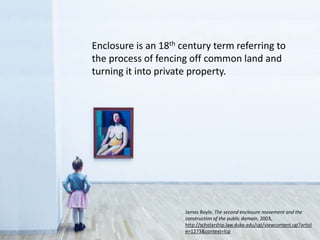
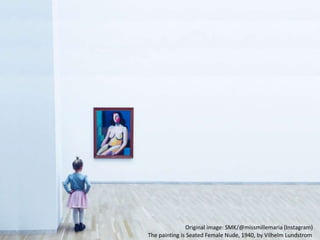
Original image: SMK/@missmillemaria (Instagram)
The painting is Seated Female Nude, 1940, by Vilhelm Lundstrom
The law locks up the man or woman
Who steals the goose from off the common
But leaves the greater villain loose
Who steals the common from off the goose
-Anonymous
England, 1800s
Via James Boyle, The second enclosure movement and the
construction of the public domain, 2003,
http://scholarship.law.duke.edu/cgi/viewcontent.cgi?articl
e=1273&context=lcp
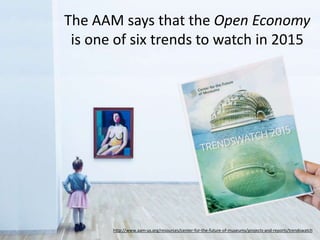
The AAM says that the Open Economy
is one of six trends to watch in 2015
Why?
http://www.aam-us.org/resources/center-for-the-future-of-museums/projects-and-reports/trendswatch
Why?
Because the world she lives
in is different than the
world most museums were
created for.
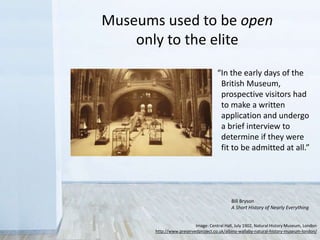
“In the early days of the
British Museum,
prospective visitors had
to make a written
application and undergo
a brief interview to
determine if they were
fit to be admitted at all.”
Museums used to be open
only to the elite
Bill Bryson
A Short History of Nearly Everything
Image: Central Hall, July 1902, Natural History Museum, London
http://www.preservedproject.co.uk/albino-wallaby-natural-history-museum-london/
We now live in a world with
3.2 billion Internet users
7.2 billion mobile phones
1.2 b photos/day shared on top 4 mobile sites
Speed and power doubling every 18 months
Disruption in virtually aspect of human endeavor
“Mobile is eating the world, 2013 edition”
http://ben-evans.com/benedictevans/2013/11/5/mobile-is-eating-the-world-autumn-2013-edition
“…Global connectivity, immense
computational power, and access to all the
world's knowledge amassed over many
centuries, in everyone’s hands…
“The world has never,
ever, been in [this]
situation before…”
http://edge.org/response-detail/10646
Keith Devlin
Executive Director, H-STAR Institute,
Stanford University
We take free, global, resources for granted
Wikipedia, Google, Facebook, Twitter, Instagram,
TED, Khan Academy…and the “read/write” web
Open access and human
rights are profoundly
connected
http://www.un.org/en/documents/udhr/
Article 27 (1)
Everyone has the right freely to
participate in the cultural life of
the community, to enjoy the
arts and to share in scientific
advancement and its benefits.
The obligations, benefits, and joy of
global access are expressed in the United
Nations Universal Declaration of Human
Rights. These values are manifest in our
missions and social contract.
http://www.ohchr.org/EN/Issues/CulturalRights/Pages/AnnualReports.aspx
Introduction
1. Science and culture are not only of great
importance to the knowledge economy;
they are also fundamental to human
dignity and autonomy.
2. In that area, two influential paradigms of
international law — intellectual property
and human rights — have evolved largely
separately.
3. Recent developments, however, have
rendered the interface of those two
regimes more salient.
Wow!
UN Report: Copyright and the Right to Science and Culture
United Nations Special Rapporteur
in the field of cultural rights, 2015
What does it mean
to be open?
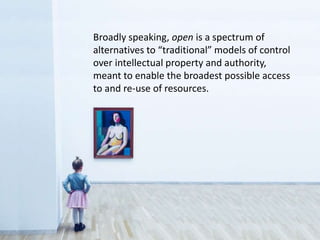
Broadly speaking, open is a spectrum of
alternatives to “traditional” models of control
over intellectual property and authority,
meant to enable the broadest possible access
to and re-use of resources.
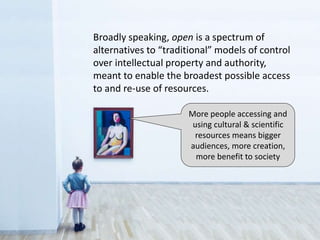
More people accessing and
using cultural & scientific
resources means bigger
audiences, more creation,
more benefit to society
Broadly speaking, open is a spectrum of
alternatives to “traditional” models of control
over intellectual property and authority,
meant to enable the broadest possible access
to and re-use of resources.
“Museums are deconstructing,
piece by piece, the authoritarian
model that presumes control of what
people see, what they learn and how
they learn it”
Trendswatch 2015
“Our understanding of research,
education, artistic creativity, and the
progress of knowledge is built upon the
axiom that no idea stands alone and all
innovation is built on the ideas and
innovations of others.”
Smithsonian Institution
Web and New Media Strategy, 2009
Open Source
The revolutionary idea that sharing source code,
rather than keeping it a secret, can improve the
quality of software, create new markets, and
catalyze innovation on a global scale
Many other forms of openness are derived from
the success of the open source software
movement
Open Images
Images that are free to use and re-use without
unnecessary restrictions
Open Data
Collections information, curatorial records,
metadata, geospatial data, and other
information
Open Knowledge
Collaborative knowledge creation through the
open sharing of data and resources
Open Government
Transparency, accountability, and efficiency
through open sharing of government data
Open Authority
The sharing of expertise with and among one’s
audiences
The Open Economy
Also called the sharing economy—economic
value created through the sharing of free
resources
Open Science
Collaboration and scientific progress through
the open exchange of research, data,
publications
Open Education
Also known as Open Educational Resources—
courseware and classes that can be used and
adapted for free
Open GLAM
Galleries, Libraries, Archives, and Museums
Intellectual property
and open
The Public Domain
Not owned by anyone.
“The public domain is not some gummy
residue left behind when all the good
stuff has been covered by property
law. The public domain is the place
where we quarry the building blocks of
our culture. It is, in fact, the majority
of our culture.”
James Boyle
The Public Domain
In America, the original
framers of copyright said
that the public domain is
the natural state of
intellectual property, and
copyright should only be a
temporary and cautiously
granted exception
“It is important for memory
organizations to recognize that as the
guardians of our shared culture and
knowledge they play a central role in
enabling the creativity of citizens and
providing the raw materials for
contemporary culture, science,
innovation and economic growth.”
Europeana Public Domain Charter
http://pro.europeana.eu/c/document_library/get_file?uuid=d542819d
-d169-4240-9247-f96749113eaa&groupId=10602
Europeana’s Public Domain charter
The Creative Commons gives owners of intellectual
property some flexibility above-and-beyond the
strict boundaries of traditional copyright.
 If you own the copyright for something, you can use a Creative
Commons “license” to give others permission to re-use it.
 If you want to use something that is under copyright, Creative
Commons licenses tell you what you can do with the resource
without having to ask the owner
http://creativecommons.org/
“The most widely used open licenses are the Creative
Commons licenses. It is estimated that, by 2015, those
licenses will have been attached to more than 1 billion
creative works, including photos, websites, music,
government databases, UNESCO publications, journal
articles and educational textbooks… The idea behind
[those] efforts is to create a “cultural commons,” in which
everyone can access, share and recombine cultural
works.”
United Nations: Copyright and the right to science and culture, 2015
http://www.ohchr.org/EN/Issues/CulturalRights/Pages/AnnualReports.aspx
“Promoting cultural participation
through open licensing
http://www.slideshare.net/MereteSanderhoff/sharing-is-caring-keynote-for-
public-domain-tagung-hek-basel-20-april-2015
Adapted from Merete Sanderhoff
National Gallery of Denmark
Creative Commons attribution (CC-BY)
“It’s ours, but we permit you to reuse it
with proper attribution.”
Creative Commons Zero (CC-0)
“It’s yours, so you have the right to reuse it
in any way you want.”
Creative Commons attribution
non-commercial (CC-BY-NC)
“It’s ours, but we permit you to reuse it
(with attribution) for non-commercial
purposes.”
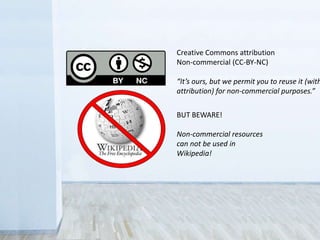
BUT BEWARE!
Non-commercial resources
can not be used in
Wikipedia!
Creative Commons attribution
non-commercial (CC-BY-NC)
“It’s ours, but we permit you to reuse it
(with attribution) for non-commercial
purposes.”
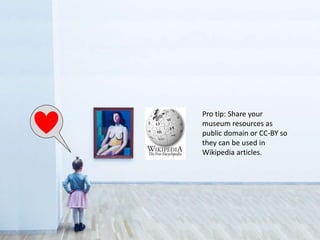
Pro tip: Share your
museum resources as
public domain or CC-BY so
they can be used in
Wikipedia articles.
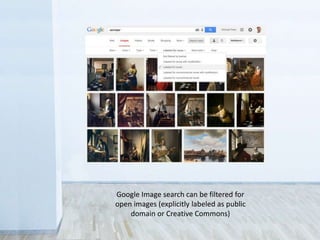
Google Image search can be filtered for
open images (explicitly labeled as public
domain or Creative Commons)
Sounds pretty
simple to me!
But access and
re-use are still
a challenge!
Enclosure
Enclosure is an 18th century term referring to
the process of fencing off common land and
turning it into private property.
James Boyle, The second enclosure movement and the
construction of the public domain, 2003,
http://scholarship.law.duke.edu/cgi/viewcontent.cgi?articl
e=1273&context=lcp
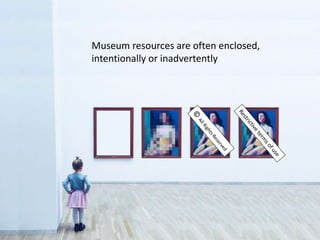
Museum resources are often enclosed,
intentionally or inadvertently
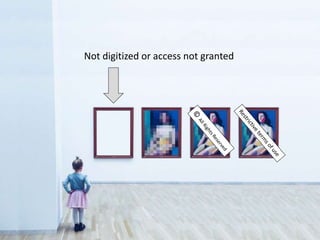
Not digitized or access not granted
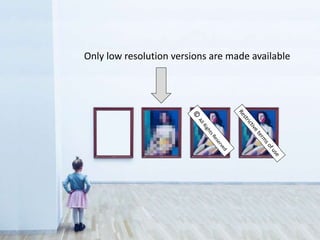
Only low resolution versions are made available
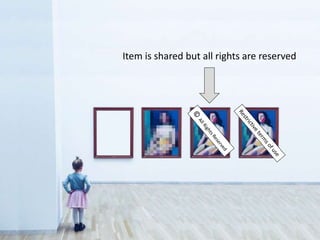
Item is shared but all rights are reserved
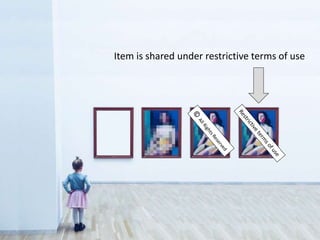
Item is shared under restrictive terms of use
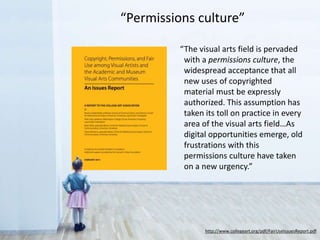
“The visual arts field is pervaded
with a permissions culture, the
widespread acceptance that all
new uses of copyrighted
material must be expressly
authorized. This assumption has
taken its toll on practice in every
area of the visual arts field…As
digital opportunities emerge, old
frustrations with this
permissions culture have taken
on a new urgency.”
http://www.collegeart.org/pdf/FairUseIssuesReport.pdf
“Permissions culture”
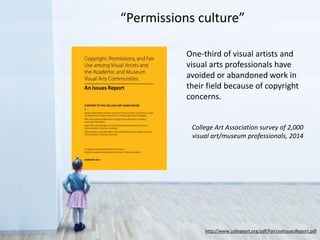
One-third of visual artists and
visual arts professionals have
avoided or abandoned work in
their field because of copyright
concerns.
College Art Association survey of 2,000
visual art/museum professionals, 2014
http://www.collegeart.org/pdf/FairUseIssuesReport.pdf
“Permissions culture”
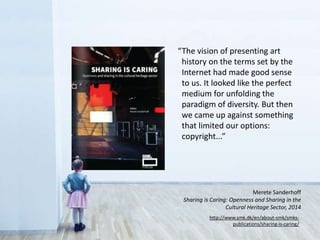
“The vision of presenting art
history on the terms set by the
Internet had made good sense
to us. It looked like the perfect
medium for unfolding the
paradigm of diversity. But then
we came up against something
that limited our options:
copyright...”
http://www.smk.dk/en/about-smk/smks-
publications/sharing-is-caring/
Merete Sanderhoff
Sharing is Caring: Openness and Sharing in the
Cultural Heritage Sector, 2014
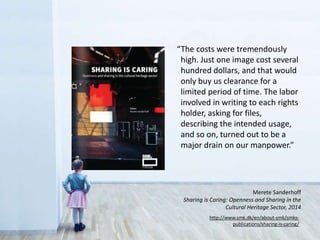
“The costs were tremendously
high. Just one image cost several
hundred dollars, and that would
only buy us clearance for a
limited period of time. The labor
involved in writing to each rights
holder, asking for files,
describing the intended usage,
and so on, turned out to be a
major drain on our manpower.”
http://www.smk.dk/en/about-smk/smks-
publications/sharing-is-caring/
Merete Sanderhoff
Sharing is Caring: Openness and Sharing in the
Cultural Heritage Sector, 2014
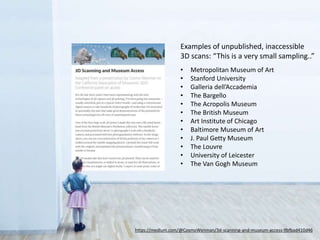
https://medium.com/@CosmoWenman/3d-scanning-and-museum-access-9bfbad410d46
Examples of unpublished, inaccessible
3D scans: “This is a very small sampling..”
• Metropolitan Museum of Art
• Stanford University
• Galleria dell’Accademia
• The Bargello
• The Acropolis Museum
• The British Museum
• Art Institute of Chicago
• Baltimore Museum of Art
• J. Paul Getty Museum
• The Louvre
• University of Leicester
• The Van Gogh Museum
https://www.youtube.com/watch?v=cHUCTDRCb4A
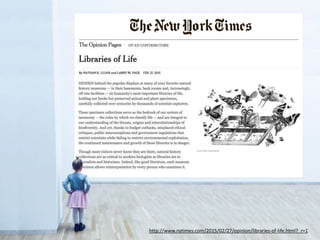
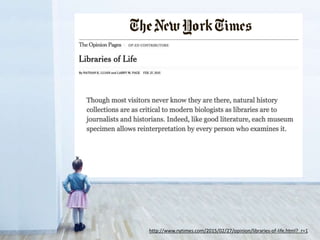
“[Museums and archives]
certainly have not been
very friendly towards us.
And they've not been very
accommodating in our
requests for information
or our requests for images
or anything else. It's an old
story and it's been going
on for a long time."
Elizabeth Ryneki’s search for her
great-grandfather’s paintings of the Warsaw ghetto
http://www.nytimes.com/2015/02/27/opinion/libraries-of-life.html?_r=1
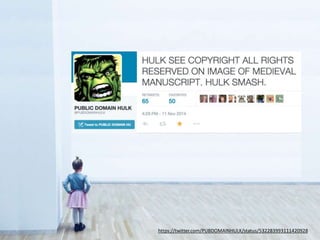
https://twitter.com/PUBDOMAINHULK/status/532283993111420928
Opening up
• Legal
Sometimes you don’t have the rights to share
• Control
Fear that the public will misuse collections
• Revenue
Concern over loss of income from licensing
• Lack of resources
No staff or money to do new things
• Inertia
“This is the way we’ve always done it…”
Copyright can be
complicated, but when
it’s simple, it’s very
simple
Release old works and
ask donors/owners for
permission to share
with Creative
Commons licenses
• Legal
Sometimes you don’t have the rights to share
Yale University says that
sometimes you don’t have the
right not to share…
• Legal
Sometimes you don’t have the rights to share
“Moreover, as the legal designation ‘public domain’ is
supported by the rationale that eventually all creators
and/or owners of content must relinquish their
monopolies over such content making such content
available for unmitigated access and use, attempts to
restrict access through licensing provisions may be
neither legally enforceable nor ethically prudent.”
http://ydc2.yale.edu/sites/default/files/OpenAccessLAMSFinal.pdf
Memo on open access to digital representations of works in the public domain from
museum, library, and archive, collections at Yale University 5 May 2011
• Legal
Sometimes you don’t have the rights to share
• Legal
Sometimes you don’t have the rights to share
• Control
Fear that the public will misuse collections
“There were concerns on the part of some
about the consequences of open access
and the loss of control of images, but over
time these concerns dissipated. ”
Mellon Foundation: Images of Works of Art in Museum
Collections: The Experience of Open Access
Mellon Foundation, 2013 http://msc.mellon.org/msc-
files/Open%20Access%20Report%2004%2025%2013-Final.pdf
“We have lost almost all control, and
this has been vital to our success.”
William Noel
Former curator of manuscripts
Walters Art Museum
Director, Kislak Center for Special Collections, Rare Books and Manuscripts & Director,
Schoenberg Institute for Manuscript Studies, U Penn
Mellon Foundation, 2013 http://msc.mellon.org/msc-
files/Open%20Access%20Report%2004%2025%2013-Final.pdf
• Legal
Sometimes you don’t have the rights to share
• Control
Fear that the public will misuse collections
• Legal
Sometimes you don’t have the rights to share
• Control
Fear that the public will misuse collections
• Revenue
Concern over loss of income from licensing
Memory institutions generate revenue from the sale and
licensing of digital images, but I have yet to find an
organization that makes a profit when overhead costs
are taken into account.
Revenue ≠ Profit
“Everyone interviewed wants to recoup costs but almost none
claimed to actually achieve or expected to achieve this…Even
those services that claimed to recoup full costs generally did
not account fully for salary costs or overhead expenses.”
Simon Tanner: Reproduction charging models & rights policy for digital images in
American art museums, a Mellon Foundation Study
http://msc.mellon.org/research-
reports/Reproduction%20charging%20models%20and%20rights%20policy.p
df/view
• Legal
Sometimes you don’t have the rights to share
• Control
Fear that the public will misuse collections
• Revenue
Concern over loss of income from licensing
• Legal
Sometimes you don’t have the rights to share
• Control
Fear that the public will misuse collections
• Revenue
Concern over loss of income from licensing
• Lack of resources
No staff or money to do new things
Mellon Foundation, 2013 http://msc.mellon.org/msc-
files/Open%20Access%20Report%2004%2025%2013-Final.pdf
“Some museums have the technological, financial,
and human resources to make the leap to open
access in one step… Others are taking the process
in steps as resources and time permit.”
Kristin Kelly: Mellon Foundation: Images of Works of Art in
Museum Collections: The Experience of Open Access
• Legal
Sometimes you don’t have the rights to share
• Control
Fear that the public will misuse collections
• Revenue
Concern over loss of income from licensing
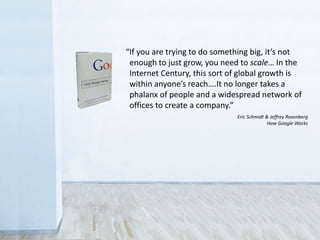
“If you are trying to do something big, it’s not
enough to just grow, you need to scale… In the
Internet Century, this sort of global growth is
within anyone’s reach….It no longer takes a
phalanx of people and a widespread network of
offices to create a company.”
Eric Schmidt & Jeffrey Rosenberg
How Google Works
• Legal
Sometimes you don’t have the rights to share
• Control
Fear that the public will misuse collections
• Revenue
Concern over loss of income from licensing
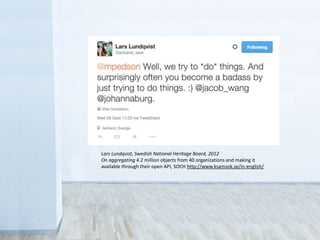
Lars Lundqvist, Swedish National Heritage Board, 2012
On aggregating 4.2 million objects from 40 organizations and making it
available through their open API, SOCH http://www.ksamsok.se/in-english/
• Legal
Sometimes you don’t have the rights to share
• Control
Fear that the public will misuse collections
• Revenue
Concern over loss of income from licensing
• Lack of resources
No staff or money to do new things
Flickr, YouTube, Twitter,
Facebook, and even your
own website terms of
use can be basis for low
cost, high impact
experiments.
• Legal
Sometimes you don’t have the rights to share
• Control
Fear that the public will misuse collections
• Revenue
Concern over loss of income from licensing
• Lack of resources
No staff or money to do new things
• Inertia
“This is the way we’ve always done it…”
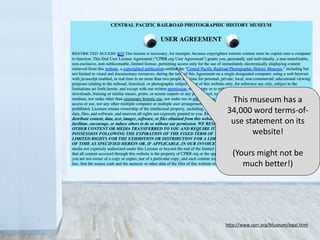
http://www.cprr.org/Museum/legal.html
This museum has a
34,000 word terms-of-
use statement on its
website!
(Yours might not be
much better!)
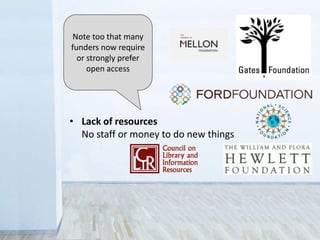
Note too that many
funders now require
or strongly prefer
open access
• Legal
Sometimes you don’t have the rights to share
• Control
Fear that the public will misuse collections
• Revenue
Concern over loss of income from licensing
• Lack of resources
No staff or money to do new things
• Inertia
“This is the way we’ve always done it…”
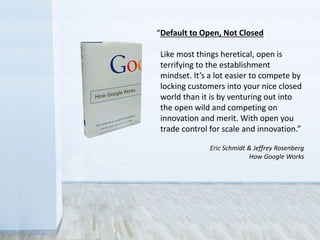
“Default to Open, Not Closed
Like most things heretical, open is
terrifying to the establishment
mindset. It’s a lot easier to compete by
locking customers into your nice closed
world than it is by venturing out into
the open wild and competing on
innovation and merit. With open you
trade control for scale and innovation.”
Eric Schmidt & Jeffrey Rosenberg
How Google Works
Open Art History
Art historians have an extraordinary opportunity—collectively—
to share our expertise openly on the web and thereby help to
educate the world about visual cultural heritage….
This magnitude of outreach is impossible without a commitment
to open licensing.
http://smarthistoryblog.org/2015/07/13/where-is-the-pedagogy-in-
digital-art-history/
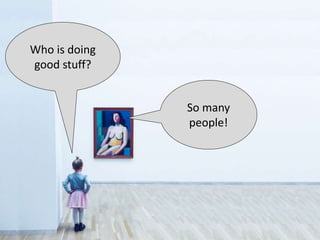
Who is doing
good stuff?
So many
people!
http://openglam.org/
#openGLAM @OpenGLAM
GLAM = Galleries, Libraries, Archives & Museums
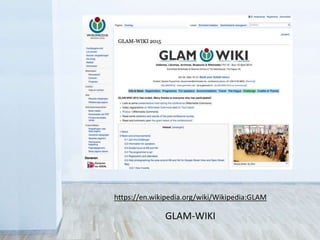
https://en.wikipedia.org/wiki/Wikipedia:GLAM
GLAM-WIKI
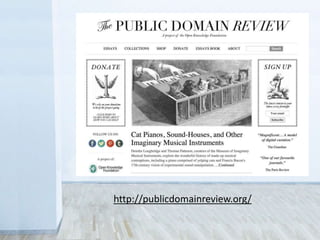
http://publicdomainreview.org/
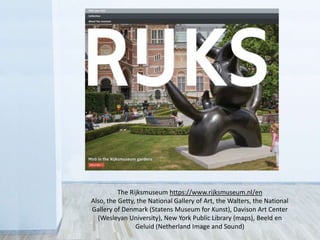
The Rijksmuseum https://www.rijksmuseum.nl/en
Also, the Getty, the National Gallery of Art, the Walters, the National
Gallery of Denmark (Statens Museum for Kunst), Davison Art Center
(Wesleyan University), New York Public Library (maps), Beeld en
Geluid (Netherland Image and Sound)
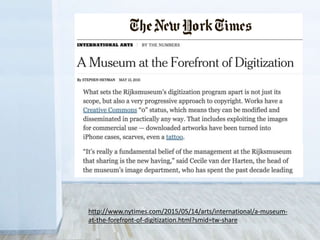
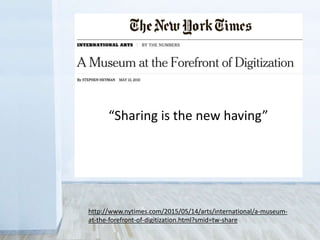
http://www.nytimes.com/2015/05/14/arts/international/a-museum-
at-the-forefront-of-digitization.html?smid=tw-share
http://www.nytimes.com/2015/05/14/arts/international/a-museum-
at-the-forefront-of-digitization.html?smid=tw-share
“Sharing is the new having”
Cecile van der Harten
Head of Imaging, Rijksmuseum
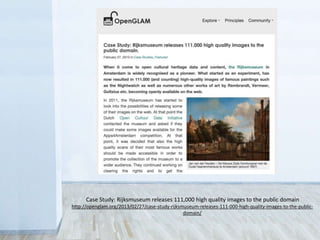
Case Study: Rijksmuseum releases 111,000 high quality images to the public domain
http://openglam.org/2013/02/27/case-study-rijksmuseum-releases-111-000-high-quality-images-to-the-public-
domain/
http://dp.la | http://europeana.eu | http://digitalnz.org/
The Digital Public Library of America, Europeana, and Digital New
Zealand are leading an international effort to provide open access to
cultural/scientific data
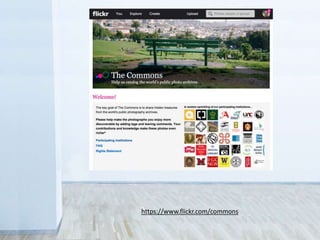
https://www.flickr.com/commons
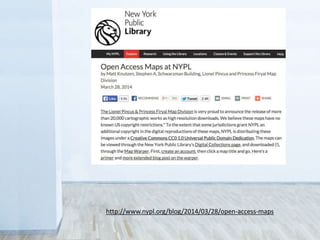
http://www.nypl.org/blog/2014/03/28/open-access-maps
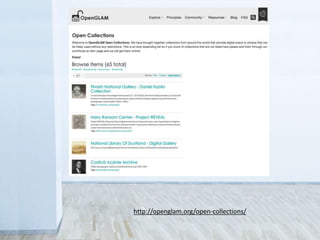
http://openglam.org/open-collections/
SO MUCH INNOVATION, OPENNESS, AND SHARING
(And if I’m sorry if I left your organization out! Let me know!!!)
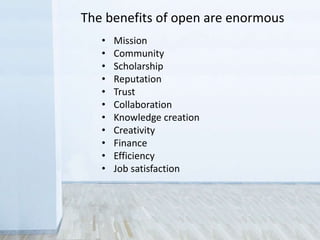
• Mission
• Community
• Scholarship
• Reputation
• Trust
• Collaboration
• Knowledge creation
• Creativity
• Finance
• Efficiency
• Job satisfaction
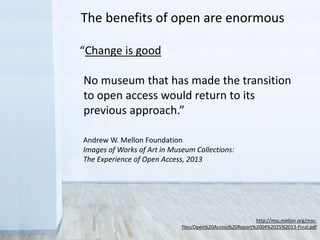
The benefits of open are enormous
“Change is good
No museum that has made the transition
to open access would return to its
previous approach.”
The benefits of open are enormous
http://msc.mellon.org/msc-
files/Open%20Access%20Report%2004%2025%2013-Final.pdf
Andrew W. Mellon Foundation
Images of Works of Art in Museum Collections:
The Experience of Open Access, 2013
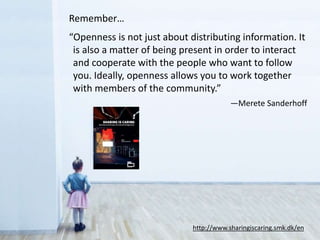
Remember…
“Openness is not just about distributing information. It
is also a matter of being present in order to interact
and cooperate with the people who want to follow
you. Ideally, openness allows you to work together
with members of the community.”
—Merete Sanderhoff
http://www.sharingiscaring.smk.dk/en
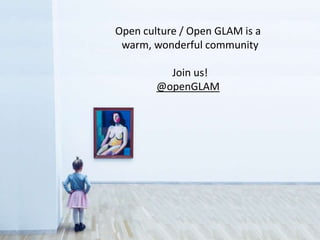
Open culture / Open GLAM is a
warm, wonderful community
Join us!
@openGLAM
Michael Peter Edson
@mpedson
http://slideshare.net/edsonm
Thank you!

The Future is Open

  • 1.
    The Future isOpen July 21, 2015 Michael Peter Edson @mpedson
  • 2.
    Original image: SMK/@missmillemaria(Instagram) The painting is Seated Female Nude, 1940, by Vilhelm Lundstrom
  • 3.
    The law locksup the man or woman Who steals the goose from off the common But leaves the greater villain loose Who steals the common from off the goose -Anonymous England, 1800s Via James Boyle, The second enclosure movement and the construction of the public domain, 2003, http://scholarship.law.duke.edu/cgi/viewcontent.cgi?articl e=1273&context=lcp
  • 4.
    The AAM saysthat the Open Economy is one of six trends to watch in 2015 Why? http://www.aam-us.org/resources/center-for-the-future-of-museums/projects-and-reports/trendswatch
  • 5.
  • 6.
    Because the worldshe lives in is different than the world most museums were created for.
  • 7.
    “In the earlydays of the British Museum, prospective visitors had to make a written application and undergo a brief interview to determine if they were fit to be admitted at all.” Museums used to be open only to the elite Bill Bryson A Short History of Nearly Everything Image: Central Hall, July 1902, Natural History Museum, London http://www.preservedproject.co.uk/albino-wallaby-natural-history-museum-london/
  • 8.
    We now livein a world with 3.2 billion Internet users 7.2 billion mobile phones 1.2 b photos/day shared on top 4 mobile sites Speed and power doubling every 18 months Disruption in virtually aspect of human endeavor “Mobile is eating the world, 2013 edition” http://ben-evans.com/benedictevans/2013/11/5/mobile-is-eating-the-world-autumn-2013-edition
  • 9.
    “…Global connectivity, immense computationalpower, and access to all the world's knowledge amassed over many centuries, in everyone’s hands… “The world has never, ever, been in [this] situation before…” http://edge.org/response-detail/10646 Keith Devlin Executive Director, H-STAR Institute, Stanford University
  • 10.
    We take free,global, resources for granted Wikipedia, Google, Facebook, Twitter, Instagram, TED, Khan Academy…and the “read/write” web
  • 11.
    Open access andhuman rights are profoundly connected
  • 12.
    http://www.un.org/en/documents/udhr/ Article 27 (1) Everyonehas the right freely to participate in the cultural life of the community, to enjoy the arts and to share in scientific advancement and its benefits. The obligations, benefits, and joy of global access are expressed in the United Nations Universal Declaration of Human Rights. These values are manifest in our missions and social contract.
  • 13.
    http://www.ohchr.org/EN/Issues/CulturalRights/Pages/AnnualReports.aspx Introduction 1. Science andculture are not only of great importance to the knowledge economy; they are also fundamental to human dignity and autonomy. 2. In that area, two influential paradigms of international law — intellectual property and human rights — have evolved largely separately. 3. Recent developments, however, have rendered the interface of those two regimes more salient. Wow! UN Report: Copyright and the Right to Science and Culture United Nations Special Rapporteur in the field of cultural rights, 2015
  • 14.
    What does itmean to be open?
  • 15.
    Broadly speaking, openis a spectrum of alternatives to “traditional” models of control over intellectual property and authority, meant to enable the broadest possible access to and re-use of resources.
  • 16.
    More people accessingand using cultural & scientific resources means bigger audiences, more creation, more benefit to society Broadly speaking, open is a spectrum of alternatives to “traditional” models of control over intellectual property and authority, meant to enable the broadest possible access to and re-use of resources.
  • 17.
    “Museums are deconstructing, pieceby piece, the authoritarian model that presumes control of what people see, what they learn and how they learn it” Trendswatch 2015
  • 18.
    “Our understanding ofresearch, education, artistic creativity, and the progress of knowledge is built upon the axiom that no idea stands alone and all innovation is built on the ideas and innovations of others.” Smithsonian Institution Web and New Media Strategy, 2009
  • 19.
    Open Source The revolutionaryidea that sharing source code, rather than keeping it a secret, can improve the quality of software, create new markets, and catalyze innovation on a global scale Many other forms of openness are derived from the success of the open source software movement
  • 20.
    Open Images Images thatare free to use and re-use without unnecessary restrictions Open Data Collections information, curatorial records, metadata, geospatial data, and other information
  • 21.
    Open Knowledge Collaborative knowledgecreation through the open sharing of data and resources Open Government Transparency, accountability, and efficiency through open sharing of government data
  • 22.
    Open Authority The sharingof expertise with and among one’s audiences The Open Economy Also called the sharing economy—economic value created through the sharing of free resources
  • 23.
    Open Science Collaboration andscientific progress through the open exchange of research, data, publications Open Education Also known as Open Educational Resources— courseware and classes that can be used and adapted for free
  • 24.
    Open GLAM Galleries, Libraries,Archives, and Museums
  • 25.
  • 26.
    The Public Domain Notowned by anyone. “The public domain is not some gummy residue left behind when all the good stuff has been covered by property law. The public domain is the place where we quarry the building blocks of our culture. It is, in fact, the majority of our culture.” James Boyle The Public Domain
  • 27.
    In America, theoriginal framers of copyright said that the public domain is the natural state of intellectual property, and copyright should only be a temporary and cautiously granted exception
  • 28.
    “It is importantfor memory organizations to recognize that as the guardians of our shared culture and knowledge they play a central role in enabling the creativity of citizens and providing the raw materials for contemporary culture, science, innovation and economic growth.” Europeana Public Domain Charter http://pro.europeana.eu/c/document_library/get_file?uuid=d542819d -d169-4240-9247-f96749113eaa&groupId=10602 Europeana’s Public Domain charter
  • 29.
    The Creative Commonsgives owners of intellectual property some flexibility above-and-beyond the strict boundaries of traditional copyright.  If you own the copyright for something, you can use a Creative Commons “license” to give others permission to re-use it.  If you want to use something that is under copyright, Creative Commons licenses tell you what you can do with the resource without having to ask the owner http://creativecommons.org/
  • 30.
    “The most widelyused open licenses are the Creative Commons licenses. It is estimated that, by 2015, those licenses will have been attached to more than 1 billion creative works, including photos, websites, music, government databases, UNESCO publications, journal articles and educational textbooks… The idea behind [those] efforts is to create a “cultural commons,” in which everyone can access, share and recombine cultural works.” United Nations: Copyright and the right to science and culture, 2015 http://www.ohchr.org/EN/Issues/CulturalRights/Pages/AnnualReports.aspx “Promoting cultural participation through open licensing
  • 31.
    http://www.slideshare.net/MereteSanderhoff/sharing-is-caring-keynote-for- public-domain-tagung-hek-basel-20-april-2015 Adapted from MereteSanderhoff National Gallery of Denmark Creative Commons attribution (CC-BY) “It’s ours, but we permit you to reuse it with proper attribution.” Creative Commons Zero (CC-0) “It’s yours, so you have the right to reuse it in any way you want.”
  • 32.
    Creative Commons attribution non-commercial(CC-BY-NC) “It’s ours, but we permit you to reuse it (with attribution) for non-commercial purposes.”
  • 33.
    BUT BEWARE! Non-commercial resources cannot be used in Wikipedia! Creative Commons attribution non-commercial (CC-BY-NC) “It’s ours, but we permit you to reuse it (with attribution) for non-commercial purposes.”
  • 34.
    Pro tip: Shareyour museum resources as public domain or CC-BY so they can be used in Wikipedia articles.
  • 35.
    Google Image searchcan be filtered for open images (explicitly labeled as public domain or Creative Commons)
  • 36.
  • 37.
    But access and re-useare still a challenge!
  • 38.
  • 39.
    Enclosure is an18th century term referring to the process of fencing off common land and turning it into private property. James Boyle, The second enclosure movement and the construction of the public domain, 2003, http://scholarship.law.duke.edu/cgi/viewcontent.cgi?articl e=1273&context=lcp
  • 40.
    Museum resources areoften enclosed, intentionally or inadvertently
  • 41.
    Not digitized oraccess not granted
  • 42.
    Only low resolutionversions are made available
  • 43.
    Item is sharedbut all rights are reserved
  • 44.
    Item is sharedunder restrictive terms of use
  • 47.
    “The visual artsfield is pervaded with a permissions culture, the widespread acceptance that all new uses of copyrighted material must be expressly authorized. This assumption has taken its toll on practice in every area of the visual arts field…As digital opportunities emerge, old frustrations with this permissions culture have taken on a new urgency.” http://www.collegeart.org/pdf/FairUseIssuesReport.pdf “Permissions culture”
  • 48.
    One-third of visualartists and visual arts professionals have avoided or abandoned work in their field because of copyright concerns. College Art Association survey of 2,000 visual art/museum professionals, 2014 http://www.collegeart.org/pdf/FairUseIssuesReport.pdf “Permissions culture”
  • 49.
    “The vision ofpresenting art history on the terms set by the Internet had made good sense to us. It looked like the perfect medium for unfolding the paradigm of diversity. But then we came up against something that limited our options: copyright...” http://www.smk.dk/en/about-smk/smks- publications/sharing-is-caring/ Merete Sanderhoff Sharing is Caring: Openness and Sharing in the Cultural Heritage Sector, 2014
  • 50.
    “The costs weretremendously high. Just one image cost several hundred dollars, and that would only buy us clearance for a limited period of time. The labor involved in writing to each rights holder, asking for files, describing the intended usage, and so on, turned out to be a major drain on our manpower.” http://www.smk.dk/en/about-smk/smks- publications/sharing-is-caring/ Merete Sanderhoff Sharing is Caring: Openness and Sharing in the Cultural Heritage Sector, 2014
  • 51.
    https://medium.com/@CosmoWenman/3d-scanning-and-museum-access-9bfbad410d46 Examples of unpublished,inaccessible 3D scans: “This is a very small sampling..” • Metropolitan Museum of Art • Stanford University • Galleria dell’Accademia • The Bargello • The Acropolis Museum • The British Museum • Art Institute of Chicago • Baltimore Museum of Art • J. Paul Getty Museum • The Louvre • University of Leicester • The Van Gogh Museum
  • 52.
    https://www.youtube.com/watch?v=cHUCTDRCb4A “[Museums and archives] certainlyhave not been very friendly towards us. And they've not been very accommodating in our requests for information or our requests for images or anything else. It's an old story and it's been going on for a long time." Elizabeth Ryneki’s search for her great-grandfather’s paintings of the Warsaw ghetto
  • 53.
  • 54.
  • 55.
  • 56.
  • 57.
    • Legal Sometimes youdon’t have the rights to share • Control Fear that the public will misuse collections • Revenue Concern over loss of income from licensing • Lack of resources No staff or money to do new things • Inertia “This is the way we’ve always done it…”
  • 58.
    Copyright can be complicated,but when it’s simple, it’s very simple Release old works and ask donors/owners for permission to share with Creative Commons licenses • Legal Sometimes you don’t have the rights to share
  • 59.
    Yale University saysthat sometimes you don’t have the right not to share… • Legal Sometimes you don’t have the rights to share
  • 60.
    “Moreover, as thelegal designation ‘public domain’ is supported by the rationale that eventually all creators and/or owners of content must relinquish their monopolies over such content making such content available for unmitigated access and use, attempts to restrict access through licensing provisions may be neither legally enforceable nor ethically prudent.” http://ydc2.yale.edu/sites/default/files/OpenAccessLAMSFinal.pdf Memo on open access to digital representations of works in the public domain from museum, library, and archive, collections at Yale University 5 May 2011 • Legal Sometimes you don’t have the rights to share
  • 61.
    • Legal Sometimes youdon’t have the rights to share • Control Fear that the public will misuse collections “There were concerns on the part of some about the consequences of open access and the loss of control of images, but over time these concerns dissipated. ” Mellon Foundation: Images of Works of Art in Museum Collections: The Experience of Open Access Mellon Foundation, 2013 http://msc.mellon.org/msc- files/Open%20Access%20Report%2004%2025%2013-Final.pdf
  • 62.
    “We have lostalmost all control, and this has been vital to our success.” William Noel Former curator of manuscripts Walters Art Museum Director, Kislak Center for Special Collections, Rare Books and Manuscripts & Director, Schoenberg Institute for Manuscript Studies, U Penn Mellon Foundation, 2013 http://msc.mellon.org/msc- files/Open%20Access%20Report%2004%2025%2013-Final.pdf • Legal Sometimes you don’t have the rights to share • Control Fear that the public will misuse collections
  • 63.
    • Legal Sometimes youdon’t have the rights to share • Control Fear that the public will misuse collections • Revenue Concern over loss of income from licensing Memory institutions generate revenue from the sale and licensing of digital images, but I have yet to find an organization that makes a profit when overhead costs are taken into account. Revenue ≠ Profit
  • 64.
    “Everyone interviewed wantsto recoup costs but almost none claimed to actually achieve or expected to achieve this…Even those services that claimed to recoup full costs generally did not account fully for salary costs or overhead expenses.” Simon Tanner: Reproduction charging models & rights policy for digital images in American art museums, a Mellon Foundation Study http://msc.mellon.org/research- reports/Reproduction%20charging%20models%20and%20rights%20policy.p df/view • Legal Sometimes you don’t have the rights to share • Control Fear that the public will misuse collections • Revenue Concern over loss of income from licensing
  • 65.
    • Legal Sometimes youdon’t have the rights to share • Control Fear that the public will misuse collections • Revenue Concern over loss of income from licensing • Lack of resources No staff or money to do new things Mellon Foundation, 2013 http://msc.mellon.org/msc- files/Open%20Access%20Report%2004%2025%2013-Final.pdf “Some museums have the technological, financial, and human resources to make the leap to open access in one step… Others are taking the process in steps as resources and time permit.” Kristin Kelly: Mellon Foundation: Images of Works of Art in Museum Collections: The Experience of Open Access
  • 66.
    • Legal Sometimes youdon’t have the rights to share • Control Fear that the public will misuse collections • Revenue Concern over loss of income from licensing “If you are trying to do something big, it’s not enough to just grow, you need to scale… In the Internet Century, this sort of global growth is within anyone’s reach….It no longer takes a phalanx of people and a widespread network of offices to create a company.” Eric Schmidt & Jeffrey Rosenberg How Google Works
  • 67.
    • Legal Sometimes youdon’t have the rights to share • Control Fear that the public will misuse collections • Revenue Concern over loss of income from licensing Lars Lundqvist, Swedish National Heritage Board, 2012 On aggregating 4.2 million objects from 40 organizations and making it available through their open API, SOCH http://www.ksamsok.se/in-english/
  • 68.
    • Legal Sometimes youdon’t have the rights to share • Control Fear that the public will misuse collections • Revenue Concern over loss of income from licensing • Lack of resources No staff or money to do new things Flickr, YouTube, Twitter, Facebook, and even your own website terms of use can be basis for low cost, high impact experiments.
  • 69.
    • Legal Sometimes youdon’t have the rights to share • Control Fear that the public will misuse collections • Revenue Concern over loss of income from licensing • Lack of resources No staff or money to do new things • Inertia “This is the way we’ve always done it…” http://www.cprr.org/Museum/legal.html This museum has a 34,000 word terms-of- use statement on its website! (Yours might not be much better!)
  • 70.
    Note too thatmany funders now require or strongly prefer open access
  • 71.
    • Legal Sometimes youdon’t have the rights to share • Control Fear that the public will misuse collections • Revenue Concern over loss of income from licensing • Lack of resources No staff or money to do new things • Inertia “This is the way we’ve always done it…”
  • 72.
    “Default to Open,Not Closed Like most things heretical, open is terrifying to the establishment mindset. It’s a lot easier to compete by locking customers into your nice closed world than it is by venturing out into the open wild and competing on innovation and merit. With open you trade control for scale and innovation.” Eric Schmidt & Jeffrey Rosenberg How Google Works
  • 73.
    Open Art History Arthistorians have an extraordinary opportunity—collectively— to share our expertise openly on the web and thereby help to educate the world about visual cultural heritage…. This magnitude of outreach is impossible without a commitment to open licensing. http://smarthistoryblog.org/2015/07/13/where-is-the-pedagogy-in- digital-art-history/
  • 74.
    Who is doing goodstuff? So many people!
  • 75.
    http://openglam.org/ #openGLAM @OpenGLAM GLAM =Galleries, Libraries, Archives & Museums
  • 76.
  • 77.
  • 78.
    The Rijksmuseum https://www.rijksmuseum.nl/en Also,the Getty, the National Gallery of Art, the Walters, the National Gallery of Denmark (Statens Museum for Kunst), Davison Art Center (Wesleyan University), New York Public Library (maps), Beeld en Geluid (Netherland Image and Sound)
  • 79.
  • 80.
  • 81.
    Case Study: Rijksmuseumreleases 111,000 high quality images to the public domain http://openglam.org/2013/02/27/case-study-rijksmuseum-releases-111-000-high-quality-images-to-the-public- domain/
  • 82.
    http://dp.la | http://europeana.eu| http://digitalnz.org/ The Digital Public Library of America, Europeana, and Digital New Zealand are leading an international effort to provide open access to cultural/scientific data
  • 83.
  • 84.
  • 85.
  • 86.
    SO MUCH INNOVATION,OPENNESS, AND SHARING (And if I’m sorry if I left your organization out! Let me know!!!)
  • 87.
    • Mission • Community •Scholarship • Reputation • Trust • Collaboration • Knowledge creation • Creativity • Finance • Efficiency • Job satisfaction The benefits of open are enormous
  • 88.
    “Change is good Nomuseum that has made the transition to open access would return to its previous approach.” The benefits of open are enormous http://msc.mellon.org/msc- files/Open%20Access%20Report%2004%2025%2013-Final.pdf Andrew W. Mellon Foundation Images of Works of Art in Museum Collections: The Experience of Open Access, 2013
  • 89.
    Remember… “Openness is notjust about distributing information. It is also a matter of being present in order to interact and cooperate with the people who want to follow you. Ideally, openness allows you to work together with members of the community.” —Merete Sanderhoff http://www.sharingiscaring.smk.dk/en
  • 90.
    Open culture /Open GLAM is a warm, wonderful community Join us! @openGLAM
  • 92.

Editor's Notes

  • #2 The painting is Seated Female Nude, 1940, by Vilhelm Lundstrom
  • #4 The full poem, as referenced by Boyle, is, The law locks up the man or woman Who steals the goose from off the common But leaves the greater villain loose Who steals the common from off the goose. The law demands that we atone When we take things we do not own But leaves the lords and ladies fine Who take things that are yours and mine. The poor and wretched don’t escape If they conspire the law to break; This must be so but they endure Those who conspire to make the law. The law locks up the man or woman Who steals the goose from off the common And geese will still a common lack Till they go and steal it back.
  • #8 Bill Bryson’s “A brief history of nearly everything.” Bryson continues: ““They then had to return a second time to pick up a ticket—that is assuming they had passed the interview—and finally come back a third time to view the museum’s treasures. Even then they were whisked through in groups and not allowed to linger.”” Image: Central Hall, July 1902, Natural History Museum, London http://www.preservedproject.co.uk/albino-wallaby-natural-history-museum-london/
  • #9 http://www.ibtimes.co.uk/there-are-more-gadgets-there-are-people-world-1468947 A comparison of real-time data from mobile network analysis firm GSMA Intelligence and the US Census Bureau reveals that the number of active SIM cards surpassed the number of humans some time in the last few weeks. The number of active mobile devices currently stands at 7.22 billion, whilst there are fewer than 7.2 billion people. The speed at which the global mobile network is growing suggests that the crossover occured somewhere around the 7.19 billion mark. The human population is growing at 1.2% annually, which comes in at about two people per second. The number of devices, on the other hand, is multiplying at a rate five times that. "No other technology has impacted us like the mobile phone. It's the fastest growing manmade phenomenon ever - from zero to 7.2 billion in three decades,
  • #13 http://www.ibtimes.co.uk/there-are-more-gadgets-there-are-people-world-1468947 A comparison of real-time data from mobile network analysis firm GSMA Intelligence and the US Census Bureau reveals that the number of active SIM cards surpassed the number of humans some time in the last few weeks. The number of active mobile devices currently stands at 7.22 billion, whilst there are fewer than 7.2 billion people. The speed at which the global mobile network is growing suggests that the crossover occured somewhere around the 7.19 billion mark. The human population is growing at 1.2% annually, which comes in at about two people per second. The number of devices, on the other hand, is multiplying at a rate five times that. "No other technology has impacted us like the mobile phone. It's the fastest growing manmade phenomenon ever - from zero to 7.2 billion in three decades,
  • #14 http://www.ibtimes.co.uk/there-are-more-gadgets-there-are-people-world-1468947 A comparison of real-time data from mobile network analysis firm GSMA Intelligence and the US Census Bureau reveals that the number of active SIM cards surpassed the number of humans some time in the last few weeks. The number of active mobile devices currently stands at 7.22 billion, whilst there are fewer than 7.2 billion people. The speed at which the global mobile network is growing suggests that the crossover occured somewhere around the 7.19 billion mark. The human population is growing at 1.2% annually, which comes in at about two people per second. The number of devices, on the other hand, is multiplying at a rate five times that. "No other technology has impacted us like the mobile phone. It's the fastest growing manmade phenomenon ever - from zero to 7.2 billion in three decades,
  • #48 art historians and editors who avoid modern-era art history, overviews of an artistic movement, and digital scholarship museums that are stalled in developing digital access to their works curators who avoid group exhibitions, controversial exhibitions, and exhibitions where copyright permissions make cost prohibitive artists who avoid collage, pop-culture critiques, digital experiments, andmultimedia
  • #49 art historians and editors who avoid modern-era art history, overviews of an artistic movement, and digital scholarship museums that are stalled in developing digital access to their works curators who avoid group exhibitions, controversial exhibitions, and exhibitions where copyright permissions make cost prohibitive artists who avoid collage, pop-culture critiques, digital experiments, andmultimedia
  • #52 More than a dozen
  • #53 Elizabeth Ryneki
  • #62 11 museums
  • #63 11 museums
  • #74 14m page views last academic year, millions of learners from virtually every country on earth.