
REAL NUMBERS
made by :-
Utkarsh srivastava
10th - f
HISTORYOF REALNUMBERS
Simple fractions have been used by the Egyptians around 1000 BC; the Vedic "Sulba Sutras" ("The rules of
chords") in, c. 600 BC, include what may be the first "use" of irrational numbers .
Around 500 BC, the Greek mathematicians led by Pythagoras realized the need for irrational numbers, in
particular the irrationality of the square root of 2.
The Middle Ages brought the acceptance of zero, negative, integral, and fractional numbers, first
by Indian and Chinese mathematicians, and then by Arabic mathematicians, who were also the first to treat
irrational numbers as algebraic objects, which was made possible by the development of algebra. Arabic
mathematicians merged the concepts of "number" and "magnitude" into a more general idea of real
numbers. The Egyptian mathematician Abū Kāmil Shujā ibn Aslam (c. 850–930) was the first to accept
irrational numbers as solutions to quadratic equations or as coefficients in an equation, often in the form of
square roots, cube roots and fourth roots
REALNUMBERS
In mathematics, a real number is a value that represents a quantity along a
continuous line. The real numbers include all the rational numbers, such as
the integer −5 and the fraction 4/3, and all the irrational numbers such
as √2 (1.41421356…, the square root of two, an irrational algebraic number)
and π (3.14159265…, atranscendental number)
EUCLID
Euclid , also known as Euclid of
Alexandria, was a Greek mathematician,
often referred to as the "Father of
Geometry". He was active
in Alexandria during the reign
of Ptolemy I (323–283 BC). His Elements is
one of the most influential works in
the history of mathematics, serving as the
main textbook for
teaching mathematics (especially geometry)
from the time of its publication until the late
19th or early 20th century. In the Elements,
Euclid deduced the principles of what is now
called Euclidean geometry from a small set
of axioms. Euclid also wrote works
on perspective, conic sections, spherical
geometry, number theory and rigor.
EUCLID”S LEMMA
In number theory, Euclid'slemma (also called Euclid'sfirsttheorem) is a lemma that captures a
fundamental property of prime numbers, namely: If a prime divides the product of two numbers, it
must divide at least one of those numbers. For example since133 × 143 = 19019 is divisible by 19, one or
both of 133 or 143 must be as well. In fact, 19 × 7 = 133.
This property is the key in the proof of the fundamental theorem of arithmetic.
It is used to define prime elements, a generalization of prime numbers to arbitrary commutative rings.
The lemma is not true for composite numbers. For example, 4 does not divide 6 and 4 does not divide
10, yet 4 does divide their product, 60.
REMARKS
2) Although Euclid’s divison algorithm is stated for only positive integers, it
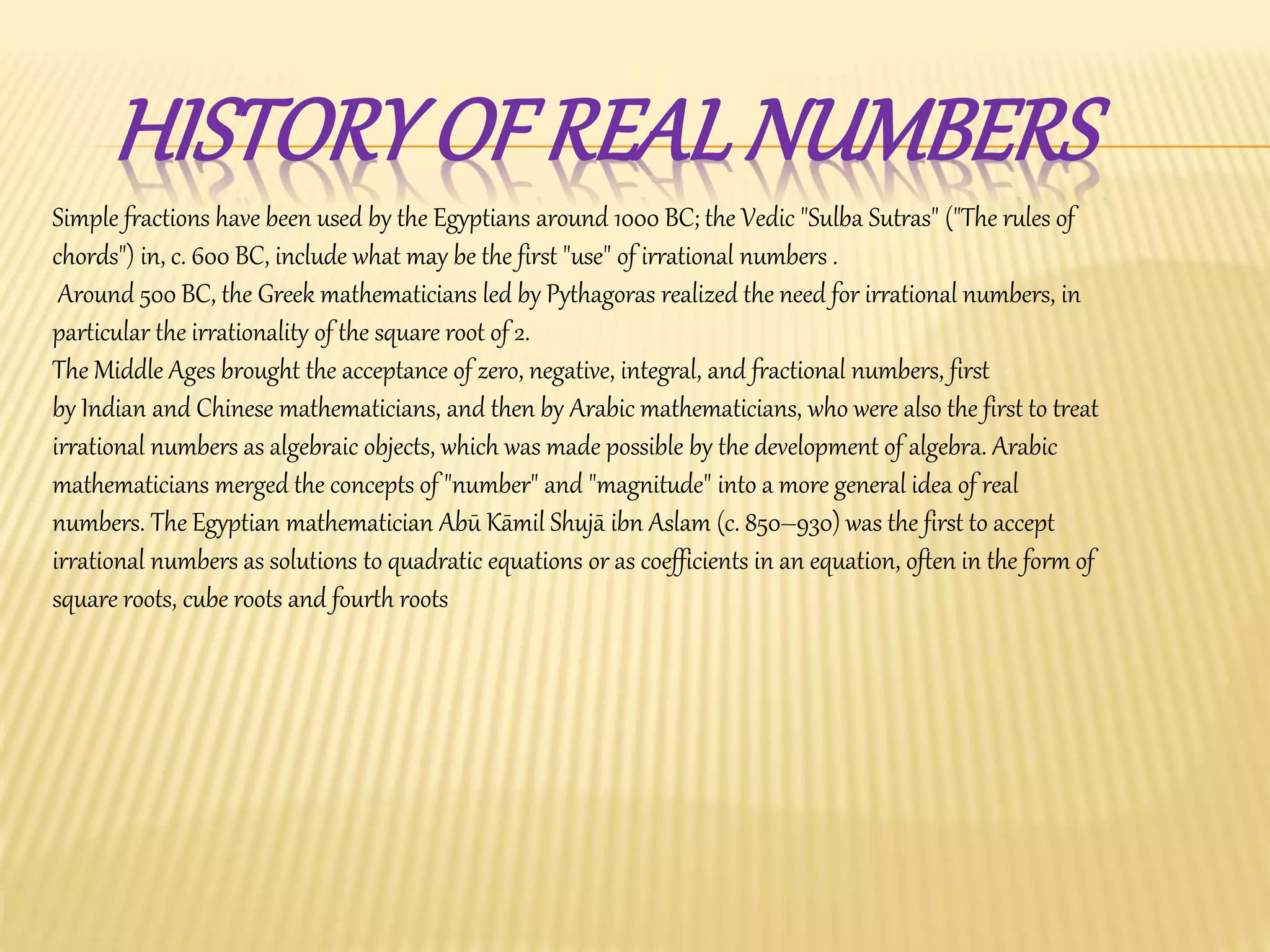
can be extended for all integers except zero ,i.e. 0.
1) Euclid’s divison lemma and algorithm are so closely interlinked that people
often Call former as the divison algorithm also.
USEEUCLID’SALGORITHMTOFINDTHE
HIGHESTCOMMONFACTOROFTHETWO
NUMBERS606AND91.?
 606 ÷ 91 = 6 R 60
91 ÷ 60 = 1 R 31
60 ÷ 31 = 1 R 29
31 ÷ 29 = 1 R 2
29 ÷ 2 = 14 R 1
2 ÷ 1 = 2 r 0
so 1 is the Hcf (The last non-zero remainder is the Hcf)
FUNDAMENTALTHEOREMOFARITHMETIC
In number theory, the fundamentaltheoremof arithmetic, also called the uniquefactorizationtheoremor
the unique-prime-factorizationtheorem, states that every integer greater than 1either is prime itself or is
the product of prime numbers, and that, although the order of the primes in the second case is
arbitrary, the primes themselves are not. For example,
1200 = 24 × 31 × 52 = 3 × 2× 2× 2× 2 × 5 × 5 = 5 × 2× 3× 2× 5 × 2 × 2 = etc.
The theorem is stating two things: first, that 1200 can be represented as a product of primes, and second,
no matter how this is done, there will always be four 2s, one 3, two 5s, and no other primes in the
product.
The requirement that the factors be prime is necessary: factorizations containing composite
numbers may not be unique (e.g. 12 = 2 × 6 = 3 × 4).
PRIMEFACTORISATION
Find the HCF and LCM of 24 and 40
24 = 2 x 3 x 2 x 2 and 40 = 2 x 2 x 2 x 5
HCF: The common factors of 24 and 40 are 2 x 2 x 2 = 8. So the HCF and LCM of 24 and 40 = 8
LCM: We take the prime factors of the smaller number (24), and they are 2, 3, 2, and 2. The only
prime factor from the larger number (40) not in this list is 5.
So the LCM of 24 and 40 is 2 x 3 x 2 x 2 x 5 = 120
REVISITINGIRRATIONALNUMBERS
Show that 5 – √3 is irrational.
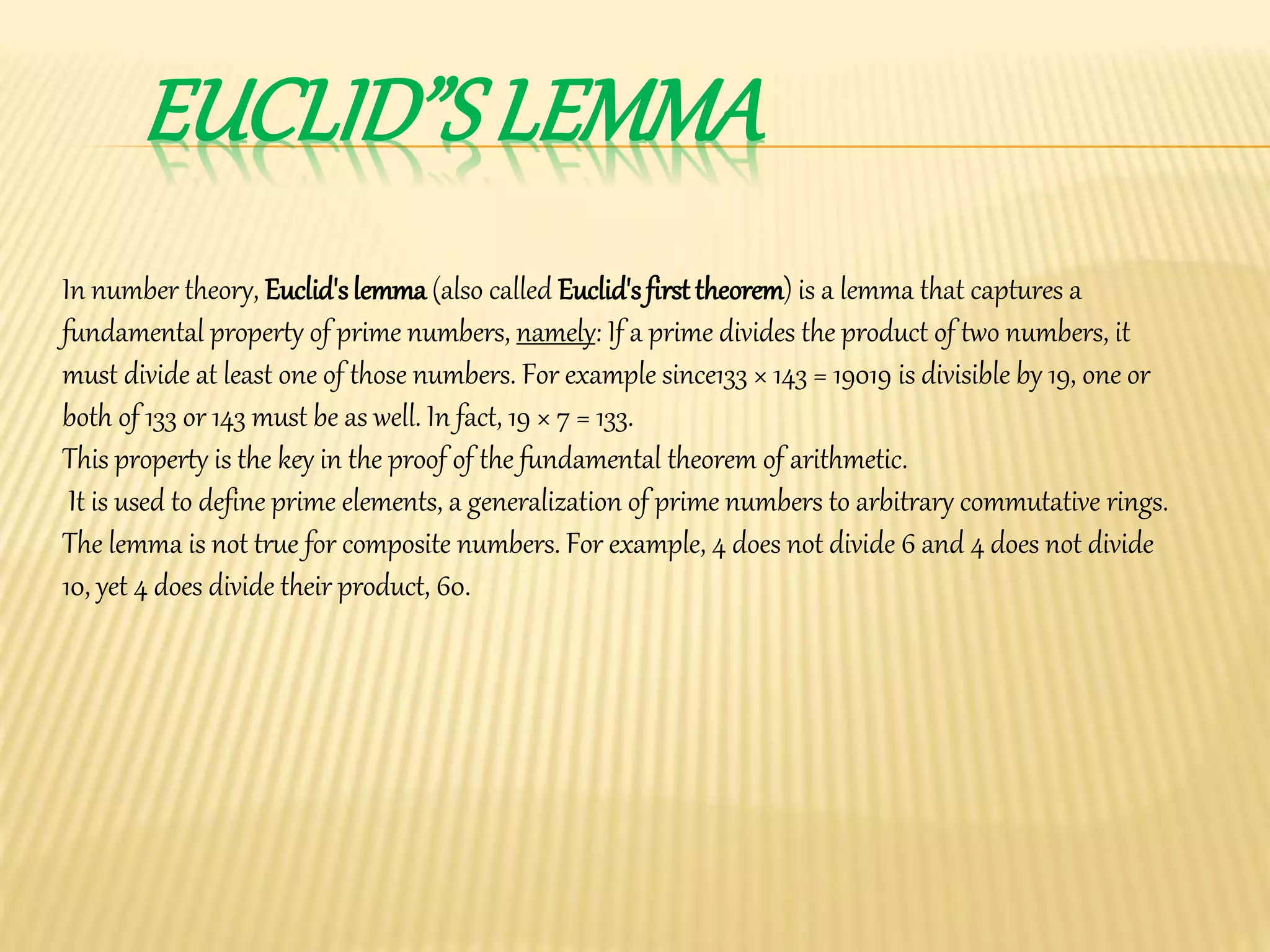
That is, we can find coprime a and b (b ≠ 0) such that
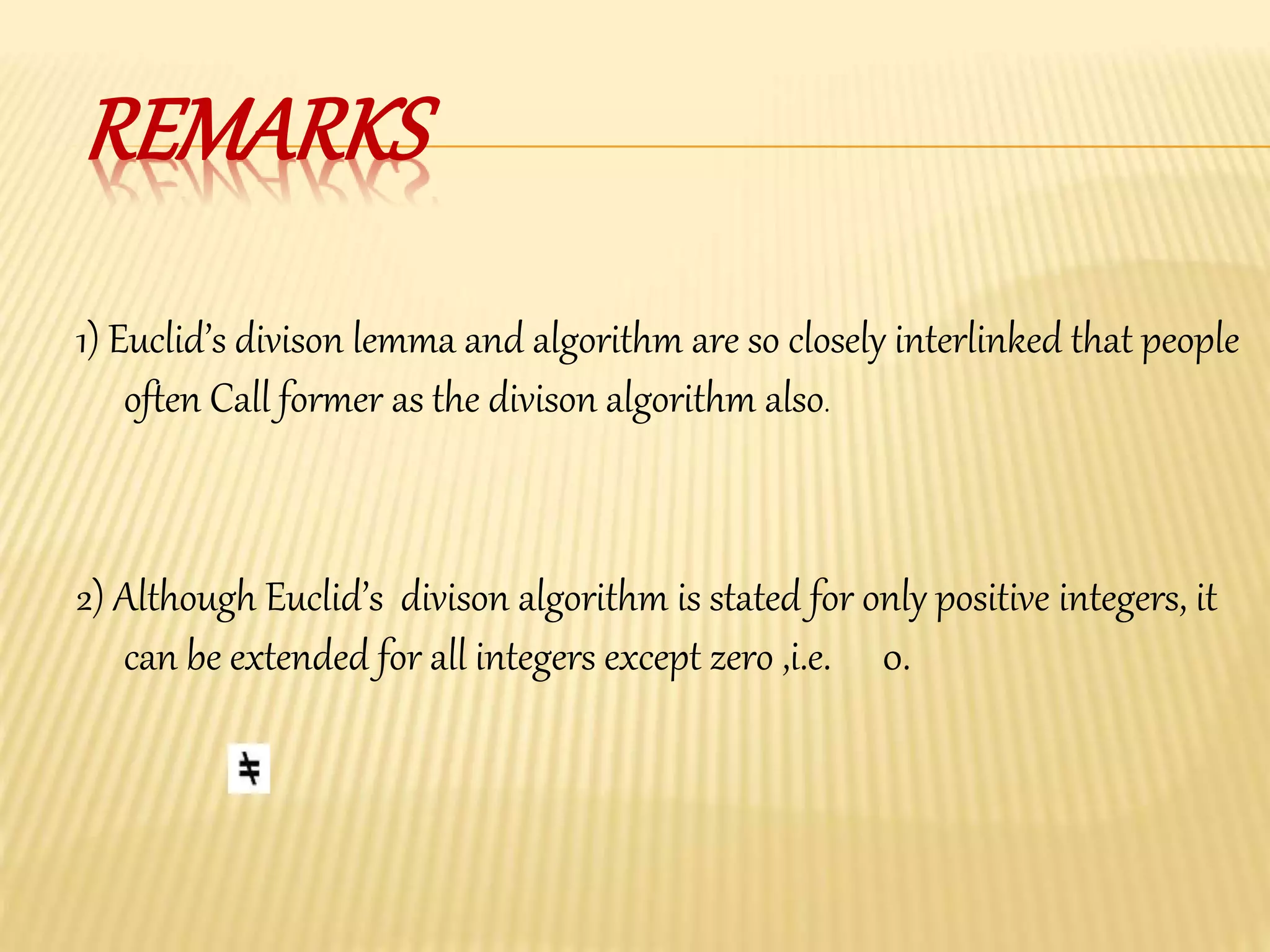
Therefore,
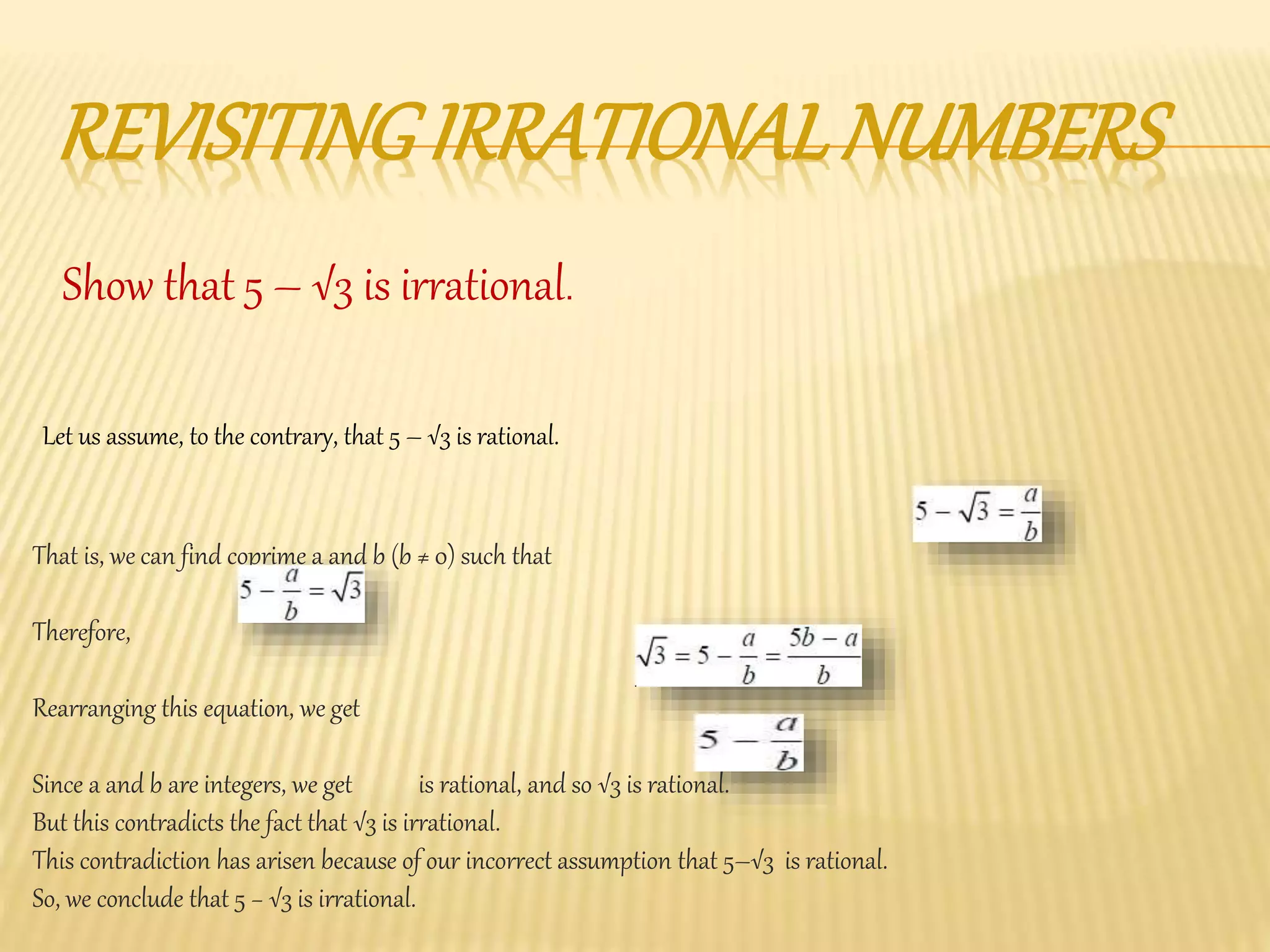
Rearranging this equation, we get
Since a and b are integers, we get is rational, and so √3 is rational.
But this contradicts the fact that √3 is irrational.
This contradiction has arisen because of our incorrect assumption that 5–√3 is rational.
So, we conclude that 5 − √3 is irrational.
Let us assume, to the contrary, that 5 – √3 is rational.
REVISITINGRATIONALNUMBERSAND
THEIRDECIMALEXPANSIONSRationalnumbersare of two types depending on whether their decimal form is terminating or non terminating
A decimal number that has digits that do not go on forever.
Examples:
0.25 (it has two decimal digits)
3.0375 (it has four decimal digits)
In contrast a Recurring Decimal has digits that go on forever
Example: 1/3 = 0.333... (the 3 repeats forever) is a Recurring Decimal, not a Terminating Decimal
Terminating
Non - Terminating
a decimalnumeral that does not end in an infinite sequence of zeros (contrasted with terminating decimal ).
Real numbers

Real numbers

  • 1.
    REAL NUMBERS made by:- Utkarsh srivastava 10th - f
  • 2.
    HISTORYOF REALNUMBERS Simple fractionshave been used by the Egyptians around 1000 BC; the Vedic "Sulba Sutras" ("The rules of chords") in, c. 600 BC, include what may be the first "use" of irrational numbers . Around 500 BC, the Greek mathematicians led by Pythagoras realized the need for irrational numbers, in particular the irrationality of the square root of 2. The Middle Ages brought the acceptance of zero, negative, integral, and fractional numbers, first by Indian and Chinese mathematicians, and then by Arabic mathematicians, who were also the first to treat irrational numbers as algebraic objects, which was made possible by the development of algebra. Arabic mathematicians merged the concepts of "number" and "magnitude" into a more general idea of real numbers. The Egyptian mathematician Abū Kāmil Shujā ibn Aslam (c. 850–930) was the first to accept irrational numbers as solutions to quadratic equations or as coefficients in an equation, often in the form of square roots, cube roots and fourth roots
  • 3.
    REALNUMBERS In mathematics, areal number is a value that represents a quantity along a continuous line. The real numbers include all the rational numbers, such as the integer −5 and the fraction 4/3, and all the irrational numbers such as √2 (1.41421356…, the square root of two, an irrational algebraic number) and π (3.14159265…, atranscendental number)
  • 4.
    EUCLID Euclid , alsoknown as Euclid of Alexandria, was a Greek mathematician, often referred to as the "Father of Geometry". He was active in Alexandria during the reign of Ptolemy I (323–283 BC). His Elements is one of the most influential works in the history of mathematics, serving as the main textbook for teaching mathematics (especially geometry) from the time of its publication until the late 19th or early 20th century. In the Elements, Euclid deduced the principles of what is now called Euclidean geometry from a small set of axioms. Euclid also wrote works on perspective, conic sections, spherical geometry, number theory and rigor.
  • 5.
    EUCLID”S LEMMA In numbertheory, Euclid'slemma (also called Euclid'sfirsttheorem) is a lemma that captures a fundamental property of prime numbers, namely: If a prime divides the product of two numbers, it must divide at least one of those numbers. For example since133 × 143 = 19019 is divisible by 19, one or both of 133 or 143 must be as well. In fact, 19 × 7 = 133. This property is the key in the proof of the fundamental theorem of arithmetic. It is used to define prime elements, a generalization of prime numbers to arbitrary commutative rings. The lemma is not true for composite numbers. For example, 4 does not divide 6 and 4 does not divide 10, yet 4 does divide their product, 60.
  • 6.
    REMARKS 2) Although Euclid’sdivison algorithm is stated for only positive integers, it can be extended for all integers except zero ,i.e. 0. 1) Euclid’s divison lemma and algorithm are so closely interlinked that people often Call former as the divison algorithm also.
  • 7.
    USEEUCLID’SALGORITHMTOFINDTHE HIGHESTCOMMONFACTOROFTHETWO NUMBERS606AND91.?  606 ÷91 = 6 R 60 91 ÷ 60 = 1 R 31 60 ÷ 31 = 1 R 29 31 ÷ 29 = 1 R 2 29 ÷ 2 = 14 R 1 2 ÷ 1 = 2 r 0 so 1 is the Hcf (The last non-zero remainder is the Hcf)
  • 8.
    FUNDAMENTALTHEOREMOFARITHMETIC In number theory,the fundamentaltheoremof arithmetic, also called the uniquefactorizationtheoremor the unique-prime-factorizationtheorem, states that every integer greater than 1either is prime itself or is the product of prime numbers, and that, although the order of the primes in the second case is arbitrary, the primes themselves are not. For example, 1200 = 24 × 31 × 52 = 3 × 2× 2× 2× 2 × 5 × 5 = 5 × 2× 3× 2× 5 × 2 × 2 = etc. The theorem is stating two things: first, that 1200 can be represented as a product of primes, and second, no matter how this is done, there will always be four 2s, one 3, two 5s, and no other primes in the product. The requirement that the factors be prime is necessary: factorizations containing composite numbers may not be unique (e.g. 12 = 2 × 6 = 3 × 4).
  • 9.
    PRIMEFACTORISATION Find the HCFand LCM of 24 and 40 24 = 2 x 3 x 2 x 2 and 40 = 2 x 2 x 2 x 5 HCF: The common factors of 24 and 40 are 2 x 2 x 2 = 8. So the HCF and LCM of 24 and 40 = 8 LCM: We take the prime factors of the smaller number (24), and they are 2, 3, 2, and 2. The only prime factor from the larger number (40) not in this list is 5. So the LCM of 24 and 40 is 2 x 3 x 2 x 2 x 5 = 120
  • 10.
    REVISITINGIRRATIONALNUMBERS Show that 5– √3 is irrational. That is, we can find coprime a and b (b ≠ 0) such that Therefore, Rearranging this equation, we get Since a and b are integers, we get is rational, and so √3 is rational. But this contradicts the fact that √3 is irrational. This contradiction has arisen because of our incorrect assumption that 5–√3 is rational. So, we conclude that 5 − √3 is irrational. Let us assume, to the contrary, that 5 – √3 is rational.
  • 11.
    REVISITINGRATIONALNUMBERSAND THEIRDECIMALEXPANSIONSRationalnumbersare of twotypes depending on whether their decimal form is terminating or non terminating A decimal number that has digits that do not go on forever. Examples: 0.25 (it has two decimal digits) 3.0375 (it has four decimal digits) In contrast a Recurring Decimal has digits that go on forever Example: 1/3 = 0.333... (the 3 repeats forever) is a Recurring Decimal, not a Terminating Decimal Terminating Non - Terminating a decimalnumeral that does not end in an infinite sequence of zeros (contrasted with terminating decimal ).