Suraj Vishwakarma
Mathematics Mentor
Founder : MyTuition.in
Our Books
https://Books.SurajSir.in
☎️7754920680
Chapter 01
Real Numbers
Part I
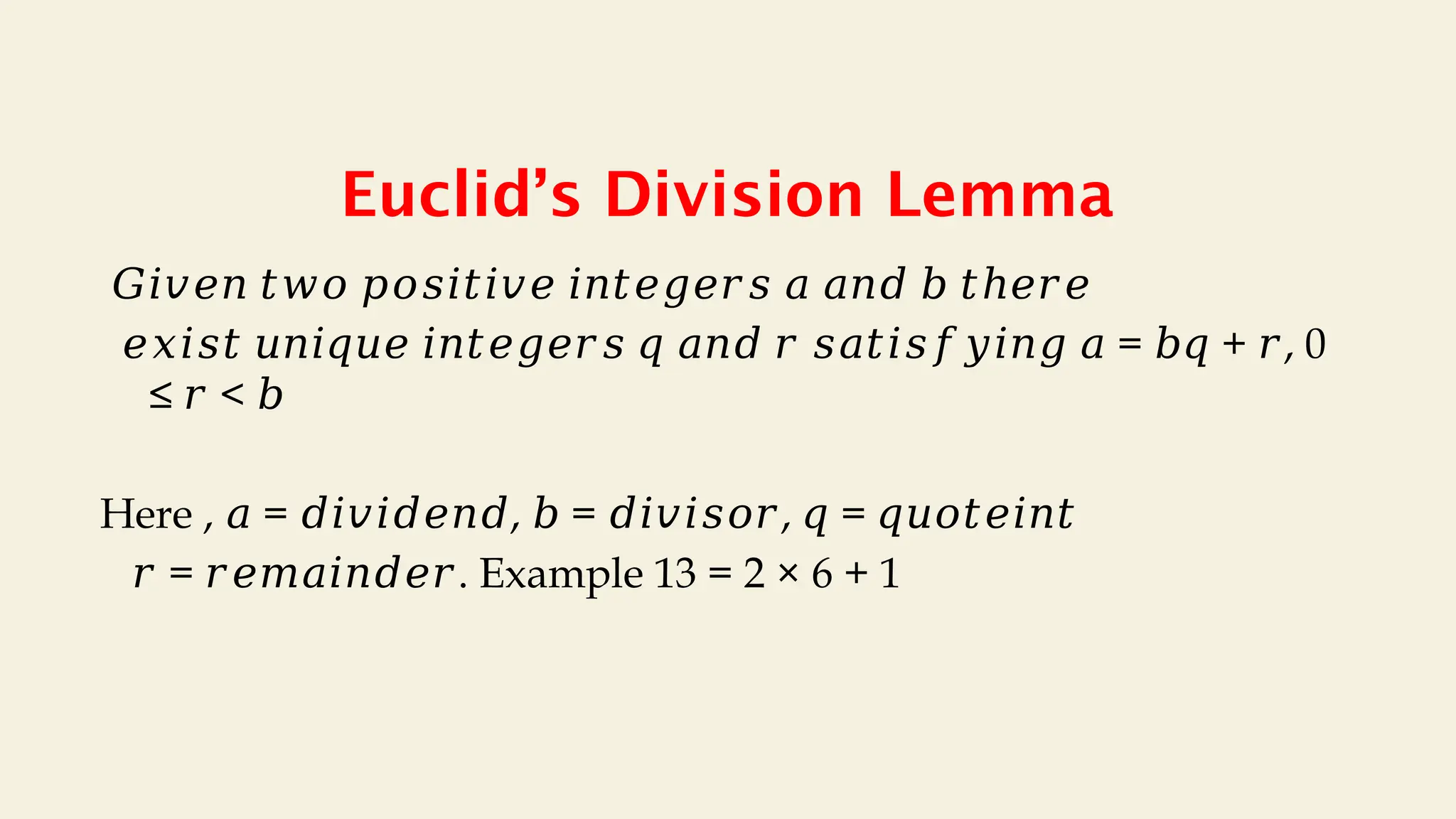
Euclid’s Division Lemma
𝐺𝑖𝑣𝑒𝑛 𝑡𝑤𝑜 𝑝𝑜𝑠𝑖𝑡𝑖𝑣𝑒 𝑖𝑛𝑡𝑒𝑔𝑒𝑟𝑠 𝑎 𝑎𝑛𝑑 𝑏 𝑡ℎ𝑒𝑟𝑒
𝑒𝑥𝑖𝑠𝑡 𝑢𝑛𝑖𝑞𝑢𝑒 𝑖𝑛𝑡𝑒𝑔𝑒𝑟𝑠 𝑞 𝑎𝑛𝑑 𝑟 𝑠𝑎𝑡𝑖𝑠𝑓𝑦𝑖𝑛𝑔 𝑎 = + , 0
𝑏𝑞 𝑟
≤ <
𝑟 𝑏
Here , = , = , =
𝑎 𝑑𝑖𝑣𝑖𝑑𝑒𝑛𝑑 𝑏 𝑑𝑖𝑣𝑖𝑠𝑜𝑟 𝑞 𝑞𝑢𝑜𝑡𝑒𝑖𝑛𝑡
𝑟 = . Example 13 = 2 × 6 + 1
𝑟𝑒𝑚𝑎𝑖𝑛𝑑𝑒𝑟
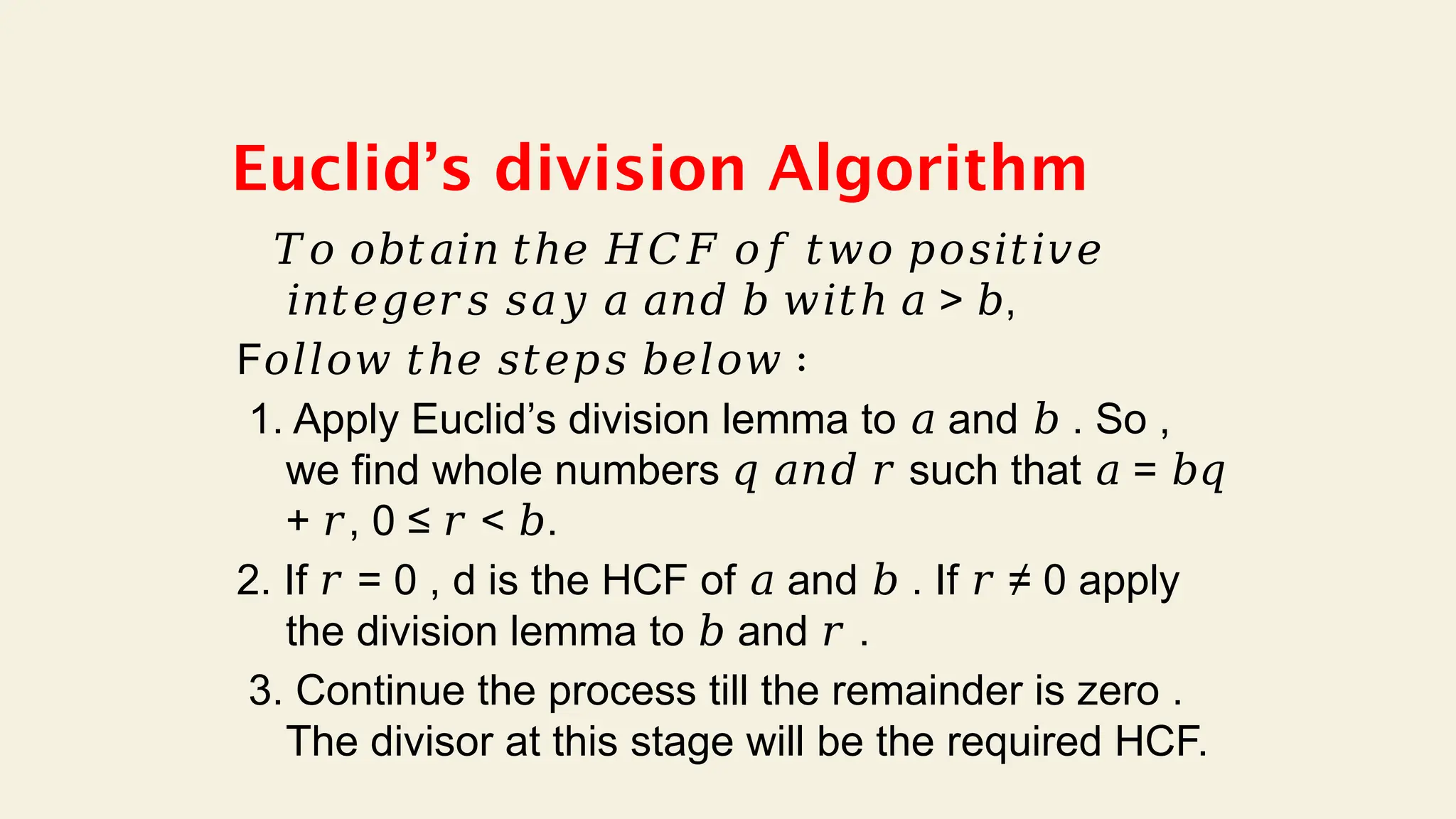
Euclid’s division Algorithm
𝑇𝑜 𝑜𝑏𝑡𝑎𝑖𝑛 𝑡ℎ𝑒 𝐻𝐶𝐹 𝑜𝑓 𝑡𝑤𝑜 𝑝𝑜𝑠𝑖𝑡𝑖𝑣𝑒
𝑖𝑛𝑡𝑒𝑔𝑒𝑟𝑠 𝑠𝑎𝑦 𝑎 𝑎𝑛𝑑 𝑏 𝑤𝑖𝑡ℎ 𝑎 > ,
𝑏
F𝑜𝑙𝑙𝑜𝑤 𝑡ℎ𝑒 𝑠𝑡𝑒𝑝𝑠 𝑏𝑒𝑙𝑜𝑤 ∶
1. Apply Euclid’s division lemma to and . So ,
𝑎 𝑏
we find whole numbers such that =
𝑞 𝑎𝑛𝑑 𝑟 𝑎 𝑏𝑞
+ , 0 ≤ < .
𝑟 𝑟 𝑏
2. If = 0 , d is the HCF of and . If ≠ 0 apply
𝑟 𝑎 𝑏 𝑟
the division lemma to and .
𝑏 𝑟
3. Continue the process till the remainder is zero .
The divisor at this stage will be the required HCF.
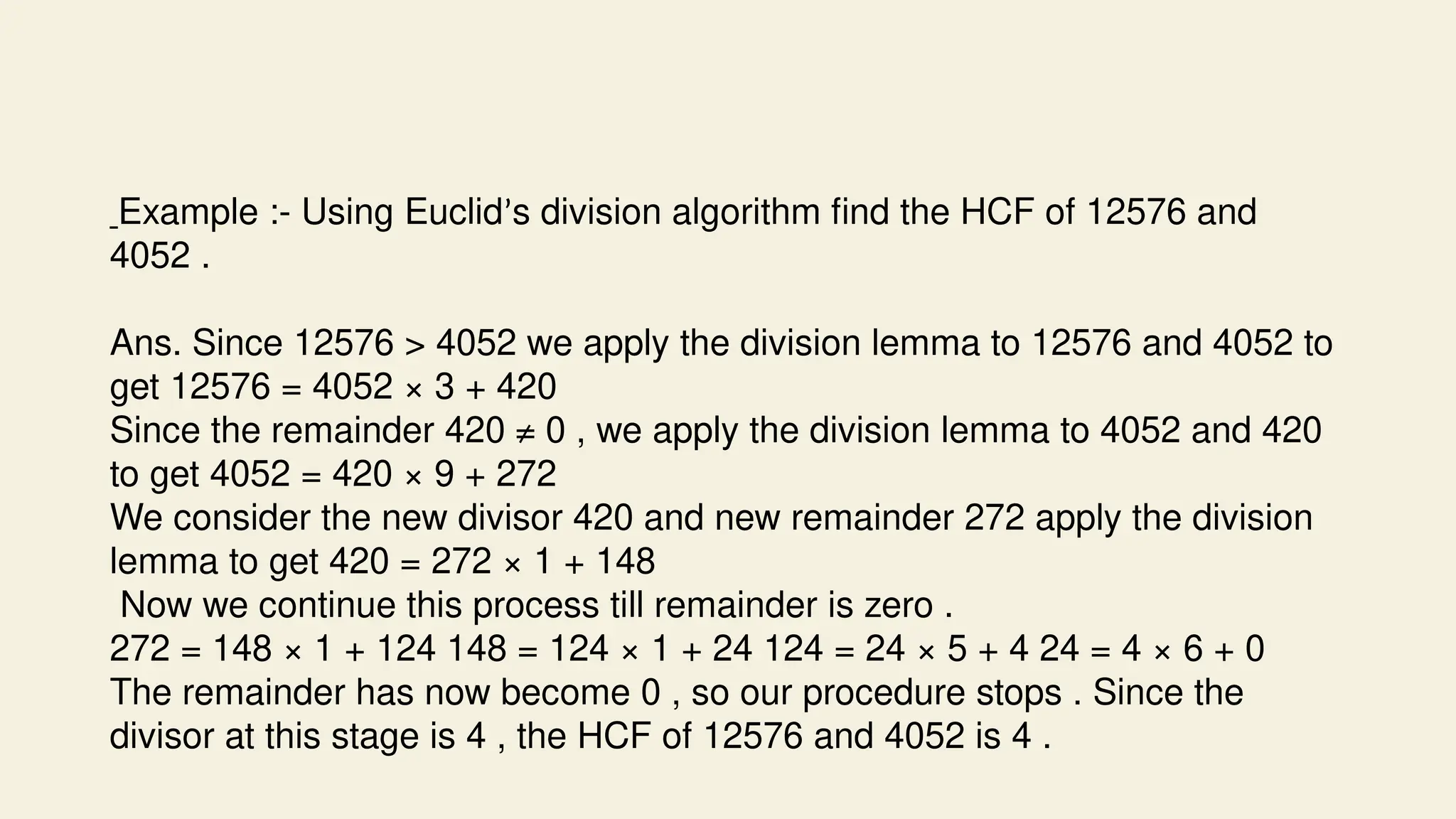
Example :- Using Euclid’s division algorithm find the HCF of 12576 and
4052 .
Ans. Since 12576 > 4052 we apply the division lemma to 12576 and 4052 to
get 12576 = 4052 × 3 + 420
Since the remainder 420 ≠ 0 , we apply the division lemma to 4052 and 420
to get 4052 = 420 × 9 + 272
We consider the new divisor 420 and new remainder 272 apply the division
lemma to get 420 = 272 × 1 + 148
Now we continue this process till remainder is zero .
272 = 148 × 1 + 124 148 = 124 × 1 + 24 124 = 24 × 5 + 4 24 = 4 × 6 + 0
The remainder has now become 0 , so our procedure stops . Since the
divisor at this stage is 4 , the HCF of 12576 and 4052 is 4 .
Fundamental Theorem of
Arithmetic
 𝐸𝑣𝑒𝑟𝑦 𝑐𝑜𝑚𝑝𝑜𝑠𝑖𝑡𝑒 𝑛𝑢𝑚𝑏𝑒𝑟 𝑐𝑎𝑛 𝑏𝑒
𝑒𝑥𝑝𝑟𝑒𝑠𝑠𝑒𝑑 𝑎𝑠 𝑎 𝑝𝑟𝑜𝑑𝑢𝑐𝑡 𝑜𝑓 𝑝𝑟𝑖𝑚𝑒𝑠,
,
𝑎𝑛𝑑 𝑡ℎ𝑖𝑠 𝑓𝑎𝑐𝑡𝑜𝑟𝑖𝑠𝑎𝑡𝑖𝑜𝑛 𝑖𝑠 𝑢𝑛𝑖𝑞𝑢𝑒
𝑎𝑝𝑎𝑟𝑡 𝑓𝑟𝑜𝑚
𝑡ℎ𝑒 𝑜𝑟𝑑𝑒𝑟 𝑖𝑛 𝑤ℎ𝑖𝑐ℎ 𝑡ℎ𝑒𝑦 𝑜𝑐𝑐𝑢𝑟. Now
factorize a large number say 32760 .
32760=2x2x2x3x3x5x7x13x13
Revisiting Irrational Numbers
 𝐿𝑒𝑡 𝑝 𝑏𝑒 𝑎 𝑝𝑟𝑖𝑚𝑒 𝑛𝑢𝑚𝑏𝑒𝑟 𝑖𝑓 𝑝 𝑑𝑖𝑣𝑖𝑑𝑒𝑠 𝑎2
, 𝑡ℎ𝑒𝑛 𝑝
, .
𝑑𝑖𝑣𝑖𝑑𝑒𝑠 𝑎 𝑖𝑠 𝑎 𝑝𝑜𝑠𝑖𝑡𝑖𝑣𝑒 𝑖𝑛𝑡𝑒𝑔𝑒𝑟
Theorem: √2 .
𝑖𝑠 𝑖𝑟𝑟𝑎𝑡𝑖𝑜𝑛𝑎𝑙
Proof: Let us assume on contrary that √2 is rational number then
we can write √2= a/b where a and b are co-prime. √2 = / (
𝑎 𝑏 𝑏
≠ 0) squaring on both sides 2 = 𝑎2
/ 𝑏2
2 𝑏2
= 𝑎2
. Here 2 divides 𝑎2
, so it also divides . So we can write
𝑎
a=2c for some integer c.
Substituting for we get 2
𝑎 𝑏2
= 4c2
that is 𝑏2
= 2c2
.
Here 2 divides 𝑏2
, so it also divides .This creates a
𝑏
contradiction that a and b have no common factors other than
1. This contradiction has arisen because of our wrong
assumption. So we conclude that √2 is a irrational number.
Revisiting Rational numbers and their decimal
expansions
 Theorem:
𝐿𝑒𝑡 𝑥 𝑏𝑒 𝑎 𝑟𝑎𝑡𝑖𝑜𝑛𝑎𝑙 𝑛𝑢𝑚𝑏𝑒𝑟 𝑤ℎ𝑜𝑠𝑒 𝑑𝑒𝑐𝑖𝑚𝑎𝑙
𝑒𝑥𝑝𝑎𝑛𝑠𝑖𝑜𝑛 𝑡𝑒𝑟𝑚𝑖𝑛𝑎𝑡𝑒.𝑇ℎ𝑒𝑛 𝑥 𝑐𝑎𝑛 𝑏𝑒
𝑒𝑥𝑝𝑟𝑒𝑠𝑠𝑒𝑑 𝑖𝑛
𝑡ℎ𝑒 𝑓𝑜𝑟𝑚 of and q, ,
𝑝 𝑤ℎ𝑒𝑟𝑒 𝑝 𝑎𝑛𝑑 𝑞 𝑎𝑟𝑒 𝑐𝑜𝑝𝑟𝑖𝑚𝑒
𝑎𝑛𝑑 𝑡ℎ𝑒 𝑝𝑟𝑖𝑚𝑒 𝑓𝑎𝑐𝑡𝑜𝑟𝑖𝑠𝑎𝑡𝑖𝑜𝑛 𝑜𝑓 𝑞 𝑖𝑠 𝑜𝑓 𝑡ℎ𝑒
𝑓𝑜𝑟𝑚 2n
5m
, where n and m -
𝑎𝑟𝑒 𝑛𝑜𝑛 𝑛𝑒𝑔𝑎𝑡𝑖𝑣𝑒
𝑖𝑛𝑡𝑒𝑔𝑒𝑟𝑠. Example:0.375= 375/103
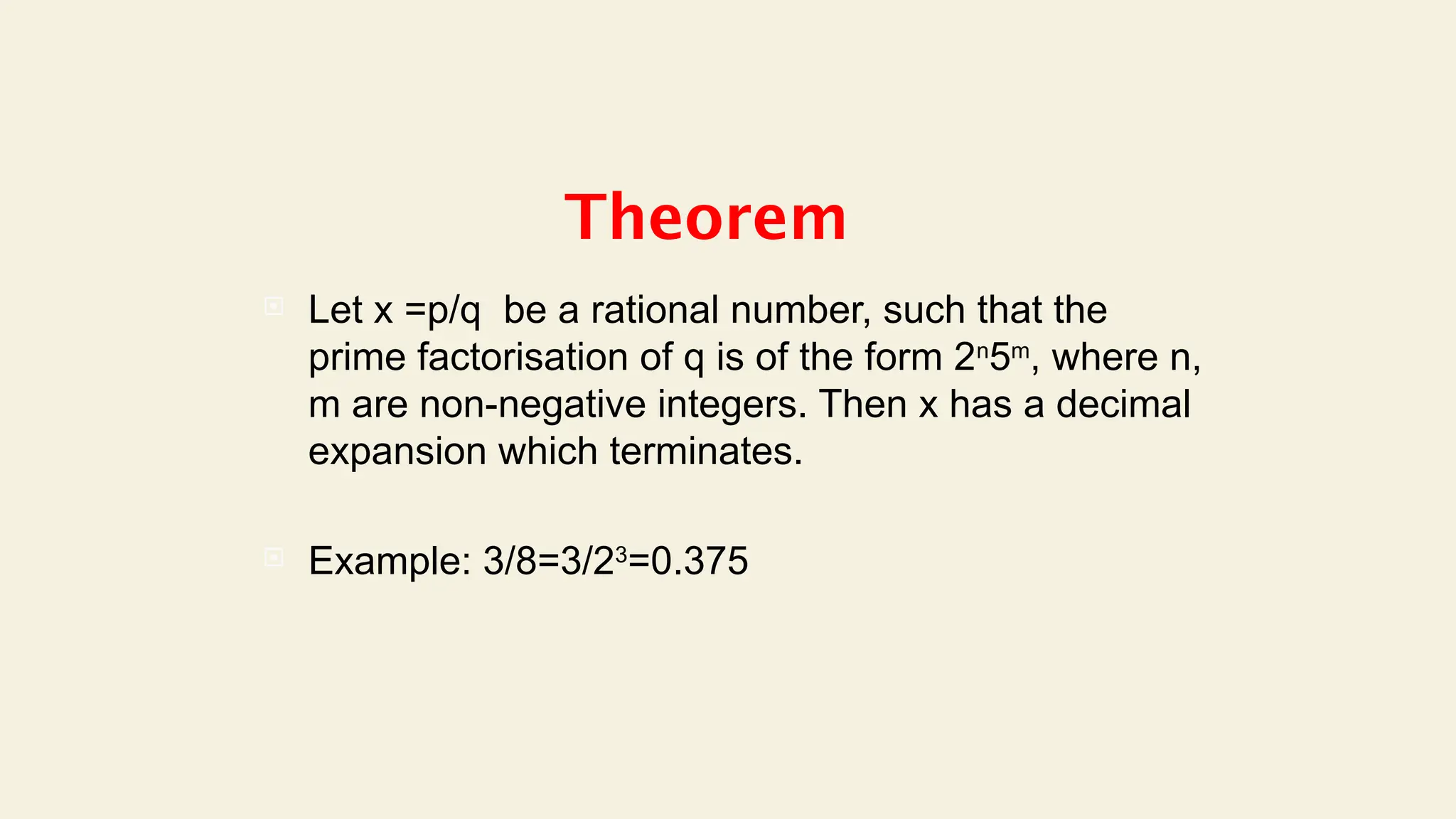
Theorem
 Let x =p/q be a rational number, such that the
prime factorisation of q is of the form 2n
5m
, where n,
m are non-negative integers. Then x has a decimal
expansion which terminates.
 Example: 3/8=3/23
=0.375
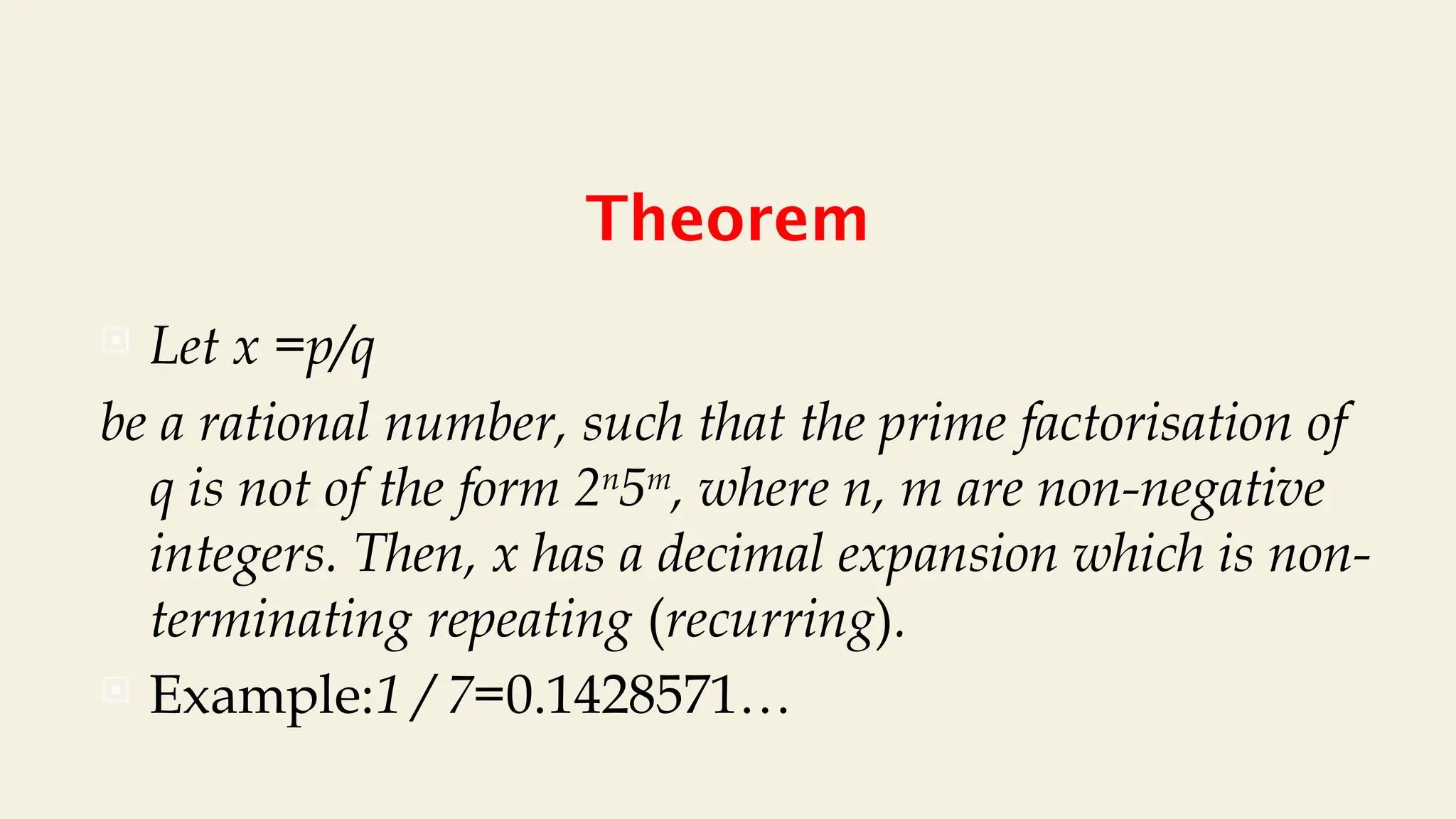
Theorem
 Let x =p/q
be a rational number, such that the prime factorisation of
q is not of the form 2n
5m
, where n, m are non-negative
integers. Then, x has a decimal expansion which is non-
terminating repeating (recurring).
 Example:1 / 7=0.1428571…
Our Books
https://Books.SurajSir.in
☎️7754920680
THANK YOU

01 Real numbers Class X powerpoint presentation by Suraj Sir

  • 1.
  • 2.
  • 3.
  • 4.
    Euclid’s Division Lemma 𝐺𝑖𝑣𝑒𝑛𝑡𝑤𝑜 𝑝𝑜𝑠𝑖𝑡𝑖𝑣𝑒 𝑖𝑛𝑡𝑒𝑔𝑒𝑟𝑠 𝑎 𝑎𝑛𝑑 𝑏 𝑡ℎ𝑒𝑟𝑒 𝑒𝑥𝑖𝑠𝑡 𝑢𝑛𝑖𝑞𝑢𝑒 𝑖𝑛𝑡𝑒𝑔𝑒𝑟𝑠 𝑞 𝑎𝑛𝑑 𝑟 𝑠𝑎𝑡𝑖𝑠𝑓𝑦𝑖𝑛𝑔 𝑎 = + , 0 𝑏𝑞 𝑟 ≤ < 𝑟 𝑏 Here , = , = , = 𝑎 𝑑𝑖𝑣𝑖𝑑𝑒𝑛𝑑 𝑏 𝑑𝑖𝑣𝑖𝑠𝑜𝑟 𝑞 𝑞𝑢𝑜𝑡𝑒𝑖𝑛𝑡 𝑟 = . Example 13 = 2 × 6 + 1 𝑟𝑒𝑚𝑎𝑖𝑛𝑑𝑒𝑟
  • 5.
    Euclid’s division Algorithm 𝑇𝑜𝑜𝑏𝑡𝑎𝑖𝑛 𝑡ℎ𝑒 𝐻𝐶𝐹 𝑜𝑓 𝑡𝑤𝑜 𝑝𝑜𝑠𝑖𝑡𝑖𝑣𝑒 𝑖𝑛𝑡𝑒𝑔𝑒𝑟𝑠 𝑠𝑎𝑦 𝑎 𝑎𝑛𝑑 𝑏 𝑤𝑖𝑡ℎ 𝑎 > , 𝑏 F𝑜𝑙𝑙𝑜𝑤 𝑡ℎ𝑒 𝑠𝑡𝑒𝑝𝑠 𝑏𝑒𝑙𝑜𝑤 ∶ 1. Apply Euclid’s division lemma to and . So , 𝑎 𝑏 we find whole numbers such that = 𝑞 𝑎𝑛𝑑 𝑟 𝑎 𝑏𝑞 + , 0 ≤ < . 𝑟 𝑟 𝑏 2. If = 0 , d is the HCF of and . If ≠ 0 apply 𝑟 𝑎 𝑏 𝑟 the division lemma to and . 𝑏 𝑟 3. Continue the process till the remainder is zero . The divisor at this stage will be the required HCF.
  • 6.
    Example :- UsingEuclid’s division algorithm find the HCF of 12576 and 4052 . Ans. Since 12576 > 4052 we apply the division lemma to 12576 and 4052 to get 12576 = 4052 × 3 + 420 Since the remainder 420 ≠ 0 , we apply the division lemma to 4052 and 420 to get 4052 = 420 × 9 + 272 We consider the new divisor 420 and new remainder 272 apply the division lemma to get 420 = 272 × 1 + 148 Now we continue this process till remainder is zero . 272 = 148 × 1 + 124 148 = 124 × 1 + 24 124 = 24 × 5 + 4 24 = 4 × 6 + 0 The remainder has now become 0 , so our procedure stops . Since the divisor at this stage is 4 , the HCF of 12576 and 4052 is 4 .
  • 7.
    Fundamental Theorem of Arithmetic 𝐸𝑣𝑒𝑟𝑦 𝑐𝑜𝑚𝑝𝑜𝑠𝑖𝑡𝑒 𝑛𝑢𝑚𝑏𝑒𝑟 𝑐𝑎𝑛 𝑏𝑒 𝑒𝑥𝑝𝑟𝑒𝑠𝑠𝑒𝑑 𝑎𝑠 𝑎 𝑝𝑟𝑜𝑑𝑢𝑐𝑡 𝑜𝑓 𝑝𝑟𝑖𝑚𝑒𝑠, , 𝑎𝑛𝑑 𝑡ℎ𝑖𝑠 𝑓𝑎𝑐𝑡𝑜𝑟𝑖𝑠𝑎𝑡𝑖𝑜𝑛 𝑖𝑠 𝑢𝑛𝑖𝑞𝑢𝑒 𝑎𝑝𝑎𝑟𝑡 𝑓𝑟𝑜𝑚 𝑡ℎ𝑒 𝑜𝑟𝑑𝑒𝑟 𝑖𝑛 𝑤ℎ𝑖𝑐ℎ 𝑡ℎ𝑒𝑦 𝑜𝑐𝑐𝑢𝑟. Now factorize a large number say 32760 . 32760=2x2x2x3x3x5x7x13x13
  • 8.
    Revisiting Irrational Numbers 𝐿𝑒𝑡 𝑝 𝑏𝑒 𝑎 𝑝𝑟𝑖𝑚𝑒 𝑛𝑢𝑚𝑏𝑒𝑟 𝑖𝑓 𝑝 𝑑𝑖𝑣𝑖𝑑𝑒𝑠 𝑎2 , 𝑡ℎ𝑒𝑛 𝑝 , . 𝑑𝑖𝑣𝑖𝑑𝑒𝑠 𝑎 𝑖𝑠 𝑎 𝑝𝑜𝑠𝑖𝑡𝑖𝑣𝑒 𝑖𝑛𝑡𝑒𝑔𝑒𝑟 Theorem: √2 . 𝑖𝑠 𝑖𝑟𝑟𝑎𝑡𝑖𝑜𝑛𝑎𝑙 Proof: Let us assume on contrary that √2 is rational number then we can write √2= a/b where a and b are co-prime. √2 = / ( 𝑎 𝑏 𝑏 ≠ 0) squaring on both sides 2 = 𝑎2 / 𝑏2 2 𝑏2 = 𝑎2 . Here 2 divides 𝑎2 , so it also divides . So we can write 𝑎 a=2c for some integer c.
  • 9.
    Substituting for weget 2 𝑎 𝑏2 = 4c2 that is 𝑏2 = 2c2 . Here 2 divides 𝑏2 , so it also divides .This creates a 𝑏 contradiction that a and b have no common factors other than 1. This contradiction has arisen because of our wrong assumption. So we conclude that √2 is a irrational number.
  • 10.
    Revisiting Rational numbersand their decimal expansions  Theorem: 𝐿𝑒𝑡 𝑥 𝑏𝑒 𝑎 𝑟𝑎𝑡𝑖𝑜𝑛𝑎𝑙 𝑛𝑢𝑚𝑏𝑒𝑟 𝑤ℎ𝑜𝑠𝑒 𝑑𝑒𝑐𝑖𝑚𝑎𝑙 𝑒𝑥𝑝𝑎𝑛𝑠𝑖𝑜𝑛 𝑡𝑒𝑟𝑚𝑖𝑛𝑎𝑡𝑒.𝑇ℎ𝑒𝑛 𝑥 𝑐𝑎𝑛 𝑏𝑒 𝑒𝑥𝑝𝑟𝑒𝑠𝑠𝑒𝑑 𝑖𝑛 𝑡ℎ𝑒 𝑓𝑜𝑟𝑚 of and q, , 𝑝 𝑤ℎ𝑒𝑟𝑒 𝑝 𝑎𝑛𝑑 𝑞 𝑎𝑟𝑒 𝑐𝑜𝑝𝑟𝑖𝑚𝑒 𝑎𝑛𝑑 𝑡ℎ𝑒 𝑝𝑟𝑖𝑚𝑒 𝑓𝑎𝑐𝑡𝑜𝑟𝑖𝑠𝑎𝑡𝑖𝑜𝑛 𝑜𝑓 𝑞 𝑖𝑠 𝑜𝑓 𝑡ℎ𝑒 𝑓𝑜𝑟𝑚 2n 5m , where n and m - 𝑎𝑟𝑒 𝑛𝑜𝑛 𝑛𝑒𝑔𝑎𝑡𝑖𝑣𝑒 𝑖𝑛𝑡𝑒𝑔𝑒𝑟𝑠. Example:0.375= 375/103
  • 11.
    Theorem  Let x=p/q be a rational number, such that the prime factorisation of q is of the form 2n 5m , where n, m are non-negative integers. Then x has a decimal expansion which terminates.  Example: 3/8=3/23 =0.375
  • 12.
    Theorem  Let x=p/q be a rational number, such that the prime factorisation of q is not of the form 2n 5m , where n, m are non-negative integers. Then, x has a decimal expansion which is non- terminating repeating (recurring).  Example:1 / 7=0.1428571…
  • 13.
  • 14.