There’s more to Pi than meets the eye
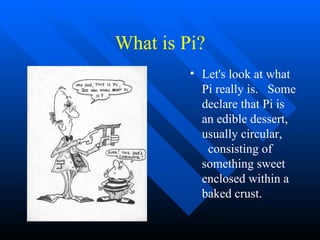
What is Pi? Let's look at what Pi really is.  Some declare that Pi is an edible dessert, usually circular,  consisting of something sweet enclosed within a baked crust.
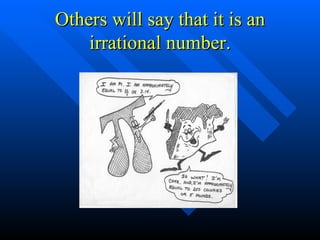
Others will say that it is an irrational number.
Or you may be convinced that it is too difficult for mortal man to understand
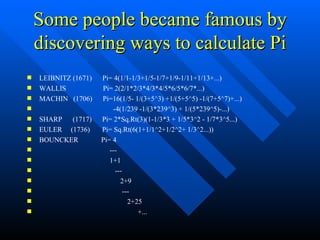
Some people became famous by discovering ways to calculate Pi LEIBNITZ (1671)  Pi= 4(1/1-1/3+1/5-1/7+1/9-1/11+1/13+...) WALLIS  Pi= 2(2/1*2/3*4/3*4/5*6/5*6/7*...) MACHIN  (1706)  Pi=16(1/5- 1/(3+5^3) +1/(5+5^5) -1/(7+5^7)+...)  -4(1/239 -1/(3*239^3) + 1/(5*239^5)-...) SHARP  (1717)  Pi= 2*Sq.Rt(3)(1-1/3*3 + 1/5*3^2 - 1/7*3^5...) EULER  (1736)  Pi= Sq.Rt(6(1+1/1^2+1/2^2+ 1/3^2...)) BOUNCKER  Pi= 4 --- 1+1 --- 2+9 --- 2+25 +...
Pi and “e” are irrational Pi is one of the longest numbers ever computed, second only to “e” another IRRATIONAL number with a value of 2.718281828459045 --  It never repeats like the decimal values of 1/3=.33333… or 5/7=.7142857142857… Visit  http://www.sciboard.louisville.edu  to see if you can find a computer program that calculates Pi or e.
You can calculate a value for PI! Shortly you will see students doing  research on pi.  They rolled  the bike along the pavement.  They measured distance rolled for 5 revolutions in a straight line.  Divided that distance by 5.  Measured the radius/diameter of the wheel.  Divided the distance of one revolution (Circumference) by radius.  What number do you think they got? Why do you suppose they made 5 revolutions? How did they get the distance rolled in one revolution? What would happen if a smaller wheel was used? What suggestions can you think of that will increase their accuracy? What is the difference between accuracy and precision?
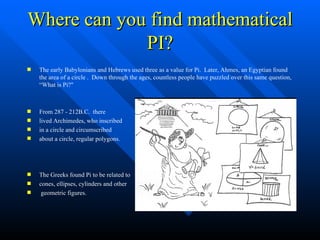
Where can you find mathematical PI? The early Babylonians and Hebrews used three as a value for Pi.  Later, Ahmes, an Egyptian found the area of a circle .  Down through the ages, countless people have puzzled over this same question, “What is Pi?" From 287 - 212B.C.  there  lived Archimedes, who inscribed  in a circle and circumscribed  about a circle, regular polygons.  The Greeks found Pi to be related to  cones, ellipses, cylinders and other geometric figures.
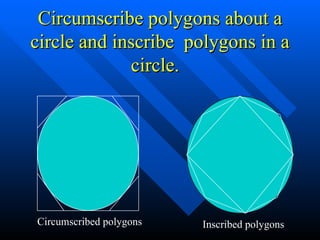
Circumscribe polygons about a circle and inscribe  polygons in a circle.  Circumscribed polygons Inscribed polygons
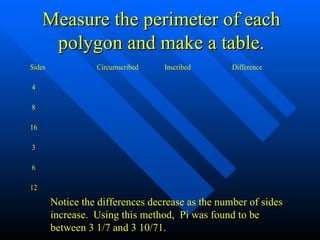
Measure the perimeter of each polygon and make a table. Notice the differences decrease as the number of sides increase.  Using this method,  Pi was found to be  between 3 1/7 and 3 10/71.
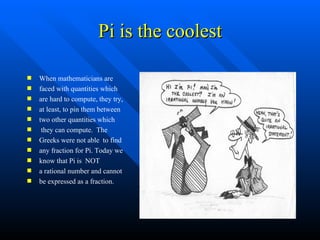
Pi is the coolest When mathematicians are  faced with quantities which  are hard to compute, they try,  at least, to pin them between two other quantities which they can compute.  The  Greeks were not able  to find  any fraction for Pi. Today we  know that Pi is  NOT  a rational number and cannot  be expressed as a fraction.
Pi slept for nearly 1500 years
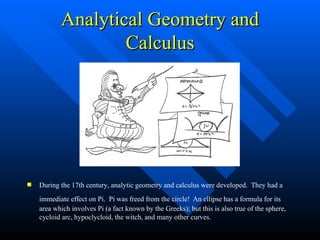
Analytical Geometry and Calculus During the 17th century, analytic geometry and calculus were developed.  They had a immediate effect on Pi.  Pi was freed from the circle!   An ellipse has a formula for its area which involves Pi (a fact known by the Greeks); but this is also true of the sphere,  cycloid arc, hypoclycloid, the witch, and many other curves.
Research on your own Look in the Mathematics Teacher  for  articles on Pi.  Learn to calculate Pi using the methods described. Using license plates  Buffoon's Needle and Monte Carlo Techniques
Calculations of Pi continued One of the major chapters in calculus deals with infinite series.  Several such series have been discovered which approximate Pi. These discoveries and the conjuncture that Pi is a transcendental number led others to compute  Pi to more places Vega  1794  137 digits Dase  1844  201 Rutherford  1853  441 Shanbis  1873  707 (only 527 were correct)
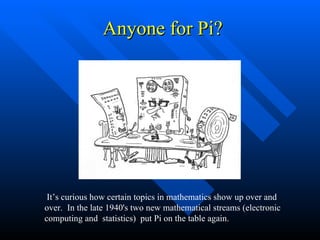
Anyone for Pi? It’s curious how certain topics in mathematics show up over and over.  In the late 1940's two new mathematical streams (electronic computing and  statistics)  put Pi on the table again.
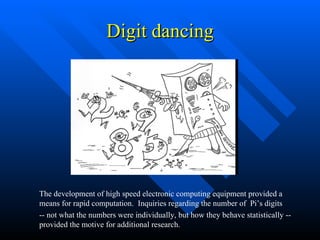
Digit dancing The development of high speed electronic computing equipment provided a means for rapid computation.  Inquiries regarding the number of  Pi’s digits -- not what the numbers were individually, but how they behave statistically -- provided the motive for additional research.
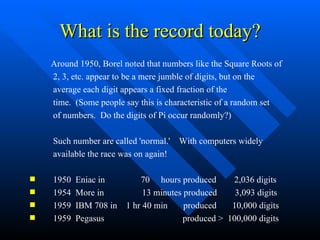
What is the record today? Around 1950, Borel noted that numbers like the Square Roots of 2, 3, etc. appear to be a mere jumble of digits, but on the average each digit appears a fixed fraction of the time.  (Some people say this is characteristic of a random set of numbers.  Do the digits of Pi occur randomly?) Such number are called 'normal.'  With computers widely available the race was on again! 1950  Eniac in  70  hours produced  2,036 digits 1954  More in  13 minutes produced  3,093 digits 1959  IBM 708 in  1 hr 40 min  produced  10,000 digits 1959  Pegasus  produced >  100,000 digits
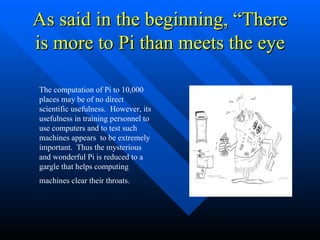
As said in the beginning, “There is more to Pi than meets the eye The computation of Pi to 10,000 places may be of no direct scientific usefulness.  However, its usefulness in training personnel to use computers and to test such machines appears  to be extremely important.  Thus the mysterious and wonderful Pi is reduced to a gargle that helps computing machines clear their throats.

Pi Ppt

  • 1.
    There’s more toPi than meets the eye
  • 2.
    What is Pi?Let's look at what Pi really is. Some declare that Pi is an edible dessert, usually circular, consisting of something sweet enclosed within a baked crust.
  • 3.
    Others will saythat it is an irrational number.
  • 4.
    Or you maybe convinced that it is too difficult for mortal man to understand
  • 5.
    Some people becamefamous by discovering ways to calculate Pi LEIBNITZ (1671) Pi= 4(1/1-1/3+1/5-1/7+1/9-1/11+1/13+...) WALLIS Pi= 2(2/1*2/3*4/3*4/5*6/5*6/7*...) MACHIN (1706) Pi=16(1/5- 1/(3+5^3) +1/(5+5^5) -1/(7+5^7)+...) -4(1/239 -1/(3*239^3) + 1/(5*239^5)-...) SHARP (1717) Pi= 2*Sq.Rt(3)(1-1/3*3 + 1/5*3^2 - 1/7*3^5...) EULER (1736) Pi= Sq.Rt(6(1+1/1^2+1/2^2+ 1/3^2...)) BOUNCKER Pi= 4 --- 1+1 --- 2+9 --- 2+25 +...
  • 6.
    Pi and “e”are irrational Pi is one of the longest numbers ever computed, second only to “e” another IRRATIONAL number with a value of 2.718281828459045 -- It never repeats like the decimal values of 1/3=.33333… or 5/7=.7142857142857… Visit http://www.sciboard.louisville.edu to see if you can find a computer program that calculates Pi or e.
  • 7.
    You can calculatea value for PI! Shortly you will see students doing research on pi. They rolled the bike along the pavement. They measured distance rolled for 5 revolutions in a straight line. Divided that distance by 5. Measured the radius/diameter of the wheel. Divided the distance of one revolution (Circumference) by radius. What number do you think they got? Why do you suppose they made 5 revolutions? How did they get the distance rolled in one revolution? What would happen if a smaller wheel was used? What suggestions can you think of that will increase their accuracy? What is the difference between accuracy and precision?
  • 8.
    Where can youfind mathematical PI? The early Babylonians and Hebrews used three as a value for Pi. Later, Ahmes, an Egyptian found the area of a circle . Down through the ages, countless people have puzzled over this same question, “What is Pi?" From 287 - 212B.C. there lived Archimedes, who inscribed in a circle and circumscribed about a circle, regular polygons. The Greeks found Pi to be related to cones, ellipses, cylinders and other geometric figures.
  • 9.
    Circumscribe polygons abouta circle and inscribe polygons in a circle. Circumscribed polygons Inscribed polygons
  • 10.
    Measure the perimeterof each polygon and make a table. Notice the differences decrease as the number of sides increase. Using this method, Pi was found to be between 3 1/7 and 3 10/71.
  • 11.
    Pi is thecoolest When mathematicians are faced with quantities which are hard to compute, they try, at least, to pin them between two other quantities which they can compute. The Greeks were not able to find any fraction for Pi. Today we know that Pi is NOT a rational number and cannot be expressed as a fraction.
  • 12.
    Pi slept fornearly 1500 years
  • 13.
    Analytical Geometry andCalculus During the 17th century, analytic geometry and calculus were developed. They had a immediate effect on Pi. Pi was freed from the circle! An ellipse has a formula for its area which involves Pi (a fact known by the Greeks); but this is also true of the sphere, cycloid arc, hypoclycloid, the witch, and many other curves.
  • 14.
    Research on yourown Look in the Mathematics Teacher for articles on Pi. Learn to calculate Pi using the methods described. Using license plates Buffoon's Needle and Monte Carlo Techniques
  • 15.
    Calculations of Picontinued One of the major chapters in calculus deals with infinite series. Several such series have been discovered which approximate Pi. These discoveries and the conjuncture that Pi is a transcendental number led others to compute Pi to more places Vega 1794 137 digits Dase 1844 201 Rutherford 1853 441 Shanbis 1873 707 (only 527 were correct)
  • 16.
    Anyone for Pi?It’s curious how certain topics in mathematics show up over and over. In the late 1940's two new mathematical streams (electronic computing and statistics) put Pi on the table again.
  • 17.
    Digit dancing Thedevelopment of high speed electronic computing equipment provided a means for rapid computation. Inquiries regarding the number of Pi’s digits -- not what the numbers were individually, but how they behave statistically -- provided the motive for additional research.
  • 18.
    What is therecord today? Around 1950, Borel noted that numbers like the Square Roots of 2, 3, etc. appear to be a mere jumble of digits, but on the average each digit appears a fixed fraction of the time. (Some people say this is characteristic of a random set of numbers. Do the digits of Pi occur randomly?) Such number are called 'normal.' With computers widely available the race was on again! 1950 Eniac in 70 hours produced 2,036 digits 1954 More in 13 minutes produced 3,093 digits 1959 IBM 708 in 1 hr 40 min produced 10,000 digits 1959 Pegasus produced > 100,000 digits
  • 19.
    As said inthe beginning, “There is more to Pi than meets the eye The computation of Pi to 10,000 places may be of no direct scientific usefulness. However, its usefulness in training personnel to use computers and to test such machines appears to be extremely important. Thus the mysterious and wonderful Pi is reduced to a gargle that helps computing machines clear their throats.