Michael Hughes
ReadSpeaker
Toronto, ON
@ServeLeadChange
2 Dec, 2016
Le Collège La Cité, Ottawa
How to Deploy & Support a
Universal Design for Learning Strategy
w/ TTS Technology
within D2L’s Learning Environment
 What is Universal Design for Learning?
 How does text-to-speech fit into UDL?
 Does TTS really help students learn?
Which ones…who benefits?
 A word about User Experience (UX) and
Universal Design for Learning (UDL)
 Who is ReadSpeaker?
 What does ReadSpeaker’s toolset range
offer educators and students?
 How does ReadSpeaker text-to-speech
software work within D2L? Let’s see it!
 What does it take to implement?
 How does pricing work?
 Questions and discussion
Key Questions
But first a demonstration (ou trois!)
 From the Canadian Mental Health Association, Ottawa Branch:
http://ottawa.cmha.ca/mental-health/your-mental-health/
 Jeunesse, J’écoute / Kids Help Phone’s CoinDesGars.ca
http://www.coindesgars.ca/Sujets-abordes/Lecole
 Global News: Global News’ text-to-speech converter aims to help
Canadians access the Internet - National | Globalnews.ca
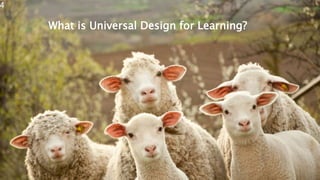
What is Universal Design for Learning?
4
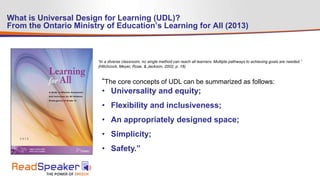
What is Universal Design for Learning (UDL)?
From the Ontario Ministry of Education’s Learning for All (2013)
“The core concepts of UDL can be summarized as follows:
• Universality and equity;
• Flexibility and inclusiveness;
• An appropriately designed space;
• Simplicity;
• Safety.”
“In a diverse classroom, no single method can reach all learners. Multiple pathways to achieving goals are needed.”
(Hitchcock, Meyer, Rose, & Jackson, 2002, p. 18)
What about UDL in Post-Secondary Education?
“Definition of UDL
• Universal Design for Learning (UDL) is the design of instructional materials
and activities that allow learning goals to be achieved by individuals with wide
differences in their abilities to see, hear, speak, move, read, write, understand
English, attend, organize, engage, and remember (Ivy Access Initiative, Brown
University)
• The essential qualities of UDL include valuing each learner’s unique perspectives
and accommodating individual differences in learners’ backgrounds, interests,
abilities, and experiences.
• The cardinal rule of UDL is that there is no single method for representing
information that will provide equal access for all students; no single method
of expression that will provide equal opportunity for all students; no single way to
ensure that all students are engaged in learning because any method that works
for some students may present barriers to learning for others (ERIC/ OSEP,
1998;as cited by Mino, 2004). Accordingly Universal Instructional Design
emphasize flexibility in curriculum and instruction.”
http://www.ryerson.ca/content/dam/lt/resources/instructionaldesign/UDLRecommendations.pdf
Universal Design for Learning in Higher Education:
“Myth of the Average Learner”
 The most consistent finding to emerge from the interdisciplinary
study of learning is that when it comes to learning, natural
variability is the rule, not the exception.
 What is perhaps most important to understand about learner
variability is not that it exists, but that not all of it is random.
 Because some variability is systematic, you can design for it in
advance.
 This approach is called Universal Design for Learning (UDL).
Source: udloncampus.CAST.org
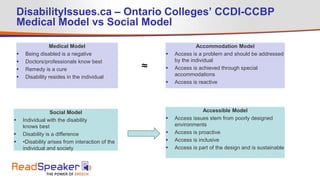
DisabilityIssues.ca – Ontario Colleges’ CCDI-CCBP
Medical Model vs Social Model
Medical Model
 Being disabled is a negative
 Doctors/professionals know best
 Remedy is a cure
 Disability resides in the individual
Social Model
 Individual with the disability
knows best
 Disability is a difference
 •Disability arises from interaction of the
individual and society
Accommodation Model
 Access is a problem and should be addressed
by the individual
 Access is achieved through special
accommodations
 Access is reactive
≈
Accessible Model
 Access issues stem from poorly designed
environments
 Access is proactive
 Access is inclusive
 Access is part of the design and is sustainable
Universal Design for Learning (UDL)
& the Social Model of Disability
 Key Idea: “environments and practices can equally enable or disable
individuals.
 “UDL moves the focus away from individual characteristics to the
environment’s own ability to widen or restrict access”.*
 “UDL then should be “seen as the procedural translation and application
of the social model of disability, and not as a
stand-alone technique of access”.*
* Fovet, Jarrett, Mole and Syncox,
McGill University, 2014
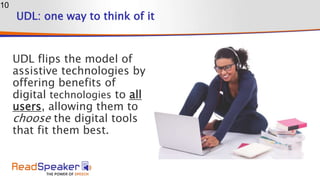
UDL: one way to think of it
UDL flips the model of
assistive technologies by
offering benefits of
digital technologies to all
users, allowing them to
choose the digital tools
that fit them best.
10
11
How does Text-to-Speech Fit into UDL?
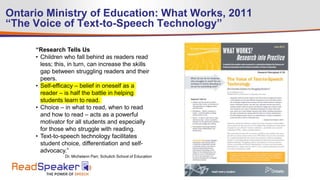
Ontario Ministry of Education: What Works, 2011
“The Voice of Text-to-Speech Technology”
“Research Tells Us
• Children who fall behind as readers read
less; this, in turn, can increase the skills
gap between struggling readers and their
peers.
• Self-efficacy – belief in oneself as a
reader – is half the battle in helping
students learn to read.
• Choice – in what to read, when to read
and how to read – acts as a powerful
motivator for all students and especially
for those who struggle with reading.
• Text-to-speech technology facilitates
student choice, differentiation and self-
advocacy.”
Dr. Michelann Parr, Schulich School of Education
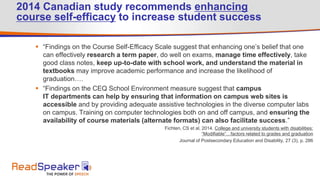
2014 Canadian study recommends enhancing
course self-efficacy to increase student success
 “Findings on the Course Self-Efficacy Scale suggest that enhancing one’s belief that one
can effectively research a term paper, do well on exams, manage time effectively, take
good class notes, keep up-to-date with school work, and understand the material in
textbooks may improve academic performance and increase the likelihood of
graduation….
 “Findings on the CEQ School Environment measure suggest that campus
IT departments can help by ensuring that information on campus web sites is
accessible and by providing adequate assistive technologies in the diverse computer labs
on campus. Training on computer technologies both on and off campus, and ensuring the
availability of course materials (alternate formats) can also facilitate success.”
Fichten, CS et al, 2014. College and university students with disabilities:
“Modifiable”…factors related to grades and graduation
Journal of Postsecondary Education and Disability, 27 (3), p. 286
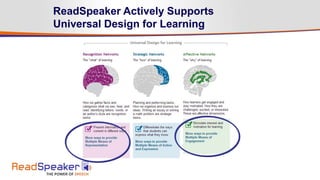
ReadSpeaker Actively Supports
Universal Design for Learning
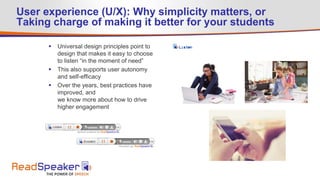
User experience (U/X): Why simplicity matters, or
Taking charge of making it better for your students
 Universal design principles point to
design that makes it easy to choose
to listen “in the moment of need”
 This also supports user autonomy
and self-efficacy
 Over the years, best practices have
improved, and
we know more about how to drive
higher engagement
16
Does TTS really help students learn?
Which ones…who benefits?
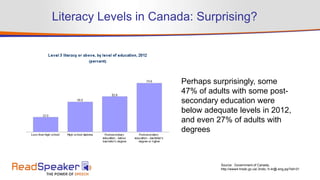
Literacy Levels in Canada: Surprising?
Source: Government of Canada,
http://www4.hrsdc.gc.ca/.3ndic.1t.4r@-eng.jsp?iid=31
Perhaps surprisingly, some
47% of adults with some post-
secondary education were
below adequate levels in 2012,
and even 27% of adults with
degrees
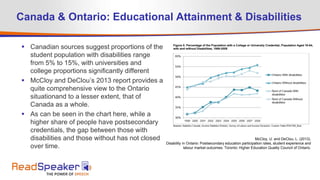
Canada & Ontario: Educational Attainment & Disabilities
 Canadian sources suggest proportions of the
student population with disabilities range
from 5% to 15%, with universities and
college proportions significantly different
 McCloy and DeClou’s 2013 report provides a
quite comprehensive view to the Ontario
situationand to a lesser extent, that of
Canada as a whole.
 As can be seen in the chart here, while a
higher share of people have postsecondary
credentials, the gap between those with
disabilities and those without has not closed
over time.
McCloy, U. and DeClou, L. (2013).
Disability in Ontario: Postsecondary education participation rates, student experience and
labour market outcomes. Toronto: Higher Education Quality Council of Ontario.
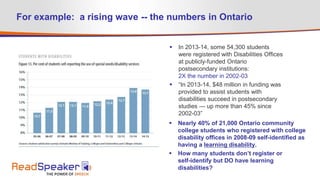
For example: a rising wave -- the numbers in Ontario
 In 2013-14, some 54,300 students
were registered with Disabilities Offices
at publicly-funded Ontario
postsecondary institutions:
2X the number in 2002-03
 “In 2013-14, $48 million in funding was
provided to assist students with
disabilities succeed in postsecondary
studies — up more than 45% since
2002-03”
 Nearly 40% of 21,000 Ontario community
college students who registered with college
disability offices in 2008-09 self-identified as
having a learning disability.
 How many students don’t register or
self-identify but DO have learning
disabilities?
Who benefits when your VLE is speech-enabled?
 Busy learners who like to multitask or listen on the go.
 Learners with reading impairments, including dyslexia.
 Learners with concentration difficulties.
 Learns with cognitive impairments.
 Learners who are non-native speakers of the language in
which they are studying (e.g. ELL students).
 Learners with visual impairments.
20
21
Who is ReadSpeaker?
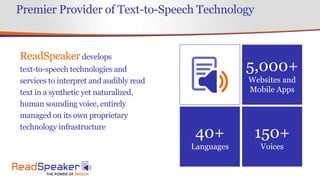
Premier Provider of Text-to-Speech Technology
ReadSpeakerdevelops
text-to-speech technologies and
services to interpret and audibly read
text in a synthetic yet naturalized,
human sounding voice, entirely
managed on its own proprietary
technology infrastructure
5,000+
Websites and
Mobile Apps
40+
Languages
150+
Voices
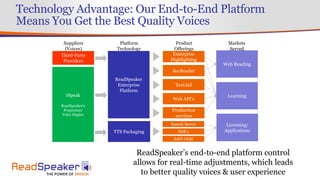
Technology Advantage: Our End-to-End Platform
Means You Get the Best Quality Voices
ReadSpeaker’s end-to-end platform control
allows for real-time adjustments, which leads
to better quality voices & user experience
ReadSpeaker
Enterprise
Platform
Enterprise
Highlighting
docReader
TextAid
Web API’s
Production
services
Third-Party
Providers
rSpeak
ReadSpeaker’s
Proprietary
Voice Engine
TTS Packaging
Speech Server
SDK’s
SAPI OEM
Product
Offerings
Web Reading
Learning
Licensing/
Applications
Platform
Technology
Markets
Served
Suppliers
(Voices)
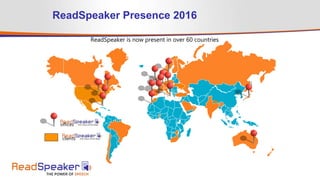
ReadSpeaker Presence 2016
ReadSpeaker is now present in over 60 countries
offices
clients
A sample of Education customers
Let’s try it out:
ReadSpeaker in Brightspace
26
ReadSpeaker for Brightspace:
Overviews and Video Tours
Video Overview: ReadSpeaker for Brightspace
Video overview: ReadSpeaker docReader in Brightspace
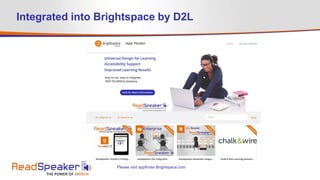
Integrated into Brightspace by D2L
Please visit appfinder.Brightspace.com
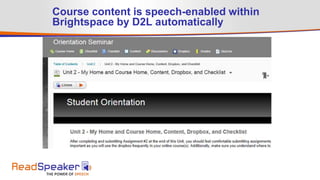
Course content is speech-enabled within
Brightspace by D2L automatically
How do we do this?
In practical terms?
30
What do I have to do to turn this on in our D2L?
How do we get started?
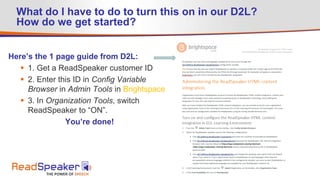
Here’s the 1 page guide from D2L:
 1. Get a ReadSpeaker customer ID
 2. Enter this ID in Config Variable
Browser in Admin Tools in Brightspace
 3. In Organization Tools, switch
ReadSpeaker to “ON”.
You’re done!
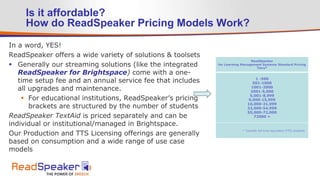
In a word, YES!
ReadSpeaker offers a wide variety of solutions & toolsets
 Generally our streaming solutions (like the integrated
ReadSpeaker for Brightspace) come with a one-
time setup fee and an annual service fee that includes
all upgrades and maintenance.
 For educational institutions, ReadSpeaker’s pricing
brackets are structured by the number of students
ReadSpeaker TextAid is priced separately and can be
individual or institutional/managed in Brightspace.
Our Production and TTS Licensing offerings are generally
based on consumption and a wide range of use case
models
Is it affordable?
How do ReadSpeaker Pricing Models Work?
ReadSpeaker
for Learning Management Systems Standard Pricing
Tiers*
1 -500
501-1000
1001-2000
2001-5,000
5,001-8,999
9,000-15,999
16,000-31,999
32,000-54,999
55,000-72,000
72000 +
* Typically full-time equivalent (FTE) students
STRATEGY
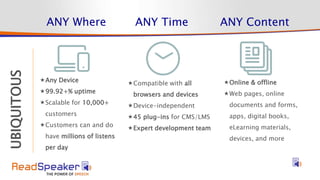
UBIQUITOUS ANY Where ANY Time ANY Content
Compatible with all
browsers and devices
Device-independent
45 plug-ins for CMS/LMS
Expert development team
Any Device
99.92+% uptime
Scalable for 10,000+
customers
Customers can and do
have millions of listens
per day
Online & offline
Web pages, online
documents and forms,
apps, digital books,
eLearning materials,
devices, and more
STRATEGY
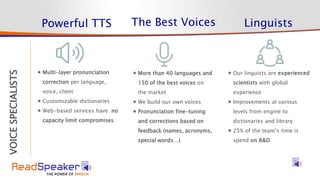
VOICESPECIALISTS
Powerful TTS The Best Voices Linguists
 More than 40 languages and
150 of the best voices on
the market
 We build our own voices
 Pronunciation fine-tuning
and corrections based on
feedback (names, acronyms,
special words…)
 Multi-layer pronunciation
correction per language,
voice, client
 Customizable dictionaries
 Web-based services have no
capacity limit compromises
 Our linguists are experienced
scientists with global
experience
 Improvements at various
levels from engine to
dictionaries and library
 25% of the team’s time is
spend on R&D

And ReadSpeaker goes that extra
mile….

…we provide implementation, deployment
and statistics....to support students and
educators with sustainable on-line UDL.
Thank You!
Michael Hughes, Business Director, Canada
ReadSpeaker
Toronto, ON
Canada
M: +1 416 455 7658
E: Michael.Hughes@ReadSpeaker.com
T: @ServeLeadChange
Questions & Discussion
BACKGROUND SLIDES
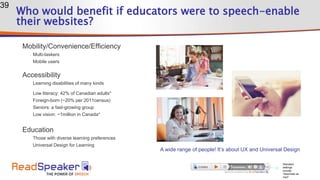
Who would benefit if educators were to speech-enable
their websites?
Mobility/Convenience/Efficiency
Multi-taskers
Mobile users
Accessibility
Learning disabilities of many kinds
Low literacy: 42% of Canadian adults*
Foreign-born (~20% per 2011census)
Seniors: a fast-growing group
Low vision: ~1million in Canada*
Education
Those with diverse learning preferences
Universal Design for Learning
39
Standard
settings
include
“download as
mp3”
A wide range of people! It’s about UX and Universal Design
Blended Learning & UDL: The Opportunity
 In Ontario’s post-secondary, roughly 40% of the 55,000 registered with campus disabilities
offices (OSD’s) identify as people with learning disabilities
 As blended learning (on-site+on-line) continues to grow, there is a tremendous opportunity to
invest in Universal Design for Learning approaches to realize better results AND better value
 For example, Ontario’s educators could deliver more widely-accessible learning content tools
to all students and faculty and free up some precious resources within OSD’s as demand for
their services continues to grow
 A case in point is ReadSpeaker text-to-speech within LMS platforms, by leveraging TTS’s
cost-effectiveness (Blackboard, D2L, Moodle, Canvas by Instructure, and other LMS and CMS
platforms). So no matter what LMS plans Humber may develop in the future, you can be
confident that ReadSpeaker will be there to support your student, staff, and faculty needs for
delivering multiple ways to learn and support UDL.
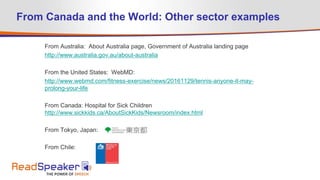
From Australia: About Australia page, Government of Australia landing page
http://www.australia.gov.au/about-australia
From the United States: WebMD:
http://www.webmd.com/fitness-exercise/news/20161129/tennis-anyone-it-may-
prolong-your-life
From Canada: Hospital for Sick Children
http://www.sickkids.ca/AboutSickKids/Newsroom/index.html
From Tokyo, Japan:
From Chile:
From Canada and the World: Other sector examples
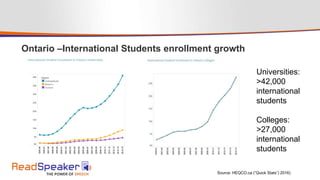
Ontario –International Students enrollment growth
Universities:
>42,000
international
students
Colleges:
>27,000
international
students
Source: HEQCO.ca (“Quick Stats”) 2016)
A few other statistics
 Half the students exiting special education into PSE in the US indicate
they no longer believe they have a disability, while a further 14% choose
not to disclose their disability (Getzel, 2014)
 This suggests a real need for widely-available tools within PSE generally for those
who learn early enough in their PSE career that they may have been mistaken but
still don’t register with accessibility offices on campus
 Statistics Canada reports that International student enrolments
accounted for almost 10% of the total post-secondary student
enrollment rose in 2013/14,
 The majority of these students were from Asia, with China as the main country of
citizenship.
 International student enrolments have been steadily increasing for almost two
decades, and rose 2.5% in 2013/14
43

Readspeaker Presentation at 2016 Brightspace Eastern Ontario (Ottawa) Connection

  • 1.
    Michael Hughes ReadSpeaker Toronto, ON @ServeLeadChange 2Dec, 2016 Le Collège La Cité, Ottawa How to Deploy & Support a Universal Design for Learning Strategy w/ TTS Technology within D2L’s Learning Environment
  • 2.
     What isUniversal Design for Learning?  How does text-to-speech fit into UDL?  Does TTS really help students learn? Which ones…who benefits?  A word about User Experience (UX) and Universal Design for Learning (UDL)  Who is ReadSpeaker?  What does ReadSpeaker’s toolset range offer educators and students?  How does ReadSpeaker text-to-speech software work within D2L? Let’s see it!  What does it take to implement?  How does pricing work?  Questions and discussion Key Questions
  • 3.
    But first ademonstration (ou trois!)  From the Canadian Mental Health Association, Ottawa Branch: http://ottawa.cmha.ca/mental-health/your-mental-health/  Jeunesse, J’écoute / Kids Help Phone’s CoinDesGars.ca http://www.coindesgars.ca/Sujets-abordes/Lecole  Global News: Global News’ text-to-speech converter aims to help Canadians access the Internet - National | Globalnews.ca
  • 4.
    What is UniversalDesign for Learning? 4
  • 5.
    What is UniversalDesign for Learning (UDL)? From the Ontario Ministry of Education’s Learning for All (2013) “The core concepts of UDL can be summarized as follows: • Universality and equity; • Flexibility and inclusiveness; • An appropriately designed space; • Simplicity; • Safety.” “In a diverse classroom, no single method can reach all learners. Multiple pathways to achieving goals are needed.” (Hitchcock, Meyer, Rose, & Jackson, 2002, p. 18)
  • 6.
    What about UDLin Post-Secondary Education? “Definition of UDL • Universal Design for Learning (UDL) is the design of instructional materials and activities that allow learning goals to be achieved by individuals with wide differences in their abilities to see, hear, speak, move, read, write, understand English, attend, organize, engage, and remember (Ivy Access Initiative, Brown University) • The essential qualities of UDL include valuing each learner’s unique perspectives and accommodating individual differences in learners’ backgrounds, interests, abilities, and experiences. • The cardinal rule of UDL is that there is no single method for representing information that will provide equal access for all students; no single method of expression that will provide equal opportunity for all students; no single way to ensure that all students are engaged in learning because any method that works for some students may present barriers to learning for others (ERIC/ OSEP, 1998;as cited by Mino, 2004). Accordingly Universal Instructional Design emphasize flexibility in curriculum and instruction.” http://www.ryerson.ca/content/dam/lt/resources/instructionaldesign/UDLRecommendations.pdf
  • 7.
    Universal Design forLearning in Higher Education: “Myth of the Average Learner”  The most consistent finding to emerge from the interdisciplinary study of learning is that when it comes to learning, natural variability is the rule, not the exception.  What is perhaps most important to understand about learner variability is not that it exists, but that not all of it is random.  Because some variability is systematic, you can design for it in advance.  This approach is called Universal Design for Learning (UDL). Source: udloncampus.CAST.org
  • 8.
    DisabilityIssues.ca – OntarioColleges’ CCDI-CCBP Medical Model vs Social Model Medical Model  Being disabled is a negative  Doctors/professionals know best  Remedy is a cure  Disability resides in the individual Social Model  Individual with the disability knows best  Disability is a difference  •Disability arises from interaction of the individual and society Accommodation Model  Access is a problem and should be addressed by the individual  Access is achieved through special accommodations  Access is reactive ≈ Accessible Model  Access issues stem from poorly designed environments  Access is proactive  Access is inclusive  Access is part of the design and is sustainable
  • 9.
    Universal Design forLearning (UDL) & the Social Model of Disability  Key Idea: “environments and practices can equally enable or disable individuals.  “UDL moves the focus away from individual characteristics to the environment’s own ability to widen or restrict access”.*  “UDL then should be “seen as the procedural translation and application of the social model of disability, and not as a stand-alone technique of access”.* * Fovet, Jarrett, Mole and Syncox, McGill University, 2014
  • 10.
    UDL: one wayto think of it UDL flips the model of assistive technologies by offering benefits of digital technologies to all users, allowing them to choose the digital tools that fit them best. 10
  • 11.
  • 12.
    Ontario Ministry ofEducation: What Works, 2011 “The Voice of Text-to-Speech Technology” “Research Tells Us • Children who fall behind as readers read less; this, in turn, can increase the skills gap between struggling readers and their peers. • Self-efficacy – belief in oneself as a reader – is half the battle in helping students learn to read. • Choice – in what to read, when to read and how to read – acts as a powerful motivator for all students and especially for those who struggle with reading. • Text-to-speech technology facilitates student choice, differentiation and self- advocacy.” Dr. Michelann Parr, Schulich School of Education
  • 13.
    2014 Canadian studyrecommends enhancing course self-efficacy to increase student success  “Findings on the Course Self-Efficacy Scale suggest that enhancing one’s belief that one can effectively research a term paper, do well on exams, manage time effectively, take good class notes, keep up-to-date with school work, and understand the material in textbooks may improve academic performance and increase the likelihood of graduation….  “Findings on the CEQ School Environment measure suggest that campus IT departments can help by ensuring that information on campus web sites is accessible and by providing adequate assistive technologies in the diverse computer labs on campus. Training on computer technologies both on and off campus, and ensuring the availability of course materials (alternate formats) can also facilitate success.” Fichten, CS et al, 2014. College and university students with disabilities: “Modifiable”…factors related to grades and graduation Journal of Postsecondary Education and Disability, 27 (3), p. 286
  • 14.
  • 15.
    User experience (U/X):Why simplicity matters, or Taking charge of making it better for your students  Universal design principles point to design that makes it easy to choose to listen “in the moment of need”  This also supports user autonomy and self-efficacy  Over the years, best practices have improved, and we know more about how to drive higher engagement
  • 16.
    16 Does TTS reallyhelp students learn? Which ones…who benefits?
  • 17.
    Literacy Levels inCanada: Surprising? Source: Government of Canada, http://www4.hrsdc.gc.ca/.3ndic.1t.4r@-eng.jsp?iid=31 Perhaps surprisingly, some 47% of adults with some post- secondary education were below adequate levels in 2012, and even 27% of adults with degrees
  • 18.
    Canada & Ontario:Educational Attainment & Disabilities  Canadian sources suggest proportions of the student population with disabilities range from 5% to 15%, with universities and college proportions significantly different  McCloy and DeClou’s 2013 report provides a quite comprehensive view to the Ontario situationand to a lesser extent, that of Canada as a whole.  As can be seen in the chart here, while a higher share of people have postsecondary credentials, the gap between those with disabilities and those without has not closed over time. McCloy, U. and DeClou, L. (2013). Disability in Ontario: Postsecondary education participation rates, student experience and labour market outcomes. Toronto: Higher Education Quality Council of Ontario.
  • 19.
    For example: arising wave -- the numbers in Ontario  In 2013-14, some 54,300 students were registered with Disabilities Offices at publicly-funded Ontario postsecondary institutions: 2X the number in 2002-03  “In 2013-14, $48 million in funding was provided to assist students with disabilities succeed in postsecondary studies — up more than 45% since 2002-03”  Nearly 40% of 21,000 Ontario community college students who registered with college disability offices in 2008-09 self-identified as having a learning disability.  How many students don’t register or self-identify but DO have learning disabilities?
  • 20.
    Who benefits whenyour VLE is speech-enabled?  Busy learners who like to multitask or listen on the go.  Learners with reading impairments, including dyslexia.  Learners with concentration difficulties.  Learns with cognitive impairments.  Learners who are non-native speakers of the language in which they are studying (e.g. ELL students).  Learners with visual impairments. 20
  • 21.
  • 22.
    Premier Provider ofText-to-Speech Technology ReadSpeakerdevelops text-to-speech technologies and services to interpret and audibly read text in a synthetic yet naturalized, human sounding voice, entirely managed on its own proprietary technology infrastructure 5,000+ Websites and Mobile Apps 40+ Languages 150+ Voices
  • 23.
    Technology Advantage: OurEnd-to-End Platform Means You Get the Best Quality Voices ReadSpeaker’s end-to-end platform control allows for real-time adjustments, which leads to better quality voices & user experience ReadSpeaker Enterprise Platform Enterprise Highlighting docReader TextAid Web API’s Production services Third-Party Providers rSpeak ReadSpeaker’s Proprietary Voice Engine TTS Packaging Speech Server SDK’s SAPI OEM Product Offerings Web Reading Learning Licensing/ Applications Platform Technology Markets Served Suppliers (Voices)
  • 24.
    ReadSpeaker Presence 2016 ReadSpeakeris now present in over 60 countries offices clients
  • 25.
    A sample ofEducation customers
  • 26.
    Let’s try itout: ReadSpeaker in Brightspace 26
  • 27.
    ReadSpeaker for Brightspace: Overviewsand Video Tours Video Overview: ReadSpeaker for Brightspace Video overview: ReadSpeaker docReader in Brightspace
  • 28.
    Integrated into Brightspaceby D2L Please visit appfinder.Brightspace.com
  • 29.
    Course content isspeech-enabled within Brightspace by D2L automatically
  • 30.
    How do wedo this? In practical terms? 30
  • 31.
    What do Ihave to do to turn this on in our D2L? How do we get started? Here’s the 1 page guide from D2L:  1. Get a ReadSpeaker customer ID  2. Enter this ID in Config Variable Browser in Admin Tools in Brightspace  3. In Organization Tools, switch ReadSpeaker to “ON”. You’re done!
  • 32.
    In a word,YES! ReadSpeaker offers a wide variety of solutions & toolsets  Generally our streaming solutions (like the integrated ReadSpeaker for Brightspace) come with a one- time setup fee and an annual service fee that includes all upgrades and maintenance.  For educational institutions, ReadSpeaker’s pricing brackets are structured by the number of students ReadSpeaker TextAid is priced separately and can be individual or institutional/managed in Brightspace. Our Production and TTS Licensing offerings are generally based on consumption and a wide range of use case models Is it affordable? How do ReadSpeaker Pricing Models Work? ReadSpeaker for Learning Management Systems Standard Pricing Tiers* 1 -500 501-1000 1001-2000 2001-5,000 5,001-8,999 9,000-15,999 16,000-31,999 32,000-54,999 55,000-72,000 72000 + * Typically full-time equivalent (FTE) students
  • 33.
    STRATEGY UBIQUITOUS ANY WhereANY Time ANY Content Compatible with all browsers and devices Device-independent 45 plug-ins for CMS/LMS Expert development team Any Device 99.92+% uptime Scalable for 10,000+ customers Customers can and do have millions of listens per day Online & offline Web pages, online documents and forms, apps, digital books, eLearning materials, devices, and more
  • 34.
    STRATEGY VOICESPECIALISTS Powerful TTS TheBest Voices Linguists  More than 40 languages and 150 of the best voices on the market  We build our own voices  Pronunciation fine-tuning and corrections based on feedback (names, acronyms, special words…)  Multi-layer pronunciation correction per language, voice, client  Customizable dictionaries  Web-based services have no capacity limit compromises  Our linguists are experienced scientists with global experience  Improvements at various levels from engine to dictionaries and library  25% of the team’s time is spend on R&D
  • 35.
     And ReadSpeaker goesthat extra mile….
  • 36.
     …we provide implementation,deployment and statistics....to support students and educators with sustainable on-line UDL.
  • 37.
    Thank You! Michael Hughes,Business Director, Canada ReadSpeaker Toronto, ON Canada M: +1 416 455 7658 E: Michael.Hughes@ReadSpeaker.com T: @ServeLeadChange Questions & Discussion
  • 38.
  • 39.
    Who would benefitif educators were to speech-enable their websites? Mobility/Convenience/Efficiency Multi-taskers Mobile users Accessibility Learning disabilities of many kinds Low literacy: 42% of Canadian adults* Foreign-born (~20% per 2011census) Seniors: a fast-growing group Low vision: ~1million in Canada* Education Those with diverse learning preferences Universal Design for Learning 39 Standard settings include “download as mp3” A wide range of people! It’s about UX and Universal Design
  • 40.
    Blended Learning &UDL: The Opportunity  In Ontario’s post-secondary, roughly 40% of the 55,000 registered with campus disabilities offices (OSD’s) identify as people with learning disabilities  As blended learning (on-site+on-line) continues to grow, there is a tremendous opportunity to invest in Universal Design for Learning approaches to realize better results AND better value  For example, Ontario’s educators could deliver more widely-accessible learning content tools to all students and faculty and free up some precious resources within OSD’s as demand for their services continues to grow  A case in point is ReadSpeaker text-to-speech within LMS platforms, by leveraging TTS’s cost-effectiveness (Blackboard, D2L, Moodle, Canvas by Instructure, and other LMS and CMS platforms). So no matter what LMS plans Humber may develop in the future, you can be confident that ReadSpeaker will be there to support your student, staff, and faculty needs for delivering multiple ways to learn and support UDL.
  • 41.
    From Australia: AboutAustralia page, Government of Australia landing page http://www.australia.gov.au/about-australia From the United States: WebMD: http://www.webmd.com/fitness-exercise/news/20161129/tennis-anyone-it-may- prolong-your-life From Canada: Hospital for Sick Children http://www.sickkids.ca/AboutSickKids/Newsroom/index.html From Tokyo, Japan: From Chile: From Canada and the World: Other sector examples
  • 42.
    Ontario –International Studentsenrollment growth Universities: >42,000 international students Colleges: >27,000 international students Source: HEQCO.ca (“Quick Stats”) 2016)
  • 43.
    A few otherstatistics  Half the students exiting special education into PSE in the US indicate they no longer believe they have a disability, while a further 14% choose not to disclose their disability (Getzel, 2014)  This suggests a real need for widely-available tools within PSE generally for those who learn early enough in their PSE career that they may have been mistaken but still don’t register with accessibility offices on campus  Statistics Canada reports that International student enrolments accounted for almost 10% of the total post-secondary student enrollment rose in 2013/14,  The majority of these students were from Asia, with China as the main country of citizenship.  International student enrolments have been steadily increasing for almost two decades, and rose 2.5% in 2013/14 43