Pro-technology: The Parent PerspectiveAmanda Brown				                                Ashleigh Burry Erin Hansen				                           Shannon McLean Jason  Skeels				                        Salamah Sulaiman
Introduction	In the 21st century, we are in dire need of competing globally.  With the constant growth and innovation of technology, we must prepare our students to compete on global levels in the workforce of tomorrow.  In this presentation, several aspects will be illustrated to highlight why parents today support teaching technology in schools. The discussions range from:Some parents today are computer literate and proficient themselves.
Parents actually utilize technology in their lives.
Parents recognize the benefits in exposing their children to technology.
Other parents who may not have technology at home and recognize the benefit in having the schools introduce students to technology who otherwise may not get the exposure. 	Both sets of parents would agree that technology increases academic achievement in general education and special education students.
PARENTS UTILIZE TECHNOLOGYResearch shows that increased parental involvement improves student achievement
Technology in the Classroom:Parents Approve it & Use it!Web based student information systems include…I. Parent/student online grade viewer , which communicates….Upcoming assignment description/due datesUpcoming project description/due datesUpcoming test datesTest reviewsEtc…
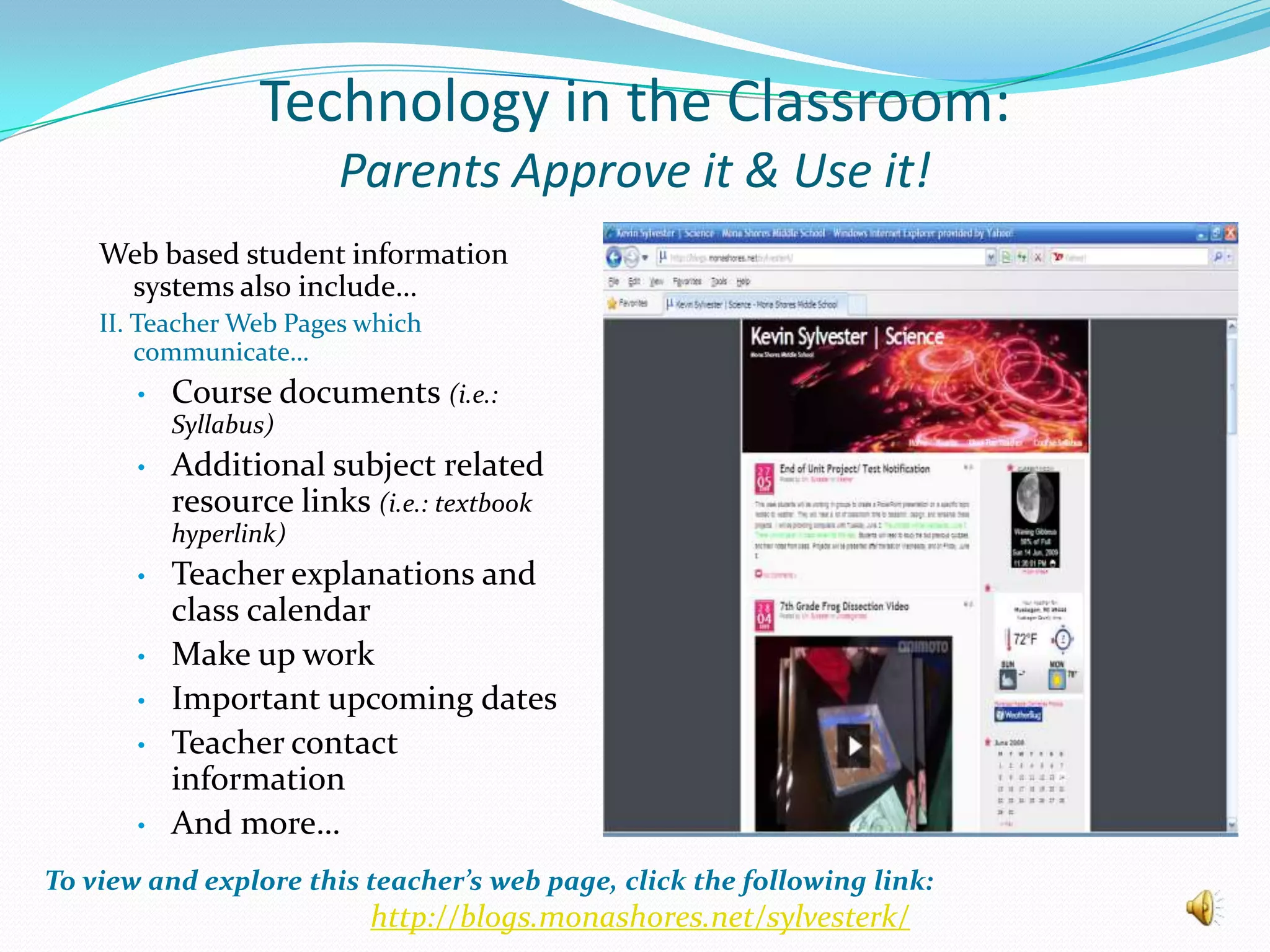
Technology in the Classroom:Parents Approve it & Use it!Web based student information systems also include…II. Teacher Web Pages which communicate…Course documents (i.e.: Syllabus)
Additional subject related resource links (i.e.: textbook hyperlink)
Teacher explanations and class calendar
Make up work
Important upcoming dates
Teacher contact information
And more…To view and explore this teacher’s web page, click the following link:  http://blogs.monashores.net/sylvesterk/
Student information system (SIS) programsOriginally created to…Manage and report assessments,Scheduling, andGradingUnexpected benefits when allowed parental access:Improved attendance,Decreased disciplinary concerns,Increased test scores, and Fulfilled No Child Left Behind requirements
Research shows that increased parental involvement improves student achievement.Including, but not limited to…
Having better college entrance statistics
Earning higher grades and test scores, and enroll in higher-level programs
Being promoted, pass their classes, and earn credits
Attending school regularly
Having better social skills, show improved behavior, and adapt well to school
And, graduating and go on to post-secondary education
And, enhance parental agreement about the following statements about that their child’s school…
Child’s teachers maintain good discipline in the classroom
In child’s school, most students and teachers respect each other
The principal and assistant principal maintain good discipline at child’s school
Child’s school welcomes my family’s involvement with the school
And, child’s school makes it easy to be involved thereOpponents may adhere to the following suggestions if they lack internet access…Telephone teacher
Utilize Homework Hotline
Attend Parent/Teacher Conferences
Read School Newsletter
In-person meeting
Utilize public internet access

94f6d7e04a4d452

  • 1.
    Pro-technology: The ParentPerspectiveAmanda Brown Ashleigh Burry Erin Hansen Shannon McLean Jason Skeels Salamah Sulaiman
  • 2.
    Introduction In the 21stcentury, we are in dire need of competing globally. With the constant growth and innovation of technology, we must prepare our students to compete on global levels in the workforce of tomorrow. In this presentation, several aspects will be illustrated to highlight why parents today support teaching technology in schools. The discussions range from:Some parents today are computer literate and proficient themselves.
  • 3.
    Parents actually utilizetechnology in their lives.
  • 4.
    Parents recognize thebenefits in exposing their children to technology.
  • 5.
    Other parents whomay not have technology at home and recognize the benefit in having the schools introduce students to technology who otherwise may not get the exposure. Both sets of parents would agree that technology increases academic achievement in general education and special education students.
  • 6.
    PARENTS UTILIZE TECHNOLOGYResearchshows that increased parental involvement improves student achievement
  • 7.
    Technology in theClassroom:Parents Approve it & Use it!Web based student information systems include…I. Parent/student online grade viewer , which communicates….Upcoming assignment description/due datesUpcoming project description/due datesUpcoming test datesTest reviewsEtc…
  • 8.
    Technology in theClassroom:Parents Approve it & Use it!Web based student information systems also include…II. Teacher Web Pages which communicate…Course documents (i.e.: Syllabus)
  • 9.
    Additional subject relatedresource links (i.e.: textbook hyperlink)
  • 10.
  • 11.
  • 12.
  • 13.
  • 14.
    And more…To viewand explore this teacher’s web page, click the following link: http://blogs.monashores.net/sylvesterk/
  • 15.
    Student information system(SIS) programsOriginally created to…Manage and report assessments,Scheduling, andGradingUnexpected benefits when allowed parental access:Improved attendance,Decreased disciplinary concerns,Increased test scores, and Fulfilled No Child Left Behind requirements
  • 16.
    Research shows thatincreased parental involvement improves student achievement.Including, but not limited to…
  • 17.
    Having better collegeentrance statistics
  • 18.
    Earning higher gradesand test scores, and enroll in higher-level programs
  • 19.
    Being promoted, passtheir classes, and earn credits
  • 20.
  • 21.
    Having better socialskills, show improved behavior, and adapt well to school
  • 22.
    And, graduating andgo on to post-secondary education
  • 23.
    And, enhance parentalagreement about the following statements about that their child’s school…
  • 24.
    Child’s teachers maintaingood discipline in the classroom
  • 25.
    In child’s school,most students and teachers respect each other
  • 26.
    The principal andassistant principal maintain good discipline at child’s school
  • 27.
    Child’s school welcomesmy family’s involvement with the school
  • 28.
    And, child’s schoolmakes it easy to be involved thereOpponents may adhere to the following suggestions if they lack internet access…Telephone teacher
  • 29.
  • 30.
  • 31.
  • 32.
  • 33.
  • 34.
    Print and mailstudent grades
  • 35.
  • 36.
    And, more…EQUITY FORALLAddressing the pros and cons of using technology in schools from the parents’ perspective for all students.
  • 37.
    Technology in Schools:Equity for AllParents feel that technology exposes their child to important experiences that are needed for the 21st Century.Parents feel that using technology in schools gives each child access to the same tools and resources. Technology use in school provides the opportunity for all students to have a leveled playing academic field.
  • 38.
    Equity for All:SurveyA parent survey was conducted in a class of twenty-seven students. The background information for the survey is as follows:11 homes without computers14 without internet accessFamilies of Low Socio-Economic Status44% of students receive free or reduced lunch
  • 39.
    SurveyHow do youfeel about your child using technology in school? What are the benefits you see with technology in school?What are some worries you have about the use of technology?If you had to choose, would you want your child to use technology or would you rather them go without?
  • 40.
    Survey ResultsQuestion 1-MultipleChoice Question93% of parents said, “ I feel great about my students use of technology”.7% of parents said, “ I don’t feel strongly either way”.Question 2-Short Answer QuestionParents can see applications for the “real world”. (11 comments)Allows them the exposure to new things they do not have at home. (12 comments)Makes work time more efficient and allows them to focus on the subject. (4 comments)My kids can help me learn new things. (2 comments)Technology will be in their future so they should learn it now. ( 2 comments)
  • 41.
    Survey Results ContinuedQuestion3-Short Answer QuestionExpensive for the district when teachers and resources are cut. (4 comments)Limited technology at home so unable to reinforce what is being taught; grades might go down because unfamiliarity with the technology. ( 5 comments)Concern of internet usage and monitoring. ( 1 comment)No Comment (17 left blank)Question 4-Multiple Choice Question100% said “ I would want my child to use technology.”
  • 42.
    Equity For AllSolutionsConsStudentswithout technology access at home:
  • 43.
    Grades may sufferdue to lack of experience
  • 44.
    May be viewedas “slower than the other students.”
  • 45.
    Parents concerned thewill be unable to reinforce technology usage that is taught because:
  • 46.
  • 47.
    Internet is toomuch monthly
  • 48.
    Computers and softwareare too expensiveTeachers can help alleviate parental concerns by:Separate Grades Extension AssignmentsLaptop CheckoutCompany DonationsLocal Libraries
  • 49.
    INCREASES ACADEMIC ACHIEVEMENT“Today’sstudents grow up in a technology-mediated world and their thinking, behavior, and emotions are heavily influenced by new technologies”.
  • 50.
    Increasing Academic AchievementTechnologypromotes equity and access in educationTechnology improves student achievement in reading, writing, and mathematicsStudents who are exposed to technology implement it in other curriculum areas Technology improves learning skills, facilitates research and provides extensive word processing toolsTechnology can be used to promote the development of higher-order thinking skills and allow opportunities for teachers to act as facilitators, as well as a co-learner with the studentsTechnology can help schools meet the needs of all students
  • 51.
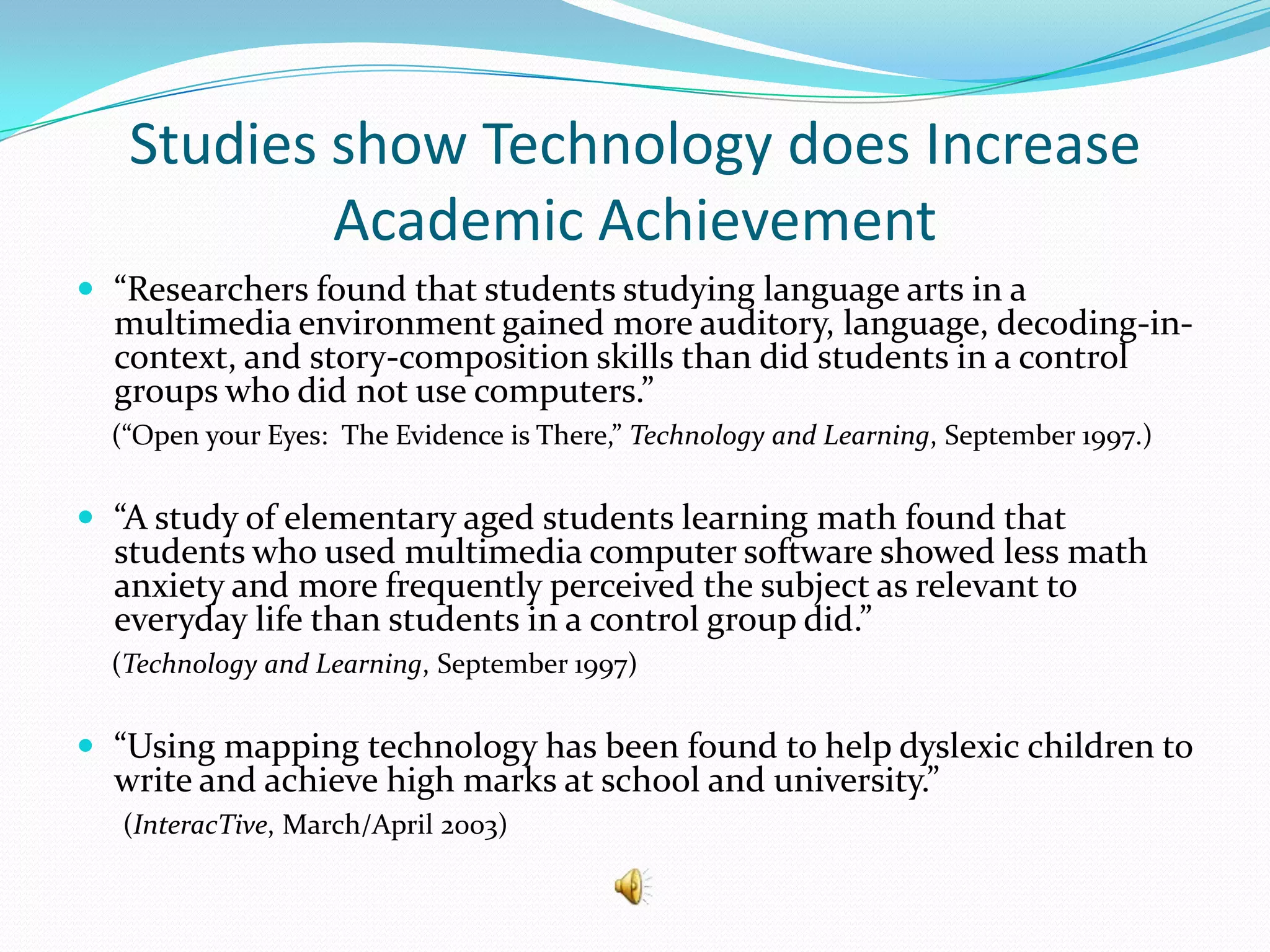
    Studies show Technologydoes Increase Academic Achievement“Researchers found that students studying language arts in a multimedia environment gained more auditory, language, decoding-in-context, and story-composition skills than did students in a control groups who did not use computers.”(“Open your Eyes: The Evidence is There,” Technology and Learning, September 1997.)“A study of elementary aged students learning math found that students who used multimedia computer software showed less math anxiety and more frequently perceived the subject as relevant to everyday life than students in a control group did.”(Technology and Learning, September 1997)“Using mapping technology has been found to help dyslexic children to write and achieve high marks at school and university.”(InteracTive, March/April 2003)
  • 52.
    Technology may NOTincrease Academic Achievement“Student’s expectation that learning must be entertaining and their failure to become active learners.”(Technology in Schools: Some say It Doesn’t Compute!, 6/11/2009)Many students waste valuable time fooling around on computers.According to USA Today story, Do Classroom PCs Help Kids Learn? (8/03/98), “the Third International Math and Science Study found that the five countries that outperformed U.S. Fourth-graders in math did not use computers in their schools very often (one-third as often as we do), and fourth graders in five other nations who had more home computers than our children did not do better in science than did our students.” The study found no correlation between computer use and math and science achievement.Another study found that because of the language interaction, a child’s one-on-one contact with an adult produced far greater gains than those achieved when playing on a computer”.(Education Week, October 1998)
  • 53.
    ASSISTIVE TECHNOLOGY FORSTUDENTS WITH SPECIAL NEEDSIt’s the Law!
  • 54.
    Why do youuse Assistive Technology?It’s the Law!
  • 55.
    When do youconsider Assistive Technology?If the student has difficulty:Reading it
  • 56.
  • 57.
  • 58.
  • 59.
  • 60.
  • 61.
  • 62.
    Keeping upThree Stagesof Assistive TechnologyLow TechSimple, low maintenance, little electronics (highlighters, page flags, writing template)Mid TechSome maintenance, some training, more electronics (speaking dictionary, MP3 player, spellchecker, digital recorder)High TechMore maintenance, more training, complex electronics (Text reader, talking word processer, interactive white boards)
  • 63.
  • 64.
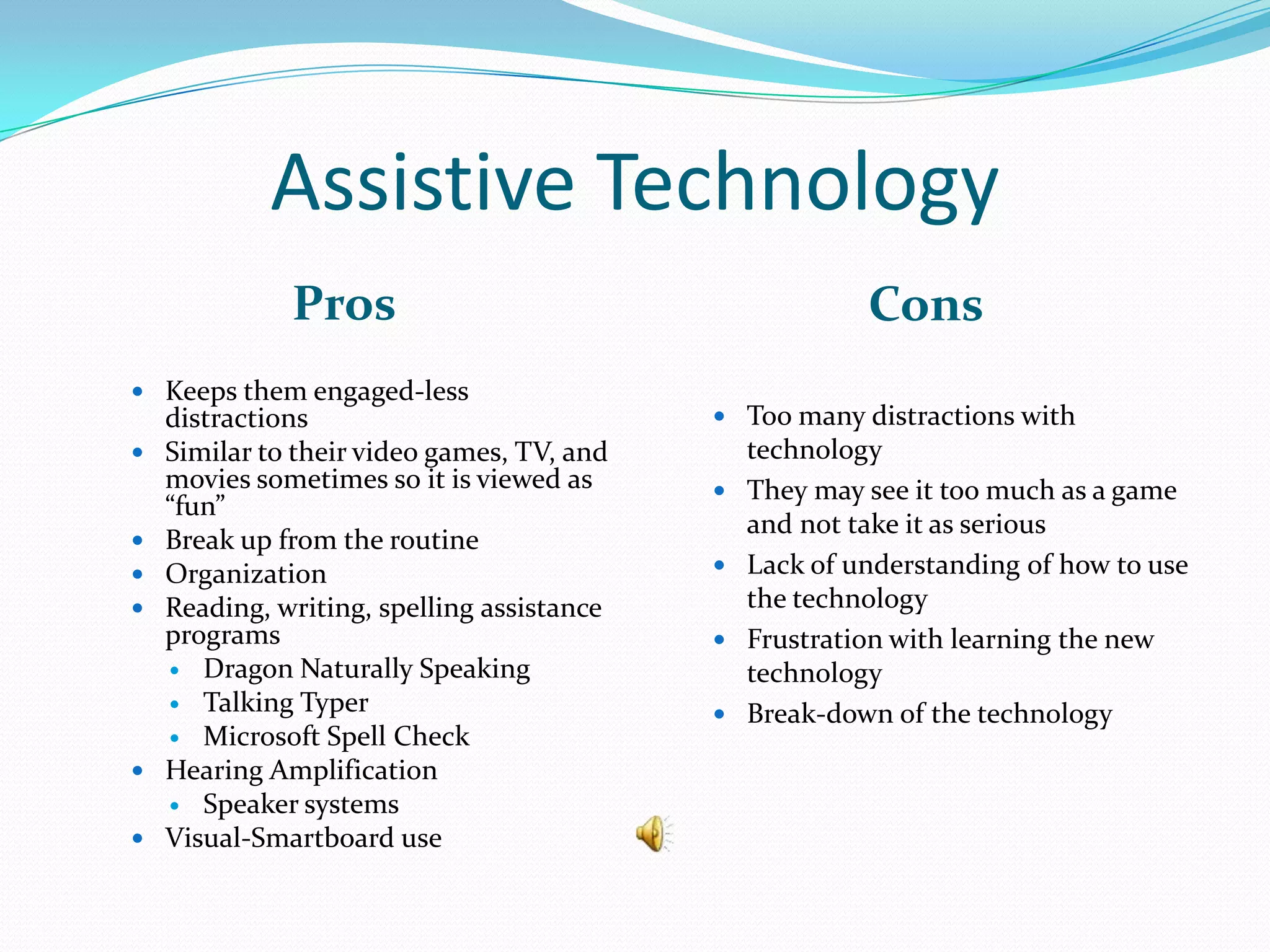
    Similar to theirvideo games, TV, and movies sometimes so it is viewed as “fun”
  • 65.
    Break up fromthe routine
  • 66.
  • 67.
    Reading, writing, spellingassistance programs
  • 68.
  • 69.
  • 70.
  • 71.
  • 72.
  • 73.
    Visual-Smartboard useToo manydistractions with technologyThey may see it too much as a game and not take it as seriousLack of understanding of how to use the technologyFrustration with learning the new technologyBreak-down of the technology
  • 74.
    Assistive Technology BenefitsTechnologyin the classroom may be time consuming for many educators, in the end it can increase academic achievement, especially for your special needs students through:
  • 75.
    Reading assistance-books onCD, smart pen, talking typers
  • 76.
  • 77.
  • 78.
  • 79.
  • 80.
    Other-email, internet forresearch, grading systems, etc.
  • 81.
    K-12 districts (especiallythe larger districts) purchasing these devices or programs would be beneficial to the special needs program within the district.
  • 82.
    All students cannow attain the same information, regardless of ability level (reading level, writing ability, sight problems, etc) through these new technologies.TECHNOLOGY PREPARES YOU FOR THE WORLDTechnology in schools is necessary to prepare students for the increasing technological demands of the workforce, across all levels and fields.
  • 83.
    Which Jobs useTechnology?Computers!Fast Food WorkerAuto MechanicCompany CEO
  • 84.
    Technology Benefits forLifeGrade point averages
  • 85.
  • 86.
  • 87.
  • 88.
    Enrollment inPost-Secondary programs
  • 89.
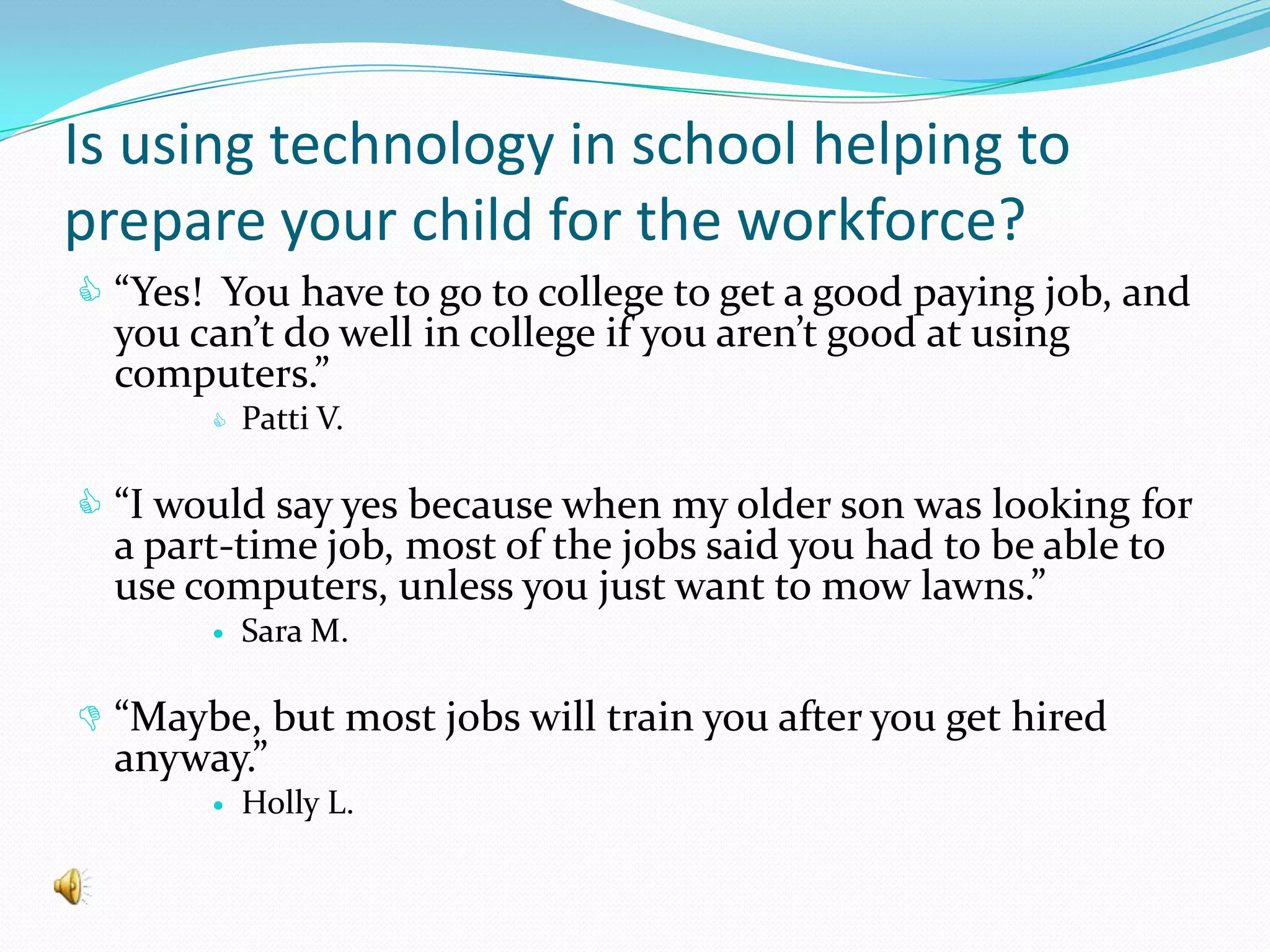
    Graduation from Post-SecondaryInstitutionsIs using technology in school helping to prepare your child for the workforce?“Yes! You have to go to college to get a good paying job, and you can’t do well in college if you aren’t good at using computers.”
  • 90.
  • 91.
    “I would sayyes because when my older son was looking for a part-time job, most of the jobs said you had to be able to use computers, unless you just want to mow lawns.”
  • 92.
  • 93.
    “Maybe, but mostjobs will train you after you get hired anyway.”
  • 94.
    Holly L.Fastest GrowingCareersNetwork SystemsData CommunicationsComputer Software EngineeringInformation TechnologyEspecially in times of recession, students need to be prepared for these fast growing jobs!
  • 95.
    Conclusion While technology doescome with its difficulties, overall it has been shown time and time again as a useful tool to help increase student learning. Through the use of comparing studies and teacher-created surveys, this presentation has shown that parents have ultimately come to the same conclusion that technology is the wave of the future and will greatly impact the lives of their child. While their concerns are valid, as teachers these concerns can be addressed practically.
  • 96.
    Works CitedAltman, Alex."High Tech, High Touch, High Growth." TIME 2009. 16 June 2009 .
  • 97.
    Bachmann, Julia &Trimmel Michael. "Cognitive, Social, Motivational and Health Aspects of Students in Laptop Classrooms." Journal of Computer Assisted Learning 20.2 (2004): 151-58.
  • 98.
    Becker, H. "Findingsfrom the Teaching, Learning, and Computing Survey: Is Larry Cuban Right." Teaching, Learning and Computing. 2000. CENTER FOR RESEARCH ON INFORMATION TECHNOLOGY AN. 16 June 2009 .
  • 99.
    Bird, Ken. "StudentInformation Systems: How Do You Spell Parental Involvement? S-I-S." THE Journal (2006). 16 June 2009 .
  • 100.
    Bronner, Ethan. "RethinkingComputers: More Than A Toy?" New York Times 30 Nov. 1997. 16 June 2009 .
  • 101.
    Chaika, Glori. "Technologyin Schools: It Does Make a Difference!." Education World. 2 Aug. 1999. 16 June 2009 .
  • 102.
    Chaika, Glori. "Technologyin Schools: Some Say It Doesn't Compute!" Education World. 23 June 1997. 16 June 2009 .
  • 103.
  • 104.
    Dickman, Jana, LindaMangene, and Steve Rybarsyk. Personal Interview. 3 June 2009.
  • 105.
    “Distance Education Coursesfor Public Elementary and Secondary School Students: 2002-03.” National Center for Education Statistics. 2005. .
  • 106.
  • 107.
    Gahala, Jan. "CriticalIssue: Promoting Technology Use in Schools." North Central Regional Educational Laboratory. Oct. 2001. Learning Point Associates. 16 June 2009 .
  • 108.
    Individuals with DisabilitiesEducation Act (IDEA). 10 June 2004. .
  • 109.
    Intel Classmate PC:.Works CitedJennifer A. Alexiou-Rey, Ann-Marie Peirano, Wilson, Elizabeth, and Vivian H. Wright. "Changing Instructional Practice: The Impact of Technology Integration on Students, Parents, and School Personnel." Electronic Journal for the Integration of Technology in Education (2003). 16 June 2009 <http://ejite.isu.edu/Volume2No2/AlexRay.htm>. Johnson, Kathy. “Is PowerPoint Crippling Our Students?”. Learning and Leading with Technology. November 2005Lane, D.M. & Silvernail, D.L. “The Impact of Maine’s One-to-One Laptop Program on Middle School Teachers and Students: Phase One Summary Evidence.” Maine Education Policy Research Institute. February 2004. <http://mainegov-images.informe.org/mlte/articles/research/MLTIPhaseOneEvaluationReport2004.pdf>.Martin, Sylvia. Special Education, Technology, and Teacher Education. 12 June 2009. <http://site.aace.org/pubs/foresite/SpecialEducation.PDF>.Muir, Mike. “Making the Laptop Disappear: Moving to Seamless Integration.” Every One Learns: Pedagogy, Technology, and Motivation. 21 June 2006. Accessed 22 April 2008. <http://everyonelearns.blogspot.com/2006/06/making-laptop-disappear-moving-to.html>.Murray, Sue. "Mapping the Mind." InteracTive 2003: 17-18. National Instructional Materials Access Center (NIMAC). 12 June 2009. <http://www.nimac.us/>."Open your Eyes: The Evidence is There." Technology and Learning Sep. 1997. 16 June 2009 <http://www.educationworld.com/a_admin/admin/admin122.shtml>.Schwartz, John. "Support Grows for Internet Filters in Schools." The New York Times on the Web 20 Oct. 2000. 16 June 2009 <http://edutech.msu.edu/archive/InternetFilters.pdf>.Tapscott, D. “Growing up digital: The rise of the net generation”. New York: McGraw-Hill. 1998. "Technology and Workforce Skills." Ed Tech Action Network. iste. 16 June 2009 <http://www.edtechactionnetwork.org/technology-and-workforce-skills>.UDL Wiki Toolkit for Educators. 12 June 2009. <http://udltechtoolkit.wikispaces.com/>.Wenglinsky, Harold. "Does it Compute? The Relationship Between Educational Technology and Student Achievement in Mathematics." Educational Testing Service. 1998. Educational Testing Service. Princeton, N.J.: ETS Policy Information Centre. 16 June 2009 <http://www.ets.org/research/researcher/PIC-TECHNOLOG.html>. “Why Technology in Schools?” Ed Tech Action Network. 11 June 2009. <http://www.edtechactionnetwork.org/technology-equity-and-access>.

Editor's Notes

  • #12 One of the major arguments for technology in schools is that it provides an equal opportunity for all students~ especially those who do not have access at home. It allows students to not be completely out-of-touch and they are exposed to current tools and resources available. As an article from Edtech Action Network states, “Technology is leveling the playing field, giving students and teachers who are challenged by their circumstances access to the education they need to succeed in the 21st century.” To see how parents felt about this, I surveyed my parents. Several of my students come from “challenged circumstances,” and do not have access at home. In a class of 27 students, there are 11 homes without computers and 14 without internet access. I asked the parents 4 questions…
  • #14 When I received the surveys back, I looked at percentages for questions 1 and 4 and for common themes for the other two since parents were asked to write in their comments. (Read the data)So in the end, all of my parents felt the need for technology in schools and most of them felt that it allows their child to get exposure to things they cannot experience at home.
  • #16 Also using my survey, I focused on the two main disadvantages of technology which were mentioned by parents. (State the two main reasons, then go into the specifics for each) These two disadvantages have some easy solutions. First, the grade issue lies with the teacher. With all the differentiating teachers do on a daily basis, technology is another thing to consider. Technology needs to be tiered based on the needs of each student. First, give a weighted grade where the concept grade is given more weight than the technology. Second, help all students be successful. Those who need more help can be in the same area and those who are proficient can be given an extension activity. For example, when working in PowerPoint students who are proficient can explore turning it into a movie using MovieMaker. This allows the struggling students more time to work on the initial task. As far as resources at home, there are several ways parents can get access. The first way has been done in several schools across the nation. Students can get laptops from the library through a check-out process as done in Maine’s Learning Technology Initiative. Grants can be given to schools to provide them with funding to purchase cheap laptops such as Classroom PC and Everex Cloudbook. Also thanks to the Computer Donation Incentive Act started in 1997, companies are given incentives to donate used computers to needy homes. Techsoup and Sharetechnology.org are just some sites that can be used to find computer donations. Last but not least, let’s not forget our public library! They have internet and computer access for all residents~ and it’s free! Technology options like these help those students who need equitable access in order to be successful. Providing technology in schools is one way to help level the playing field.
  • #18 Technology makes a difference in improving test scores and helping students to reach performance goals. It also engages students in learning; improves attendance, decreases dropout rates, increases graduation rates and facilitates parent involvement. Using technology , students develop learning skills, such as thinking and problem-solving skills, information and communication skills, and interpersonal and self-directional skills. In addition, programs such as Spell Check and Grammar Check also aid students in achieving higher marks by allowing them to effectively revise and edit all written work prior to submission.
  • #19 Harold Wenglinsky did a study which he documented in, “Does it Compute: The Relationship between Educational Technology and Student Achievement in mathematics.” In the study, he concluded that the technology for 4th and 8th graders had “positive benefits” on achievement as measured in mathematical tests. However, he did argue that not all uses of technology were beneficial. He found that using computers to teach low order thinking skills was worse than doing absolutely nothing to reinforce the learning (Wenglinsky, 1998).
  • #28 Technology in schools is necessary to prepare students for the increasing technological demands of the workforce, across all levels and fields. These pictures show a fast food worker, an auto mechanic, and a company CEO, all using computers in their daily work.
  • #29 So why is technology important to help students get better jobs? The Ed Tech Action Network reports that students enrolled in programs that integrate technology and applied learning have improved grade-point averages, state test scores, attendance rates, graduation rates, and enrollment in postsecondary programs. Increases in these areas will help students to get better jobs when they try to enter the workforce. If students are able to get a job right after college, they will be less of a financial burden on their parents and society.http://www.edtechactionnetwork.org/technology-and-workforce-skills
  • #30 To get an authentic parent perspective about the importance of technology, I sent home a short survey to parents at my school. My first question was “Is using technology in school helping to prepare your child for the workforce?” Here you can see three of the responses I received. Most parents said that students need to learn technology at school in order to get a good job and to be successful after high school.Even though most parents said that technology was important to get a good job, I wanted to find out if they thought it was necessary to teach that technology in school, or if students would just learn the technology on their own. So my second survey question asked, “Should we teach technology in school, or can students learn it at home?” Most parents replied that their children mostly use the computer for games and email at home, so they need to be taught more advanced uses for technology at school. Most parents also indicated that they didn’t feel qualified to teach the technology to their child on their own, because their child already knows more than they do about technology!
  • #31 Not only can technology help students to get a better job, it might help them to land a job where others who are less technologically proficient are not qualified.The U.S. Department of Labor says that network systems, data communications, and computer-software engineering are among the occupations projected to grow most explosively by 2016. Over the next seven years, the number of jobs in the information-technology sector is expected to grow by 24% — which is more than twice the overall job-growth rate. Especially during a recession, when unemployment is high, students must have access to these fast growing jobs, or they might be left with no job at all.http://www.time.com/time/specials/packages/article/0,28804,1898024_1898023_1898101,00.html