Sara Ratty
 Connecting to the 21st-Century Student
 Students Teach Technology to Teachers
 Word Up: Bring the World's Languages to Your
Classroom
 Conclusion
 References
“There's something about changing over to an electronic
medium, something about that screen. It's psychological. It's a
generational thing. Teachers in every strata of education are
increasingly dealing with a student population that is not only
more wired than they are but also grew up in a techno-
drenched atmosphere that has trained them to absorb and
process information in fundamentally different
ways(McHugh).”
•Educational methods of the past are no longer all functional
and effective with today’s youth. They have learned to absorb
information in a completely new way, and we as educators
must recognize and reciprocate that.
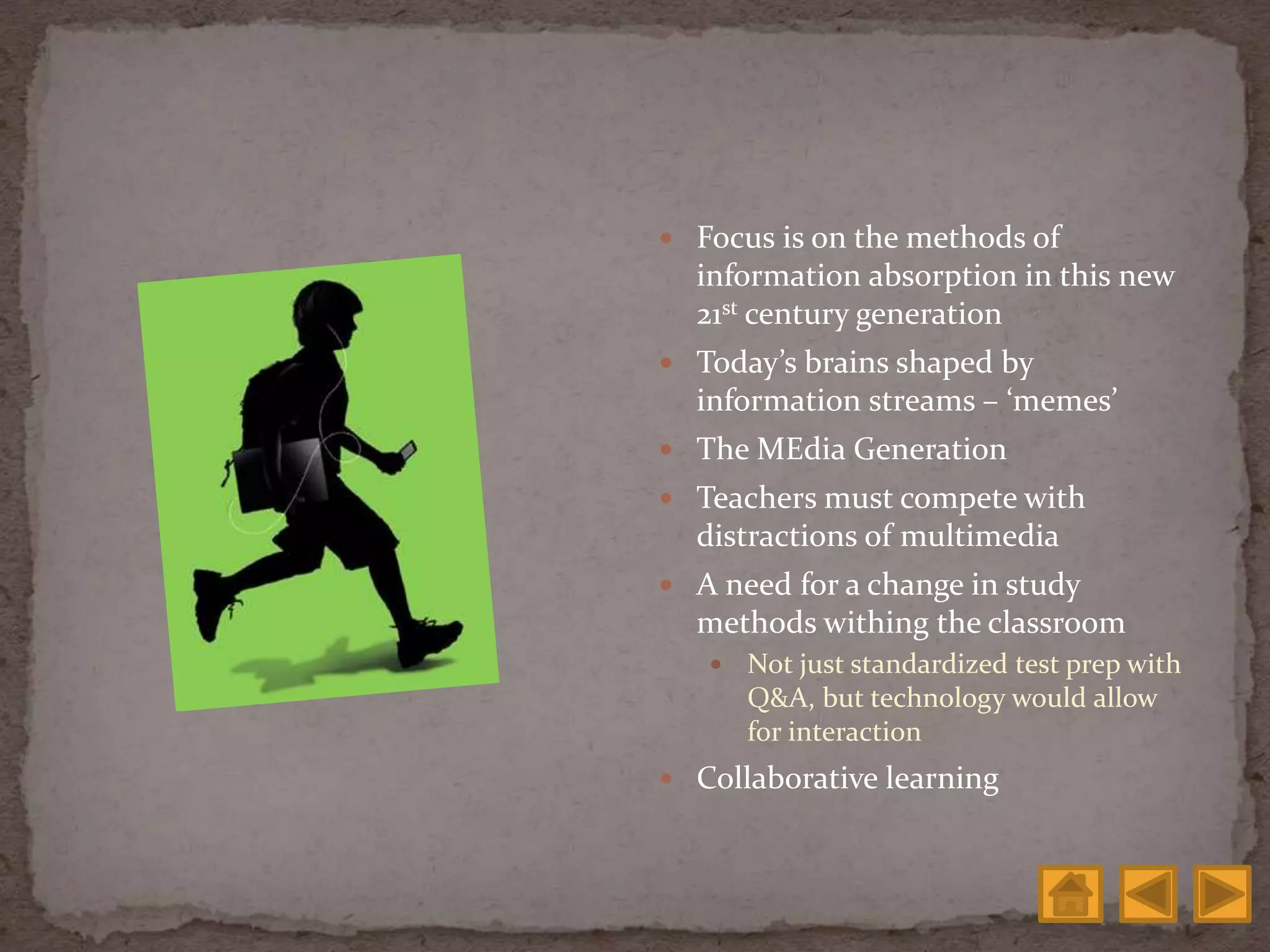
 Focus is on the methods of
information absorption in this new
21st century generation
 Today’s brains shaped by
information streams – ‘memes’
 The MEdia Generation
 Teachers must compete with
distractions of multimedia
 A need for a change in study
methods withing the classroom
 Not just standardized test prep with
Q&A, but technology would allow
for interaction
 Collaborative learning
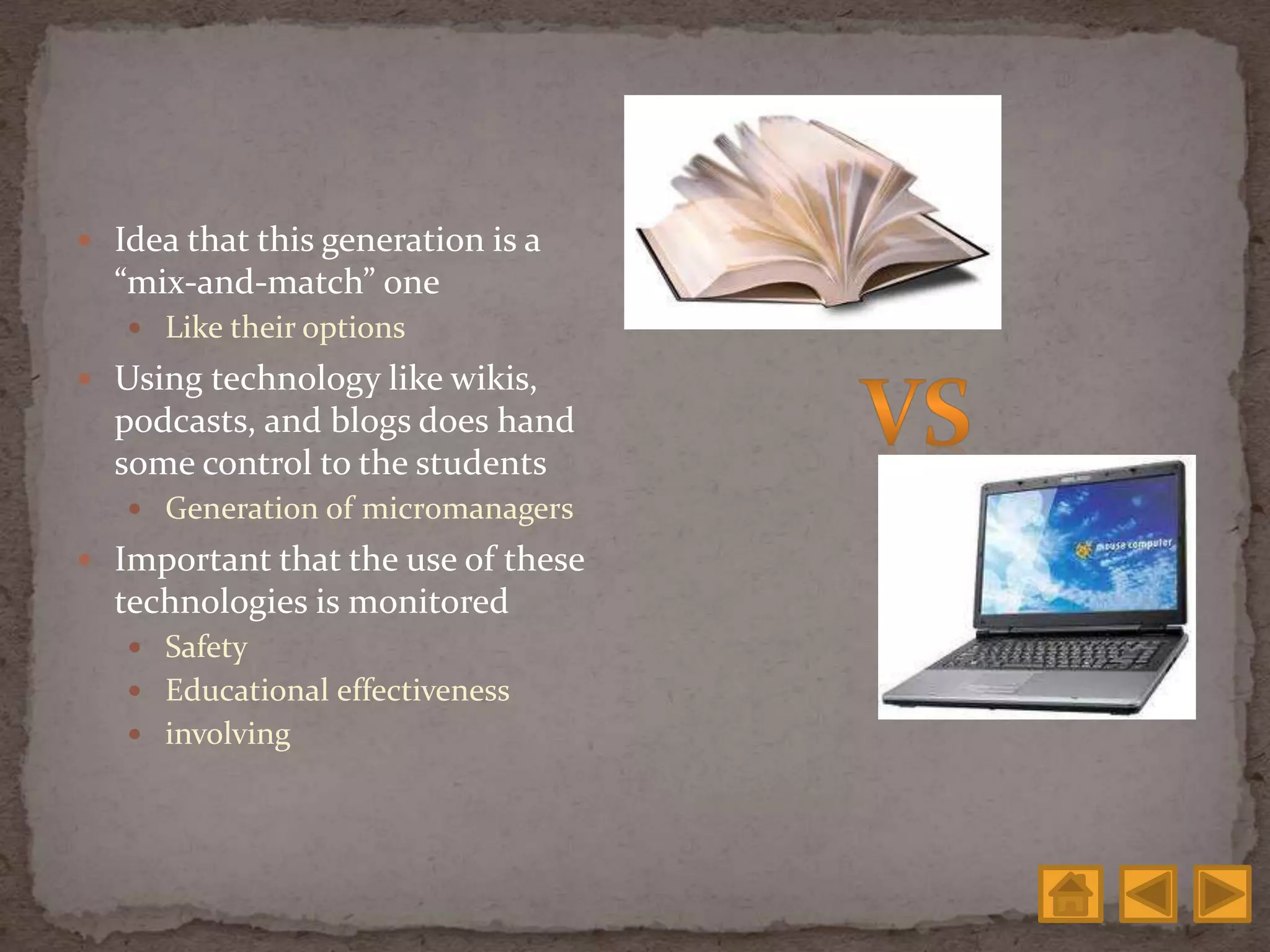
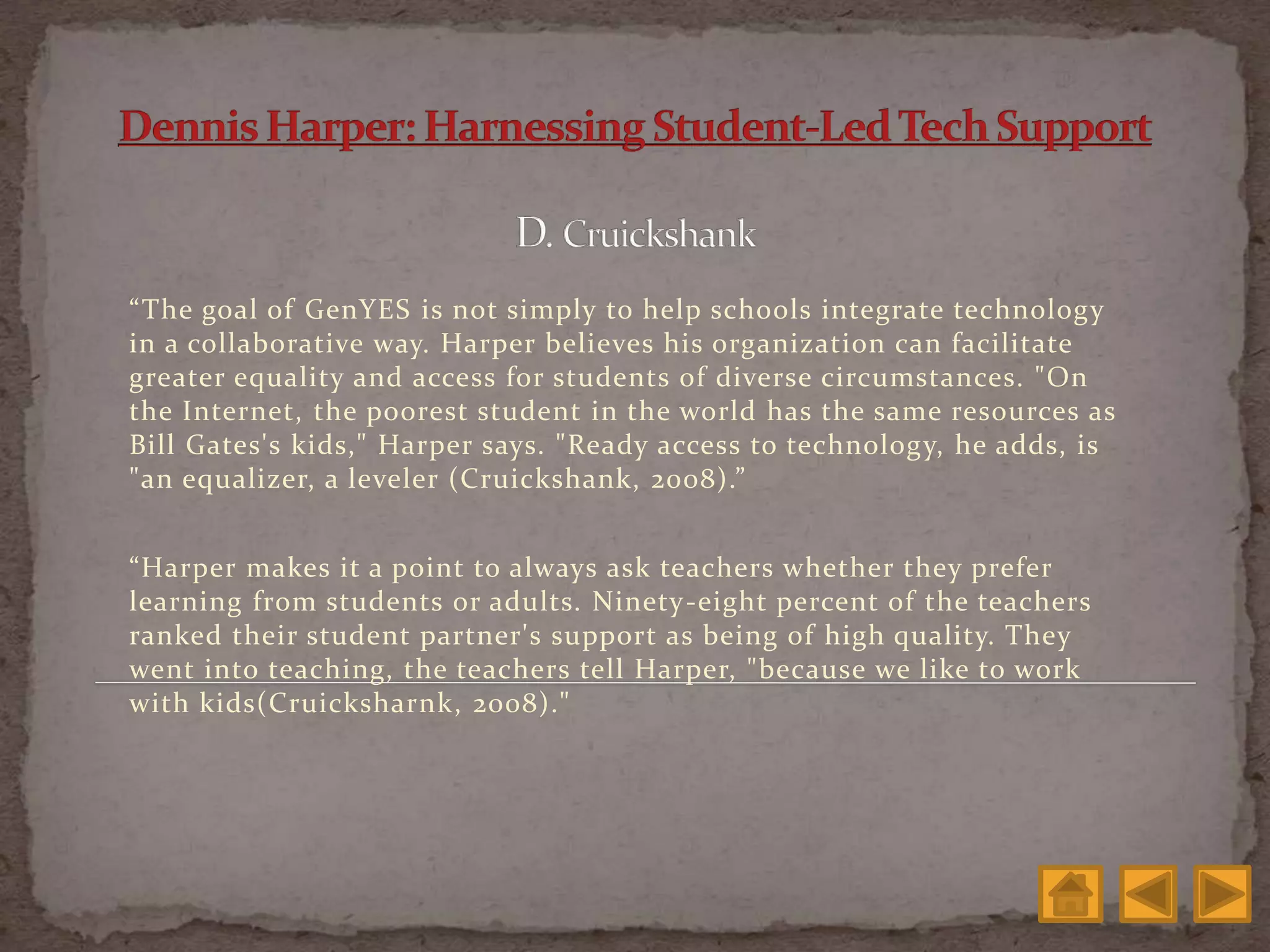
 Idea that this generation is a
“mix-and-match” one
 Like their options
 Using technology like wikis,
podcasts, and blogs does hand
some control to the students
 Generation of micromanagers
 Important that the use of these
technologies is monitored
 Safety
 Educational effectiveness
 involving
“The goal of GenYES is not simply to help schools integrate technology
in a collaborative way. Harper believes his organization can facilitate
greater equality and access for students of diverse circumstances. "On
the Internet, the poorest student in the world has the same resources as
Bill Gates's kids," Harper says. "Ready access to technology, he adds, is
"an equalizer, a leveler (Cruickshank, 2008).”
“Harper makes it a point to always ask teachers whether they prefer
learning from students or adults. Ninety-eight percent of the teachers
ranked their student partner's support as being of high quality. They
went into teaching, the teachers tell Harper, "because we like to work
with kids(Cruicksharnk, 2008)."
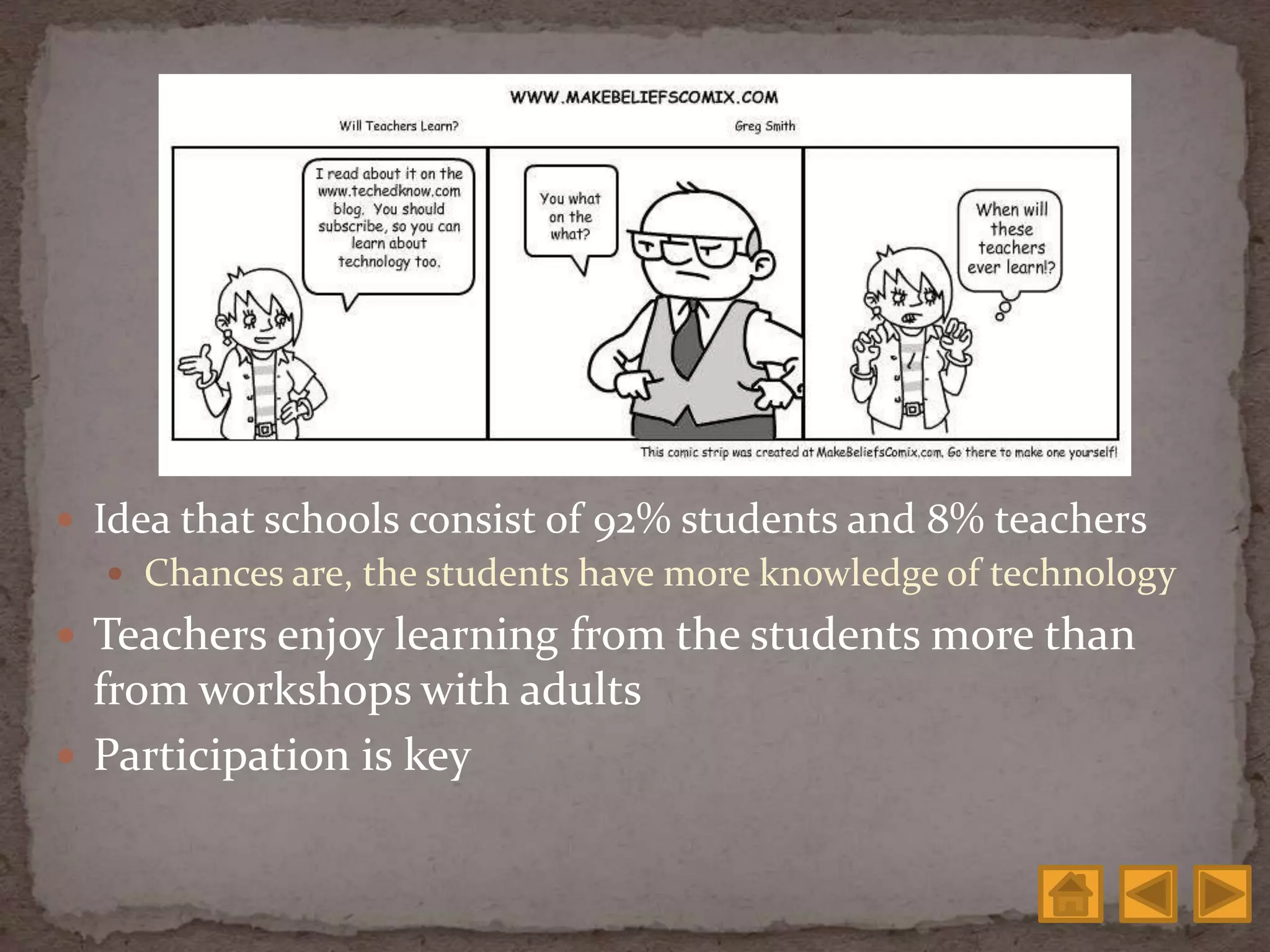
 Idea that schools consist of 92% students and 8% teachers
 Chances are, the students have more knowledge of technology
 Teachers enjoy learning from the students more than
from workshops with adults
 Participation is key
 Technology is an equalizer
 A poor child has the same resources via the web as
would a wealthy child
 Responsibility is what kids need
 Technology is a tool to teach responsibility
 Education is essential
 Trust in the youth
 Next generation is always the hope of the future
I love the idea that technology can be an equalizer. Not only
an equalizer amongst children, but an equalizer amongst
teachers and students. To give students the opportunity to
be involved and have responsibility gives them something
that is experiential rather than just regurgitation. In my
opinion, students of this MEdia generation are more
knowledgeable in technology because they’re more apt to
experiment. They click around until they find what they
need. Some who are not as familiar with technology are too
timid to take charge and discover what technology has to
offer. Allow the students to reveal the resources to the
teachers and do the “clicking-around” in a sense, and then
let the teachers utilize the resources within the classroom.
Both feel equally involved in the progress and the students
become more likely to participate.
•“One of the biggest challenges for foreign language teachers
is to expose their students to authentic speech by native
speakers. Another is to immerse them in the culture of the
language they're studying when that culture may be half a
world away. But in our expanding digital age, it's increasingly
easy to connect live with overseas students, find related
videos and audio clips, and discover examples of living
language online -- all free(Weir, 2008).”
•“The Internet has made accessing authentic materials and
interacting with native speakers an everyday occurrence in
many schools across the country,“ It has really brought the
world into our classrooms(Weir, 2008)."
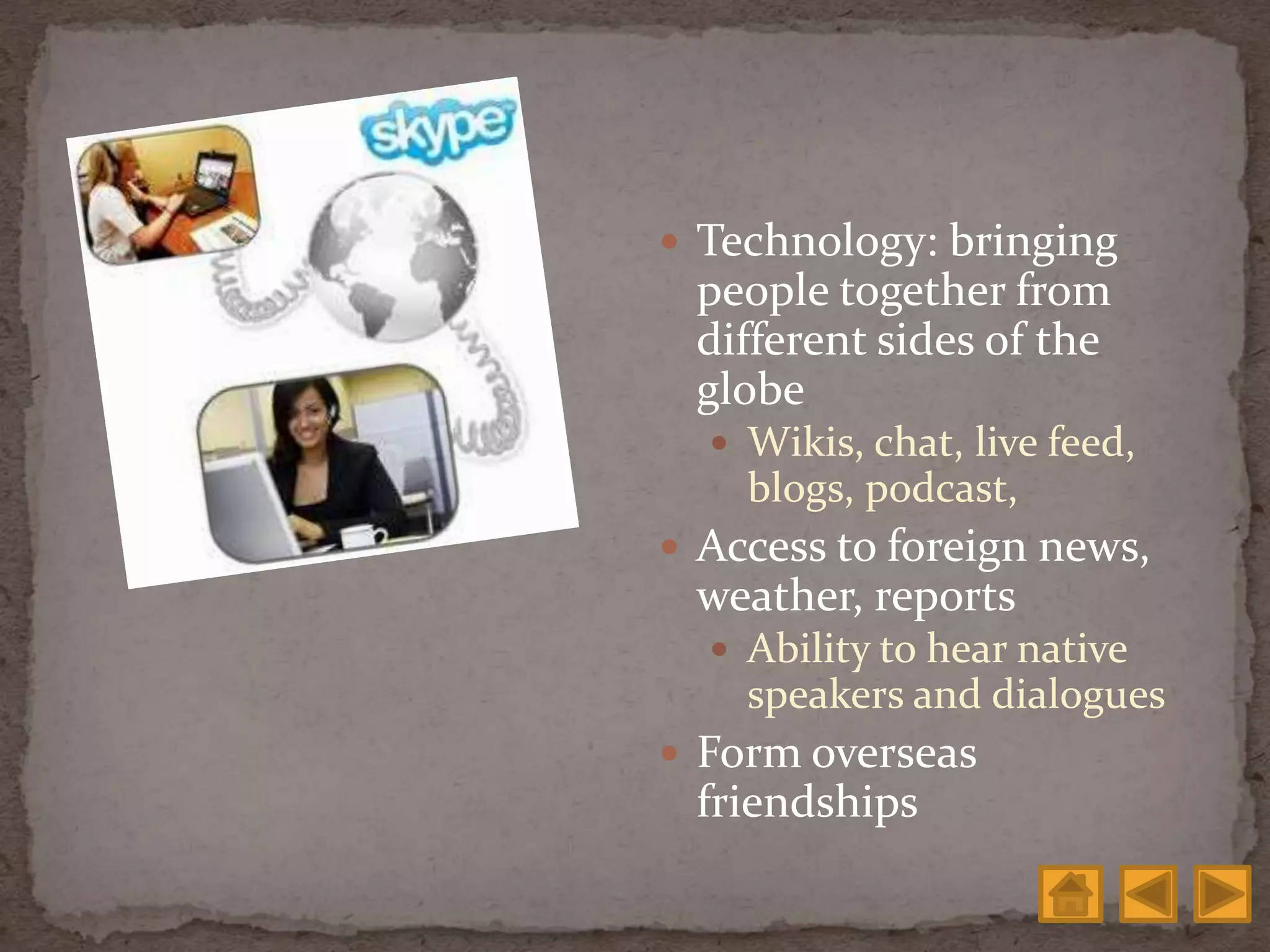
 Technology: bringing
people together from
different sides of the
globe
 Wikis, chat, live feed,
blogs, podcast,
 Access to foreign news,
weather, reports
 Ability to hear native
speakers and dialogues
 Form overseas
friendships
 Speaking and reading a language is different from
hearing a language spoken at its native speed
 Podcasts allow students to repeatedly hear a language
 ePals-program that generates electronic pen pals,
faster, more reliable results
 Technology is revolutionizing the way we learn
language
Learning a language usually begins with basic vocabulary and
cultural knowledge. A set of skills for students made
standard by the state is that the students can regurgitate
basic grammar laws and define or translate the language to
their own. However, another skill, possibly even a more
useful one, is conversational skills. Being able to
understand a native speaker of a language can be essential
in language education. With all of the tools technology is
providing, the importance of translating and
communication will expand. Hopefully, language
education can transfer from just a regurgitation of sorts to
a more conversational, real world skill with the help of
things like podcasts, Skype, e-Pals, and audio aides.
 To conclude, I see the responsibility of integrating
technology into the class as both the teachers’ and the
students’. It is the students’ responsibility to be
responsible with the technology available to them. It is
the teachers’ responsibility to make themselves aware
of what resources can truly impact the classroom and
education experience. Technology is meant to aide and
enhance. This new generation is keenly aware of the
resources available to them, and teachers should
recognize that by incorporating the learning tools of
this MEdia Generation, students range of learning and
understanding is broadened.
 Cruickshank, D. (2008, April). Dennis Harper:
Harnessing student-led tech support. Edutopia .
 McHugh, J. (n.d.). Connecting to the 21st-Century
Student. Edutopia .
 Weir, L. (2008, March 11). Word Up: Bring the World's
Languages to Your Classroom. Edutopia .

Module 6

  • 1.
  • 2.
     Connecting tothe 21st-Century Student  Students Teach Technology to Teachers  Word Up: Bring the World's Languages to Your Classroom  Conclusion  References
  • 3.
    “There's something aboutchanging over to an electronic medium, something about that screen. It's psychological. It's a generational thing. Teachers in every strata of education are increasingly dealing with a student population that is not only more wired than they are but also grew up in a techno- drenched atmosphere that has trained them to absorb and process information in fundamentally different ways(McHugh).” •Educational methods of the past are no longer all functional and effective with today’s youth. They have learned to absorb information in a completely new way, and we as educators must recognize and reciprocate that.
  • 4.
     Focus ison the methods of information absorption in this new 21st century generation  Today’s brains shaped by information streams – ‘memes’  The MEdia Generation  Teachers must compete with distractions of multimedia  A need for a change in study methods withing the classroom  Not just standardized test prep with Q&A, but technology would allow for interaction  Collaborative learning
  • 5.
     Idea thatthis generation is a “mix-and-match” one  Like their options  Using technology like wikis, podcasts, and blogs does hand some control to the students  Generation of micromanagers  Important that the use of these technologies is monitored  Safety  Educational effectiveness  involving
  • 6.
    “The goal ofGenYES is not simply to help schools integrate technology in a collaborative way. Harper believes his organization can facilitate greater equality and access for students of diverse circumstances. "On the Internet, the poorest student in the world has the same resources as Bill Gates's kids," Harper says. "Ready access to technology, he adds, is "an equalizer, a leveler (Cruickshank, 2008).” “Harper makes it a point to always ask teachers whether they prefer learning from students or adults. Ninety-eight percent of the teachers ranked their student partner's support as being of high quality. They went into teaching, the teachers tell Harper, "because we like to work with kids(Cruicksharnk, 2008)."
  • 7.
     Idea thatschools consist of 92% students and 8% teachers  Chances are, the students have more knowledge of technology  Teachers enjoy learning from the students more than from workshops with adults  Participation is key
  • 8.
     Technology isan equalizer  A poor child has the same resources via the web as would a wealthy child  Responsibility is what kids need  Technology is a tool to teach responsibility  Education is essential  Trust in the youth  Next generation is always the hope of the future
  • 9.
    I love theidea that technology can be an equalizer. Not only an equalizer amongst children, but an equalizer amongst teachers and students. To give students the opportunity to be involved and have responsibility gives them something that is experiential rather than just regurgitation. In my opinion, students of this MEdia generation are more knowledgeable in technology because they’re more apt to experiment. They click around until they find what they need. Some who are not as familiar with technology are too timid to take charge and discover what technology has to offer. Allow the students to reveal the resources to the teachers and do the “clicking-around” in a sense, and then let the teachers utilize the resources within the classroom. Both feel equally involved in the progress and the students become more likely to participate.
  • 10.
    •“One of thebiggest challenges for foreign language teachers is to expose their students to authentic speech by native speakers. Another is to immerse them in the culture of the language they're studying when that culture may be half a world away. But in our expanding digital age, it's increasingly easy to connect live with overseas students, find related videos and audio clips, and discover examples of living language online -- all free(Weir, 2008).” •“The Internet has made accessing authentic materials and interacting with native speakers an everyday occurrence in many schools across the country,“ It has really brought the world into our classrooms(Weir, 2008)."
  • 11.
     Technology: bringing peopletogether from different sides of the globe  Wikis, chat, live feed, blogs, podcast,  Access to foreign news, weather, reports  Ability to hear native speakers and dialogues  Form overseas friendships
  • 12.
     Speaking andreading a language is different from hearing a language spoken at its native speed  Podcasts allow students to repeatedly hear a language  ePals-program that generates electronic pen pals, faster, more reliable results  Technology is revolutionizing the way we learn language
  • 13.
    Learning a languageusually begins with basic vocabulary and cultural knowledge. A set of skills for students made standard by the state is that the students can regurgitate basic grammar laws and define or translate the language to their own. However, another skill, possibly even a more useful one, is conversational skills. Being able to understand a native speaker of a language can be essential in language education. With all of the tools technology is providing, the importance of translating and communication will expand. Hopefully, language education can transfer from just a regurgitation of sorts to a more conversational, real world skill with the help of things like podcasts, Skype, e-Pals, and audio aides.
  • 14.
     To conclude,I see the responsibility of integrating technology into the class as both the teachers’ and the students’. It is the students’ responsibility to be responsible with the technology available to them. It is the teachers’ responsibility to make themselves aware of what resources can truly impact the classroom and education experience. Technology is meant to aide and enhance. This new generation is keenly aware of the resources available to them, and teachers should recognize that by incorporating the learning tools of this MEdia Generation, students range of learning and understanding is broadened.
  • 15.
     Cruickshank, D.(2008, April). Dennis Harper: Harnessing student-led tech support. Edutopia .  McHugh, J. (n.d.). Connecting to the 21st-Century Student. Edutopia .  Weir, L. (2008, March 11). Word Up: Bring the World's Languages to Your Classroom. Edutopia .