
Reading
vs
Listening
Which Is More Effective for Learning and Remembering
In recent times, there has been a lot of debate on the very
important question about differences between reading and
listening and which of the two leads to better comprehension,
retention and efficiency.
Many studies and reviews have been conducted on this subject
with a focus on evaluating many important factors to arrive at
the decision whether reading or listening is more effective.
Reading
Listening
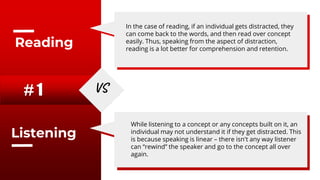
In the case of reading, if an individual gets distracted, they
can come back to the words, and then read over concept
easily. Thus, speaking from the aspect of distraction,
reading is a lot better for comprehension and retention.
While listening to a concept or any concepts built on it, an
individual may not understand it if they get distracted. This
is because speaking is linear – there isn't any way listener
can “rewind” the speaker and go to the concept all over
again.
VS# 1
Reading
Listening
While reading, an individual can read and understand at
their own pace. This also allows them to comprehend at
their own pace, which ultimately results in better
understanding and retention of information.
Since listening requires real-time comprehension skills, it
is more challenging on humans. To be able to
understand what a person is saying, an individual must
listen and interpret instantaneously. This becomes all
the more challenging when the person is taking notes,
such as in a lecture or a business meeting.
VS# 2
Reading
Listening
Reading helps your acquire vocabulary and understand
the logic behind the language.
If your aim is to focus on conversing, you would probably
want to concentrate on listening.
VS# 3
Reading
Listening
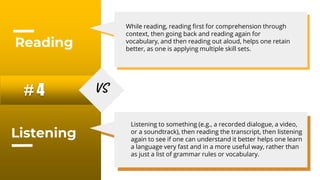
While reading, reading first for comprehension through
context, then going back and reading again for
vocabulary, and then reading out aloud, helps one retain
better, as one is applying multiple skill sets.
Listening to something (e.g., a recorded dialogue, a video,
or a soundtrack), then reading the transcript, then listening
again to see if one can understand it better helps one learn
a language very fast and in a more useful way, rather than
as just a list of grammar rules or vocabulary.
VS# 4
A final, important element to this comparison, has
been definitely proven through studies: reading, for
sure, has an advantage.
CONCLUSION
Prepared by:
GMR Transcription Services, Inc
Accurate at Affordable Rates
www.gmrtranscription.com Call Us: 714-202-9653
Transcription Services

Reading vs listening

  • 1.
    Reading vs Listening Which Is MoreEffective for Learning and Remembering
  • 2.
    In recent times,there has been a lot of debate on the very important question about differences between reading and listening and which of the two leads to better comprehension, retention and efficiency. Many studies and reviews have been conducted on this subject with a focus on evaluating many important factors to arrive at the decision whether reading or listening is more effective.
  • 3.
    Reading Listening In the caseof reading, if an individual gets distracted, they can come back to the words, and then read over concept easily. Thus, speaking from the aspect of distraction, reading is a lot better for comprehension and retention. While listening to a concept or any concepts built on it, an individual may not understand it if they get distracted. This is because speaking is linear – there isn't any way listener can “rewind” the speaker and go to the concept all over again. VS# 1
  • 4.
    Reading Listening While reading, anindividual can read and understand at their own pace. This also allows them to comprehend at their own pace, which ultimately results in better understanding and retention of information. Since listening requires real-time comprehension skills, it is more challenging on humans. To be able to understand what a person is saying, an individual must listen and interpret instantaneously. This becomes all the more challenging when the person is taking notes, such as in a lecture or a business meeting. VS# 2
  • 5.
    Reading Listening Reading helps youracquire vocabulary and understand the logic behind the language. If your aim is to focus on conversing, you would probably want to concentrate on listening. VS# 3
  • 6.
    Reading Listening While reading, readingfirst for comprehension through context, then going back and reading again for vocabulary, and then reading out aloud, helps one retain better, as one is applying multiple skill sets. Listening to something (e.g., a recorded dialogue, a video, or a soundtrack), then reading the transcript, then listening again to see if one can understand it better helps one learn a language very fast and in a more useful way, rather than as just a list of grammar rules or vocabulary. VS# 4
  • 7.
    A final, importantelement to this comparison, has been definitely proven through studies: reading, for sure, has an advantage. CONCLUSION
  • 8.
    Prepared by: GMR TranscriptionServices, Inc Accurate at Affordable Rates www.gmrtranscription.com Call Us: 714-202-9653 Transcription Services