Open University
Modern Methodology for Language Teaching
TEACHING
LISTENING AND READING
SKILLS
Group 2:
1. Đoàn Nguyễn Phương Thái
2. Trương Nguyễn Ngọc Thy
3. Trần Nguyên Bảo Trang
4. Nguyễn Thị Thanh Tú
Lecturer: Dương Thị Hoàng Oanh, Ph.D
Đoàn Nguyễn Phương Thái
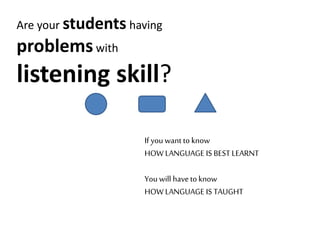
Are your students having
problemswith
listening skill?
If you want to know
HOW LANGUAGE IS BEST LEARNT
You will have to know
HOW LANGUAGE IS TAUGHT
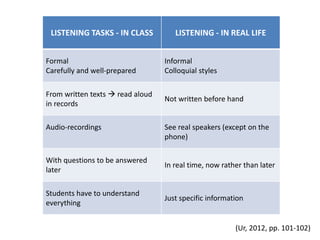
LISTENING TASKS - IN CLASS LISTENING - IN REAL LIFE
Formal
Carefully and well-prepared
Informal
Colloquial styles
From written texts  read aloud
in records
Not written before hand
Audio-recordings See real speakers (except on the
phone)
With questions to be answered
later
In real time, now rather than later
Students have to understand
everything
Just specific information
(Ur, 2012, pp. 101-102)
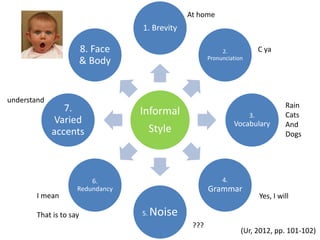
Informal
Style
1. Brevity
2.
Pronunciation
3.
Vocabulary
4.
Grammar
5. Noise
6.
Redundancy
7.
Varied
accents
8. Face
& Body
At home
C ya
Rain
Cats
And
Dogs
Yes, I will
???
understand
I mean
That is to say
(Ur, 2012, pp. 101-102)
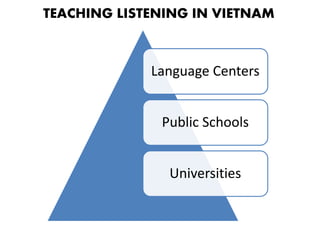
TEACHING LISTENING IN VIETNAM
Language Centers
Public Schools
Universities
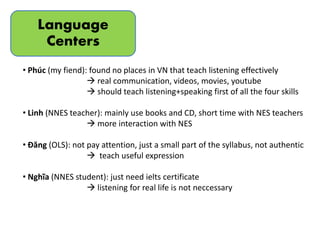
Language
Centers
• Phúc (my fiend): found no places in VN that teach listening effectively
 real communication, videos, movies, youtube
 should teach listening+speaking first of all the four skills
• Linh (NNES teacher): mainly use books and CD, short time with NES teachers
 more interaction with NES
• Đăng (OLS): not pay attention, just a small part of the syllabus, not authentic
 teach useful expression
• Nghĩa (NNES student): just need ielts certificate
 listening for real life is not neccessary
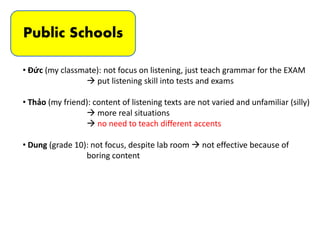
Public Schools
• Đức (my classmate): not focus on listening, just teach grammar for the EXAM
 put listening skill into tests and exams
• Thảo (my friend): content of listening texts are not varied and unfamiliar (silly)
 more real situations
 no need to teach different accents
• Dung (grade 10): not focus, despite lab room  not effective because of
boring content
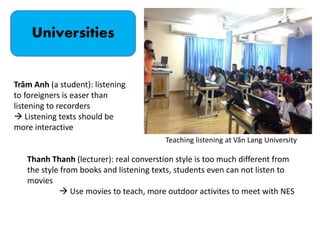
Universities
Teaching listening at Văn Lang University
Trâm Anh (a student): listening
to foreigners is easer than
listening to recorders
 Listening texts should be
more interactive
Thanh Thanh (lecturer): real converstion style is too much different from
the style from books and listening texts, students even can not listen to
movies
 Use movies to teach, more outdoor activites to meet with NES
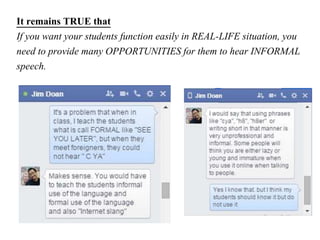
It remains TRUE that
If you want your students function easily in REAL-LIFE situation, you
need to provide many OPPORTUNITIES for them to hear INFORMAL
speech.
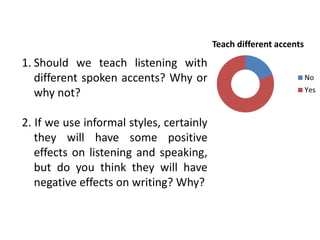
1. Should we teach listening with
different spoken accents? Why or
why not?
2. If we use informal styles, certainly
they will have some positive
effects on listening and speaking,
but do you think they will have
negative effects on writing? Why?
Teach different accents
No
Yes
Trương Nguyễn Ngọc Thy
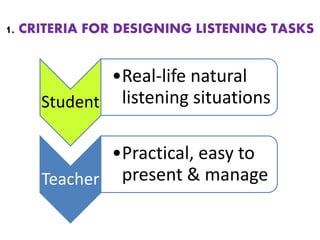
Student
•Real-life natural
listening situations
Teacher
•Practical, easy to
present & manage
1. CRITERIA FOR DESIGNING LISTENING TASKS
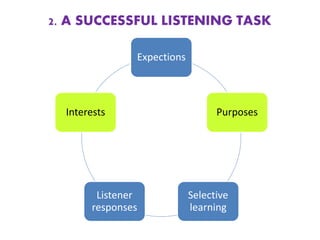
Expections
Purposes
Selective
learning
Listener
responses
Interests
2. A SUCCESSFUL LISTENING TASK
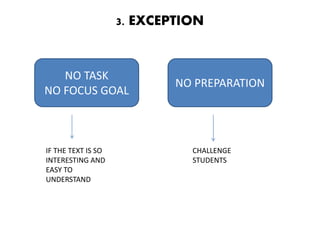
3. EXCEPTION
NO TASK
NO FOCUS GOAL
NO PREPARATION
IF THE TEXT IS SO
INTERESTING AND
EASY TO
UNDERSTAND
CHALLENGE
STUDENTS
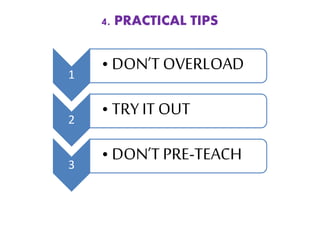
4. PRACTICAL TIPS
1
• DON’T OVERLOAD
2
• TRY IT OUT
3
• DON’T PRE-TEACH
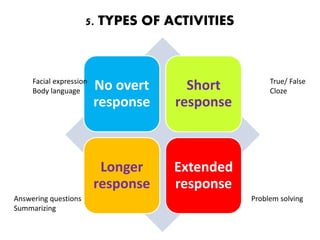
5. TYPES OF ACTIVITIES
No overt
response
Short
response
Longer
response
Extended
response
Facial expression
Body language
True/ False
Cloze
Problem solvingAnswering questions
Summarizing
Trần Nguyên Bảo Trang
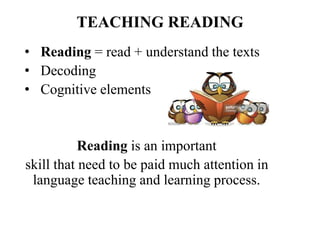
TEACHING READING
• Reading = read + understand the texts
• Decoding
• Cognitive elements
Reading is an important
skill that need to be paid much attention in
language teaching and learning process.
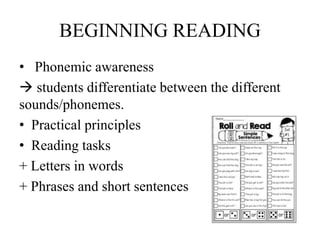
BEGINNING READING
• Phonemic awareness
 students differentiate between the different
sounds/phonemes.
• Practical principles
• Reading tasks
+ Letters in words
+ Phrases and short sentences
SUGGESTIONS
- Choose authentic texts. (Nguyen, 2000)
- Choose good books. (Dyson & genishi, 1994)
- Use technology in teaching reading ( NRP, 2000)
- “encourage students to read silently rather
than reading aloud” (Ur, 2012, p.136)
USING TECHOLOGY
IN TEACHING READING
Pre-reading Post-reading
While-reading
(NRP, 2000)
IMPLICATIONS
READING ALOUD
• Helps students build
foundational skills
• Allows teachers monitor
how students learn
sounds
Be USEFUL at
the EARLY STAGE of
learning letters
( Brekekamp et at, 2000)
READING SILENTLY
• Allows students study
the text at their own
pace.
• Encourages students to
focus on meaning
Be USEFUL for
ADVANCED READING
(Fountas & Pinnell, 1996)
Nguyễn Thị Thanh Tú
FLUENT READING
In order to understand a text, readers need to be able
to understand between 95% and 98% of its words
(Schmitt, 2008)
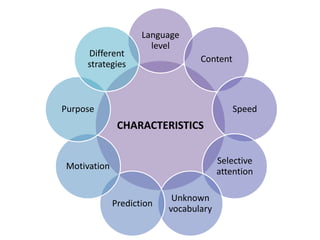
CHARACTERISTICS
Language
level
Content
Speed
Selective
attention
Unknown
vocabulary
Prediction
Motivation
Purpose
Different
strategies
IMPLICATIONS FOR TEACHINGT: Providing comprehensible contents to
readers
S: Understanding 95%-98% of a text’s
words
T: providing familiar information/ world
knowledge
T: Using various pre-reading strategies to
supply the missing information.
T: Provision of a large amount of experience
of successful reading
T: Giving readers tips as to reading strategies
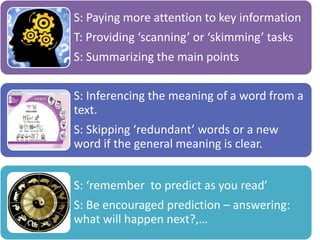
S: Paying more attention to key information
T: Providing ‘scanning’ or ‘skimming’ tasks
S: Summarizing the main points
S: Inferencing the meaning of a word from a
text.
S: Skipping ‘redundant’ words or a new
word if the general meaning is clear.
S: ‘remember to predict as you read’
S: Be encouraged prediction – answering:
what will happen next?,…
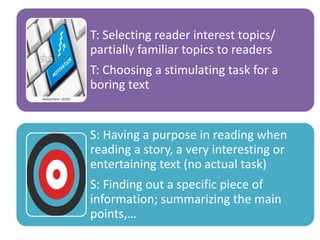
T: Selecting reader interest topics/
partially familiar topics to readers
T: Choosing a stimulating task for a
boring text
S: Having a purpose in reading when
reading a story, a very interesting or
entertaining text (no actual task)
S: Finding out a specific piece of
information; summarizing the main
points,…
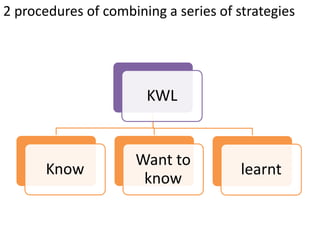
2 procedures of combining a series of strategies
KWL
Know
Want to
know
learnt
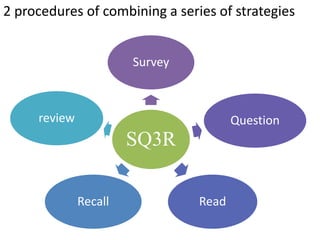
2 procedures of combining a series of strategies
SQ3R
Survey
Question
ReadRecall
review
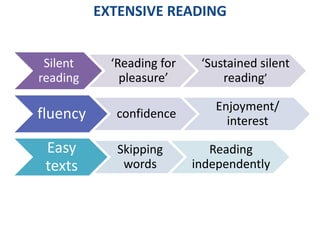
EXTENSIVE READING
Silent
reading
‘Reading for
pleasure’
‘Sustained silent
reading’
fluency confidence
Enjoyment/
interest
Easy
texts
Skipping
words
Reading
independently
Thank you for your attention!
• Comments
• Q and A
References
Scrivener, J. (2010). Learning teaching: The essential
guide to English Language teaching (3rd edt.)
Macmillan.
Ur, P. (2012). A course in English language teaching.
Cambridge: Cambridge university press

Teaching Listening and Reading

  • 1.
    Open University Modern Methodologyfor Language Teaching TEACHING LISTENING AND READING SKILLS Group 2: 1. Đoàn Nguyễn Phương Thái 2. Trương Nguyễn Ngọc Thy 3. Trần Nguyên Bảo Trang 4. Nguyễn Thị Thanh Tú Lecturer: Dương Thị Hoàng Oanh, Ph.D
  • 2.
  • 3.
    Are your studentshaving problemswith listening skill? If you want to know HOW LANGUAGE IS BEST LEARNT You will have to know HOW LANGUAGE IS TAUGHT
  • 4.
    LISTENING TASKS -IN CLASS LISTENING - IN REAL LIFE Formal Carefully and well-prepared Informal Colloquial styles From written texts  read aloud in records Not written before hand Audio-recordings See real speakers (except on the phone) With questions to be answered later In real time, now rather than later Students have to understand everything Just specific information (Ur, 2012, pp. 101-102)
  • 5.
    Informal Style 1. Brevity 2. Pronunciation 3. Vocabulary 4. Grammar 5. Noise 6. Redundancy 7. Varied accents 8.Face & Body At home C ya Rain Cats And Dogs Yes, I will ??? understand I mean That is to say (Ur, 2012, pp. 101-102)
  • 6.
    TEACHING LISTENING INVIETNAM Language Centers Public Schools Universities
  • 7.
    Language Centers • Phúc (myfiend): found no places in VN that teach listening effectively  real communication, videos, movies, youtube  should teach listening+speaking first of all the four skills • Linh (NNES teacher): mainly use books and CD, short time with NES teachers  more interaction with NES • Đăng (OLS): not pay attention, just a small part of the syllabus, not authentic  teach useful expression • Nghĩa (NNES student): just need ielts certificate  listening for real life is not neccessary
  • 8.
    Public Schools • Đức(my classmate): not focus on listening, just teach grammar for the EXAM  put listening skill into tests and exams • Thảo (my friend): content of listening texts are not varied and unfamiliar (silly)  more real situations  no need to teach different accents • Dung (grade 10): not focus, despite lab room  not effective because of boring content
  • 9.
    Universities Teaching listening atVăn Lang University Trâm Anh (a student): listening to foreigners is easer than listening to recorders  Listening texts should be more interactive Thanh Thanh (lecturer): real converstion style is too much different from the style from books and listening texts, students even can not listen to movies  Use movies to teach, more outdoor activites to meet with NES
  • 10.
    It remains TRUEthat If you want your students function easily in REAL-LIFE situation, you need to provide many OPPORTUNITIES for them to hear INFORMAL speech.
  • 11.
    1. Should weteach listening with different spoken accents? Why or why not? 2. If we use informal styles, certainly they will have some positive effects on listening and speaking, but do you think they will have negative effects on writing? Why? Teach different accents No Yes
  • 12.
  • 13.
    Student •Real-life natural listening situations Teacher •Practical,easy to present & manage 1. CRITERIA FOR DESIGNING LISTENING TASKS
  • 14.
  • 15.
    3. EXCEPTION NO TASK NOFOCUS GOAL NO PREPARATION IF THE TEXT IS SO INTERESTING AND EASY TO UNDERSTAND CHALLENGE STUDENTS
  • 16.
    4. PRACTICAL TIPS 1 •DON’T OVERLOAD 2 • TRY IT OUT 3 • DON’T PRE-TEACH
  • 17.
    5. TYPES OFACTIVITIES No overt response Short response Longer response Extended response Facial expression Body language True/ False Cloze Problem solvingAnswering questions Summarizing
  • 18.
  • 19.
    TEACHING READING • Reading= read + understand the texts • Decoding • Cognitive elements Reading is an important skill that need to be paid much attention in language teaching and learning process.
  • 20.
    BEGINNING READING • Phonemicawareness  students differentiate between the different sounds/phonemes. • Practical principles • Reading tasks + Letters in words + Phrases and short sentences
  • 21.
    SUGGESTIONS - Choose authentictexts. (Nguyen, 2000) - Choose good books. (Dyson & genishi, 1994) - Use technology in teaching reading ( NRP, 2000) - “encourage students to read silently rather than reading aloud” (Ur, 2012, p.136)
  • 22.
    USING TECHOLOGY IN TEACHINGREADING Pre-reading Post-reading While-reading (NRP, 2000)
  • 23.
    IMPLICATIONS READING ALOUD • Helpsstudents build foundational skills • Allows teachers monitor how students learn sounds Be USEFUL at the EARLY STAGE of learning letters ( Brekekamp et at, 2000) READING SILENTLY • Allows students study the text at their own pace. • Encourages students to focus on meaning Be USEFUL for ADVANCED READING (Fountas & Pinnell, 1996)
  • 24.
  • 25.
    FLUENT READING In orderto understand a text, readers need to be able to understand between 95% and 98% of its words (Schmitt, 2008)
  • 26.
  • 27.
    IMPLICATIONS FOR TEACHINGT:Providing comprehensible contents to readers S: Understanding 95%-98% of a text’s words T: providing familiar information/ world knowledge T: Using various pre-reading strategies to supply the missing information. T: Provision of a large amount of experience of successful reading T: Giving readers tips as to reading strategies
  • 28.
    S: Paying moreattention to key information T: Providing ‘scanning’ or ‘skimming’ tasks S: Summarizing the main points S: Inferencing the meaning of a word from a text. S: Skipping ‘redundant’ words or a new word if the general meaning is clear. S: ‘remember to predict as you read’ S: Be encouraged prediction – answering: what will happen next?,…
  • 29.
    T: Selecting readerinterest topics/ partially familiar topics to readers T: Choosing a stimulating task for a boring text S: Having a purpose in reading when reading a story, a very interesting or entertaining text (no actual task) S: Finding out a specific piece of information; summarizing the main points,…
  • 30.
    2 procedures ofcombining a series of strategies KWL Know Want to know learnt
  • 31.
    2 procedures ofcombining a series of strategies SQ3R Survey Question ReadRecall review
  • 32.
    EXTENSIVE READING Silent reading ‘Reading for pleasure’ ‘Sustainedsilent reading’ fluency confidence Enjoyment/ interest Easy texts Skipping words Reading independently
  • 33.
    Thank you foryour attention! • Comments • Q and A
  • 34.
    References Scrivener, J. (2010).Learning teaching: The essential guide to English Language teaching (3rd edt.) Macmillan. Ur, P. (2012). A course in English language teaching. Cambridge: Cambridge university press