Colegio San Patricio
                              Review 4th Period Exam
    Name _______________________________________________ Date ____________________


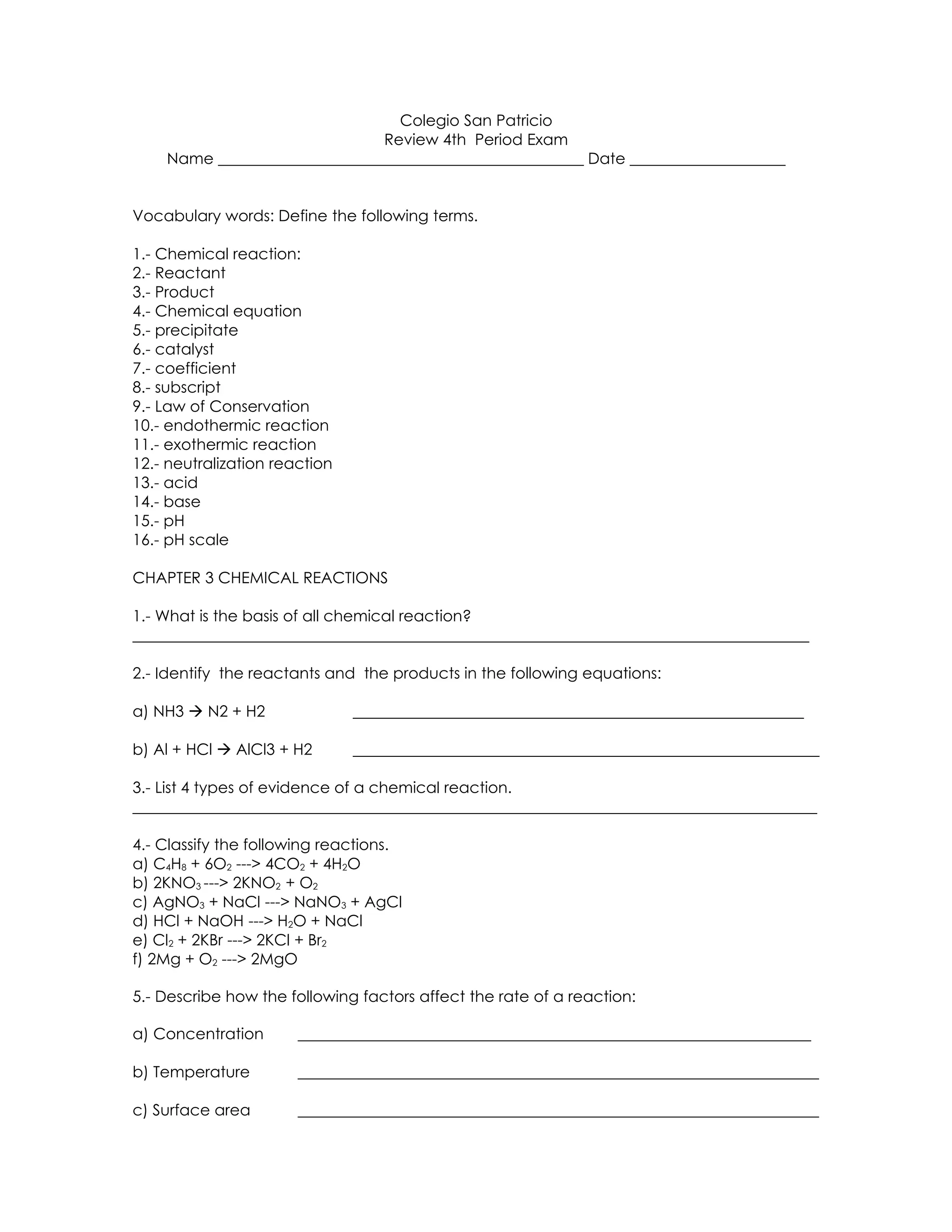
Vocabulary words: Define the following terms.

1.- Chemical reaction:
2.- Reactant
3.- Product
4.- Chemical equation
5.- precipitate
6.- catalyst
7.- coefficient
8.- subscript
9.- Law of Conservation
10.- endothermic reaction
11.- exothermic reaction
12.- neutralization reaction
13.- acid
14.- base
15.- pH
16.- pH scale

CHAPTER 3 CHEMICAL REACTIONS

1.- What is the basis of all chemical reaction?
_______________________________________________________________________________________

2.- Identify the reactants and the products in the following equations:

a) NH3  N2 + H2               __________________________________________________________

b) Al + HCl  AlCl3 + H2       ____________________________________________________________

3.- List 4 types of evidence of a chemical reaction.
________________________________________________________________________________________

4.- Classify the following reactions.
a) C4H8 + 6O2 ---> 4CO2 + 4H2O
b) 2KNO3 ---> 2KNO2 + O2
c) AgNO3 + NaCl ---> NaNO3 + AgCl
d) HCl + NaOH ---> H2O + NaCl
e) Cl2 + 2KBr ---> 2KCl + Br2
f) 2Mg + O2 ---> 2MgO

5.- Describe how the following factors affect the rate of a reaction:

a) Concentration       __________________________________________________________________

b) Temperature         ___________________________________________________________________

c) Surface area        ___________________________________________________________________
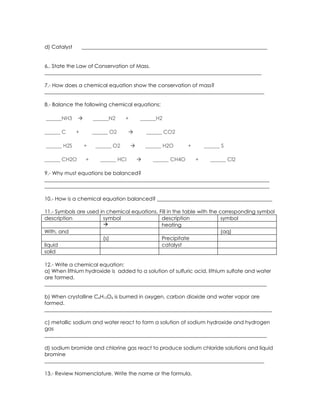
d) Catalyst       _______________________________________________________________________


6,. State the Law of Conservation of Mass.
___________________________________________________________________________________

7.- How does a chemical equation show the conservation of mass?
____________________________________________________________________________________

8.- Balance the following chemical equations:

______NH3             ______N2     +       ______H2

______ C      +        ______ O2               ______ CO2

______ H2S        +     ______ O2              ______ H2O      +       ______ S

______ CH2O        +     ______ HCl              ______ CH4O       +     ______ Cl2

9.- Why must equations be balanced?
______________________________________________________________________________________
______________________________________________________________________________________

10.- How is a chemical equation balanced? ____________________________________________

11.- Symbols are used in chemical equations. Fill in the table with the corresponding symbol
description            symbol                 description                symbol
                                             heating
With, and                                                                (aq)
                       (s)                    Precipitate
liquid                                        catalyst
solid

12.- Write a chemical equation:
a) When lithium hydroxide is added to a solution of sulfuric acid, lithium sulfate and water
are formed.
_____________________________________________________________________________________

b) When crystalline C6H12O6 is burned in oxygen, carbon dioxide and water vapor are
formed.
_______________________________________________________________________________________

c) metallic sodium and water react to form a solution of sodium hydroxide and hydrogen
gas
_____________________________________________________________________________________

d) sodium bromide and chlorine gas react to produce sodium chloride solutions and liquid
bromine
____________________________________________________________________________________

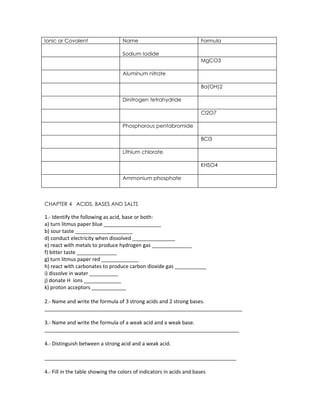
13.- Review Nomenclature. Write the name or the formula.
Ionic or Covalent                  Name                               Formula

                                   Sodium Iodide
                                                                      MgCO3

                                   Aluminum nitrate

                                                                      Ba(OH)2

                                   Dinitrogen tetrahydride

                                                                      Cl2O7

                                   Phosphorous pentabromide

                                                                      BCl3

                                   Lithium chlorate

                                                                      KHSO4

                                   Ammonium phosphate


CHAPTER 4 ACIDS, BASES AND SALTS

1.- Identify the following as acid, base or both:
a) turn litmus paper blue ____________________
b) sour taste ____________________
d) conduct electricity when dissolved _______________
e) react with metals to produce hydrogen gas ______________
f) bitter taste ______________
g) turn litmus paper red _____________
h) react with carbonates to produce carbon dioxide gas ___________
i) dissolve in water __________
j) donate H ions _____________
k) proton acceptors ____________

2.- Name and write the formula of 3 strong acids and 2 strong bases.
_____________________________________________________________________

3.- Name and write the formula of a weak acid and a weak base.
____________________________________________________________________

4.- Distinguish between a strong acid and a weak acid.

___________________________________________________________________

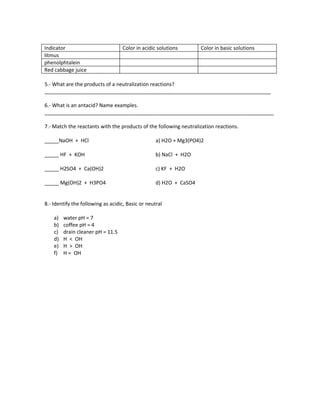
4.- Fill in the table showing the colors of indicators in acids and bases
Indicator                          Color in acidic solutions        Color in basic solutions
litmus
phenolphtalein
Red cabbage juice

5.- What are the products of a neutralization reactions?
_______________________________________________________________________________

6.- What is an antacid? Name examples.
________________________________________________________________________________

7.- Match the reactants with the products of the following neutralization reactions.

_____NaOH + HCl                                    a) H2O + Mg3(PO4)2

_____ HF + KOH                                     b) NaCl + H2O

_____ H2SO4 + Ca(OH)2                              c) KF + H2O

_____ Mg(OH)2 + H3PO4                              d) H2O + CaSO4


8.- Identify the following as acidic, Basic or neutral

    a)   water pH = 7
    b)   coffee pH = 4
    c)   drain cleaner pH = 11.5
    d)   H < OH
    e)   H > OH
    f)   H = OH

Review Chemistry 4th Period

  • 1.
    Colegio San Patricio Review 4th Period Exam Name _______________________________________________ Date ____________________ Vocabulary words: Define the following terms. 1.- Chemical reaction: 2.- Reactant 3.- Product 4.- Chemical equation 5.- precipitate 6.- catalyst 7.- coefficient 8.- subscript 9.- Law of Conservation 10.- endothermic reaction 11.- exothermic reaction 12.- neutralization reaction 13.- acid 14.- base 15.- pH 16.- pH scale CHAPTER 3 CHEMICAL REACTIONS 1.- What is the basis of all chemical reaction? _______________________________________________________________________________________ 2.- Identify the reactants and the products in the following equations: a) NH3  N2 + H2 __________________________________________________________ b) Al + HCl  AlCl3 + H2 ____________________________________________________________ 3.- List 4 types of evidence of a chemical reaction. ________________________________________________________________________________________ 4.- Classify the following reactions. a) C4H8 + 6O2 ---> 4CO2 + 4H2O b) 2KNO3 ---> 2KNO2 + O2 c) AgNO3 + NaCl ---> NaNO3 + AgCl d) HCl + NaOH ---> H2O + NaCl e) Cl2 + 2KBr ---> 2KCl + Br2 f) 2Mg + O2 ---> 2MgO 5.- Describe how the following factors affect the rate of a reaction: a) Concentration __________________________________________________________________ b) Temperature ___________________________________________________________________ c) Surface area ___________________________________________________________________
  • 2.
    d) Catalyst _______________________________________________________________________ 6,. State the Law of Conservation of Mass. ___________________________________________________________________________________ 7.- How does a chemical equation show the conservation of mass? ____________________________________________________________________________________ 8.- Balance the following chemical equations: ______NH3  ______N2 + ______H2 ______ C + ______ O2  ______ CO2 ______ H2S + ______ O2  ______ H2O + ______ S ______ CH2O + ______ HCl  ______ CH4O + ______ Cl2 9.- Why must equations be balanced? ______________________________________________________________________________________ ______________________________________________________________________________________ 10.- How is a chemical equation balanced? ____________________________________________ 11.- Symbols are used in chemical equations. Fill in the table with the corresponding symbol description symbol description symbol  heating With, and (aq) (s) Precipitate liquid catalyst solid 12.- Write a chemical equation: a) When lithium hydroxide is added to a solution of sulfuric acid, lithium sulfate and water are formed. _____________________________________________________________________________________ b) When crystalline C6H12O6 is burned in oxygen, carbon dioxide and water vapor are formed. _______________________________________________________________________________________ c) metallic sodium and water react to form a solution of sodium hydroxide and hydrogen gas _____________________________________________________________________________________ d) sodium bromide and chlorine gas react to produce sodium chloride solutions and liquid bromine ____________________________________________________________________________________ 13.- Review Nomenclature. Write the name or the formula.
  • 3.
    Ionic or Covalent Name Formula Sodium Iodide MgCO3 Aluminum nitrate Ba(OH)2 Dinitrogen tetrahydride Cl2O7 Phosphorous pentabromide BCl3 Lithium chlorate KHSO4 Ammonium phosphate CHAPTER 4 ACIDS, BASES AND SALTS 1.- Identify the following as acid, base or both: a) turn litmus paper blue ____________________ b) sour taste ____________________ d) conduct electricity when dissolved _______________ e) react with metals to produce hydrogen gas ______________ f) bitter taste ______________ g) turn litmus paper red _____________ h) react with carbonates to produce carbon dioxide gas ___________ i) dissolve in water __________ j) donate H ions _____________ k) proton acceptors ____________ 2.- Name and write the formula of 3 strong acids and 2 strong bases. _____________________________________________________________________ 3.- Name and write the formula of a weak acid and a weak base. ____________________________________________________________________ 4.- Distinguish between a strong acid and a weak acid. ___________________________________________________________________ 4.- Fill in the table showing the colors of indicators in acids and bases
  • 4.
    Indicator Color in acidic solutions Color in basic solutions litmus phenolphtalein Red cabbage juice 5.- What are the products of a neutralization reactions? _______________________________________________________________________________ 6.- What is an antacid? Name examples. ________________________________________________________________________________ 7.- Match the reactants with the products of the following neutralization reactions. _____NaOH + HCl a) H2O + Mg3(PO4)2 _____ HF + KOH b) NaCl + H2O _____ H2SO4 + Ca(OH)2 c) KF + H2O _____ Mg(OH)2 + H3PO4 d) H2O + CaSO4 8.- Identify the following as acidic, Basic or neutral a) water pH = 7 b) coffee pH = 4 c) drain cleaner pH = 11.5 d) H < OH e) H > OH f) H = OH