Assessing Community Vulnerability
to COVID-19 in Malawi: A Spatial
Outlook
Dr. John Ulimwengu, Africawide ReSAKSS Coordinator
With analysis by Dr. Greenwell Matchaya, Sibusiso Nhlengethwa, Léa Magne Domgho
April 28, 2021
Outline
I. Community vulnerability analysis
• Introduction
• Methodology
• Findings
• Conclusion
• Implications
II. Effects of Covid-19 on micronutrient demand
I. Community vulnerability analysis
Introduction (1)
• The impacts of crises are especially severe in areas where chronic
vulnerability is high.
• Understanding patterns of vulnerability is thus of major importance
to guide strategies to prepare for and respond to crises.
• Our goal is to identify areas which, if affected by Covid, would have
the least capacity to absorb shocks and would face the most serious
consequences.
3
Introduction (2)
• This study focuses on differentiated spatial vulnerability in Malawi
using an overlay of indicators:
• Susceptibility to the spread of the disease: Population density; disease burden
• Inability to care for infected people: Health infrastructure
• Existing food and nutrition insecurity: Child undernutrition, food consumption
• Due to limited resources, the most vulnerable communities should be
prioritized in crisis prevention and mitigation efforts.
Methodology (1)
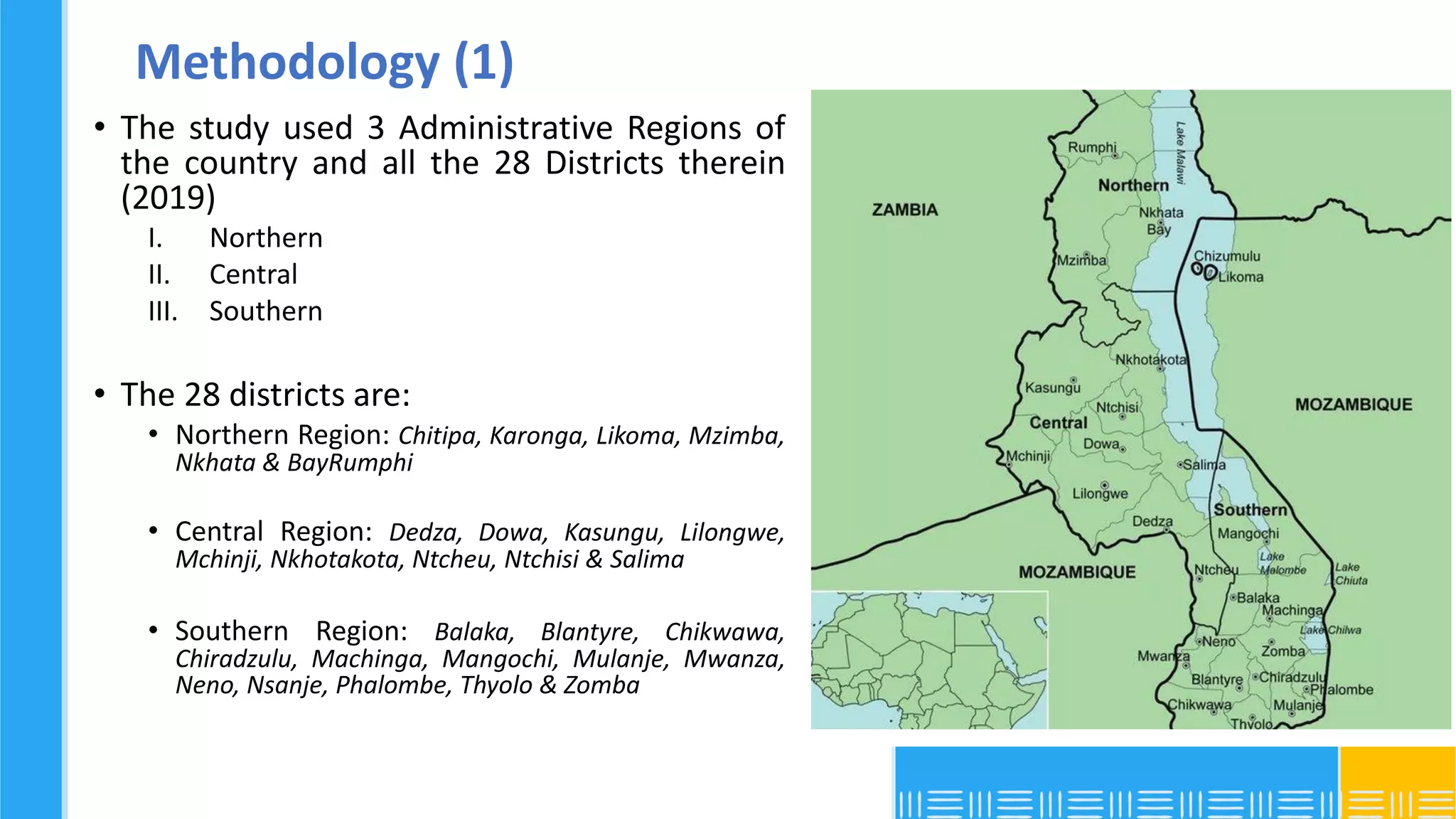
• The study used 3 Administrative Regions of
the country and all the 28 Districts therein
(2019)
I. Northern
II. Central
III. Southern
• The 28 districts are:
• Northern Region: Chitipa, Karonga, Likoma, Mzimba,
Nkhata & BayRumphi
• Central Region: Dedza, Dowa, Kasungu, Lilongwe,
Mchinji, Nkhotakota, Ntcheu, Ntchisi & Salima
• Southern Region: Balaka, Blantyre, Chikwawa,
Chiradzulu, Machinga, Mangochi, Mulanje, Mwanza,
Neno, Nsanje, Phalombe, Thyolo & Zomba
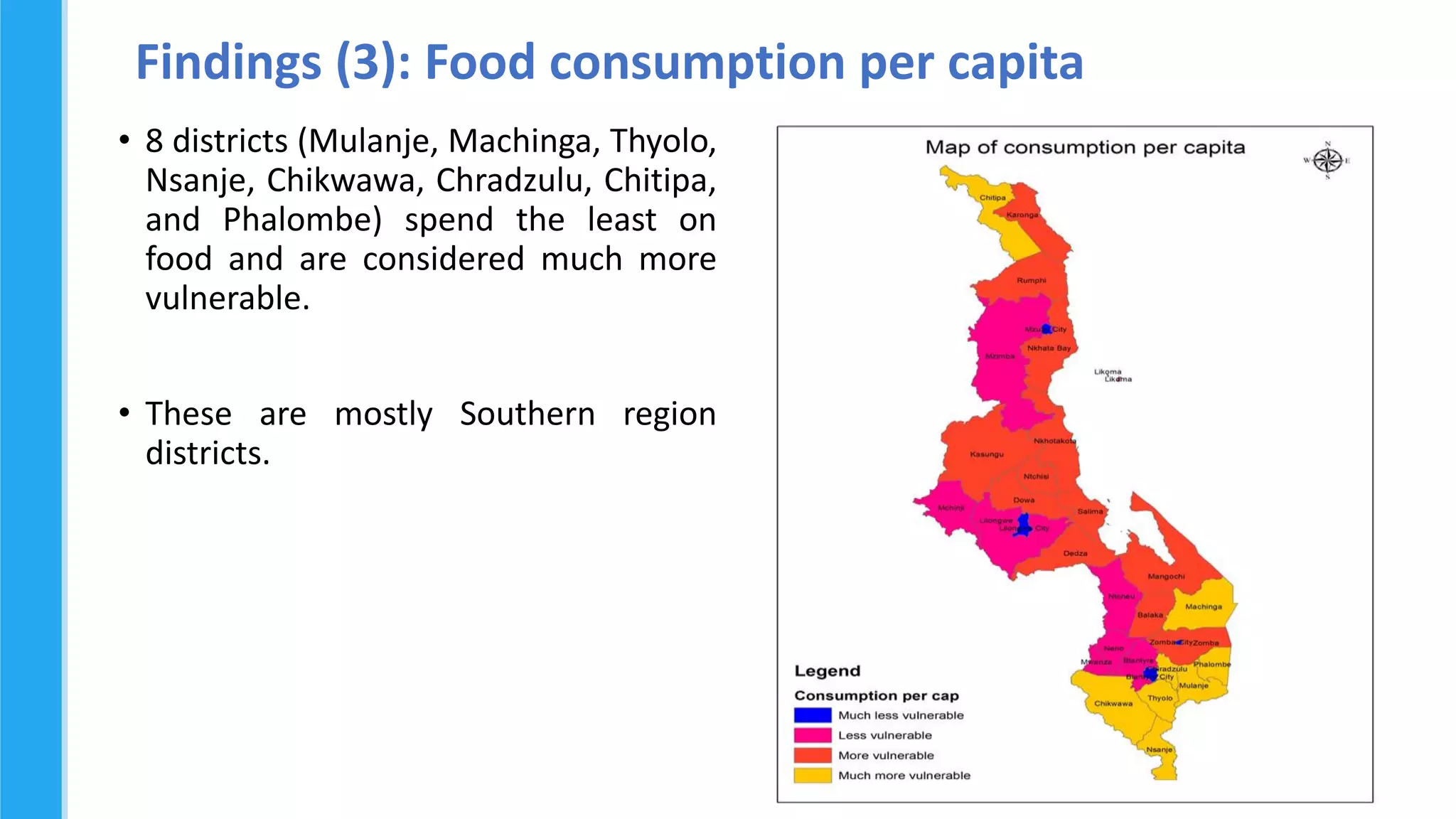
Methodology (2)
Various data sources were considered:
Variable Description DATA SOURCE
hfa2 Height-for-age (Prevalence of stunting)
Demographic and Health Survey
(DHS) 2017
Wfa2 Weight-for-age (Prevalence of Underweight) (DHS) 2017
Wfh2 Wight-for-height (Prevalence of wasting) (DHS) 2017
diab Prevalence of diabetes (DHS) 2017
bloodp Prevalence of high blood pressure (DHS) 2017
Assis_pp
Proportion of females (15-49) getting assistance from doctor,
nurse/midwife, (DHS) 2017
medhelp_disthf
Proportion of females (15-49) for whom distance to health facility
is a big problem (DHS) 2017
pcfood Food expenditure per capita Malawi Housing Census (2018)
density_pop_sup Density of inhabited areas (estimated through remote sensing) Malawi Housing Census (2018)
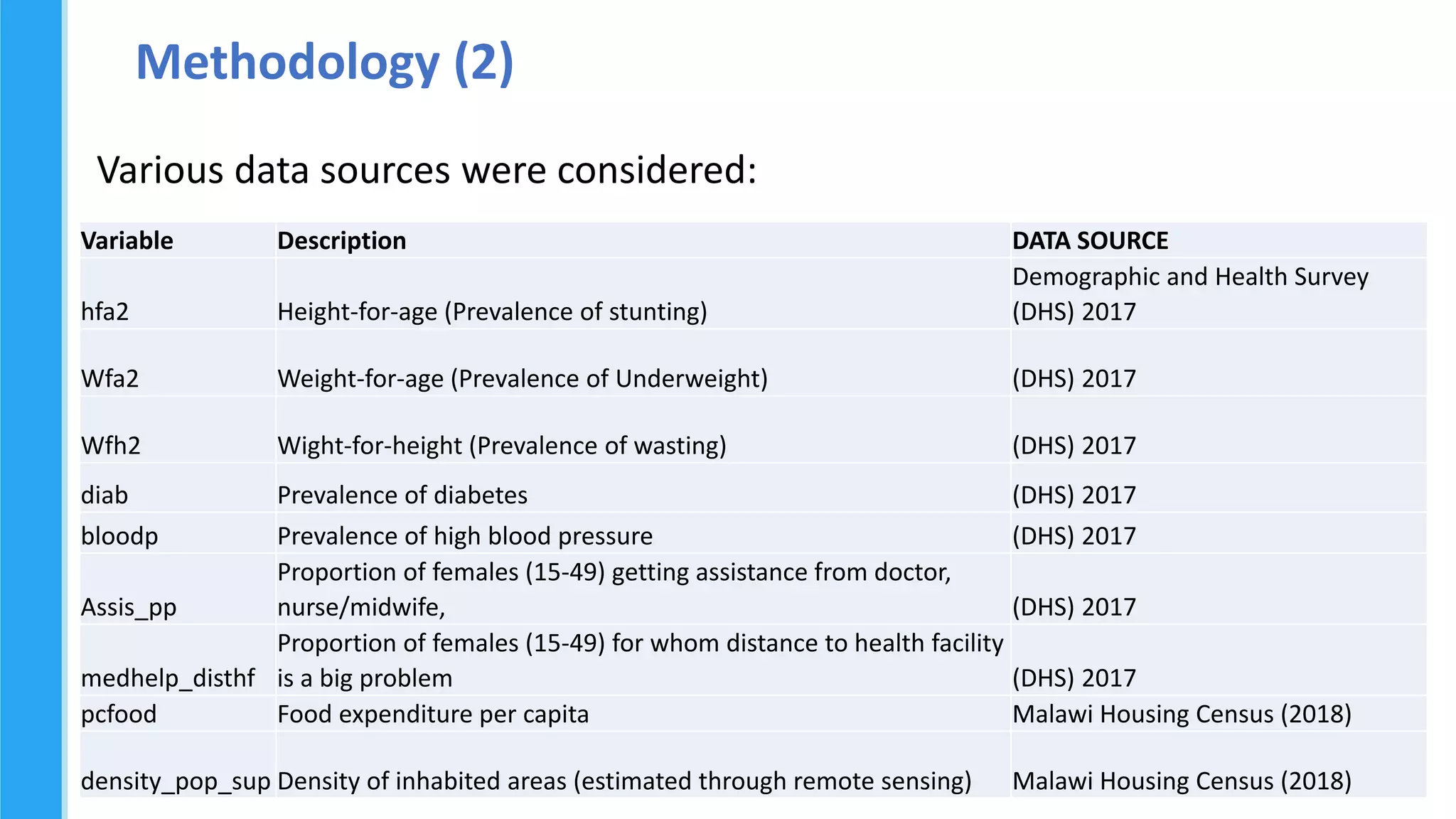
Findings (1): Country vulnerability index
• The composite vulnerability index
suggests that chronic vulnerability is
highest in the Southern Region and
lowest in the Northern Region.
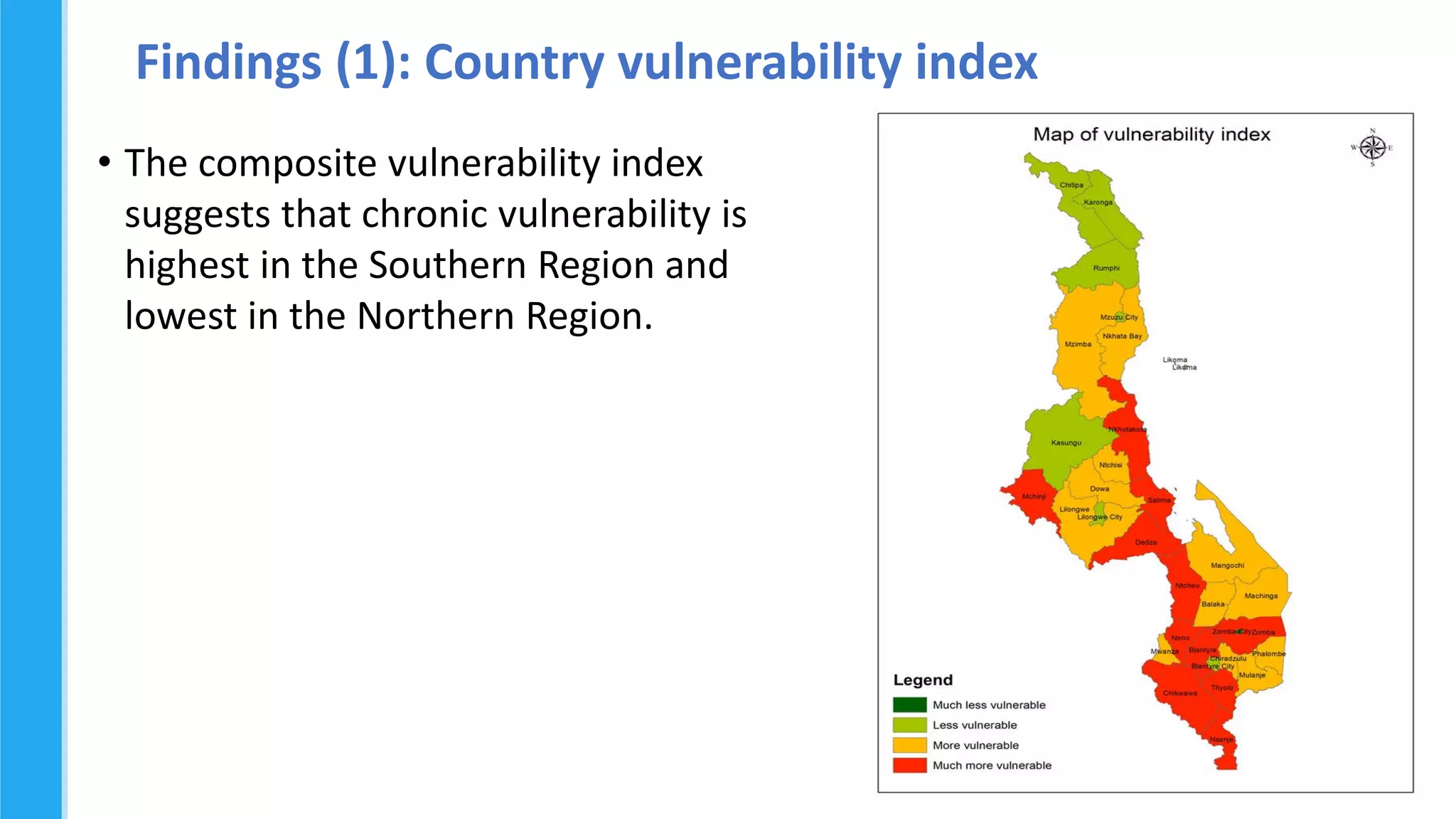
Findings (2): Stunting
• The prevalence of stunting is highest in 9
districts (Dedza, Neno, Mchinji, Zomba
Rural, Ntcheu, Mangochi, Mzimba,
Lilongwe Rural and Ntchisi).
• 6 districts (Likoma, Blantyre City, Karonga,
Zomba City, Lilongwe City, and Mzuzu City)
have lower proportions of stunting and are
hence considered much less vulnerable
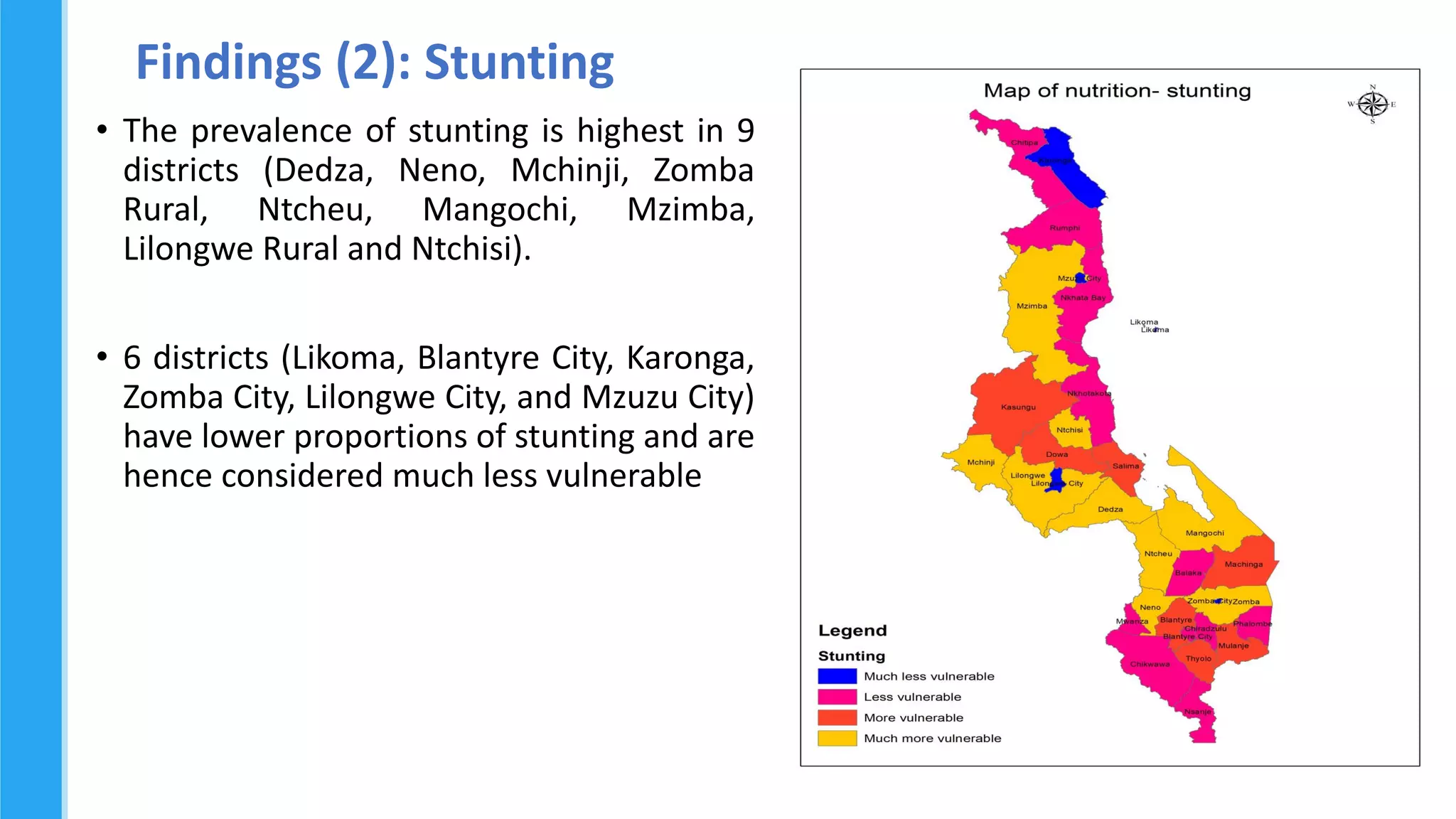
Findings (3): Food consumption per capita
• 8 districts (Mulanje, Machinga, Thyolo,
Nsanje, Chikwawa, Chradzulu, Chitipa,
and Phalombe) spend the least on
food and are considered much more
vulnerable.
• These are mostly Southern region
districts.
Findings (4): Access to health services
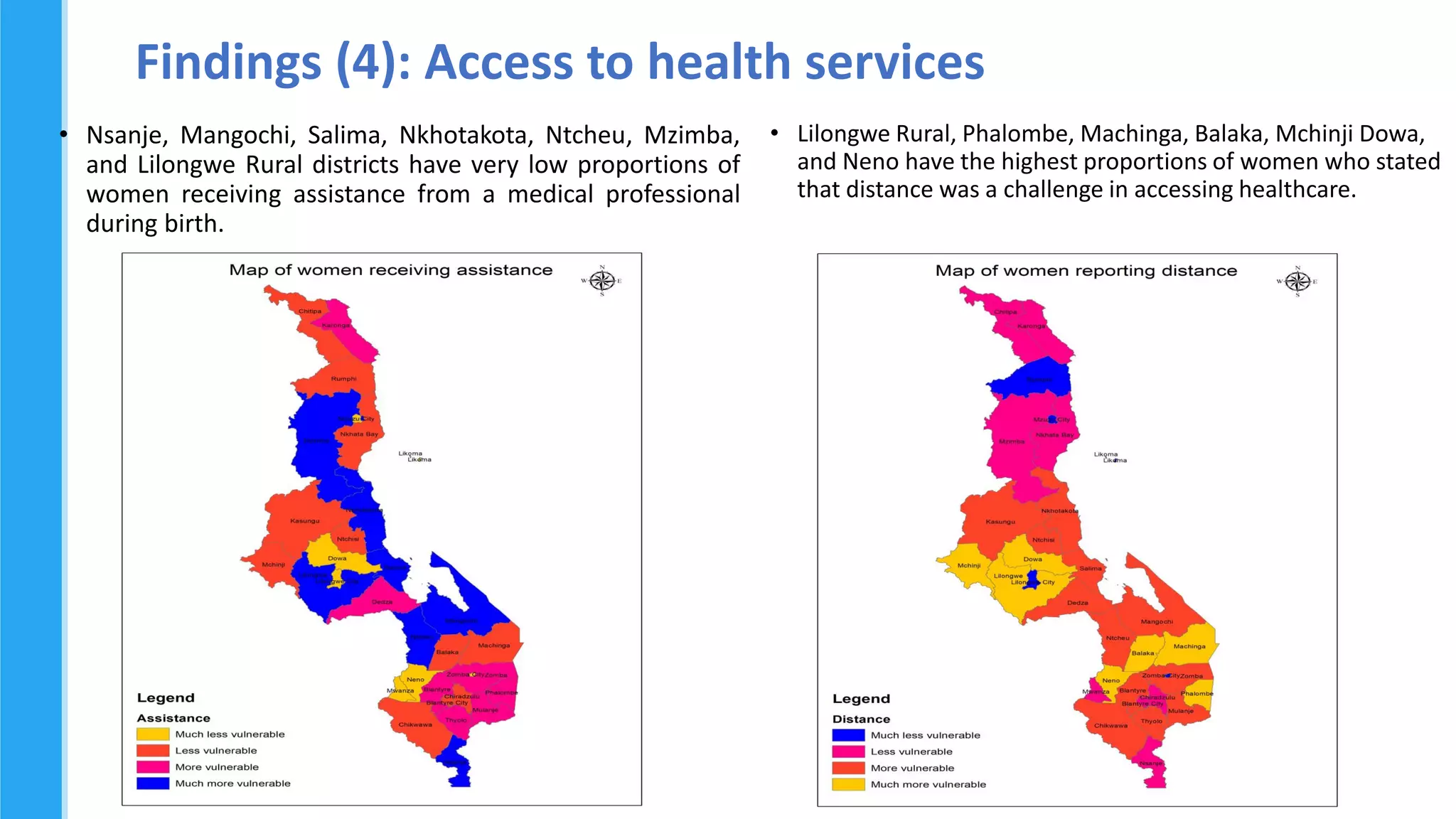
• Nsanje, Mangochi, Salima, Nkhotakota, Ntcheu, Mzimba,
and Lilongwe Rural districts have very low proportions of
women receiving assistance from a medical professional
during birth.
• Lilongwe Rural, Phalombe, Machinga, Balaka, Mchinji Dowa,
and Neno have the highest proportions of women who stated
that distance was a challenge in accessing healthcare.
Findings (5): Disease Burden
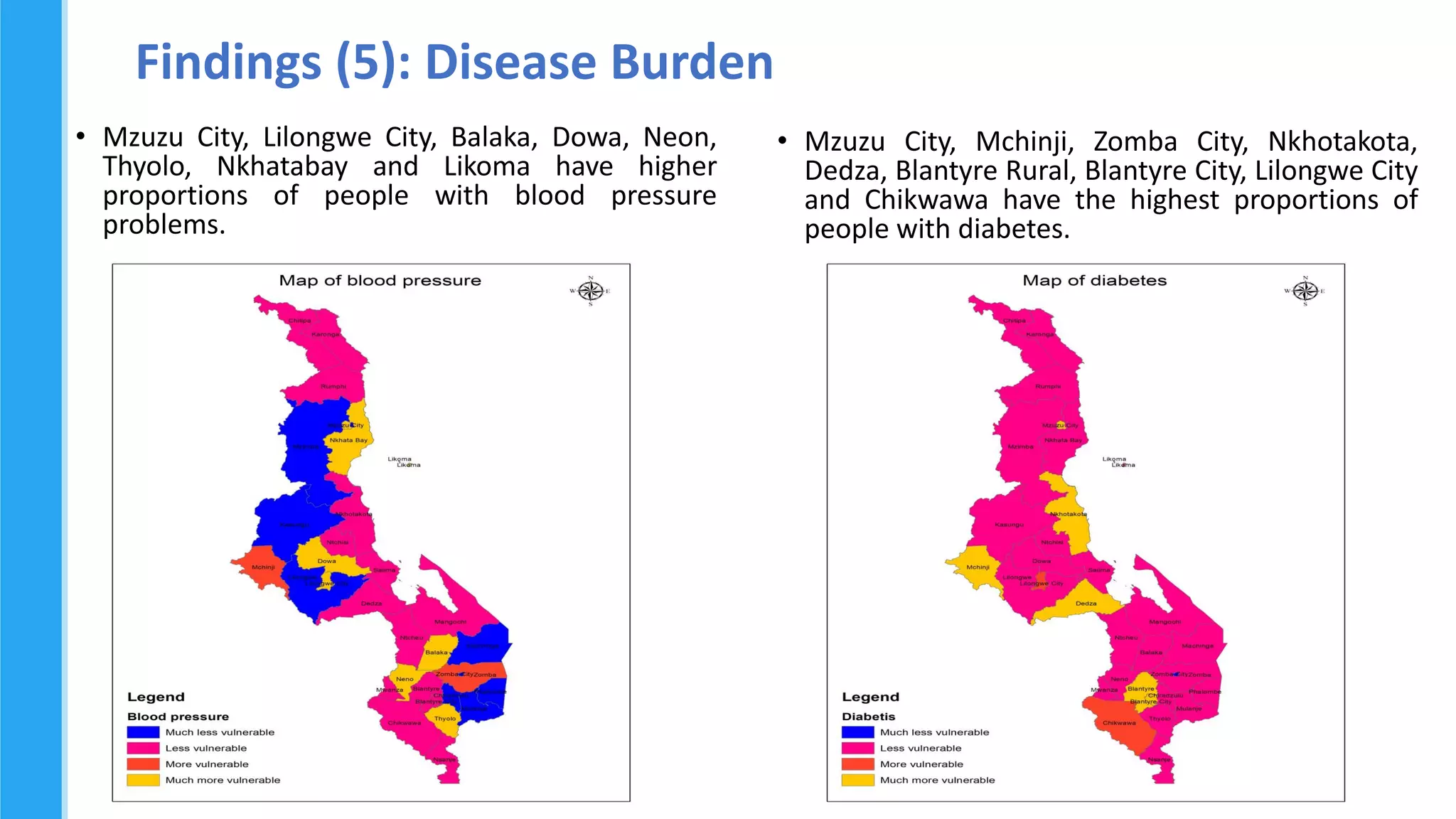
• Mzuzu City, Lilongwe City, Balaka, Dowa, Neon,
Thyolo, Nkhatabay and Likoma have higher
proportions of people with blood pressure
problems.
• Mzuzu City, Mchinji, Zomba City, Nkhotakota,
Dedza, Blantyre Rural, Blantyre City, Lilongwe City
and Chikwawa have the highest proportions of
people with diabetes.
Findings (6): Population density
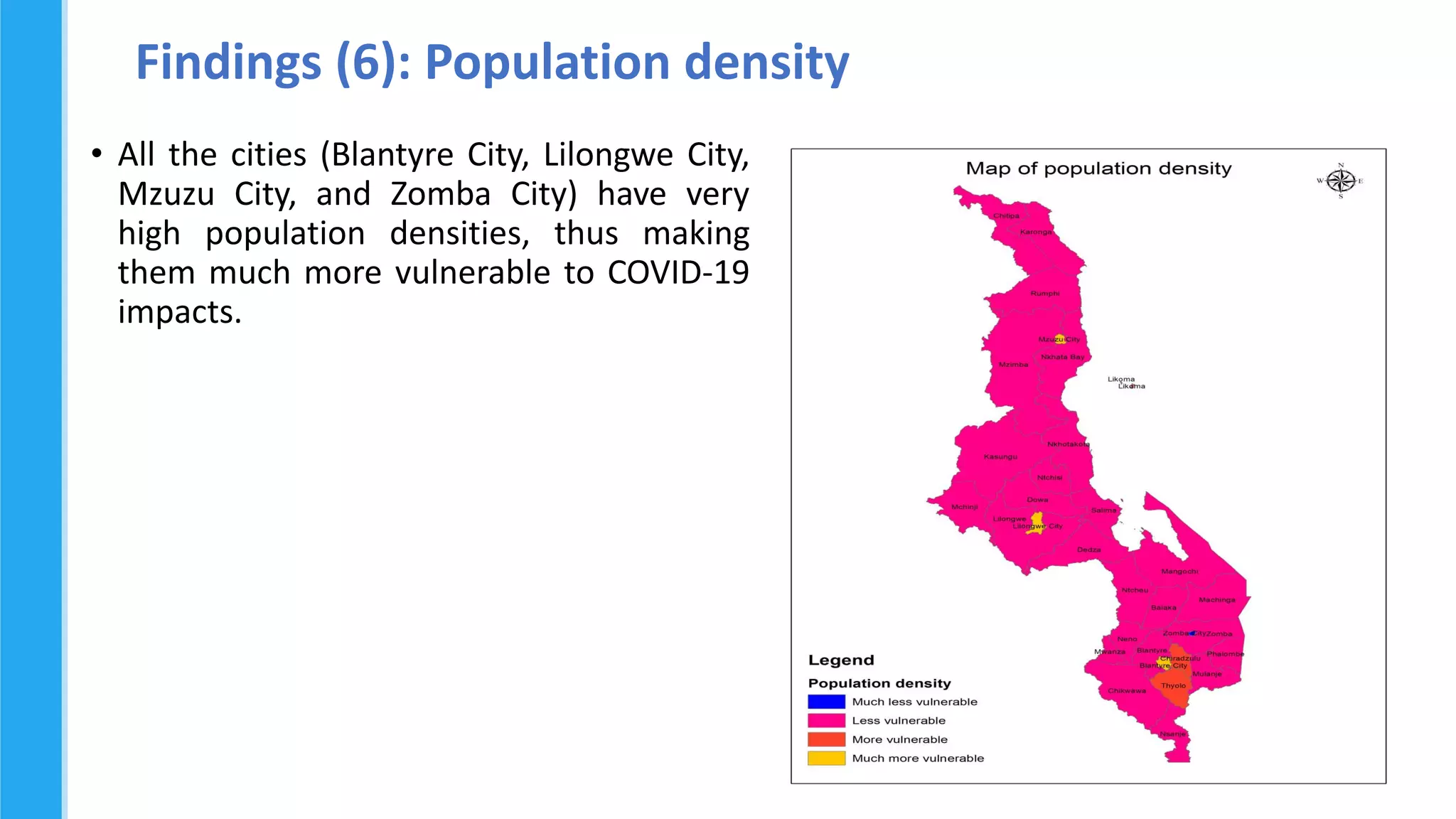
• All the cities (Blantyre City, Lilongwe City,
Mzuzu City, and Zomba City) have very
high population densities, thus making
them much more vulnerable to COVID-19
impacts.
II. Effects of Covid-19 on micronutrient demand
• Covid-19-related price changes affect nutrition through
their impacts on demand for key micronutrients.
• We estimate micronutrient price elasticities and apply
them to actual 2020 price changes to predict impacts on
micronutrient demand.
Price changes in April-November 2020
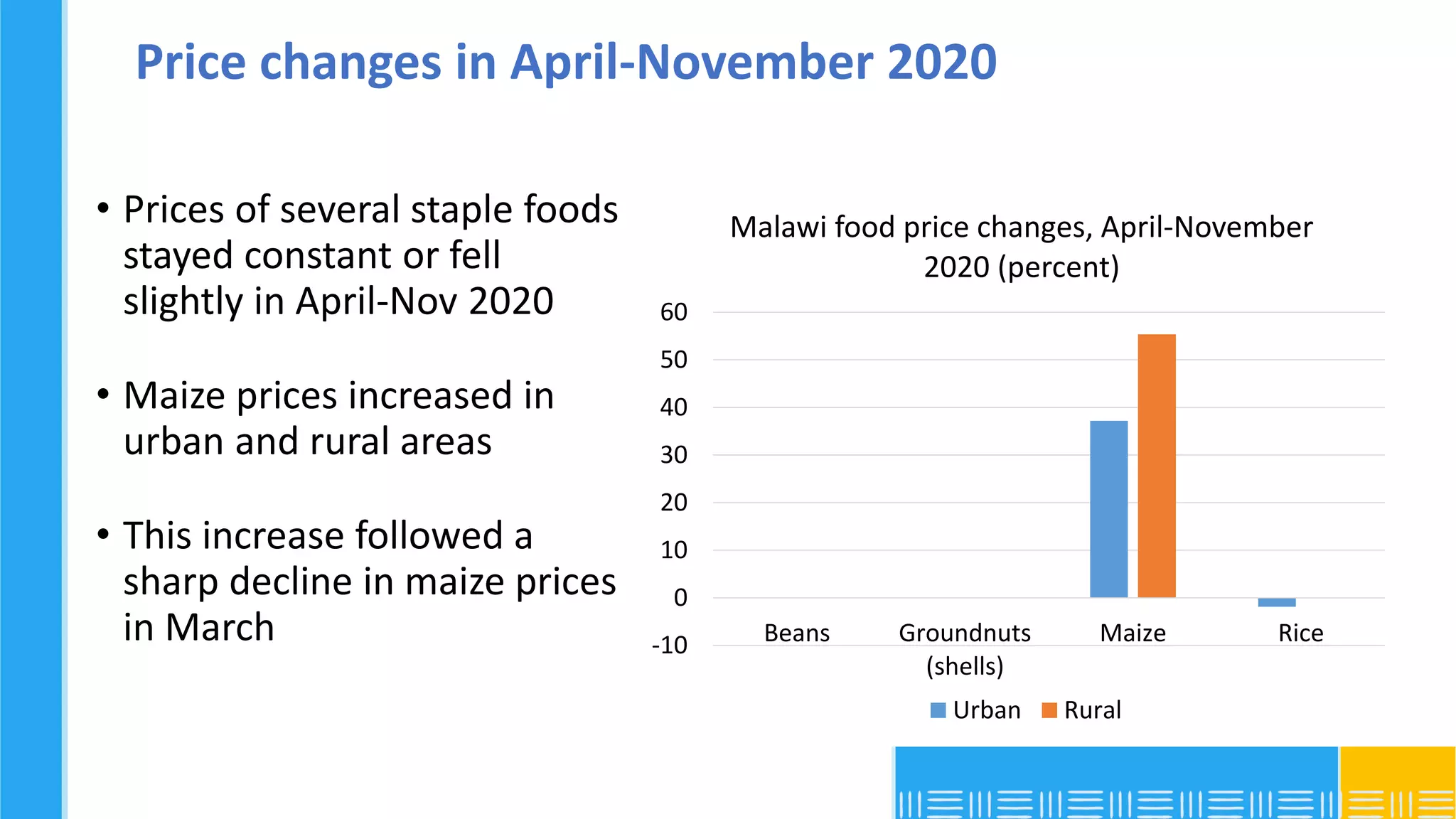
• Prices of several staple foods
stayed constant or fell
slightly in April-Nov 2020
• Maize prices increased in
urban and rural areas
• This increase followed a
sharp decline in maize prices
in March -10
0
10
20
30
40
50
60
Beans Groundnuts
(shells)
Maize Rice
Malawi food price changes, April-November
2020 (percent)
Urban Rural
Existing micronutrient deficiencies
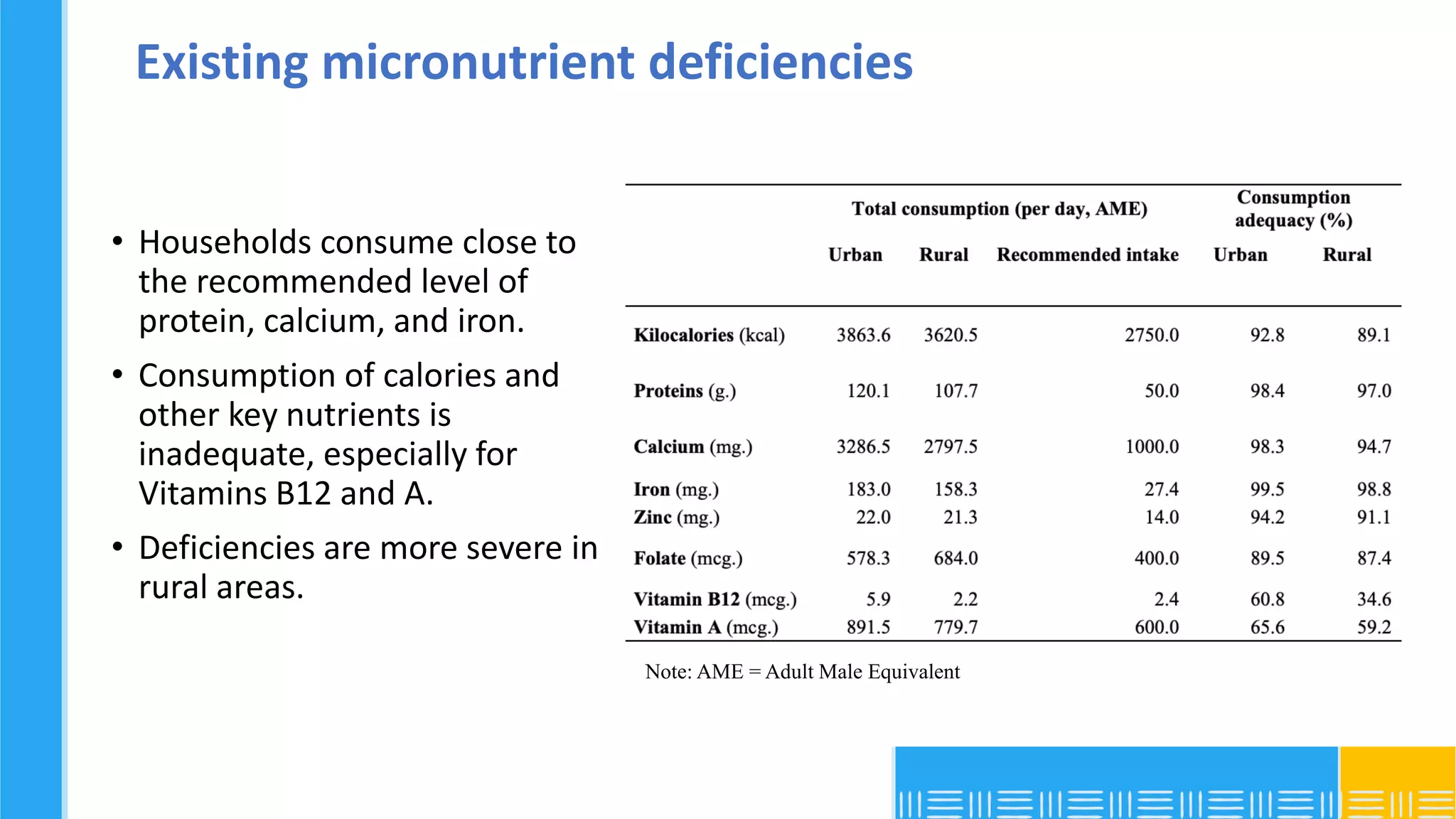
• Households consume close to
the recommended level of
protein, calcium, and iron.
• Consumption of calories and
other key nutrients is
inadequate, especially for
Vitamins B12 and A.
• Deficiencies are more severe in
rural areas.
Note: AME = Adult Male Equivalent
Price elasticities of calories and micronutrients
-0,80
-0,60
-0,40
-0,20
0,00
0,20
Calories Protein Calcium Iron Zinc Folate Vitamin B12 Vitamin A
Rural
Cereals & Products Roots, Tubers, and Plantains Nuts and Pulses Vegetables
Meat, Fish & products Fruits Milk and Products Cooked Foods from Vendors
Sugar & sweet Oils and Fats Beverages Spices & Miscellaneous
-0,80
-0,60
-0,40
-0,20
0,00
0,20
0,40
Calories Protein Calcium Iron Zinc Folate Vitamin B12 Vitamin A
Urban
Cereals & Products Roots, Tubers, and Plantains Nuts and Pulses Vegetables
Meat, Fish & products Fruits Milk and Products Cooked Foods from Vendors
Sugar & sweet Oils and Fats Beverages Spices & Miscellaneous
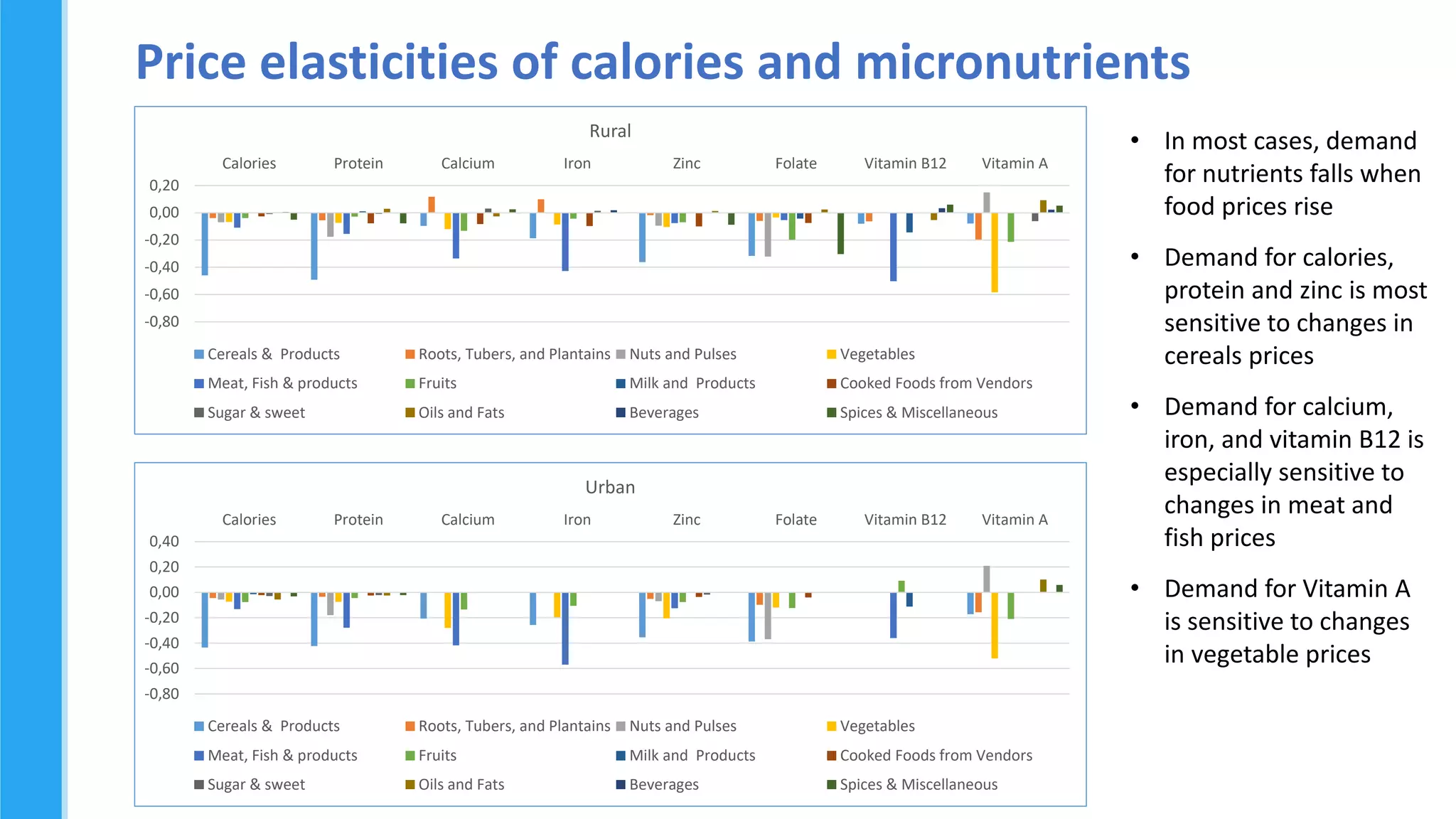
• In most cases, demand
for nutrients falls when
food prices rise
• Demand for calories,
protein and zinc is most
sensitive to changes in
cereals prices
• Demand for calcium,
iron, and vitamin B12 is
especially sensitive to
changes in meat and
fish prices
• Demand for Vitamin A
is sensitive to changes
in vegetable prices
Impact of 2020 food price changes on nutrient demand
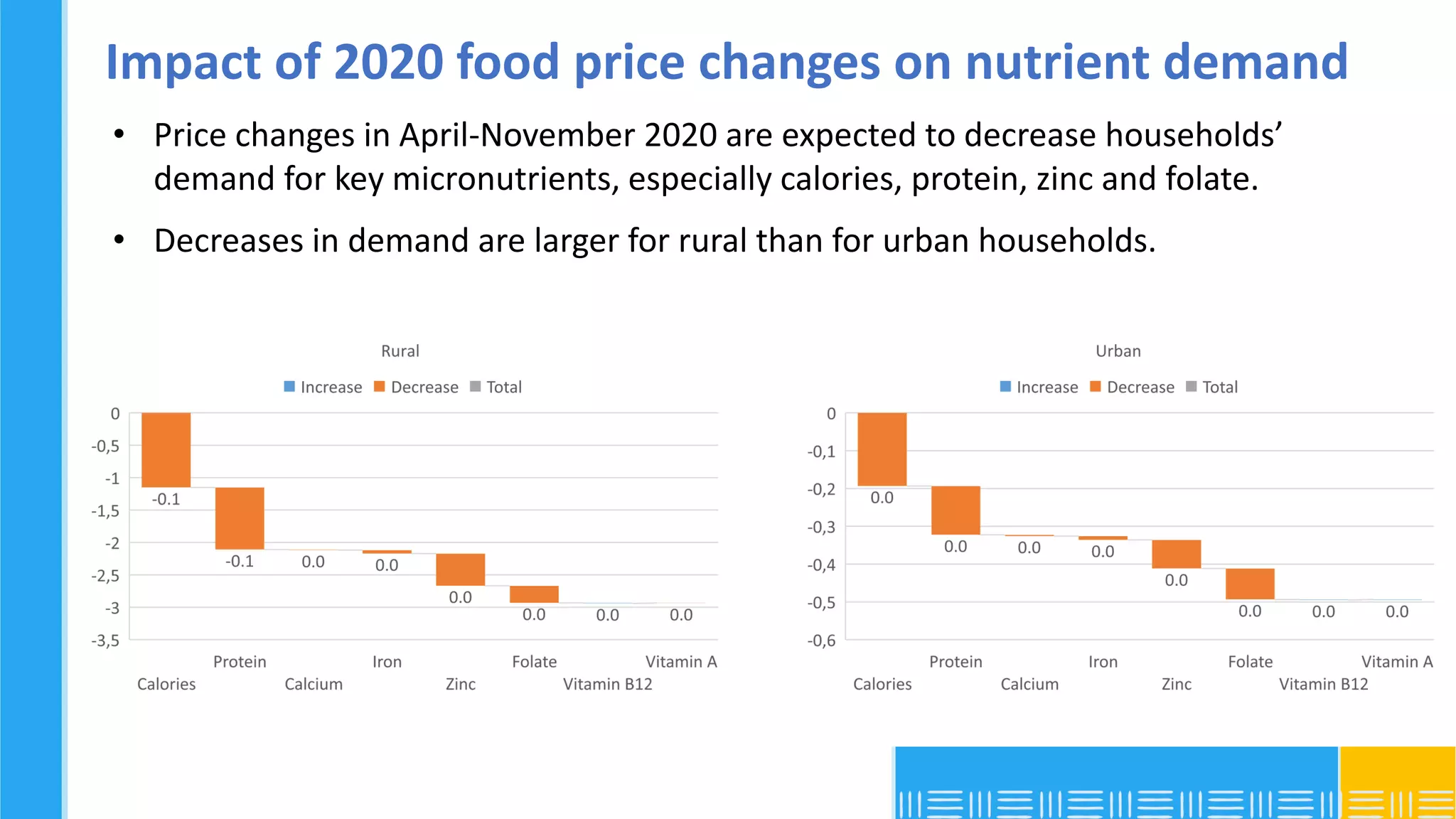
• Price changes in April-November 2020 are expected to decrease households’
demand for key micronutrients, especially calories, protein, zinc and folate.
• Decreases in demand are larger for rural than for urban households.
Key Messages
• The impacts of crises are especially severe in areas where chronic
vulnerability is high.
• Understanding patterns of vulnerability is thus of major importance
to guide strategies to prepare for and respond to crises.
• Our goal is to identify areas which, if affected by Covid, would have
the least capacity to absorb shocks and would face the most serious
consequences.
18
Key Messages (continued)
• We construct an indicator to measure the level of vulnerability to
serious food security consequences of Covid-19.
• Three components: Susceptibility to the spread of the disease,
inability to care for infected people, and existing food and
nutrition insecurity.
• We identify areas of particular concern where governments should
focus crisis monitoring and mitigation efforts.
19
Key Messages (continued)
• Changes in price during 2020 modestly affected consumption of key
micronutrients, including calories, protein, zinc and folate.
• Even small changes could exacerbate existing micronutrient
deficiencies.
• Effects were larger in rural areas, which also suffer from greater
existing micronutrient deficiencies.
20
THANK YOU
• AKADEMIYA2063 – Kicukiro / Niboye KK 360 St 8 I P.O. Box 4729 Kigali-Rwanda

Malawi Learning Event - Assessing Community vulnerability to COVID-19 - April, 28, 2021

  • 1.
    Assessing Community Vulnerability toCOVID-19 in Malawi: A Spatial Outlook Dr. John Ulimwengu, Africawide ReSAKSS Coordinator With analysis by Dr. Greenwell Matchaya, Sibusiso Nhlengethwa, Léa Magne Domgho April 28, 2021
  • 2.
    Outline I. Community vulnerabilityanalysis • Introduction • Methodology • Findings • Conclusion • Implications II. Effects of Covid-19 on micronutrient demand
  • 3.
    I. Community vulnerabilityanalysis Introduction (1) • The impacts of crises are especially severe in areas where chronic vulnerability is high. • Understanding patterns of vulnerability is thus of major importance to guide strategies to prepare for and respond to crises. • Our goal is to identify areas which, if affected by Covid, would have the least capacity to absorb shocks and would face the most serious consequences. 3
  • 4.
    Introduction (2) • Thisstudy focuses on differentiated spatial vulnerability in Malawi using an overlay of indicators: • Susceptibility to the spread of the disease: Population density; disease burden • Inability to care for infected people: Health infrastructure • Existing food and nutrition insecurity: Child undernutrition, food consumption • Due to limited resources, the most vulnerable communities should be prioritized in crisis prevention and mitigation efforts.
  • 5.
    Methodology (1) • Thestudy used 3 Administrative Regions of the country and all the 28 Districts therein (2019) I. Northern II. Central III. Southern • The 28 districts are: • Northern Region: Chitipa, Karonga, Likoma, Mzimba, Nkhata & BayRumphi • Central Region: Dedza, Dowa, Kasungu, Lilongwe, Mchinji, Nkhotakota, Ntcheu, Ntchisi & Salima • Southern Region: Balaka, Blantyre, Chikwawa, Chiradzulu, Machinga, Mangochi, Mulanje, Mwanza, Neno, Nsanje, Phalombe, Thyolo & Zomba
  • 6.
    Methodology (2) Various datasources were considered: Variable Description DATA SOURCE hfa2 Height-for-age (Prevalence of stunting) Demographic and Health Survey (DHS) 2017 Wfa2 Weight-for-age (Prevalence of Underweight) (DHS) 2017 Wfh2 Wight-for-height (Prevalence of wasting) (DHS) 2017 diab Prevalence of diabetes (DHS) 2017 bloodp Prevalence of high blood pressure (DHS) 2017 Assis_pp Proportion of females (15-49) getting assistance from doctor, nurse/midwife, (DHS) 2017 medhelp_disthf Proportion of females (15-49) for whom distance to health facility is a big problem (DHS) 2017 pcfood Food expenditure per capita Malawi Housing Census (2018) density_pop_sup Density of inhabited areas (estimated through remote sensing) Malawi Housing Census (2018)
  • 7.
    Findings (1): Countryvulnerability index • The composite vulnerability index suggests that chronic vulnerability is highest in the Southern Region and lowest in the Northern Region.
  • 8.
    Findings (2): Stunting •The prevalence of stunting is highest in 9 districts (Dedza, Neno, Mchinji, Zomba Rural, Ntcheu, Mangochi, Mzimba, Lilongwe Rural and Ntchisi). • 6 districts (Likoma, Blantyre City, Karonga, Zomba City, Lilongwe City, and Mzuzu City) have lower proportions of stunting and are hence considered much less vulnerable
  • 9.
    Findings (3): Foodconsumption per capita • 8 districts (Mulanje, Machinga, Thyolo, Nsanje, Chikwawa, Chradzulu, Chitipa, and Phalombe) spend the least on food and are considered much more vulnerable. • These are mostly Southern region districts.
  • 10.
    Findings (4): Accessto health services • Nsanje, Mangochi, Salima, Nkhotakota, Ntcheu, Mzimba, and Lilongwe Rural districts have very low proportions of women receiving assistance from a medical professional during birth. • Lilongwe Rural, Phalombe, Machinga, Balaka, Mchinji Dowa, and Neno have the highest proportions of women who stated that distance was a challenge in accessing healthcare.
  • 11.
    Findings (5): DiseaseBurden • Mzuzu City, Lilongwe City, Balaka, Dowa, Neon, Thyolo, Nkhatabay and Likoma have higher proportions of people with blood pressure problems. • Mzuzu City, Mchinji, Zomba City, Nkhotakota, Dedza, Blantyre Rural, Blantyre City, Lilongwe City and Chikwawa have the highest proportions of people with diabetes.
  • 12.
    Findings (6): Populationdensity • All the cities (Blantyre City, Lilongwe City, Mzuzu City, and Zomba City) have very high population densities, thus making them much more vulnerable to COVID-19 impacts.
  • 13.
    II. Effects ofCovid-19 on micronutrient demand • Covid-19-related price changes affect nutrition through their impacts on demand for key micronutrients. • We estimate micronutrient price elasticities and apply them to actual 2020 price changes to predict impacts on micronutrient demand.
  • 14.
    Price changes inApril-November 2020 • Prices of several staple foods stayed constant or fell slightly in April-Nov 2020 • Maize prices increased in urban and rural areas • This increase followed a sharp decline in maize prices in March -10 0 10 20 30 40 50 60 Beans Groundnuts (shells) Maize Rice Malawi food price changes, April-November 2020 (percent) Urban Rural
  • 15.
    Existing micronutrient deficiencies •Households consume close to the recommended level of protein, calcium, and iron. • Consumption of calories and other key nutrients is inadequate, especially for Vitamins B12 and A. • Deficiencies are more severe in rural areas. Note: AME = Adult Male Equivalent
  • 16.
    Price elasticities ofcalories and micronutrients -0,80 -0,60 -0,40 -0,20 0,00 0,20 Calories Protein Calcium Iron Zinc Folate Vitamin B12 Vitamin A Rural Cereals & Products Roots, Tubers, and Plantains Nuts and Pulses Vegetables Meat, Fish & products Fruits Milk and Products Cooked Foods from Vendors Sugar & sweet Oils and Fats Beverages Spices & Miscellaneous -0,80 -0,60 -0,40 -0,20 0,00 0,20 0,40 Calories Protein Calcium Iron Zinc Folate Vitamin B12 Vitamin A Urban Cereals & Products Roots, Tubers, and Plantains Nuts and Pulses Vegetables Meat, Fish & products Fruits Milk and Products Cooked Foods from Vendors Sugar & sweet Oils and Fats Beverages Spices & Miscellaneous • In most cases, demand for nutrients falls when food prices rise • Demand for calories, protein and zinc is most sensitive to changes in cereals prices • Demand for calcium, iron, and vitamin B12 is especially sensitive to changes in meat and fish prices • Demand for Vitamin A is sensitive to changes in vegetable prices
  • 17.
    Impact of 2020food price changes on nutrient demand • Price changes in April-November 2020 are expected to decrease households’ demand for key micronutrients, especially calories, protein, zinc and folate. • Decreases in demand are larger for rural than for urban households.
  • 18.
    Key Messages • Theimpacts of crises are especially severe in areas where chronic vulnerability is high. • Understanding patterns of vulnerability is thus of major importance to guide strategies to prepare for and respond to crises. • Our goal is to identify areas which, if affected by Covid, would have the least capacity to absorb shocks and would face the most serious consequences. 18
  • 19.
    Key Messages (continued) •We construct an indicator to measure the level of vulnerability to serious food security consequences of Covid-19. • Three components: Susceptibility to the spread of the disease, inability to care for infected people, and existing food and nutrition insecurity. • We identify areas of particular concern where governments should focus crisis monitoring and mitigation efforts. 19
  • 20.
    Key Messages (continued) •Changes in price during 2020 modestly affected consumption of key micronutrients, including calories, protein, zinc and folate. • Even small changes could exacerbate existing micronutrient deficiencies. • Effects were larger in rural areas, which also suffer from greater existing micronutrient deficiencies. 20
  • 21.
    THANK YOU • AKADEMIYA2063– Kicukiro / Niboye KK 360 St 8 I P.O. Box 4729 Kigali-Rwanda