1
Results-Based Management (RBM):
Logical Framework Approach (LFA)
for the project idea development
Anne-Marie Tuomala, MUAS Energy and Environmental Technology
RBM and Logical Framework
Approach (LFA)
The LFA is an RBM tool used for systematic
planning, implementing, monitoring, and
evaluating projects/programs.
It is applicable in different levels: from local/micro
project level to the large global development
programs
2
Anne-Marie Tuomala, MUAS Energy and Environmental Technology
Logical framework 3
Anne-Marie Tuomala, MUAS Energy and Environmental Technology
The Logical Framework Approach (i)
4
Features of LFA :
• stakeholder involvement
• needs-based approach
• logical intervention approach
• framework for assessing relevance,
feasibility and sustainability
Anne-Marie Tuomala, MUAS Energy and Environmental Technology
5
The Logical Framework Approach
(ii)
Features of LFA :
• results-oriented – not activity driven
• logically sets objectives and their causal
relationships
• shows whether objectives have been
achieved: Indicators
• describes external factors that influence
the project’s success: assumptions and risks
Anne-Marie Tuomala, MUAS Energy and Environmental Technology
6
Main steps:
• Stakeholder Analysis
• SWOT Analysis
• Problem Tree Analysis
• Objective Tree Analysis
• Logical Framework Matrix
• Monitoring and evaluation
LFA Key Features
Anne-Marie Tuomala, MUAS Energy and Environmental Technology
7
The Logframe Matrix
• The main output of the LFA is the logframe
matrix.
• The Logical Framework Matrix is used to present
information about project objectives, outputs
and activities in a systematic and logical way.
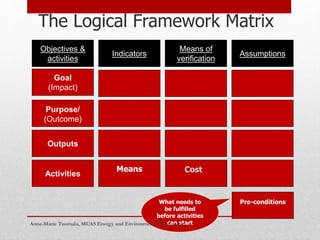
• The basic Logframe matrix contains 16 cells
organized into 4 columns and 4 rows, as
indicated in the next slide:
Anne-Marie Tuomala, MUAS Energy and Environmental Technology
8
The Logical Framework Matrix
Objectives &
activities
Purpose/
(Outcome)
Goal
(Impact)
Outputs
Activities
Means
Indicators
Means of
verification
Assumptions
What needs to
be fulfilled
before activities
can start
Pre-conditions
Cost
Anne-Marie Tuomala, MUAS Energy and Environmental Technology
STAKEHOLDER ANALYSIS
Anne-Marie Tuomala, MUAS Energy and Environmental Technology
9
STAKEHOLDER ANALYSIS
Stakeholder is any individuals, group or organization,
community, with an interest in the outcome of a
programme/project.
10
Anne-Marie Tuomala, MUAS Energy and Environmental Technology
Stakeholder Analysis
Purpose:
To identify
• The needs and interest of stakeholders
• The organizations, groups that should be
encouraged to participate in different stages
of the project;
• Potential risks that could put at risk
programme;
• Opportunities in implementing a programme;
11
Anne-Marie Tuomala, MUAS Energy and Environmental Technology
SWOT ANALYSIS 12
Anne-Marie Tuomala, MUAS Energy and Environmental Technology
SWOT Analysis (i)
Purpose:
• To assess the performance and capacity of the
participating units, divisions of organization.
• Each participating unit has to undertake SWOT
analysis.
13
Anne-Marie Tuomala, MUAS Energy and Environmental Technology
SWOT Analysis (ii)
• SWOT analysis is a tool for institutional
appraisal and a brainstorming exercise in which
the representatives of the organization
participate fully.
14
Anne-Marie Tuomala, MUAS Energy and Environmental Technology
15
SWOT Analysis (iii)
SWOT stands for:
• Strengths - the positive internal attributes of the
organisation
• Weaknesses - the negative internal attributes of the
organisation
• Opportunities - external factors which could
improve the organisation’s prospects
• Threats - external factors which could undermine the
organisation’s prospects
Anne-Marie Tuomala, MUAS Energy and Environmental Technology
PROBLEM TREE ANALYSIS 16
Anne-Marie Tuomala, MUAS Energy and Environmental Technology
17
Purpose:
- to identify major problems and their main
causal relationships.
Output:
problem tree with cause and effects
Problem Tree Analysis
Anne-Marie Tuomala, MUAS Energy and Environmental Technology
Steps in Undertaking Problem Tree
1. Identify the major problems that the project will
address. State problems in negative manner.
2. Group problems by similarity of concerns.
3. Develop the problem tree:
a) Select a focal problem from the list and relate
other problems to the focal problem.
b) If the problem is a cause of the focal problem it is
placed below the focal problem
c) If the problem is an effect of the focal problem is
goes above
18
Anne-Marie Tuomala, MUAS Energy and Environmental Technology
19
Problem Tree Scheme
CAUSE
EFFECT
Anne-Marie Tuomala, MUAS Energy and Environmental Technology
OBJECTIVE TREE 20
Anne-Marie Tuomala, MUAS Energy and Environmental Technology
Analysis of Objectives
• Transforming the problem tree into an
objectives tree by restating the problems as
objectives.
• Problem statement converted in to positive
statements
• Top of the tree is the end that is desired
• Lower levels are the means to achieving the
end.
21
Anne-Marie Tuomala, MUAS Energy and Environmental Technology
22
Objectives Tree
Ends
Means
*
Anne-Marie Tuomala, MUAS Energy and Environmental Technology
The relationship between the problems
tree and the objective tree
PROBLEM TREE OBJECTIVE TREE
• Focal problem Project Purpose
• Effects Overall Objectives
• Causes Results
23
Anne-Marie Tuomala, MUAS Energy and Environmental Technology
STRATEGY ANALYSIS 24
Anne-Marie Tuomala, MUAS Energy and Environmental Technology
Strategy Analysis (i)
• The aim of strategy analysis is division of the
objectives tree into more consistent smaller sub-
units that may, compose the core for a project.
• Each of the sub-units of the objective tree can
represent an alternative strategy for the future
project.
• The project objectives set the framework for the
strategy of the project.
25
Anne-Marie Tuomala, MUAS Energy and Environmental Technology
Strategy Analysis (ii)
Criteria for selection of the project strategy:
1. RELEVANCE: the strategy corresponds to the needs of
the stakeholders.
2. EFFECTIVENESS: the lower level objectives of the
strategy will contribute to achievement of the project
purpose
3. EFFICIENCY: cost-effectiveness of the strategy in
transforming the means into results.
4. CONSISTENT with development policies
5. SUSTAINABILITY of the project
6. ASSUMPTIONS and RISKS 26
Anne-Marie Tuomala, MUAS Energy and Environmental Technology
27
Assumptions (i)
• Describe necessary internal and external
conditions in order to ensure that the
activities will produce results
• Assumptions are risks, which can jeopardize
the success of the project
• Are worded positively, i.e. they describe
circumstances required to achieve certain
objectives
Anne-Marie Tuomala, MUAS Energy and Environmental Technology
28
Assumptions (ii)
• Should be relevant and probable
• If an assumption is not important or almost
certain: Do not include
• If an assumption is unlikely to occur: Killer
assumption – abandon project
Anne-Marie Tuomala, MUAS Energy and Environmental Technology
29
Assumptions (iii)
• Example of Assumptions for the Goal and
Purpose:
– Political – stability of NSO and
government staff
– Economic – sustainable economy
– Etc.
Anne-Marie Tuomala, MUAS Energy and Environmental Technology
30
Assumptions (iv)
• Example of Assumptions:
– Adequate funds materials.
– Skilled people – training needs.
– Approvals & contracts – legal,
administrative.
– Participation of stakeholders.
Anne-Marie Tuomala, MUAS Energy and Environmental Technology
31
The logical framework
Outcome
Impact
Outputs
Activities
Assumptions
Assumptions
Assumptions
Anne-Marie Tuomala, MUAS Energy and Environmental Technology
32
Indicators (i)
• Indicators measure to verify to what extant the
results are achieved.
• Specify how the achievement of an objective can
be verified or demonstrated
• Provide a basis for Monitoring and Evaluation
• 3 Dimensions of Indicators
– Quantity
– Quality
– Time
Anne-Marie Tuomala, MUAS Energy and Environmental Technology
33
Indicators (ii)
Anne-Marie Tuomala, MUAS Energy and Environmental Technology
Means of Verification
• Tools or means to obtain the information
required by the indicators
• Include:
• project documents
• field verification
• ad-hoc studies
34
Anne-Marie Tuomala, MUAS Energy and Environmental Technology
35
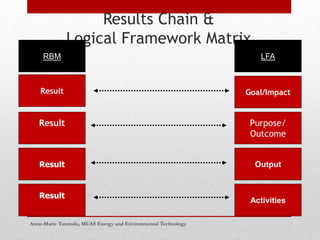
Results Chain &
Logical Framework Matrix
RBM
Result
Result
Result
Goal/Impact
Result
Purpose/
Outcome
Output
Activities
LFA
Anne-Marie Tuomala, MUAS Energy and Environmental Technology
MONITORING 36
Anne-Marie Tuomala, MUAS Energy and Environmental Technology
Monitoring and Evaluation
• Based on the logical framework
• Strengthens accountability and transparency
• Provides information for effective
management
• Helps determine what works well and what
requires improvement
• Builds knowledge
37
Anne-Marie Tuomala, MUAS Energy and Environmental Technology
38
Purpose of Monitoring and
Evaluation
It is the continuous process of collecting,
processing and assessing information about
the:
– Project implementation
– Project progress
– Project impact and effects
– Project environment
Anne-Marie Tuomala, MUAS Energy and Environmental Technology
39
Monitoring (i)
Continuous function that aims to provide
early indications of progress or lack thereof
in the achievement of results
Anne-Marie Tuomala, MUAS Energy and Environmental Technology
40
Monitoring (ii)
• Assumes the validity of the existing plan
• Takes place at project level
• Is the responsibility of the project
management
• Is based on the indicators defined in the
logical framework
Anne-Marie Tuomala, MUAS Energy and Environmental Technology
41
Monitoring Responsibility
• Project Management
– Activities
– Output indicators
– Early outcome indicators
• Project Target Group
– Outcome indicators
– Impact indicators
Anne-Marie Tuomala, MUAS Energy and Environmental Technology
EVALUATION 42
Anne-Marie Tuomala, MUAS Energy and Environmental Technology
43
Evaluation
• Time-bound exercise to assess the relevance,
performance and success of on-going or
completed projects
• Questions the validity of existing planning
• Is related to the impact of a project
• Opens the mind for strategic adjustments
Anne-Marie Tuomala, MUAS Energy and Environmental Technology
Evaluation plan frame 44
Anne-Marie Tuomala, MUAS Energy and Environmental Technology
45
Evaluation Quality Criteria
• Relevance (overall)
• Efficiency (activities, outputs)
• Effectiveness (outputs, outcome)
• Impact (outcome, impact)
• Sustainability (outcome, impact)
Anne-Marie Tuomala, MUAS Energy and Environmental Technology
TASK 2 START
PHASES (1)
1- List environmental protection problems which
you think to be related to the each other
2 -Select Fiscal (Main problem)
3 – Think the listed problems, which of them are
causes or effects of the fiscal problem…if any
4 – Develop your problem tree
Anne-Marie Tuomala, MUAS Energy and Environmental Technology
46
TASK 2 START
PHASES (2)
1- Turn your problem tree into objectives tree
2 – Start to develop Logical Framework Matrix
Your should return the task result in LF matrix
form into the Moodle drop box by 4.4.2013
You will tell the main points of your work to the
group on Friday 5.4.2013
Anne-Marie Tuomala, MUAS Energy and Environmental Technology
47

RBM and LFA

  • 1.
    1 Results-Based Management (RBM): LogicalFramework Approach (LFA) for the project idea development Anne-Marie Tuomala, MUAS Energy and Environmental Technology
  • 2.
    RBM and LogicalFramework Approach (LFA) The LFA is an RBM tool used for systematic planning, implementing, monitoring, and evaluating projects/programs. It is applicable in different levels: from local/micro project level to the large global development programs 2 Anne-Marie Tuomala, MUAS Energy and Environmental Technology
  • 3.
    Logical framework 3 Anne-MarieTuomala, MUAS Energy and Environmental Technology
  • 4.
    The Logical FrameworkApproach (i) 4 Features of LFA : • stakeholder involvement • needs-based approach • logical intervention approach • framework for assessing relevance, feasibility and sustainability Anne-Marie Tuomala, MUAS Energy and Environmental Technology
  • 5.
    5 The Logical FrameworkApproach (ii) Features of LFA : • results-oriented – not activity driven • logically sets objectives and their causal relationships • shows whether objectives have been achieved: Indicators • describes external factors that influence the project’s success: assumptions and risks Anne-Marie Tuomala, MUAS Energy and Environmental Technology
  • 6.
    6 Main steps: • StakeholderAnalysis • SWOT Analysis • Problem Tree Analysis • Objective Tree Analysis • Logical Framework Matrix • Monitoring and evaluation LFA Key Features Anne-Marie Tuomala, MUAS Energy and Environmental Technology
  • 7.
    7 The Logframe Matrix •The main output of the LFA is the logframe matrix. • The Logical Framework Matrix is used to present information about project objectives, outputs and activities in a systematic and logical way. • The basic Logframe matrix contains 16 cells organized into 4 columns and 4 rows, as indicated in the next slide: Anne-Marie Tuomala, MUAS Energy and Environmental Technology
  • 8.
    8 The Logical FrameworkMatrix Objectives & activities Purpose/ (Outcome) Goal (Impact) Outputs Activities Means Indicators Means of verification Assumptions What needs to be fulfilled before activities can start Pre-conditions Cost Anne-Marie Tuomala, MUAS Energy and Environmental Technology
  • 9.
    STAKEHOLDER ANALYSIS Anne-Marie Tuomala,MUAS Energy and Environmental Technology 9
  • 10.
    STAKEHOLDER ANALYSIS Stakeholder isany individuals, group or organization, community, with an interest in the outcome of a programme/project. 10 Anne-Marie Tuomala, MUAS Energy and Environmental Technology
  • 11.
    Stakeholder Analysis Purpose: To identify •The needs and interest of stakeholders • The organizations, groups that should be encouraged to participate in different stages of the project; • Potential risks that could put at risk programme; • Opportunities in implementing a programme; 11 Anne-Marie Tuomala, MUAS Energy and Environmental Technology
  • 12.
    SWOT ANALYSIS 12 Anne-MarieTuomala, MUAS Energy and Environmental Technology
  • 13.
    SWOT Analysis (i) Purpose: •To assess the performance and capacity of the participating units, divisions of organization. • Each participating unit has to undertake SWOT analysis. 13 Anne-Marie Tuomala, MUAS Energy and Environmental Technology
  • 14.
    SWOT Analysis (ii) •SWOT analysis is a tool for institutional appraisal and a brainstorming exercise in which the representatives of the organization participate fully. 14 Anne-Marie Tuomala, MUAS Energy and Environmental Technology
  • 15.
    15 SWOT Analysis (iii) SWOTstands for: • Strengths - the positive internal attributes of the organisation • Weaknesses - the negative internal attributes of the organisation • Opportunities - external factors which could improve the organisation’s prospects • Threats - external factors which could undermine the organisation’s prospects Anne-Marie Tuomala, MUAS Energy and Environmental Technology
  • 16.
    PROBLEM TREE ANALYSIS16 Anne-Marie Tuomala, MUAS Energy and Environmental Technology
  • 17.
    17 Purpose: - to identifymajor problems and their main causal relationships. Output: problem tree with cause and effects Problem Tree Analysis Anne-Marie Tuomala, MUAS Energy and Environmental Technology
  • 18.
    Steps in UndertakingProblem Tree 1. Identify the major problems that the project will address. State problems in negative manner. 2. Group problems by similarity of concerns. 3. Develop the problem tree: a) Select a focal problem from the list and relate other problems to the focal problem. b) If the problem is a cause of the focal problem it is placed below the focal problem c) If the problem is an effect of the focal problem is goes above 18 Anne-Marie Tuomala, MUAS Energy and Environmental Technology
  • 19.
    19 Problem Tree Scheme CAUSE EFFECT Anne-MarieTuomala, MUAS Energy and Environmental Technology
  • 20.
    OBJECTIVE TREE 20 Anne-MarieTuomala, MUAS Energy and Environmental Technology
  • 21.
    Analysis of Objectives •Transforming the problem tree into an objectives tree by restating the problems as objectives. • Problem statement converted in to positive statements • Top of the tree is the end that is desired • Lower levels are the means to achieving the end. 21 Anne-Marie Tuomala, MUAS Energy and Environmental Technology
  • 22.
    22 Objectives Tree Ends Means * Anne-Marie Tuomala,MUAS Energy and Environmental Technology
  • 23.
    The relationship betweenthe problems tree and the objective tree PROBLEM TREE OBJECTIVE TREE • Focal problem Project Purpose • Effects Overall Objectives • Causes Results 23 Anne-Marie Tuomala, MUAS Energy and Environmental Technology
  • 24.
    STRATEGY ANALYSIS 24 Anne-MarieTuomala, MUAS Energy and Environmental Technology
  • 25.
    Strategy Analysis (i) •The aim of strategy analysis is division of the objectives tree into more consistent smaller sub- units that may, compose the core for a project. • Each of the sub-units of the objective tree can represent an alternative strategy for the future project. • The project objectives set the framework for the strategy of the project. 25 Anne-Marie Tuomala, MUAS Energy and Environmental Technology
  • 26.
    Strategy Analysis (ii) Criteriafor selection of the project strategy: 1. RELEVANCE: the strategy corresponds to the needs of the stakeholders. 2. EFFECTIVENESS: the lower level objectives of the strategy will contribute to achievement of the project purpose 3. EFFICIENCY: cost-effectiveness of the strategy in transforming the means into results. 4. CONSISTENT with development policies 5. SUSTAINABILITY of the project 6. ASSUMPTIONS and RISKS 26 Anne-Marie Tuomala, MUAS Energy and Environmental Technology
  • 27.
    27 Assumptions (i) • Describenecessary internal and external conditions in order to ensure that the activities will produce results • Assumptions are risks, which can jeopardize the success of the project • Are worded positively, i.e. they describe circumstances required to achieve certain objectives Anne-Marie Tuomala, MUAS Energy and Environmental Technology
  • 28.
    28 Assumptions (ii) • Shouldbe relevant and probable • If an assumption is not important or almost certain: Do not include • If an assumption is unlikely to occur: Killer assumption – abandon project Anne-Marie Tuomala, MUAS Energy and Environmental Technology
  • 29.
    29 Assumptions (iii) • Exampleof Assumptions for the Goal and Purpose: – Political – stability of NSO and government staff – Economic – sustainable economy – Etc. Anne-Marie Tuomala, MUAS Energy and Environmental Technology
  • 30.
    30 Assumptions (iv) • Exampleof Assumptions: – Adequate funds materials. – Skilled people – training needs. – Approvals & contracts – legal, administrative. – Participation of stakeholders. Anne-Marie Tuomala, MUAS Energy and Environmental Technology
  • 31.
  • 32.
    32 Indicators (i) • Indicatorsmeasure to verify to what extant the results are achieved. • Specify how the achievement of an objective can be verified or demonstrated • Provide a basis for Monitoring and Evaluation • 3 Dimensions of Indicators – Quantity – Quality – Time Anne-Marie Tuomala, MUAS Energy and Environmental Technology
  • 33.
    33 Indicators (ii) Anne-Marie Tuomala,MUAS Energy and Environmental Technology
  • 34.
    Means of Verification •Tools or means to obtain the information required by the indicators • Include: • project documents • field verification • ad-hoc studies 34 Anne-Marie Tuomala, MUAS Energy and Environmental Technology
  • 35.
    35 Results Chain & LogicalFramework Matrix RBM Result Result Result Goal/Impact Result Purpose/ Outcome Output Activities LFA Anne-Marie Tuomala, MUAS Energy and Environmental Technology
  • 36.
    MONITORING 36 Anne-Marie Tuomala,MUAS Energy and Environmental Technology
  • 37.
    Monitoring and Evaluation •Based on the logical framework • Strengthens accountability and transparency • Provides information for effective management • Helps determine what works well and what requires improvement • Builds knowledge 37 Anne-Marie Tuomala, MUAS Energy and Environmental Technology
  • 38.
    38 Purpose of Monitoringand Evaluation It is the continuous process of collecting, processing and assessing information about the: – Project implementation – Project progress – Project impact and effects – Project environment Anne-Marie Tuomala, MUAS Energy and Environmental Technology
  • 39.
    39 Monitoring (i) Continuous functionthat aims to provide early indications of progress or lack thereof in the achievement of results Anne-Marie Tuomala, MUAS Energy and Environmental Technology
  • 40.
    40 Monitoring (ii) • Assumesthe validity of the existing plan • Takes place at project level • Is the responsibility of the project management • Is based on the indicators defined in the logical framework Anne-Marie Tuomala, MUAS Energy and Environmental Technology
  • 41.
    41 Monitoring Responsibility • ProjectManagement – Activities – Output indicators – Early outcome indicators • Project Target Group – Outcome indicators – Impact indicators Anne-Marie Tuomala, MUAS Energy and Environmental Technology
  • 42.
    EVALUATION 42 Anne-Marie Tuomala,MUAS Energy and Environmental Technology
  • 43.
    43 Evaluation • Time-bound exerciseto assess the relevance, performance and success of on-going or completed projects • Questions the validity of existing planning • Is related to the impact of a project • Opens the mind for strategic adjustments Anne-Marie Tuomala, MUAS Energy and Environmental Technology
  • 44.
    Evaluation plan frame44 Anne-Marie Tuomala, MUAS Energy and Environmental Technology
  • 45.
    45 Evaluation Quality Criteria •Relevance (overall) • Efficiency (activities, outputs) • Effectiveness (outputs, outcome) • Impact (outcome, impact) • Sustainability (outcome, impact) Anne-Marie Tuomala, MUAS Energy and Environmental Technology
  • 46.
    TASK 2 START PHASES(1) 1- List environmental protection problems which you think to be related to the each other 2 -Select Fiscal (Main problem) 3 – Think the listed problems, which of them are causes or effects of the fiscal problem…if any 4 – Develop your problem tree Anne-Marie Tuomala, MUAS Energy and Environmental Technology 46
  • 47.
    TASK 2 START PHASES(2) 1- Turn your problem tree into objectives tree 2 – Start to develop Logical Framework Matrix Your should return the task result in LF matrix form into the Moodle drop box by 4.4.2013 You will tell the main points of your work to the group on Friday 5.4.2013 Anne-Marie Tuomala, MUAS Energy and Environmental Technology 47